Actions, events, states that started and finished in the past (…ago, last …, yesterday… ) Regular verbs:  -ed Irregular verbs:  change spelling,  memorize for list of irregular verbs, see  Blackboard Course Documents, Verb Tenses, Past Tense folder Grammar Express textbook pages 336 - 337 The instructor
What did you do yesterday? What did you do Friday night? Where were you Saturday morning? What did you do to celebrate your last birthday? When did you move to the U.S.? Why did you start taking classes at MiraCosta College? How did you learn to speak English so well?
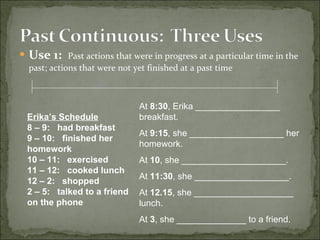
Use 1:   Past actions that were in progress at a particular time in the past; actions that were not yet finished at a past time Erika’s Schedule 8 – 9:  had breakfast 9 – 10:  finished her homework 10 – 11:  exercised 11 – 12:  cooked lunch 12 – 2:  shopped 2 – 5:  talked to a friend on the phone At  8:30 , Erika _________________ breakfast. At  9:15 , she ___________________ her homework. At  10 , she _____________________. At  11:30 , she ___________________. At  12.15 , she ____________________ lunch. At  3 , she ______________ to a friend.
Where were you last Thursday at 8 p.m.?  What were you doing? What were you doing Friday at 5 p.m.?  Where were you?  Who were you with? What were you doing Sunday morning at 7 a.m.? What were you doing last night at this time? What were you doing last week at this time? What were you doing last year at this time?
Use 2:   Two (or more) actions that were in progress in the past at the same time Use  while Examples:   Sorry, I  wasn’t listening  to you while you  were talking . While I  was reading , he  was writing .
Use 3:   Describe and set the scene; tell what was happening or in progress when something else happened or interrupted a past in-progress action Examples: Car accident Broken bone Meeting a future spouse A Crime
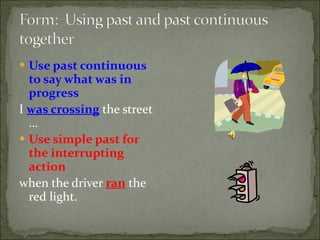
Use past continuous to say what was in progress I  was crossing  the street … Use simple past for the interrupting action when the driver  ran  the red light.
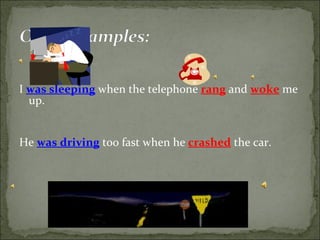
I  was sleeping  when the telephone  rang  and  woke   me up. He  was driving  too fast when he  crashed  the car.
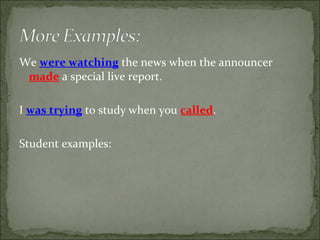
We  were watching  the news when the announcer  made  a special live report. I  was trying  to study when you  called . Student examples:
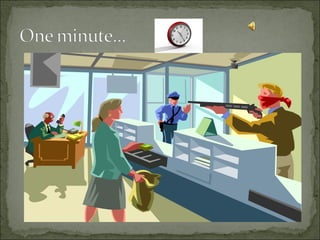
Directions:   Look at the following picture for one minute.  Try to remember as many details as you can, but don’t write anything.
Ready, go ….
 
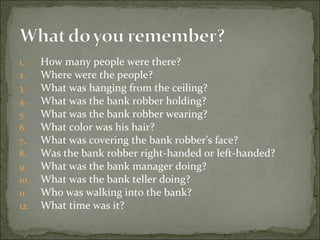
How many people were there? Where were the people? What was hanging from the ceiling? What was the bank robber holding? What was the bank robber wearing? What color was his hair? What was covering the bank robber’s face? Was the bank robber right-handed or left-handed? What was the bank manager doing? What was the bank teller doing? Who was walking into the bank? What time was it?
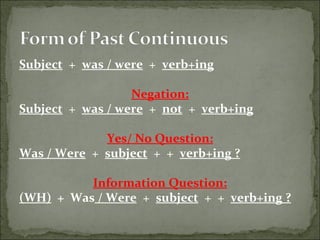
Subject   +  was / were   +  verb+ing Negation: Subject   +  was / were   +  not   +  verb+ing Yes/ No Question: Was / Were   +  subject   +  +  verb+ing ? Information Question: (WH)   +  Was  / Were   +  subject   +  +  verb+ing ?
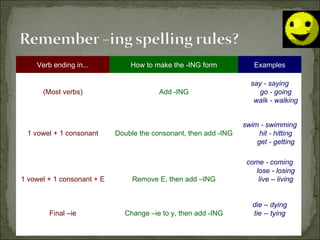
Verb ending in... How to make the -ING form Examples (Most verbs) Add -ING say - saying go - going walk - walking 1 vowel + 1 consonant Double the consonant, then add -ING swim - swimming hit - hitting get - getting 1 vowel + 1 consonant + E Final –ie Remove E, then add –ING Change –ie to y, then add -ING come - coming lose - losing live – living die – dying tie -- tying
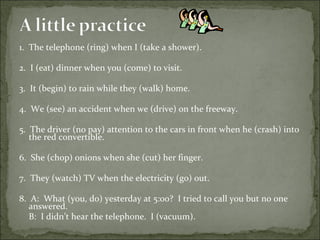
1.  The telephone (ring) when I (take a shower). 2.  I (eat) dinner when you (come) to visit. 3.  It (begin) to rain while they (walk) home. 4.  We (see) an accident when we (drive) on the freeway. 5.  The driver (no pay) attention to the cars in front when he (crash) into the red convertible. 6.  She (chop) onions when she (cut) her finger. 7.  They (watch) TV when the electricity (go) out. 8.  A:  What (you, do) yesterday at 5:00?  I tried to call you but no one answered. B:  I didn’t hear the telephone.  I (vacuum).
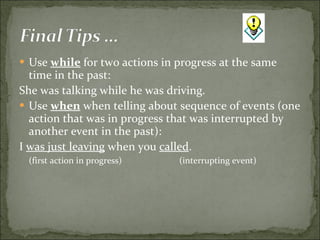
Use  while  for two actions in progress at the same time in the past:  She was talking while he was driving. Use  when  when telling about sequence of events (one action that was in progress that was interrupted by another event in the past): I  was just leaving  when you  called . (first action in progress) (interrupting event)
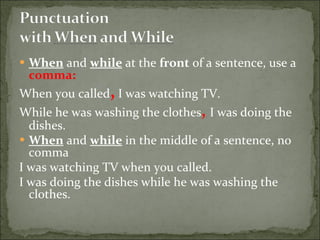
When  and  while  at the  front  of a sentence, use a  comma: When you called ,  I was watching TV. While he was washing the clothes ,   I was doing the dishes. When  and  while  in the middle of a sentence, no comma I was watching TV when you called. I was doing the dishes while he was washing the clothes.

Past tenseandpastcontinuousverbs

  • 1.
  • 2.
    Actions, events, statesthat started and finished in the past (…ago, last …, yesterday… ) Regular verbs: -ed Irregular verbs: change spelling, memorize for list of irregular verbs, see Blackboard Course Documents, Verb Tenses, Past Tense folder Grammar Express textbook pages 336 - 337 The instructor
  • 3.
    What did youdo yesterday? What did you do Friday night? Where were you Saturday morning? What did you do to celebrate your last birthday? When did you move to the U.S.? Why did you start taking classes at MiraCosta College? How did you learn to speak English so well?
  • 4.
    Use 1: Past actions that were in progress at a particular time in the past; actions that were not yet finished at a past time Erika’s Schedule 8 – 9: had breakfast 9 – 10: finished her homework 10 – 11: exercised 11 – 12: cooked lunch 12 – 2: shopped 2 – 5: talked to a friend on the phone At 8:30 , Erika _________________ breakfast. At 9:15 , she ___________________ her homework. At 10 , she _____________________. At 11:30 , she ___________________. At 12.15 , she ____________________ lunch. At 3 , she ______________ to a friend.
  • 5.
    Where were youlast Thursday at 8 p.m.? What were you doing? What were you doing Friday at 5 p.m.? Where were you? Who were you with? What were you doing Sunday morning at 7 a.m.? What were you doing last night at this time? What were you doing last week at this time? What were you doing last year at this time?
  • 6.
    Use 2: Two (or more) actions that were in progress in the past at the same time Use while Examples: Sorry, I wasn’t listening to you while you were talking . While I was reading , he was writing .
  • 7.
    Use 3: Describe and set the scene; tell what was happening or in progress when something else happened or interrupted a past in-progress action Examples: Car accident Broken bone Meeting a future spouse A Crime
  • 8.
    Use past continuousto say what was in progress I was crossing the street … Use simple past for the interrupting action when the driver ran the red light.
  • 9.
    I wassleeping when the telephone rang and woke me up. He was driving too fast when he crashed the car.
  • 10.
    We werewatching the news when the announcer made a special live report. I was trying to study when you called . Student examples:
  • 11.
    Directions: Look at the following picture for one minute. Try to remember as many details as you can, but don’t write anything.
  • 12.
  • 13.
  • 14.
    How many peoplewere there? Where were the people? What was hanging from the ceiling? What was the bank robber holding? What was the bank robber wearing? What color was his hair? What was covering the bank robber’s face? Was the bank robber right-handed or left-handed? What was the bank manager doing? What was the bank teller doing? Who was walking into the bank? What time was it?
  • 15.
    Subject + was / were + verb+ing Negation: Subject + was / were + not + verb+ing Yes/ No Question: Was / Were + subject + + verb+ing ? Information Question: (WH) + Was / Were + subject + + verb+ing ?
  • 16.
    Verb ending in...How to make the -ING form Examples (Most verbs) Add -ING say - saying go - going walk - walking 1 vowel + 1 consonant Double the consonant, then add -ING swim - swimming hit - hitting get - getting 1 vowel + 1 consonant + E Final –ie Remove E, then add –ING Change –ie to y, then add -ING come - coming lose - losing live – living die – dying tie -- tying
  • 17.
    1. Thetelephone (ring) when I (take a shower). 2. I (eat) dinner when you (come) to visit. 3. It (begin) to rain while they (walk) home. 4. We (see) an accident when we (drive) on the freeway. 5. The driver (no pay) attention to the cars in front when he (crash) into the red convertible. 6. She (chop) onions when she (cut) her finger. 7. They (watch) TV when the electricity (go) out. 8. A: What (you, do) yesterday at 5:00? I tried to call you but no one answered. B: I didn’t hear the telephone. I (vacuum).
  • 18.
    Use while for two actions in progress at the same time in the past: She was talking while he was driving. Use when when telling about sequence of events (one action that was in progress that was interrupted by another event in the past): I was just leaving when you called . (first action in progress) (interrupting event)
  • 19.
    When and while at the front of a sentence, use a comma: When you called , I was watching TV. While he was washing the clothes , I was doing the dishes. When and while in the middle of a sentence, no comma I was watching TV when you called. I was doing the dishes while he was washing the clothes.