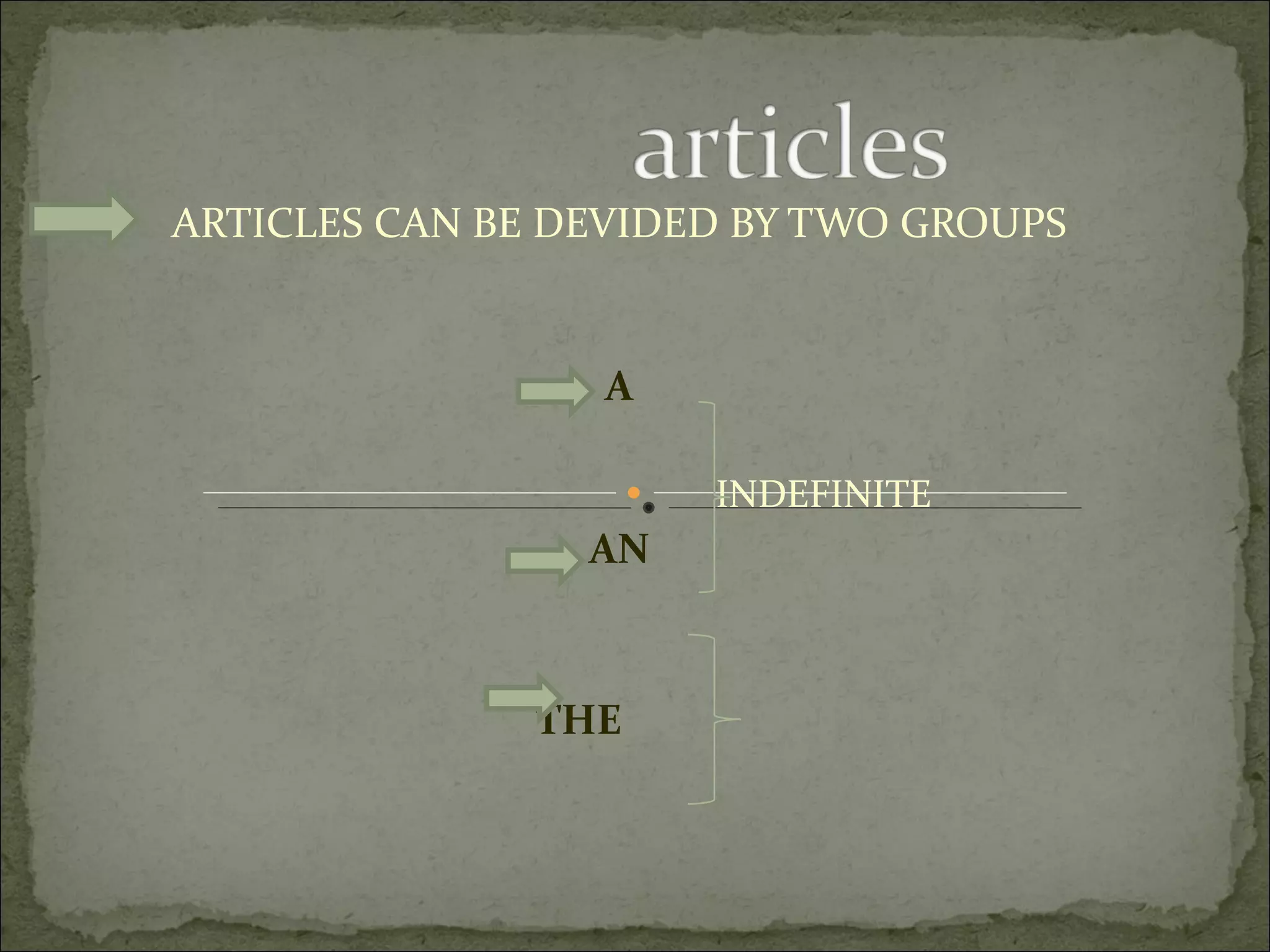
ARTICLES CAN BE DEVIDED BY TWO GROUPS A INDEFINITE AN THE
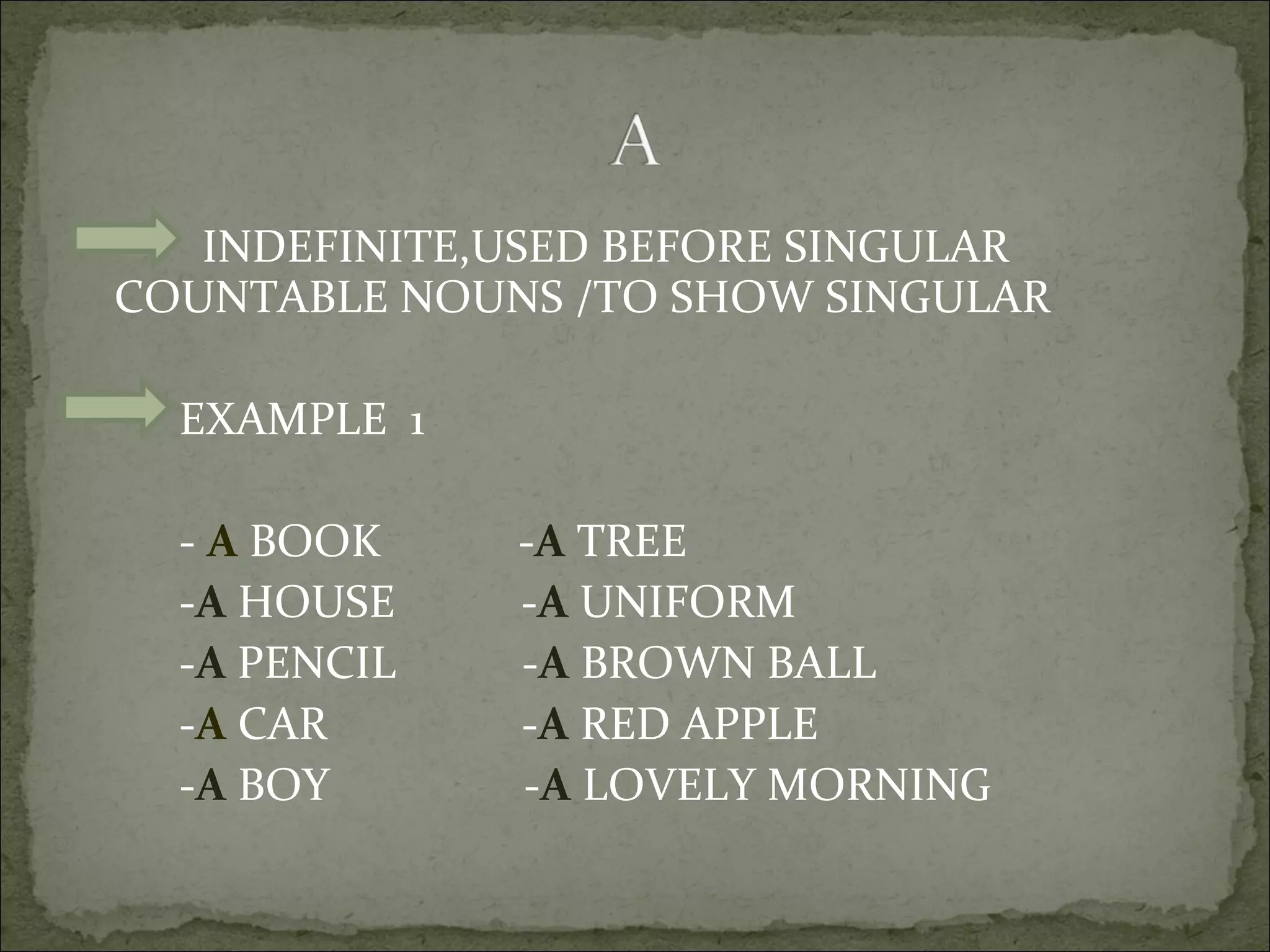
INDEFINITE,USED BEFORE SINGULAR COUNTABLE NOUNS /TO SHOW SINGULAR EXAMPLE  1 -  A  BOOK  - A  TREE - A  HOUSE  - A  UNIFORM - A  PENCIL  - A  BROWN BALL - A  CAR  - A  RED APPLE - A  BOY  - A  LOVELY MORNING
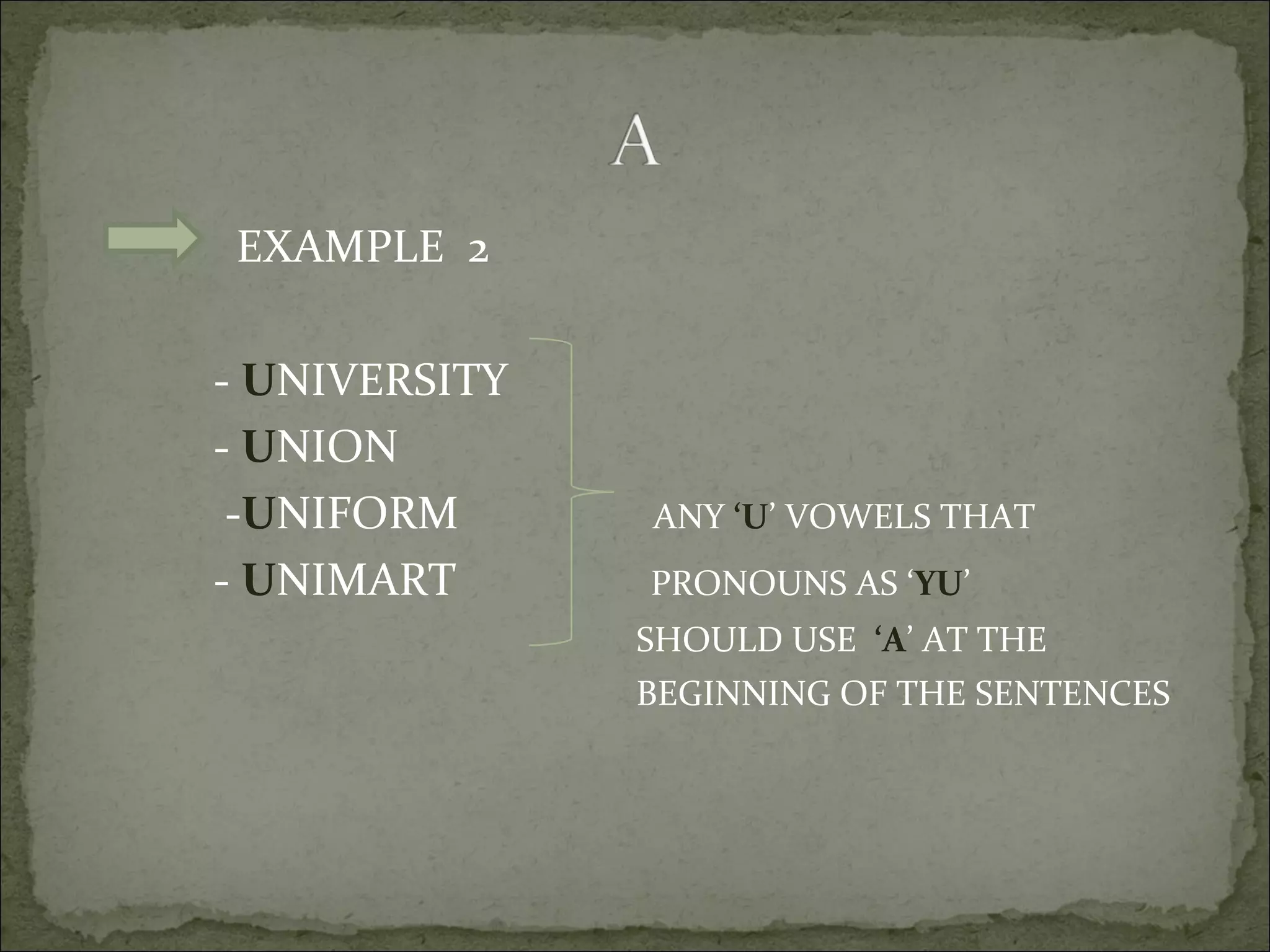
EXAMPLE  2 -  U NIVERSITY -  U NION - U NIFORM  ANY  ‘U ’ VOWELS THAT  -  U NIMART  PRONOUNS AS ‘ YU ’ SHOULD USE  ‘A ’ AT THE  BEGINNING OF THE SENTENCES
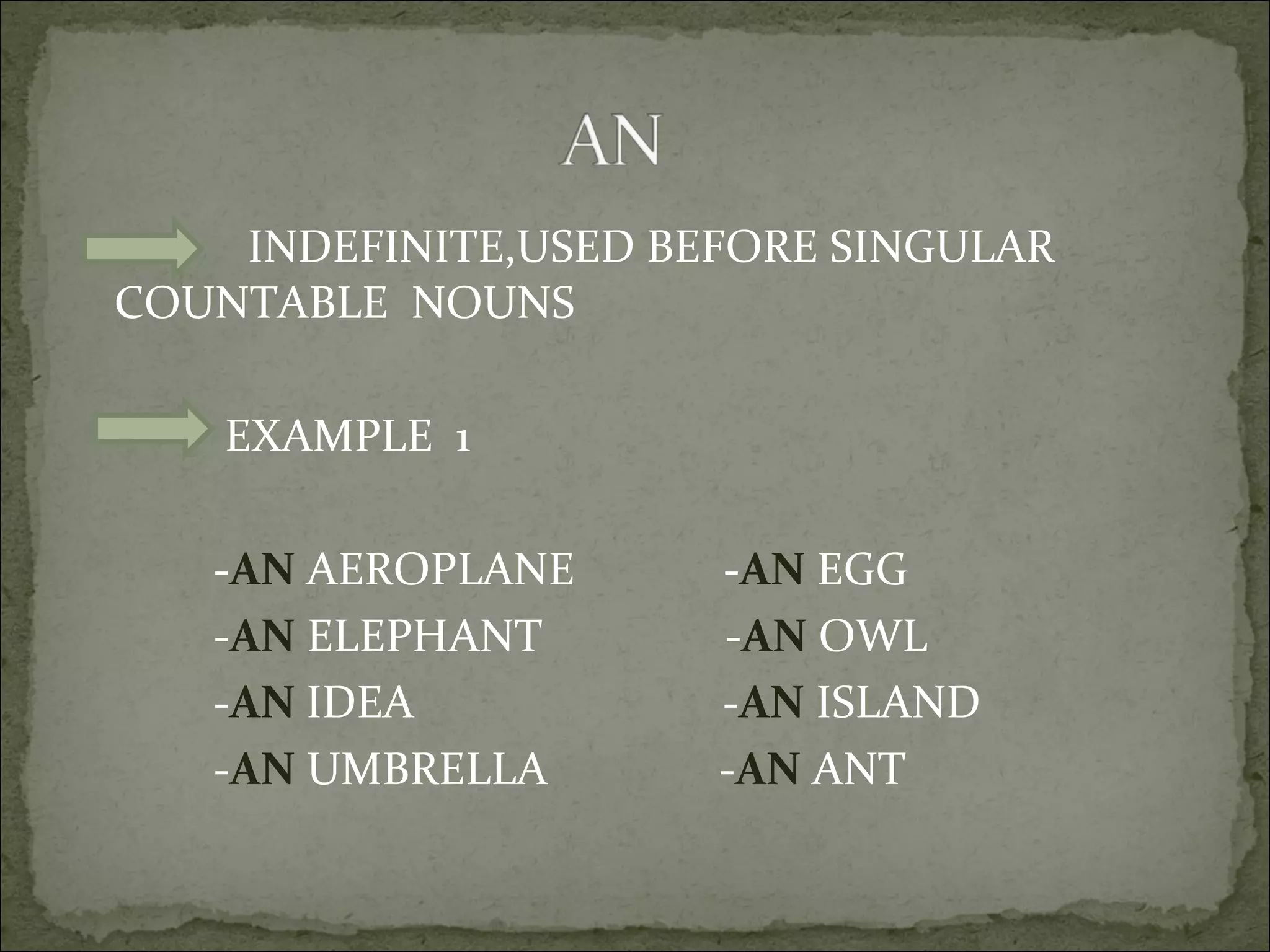
INDEFINITE,USED BEFORE SINGULAR COUNTABLE  NOUNS EXAMPLE  1 - AN  AEROPLANE  - AN  EGG - AN  ELEPHANT  - AN  OWL - AN  IDEA  - AN  ISLAND - AN  UMBRELLA  - AN  ANT
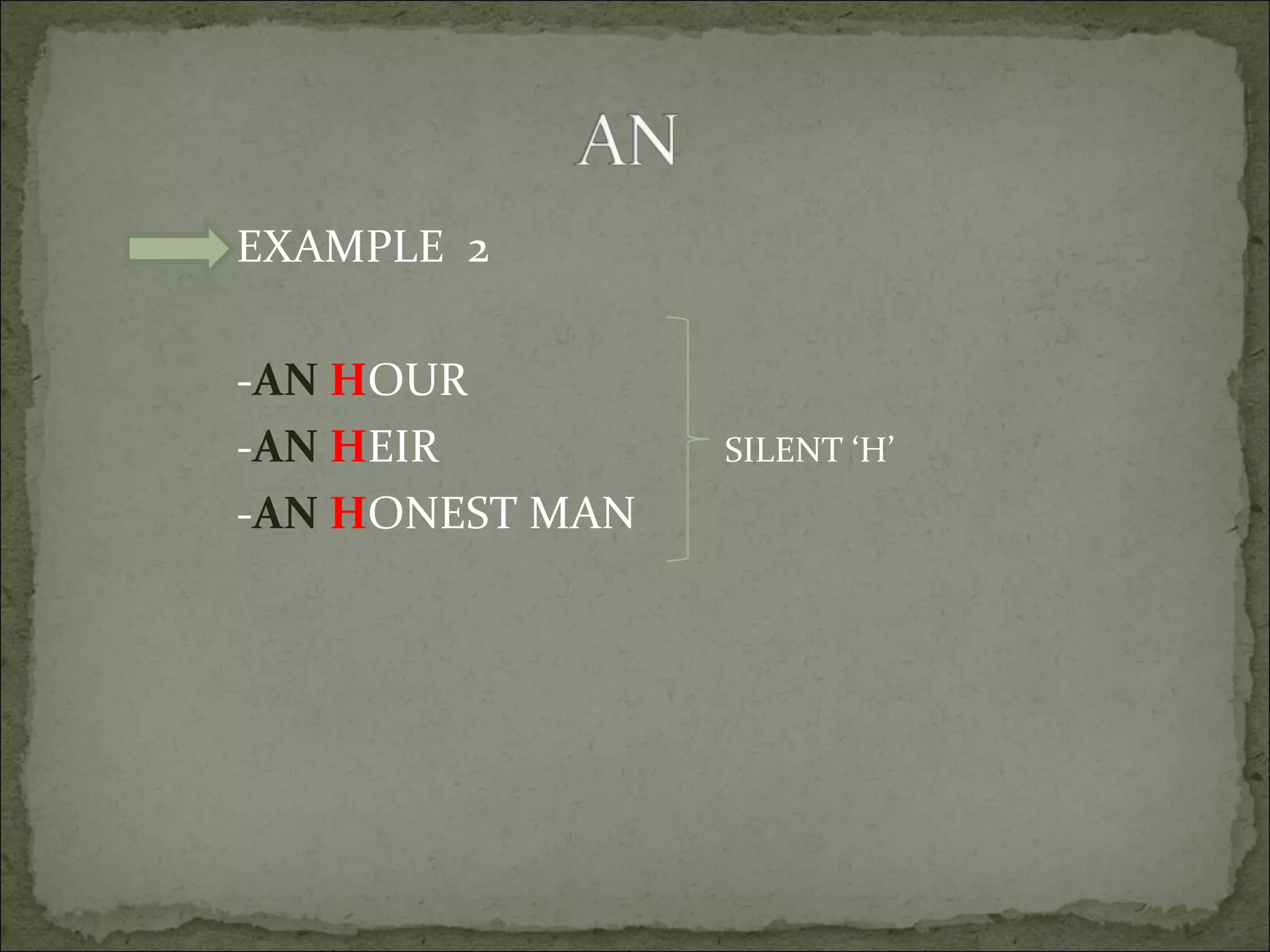
EXAMPLE  2 - AN   H OUR - AN   H EIR  SILENT ‘H’ - AN   H ONEST MAN
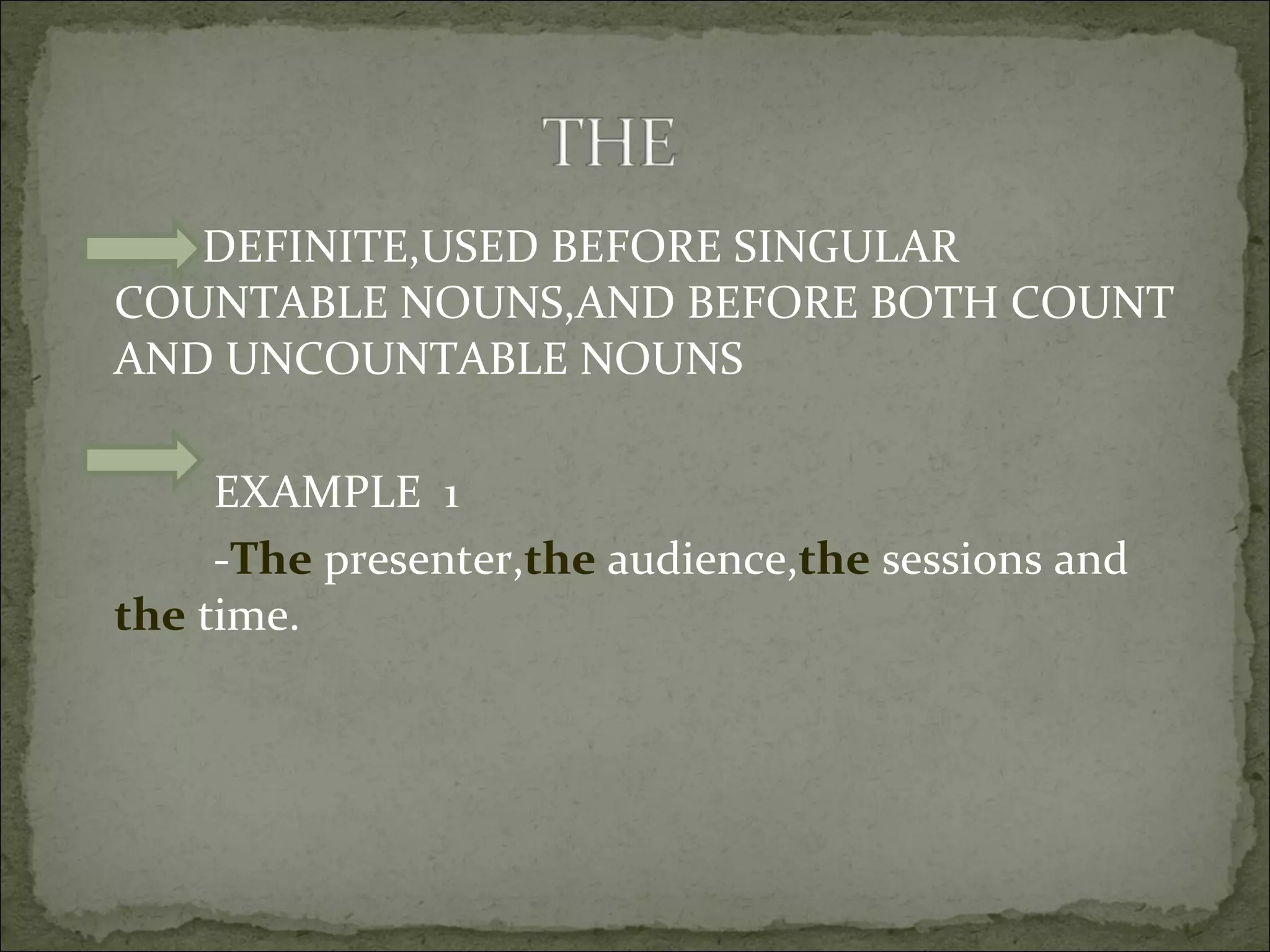
DEFINITE,USED BEFORE SINGULAR COUNTABLE NOUNS,AND BEFORE BOTH COUNT AND UNCOUNTABLE NOUNS  EXAMPLE  1 - The  presenter, the  audience, the  sessions and  the  time.
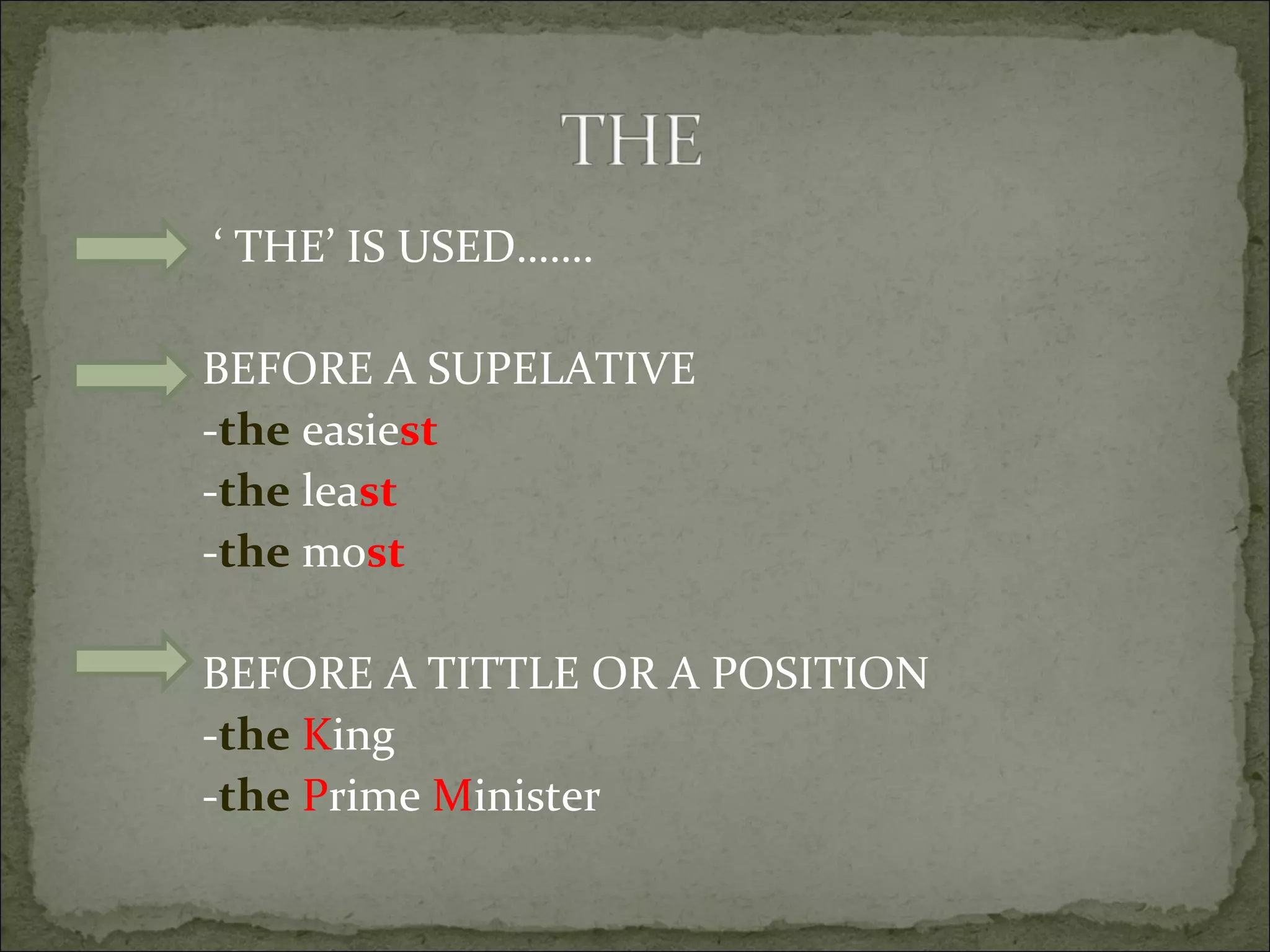
‘  THE’ IS USED……. BEFORE A SUPELATIVE - the  easie st - the  lea st - the  mo st BEFORE A TITTLE OR A POSITION - the   K ing - the   P rime  M inister
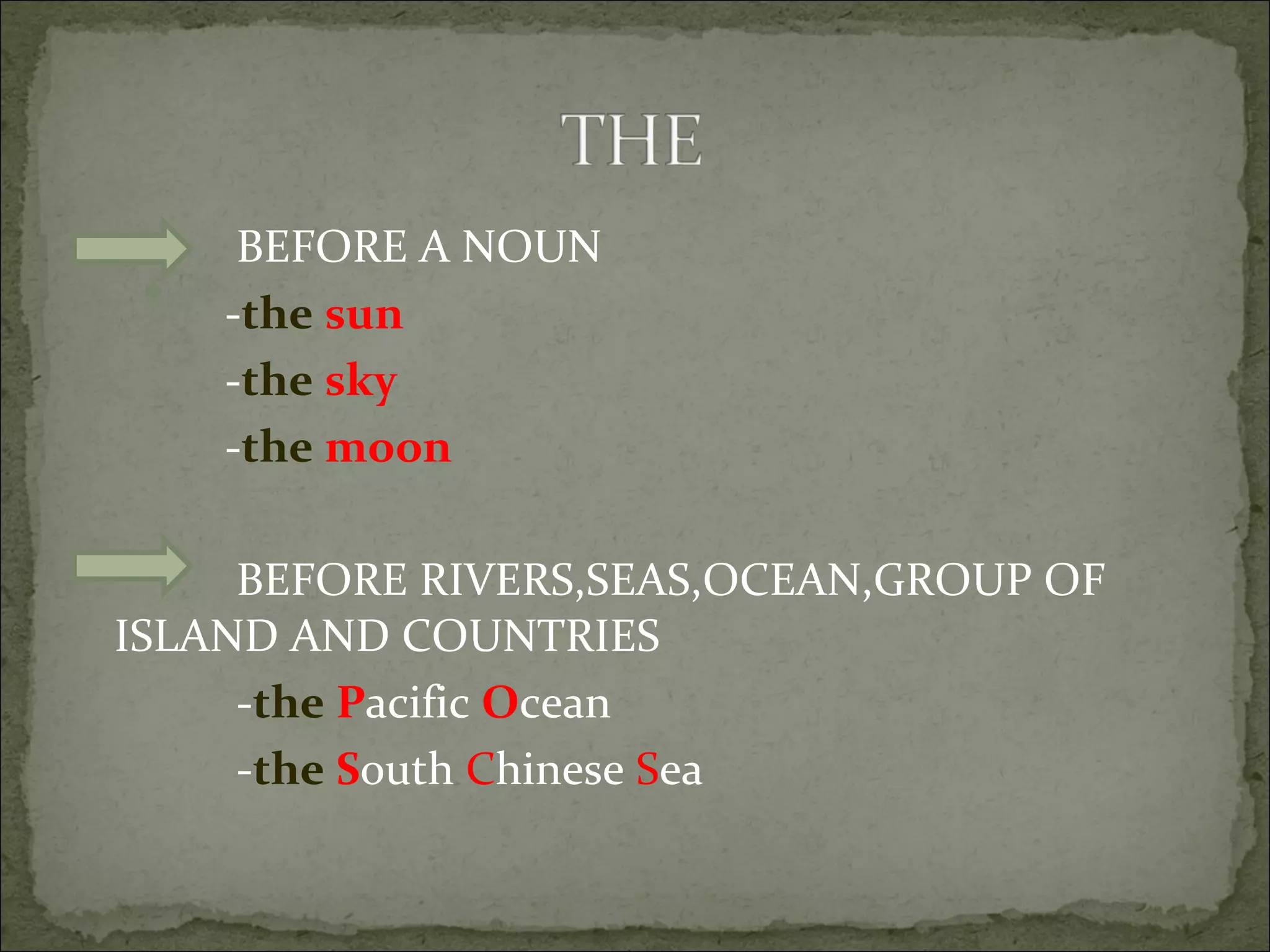
BEFORE A NOUN - the   sun - the   sky - the   moon BEFORE RIVERS,SEAS,OCEAN,GROUP OF ISLAND AND COUNTRIES - the   P acific  O cean - the   S outh  C hinese  S ea
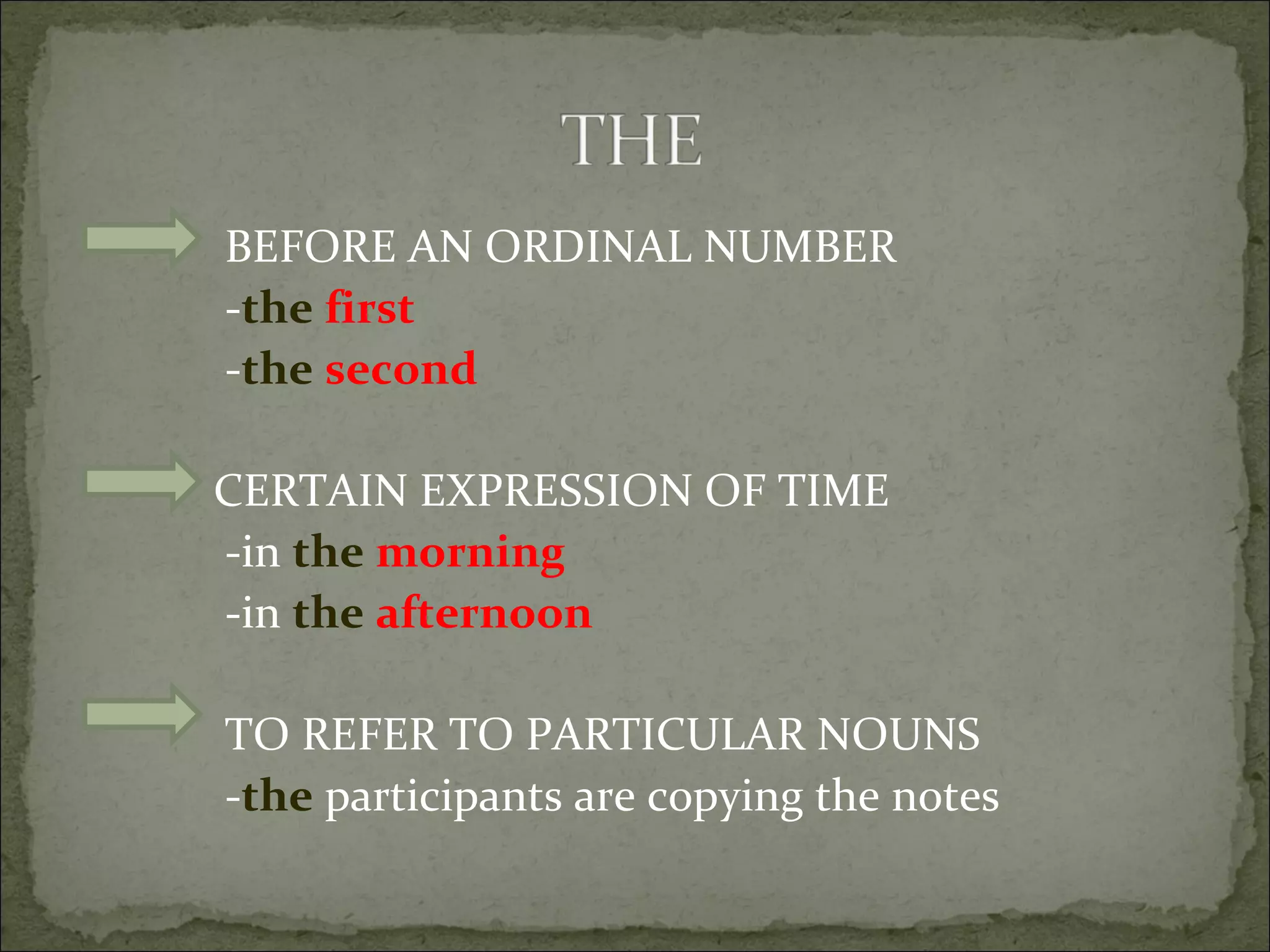
BEFORE AN ORDINAL NUMBER - the   first - the   second CERTAIN EXPRESSION OF TIME -in  the   morning -in  the   afternoon TO REFER TO PARTICULAR NOUNS - the  participants are copying the notes
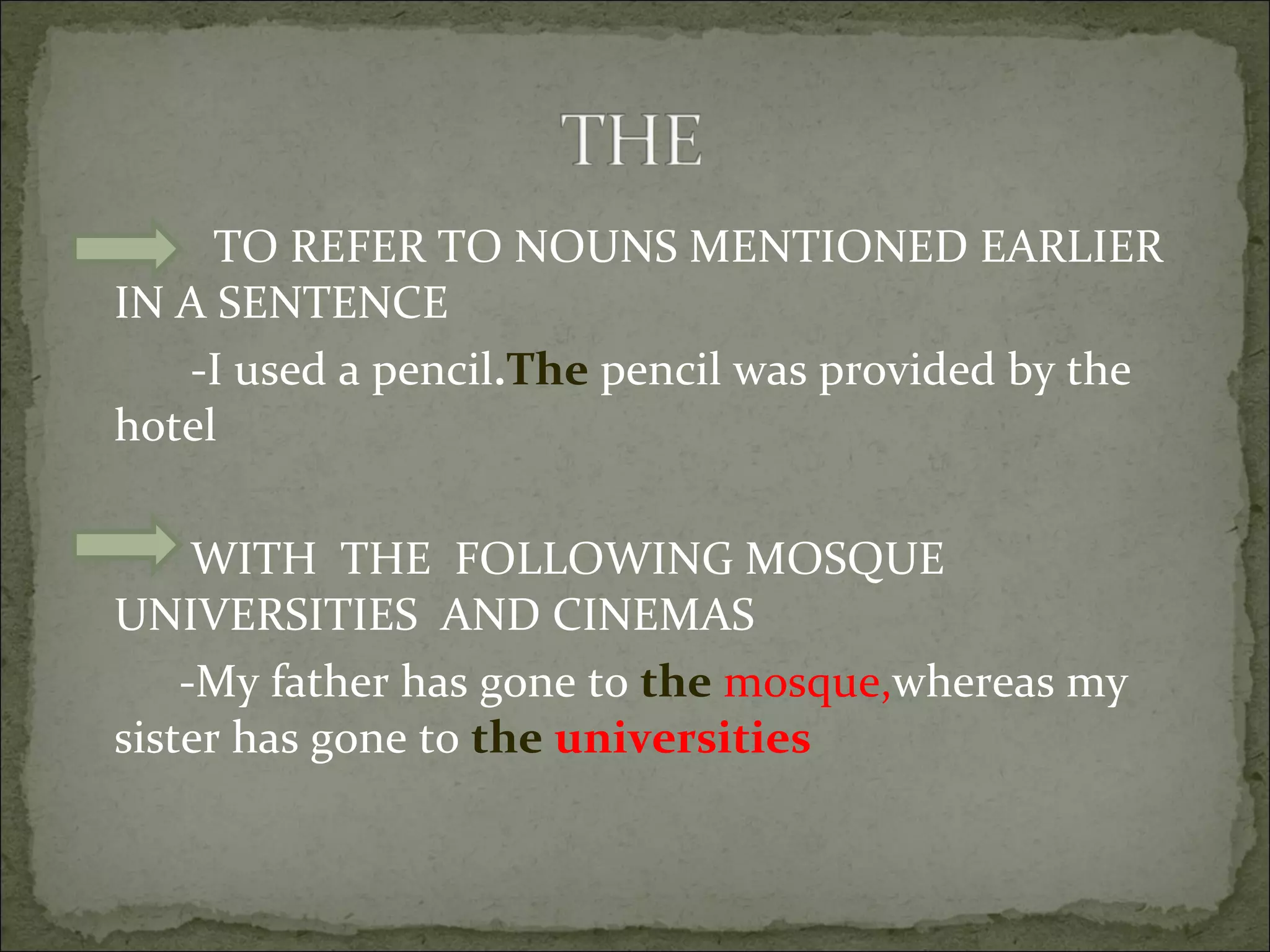
TO REFER TO NOUNS MENTIONED EARLIER IN A SENTENCE -I used a pencil . The  pencil was provided by the hotel WITH  THE  FOLLOWING MOSQUE UNIVERSITIES  AND CINEMAS -My father has gone to  the   mosque, whereas my sister has gone to  the   universities
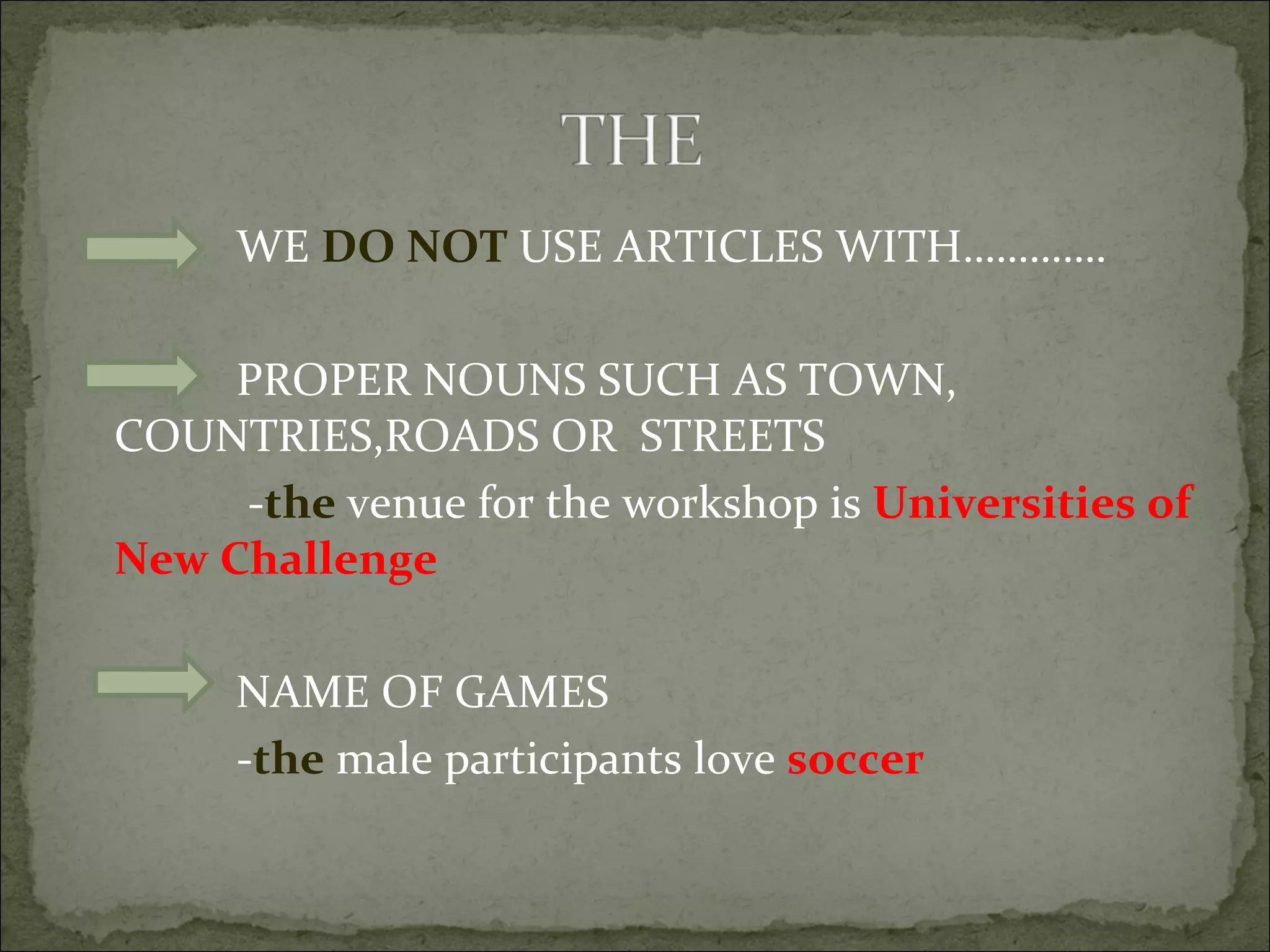
WE  DO NOT  USE ARTICLES WITH…………. PROPER NOUNS SUCH AS TOWN, COUNTRIES,ROADS OR  STREETS - the  venue for the workshop is  Universities of New Challenge NAME OF GAMES - the  male participants love  soccer
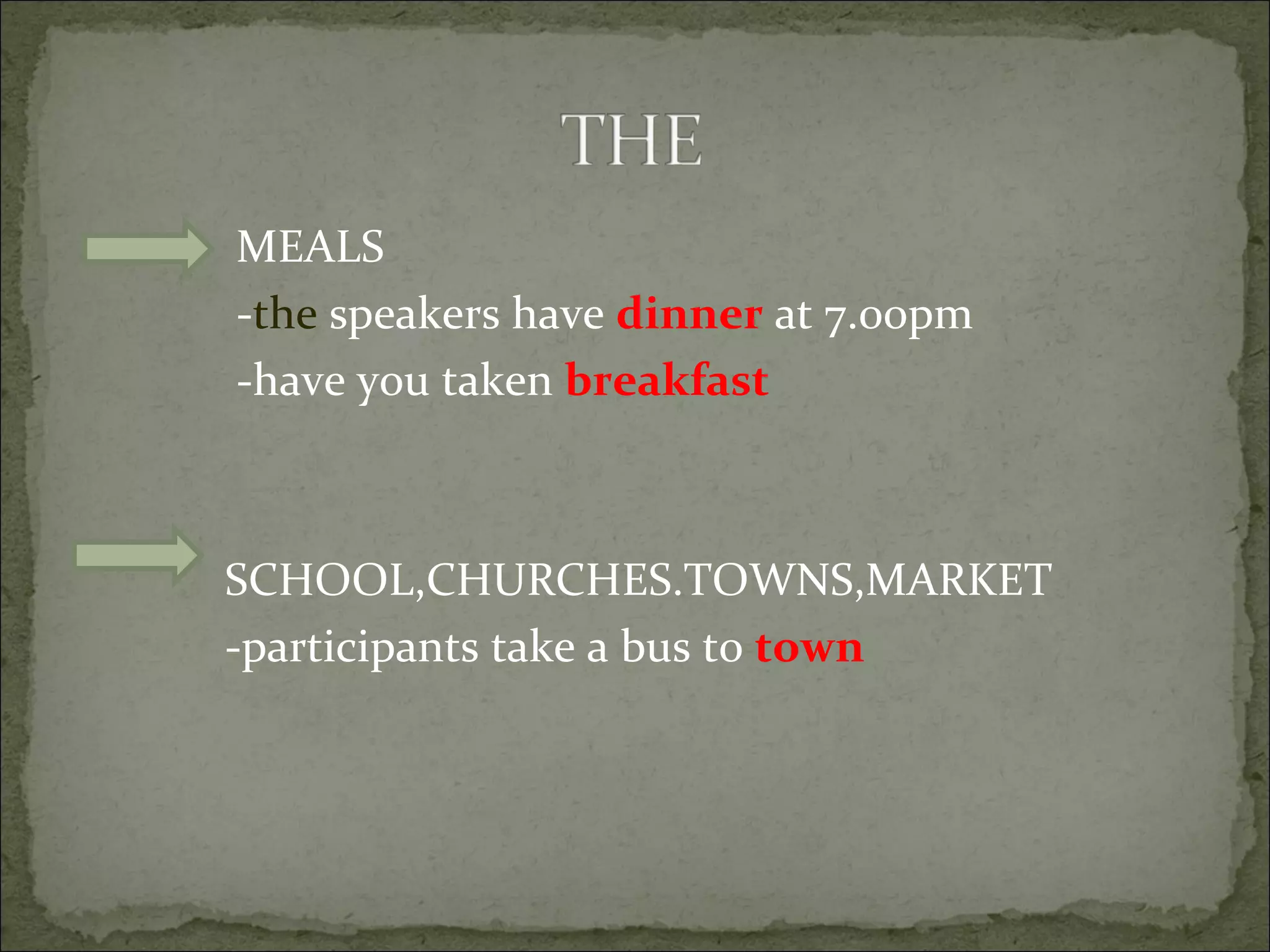
MEALS - the  speakers have  dinner  at 7.00pm -have you taken  breakfast SCHOOL,CHURCHES.TOWNS,MARKET -participants take a bus to  town
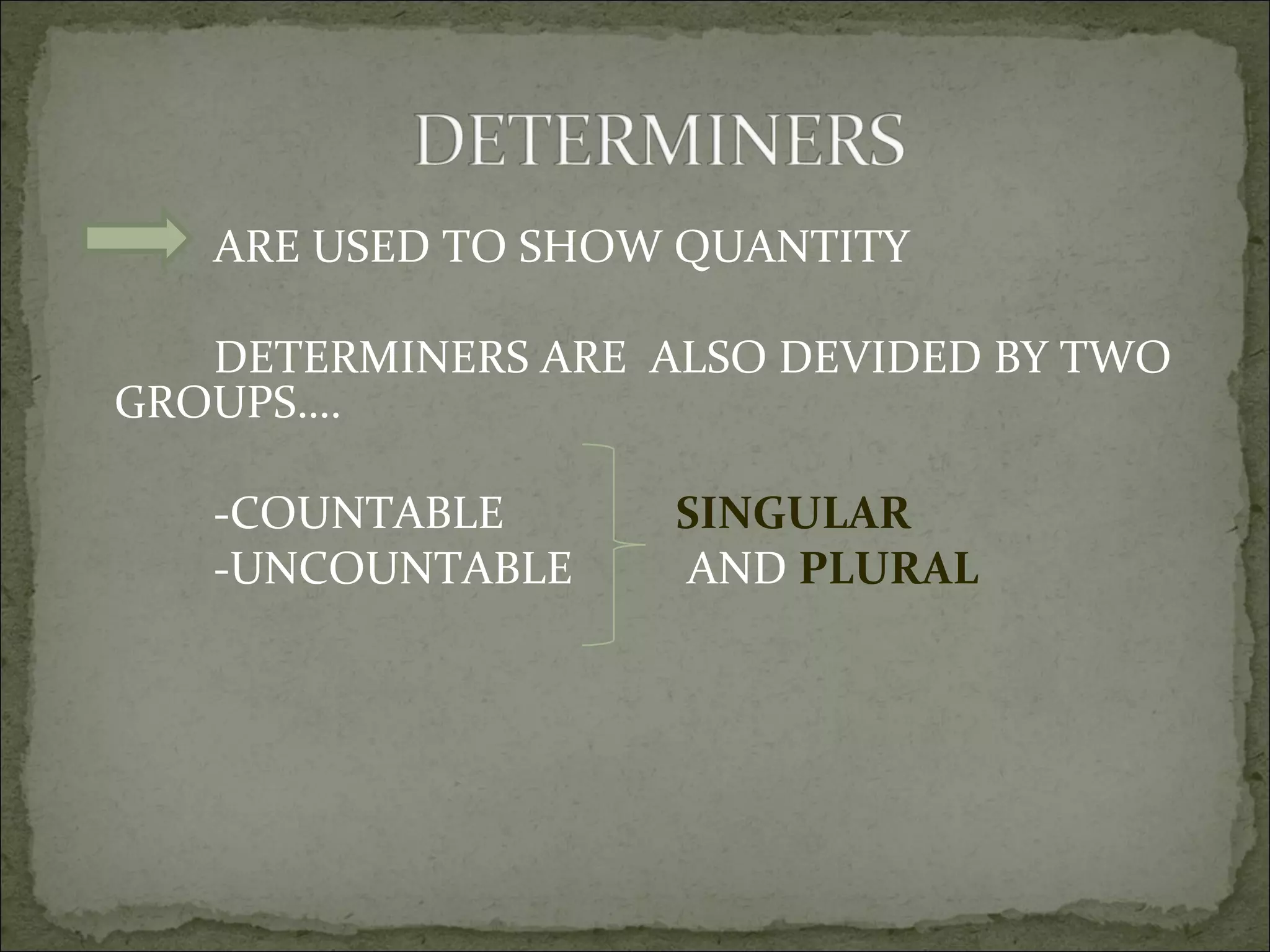
ARE USED TO SHOW QUANTITY DETERMINERS ARE  ALSO DEVIDED BY TWO GROUPS…. -COUNTABLE  SINGULAR   -UNCOUNTABLE  AND  PLURAL
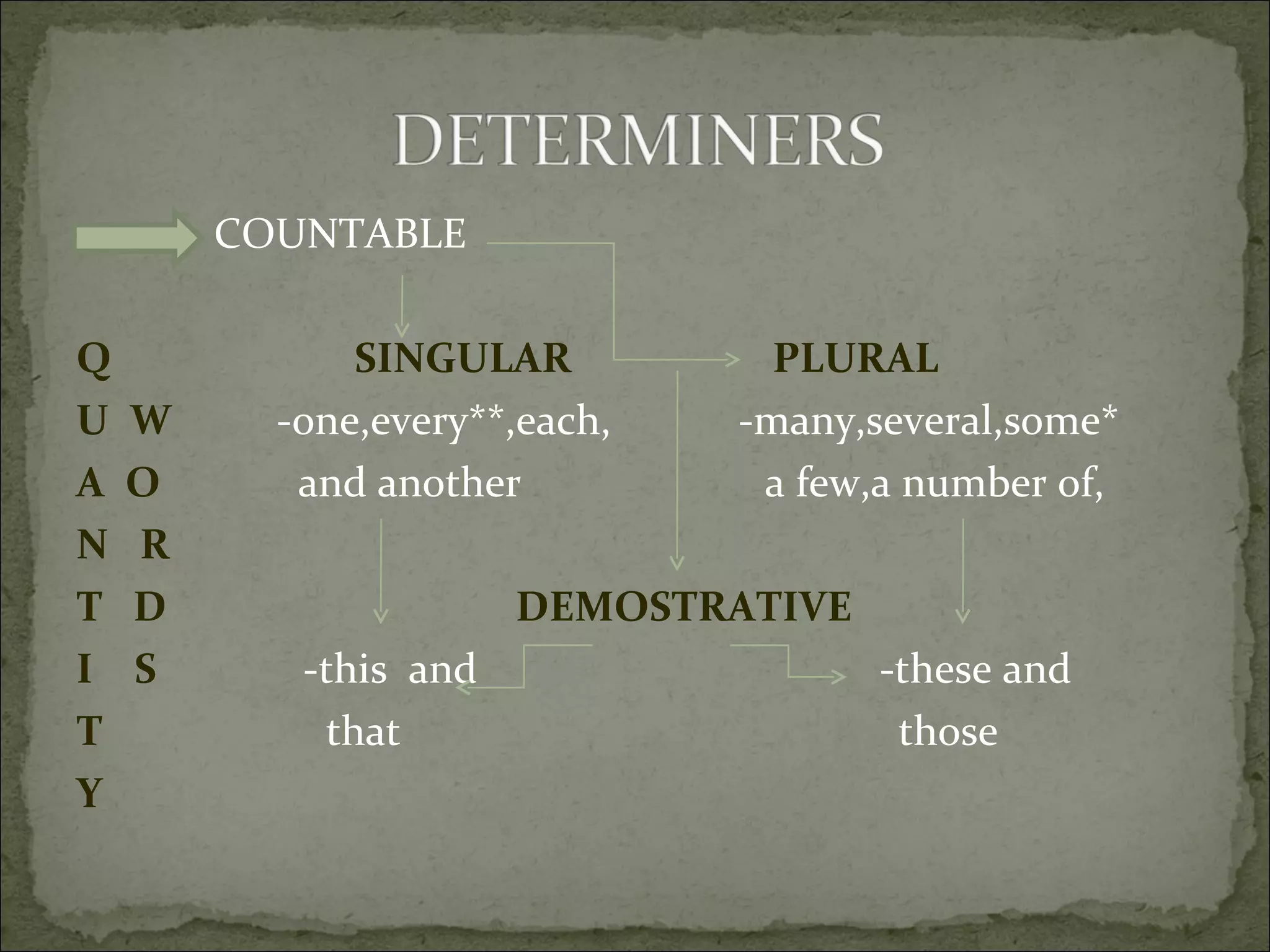
COUNTABLE Q  SINGULAR   PLURAL U   W  -one,every**,each,  -many,several,some* A  O   and another  a few,a number of, N   R   T  D   DEMOSTRATIVE I  S  -this  and  -these and  T  that  those Y
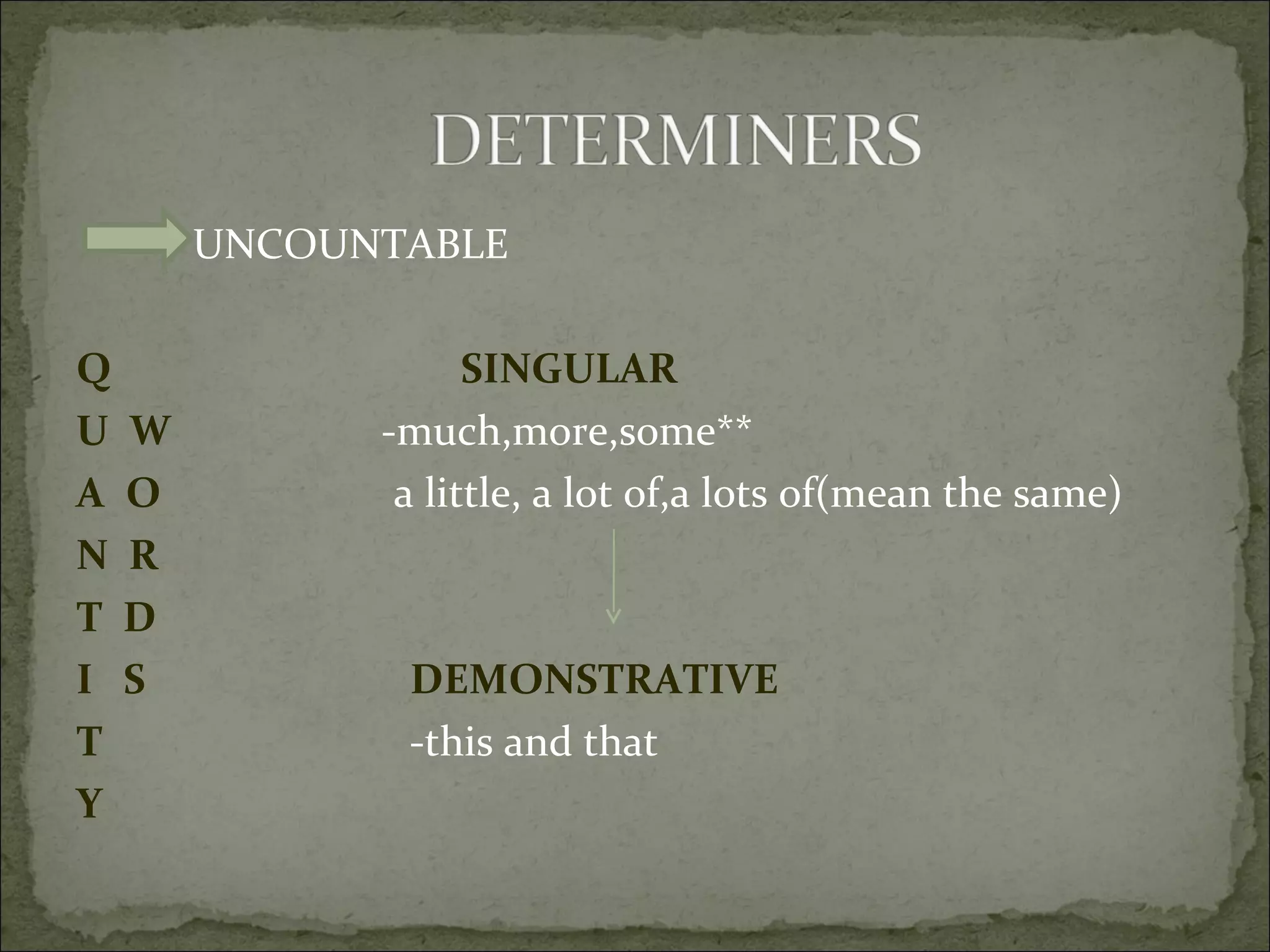
UNCOUNTABLE Q   SINGULAR U  W  -much,more,some** A   O   a little, a lot of,a lots of(mean the same) N  R T  D   I  S   DEMONSTRATIVE T   -this and that  Y
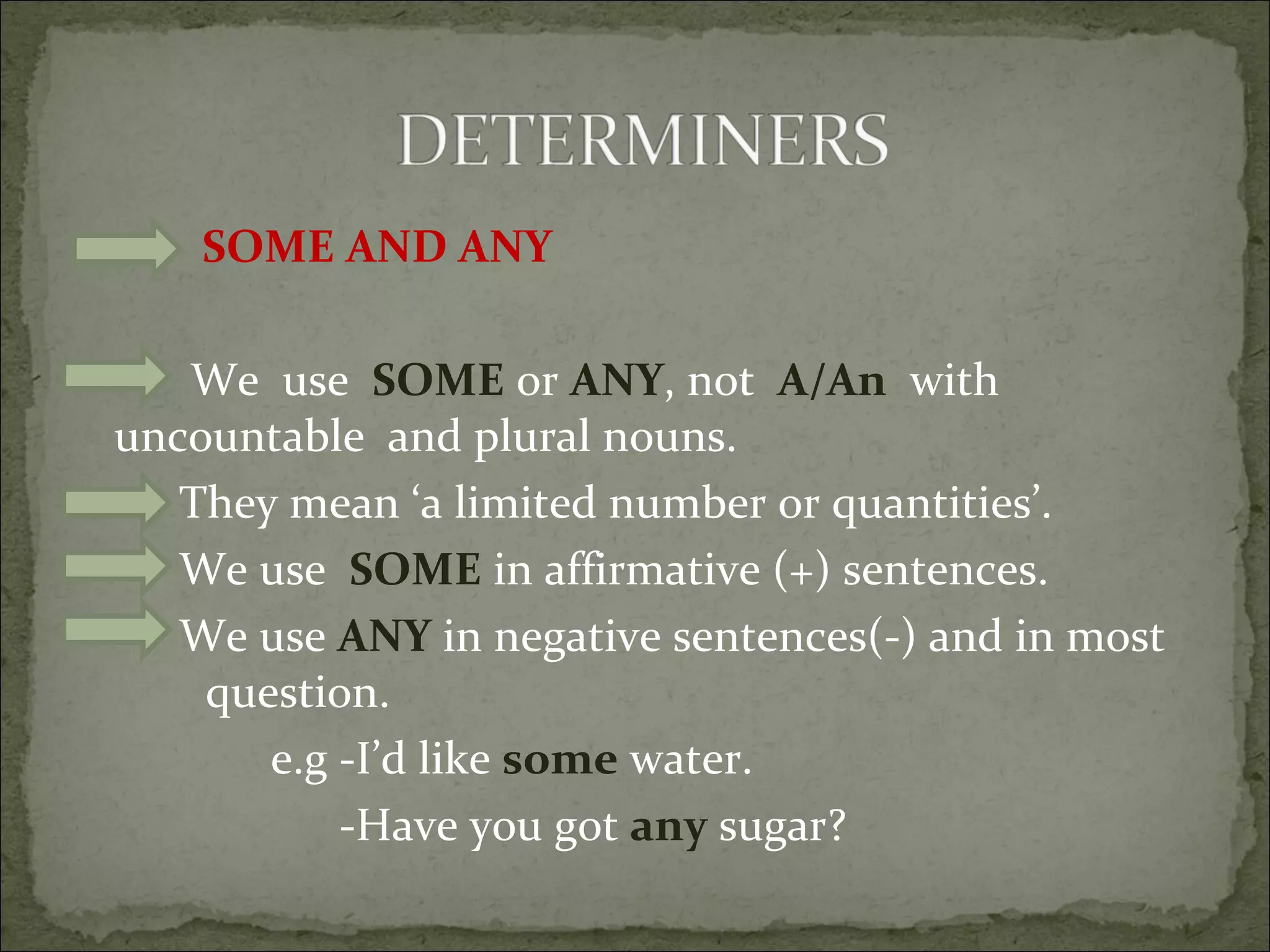
SOME AND ANY We  use  SOME  or  ANY , not  A/An   with uncountable  and plural nouns. They mean ‘a limited number or quantities’. We use  SOME  in affirmative (+) sentences. We use  ANY  in negative sentences(-) and in most  question.  e.g -I’d like  some  water. -Have you got  any  sugar?
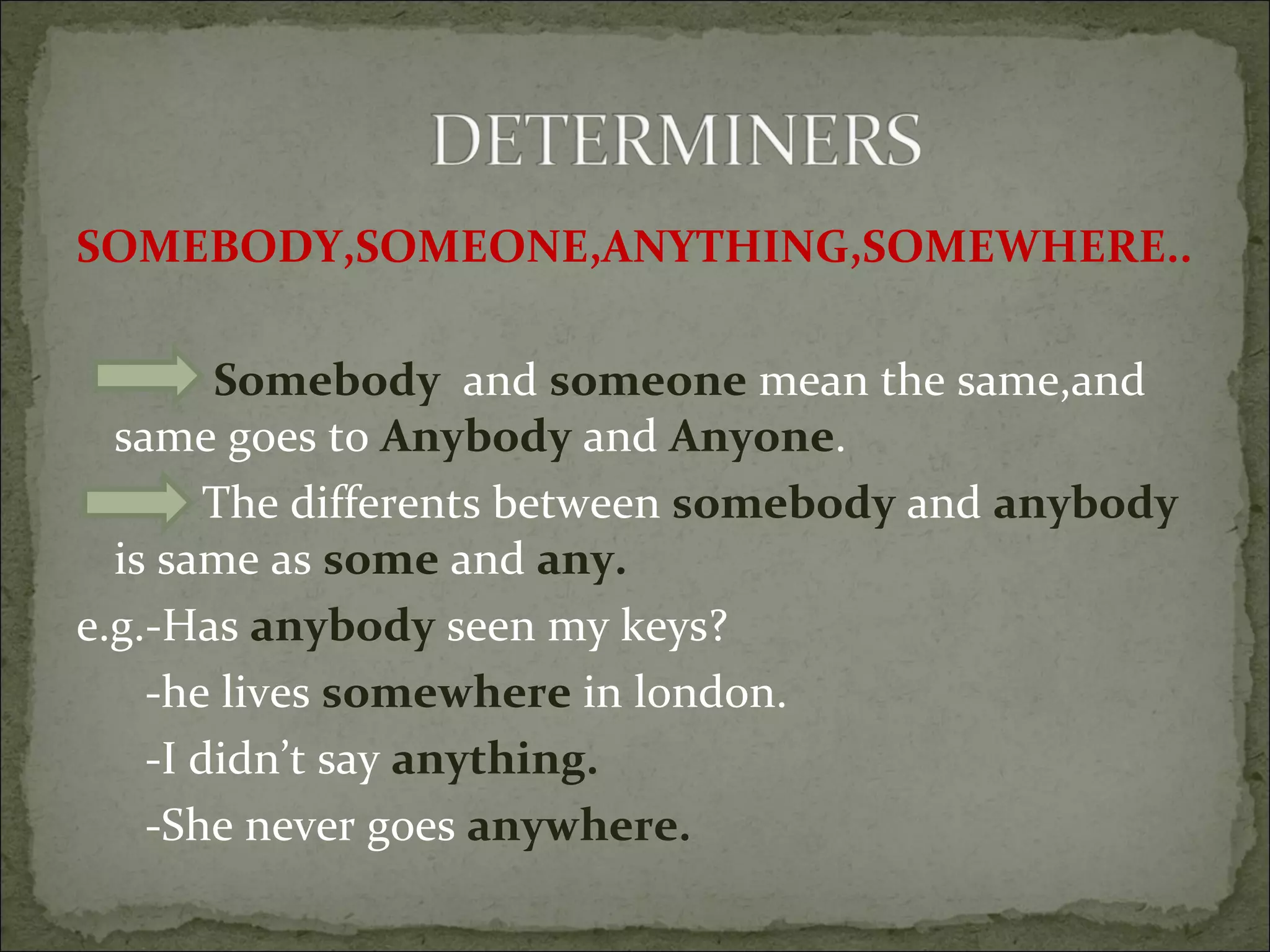
SOMEBODY,SOMEONE,ANYTHING,SOMEWHERE.. Somebody   and  someone  mean the same,and same goes to  Anybody  and  Anyone . The differents between  somebody  and  anybody  is same as  some  and  any. e.g.-Has  anybody  seen my keys? -he lives  somewhere  in london. -I didn’t say  anything. -She never goes  anywhere.
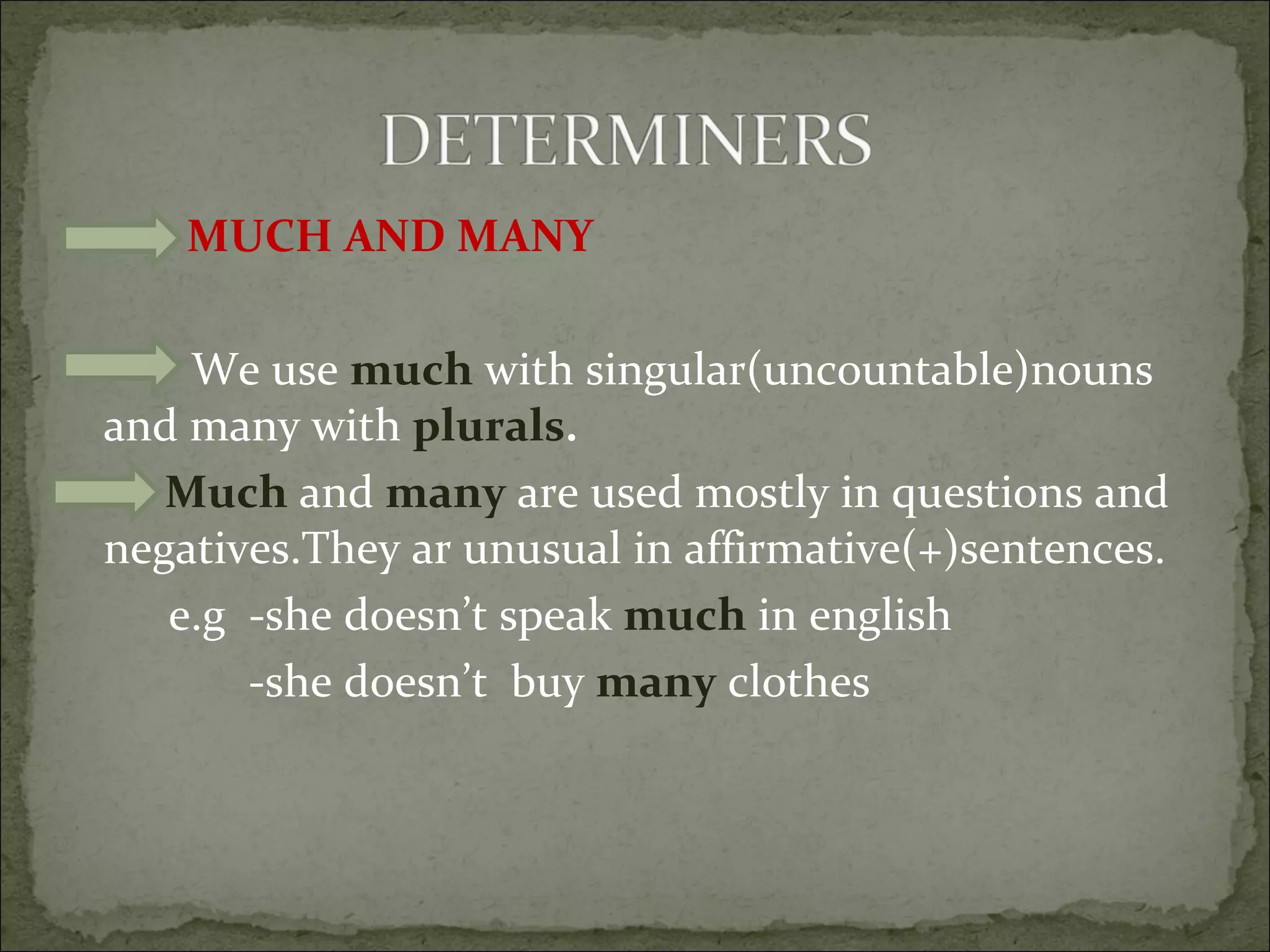
MUCH AND MANY We use  much  with singular(uncountable)nouns and many with  plurals . Much  and  many  are used mostly in questions and negatives.They ar unusual in affirmative(+)sentences. e.g  -she doesn’t speak  much  in english -she doesn’t  buy  many  clothes
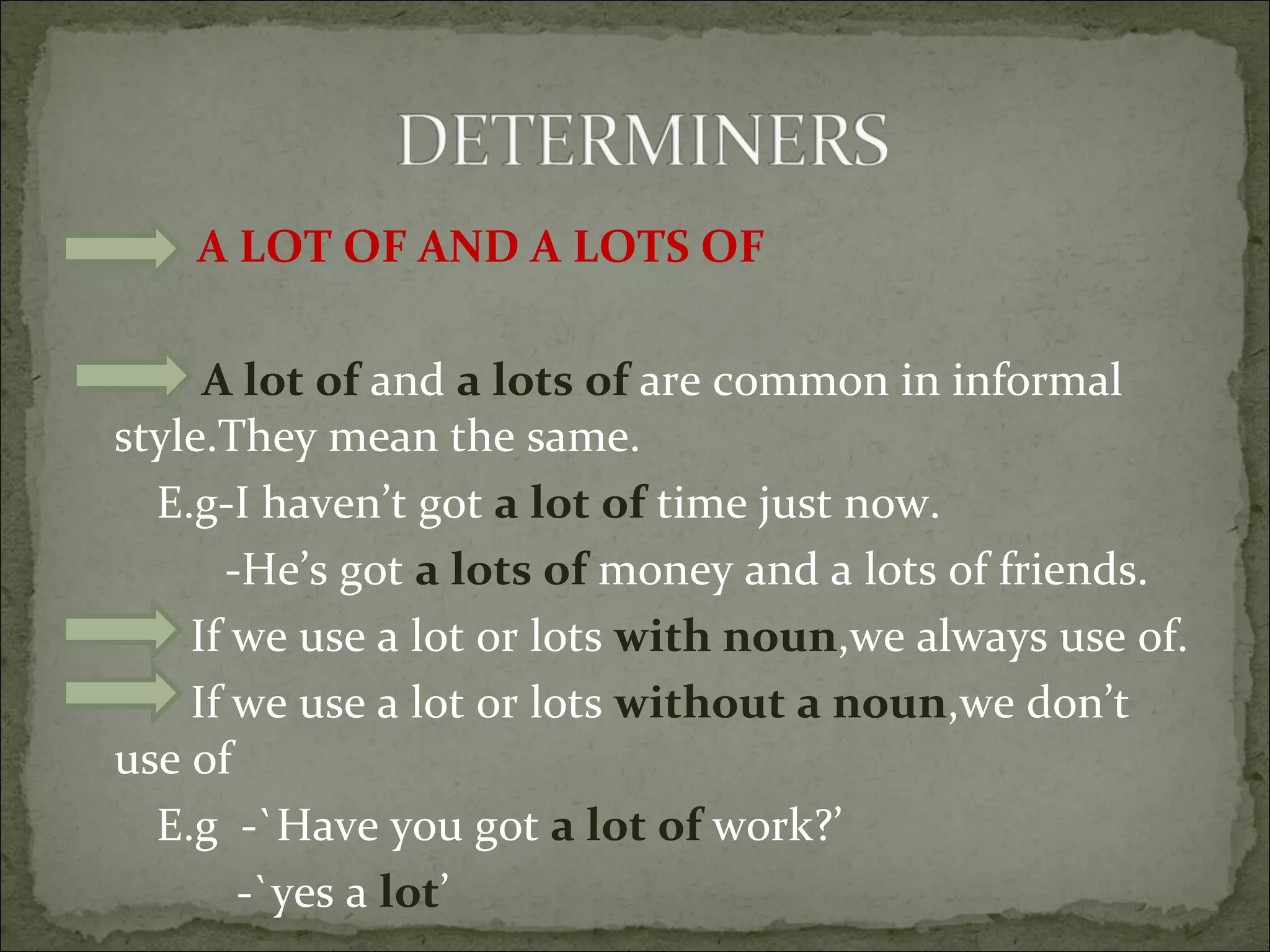
A LOT OF AND A LOTS OF A lot of  and  a lots of  are common in informal style.They mean the same.  E.g-I haven’t got  a lot of  time just now.  -He’s got  a lots of  money and a lots of friends. If we use a lot or lots  with noun ,we always use of. If we use a lot or lots  without a noun ,we don’t use of E.g  -`Have you got  a lot of  work?’ -`yes a  lot ’
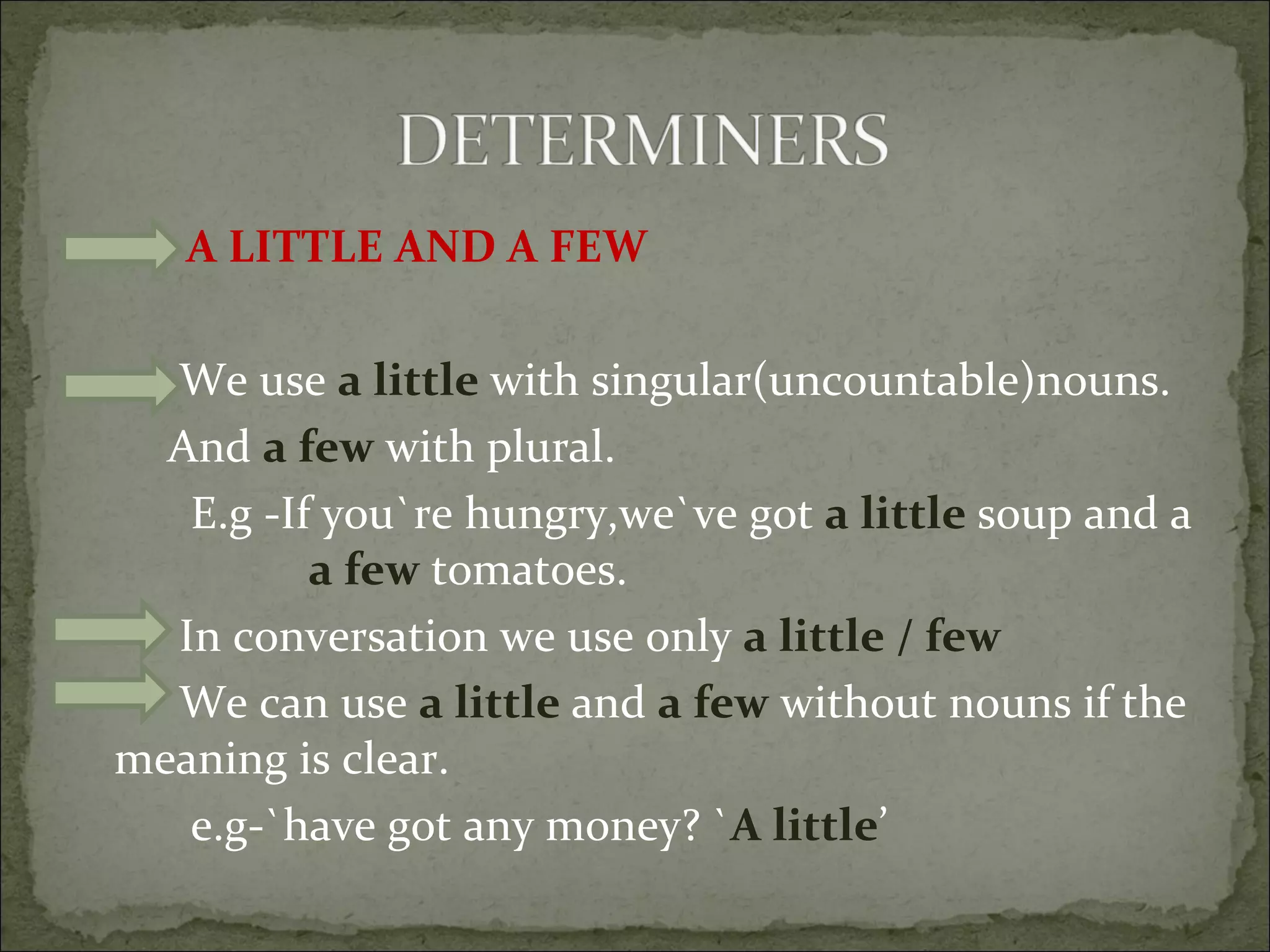
A LITTLE AND A FEW We use  a little  with singular(uncountable)nouns. And  a few  with plural. E.g -If you`re hungry,we`ve got  a little  soup and a  a few  tomatoes. In conversation we use only  a little / few We can use  a little  and  a few  without nouns if the meaning is clear. e.g-`have got any money? ` A little ’
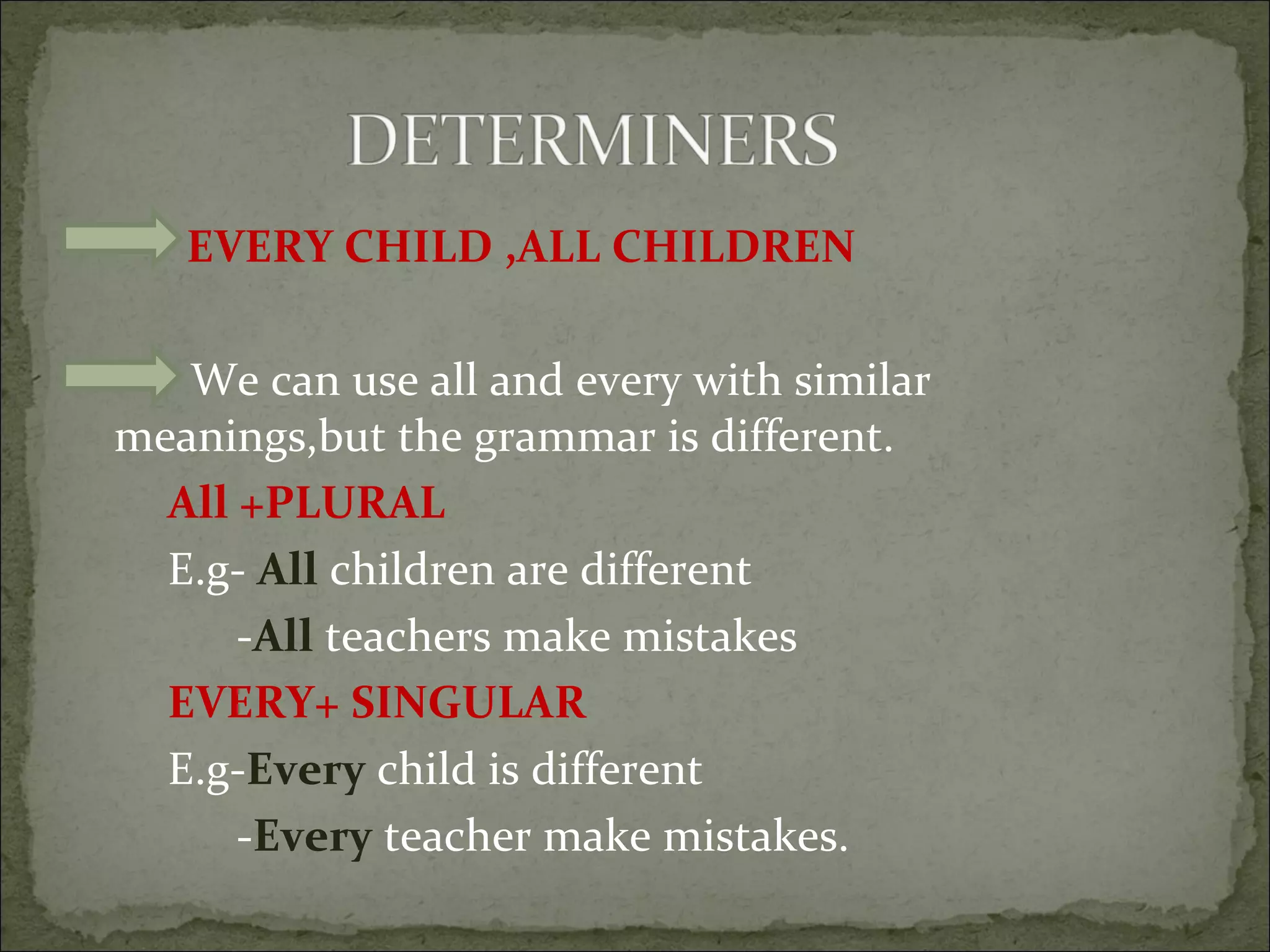
EVERY CHILD ,ALL CHILDREN We can use all and every with similar meanings,but the grammar is different. All +PLURAL  E.g-  All  children are different - All  teachers make mistakes EVERY+ SINGULAR E.g- Every  child is different - Every  teacher make mistakes.
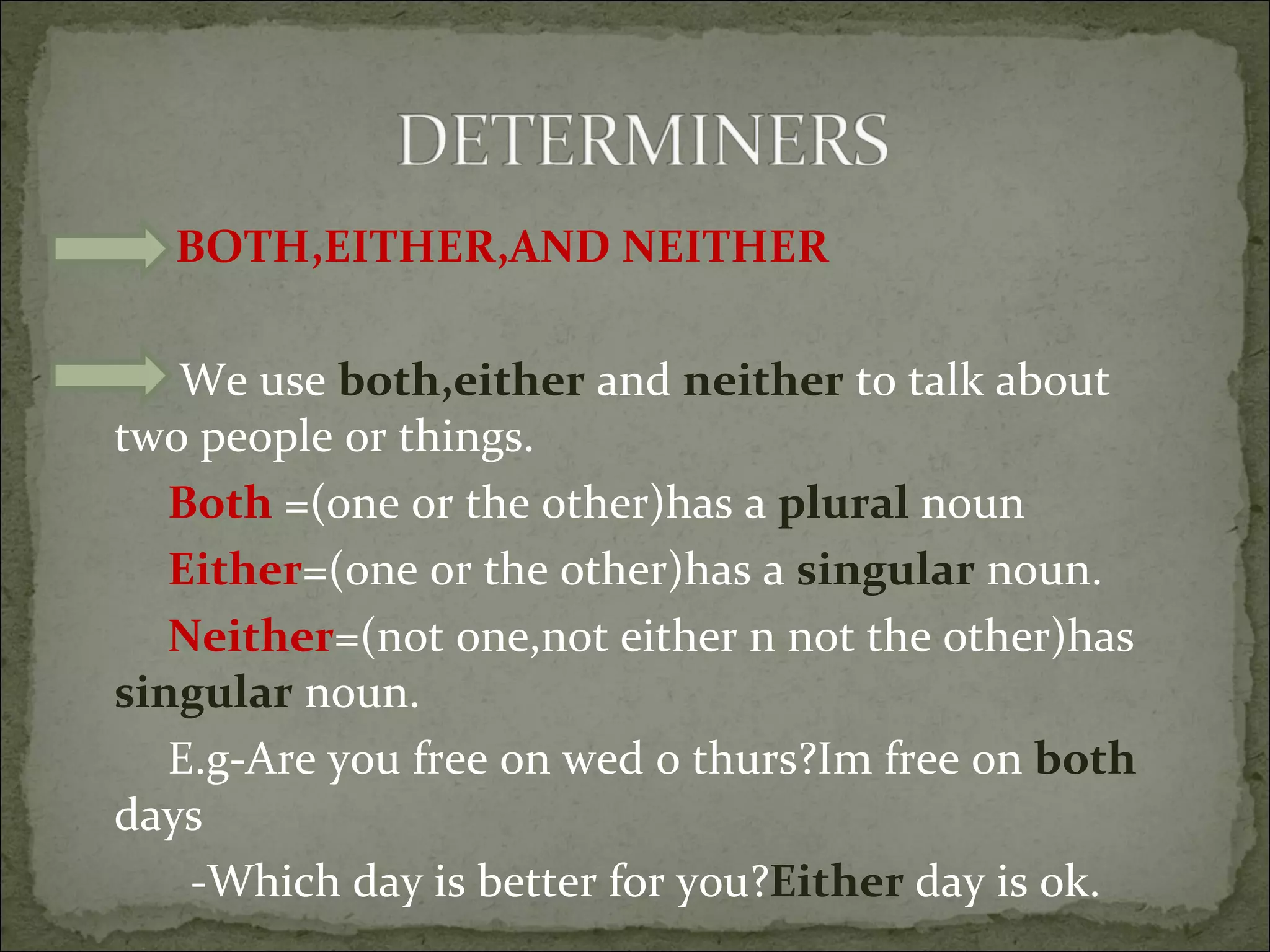
BOTH,EITHER,AND NEITHER We use  both,either  and  neither  to talk about two people or things. Both  =(one or the other)has a  plural  noun Either =(one or the other)has a  singular  noun. Neither =(not one,not either n not the other)has  singular  noun. E.g-Are you free on wed o thurs?Im free on  both  days -Which day is better for you? Either  day is ok.
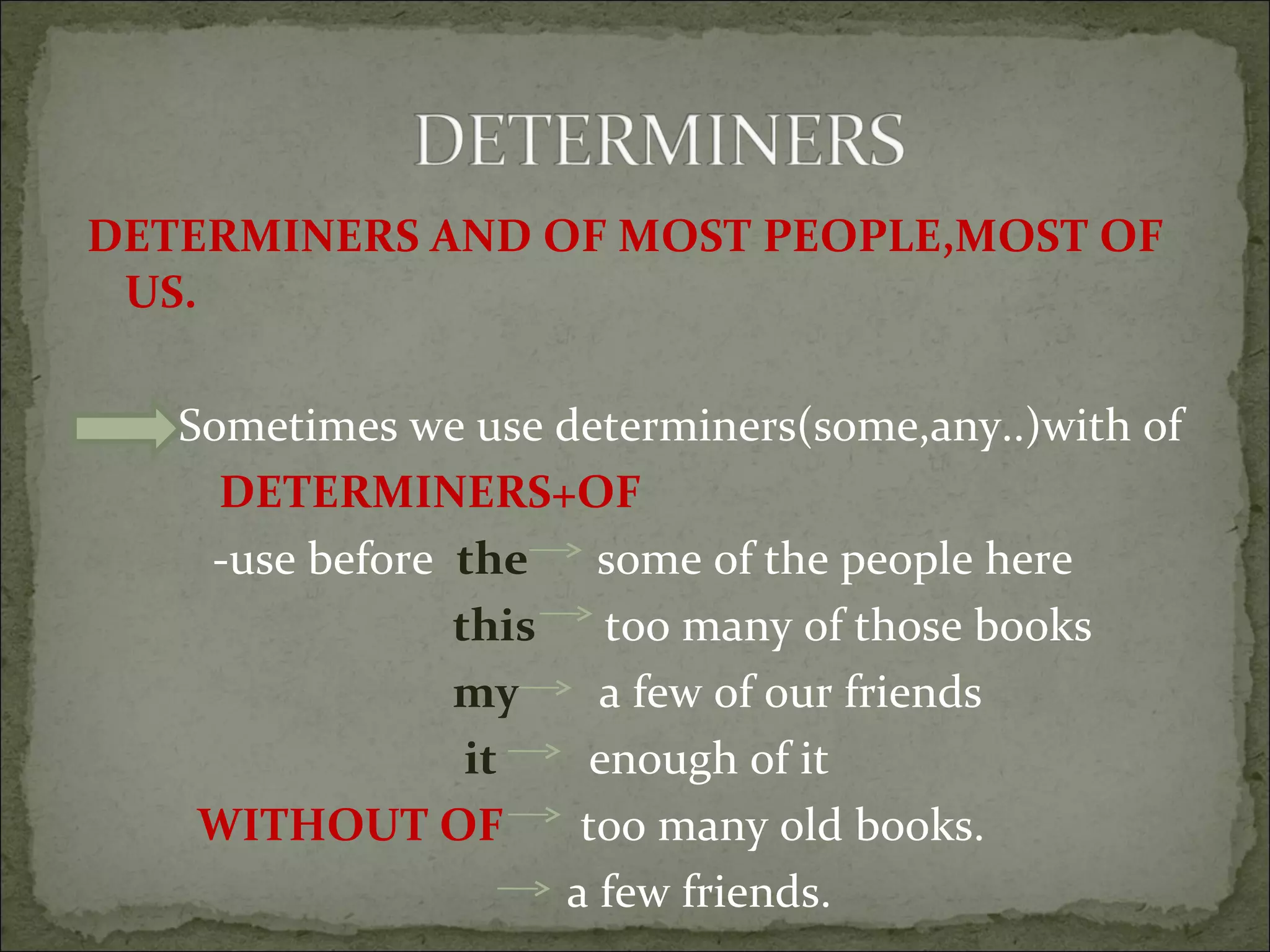
DETERMINERS AND OF MOST PEOPLE,MOST OF US. Sometimes we use determiners(some,any..)with of DETERMINERS+OF  -use before  the   some of the people here this   too many of those books my   a few of our friends it   enough of it WITHOUT OF  too many old books. a few friends.

Articles n detminers

  • 1.
    ARTICLES CAN BEDEVIDED BY TWO GROUPS A INDEFINITE AN THE
  • 2.
    INDEFINITE,USED BEFORE SINGULARCOUNTABLE NOUNS /TO SHOW SINGULAR EXAMPLE 1 - A BOOK - A TREE - A HOUSE - A UNIFORM - A PENCIL - A BROWN BALL - A CAR - A RED APPLE - A BOY - A LOVELY MORNING
  • 3.
    EXAMPLE 2- U NIVERSITY - U NION - U NIFORM ANY ‘U ’ VOWELS THAT - U NIMART PRONOUNS AS ‘ YU ’ SHOULD USE ‘A ’ AT THE BEGINNING OF THE SENTENCES
  • 4.
    INDEFINITE,USED BEFORE SINGULARCOUNTABLE NOUNS EXAMPLE 1 - AN AEROPLANE - AN EGG - AN ELEPHANT - AN OWL - AN IDEA - AN ISLAND - AN UMBRELLA - AN ANT
  • 5.
    EXAMPLE 2- AN H OUR - AN H EIR SILENT ‘H’ - AN H ONEST MAN
  • 6.
    DEFINITE,USED BEFORE SINGULARCOUNTABLE NOUNS,AND BEFORE BOTH COUNT AND UNCOUNTABLE NOUNS EXAMPLE 1 - The presenter, the audience, the sessions and the time.
  • 7.
    ‘ THE’IS USED……. BEFORE A SUPELATIVE - the easie st - the lea st - the mo st BEFORE A TITTLE OR A POSITION - the K ing - the P rime M inister
  • 8.
    BEFORE A NOUN- the sun - the sky - the moon BEFORE RIVERS,SEAS,OCEAN,GROUP OF ISLAND AND COUNTRIES - the P acific O cean - the S outh C hinese S ea
  • 9.
    BEFORE AN ORDINALNUMBER - the first - the second CERTAIN EXPRESSION OF TIME -in the morning -in the afternoon TO REFER TO PARTICULAR NOUNS - the participants are copying the notes
  • 10.
    TO REFER TONOUNS MENTIONED EARLIER IN A SENTENCE -I used a pencil . The pencil was provided by the hotel WITH THE FOLLOWING MOSQUE UNIVERSITIES AND CINEMAS -My father has gone to the mosque, whereas my sister has gone to the universities
  • 11.
    WE DONOT USE ARTICLES WITH…………. PROPER NOUNS SUCH AS TOWN, COUNTRIES,ROADS OR STREETS - the venue for the workshop is Universities of New Challenge NAME OF GAMES - the male participants love soccer
  • 12.
    MEALS - the speakers have dinner at 7.00pm -have you taken breakfast SCHOOL,CHURCHES.TOWNS,MARKET -participants take a bus to town
  • 13.
    ARE USED TOSHOW QUANTITY DETERMINERS ARE ALSO DEVIDED BY TWO GROUPS…. -COUNTABLE SINGULAR -UNCOUNTABLE AND PLURAL
  • 14.
    COUNTABLE Q SINGULAR PLURAL U W -one,every**,each, -many,several,some* A O and another a few,a number of, N R T D DEMOSTRATIVE I S -this and -these and T that those Y
  • 15.
    UNCOUNTABLE Q SINGULAR U W -much,more,some** A O a little, a lot of,a lots of(mean the same) N R T D I S DEMONSTRATIVE T -this and that Y
  • 16.
    SOME AND ANYWe use SOME or ANY , not A/An with uncountable and plural nouns. They mean ‘a limited number or quantities’. We use SOME in affirmative (+) sentences. We use ANY in negative sentences(-) and in most question. e.g -I’d like some water. -Have you got any sugar?
  • 17.
    SOMEBODY,SOMEONE,ANYTHING,SOMEWHERE.. Somebody and someone mean the same,and same goes to Anybody and Anyone . The differents between somebody and anybody is same as some and any. e.g.-Has anybody seen my keys? -he lives somewhere in london. -I didn’t say anything. -She never goes anywhere.
  • 18.
    MUCH AND MANYWe use much with singular(uncountable)nouns and many with plurals . Much and many are used mostly in questions and negatives.They ar unusual in affirmative(+)sentences. e.g -she doesn’t speak much in english -she doesn’t buy many clothes
  • 19.
    A LOT OFAND A LOTS OF A lot of and a lots of are common in informal style.They mean the same. E.g-I haven’t got a lot of time just now. -He’s got a lots of money and a lots of friends. If we use a lot or lots with noun ,we always use of. If we use a lot or lots without a noun ,we don’t use of E.g -`Have you got a lot of work?’ -`yes a lot ’
  • 20.
    A LITTLE ANDA FEW We use a little with singular(uncountable)nouns. And a few with plural. E.g -If you`re hungry,we`ve got a little soup and a a few tomatoes. In conversation we use only a little / few We can use a little and a few without nouns if the meaning is clear. e.g-`have got any money? ` A little ’
  • 21.
    EVERY CHILD ,ALLCHILDREN We can use all and every with similar meanings,but the grammar is different. All +PLURAL E.g- All children are different - All teachers make mistakes EVERY+ SINGULAR E.g- Every child is different - Every teacher make mistakes.
  • 22.
    BOTH,EITHER,AND NEITHER Weuse both,either and neither to talk about two people or things. Both =(one or the other)has a plural noun Either =(one or the other)has a singular noun. Neither =(not one,not either n not the other)has singular noun. E.g-Are you free on wed o thurs?Im free on both days -Which day is better for you? Either day is ok.
  • 23.
    DETERMINERS AND OFMOST PEOPLE,MOST OF US. Sometimes we use determiners(some,any..)with of DETERMINERS+OF -use before the some of the people here this too many of those books my a few of our friends it enough of it WITHOUT OF too many old books. a few friends.