Passive Solar ECM/EMO
Applications at
Rideau Public School
Summarizing Presentation
By: Michael Reid & Nick Cousineau
Unfortunate For Passive Solar
– Two methods of analysis show us that the overall
annual negative impacts of passive solar
applications are realistic and likely accurate.
– Passive solar has a net negative annual impact.
– Passive solar has a positive monthly impact only
during the shoulder seasons.
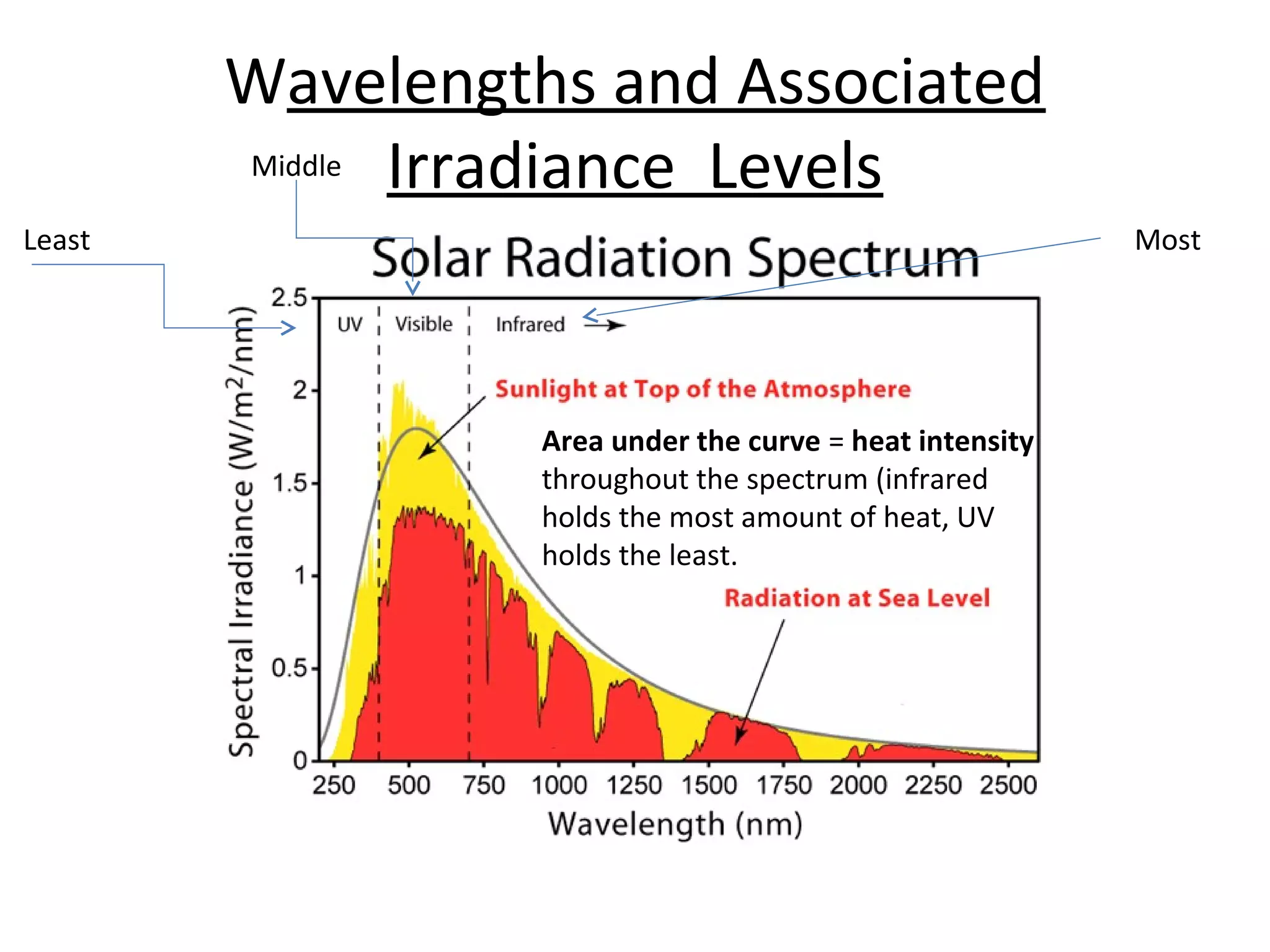
Wavelengths and Associated
Irradiance Levels
Area under the curve = heat intensity
throughout the spectrum (infrared
holds the most amount of heat, UV
holds the least.
MostLeast
Middle
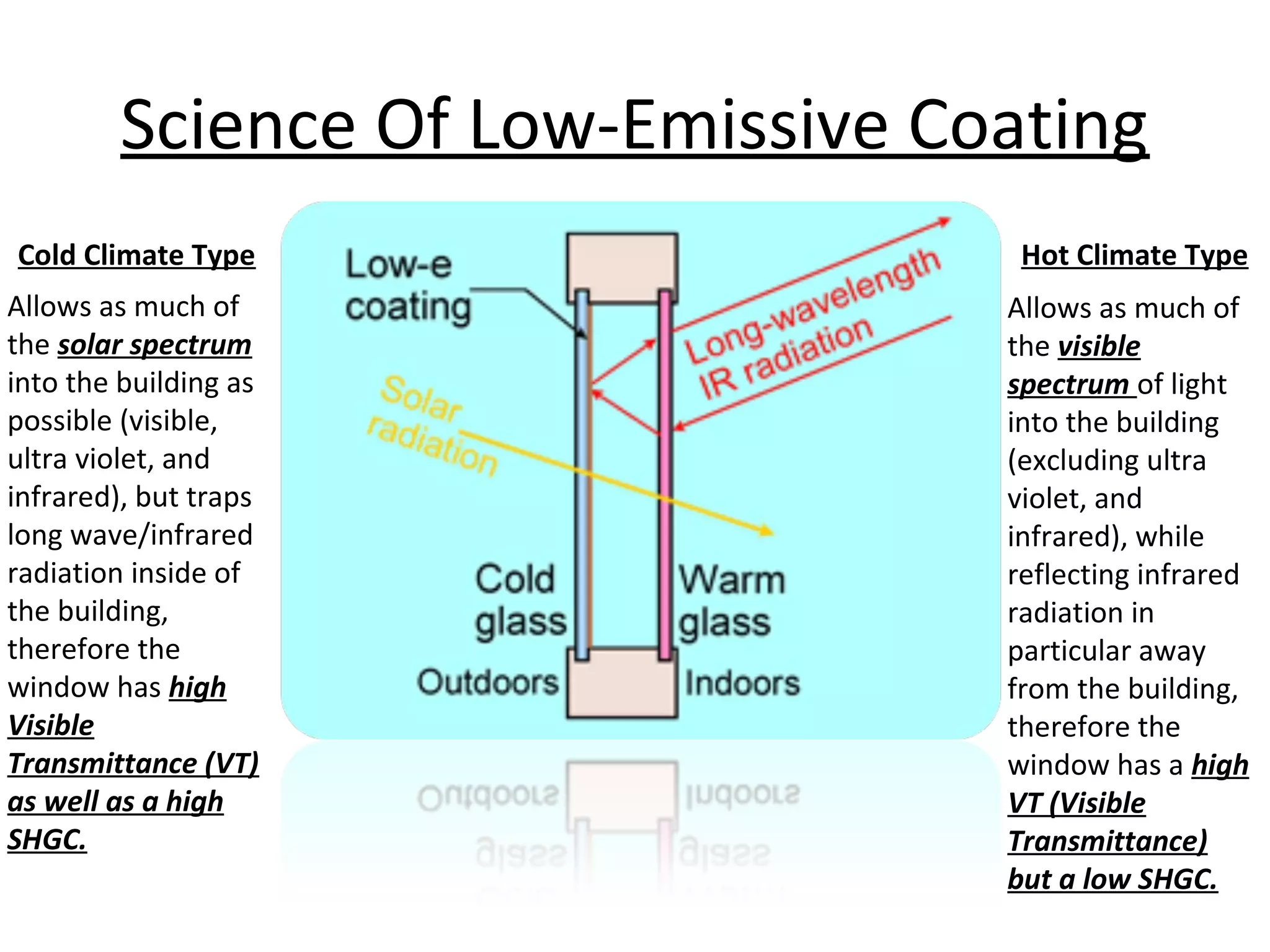
Science Of Low-Emissive Coating
Cold Climate Type Hot Climate Type
Allows as much of
the solar spectrum
into the building as
possible (visible,
ultra violet, and
infrared), but traps
long wave/infrared
radiation inside of
the building,
therefore the
window has high
Visible
Transmittance (VT)
as well as a high
SHGC.
Allows as much of
the visible
spectrum of light
into the building
(excluding ultra
violet, and
infrared), while
reflecting infrared
radiation in
particular away
from the building,
therefore the
window has a high
VT (Visible
Transmittance)
but a low SHGC.
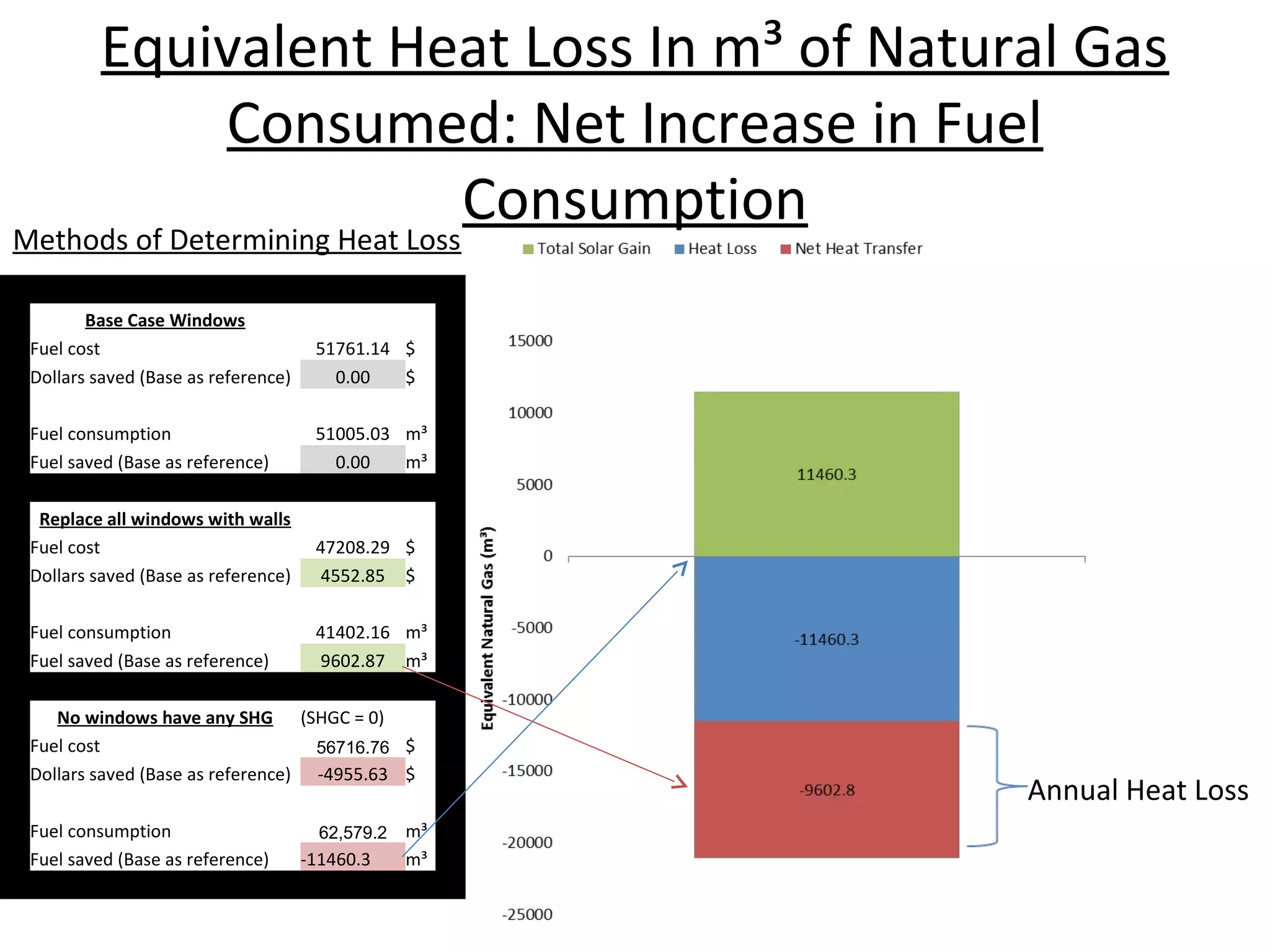
Equivalent Heat Loss In m³ of Natural Gas
Consumed: Net Increase in Fuel
Consumption
Annual Heat Loss
Base Case Windows
Fuel cost 51761.14 $
Dollars saved (Base as reference) 0.00 $
Fuel consumption 51005.03 m³
Fuel saved (Base as reference) 0.00 m³
Replace all windows with walls
Fuel cost 47208.29 $
Dollars saved (Base as reference) 4552.85 $
Fuel consumption 41402.16 m³
Fuel saved (Base as reference) 9602.87 m³
No windows have any SHG (SHGC = 0)
Fuel cost 56716.76 $
Dollars saved (Base as reference) -4955.63 $
Fuel consumption 62,579.2 m³
Fuel saved (Base as reference) -11460.3 m³
Methods of Determining Heat Loss
Conclusion/Recommendations
• Ultimately, the research we have obtained and the
data we have modeled proposes that the passive
solar ECM/EMO is best suited for use in the shoulder
seasons of the year.
• The only way to generate a net positive annual heat
gain/net reduction in fuel consumption is by
upgrading the windows to a u-value of 0.7 rather than
4.67 (for the 1927 section of the building) (expensive
upgrade) which happens to be the largest area of
south facing windows on site (1110.32 ft² of window
upgrades).
Conclusion/Recommendations
• Ultimately, the research we have obtained and the
data we have modeled proposes that the passive
solar ECM/EMO is best suited for use in the shoulder
seasons of the year.
• The only way to generate a net positive annual heat
gain/net reduction in fuel consumption is by
upgrading the windows to a u-value of 0.7 rather than
4.67 (for the 1927 section of the building) (expensive
upgrade) which happens to be the largest area of
south facing windows on site (1110.32 ft² of window
upgrades).

Passive Solar ECM Presentation (Final Summary)

  • 1.
    Passive Solar ECM/EMO Applicationsat Rideau Public School Summarizing Presentation By: Michael Reid & Nick Cousineau
  • 2.
    Unfortunate For PassiveSolar – Two methods of analysis show us that the overall annual negative impacts of passive solar applications are realistic and likely accurate. – Passive solar has a net negative annual impact. – Passive solar has a positive monthly impact only during the shoulder seasons.
  • 3.
    Wavelengths and Associated IrradianceLevels Area under the curve = heat intensity throughout the spectrum (infrared holds the most amount of heat, UV holds the least. MostLeast Middle
  • 4.
    Science Of Low-EmissiveCoating Cold Climate Type Hot Climate Type Allows as much of the solar spectrum into the building as possible (visible, ultra violet, and infrared), but traps long wave/infrared radiation inside of the building, therefore the window has high Visible Transmittance (VT) as well as a high SHGC. Allows as much of the visible spectrum of light into the building (excluding ultra violet, and infrared), while reflecting infrared radiation in particular away from the building, therefore the window has a high VT (Visible Transmittance) but a low SHGC.
  • 5.
    Equivalent Heat LossIn m³ of Natural Gas Consumed: Net Increase in Fuel Consumption Annual Heat Loss Base Case Windows Fuel cost 51761.14 $ Dollars saved (Base as reference) 0.00 $ Fuel consumption 51005.03 m³ Fuel saved (Base as reference) 0.00 m³ Replace all windows with walls Fuel cost 47208.29 $ Dollars saved (Base as reference) 4552.85 $ Fuel consumption 41402.16 m³ Fuel saved (Base as reference) 9602.87 m³ No windows have any SHG (SHGC = 0) Fuel cost 56716.76 $ Dollars saved (Base as reference) -4955.63 $ Fuel consumption 62,579.2 m³ Fuel saved (Base as reference) -11460.3 m³ Methods of Determining Heat Loss
  • 6.
    Conclusion/Recommendations • Ultimately, theresearch we have obtained and the data we have modeled proposes that the passive solar ECM/EMO is best suited for use in the shoulder seasons of the year. • The only way to generate a net positive annual heat gain/net reduction in fuel consumption is by upgrading the windows to a u-value of 0.7 rather than 4.67 (for the 1927 section of the building) (expensive upgrade) which happens to be the largest area of south facing windows on site (1110.32 ft² of window upgrades).
  • 7.
    Conclusion/Recommendations • Ultimately, theresearch we have obtained and the data we have modeled proposes that the passive solar ECM/EMO is best suited for use in the shoulder seasons of the year. • The only way to generate a net positive annual heat gain/net reduction in fuel consumption is by upgrading the windows to a u-value of 0.7 rather than 4.67 (for the 1927 section of the building) (expensive upgrade) which happens to be the largest area of south facing windows on site (1110.32 ft² of window upgrades).