PASE v. Hannon: The Larry P.
Case All Over Again – But Not
            Quite

      Sherwood Best, Ph.D.
           Professor
            CSULA
                             1
PASE
        v.
      Hannon

506 F. Supp. 831 (1980)

Argued January, 1980
Decided July 7, 1980
                          2
Terms
   EMH – Educably Mentally Handicapped. A
    term used by school districts to assign
    students with IQ scores in the borderland-
    mild range to special classes. Not a federal
    category. In California, the term EMR has
    been used.


                                          3
Background
   Placement into EMH classes began with referral
    from general education, followed by assessment
    & recommendation by a school psychologist.

   Illinois school code required classes for EMH
    students who were defined as “children between
    the ages of 3 & 21 years who because of
    retarded intellectual development as determined
    by individual psychological evaluation are
    incapable of being educated profitable and
    efficiently through ordinary classroom
    instruction, but who may be expected to benefit
    from special education facilities designed to
    make them economically useful & socially
    adjusted.”                                  4
Background
   A class action lawsuit was brought in US
    District Court on behalf of all black
    children in the Chicago school system who
    were or might be assigned to EMH
    classes against:
       Superintendent of Schools Joseph P. Hannon
       Members of the Chicago Board of Education
       Superintendent of the Illinois State Board of
        Education
       Illinois State Office of Education
                                                5
Issues
   Were black children being labeled as EMH
    inappropriately & disproportionately due to IQ
    testing?

   If so, did their placement in EMH classes
    constitute discrimination?
   If so, were children being placed improperly and
    stigmatized by the IQ tests?

   Were the 14th Amendment rights of the children
    violated?
                                                6
Applicable Law
   The Education of All Handicapped Children
    Act (EAHCA) of 1975
   The Rehabilitation Act of 1973
   Title VI of the Civil Rights Act of 1964
   The Equal Education Opportunities Act of
    1974
   The Equal Protection Clause of the 14th
    Amendment of the US Constitution
                                       7
Arguments - Plaintiffs
   The IQ tests measure a child’s “sharing of the
    dominant white culture.” Poor performance denotes
    nothing about the child’s intellectual functioning.

   Racial bias in IQ tests is shown circumstantially by
    the fact that black children do not score as well as
    white children on these tests.

   The use of IQ tests resulted in disproportionate
    placement of black children into EMH classes that
    stigmatized them, provided inadequate education,
    & limited their skills.
                                                 8
Arguments - Defendants
   IQ tests measure the child’s current level of
    abilities which correlate highly with his/her
    prospects of succeeding in school. (academic
    achievement)
   Diagnosis of mental retardation is not based
    solely on IQ scores but on a combination of
    relevant factors. (IQ not the sole determiner)
   The test under consideration is the Wechsler
    Intelligence Scale for Children, or the WISC-R.


                                               9
Judge’s Evaluations
  Judge Grady insisted on examination of the tests
   itself, as well as other standardized intelligence
   tests (Stanford Binet, WISC) to determine if, in
   fact, the items on the tests were biased. He
   provided the following example (paraphrased):
“Item 13 asks ‘What does the stomach do?’ The
   acceptable answer focus on the function of the
   stomach – digesting or holding food. It was
   testified that many black children answer ‘It
   growls.” Children who come from poverty
   level homes do not have enough to eat. The
   point seems well taken”.
                                              10
Judge’s Evaluations
   Judge Grady proceeded with a point-by-point
    evaluation of all disputed items on the WISC-R,
    and came to the following conclusions:
       The test manual instructs examiners to give credit for
        responses that are similar or better than those
        identified in the manual.
       Some of the items identified as biased because they
        would not be relevant to the black child’s environment
        were not found to be any more related to a white
        child’s environment than that of a black child.
       Some test items had a strong racial bias. An
        example is the “fight” item: “What is the thing to do if
        a child much smaller than you starts a fight with
        you?”
   Judge Grady concluded that all but a few of their
    items on their face appear racially neutral.
                                                       11
Judge’s Evaluation
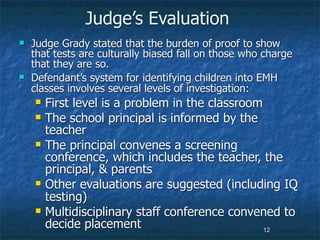
   Judge Grady stated that the burden of proof to show
    that tests are culturally biased fall on those who charge
    that they are so.
   Defendant’s system for identifying children into EMH
    classes involves several levels of investigation:
       First level is a problem in the classroom
       The school principal is informed by the
        teacher
       The principal convenes a screening
        conference, which includes the teacher, the
        principal, & parents
       Other evaluations are suggested (including IQ
        testing)
       Multidisciplinary staff conference convened to
        decide placement                          12
One Last Statement
   Judge Grady noted that the two plaintiffs
    (Barbara and Angela), had, in fact, been
    inappropriately assessed and placed into EMH
    classes. They were, in fact, learning disabled. In
    fact, a witness for the plaintiffs, a psychologist
    who re-assessed both girl, testified that their low
    scores on the WISC-R was due to visual &
    auditory discrimination problems, and not any
    cultural bias. The judge noted that the plaintiffs
    did not realize that this evidence indicates that
    the two class representatives do not have claims
    which are typical to the class that they purport
    to represent.
                                               13
Holding
   The plaintiffs contention that IQ tests unfairly
    discriminate against black children, that their
    14th Amendment rights have been violated, and
    that the tenants of the EAHCA have been
    violated, is not tenable.

   Judge Grady found for the defendants and rules
    that standardized IQ tests could remain one
    aspect of assessment for placement in EMH
    classes.

                                              14
Dicta
   Several factors mitigate the situation of missing
    items on the test:
       The importance of an individual item is lessened by
        the fact that the child continues with the sub-test
        until s/he has a certain number of consecutive
        misses.
       Some objectionable items appear on the test at a
        point of level of difficulty that a child in early school
        years when the time of EMH placement is made is not
        expected to reach anyway.
       The IQ score is not the sole determiner for EMH
        placement.
       The examiner who knows the milieu of the child can
        correct for bias by asking questions in a sensitive way.

                                                        15
Court’s Orders
   Chicago Public Schools were to continue the use
    of IQ tests as part of a multi-level system of
    assessment for special education placement.


                                             16
Implications - Special Education
   EAHCA mandate of non-discriminatory &
    multiple assessments had been in place
    for 5 years at the time of the PASE case.
   Appropriate focus on special needs
    children who are culturally/linguistically
    diverse.
   LEAs that adhere to legislative mandates
    can defend their policies.

                                         17

Pase v. hannon 1980

  • 1.
    PASE v. Hannon:The Larry P. Case All Over Again – But Not Quite Sherwood Best, Ph.D. Professor CSULA 1
  • 2.
    PASE v. Hannon 506 F. Supp. 831 (1980) Argued January, 1980 Decided July 7, 1980 2
  • 3.
    Terms  EMH – Educably Mentally Handicapped. A term used by school districts to assign students with IQ scores in the borderland- mild range to special classes. Not a federal category. In California, the term EMR has been used. 3
  • 4.
    Background  Placement into EMH classes began with referral from general education, followed by assessment & recommendation by a school psychologist.  Illinois school code required classes for EMH students who were defined as “children between the ages of 3 & 21 years who because of retarded intellectual development as determined by individual psychological evaluation are incapable of being educated profitable and efficiently through ordinary classroom instruction, but who may be expected to benefit from special education facilities designed to make them economically useful & socially adjusted.” 4
  • 5.
    Background  A class action lawsuit was brought in US District Court on behalf of all black children in the Chicago school system who were or might be assigned to EMH classes against:  Superintendent of Schools Joseph P. Hannon  Members of the Chicago Board of Education  Superintendent of the Illinois State Board of Education  Illinois State Office of Education 5
  • 6.
    Issues  Were black children being labeled as EMH inappropriately & disproportionately due to IQ testing?  If so, did their placement in EMH classes constitute discrimination?  If so, were children being placed improperly and stigmatized by the IQ tests?  Were the 14th Amendment rights of the children violated? 6
  • 7.
    Applicable Law  The Education of All Handicapped Children Act (EAHCA) of 1975  The Rehabilitation Act of 1973  Title VI of the Civil Rights Act of 1964  The Equal Education Opportunities Act of 1974  The Equal Protection Clause of the 14th Amendment of the US Constitution 7
  • 8.
    Arguments - Plaintiffs  The IQ tests measure a child’s “sharing of the dominant white culture.” Poor performance denotes nothing about the child’s intellectual functioning.  Racial bias in IQ tests is shown circumstantially by the fact that black children do not score as well as white children on these tests.  The use of IQ tests resulted in disproportionate placement of black children into EMH classes that stigmatized them, provided inadequate education, & limited their skills. 8
  • 9.
    Arguments - Defendants  IQ tests measure the child’s current level of abilities which correlate highly with his/her prospects of succeeding in school. (academic achievement)  Diagnosis of mental retardation is not based solely on IQ scores but on a combination of relevant factors. (IQ not the sole determiner)  The test under consideration is the Wechsler Intelligence Scale for Children, or the WISC-R. 9
  • 10.
    Judge’s Evaluations  Judge Grady insisted on examination of the tests itself, as well as other standardized intelligence tests (Stanford Binet, WISC) to determine if, in fact, the items on the tests were biased. He provided the following example (paraphrased): “Item 13 asks ‘What does the stomach do?’ The acceptable answer focus on the function of the stomach – digesting or holding food. It was testified that many black children answer ‘It growls.” Children who come from poverty level homes do not have enough to eat. The point seems well taken”. 10
  • 11.
    Judge’s Evaluations  Judge Grady proceeded with a point-by-point evaluation of all disputed items on the WISC-R, and came to the following conclusions:  The test manual instructs examiners to give credit for responses that are similar or better than those identified in the manual.  Some of the items identified as biased because they would not be relevant to the black child’s environment were not found to be any more related to a white child’s environment than that of a black child.  Some test items had a strong racial bias. An example is the “fight” item: “What is the thing to do if a child much smaller than you starts a fight with you?”  Judge Grady concluded that all but a few of their items on their face appear racially neutral. 11
  • 12.
    Judge’s Evaluation  Judge Grady stated that the burden of proof to show that tests are culturally biased fall on those who charge that they are so.  Defendant’s system for identifying children into EMH classes involves several levels of investigation:  First level is a problem in the classroom  The school principal is informed by the teacher  The principal convenes a screening conference, which includes the teacher, the principal, & parents  Other evaluations are suggested (including IQ testing)  Multidisciplinary staff conference convened to decide placement 12
  • 13.
    One Last Statement  Judge Grady noted that the two plaintiffs (Barbara and Angela), had, in fact, been inappropriately assessed and placed into EMH classes. They were, in fact, learning disabled. In fact, a witness for the plaintiffs, a psychologist who re-assessed both girl, testified that their low scores on the WISC-R was due to visual & auditory discrimination problems, and not any cultural bias. The judge noted that the plaintiffs did not realize that this evidence indicates that the two class representatives do not have claims which are typical to the class that they purport to represent. 13
  • 14.
    Holding  The plaintiffs contention that IQ tests unfairly discriminate against black children, that their 14th Amendment rights have been violated, and that the tenants of the EAHCA have been violated, is not tenable.  Judge Grady found for the defendants and rules that standardized IQ tests could remain one aspect of assessment for placement in EMH classes. 14
  • 15.
    Dicta  Several factors mitigate the situation of missing items on the test:  The importance of an individual item is lessened by the fact that the child continues with the sub-test until s/he has a certain number of consecutive misses.  Some objectionable items appear on the test at a point of level of difficulty that a child in early school years when the time of EMH placement is made is not expected to reach anyway.  The IQ score is not the sole determiner for EMH placement.  The examiner who knows the milieu of the child can correct for bias by asking questions in a sensitive way. 15
  • 16.
    Court’s Orders  Chicago Public Schools were to continue the use of IQ tests as part of a multi-level system of assessment for special education placement. 16
  • 17.
    Implications - SpecialEducation  EAHCA mandate of non-discriminatory & multiple assessments had been in place for 5 years at the time of the PASE case.  Appropriate focus on special needs children who are culturally/linguistically diverse.  LEAs that adhere to legislative mandates can defend their policies. 17

Editor's Notes

  • #2 \n
  • #3 \n
  • #4 \n
  • #5 \n
  • #6 \n
  • #7 \n
  • #8 \n
  • #9 \n
  • #10 \n
  • #11 \n
  • #12 his answer can be acceptable- Could the psychologist have adjusted and accept his answer? Questionable of psychologist Training\n\n\n
  • #13 There need to be an attempt to support, such as a meeting with a parent and principal. \n
  • #14 \n
  • #15 \n
  • #16 \n
  • #17 \n
  • #18 It is possible to place appropriate focus on children who are diverse, because if they need services they should receive them. \nCan make the case that they need the services, instead of overlooking a child.\n\n\nParents did not appeal\nTheir concern was that their children were inappropriateley assessed and placed in special education\n