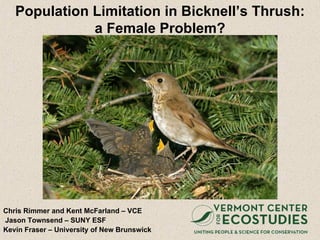

Population Limitation in Bicknell’s Thrush: a Female Problem? Chris Rimmer and Kent McFarland – VCE Jason Townsend – SUNY ESF  Kevin Fraser – University of New Brunswick
Partners In Flight = North America Watch List IUCN Red List = Vulnerable ABC/Audubon WatchList = Red List Canada = Candidate for Federal Listing USFWS = Special Concern ME, NH, NY, VT = Special Concern  www.bicknellsthrush.org
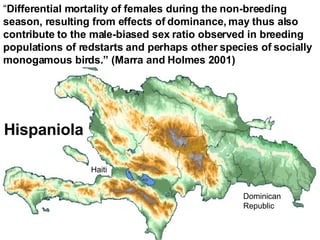
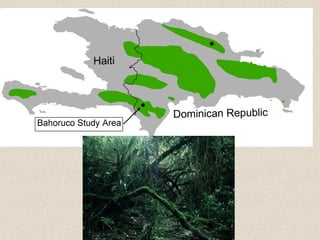
“ Differential mortality of females during the non-breeding season, resulting from effects of dominance, may thus also contribute to the male-biased sex ratio observed in breeding populations of redstarts and perhaps other species of socially monogamous birds.” (Marra and Holmes 2001) Hispaniola Dominican Republic Haiti
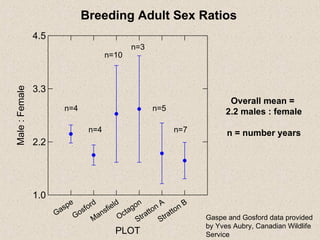
n=4 n=4 n=10 n=3 n=5 n=7 Overall mean =  2.2 males : female n = number years Breeding Adult Sex Ratios Gaspe and Gosford data provided by Yves Aubry, Canadian Wildlife Service
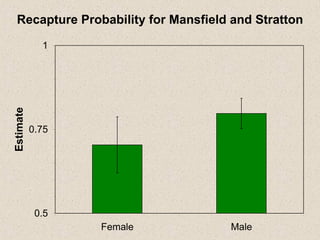
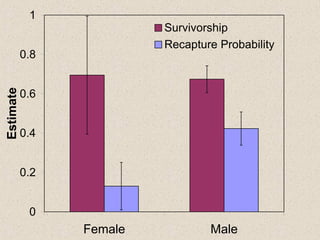
Recapture Probability for Mansfield and Stratton
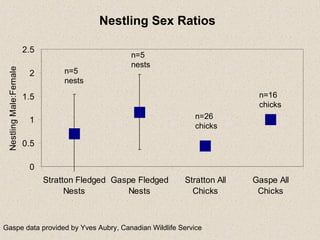
n=5 nests n=5 nests Nestling Sex Ratios n=16 chicks n=26 chicks Gaspe data provided by Yves Aubry, Canadian Wildlife Service
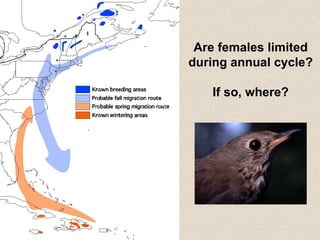
Are females limited during annual cycle? If so, where?
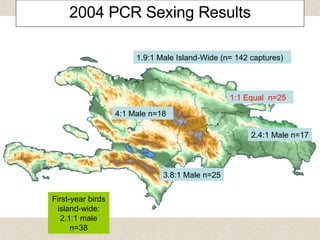
2004 PCR Sexing Results 1:1 Equal  n=25 4:1 Male n=18 3.8:1 Male n=25 1.9:1 Male Island-Wide (n= 142 captures) First-year birds island-wide: 2.1:1 male n=38 2.4:1 Male n=17
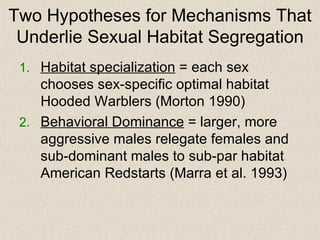
Two Hypotheses for Mechanisms That Underlie Sexual Habitat Segregation Habitat specialization  = each sex chooses sex-specific optimal habitat Hooded Warblers (Morton 1990)  Behavioral Dominance  = larger, more aggressive males relegate females and sub-dominant males to sub-par habitat American Redstarts (Marra et al. 1993)
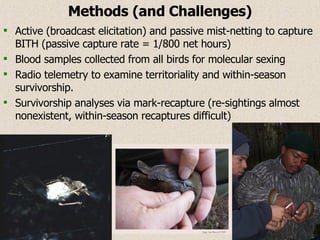
Methods (and Challenges) Active (broadcast elicitation) and passive mist-netting to capture BITH (passive capture rate = 1/800 net hours) Blood samples collected from all birds for molecular sexing Radio telemetry to examine territoriality and within-season survivorship. Survivorship analyses via mark-recapture (re-sightings almost nonexistent, within-season recaptures difficult)
 
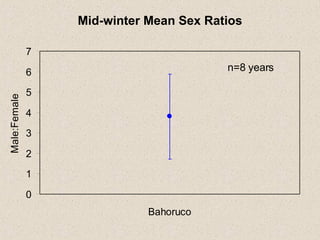
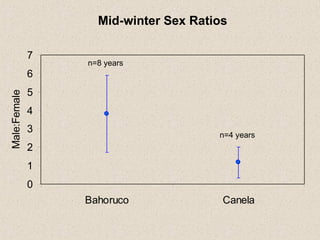
Mid-winter Mean Sex Ratios n=8 years
 
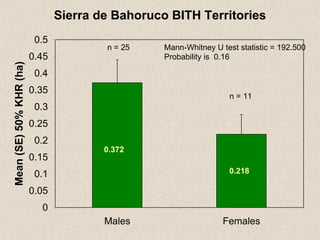
Sierra de Bahoruco BITH Territories 0.372 0.218
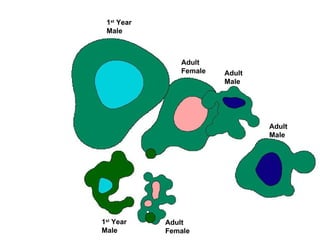
1 st  Year Male Adult Female Adult  Male Adult Male 1 st  Year Male Adult  Female
 
Mid-winter Sex Ratios n=8 years  n=4 years
 
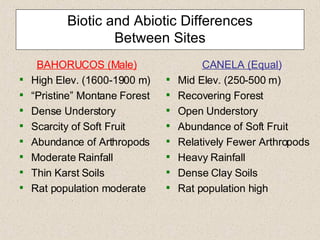
Biotic and Abiotic Differences  Between Sites BAHORUCOS (Male) High Elev. (1600-1900 m) “ Pristine” Montane Forest Dense Understory Scarcity of Soft Fruit Abundance of Arthropods Moderate Rainfall Thin Karst Soils Rat population moderate CANELA (Equal) Mid Elev. (250-500 m) Recovering Forest Open Understory Abundance of Soft Fruit Relatively Fewer Arthropods Heavy Rainfall Dense Clay Soils Rat population high
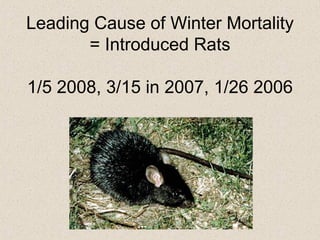
Leading Cause of Winter Mortality = Introduced Rats 1/5 2008, 3/15 in 2007, 1/26 2006
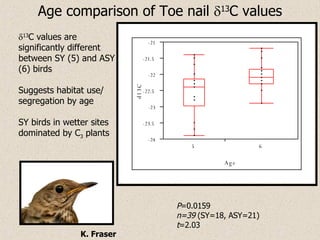
Age comparison of Toe nail   13 C values P =0.0159 n=39  (SY=18, ASY=21) t =2.03  13 C values are  significantly different  between SY (5) and ASY (6) birds Suggests habitat use/ segregation by age SY birds in wetter sites dominated by C 3  plants  K. Fraser
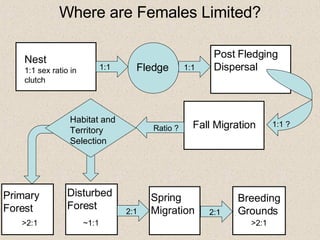
Where are Females Limited? Nest 1:1 sex ratio in clutch Fledge Post Fledging Dispersal 1:1 1:1 Fall Migration 1:1 ? Ratio ? 2:1 Spring Migration 2:1 Breeding Grounds >2:1 Primary Forest >2:1 Disturbed Forest ~1:1 Habitat and Territory Selection
 
Acknowledgements Field work and data analysis: Esteban Garrido, Vinicio Mejia, Elvis Cuevas, Jesus Almonte  Jorge Brocca – Sociedad Ornithologica de la Hispaniola Juan Klavins and Sarah Frey, VCE Jim Goetz, Cornell Lab of Ornithology Andrea Townsend, Cornell Lab of Ornithology Scott Sillett, Smithsonian Migratory Bird Center Yves Aubry,Canadian Wildlife Service Funding: Nuttall Ornithological Club Stewart Family Foundation  Thomas Marshall Foundation The Nature Conservancy U.S. Fish and Wildlife Service

Partners in Flight 2008: Bicknell's Thrush

  • 1.
    Population Limitation inBicknell’s Thrush: a Female Problem? Chris Rimmer and Kent McFarland – VCE Jason Townsend – SUNY ESF Kevin Fraser – University of New Brunswick
  • 2.
    Partners In Flight= North America Watch List IUCN Red List = Vulnerable ABC/Audubon WatchList = Red List Canada = Candidate for Federal Listing USFWS = Special Concern ME, NH, NY, VT = Special Concern www.bicknellsthrush.org
  • 3.
    “ Differential mortalityof females during the non-breeding season, resulting from effects of dominance, may thus also contribute to the male-biased sex ratio observed in breeding populations of redstarts and perhaps other species of socially monogamous birds.” (Marra and Holmes 2001) Hispaniola Dominican Republic Haiti
  • 4.
    n=4 n=4 n=10n=3 n=5 n=7 Overall mean = 2.2 males : female n = number years Breeding Adult Sex Ratios Gaspe and Gosford data provided by Yves Aubry, Canadian Wildlife Service
  • 5.
    Recapture Probability forMansfield and Stratton
  • 6.
    n=5 nests n=5nests Nestling Sex Ratios n=16 chicks n=26 chicks Gaspe data provided by Yves Aubry, Canadian Wildlife Service
  • 7.
    Are females limitedduring annual cycle? If so, where?
  • 8.
    2004 PCR SexingResults 1:1 Equal n=25 4:1 Male n=18 3.8:1 Male n=25 1.9:1 Male Island-Wide (n= 142 captures) First-year birds island-wide: 2.1:1 male n=38 2.4:1 Male n=17
  • 9.
    Two Hypotheses forMechanisms That Underlie Sexual Habitat Segregation Habitat specialization = each sex chooses sex-specific optimal habitat Hooded Warblers (Morton 1990) Behavioral Dominance = larger, more aggressive males relegate females and sub-dominant males to sub-par habitat American Redstarts (Marra et al. 1993)
  • 10.
    Methods (and Challenges)Active (broadcast elicitation) and passive mist-netting to capture BITH (passive capture rate = 1/800 net hours) Blood samples collected from all birds for molecular sexing Radio telemetry to examine territoriality and within-season survivorship. Survivorship analyses via mark-recapture (re-sightings almost nonexistent, within-season recaptures difficult)
  • 11.
  • 12.
    Mid-winter Mean SexRatios n=8 years
  • 13.
  • 14.
    Sierra de BahorucoBITH Territories 0.372 0.218
  • 15.
    1 st Year Male Adult Female Adult Male Adult Male 1 st Year Male Adult Female
  • 16.
  • 17.
    Mid-winter Sex Ratiosn=8 years n=4 years
  • 18.
  • 19.
    Biotic and AbioticDifferences Between Sites BAHORUCOS (Male) High Elev. (1600-1900 m) “ Pristine” Montane Forest Dense Understory Scarcity of Soft Fruit Abundance of Arthropods Moderate Rainfall Thin Karst Soils Rat population moderate CANELA (Equal) Mid Elev. (250-500 m) Recovering Forest Open Understory Abundance of Soft Fruit Relatively Fewer Arthropods Heavy Rainfall Dense Clay Soils Rat population high
  • 20.
    Leading Cause ofWinter Mortality = Introduced Rats 1/5 2008, 3/15 in 2007, 1/26 2006
  • 21.
    Age comparison ofToe nail  13 C values P =0.0159 n=39 (SY=18, ASY=21) t =2.03  13 C values are significantly different between SY (5) and ASY (6) birds Suggests habitat use/ segregation by age SY birds in wetter sites dominated by C 3 plants K. Fraser
  • 22.
    Where are FemalesLimited? Nest 1:1 sex ratio in clutch Fledge Post Fledging Dispersal 1:1 1:1 Fall Migration 1:1 ? Ratio ? 2:1 Spring Migration 2:1 Breeding Grounds >2:1 Primary Forest >2:1 Disturbed Forest ~1:1 Habitat and Territory Selection
  • 23.
  • 24.
    Acknowledgements Field workand data analysis: Esteban Garrido, Vinicio Mejia, Elvis Cuevas, Jesus Almonte Jorge Brocca – Sociedad Ornithologica de la Hispaniola Juan Klavins and Sarah Frey, VCE Jim Goetz, Cornell Lab of Ornithology Andrea Townsend, Cornell Lab of Ornithology Scott Sillett, Smithsonian Migratory Bird Center Yves Aubry,Canadian Wildlife Service Funding: Nuttall Ornithological Club Stewart Family Foundation Thomas Marshall Foundation The Nature Conservancy U.S. Fish and Wildlife Service