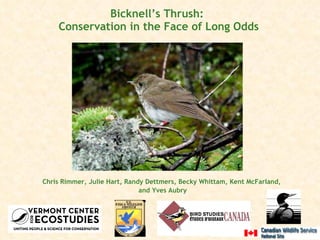
Bicknell’s Thrush:  Conservation in the Face of Long Odds Chris Rimmer, Julie Hart, Randy Dettmers, Becky Whittam, Kent McFarland,  and Yves Aubry
Why Bicknell’s Thrush? Rare  global population < 50,000 individuals Ranges restricted and fragmented occupies habitat “islands” ~90% winter population on Hispaniola At risk population declines multiple habitat threats in N. America severe, ongoing winter habitat loss Reclusive and Enigmatic many obstacles to understanding status few baseline population data  = Vulnerable
Partners In Flight = North America Watch List IUCN Red List = Vulnerable ABC/Audubon WatchList = Red List Canada = Candidate for Federal Listing USFWS = Special Concern ME, NH, NY, VT = Special Concern  www.bicknellsthrush.org
George J. Wallace c. 1935 Eugene P. Bicknell c. 1881
The New Generation  of BITHnologists Henri R. Ouellet, 1995
BITH Migratory Range “ Islands” north and south Migration routes/patterns = ??
Bicknell’s Thrush Distribution  in the U.S. 5 km² 263 km² 88 km² 496 km² 261 km²
 
Threats to Breeding Habitats
“ Only a freak ornithologist  would think of leaving the trails  for more than a few feet.” George J. Wallace, 1936
 
BITH habitat declines sharply with rising temperature 0 20 40 60 80 100 120 140 160 +0 +1 +2 +3 +4 +5 +6 +7 Mean July Temp. Change  (°C ) Relative to 1950-1980 BITH Habitat (1,000 ha) Low emissions 2.8°C High emissions 5.9°C
Complex Breeding System Polygynandry: Both males and females mate with multiple partners; paternity is highly mixed Nesting Female Male Home Range r r r r r
n=4 n=4 n=10 n=3 n=5 n=7 Overall mean =  2.2 males : female Breeding Adult Sex Ratios
Hispaniola: winter stronghold of BITH Dominican Republic Haiti DR: ~10% original forest remains Haiti: 1-2% original forest left
Limiting Factors in  Winter Habitats
% Unprotected Wet Broadleaf Forest 65.9 Dense Conifer Forest 39.3 Semi-humid Broadleaf Forest 75.9
Strong evidence that females are limited during annual cycle When and where?
Where are Females Limited? Nest 1:1 sex ratio in clutch Fledge Post Fledging Dispersal 1:1 1:1 Fall Migration 1:1 ? 1:1 ? Ratio ? Spring Migration Ratio ? Breeding Grounds >2:1 Cloud  Forest >1:1 Rain Forest <1:1 Habitat and Territory Selection
What do we know about BITH populations?
Bicknell’s Thrush in the White Mountains: 7% Annual Decline 9 Years 17 Routes 2002-2008 declines in Canada: New Brunswick – 20%, Nova Scotia – 19%
BITH relative abundance on U.S. routes surveyed annually, 2001-2008
www.bicknellsthrush.org/ International Bicknell’s Thrush Conservation Group (IBTCG) www.bicknellsthrush.org Developing a  Conservation Action Plan
IBTCG structure: inclusive, flexible Breeding and Migration  Research Breeding and Migration Forestry Wintering Grounds Coordination Committee Breeding and Migration  Monitoring
Over-winter Survival Fecundity Autumn Migratory Survival & Seasonal Interactions Spring Migratory Survival & Seasonal Interactions Winter Habitat Amount/quality Direct Mortality Physiological Condition Introduced Predators More Catastrophic Weather Atmospheric Phenomenon  (Hg, Pb, Acid Rain) Climate Change Increased Drought & Wind Natural Fires Subsistence Farming & Logging Disease, Parasites, etc. Feral Domestic Animals Human-caused Fires Low Genetic Diversity Breeding Habitat Amount/quality Direct Mortality Breeding Season Survival + Physiological Condition Atmospheric Phenomenon  (Hg, Pb, Acid Rain) Climate Change Cone-Squirrel Cycle Disruption Forest Conversion Increased Rain & Wind Forestry Practices Incidental Take Forest Succession Male-biased Sex Ratio Human Disturbance Industrial Development Disease, Parasites, etc. Coastal Development Δ  in Prey Emergence Forest Pathogens
Over-winter Survival Fecundity Autumn Migratory Survival & Seasonal Interactions Spring Migratory Survival & Seasonal Interactions Amount of Winter Habitat Direct Mortality Physiological Condition Amount of Breeding Habitat Direct Mortality Breeding Season Survival + Physiological Condition Track effects of climate change ID Important Migratory Sites Determine Forestry Effects Assess Effects of Acid Deposition Monitor Responses to Development Track effects of climate change Develop Forest Mgmt Guidelines and Habitat Supply Analysis ID Where Deforestation is Occurring Prioritize Remaining Forest for Protection Habitat Use and Survival Relative to Land Use and Condition Protection & Restoration of  Key Habitats
Primary IBTCG Goals   Estimate the global population of BITH estimate with 95% CI, which itself is ≤ 20% of population estimate  (e.g., 95% CI of 45–55,000 individuals on a total population est. of 50,000)   * Increase global population of BITH by 50% over the next 50 years Determine BITH population status annually   density and abundance indices with CV  <  0.2 site-specific occurrence data to map rangewide breeding distribution  Document BITH population trends over time implement Mountain Birdwatch Version 2.0 in 2010 80% power to detect  >  3% annual change over 50 years at  P   <  0.1  Relate BITH population trends and demographics to limiting factors e.g., habitat/landscape characteristics, climate, red squirrel abundance,  Hg exposure, Ca availability, forestry practices, winter habitat extent
Wintering Grounds Conservation Actions Protect, restore, and manage current and potential winter habitat Investigate overwinter survival and demography relative to local habitat  condition and quality (connectivity, seasonal carry-over effects) Expand resources and reach of BITH Habitat Protection Fund Clarify BITH distribution and habitat use on other Greater Antillean islands  Involve and build capacity of in-country partners
Can we get there from here?? A Conservation Triage Approach? How optimally allocate scarce resources of time, capacity and $$? Prioritize conservation actions that will produce greatest effects Continually measure and evaluate outcomes Expand yet focus research and monitoring  Develop a multilateral, hemispheric “business plan”  Ride bicycles…
 
 
IBTCG Partners American Bird Conservancy Atlantic Coast Joint Venture Audubon New York Bird Studies Canada Canadian Wildlife Service Cornell University Fornebu Lumber  Maine Dept. Inland Fisheries & Wildlife  National Aviary National Park Service New Brunswick Dept  Natural Resources  New Hampshire Audubon New Hampshire Fish & Game Dept. NewPage Port Hawkesbury Corp  Parks Canada Plum Creek  Regroupement QuébecOiseaux  SUNY—Environmental Science and Forestry  University of Massachusetts University of New Brunswick U.S. Fish and Wildlife Service U.S. Forest Service Intl. Program Vermont Center for Ecostudies Vermont Fish & Wildlife Dept.

Bicknell's Thrush: Conservation in fhe Face of Long Odds

  • 1.
    Bicknell’s Thrush: Conservation in the Face of Long Odds Chris Rimmer, Julie Hart, Randy Dettmers, Becky Whittam, Kent McFarland, and Yves Aubry
  • 2.
    Why Bicknell’s Thrush?Rare global population < 50,000 individuals Ranges restricted and fragmented occupies habitat “islands” ~90% winter population on Hispaniola At risk population declines multiple habitat threats in N. America severe, ongoing winter habitat loss Reclusive and Enigmatic many obstacles to understanding status few baseline population data = Vulnerable
  • 3.
    Partners In Flight= North America Watch List IUCN Red List = Vulnerable ABC/Audubon WatchList = Red List Canada = Candidate for Federal Listing USFWS = Special Concern ME, NH, NY, VT = Special Concern www.bicknellsthrush.org
  • 4.
    George J. Wallacec. 1935 Eugene P. Bicknell c. 1881
  • 5.
    The New Generation of BITHnologists Henri R. Ouellet, 1995
  • 6.
    BITH Migratory Range“ Islands” north and south Migration routes/patterns = ??
  • 7.
    Bicknell’s Thrush Distribution in the U.S. 5 km² 263 km² 88 km² 496 km² 261 km²
  • 8.
  • 9.
  • 10.
    “ Only afreak ornithologist would think of leaving the trails for more than a few feet.” George J. Wallace, 1936
  • 11.
  • 12.
    BITH habitat declinessharply with rising temperature 0 20 40 60 80 100 120 140 160 +0 +1 +2 +3 +4 +5 +6 +7 Mean July Temp. Change (°C ) Relative to 1950-1980 BITH Habitat (1,000 ha) Low emissions 2.8°C High emissions 5.9°C
  • 13.
    Complex Breeding SystemPolygynandry: Both males and females mate with multiple partners; paternity is highly mixed Nesting Female Male Home Range r r r r r
  • 14.
    n=4 n=4 n=10n=3 n=5 n=7 Overall mean = 2.2 males : female Breeding Adult Sex Ratios
  • 15.
    Hispaniola: winter strongholdof BITH Dominican Republic Haiti DR: ~10% original forest remains Haiti: 1-2% original forest left
  • 16.
    Limiting Factors in Winter Habitats
  • 17.
    % Unprotected WetBroadleaf Forest 65.9 Dense Conifer Forest 39.3 Semi-humid Broadleaf Forest 75.9
  • 18.
    Strong evidence thatfemales are limited during annual cycle When and where?
  • 19.
    Where are FemalesLimited? Nest 1:1 sex ratio in clutch Fledge Post Fledging Dispersal 1:1 1:1 Fall Migration 1:1 ? 1:1 ? Ratio ? Spring Migration Ratio ? Breeding Grounds >2:1 Cloud Forest >1:1 Rain Forest <1:1 Habitat and Territory Selection
  • 20.
    What do weknow about BITH populations?
  • 21.
    Bicknell’s Thrush inthe White Mountains: 7% Annual Decline 9 Years 17 Routes 2002-2008 declines in Canada: New Brunswick – 20%, Nova Scotia – 19%
  • 22.
    BITH relative abundanceon U.S. routes surveyed annually, 2001-2008
  • 23.
    www.bicknellsthrush.org/ International Bicknell’sThrush Conservation Group (IBTCG) www.bicknellsthrush.org Developing a Conservation Action Plan
  • 24.
    IBTCG structure: inclusive,flexible Breeding and Migration Research Breeding and Migration Forestry Wintering Grounds Coordination Committee Breeding and Migration Monitoring
  • 25.
    Over-winter Survival FecundityAutumn Migratory Survival & Seasonal Interactions Spring Migratory Survival & Seasonal Interactions Winter Habitat Amount/quality Direct Mortality Physiological Condition Introduced Predators More Catastrophic Weather Atmospheric Phenomenon (Hg, Pb, Acid Rain) Climate Change Increased Drought & Wind Natural Fires Subsistence Farming & Logging Disease, Parasites, etc. Feral Domestic Animals Human-caused Fires Low Genetic Diversity Breeding Habitat Amount/quality Direct Mortality Breeding Season Survival + Physiological Condition Atmospheric Phenomenon (Hg, Pb, Acid Rain) Climate Change Cone-Squirrel Cycle Disruption Forest Conversion Increased Rain & Wind Forestry Practices Incidental Take Forest Succession Male-biased Sex Ratio Human Disturbance Industrial Development Disease, Parasites, etc. Coastal Development Δ in Prey Emergence Forest Pathogens
  • 26.
    Over-winter Survival FecundityAutumn Migratory Survival & Seasonal Interactions Spring Migratory Survival & Seasonal Interactions Amount of Winter Habitat Direct Mortality Physiological Condition Amount of Breeding Habitat Direct Mortality Breeding Season Survival + Physiological Condition Track effects of climate change ID Important Migratory Sites Determine Forestry Effects Assess Effects of Acid Deposition Monitor Responses to Development Track effects of climate change Develop Forest Mgmt Guidelines and Habitat Supply Analysis ID Where Deforestation is Occurring Prioritize Remaining Forest for Protection Habitat Use and Survival Relative to Land Use and Condition Protection & Restoration of Key Habitats
  • 27.
    Primary IBTCG Goals Estimate the global population of BITH estimate with 95% CI, which itself is ≤ 20% of population estimate (e.g., 95% CI of 45–55,000 individuals on a total population est. of 50,000) * Increase global population of BITH by 50% over the next 50 years Determine BITH population status annually density and abundance indices with CV < 0.2 site-specific occurrence data to map rangewide breeding distribution Document BITH population trends over time implement Mountain Birdwatch Version 2.0 in 2010 80% power to detect > 3% annual change over 50 years at P < 0.1 Relate BITH population trends and demographics to limiting factors e.g., habitat/landscape characteristics, climate, red squirrel abundance, Hg exposure, Ca availability, forestry practices, winter habitat extent
  • 28.
    Wintering Grounds ConservationActions Protect, restore, and manage current and potential winter habitat Investigate overwinter survival and demography relative to local habitat condition and quality (connectivity, seasonal carry-over effects) Expand resources and reach of BITH Habitat Protection Fund Clarify BITH distribution and habitat use on other Greater Antillean islands Involve and build capacity of in-country partners
  • 29.
    Can we getthere from here?? A Conservation Triage Approach? How optimally allocate scarce resources of time, capacity and $$? Prioritize conservation actions that will produce greatest effects Continually measure and evaluate outcomes Expand yet focus research and monitoring Develop a multilateral, hemispheric “business plan” Ride bicycles…
  • 30.
  • 31.
  • 32.
    IBTCG Partners AmericanBird Conservancy Atlantic Coast Joint Venture Audubon New York Bird Studies Canada Canadian Wildlife Service Cornell University Fornebu Lumber Maine Dept. Inland Fisheries & Wildlife National Aviary National Park Service New Brunswick Dept Natural Resources New Hampshire Audubon New Hampshire Fish & Game Dept. NewPage Port Hawkesbury Corp Parks Canada Plum Creek Regroupement QuébecOiseaux SUNY—Environmental Science and Forestry University of Massachusetts University of New Brunswick U.S. Fish and Wildlife Service U.S. Forest Service Intl. Program Vermont Center for Ecostudies Vermont Fish & Wildlife Dept.

Editor's Notes

  • #3 Rare and declining (estimated total population &lt; 50,000 individuals; 4-5% annual decline) Ranges restricted and fragmented at both ends ~90% of global winter population concentrated on Hispaniola Severe, ongoing winter habitat loss and degradation
  • #4 Why Bicknell’s Thrush? 1 Rare and declining - estimated total population 20-40,000 individuals; ~7% annual decline 2 Ranges restricted and fragmented at both ends 3 ~90% of global winter population concentrated on Hispaniola 4 Severe, ongoing winter habitat loss and degradation
  • #8 Mountain Birdwatch records were used to generate a BITH distribution map, based on latitude, elevation and forest type. 92% accurate in predicting the presence or absence of BITH from a given location.
  • #10 Numerous pressures on montane forests: acid precipitation depleting Ca from food chain, elevating risk of red spruce winter mortality; ski area development (some logging pressures, esp in Maine); telecommunications towers; wind power development; mercury contamination (first documentation or organic methylmercury in terrestrial system was in the high-elevation forest ecosystem); but the most insidious and profound of all is…
  • #11 Harsh, inhospitable climate, dynamic and subject to much natural mortality, maybe compounded by other ecological stressors… AND imposing logistical challenges to working within them
  • #13 Our simulations predict that regional warming of even 1 °C (or 1.8 degrees F) could reduce potential BITH habitat by more than half and an increase of 2 °C may be sufficient to eliminate all breeding sites from the Catskill Mountains of New York and most of Vermont. A 3 °C increase in growing season temperatures has the potential to nearly eliminate the habitat of BITH in the Northeast. By the end of the 21 st century, summer temperatures are projected to rise on average by 2.8 °C under the lower-emissions scenario and 5.9 °C under the higher-emission scenario compared with the 1961 to 1990 average (UCS 2006).
  • #14 BITH have developed an unusual mating system to accommodate to the habitat. You are familiar with polygyny, which refers to a male having multiple wives. There is also polyandry, in which a female mates with multiple males. And there are cases of males mating with multiple females and females mating with multiple males, or polygynandry, which is the case with Bicknell’s Thrush. All nests tested so far have multiple paternity. In this diagram you can see evidence of polygynandrous mating system. Explain symbols and point out multiple nests per male. Normally you think of males defending territories. With Bicknell’s the females defend the territory around their nest from other females and the males defend home ranges which overlap. The benefit to the female is having extra help feeding her nestlings. We have actually found a correlation between the quality of the habitat and the number of males helping feed nestlings, with anywhere from 0 males helping at high quality areas and up to 4 at nests in low quality feeding areas.
  • #15 The Problem. Apparent skewed sex ratio found throughout the breeding range. Unique mating system -- multiple males per female, mixed paternity, appears driven by food abundance on female “territories”.
  • #19 Logical to conclude then that females must be limited at some point during their annual cycle Breeding, migration, or winter? No data on post-fledging or post-breeding period, or during migration, but no a priori reason to predict differential survivorship. Given the loss of winter habitat….Are primary limiting factors on wintering grounds? SEASONAL CARRY-OVER EFFECTS?
  • #22 In New Hampshire, high-elevation surveys have been conducted since the early 90s. Based on 9 years of data collected by the White Mountain National Forest, Bicknell’s Thrush populations are estimated to be in decline at about 7% per year. If this accurately depicts what is happening with Bicknell’s, it is an alarming statistic and, I think, provides strong evidence for continued monitoring of high-elevation songbirds.