Mountain Birdwatch Phase 2:
Monitoring high-elevation birds in
the Atlantic Northern Forest
Julie Hart & Dan Lambert
Sugarloaf Mountain, NH
NH-ME BBS routes
Why high-elevation birds?
Bicknell’s Thrush
•  Endemic
•  Habitat specialist
•  Restricted range
•  Small population
•  Uncertain status
•  Conservation priority
= Vulnerable
Past Limitations
•  Count protocols vary
•  Limited statistical inference
•  Detectability issues
•  Occupancy estimates
•  Unable to estimate population size,
assess limiting factors, or
adequately model metapopulations
•  Grumpy editors
Mountain Birdwatch II
•  VISION: Create a unified program
that spans the entire breeding
range of Bicknell’s Thrush
•  Organizations involved:
– Vermont Center for Ecostudies
– Bird Studies Canada
– Canadian Wildlife Service
– White Mountain National Forest
Addressing the Challenge
•  2006 – NECBM Mountain Bird Group
•  2007 – International Bicknell’s Thrush
Conservation Group
•  2008 – Develop protocol and SOPs
•  2009 – Begin regional coordination
•  2010 – Export model to Newfoundland
and Appalachian Mountain BCR
www.bicknellsthrush.org
Project Goals
1.  Measure changes in distribution
and abundance with an emphasis
on SGCN.
2.  Investigate the relationship
between breeding ground
population status of BITH and
winter habitat availability.
3.  Produce tools and data to guide
stewardship and conservation.
Project Goals (cont.)
•  Estimate BITH population size
•  Investigate the influence of:
– Habitat
– Climate
– Red squirrel / cone mast dynamics
– Hg exposure
– Calcium availability
– Forestry practices
Spatially Balanced Sampling
•  GRTS Survey Design
–  BITH habitat model
–  Trails and roads
•  Cost Surface Layer
–  Effort as distance nearest road
•  Flexible
–  add new sites over time
–  intensify sampling within pre-defined strata
Spatially Balanced Sampling
•  GRTS Survey Design
–  BITH habitat model
–  Trails and roads
•  Cost Surface Layer
–  Effort as distance nearest road
•  Flexible
–  add new sites over time
–  intensify sampling within pre-defined strata
Optimal Point Count Method
•  Trained volunteers and technicians
survey once a year during 3-week
window in June
•  Surveys begin 30 min before sunrise
•  Target 10 focal species plus Red
Squirrel
Target Species
SPECIES RATIONALE
YBFL NF indicator species
BCCH Niche overlap with BOCH
BOCH NF indicator species
WIWR Abundant, easy to identify
BITH Top conservation priority, specialist
SWTH Niche overlap with BITH
HETH Niche overlap with SWTH
BLPW NF indicator species
WTSP Abundant, easy to identify, BBS decline
FOSP Priority for Canada
RESQ Main predator of BITH nests & chicks
5 minutes 5 minutes 5 minutes 5 minutes
1 1 1 1 1 1 1 1 1 1 1 1 1 1 1 1 1 1 1 1
Two Pilot Protocols
Time of
detection
in 1-min
intervals
for BITH
simultaneous with
Repeated
simple
counts for
all focal
species
Repeated
p/a for
all focal
species
OR
5 minutes 5 minutes 5 minutes 5 minutes
Pilot Results
•  519 points surveyed
–  437 using simple counts
–  82 using presence/absence
–  144 BITH in first 10 minutes
•  Volunteer feedback
–  20 min long time
–  Hard to estimate distance by sound
–  Most would continue with MBW
•  Team of statisticians running variance
estimates using occupancy, time-of-
detection, n-mixture models, and distance
estimation
Data management
•  Georeferenced database
•  Standardized fields aligned to AKN
•  AKN archive
•  Opportunity to analyze and
visualize using AKN applications
•  Metadata documented through
BMDE
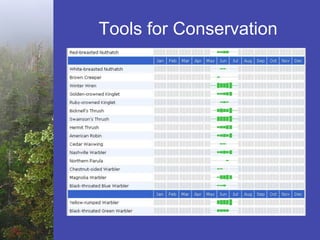
Tools for Conservation
•  Public access to data and
visualizations via AKN
Tools for Conservation
•  Public access to data and
visualizations via AKN
•  Wind farm siting assessment
• Of highest wind
potential areas,
only 5.4% is in
BITH habitat
• Of all potential
BITH habitat, 84%
falls within the
highest wind
potential category
VT Wind Resource Map
from NREL 2007
Wind
Farm
Siting
Tools for Conservation
•  Public access to data and
visualizations via AKN
•  Wind farm siting assessment
•  Range-wide analysis of preferred
habitat characteristics
Climate and Habitat Covariates
•  Elevation
•  Slope
•  Aspect
•  Topographical index
•  Surficial geology
•  Latitude/longitude
•  Mean daily temperature
•  Mean night-time
temperature
•  Mean precipitation
•  Canopy/subcanopy
characteristics
•  Stem density
•  Basal area by class
•  Foliar calcium
•  Mercury exposure
•  Cone mast
•  Red Squirrel
abundance
•  Wind power potential
•  Patch size
•  Patch composition
•  Isolation
Tools for Conservation
•  Public access to data and
visualizations via AKN
•  Wind farm siting assessment
•  Range-wide analysis of preferred
habitat characteristics
•  Assess habitat restoration in
Hispaniola
Winter Habitat Restoration
•  Restore historical broadleaf forest in
the Dominican Republic
•  Improve enforcement of protected
areas
•  Correlate the extent of forest in
Hispaniola with abundance of
Bicknell’s Thrush on breeding range
Winter Habitat Restoration
Population	
  Size:	
  Our	
  Vision2008
2012
2016
2020
2024
2028
2032
2036
2040
2044
2048
2052
2056
2060
Meeting Citizen Science
Challenges
•  Generate matching
funds
•  Balance quantity with quality of info
•  Observer effects
•  Large geographic
scope
•  Sustaining interest
•  Recruiting and training
Next Steps
Acknowledgements
A special thanks to Mountain Birdwatch volunteers

Mountain Birdwatch Phase 2: Monitoring High-elevation birds in the Atlantic Northern Forest

  • 1.
    Mountain Birdwatch Phase2: Monitoring high-elevation birds in the Atlantic Northern Forest Julie Hart & Dan Lambert Sugarloaf Mountain, NH
  • 2.
    NH-ME BBS routes Whyhigh-elevation birds?
  • 3.
    Bicknell’s Thrush •  Endemic • Habitat specialist •  Restricted range •  Small population •  Uncertain status •  Conservation priority = Vulnerable
  • 4.
    Past Limitations •  Countprotocols vary •  Limited statistical inference •  Detectability issues •  Occupancy estimates •  Unable to estimate population size, assess limiting factors, or adequately model metapopulations •  Grumpy editors
  • 5.
    Mountain Birdwatch II • VISION: Create a unified program that spans the entire breeding range of Bicknell’s Thrush •  Organizations involved: – Vermont Center for Ecostudies – Bird Studies Canada – Canadian Wildlife Service – White Mountain National Forest
  • 6.
    Addressing the Challenge • 2006 – NECBM Mountain Bird Group •  2007 – International Bicknell’s Thrush Conservation Group •  2008 – Develop protocol and SOPs •  2009 – Begin regional coordination •  2010 – Export model to Newfoundland and Appalachian Mountain BCR www.bicknellsthrush.org
  • 7.
    Project Goals 1.  Measurechanges in distribution and abundance with an emphasis on SGCN. 2.  Investigate the relationship between breeding ground population status of BITH and winter habitat availability. 3.  Produce tools and data to guide stewardship and conservation.
  • 8.
    Project Goals (cont.) • Estimate BITH population size •  Investigate the influence of: – Habitat – Climate – Red squirrel / cone mast dynamics – Hg exposure – Calcium availability – Forestry practices
  • 9.
    Spatially Balanced Sampling • GRTS Survey Design –  BITH habitat model –  Trails and roads •  Cost Surface Layer –  Effort as distance nearest road •  Flexible –  add new sites over time –  intensify sampling within pre-defined strata
  • 10.
    Spatially Balanced Sampling • GRTS Survey Design –  BITH habitat model –  Trails and roads •  Cost Surface Layer –  Effort as distance nearest road •  Flexible –  add new sites over time –  intensify sampling within pre-defined strata
  • 11.
    Optimal Point CountMethod •  Trained volunteers and technicians survey once a year during 3-week window in June •  Surveys begin 30 min before sunrise •  Target 10 focal species plus Red Squirrel
  • 12.
    Target Species SPECIES RATIONALE YBFLNF indicator species BCCH Niche overlap with BOCH BOCH NF indicator species WIWR Abundant, easy to identify BITH Top conservation priority, specialist SWTH Niche overlap with BITH HETH Niche overlap with SWTH BLPW NF indicator species WTSP Abundant, easy to identify, BBS decline FOSP Priority for Canada RESQ Main predator of BITH nests & chicks
  • 13.
    5 minutes 5minutes 5 minutes 5 minutes 1 1 1 1 1 1 1 1 1 1 1 1 1 1 1 1 1 1 1 1 Two Pilot Protocols Time of detection in 1-min intervals for BITH simultaneous with Repeated simple counts for all focal species Repeated p/a for all focal species OR 5 minutes 5 minutes 5 minutes 5 minutes
  • 14.
    Pilot Results •  519points surveyed –  437 using simple counts –  82 using presence/absence –  144 BITH in first 10 minutes •  Volunteer feedback –  20 min long time –  Hard to estimate distance by sound –  Most would continue with MBW •  Team of statisticians running variance estimates using occupancy, time-of- detection, n-mixture models, and distance estimation
  • 15.
    Data management •  Georeferenceddatabase •  Standardized fields aligned to AKN •  AKN archive •  Opportunity to analyze and visualize using AKN applications •  Metadata documented through BMDE
  • 16.
    Tools for Conservation • Public access to data and visualizations via AKN
  • 17.
  • 18.
    Tools for Conservation • Public access to data and visualizations via AKN •  Wind farm siting assessment
  • 19.
    • Of highest wind potentialareas, only 5.4% is in BITH habitat • Of all potential BITH habitat, 84% falls within the highest wind potential category VT Wind Resource Map from NREL 2007 Wind Farm Siting
  • 20.
    Tools for Conservation • Public access to data and visualizations via AKN •  Wind farm siting assessment •  Range-wide analysis of preferred habitat characteristics
  • 21.
    Climate and HabitatCovariates •  Elevation •  Slope •  Aspect •  Topographical index •  Surficial geology •  Latitude/longitude •  Mean daily temperature •  Mean night-time temperature •  Mean precipitation •  Canopy/subcanopy characteristics •  Stem density •  Basal area by class •  Foliar calcium •  Mercury exposure •  Cone mast •  Red Squirrel abundance •  Wind power potential •  Patch size •  Patch composition •  Isolation
  • 22.
    Tools for Conservation • Public access to data and visualizations via AKN •  Wind farm siting assessment •  Range-wide analysis of preferred habitat characteristics •  Assess habitat restoration in Hispaniola
  • 23.
    Winter Habitat Restoration • Restore historical broadleaf forest in the Dominican Republic •  Improve enforcement of protected areas •  Correlate the extent of forest in Hispaniola with abundance of Bicknell’s Thrush on breeding range
  • 24.
    Winter Habitat Restoration Population  Size:  Our  Vision2008 2012 2016 2020 2024 2028 2032 2036 2040 2044 2048 2052 2056 2060
  • 25.
    Meeting Citizen Science Challenges • Generate matching funds •  Balance quantity with quality of info •  Observer effects •  Large geographic scope •  Sustaining interest •  Recruiting and training
  • 26.
  • 27.
    Acknowledgements A special thanksto Mountain Birdwatch volunteers