WELCOME
2
Arunkumar, B.
2013-12-118
Dept. of Olericulture
3
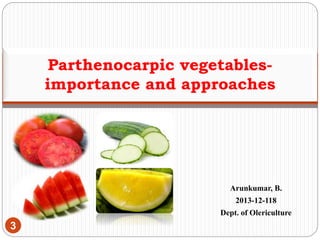
Parthenocarpic vegetables-
importance and approaches
Outline
4
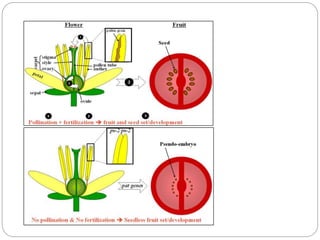
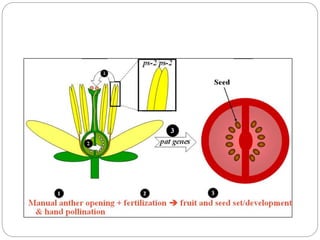
 Parthenocarpy
 Importance
 Mechanism of parthenocarpy
 Different approaches
 Tomato
 Cucumber
 Brinjal
 Capsicum
 Watermelon
 Conclusion
 Future thrust
Parthenocarpy
5
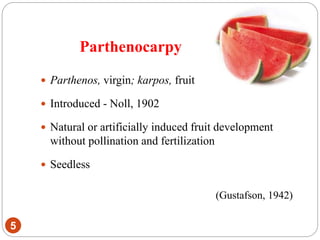
 Parthenos, virgin; karpos, fruit
 Introduced - Noll, 1902
 Natural or artificially induced fruit development
without pollination and fertilization
 Seedless
(Gustafson, 1942)
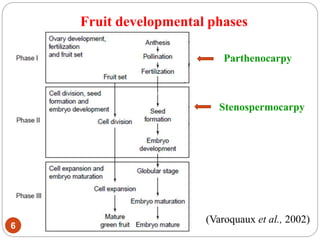
Parthenocarpy
Stenospermocarpy
(Varoquaux et al., 2002)
6
Fruit developmental phases
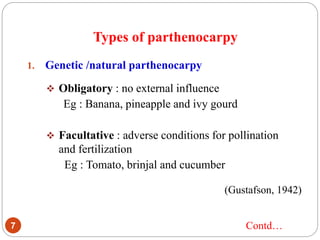
Types of parthenocarpy
7
1. Genetic /natural parthenocarpy
 Obligatory : no external influence
Eg : Banana, pineapple and ivy gourd
 Facultative : adverse conditions for pollination
and fertilization
Eg : Tomato, brinjal and cucumber
(Gustafson, 1942)
Contd…
8
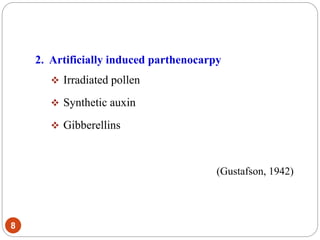
2. Artificially induced parthenocarpy
 Irradiated pollen
 Synthetic auxin
 Gibberellins
(Gustafson, 1942)
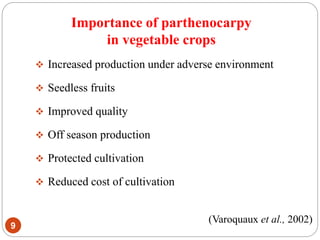
Importance of parthenocarpy
in vegetable crops
9
 Increased production under adverse environment
 Seedless fruits
 Improved quality
 Off season production
 Protected cultivation
 Reduced cost of cultivation
(Varoquaux et al., 2002)
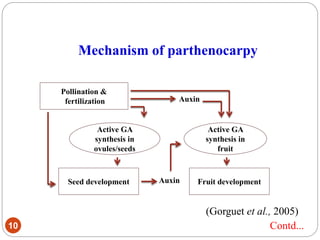
Mechanism of parthenocarpy
10
(Gorguet et al., 2005)
Pollination &
fertilization
Seed development Fruit development
Active GA
synthesis in
ovules/seeds
Active GA
synthesis in
fruit
Auxin
Auxin
Contd...
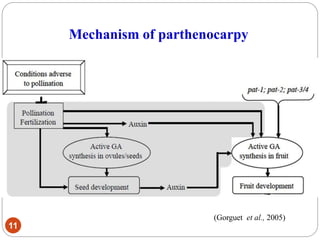
11
(Gorguet et al., 2005)
Mechanism of parthenocarpy
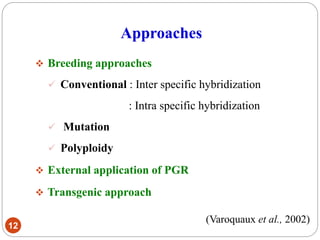
Approaches
12
 Breeding approaches
 Conventional : Inter specific hybridization
: Intra specific hybridization
 Mutation
 Polyploidy
 External application of PGR
 Transgenic approach
(Varoquaux et al., 2002)
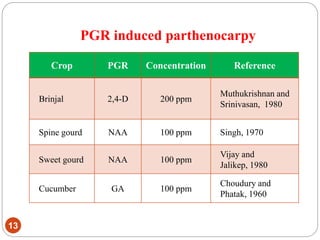
PGR induced parthenocarpy
13
Crop PGR Concentration Reference
Brinjal 2,4-D 200 ppm
Muthukrishnan and
Srinivasan, 1980
Spine gourd NAA 100 ppm Singh, 1970
Sweet gourd NAA 100 ppm
Vijay and
Jalikep, 1980
Cucumber GA 100 ppm
Choudury and
Phatak, 1960
Genetic engineering for parthenocarpy
14
 Unbalanced embryo development and/or prevention
of seed development
 Affecting phytohormone content and/or activity in
the desired organ
(Rotino et al., 1997)
DefH9- iaaM chimeric gene
15
 iaaM- auxin synthesising gene- Pseudomonas
syringae pv. savastanoi
 Indolacetamide monoxiginase
 DefH9- ovule/placenta specific promoter-
Antirrhinum majus
 Tomato, eggplant and cucumber
(Rotino et al., 1997)
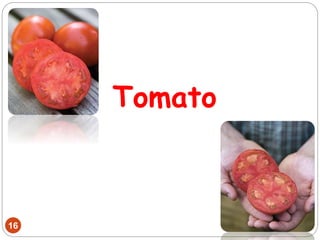
Tomato
16
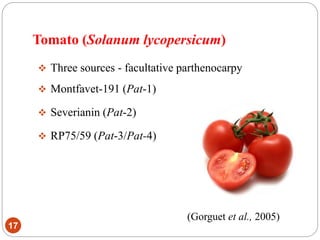
Tomato (Solanum lycopersicum)
17
 Three sources - facultative parthenocarpy
 Montfavet-191 (Pat-1)
 Severianin (Pat-2)
 RP75/59 (Pat-3/Pat-4)
(Gorguet et al., 2005)
Pat-1
18
 Montfavet-191
 Abnormal stamens
 Higher ovary and pericarp growth
 Female sterility
 Defective pollen tube- placenta interaction
 Low seed set
(Gorguet et al., 2005)
Pat-2
19
 Single recessive gene
 Genetic background of the recurrent parent is
very important for vigour
(Philouze et al.,1988)
 Parthenocarpic plants have determinate growth
habit
(Lin et al., 1984)
Pat-3/Pat-4
20
 RP75/59 progeny of Atom x Budjekosoko
 Seeded fruits suppress the size of seedless fruits
 Digenic inheritance
(Gorguet et al., 2005)
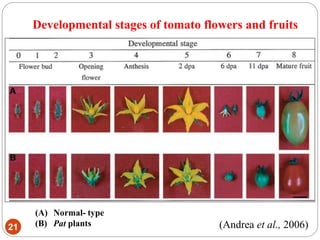
Developmental stages of tomato flowers and fruits
21
(A) Normal- type
(B) Pat plants (Andrea et al., 2006)
22
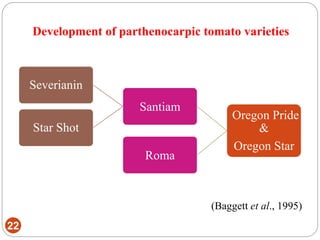
Oregon Pride
&
Oregon Star
Santiam
Severianin
Star Shot
Roma
(Baggett et al., 1995)
Development of parthenocarpic tomato varieties
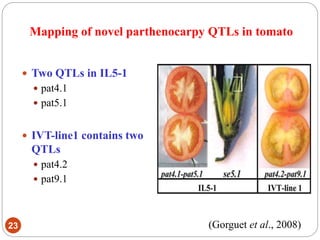
Mapping of novel parthenocarpy QTLs in tomato
23
 Two QTLs in IL5-1
 pat4.1
 pat5.1
 IVT-line1 contains two
QTLs
 pat4.2
 pat9.1
(Gorguet et al., 2008)
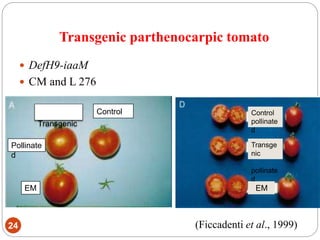
Transgenic parthenocarpic tomato
24
 DefH9-iaaM
 CM and L 276
(Ficcadenti et al., 1999)
Transgenic
Control
Pollinate
d
EM
Control
pollinate
d
Transge
nic
pollinate
d
EM
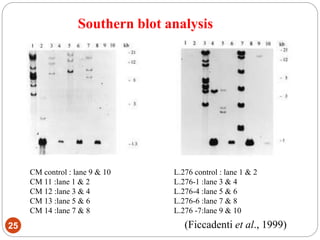
Southern blot analysis
25
CM control : lane 9 & 10
CM 11 :lane 1 & 2
CM 12 :lane 3 & 4
CM 13 :lane 5 & 6
CM 14 :lane 7 & 8
L.276 control : lane 1 & 2
L.276-1 :lane 3 & 4
L.276-4 :lane 5 & 6
L.276-6 :lane 7 & 8
L.276 -7:lane 9 & 10
(Ficcadenti et al., 1999)
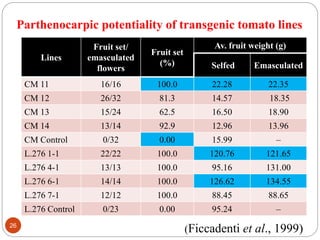
Parthenocarpic potentiality of transgenic tomato lines
26
Lines
Fruit set/
emasculated
flowers
Fruit set
(%)
Av. fruit weight (g)
Selfed Emasculated
CM 11 16/16 100.0 22.28 22.35
CM 12 26/32 81.3 14.57 18.35
CM 13 15/24 62.5 16.50 18.90
CM 14 13/14 92.9 12.96 13.96
CM Control 0/32 0.00 15.99 –
L.276 1-1 22/22 100.0 120.76 121.65
L.276 4-1 13/13 100.0 95.16 131.00
L.276 6-1 14/14 100.0 126.62 134.55
L.276 7-1 12/12 100.0 88.45 88.65
L.276 Control 0/23 0.00 95.24 –
(Ficcadenti et al., 1999)
27
Cucumber
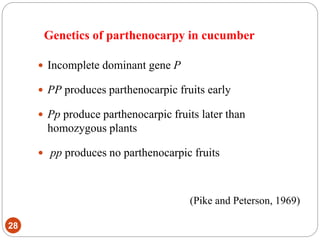
Genetics of parthenocarpy in cucumber
28
 Incomplete dominant gene P
 PP produces parthenocarpic fruits early
 Pp produce parthenocarpic fruits later than
homozygous plants
 pp produces no parthenocarpic fruits
(Pike and Peterson, 1969)
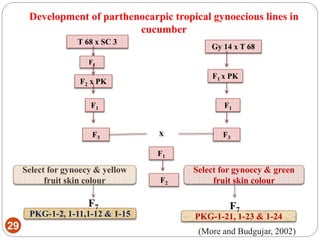
T 68 x SC 3
Gy 14 x T 68
F2 x PK
F1 x PK
F1
F1 F1
F3 F3
X
F1
F2
Select for gynoecy & green
fruit skin colour
Select for gynoecy & yellow
fruit skin colour
PKG-1-21, 1-23 & 1-24PKG-1-2, 1-11,1-12 & 1-15
F7 F7
Development of parthenocarpic tropical gynoecious lines in
cucumber
29 (More and Budgujar, 2002)
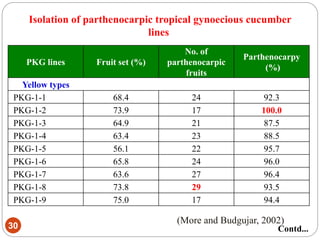
Isolation of parthenocarpic tropical gynoecious cucumber
lines
PKG lines Fruit set (%)
No. of
parthenocarpic
fruits
Parthenocarpy
(%)
Yellow types
PKG-1-1 68.4 24 92.3
PKG-1-2 73.9 17 100.0
PKG-1-3 64.9 21 87.5
PKG-1-4 63.4 23 88.5
PKG-1-5 56.1 22 95.7
PKG-1-6 65.8 24 96.0
PKG-1-7 63.6 27 96.4
PKG-1-8 73.8 29 93.5
PKG-1-9 75.0 17 94.4
(More and Budgujar, 2002)
30 Contd...
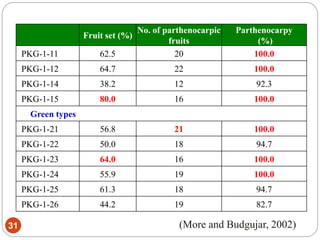
Fruit set (%)
No. of parthenocarpic
fruits
Parthenocarpy
(%)
PKG-1-11 62.5 20 100.0
PKG-1-12 64.7 22 100.0
PKG-1-14 38.2 12 92.3
PKG-1-15 80.0 16 100.0
Green types
PKG-1-21 56.8 21 100.0
PKG-1-22 50.0 18 94.7
PKG-1-23 64.0 16 100.0
PKG-1-24 55.9 19 100.0
PKG-1-25 61.3 18 94.7
PKG-1-26 44.2 19 82.7
(More and Budgujar, 2002)31
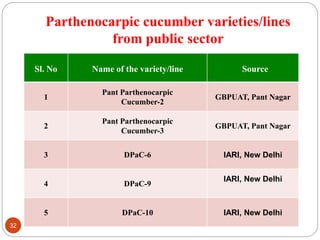
Parthenocarpic cucumber varieties/lines
from public sector
32
Sl. No Name of the variety/line Source
1
Pant Parthenocarpic
Cucumber-2
GBPUAT, Pant Nagar
2
Pant Parthenocarpic
Cucumber-3
GBPUAT, Pant Nagar
3 DPaC-6 IARI, New Delhi
4 DPaC-9
IARI, New Delhi
5 DPaC-10 IARI, New Delhi
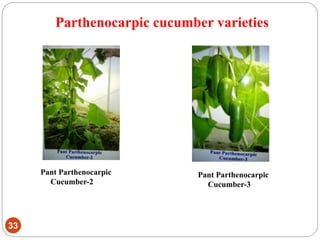
33
Pant Parthenocarpic
Cucumber-3
Parthenocarpic cucumber varieties
Pant Parthenocarpic
Cucumber-2
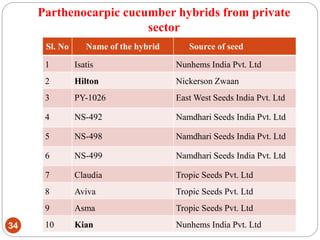
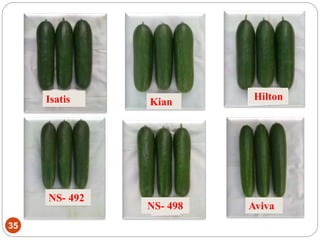
Parthenocarpic cucumber hybrids from private
sector
34
Sl. No Name of the hybrid Source of seed
1 Isatis Nunhems India Pvt. Ltd
2 Hilton Nickerson Zwaan
3 PY-1026 East West Seeds India Pvt. Ltd
4 NS-492 Namdhari Seeds India Pvt. Ltd
5 NS-498 Namdhari Seeds India Pvt. Ltd
6 NS-499 Namdhari Seeds India Pvt. Ltd
7 Claudia Tropic Seeds Pvt. Ltd
8 Aviva Tropic Seeds Pvt. Ltd
9 Asma Tropic Seeds Pvt. Ltd
10 Kian Nunhems India Pvt. Ltd
35
Isatis Kian
Hilton
NS- 492
NS- 498 Aviva
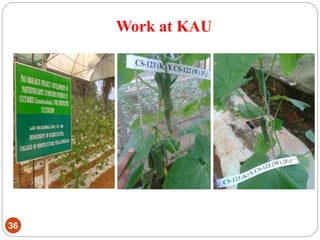
Work at KAU
36
Maintenance of parthenocarpic gynoecious
lines
37
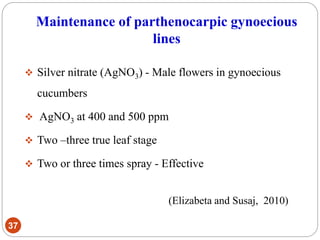
 Silver nitrate (AgNO3) - Male flowers in gynoecious
cucumbers
 AgNO3 at 400 and 500 ppm
 Two –three true leaf stage
 Two or three times spray - Effective
(Elizabeta and Susaj, 2010)
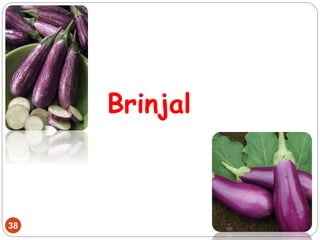
Brinjal
38
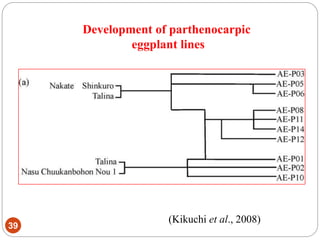
Development of parthenocarpic
eggplant lines
39
(Kikuchi et al., 2008)
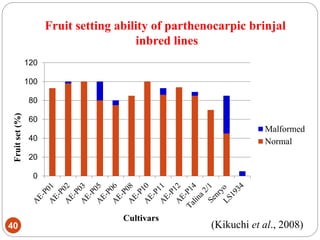
Fruit setting ability of parthenocarpic brinjal
inbred lines
40
0
20
40
60
80
100
120
Malformed
Normal
Fruitset(%)
Cultivars
(Kikuchi et al., 2008)
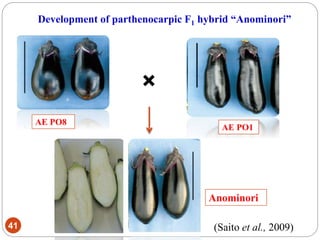
41
AE PO8
AE PO1
Anominori
Development of parthenocarpic F1 hybrid “Anominori”
×
(Saito et al., 2009)
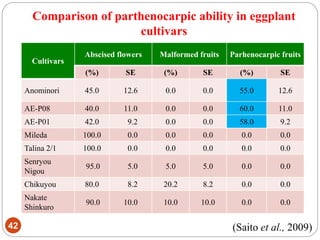
Comparison of parthenocarpic ability in eggplant
cultivars
42 (Saito et al., 2009)
Cultivars
Abscised flowers Malformed fruits Parhenocarpic fruits
(%) SE (%) SE (%) SE
Anominori 45.0 12.6 0.0 0.0 55.0 12.6
AE-P08 40.0 11.0 0.0 0.0 60.0 11.0
AE-P01 42.0 9.2 0.0 0.0 58.0 9.2
Mileda 100.0 0.0 0.0 0.0 0.0 0.0
Talina 2/1 100.0 0.0 0.0 0.0 0.0 0.0
Senryou
Nigou
95.0 5.0 5.0 5.0 0.0 0.0
Chikuyou 80.0 8.2 20.2 8.2 0.0 0.0
Nakate
Shinkuro
90.0 10.0 10.0 10.0 0.0 0.0
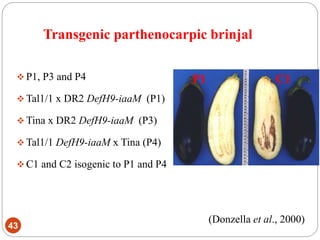
Transgenic parthenocarpic brinjal
43
 P1, P3 and P4
 Tal1/1 x DR2 DefH9-iaaM (P1)
 Tina x DR2 DefH9-iaaM (P3)
 Tal1/1 DefH9-iaaM x Tina (P4)
 C1 and C2 isogenic to P1 and P4
P1 C1
(Donzella et al., 2000)
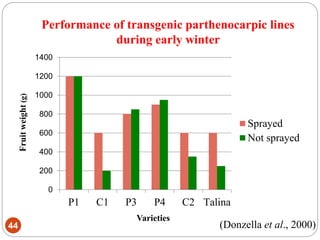
Performance of transgenic parthenocarpic lines
during early winter
44
0
200
400
600
800
1000
1200
1400
P1 C1 P3 P4 C2 Talina
Sprayed
Not sprayed
(Donzella et al., 2000)
Varieties
Fruitweight(g)
Capsicum
45
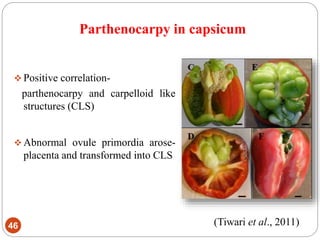
Parthenocarpy in capsicum
46
 Positive correlation-
parthenocarpy and carpelloid like
structures (CLS)
 Abnormal ovule primordia arose-
placenta and transformed into CLS
(Tiwari et al., 2011)
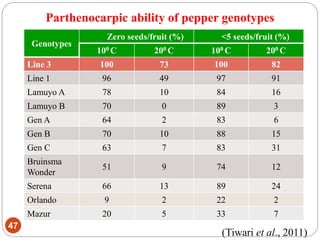
Parthenocarpic ability of pepper genotypes
47
Genotypes
Zero seeds/fruit (%) <5 seeds/fruit (%)
100 C 200 C 100 C 200 C
Line 3 100 73 100 82
Line 1 96 49 97 91
Lamuyo A 78 10 84 16
Lamuyo B 70 0 89 3
Gen A 64 2 83 6
Gen B 70 10 88 15
Gen C 63 7 83 31
Bruinsma
Wonder
51 9 74 12
Serena 66 13 89 24
Orlando 9 2 22 2
Mazur 20 5 33 7
(Tiwari et al., 2011)
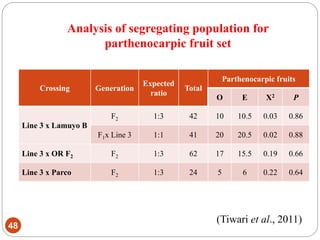
Analysis of segregating population for
parthenocarpic fruit set
48
Crossing Generation
Expected
ratio
Total
Parthenocarpic fruits
O E X2 P
Line 3 x Lamuyo B
F2 1:3 42 10 10.5 0.03 0.86
F1x Line 3 1:1 41 20 20.5 0.02 0.88
Line 3 x OR F2 F2 1:3 62 17 15.5 0.19 0.66
Line 3 x Parco F2 1:3 24 5 6 0.22 0.64
(Tiwari et al., 2011)
49
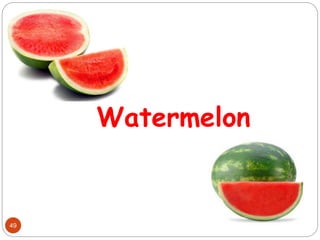
Watermelon
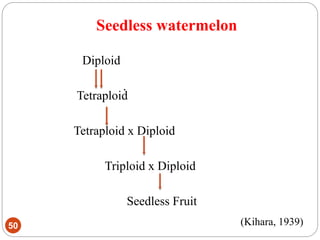
Seedless watermelon
50
Diploid
Tetraploid
Tetraploid x Diploid
Triploid x Diploid
Seedless Fruit
(Kihara, 1939)
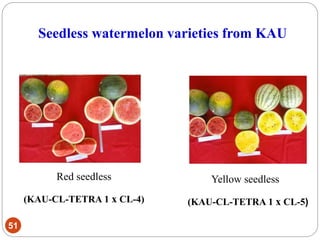
Seedless watermelon varieties from KAU
51
Yellow seedless
(KAU-CL-TETRA 1 x CL-5)
Red seedless
(KAU-CL-TETRA 1 x CL-4)
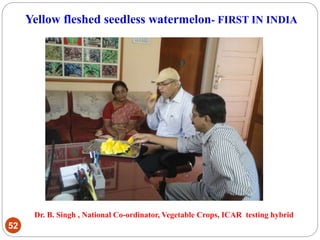
Yellow fleshed seedless watermelon- FIRST IN INDIA
52
Dr. B. Singh , National Co-ordinator, Vegetable Crops, ICAR testing hybrid
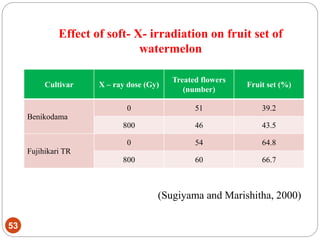
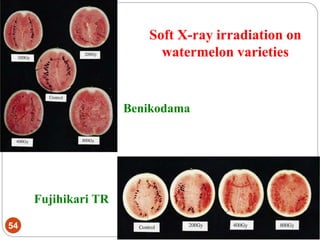
Effect of soft- X- irradiation on fruit set of
watermelon
53
Cultivar X – ray dose (Gy)
Treated flowers
(number)
Fruit set (%)
Benikodama
0 51 39.2
800 46 43.5
Fujihikari TR
0 54 64.8
800 60 66.7
(Sugiyama and Marishitha, 2000)
Fujihikari TR
Benikodama
54
Soft X-ray irradiation on
watermelon varieties
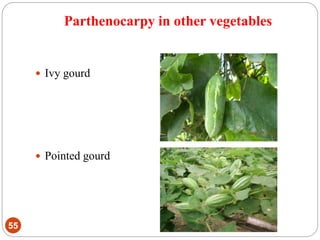
Parthenocarpy in other vegetables
55
 Ivy gourd
 Pointed gourd
Limitations
56
 Lack of stability and uniformity in the expression of
parthenocarpy
 Small sized fruits
 Presence of knots or malformed fruits
 Hampers the production of commercial seeds
Conclusion
57
Efficient tool to obtain stable yields under adverse
conditions
Seedlessness for processing industry
DefH9-iaaM gene might be used to improve yield
and quality of other vegetable crops
Future thrust
58
 High level and stable parthenocarpy
 Combining several parthenocarpy genes
 Developing parthenocarpy in high value crops
 Combining parthenocarpy with male sterility
59
THANK YOU
Parthenocarpy
Parthenocarpy

Parthenocarpy

  • 1.
  • 2.
  • 3.
    Arunkumar, B. 2013-12-118 Dept. ofOlericulture 3 Parthenocarpic vegetables- importance and approaches
  • 4.
    Outline 4  Parthenocarpy  Importance Mechanism of parthenocarpy  Different approaches  Tomato  Cucumber  Brinjal  Capsicum  Watermelon  Conclusion  Future thrust
  • 5.
    Parthenocarpy 5  Parthenos, virgin;karpos, fruit  Introduced - Noll, 1902  Natural or artificially induced fruit development without pollination and fertilization  Seedless (Gustafson, 1942)
  • 6.
    Parthenocarpy Stenospermocarpy (Varoquaux et al.,2002) 6 Fruit developmental phases
  • 7.
    Types of parthenocarpy 7 1.Genetic /natural parthenocarpy  Obligatory : no external influence Eg : Banana, pineapple and ivy gourd  Facultative : adverse conditions for pollination and fertilization Eg : Tomato, brinjal and cucumber (Gustafson, 1942) Contd…
  • 8.
    8 2. Artificially inducedparthenocarpy  Irradiated pollen  Synthetic auxin  Gibberellins (Gustafson, 1942)
  • 9.
    Importance of parthenocarpy invegetable crops 9  Increased production under adverse environment  Seedless fruits  Improved quality  Off season production  Protected cultivation  Reduced cost of cultivation (Varoquaux et al., 2002)
  • 10.
    Mechanism of parthenocarpy 10 (Gorguetet al., 2005) Pollination & fertilization Seed development Fruit development Active GA synthesis in ovules/seeds Active GA synthesis in fruit Auxin Auxin Contd...
  • 11.
    11 (Gorguet et al.,2005) Mechanism of parthenocarpy
  • 12.
    Approaches 12  Breeding approaches Conventional : Inter specific hybridization : Intra specific hybridization  Mutation  Polyploidy  External application of PGR  Transgenic approach (Varoquaux et al., 2002)
  • 13.
    PGR induced parthenocarpy 13 CropPGR Concentration Reference Brinjal 2,4-D 200 ppm Muthukrishnan and Srinivasan, 1980 Spine gourd NAA 100 ppm Singh, 1970 Sweet gourd NAA 100 ppm Vijay and Jalikep, 1980 Cucumber GA 100 ppm Choudury and Phatak, 1960
  • 14.
    Genetic engineering forparthenocarpy 14  Unbalanced embryo development and/or prevention of seed development  Affecting phytohormone content and/or activity in the desired organ (Rotino et al., 1997)
  • 15.
    DefH9- iaaM chimericgene 15  iaaM- auxin synthesising gene- Pseudomonas syringae pv. savastanoi  Indolacetamide monoxiginase  DefH9- ovule/placenta specific promoter- Antirrhinum majus  Tomato, eggplant and cucumber (Rotino et al., 1997)
  • 16.
  • 17.
    Tomato (Solanum lycopersicum) 17 Three sources - facultative parthenocarpy  Montfavet-191 (Pat-1)  Severianin (Pat-2)  RP75/59 (Pat-3/Pat-4) (Gorguet et al., 2005)
  • 18.
    Pat-1 18  Montfavet-191  Abnormalstamens  Higher ovary and pericarp growth  Female sterility  Defective pollen tube- placenta interaction  Low seed set (Gorguet et al., 2005)
  • 19.
    Pat-2 19  Single recessivegene  Genetic background of the recurrent parent is very important for vigour (Philouze et al.,1988)  Parthenocarpic plants have determinate growth habit (Lin et al., 1984)
  • 20.
    Pat-3/Pat-4 20  RP75/59 progenyof Atom x Budjekosoko  Seeded fruits suppress the size of seedless fruits  Digenic inheritance (Gorguet et al., 2005)
  • 21.
    Developmental stages oftomato flowers and fruits 21 (A) Normal- type (B) Pat plants (Andrea et al., 2006)
  • 22.
    22 Oregon Pride & Oregon Star Santiam Severianin StarShot Roma (Baggett et al., 1995) Development of parthenocarpic tomato varieties
  • 23.
    Mapping of novelparthenocarpy QTLs in tomato 23  Two QTLs in IL5-1  pat4.1  pat5.1  IVT-line1 contains two QTLs  pat4.2  pat9.1 (Gorguet et al., 2008)
  • 24.
    Transgenic parthenocarpic tomato 24 DefH9-iaaM  CM and L 276 (Ficcadenti et al., 1999) Transgenic Control Pollinate d EM Control pollinate d Transge nic pollinate d EM
  • 25.
    Southern blot analysis 25 CMcontrol : lane 9 & 10 CM 11 :lane 1 & 2 CM 12 :lane 3 & 4 CM 13 :lane 5 & 6 CM 14 :lane 7 & 8 L.276 control : lane 1 & 2 L.276-1 :lane 3 & 4 L.276-4 :lane 5 & 6 L.276-6 :lane 7 & 8 L.276 -7:lane 9 & 10 (Ficcadenti et al., 1999)
  • 26.
    Parthenocarpic potentiality oftransgenic tomato lines 26 Lines Fruit set/ emasculated flowers Fruit set (%) Av. fruit weight (g) Selfed Emasculated CM 11 16/16 100.0 22.28 22.35 CM 12 26/32 81.3 14.57 18.35 CM 13 15/24 62.5 16.50 18.90 CM 14 13/14 92.9 12.96 13.96 CM Control 0/32 0.00 15.99 – L.276 1-1 22/22 100.0 120.76 121.65 L.276 4-1 13/13 100.0 95.16 131.00 L.276 6-1 14/14 100.0 126.62 134.55 L.276 7-1 12/12 100.0 88.45 88.65 L.276 Control 0/23 0.00 95.24 – (Ficcadenti et al., 1999)
  • 27.
  • 28.
    Genetics of parthenocarpyin cucumber 28  Incomplete dominant gene P  PP produces parthenocarpic fruits early  Pp produce parthenocarpic fruits later than homozygous plants  pp produces no parthenocarpic fruits (Pike and Peterson, 1969)
  • 29.
    T 68 xSC 3 Gy 14 x T 68 F2 x PK F1 x PK F1 F1 F1 F3 F3 X F1 F2 Select for gynoecy & green fruit skin colour Select for gynoecy & yellow fruit skin colour PKG-1-21, 1-23 & 1-24PKG-1-2, 1-11,1-12 & 1-15 F7 F7 Development of parthenocarpic tropical gynoecious lines in cucumber 29 (More and Budgujar, 2002)
  • 30.
    Isolation of parthenocarpictropical gynoecious cucumber lines PKG lines Fruit set (%) No. of parthenocarpic fruits Parthenocarpy (%) Yellow types PKG-1-1 68.4 24 92.3 PKG-1-2 73.9 17 100.0 PKG-1-3 64.9 21 87.5 PKG-1-4 63.4 23 88.5 PKG-1-5 56.1 22 95.7 PKG-1-6 65.8 24 96.0 PKG-1-7 63.6 27 96.4 PKG-1-8 73.8 29 93.5 PKG-1-9 75.0 17 94.4 (More and Budgujar, 2002) 30 Contd...
  • 31.
    Fruit set (%) No.of parthenocarpic fruits Parthenocarpy (%) PKG-1-11 62.5 20 100.0 PKG-1-12 64.7 22 100.0 PKG-1-14 38.2 12 92.3 PKG-1-15 80.0 16 100.0 Green types PKG-1-21 56.8 21 100.0 PKG-1-22 50.0 18 94.7 PKG-1-23 64.0 16 100.0 PKG-1-24 55.9 19 100.0 PKG-1-25 61.3 18 94.7 PKG-1-26 44.2 19 82.7 (More and Budgujar, 2002)31
  • 32.
    Parthenocarpic cucumber varieties/lines frompublic sector 32 Sl. No Name of the variety/line Source 1 Pant Parthenocarpic Cucumber-2 GBPUAT, Pant Nagar 2 Pant Parthenocarpic Cucumber-3 GBPUAT, Pant Nagar 3 DPaC-6 IARI, New Delhi 4 DPaC-9 IARI, New Delhi 5 DPaC-10 IARI, New Delhi
  • 33.
    33 Pant Parthenocarpic Cucumber-3 Parthenocarpic cucumbervarieties Pant Parthenocarpic Cucumber-2
  • 34.
    Parthenocarpic cucumber hybridsfrom private sector 34 Sl. No Name of the hybrid Source of seed 1 Isatis Nunhems India Pvt. Ltd 2 Hilton Nickerson Zwaan 3 PY-1026 East West Seeds India Pvt. Ltd 4 NS-492 Namdhari Seeds India Pvt. Ltd 5 NS-498 Namdhari Seeds India Pvt. Ltd 6 NS-499 Namdhari Seeds India Pvt. Ltd 7 Claudia Tropic Seeds Pvt. Ltd 8 Aviva Tropic Seeds Pvt. Ltd 9 Asma Tropic Seeds Pvt. Ltd 10 Kian Nunhems India Pvt. Ltd
  • 35.
  • 36.
  • 37.
    Maintenance of parthenocarpicgynoecious lines 37  Silver nitrate (AgNO3) - Male flowers in gynoecious cucumbers  AgNO3 at 400 and 500 ppm  Two –three true leaf stage  Two or three times spray - Effective (Elizabeta and Susaj, 2010)
  • 38.
  • 39.
    Development of parthenocarpic eggplantlines 39 (Kikuchi et al., 2008)
  • 40.
    Fruit setting abilityof parthenocarpic brinjal inbred lines 40 0 20 40 60 80 100 120 Malformed Normal Fruitset(%) Cultivars (Kikuchi et al., 2008)
  • 41.
    41 AE PO8 AE PO1 Anominori Developmentof parthenocarpic F1 hybrid “Anominori” × (Saito et al., 2009)
  • 42.
    Comparison of parthenocarpicability in eggplant cultivars 42 (Saito et al., 2009) Cultivars Abscised flowers Malformed fruits Parhenocarpic fruits (%) SE (%) SE (%) SE Anominori 45.0 12.6 0.0 0.0 55.0 12.6 AE-P08 40.0 11.0 0.0 0.0 60.0 11.0 AE-P01 42.0 9.2 0.0 0.0 58.0 9.2 Mileda 100.0 0.0 0.0 0.0 0.0 0.0 Talina 2/1 100.0 0.0 0.0 0.0 0.0 0.0 Senryou Nigou 95.0 5.0 5.0 5.0 0.0 0.0 Chikuyou 80.0 8.2 20.2 8.2 0.0 0.0 Nakate Shinkuro 90.0 10.0 10.0 10.0 0.0 0.0
  • 43.
    Transgenic parthenocarpic brinjal 43 P1, P3 and P4  Tal1/1 x DR2 DefH9-iaaM (P1)  Tina x DR2 DefH9-iaaM (P3)  Tal1/1 DefH9-iaaM x Tina (P4)  C1 and C2 isogenic to P1 and P4 P1 C1 (Donzella et al., 2000)
  • 44.
    Performance of transgenicparthenocarpic lines during early winter 44 0 200 400 600 800 1000 1200 1400 P1 C1 P3 P4 C2 Talina Sprayed Not sprayed (Donzella et al., 2000) Varieties Fruitweight(g)
  • 45.
  • 46.
    Parthenocarpy in capsicum 46 Positive correlation- parthenocarpy and carpelloid like structures (CLS)  Abnormal ovule primordia arose- placenta and transformed into CLS (Tiwari et al., 2011)
  • 47.
    Parthenocarpic ability ofpepper genotypes 47 Genotypes Zero seeds/fruit (%) <5 seeds/fruit (%) 100 C 200 C 100 C 200 C Line 3 100 73 100 82 Line 1 96 49 97 91 Lamuyo A 78 10 84 16 Lamuyo B 70 0 89 3 Gen A 64 2 83 6 Gen B 70 10 88 15 Gen C 63 7 83 31 Bruinsma Wonder 51 9 74 12 Serena 66 13 89 24 Orlando 9 2 22 2 Mazur 20 5 33 7 (Tiwari et al., 2011)
  • 48.
    Analysis of segregatingpopulation for parthenocarpic fruit set 48 Crossing Generation Expected ratio Total Parthenocarpic fruits O E X2 P Line 3 x Lamuyo B F2 1:3 42 10 10.5 0.03 0.86 F1x Line 3 1:1 41 20 20.5 0.02 0.88 Line 3 x OR F2 F2 1:3 62 17 15.5 0.19 0.66 Line 3 x Parco F2 1:3 24 5 6 0.22 0.64 (Tiwari et al., 2011)
  • 49.
  • 50.
    Seedless watermelon 50 Diploid Tetraploid Tetraploid xDiploid Triploid x Diploid Seedless Fruit (Kihara, 1939)
  • 51.
    Seedless watermelon varietiesfrom KAU 51 Yellow seedless (KAU-CL-TETRA 1 x CL-5) Red seedless (KAU-CL-TETRA 1 x CL-4)
  • 52.
    Yellow fleshed seedlesswatermelon- FIRST IN INDIA 52 Dr. B. Singh , National Co-ordinator, Vegetable Crops, ICAR testing hybrid
  • 53.
    Effect of soft-X- irradiation on fruit set of watermelon 53 Cultivar X – ray dose (Gy) Treated flowers (number) Fruit set (%) Benikodama 0 51 39.2 800 46 43.5 Fujihikari TR 0 54 64.8 800 60 66.7 (Sugiyama and Marishitha, 2000)
  • 54.
    Fujihikari TR Benikodama 54 Soft X-rayirradiation on watermelon varieties
  • 55.
    Parthenocarpy in othervegetables 55  Ivy gourd  Pointed gourd
  • 56.
    Limitations 56  Lack ofstability and uniformity in the expression of parthenocarpy  Small sized fruits  Presence of knots or malformed fruits  Hampers the production of commercial seeds
  • 57.
    Conclusion 57 Efficient tool toobtain stable yields under adverse conditions Seedlessness for processing industry DefH9-iaaM gene might be used to improve yield and quality of other vegetable crops
  • 58.
    Future thrust 58  Highlevel and stable parthenocarpy  Combining several parthenocarpy genes  Developing parthenocarpy in high value crops  Combining parthenocarpy with male sterility
  • 59.

Editor's Notes