








BEAUTIFUL AND WONDERFUL BOTANY By An Admirer Of Nature
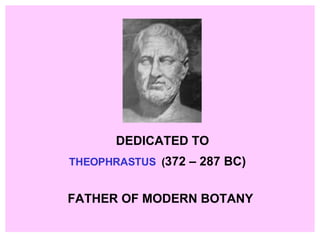
DEDICATED TO   THEOPHRASTUS   ( 372 – 287 BC)   FATHER OF MODERN BOTANY
ALSO   DEDICATED TO   Carl Linnaeus FATHER OF BINOMIAL NOMENCLATURE
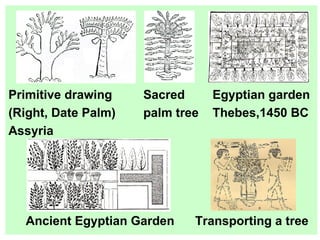
Primitive drawing  Sacred  Egyptian garden (Right, Date Palm)  palm tree  Thebes,1450 BC Assyria Ancient Egyptian Garden  Transporting a tree
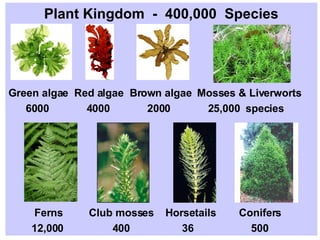
Plant Kingdom  -  400,000  Species Green algae  Red algae  Brown algae  Mosses & Liverworts 6000  4000  2000  25,000  species Ferns  Club mosses  Horsetails  Conifers 12,000  400  36  500
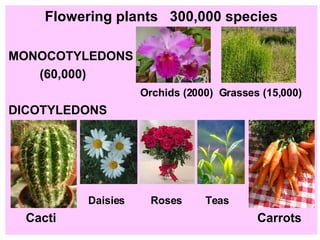
Flowering plants  300,000 species MONOCOTYLEDONS (60,000) Orchids (2000)  Grasses (15,000)   DICOTYLEDONS  Daisies  Roses  Teas  Cacti  Carrots
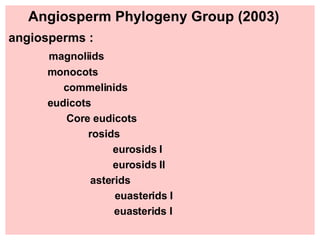
Angiosperm Phylogeny Group (2003) angiosperms :   magnoliids monocots   commelinids   eudicots   Core eudicots   rosids   eurosids I   eurosids II   asterids euasterids I euasterids I
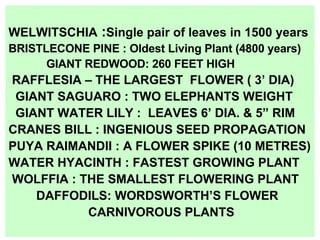
WELWITSCHIA  : Single pair of leaves in 1500 years   BRISTLECONE PINE : Oldest Living Plant (4800 years) GIANT REDWOOD: 260 FEET HIGH RAFFLESIA – THE LARGEST  FLOWER ( 3’ DIA) GIANT SAGUARO : TWO ELEPHANTS WEIGHT GIANT WATER LILY :  LEAVES 6’ DIA. & 5” RIM CRANES BILL : INGENIOUS SEED PROPAGATION PUYA RAIMANDII : A FLOWER SPIKE (10 METRES) WATER HYACINTH : FASTEST GROWING PLANT WOLFFIA : THE SMALLEST FLOWERING PLANT  DAFFODILS: WORDSWORTH’S FLOWER CARNIVOROUS PLANTS
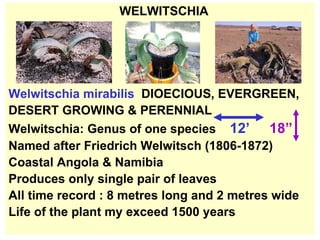
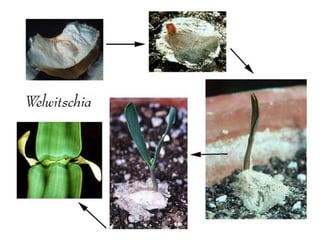
WELWITSCHIA Welwitschia mirabilis  DIOECIOUS, EVERGREEN, DESERT GROWING & PERENNIAL  Welwitschia: Genus of one species  12’  18” Named after Friedrich Welwitsch (1806-1872) Coastal Angola & Namibia Produces only single pair of leaves  All time record : 8 metres long and 2 metres wide  Life of the plant my exceed 1500 years
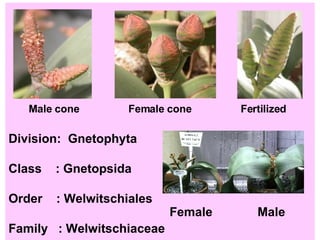
Male cone  Female cone  Fertilized  Division:  Gnetophyta Class  : Gnetopsida Order  : Welwitschiales   Female  Male Family  : Welwitschiaceae
 
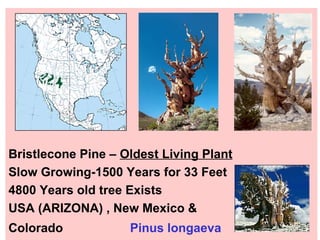
Bristlecone Pine –  Oldest Living Plant Slow Growing-1500 Years for 33 Feet 4800 Years old tree Exists  USA (ARIZONA) , New Mexico &  Colorado   Pinus longaeva
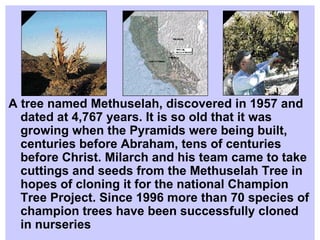
A tree named Methuselah, discovered in 1957 and dated at 4,767 years. It is so old that it was growing when the Pyramids were being built, centuries before Abraham, tens of centuries before Christ. Milarch and his team came to take cuttings and seeds from the Methuselah Tree in hopes of cloning it for the national Champion Tree Project. Since 1996 more than 70 species of champion trees have been successfully cloned in nurseries
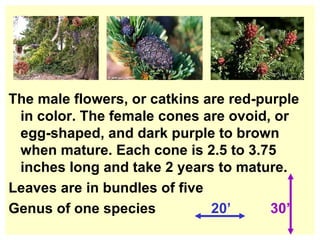
The male flowers, or catkins are red-purple in color. The female cones are ovoid, or egg-shaped, and dark purple to brown when mature. Each cone is 2.5 to 3.75 inches long and take 2 years to mature. Leaves are in bundles of five Genus of one species  20’   30’
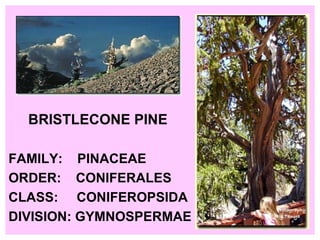
BRISTLECONE PINE FAMILY:  PINACEAE ORDER:  CONIFERALES CLASS:  CONIFEROPSIDA DIVISION: GYMNOSPERMAE
Survival strategies:  Needles can live twenty to thirty years and provide a stable photosynthetic capacity to sustain the tree over years of severe stress.  Another strategy for surviving is the gradual dieback of bark and the tissue that conducts water (xylem) when the tree is damaged because of fire, lightning, drought or damaging storms. This reduction of tissue that the crown has to supply with nutrients, balances the effect of any damage sustained. The surviving parts remain quite healthy. As an example, "Pine Alpha" at over 4000 years, is nearly four feet in diameter, yet has only a ten inch strip of living bark to support it.  Invasions from bacteria, fungus or insects that prey upon most plants are unknown to the bristlecone due to their dense, highly resinous wood. The dry air common in the sub-alpine region can kill by desiccation , but also helps preserve the trees from rotting
Bristlecones can remain standing for hundreds of years after death. They fall because the supporting roots finally decay or are undermined by erosion.  The oldest bristlecones live in the most exposed sites, with a considerable amount of space between each tree. The longevity of the bristlecone needles and the inability of other plants to grow in the dolomite soil make for little leaf litter or ground cover. This distance in between, combined with the lack of ground cover, is how a tree can sustain a lightning strike, catch fire, and not have the fire spread to surrounding trees.  Even the oldest trees have the ability to produce cones with viable seeds
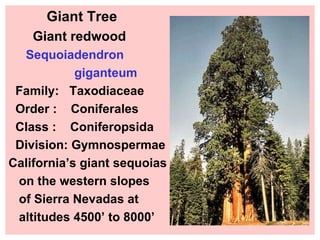
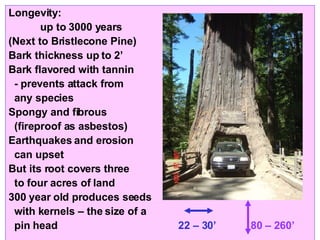
Giant Tree Giant redwood Sequoiadendron giganteum Family:  Taxodiaceae Order :  Coniferales Class :  Coniferopsida Division: Gymnospermae California’s giant sequoias on the western slopes of Sierra Nevadas at  altitudes 4500’ to 8000’
Longevity:  up to 3000 years (Next to Bristlecone Pine) Bark thickness up to 2’ Bark flavored with tannin - prevents attack from any species Spongy and fibrous (fireproof as asbestos) Earthquakes and erosion  can upset But its root covers three to four acres of land  300 year old produces seeds  with kernels – the size of a pin head  22 – 30’  80 – 260’
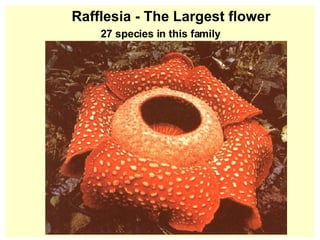
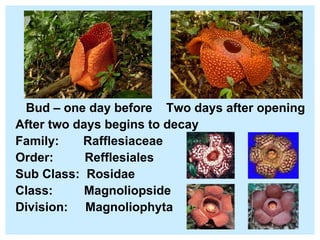
Rafflesia - The Largest flower  27 species in this family
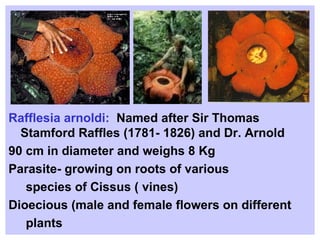
Rafflesia arnoldi:   Named after Sir Thomas Stamford Raffles (1781- 1826) and Dr. Arnold 90 cm in diameter and weighs 8 Kg Parasite- growing on roots of various  species of Cissus ( vines) Dioecious (male and female flowers on different plants
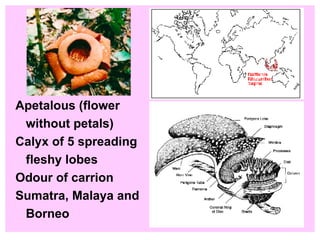
Apetalous (flower  without petals) Calyx of 5 spreading  fleshy lobes Odour of carrion Sumatra, Malaya and Borneo
Bud – one day before  Two days after opening After two days begins to decay  Family:  Rafflesiaceae  Order:  Refflesiales Sub Class:  Rosidae Class:  Magnoliopside Division:  Magnoliophyta
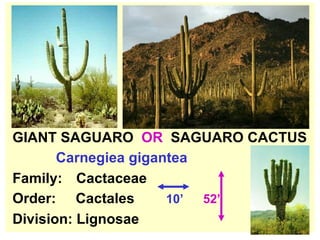
GIANT SAGUARO  OR   SAGUARO CACTUS Carnegiea gigantea   Family:   Cactaceae Order:  Cactales  10’   52’ Division: Lignosae
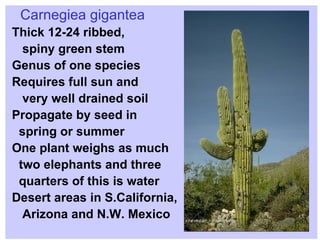
Carnegiea gigantea Thick 12-24 ribbed,  spiny green stem  Genus of one species Requires full sun and  very well drained soil Propagate by seed in spring or summer One plant weighs as much  two elephants and three quarters of this is water Desert areas in S.California, Arizona and N.W. Mexico
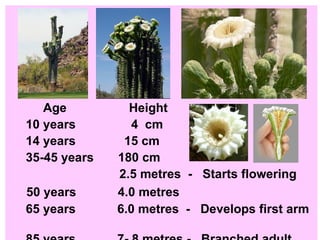
Age  Height  10 years  4  cm 14 years  15 cm 35-45 years  180 cm  2.5 metres  -  Starts flowering 50 years  4.0 metres 65 years  6.0 metres  -  Develops first arm  85 years  7- 8 metres -  Branched adult
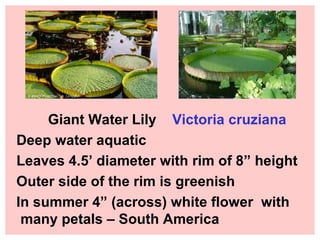
Giant Water Lily  Victoria cruziana Deep water aquatic  Leaves 4.5’ diameter with rim of 8” height Outer side of the rim is greenish In summer 4” (across) white flower  with many petals – South America
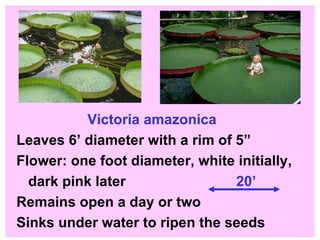
Victoria amazonica Leaves 6’ diameter with a rim of 5” Flower: one foot diameter, white initially,  dark pink later  20’ Remains open a day or two  Sinks under water to ripen the seeds
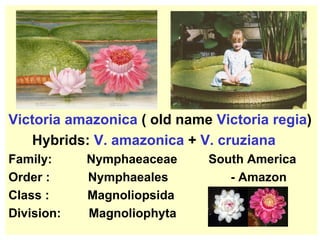
Victoria amazonica  ( old name  Victoria regia ) Hybrids:  V. amazonica  +  V. cruziana Family:  Nymphaeaceae  South America  Order :  Nymphaeales  - Amazon Class :  Magnoliopsida  Division:  Magnoliophyta
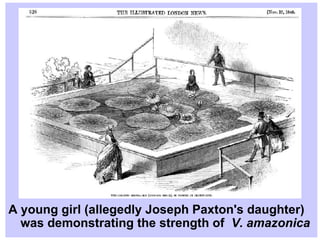
A young girl (allegedly Joseph Paxton's daughter) was demonstrating the strength of  V. amazonica
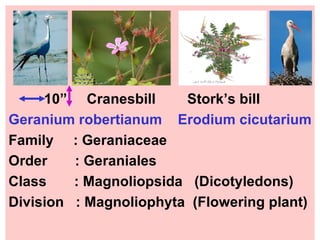
10”  Cranesbill  Stork’s bill Geranium robertianum  Erodium cicutarium Family  : Geraniaceae Order  : Geraniales Class  : Magnoliopsida  (Dicotyledons) Division  : Magnoliophyta  (Flowering plant)
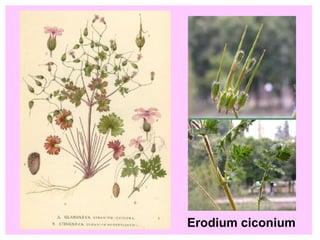
Erodium ciconium
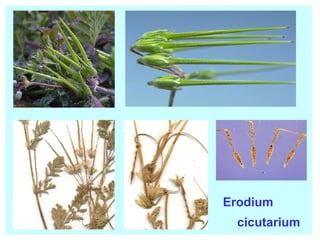
Erodium cicutarium
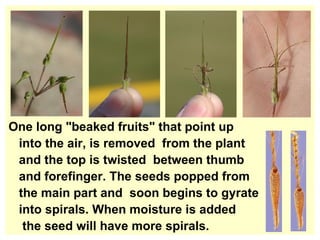
One long "beaked fruits" that point up into the air, is removed  from the plant  and the top is twisted  between thumb  and forefinger. The seeds popped from the main part and  soon begins to gyrate into spirals. When moisture is added the seed will have more spirals.
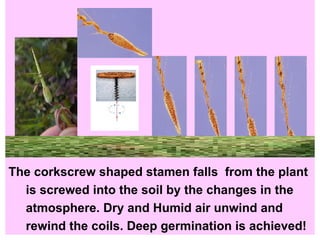
The corkscrew shaped stamen falls  from the plant is screwed into the soil by the changes in the  atmosphere. Dry and Humid air unwind and  rewind the coils. Deep germination is achieved!
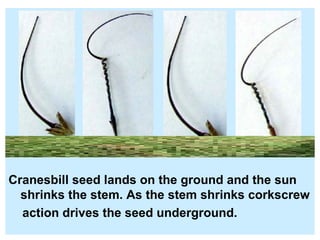
Cranesbill seed lands on the ground and the sun shrinks the stem. As the stem shrinks corkscrew action drives the seed underground.
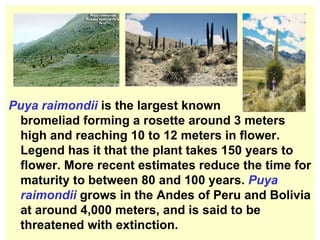
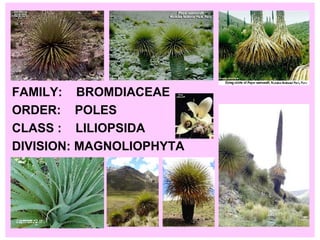
Puya raimondii  is the largest known bromeliad forming a rosette around 3 meters high and reaching 10 to 12 meters in flower.  Legend has it that the plant takes 150 years to flower. More recent estimates reduce the time for maturity to between 80 and 100 years.  Puya raimondii  grows in the Andes of Peru and Bolivia at around 4,000 meters, and is said to be threatened with extinction.
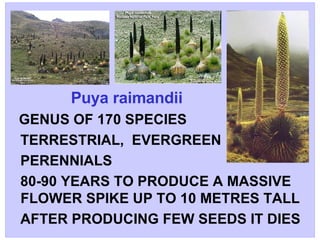
Puya raimandii GENUS OF 170 SPECIES TERRESTRIAL,  EVERGREEN PERENNIALS 80-90 YEARS TO PRODUCE A MASSIVE FLOWER SPIKE UP TO 10 METRES TALL  AFTER PRODUCING FEW SEEDS IT DIES
FAMILY:  BROMDIACEAE ORDER:  POLES CLASS :  LILIOPSIDA DIVISION: MAGNOLIOPHYTA
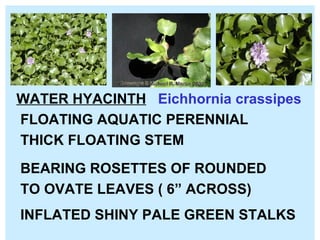
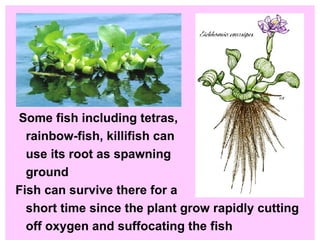
WATER HYACINTH   Eichhornia crassipes  FLOATING AQUATIC PERENNIAL THICK FLOATING STEM BEARING ROSETTES OF ROUNDED  TO OVATE LEAVES ( 6” ACROSS) INFLATED SHINY PALE GREEN STALKS
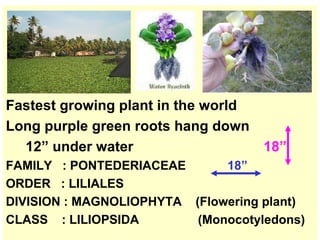
Fastest growing plant in the world   Long purple green roots hang down 12” under water  18” FAMILY  : PONTEDERIACEAE  18” ORDER  : LILIALES  DIVISION : MAGNOLIOPHYTA  (Flowering plant) CLASS  : LILIOPSIDA  (Monocotyledons)
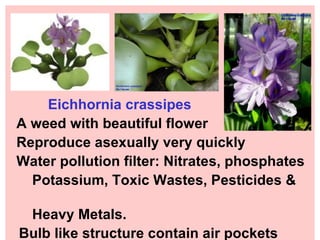
Eichhornia crassipes  A weed with beautiful flower  Reproduce asexually very quickly Water pollution filter: Nitrates, phosphates Potassium, Toxic Wastes, Pesticides &  Heavy Metals. Bulb like structure contain air pockets
Some fish including tetras, rainbow-fish, killifish can use its root as spawning  ground Fish can survive there for a short time since the plant grow rapidly cutting  off oxygen and suffocating the fish
Department of Boating and Waterways, California maintains a program of control of aquatic weeds in the Sacramento-San Joaquin Delta to keep the channels open for navigation and commerce. The weeds grew to choke Delta waterways in the 1980s, interfering with irrigation, agriculture, recreation, and business there.
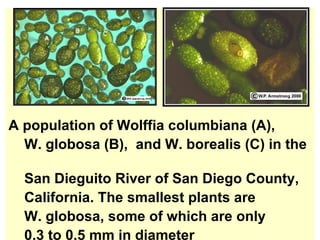
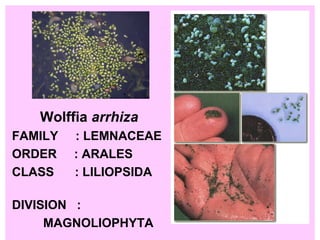
A population of Wolffia columbiana (A),  W. globosa (B),  and W. borealis (C) in the  San Dieguito River of San Diego County,  California. The smallest plants are W. globosa, some of which are only  0.3 to 0.5 mm in diameter
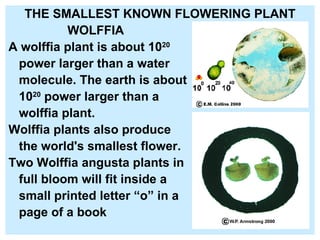
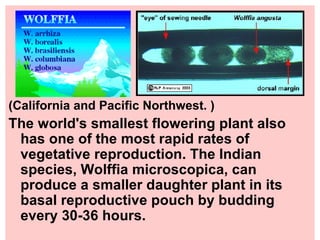
THE SMALLEST KNOWN FLOWERING PLANT WOLFFIA A wolffia plant is about 10 20   power larger than a water  molecule. The earth is about  10 20  power larger than a  wolffia plant. Wolffia plants also produce  the world's smallest flower.  Two Wolffia angusta plants in  full bloom will fit inside a  small printed letter “o” in a  page of a book
(California and Pacific Northwest. )   The world's smallest flowering plant also has one of the most rapid rates of vegetative reproduction. The Indian species, Wolffia microscopica, can produce a smaller daughter plant in its basal reproductive pouch by budding every 30-36 hours.
Wolffia  arrhiza FAMILY  : LEMNACEAE ORDER   :   ARALES   CLASS   : LILIOPSIDA   DIVISION  : MAGNOLIOPHYTA
The Daffodils  Williams Wordsworth I wandered lonely as a cloud That floats on high o'er vales and hills, When all at once I saw a crowd, A host of golden daffodils; Beside the lake, beneath the trees  Fluttering and dancing in the breeze.
Continuous as the stars that shine And twinkle on the milky way, They stretched in never - ending line Along the margin of a bay; Ten thousand saw I at a glance, Tossing their heads in sprightly dance.
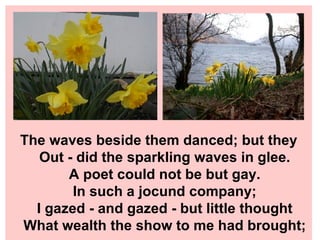
The waves beside them danced; but they Out - did the sparkling waves in glee. A poet could not be but gay. In such a jocund company; I gazed - and gazed - but little thought What wealth the show to me had brought;
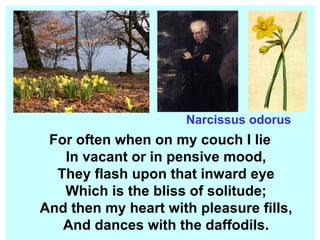
Narcissus odorus For often when on my couch I lie In vacant or in pensive mood, They flash upon that inward eye Which is the bliss of solitude; And then my heart with pleasure fills, And dances with the daffodils.
'Cockermouth - Wordsworth Memorial' This bronze bust of  the poet, unveiled on  7 April 1970, the  bicentenary of poet’s birth, by his great-great -grandson.  As part of the same  celebrations, 27000  daffodils were planted  on open spaces and  approaches to the town.
J.W. Waterhouse,1903  Caravaggio,1598   Salvador Dali,1936   ECHO and NARCISSUS  Tiresias foretells the fate of Narcissus  "He will live a long life if he never knows himself"  Beautiful, proud, aloof youth  Bernard Lepicie 1771 Rejects all lovers, incl. the nymph Echo, who wastes away  Falls in love with his own reflection  Dies of love for himself, turned into flower  Hence the term: "Narcissism "  Nicolas Poussin 1628
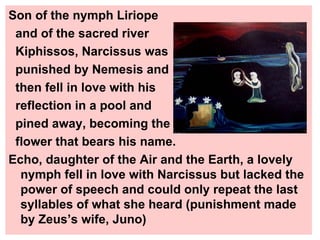
Son of the nymph Liriope  and of the sacred river  Kiphissos, Narcissus was  punished by Nemesis and then fell in love with his  reflection in a pool and  pined away, becoming the flower that bears his name. Echo, daughter of the Air and the Earth, a lovely nymph fell in love with Narcissus but lacked the power of speech and could only repeat the last syllables of what she heard (punishment made by Zeus’s wife, Juno)
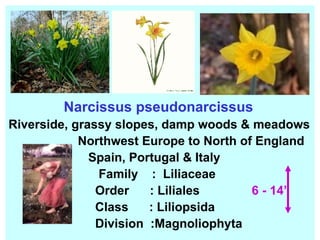
Narcissus pseudonarcissus Riverside, grassy slopes, damp woods & meadows Northwest Europe to North of England Spain, Portugal & Italy Family  :  Liliaceae Order  : Liliales  6 - 14” Class  : Liliopsida  Division  :Magnoliophyta
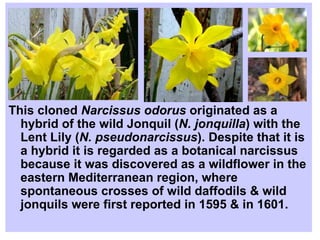
This cloned  Narcissus odorus  originated as a hybrid of the wild Jonquil ( N. jonquilla ) with the Lent Lily ( N. pseudonarcissus ). Despite that it is a hybrid it is regarded as a botanical narcissus because it was discovered as a wildflower in the eastern Mediterranean region, where spontaneous crosses of wild daffodils & wild jonquils were first reported in 1595 & in 1601.
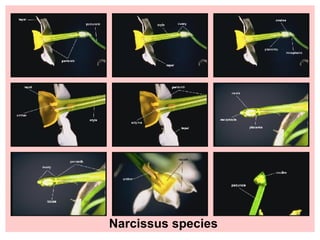
Narcissus species
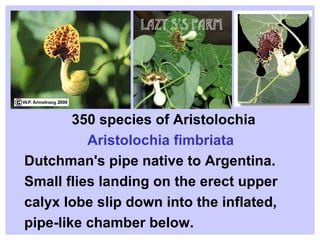
350 species of Aristolochia   Aristolochia fimbriata Dutchman's pipe native to Argentina.  Small flies landing on the erect upper  calyx lobe slip down into the inflated,  pipe-like chamber below.
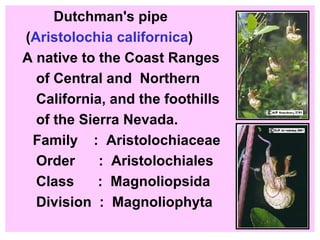
Dutchman's pipe   ( Aristolochia californica ) A native to the Coast Ranges of Central and  Northern  California, and the foothills  of the Sierra Nevada. Family  :  Aristolochiaceae Order  :  Aristolochiales Class  :  Magnoliopsida Division  :  Magnoliophyta
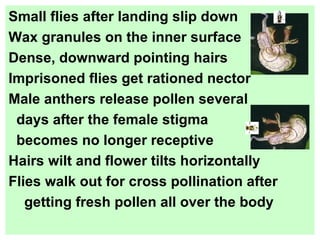
Small flies after landing slip down Wax granules on the inner surface Dense, downward pointing hairs Imprisoned flies get rationed nector Male anthers release pollen several  days after the female stigma  becomes no longer receptive  Hairs wilt and flower tilts horizontally Flies walk out for cross pollination after  getting fresh pollen all over the body
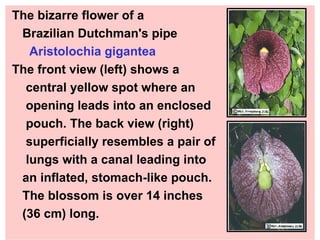
The bizarre flower of a  Brazilian Dutchman's pipe Aristolochia gigantea   The front view (left) shows a  central yellow spot where an  opening leads into an enclosed pouch. The back view (right)  superficially resembles a pair of lungs with a canal leading into  an inflated, stomach-like pouch.  The blossom is over 14 inches  (36 cm) long.
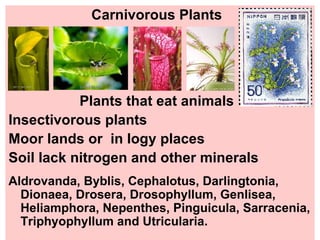
   Carnivorous Plants Plants that eat animals Insectivorous plants Moor lands or  in logy places Soil lack nitrogen and other minerals Aldrovanda, Byblis, Cephalotus, Darlingtonia, Dionaea, Drosera, Drosophyllum, Genlisea, Heliamphora, Nepenthes, Pinguicula, Sarracenia, Triphyophyllum and Utricularia.
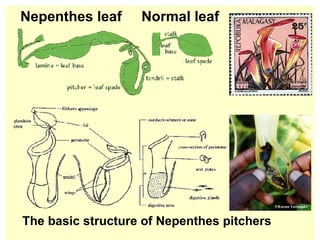
Nepenthes leaf  Normal leaf The basic structure of Nepenthes pitchers
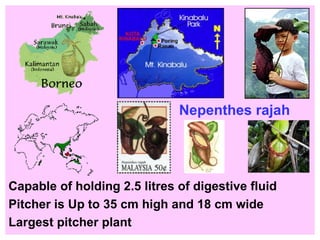
Nepenthes rajah Capable of holding 2.5 litres of digestive fluid Pitcher is Up to 35 cm high and 18 cm wide Largest pitcher plant
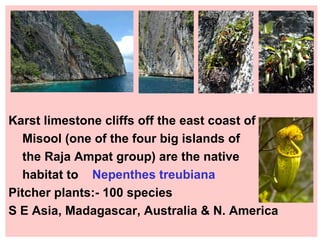
Karst limestone cliffs off the east coast of Misool (one of the four big islands of the Raja Ampat group) are the native  habitat to  Nepenthes treubiana Pitcher plants:- 100 species S E Asia, Madagascar, Australia & N. America
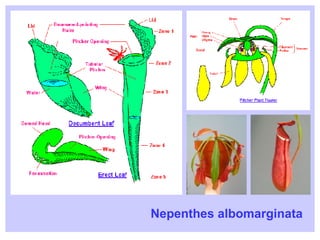
Nepenthes albomarginata
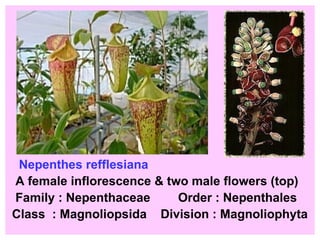
Nepenthes refflesiana A female inflorescence & two male flowers (top) Family : Nepenthaceae  Order : Nepenthales Class  : Magnoliopsida  Division : Magnoliophyta
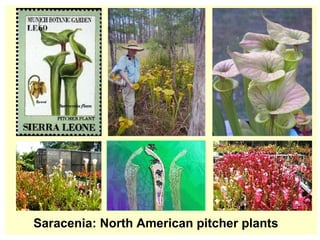
Saracenia: North American pitcher plants
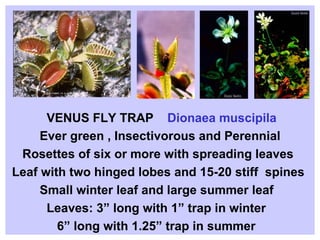
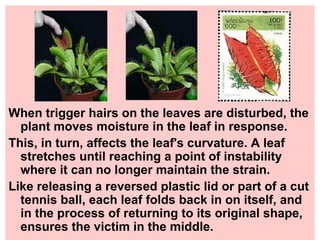
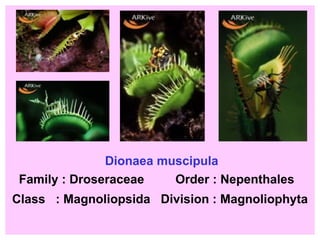
VENUS FLY TRAP  Dionaea muscipila  Ever green , Insectivorous and Perennial Rosettes of six or more with spreading leaves  Leaf with two hinged lobes and 15-20 stiff  spines Small winter leaf and large summer leaf Leaves: 3” long with 1” trap in winter 6” long with 1.25” trap in summer
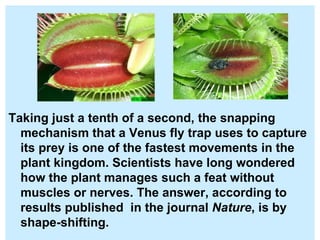
Taking just a tenth of a second, the snapping mechanism that a Venus fly trap uses to capture its prey is one of the fastest movements in the plant kingdom. Scientists have long wondered how the plant manages such a feat without muscles or nerves. The answer, according to results published  in the journal  Nature , is by shape-shifting.
When trigger hairs on the leaves are disturbed, the plant moves moisture in the leaf in response. This, in turn, affects the leaf's curvature. A leaf stretches until reaching a point of instability where it can no longer maintain the strain. Like releasing a reversed plastic lid or part of a cut tennis ball, each leaf folds back in on itself, and in the process of returning to its original shape, ensures the victim in the middle.
Dionaea muscipula Family : Droseraceae  Order : Nepenthales Class  : Magnoliopsida  Division : Magnoliophyta
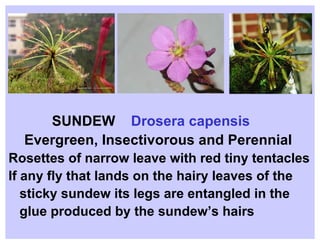
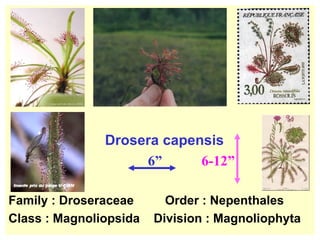
SUNDEW  Drosera capensis Evergreen, Insectivorous and Perennial Rosettes of narrow leave with red tiny tentacles If any fly that lands on the hairy leaves of the  sticky sundew its legs are entangled in the glue produced by the sundew’s hairs
Drosera capensis   6”  6-12” Family : Droseraceae  Order : Nepenthales Class : Magnoliopsida  Division : Magnoliophyta
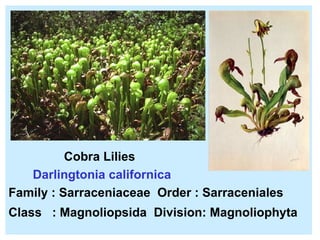
Cobra Lilies  Darlingtonia californica Family : Sarraceniaceae  Order : Sarraceniales Class  : Magnoliopsida   Division: Magnoliophyta
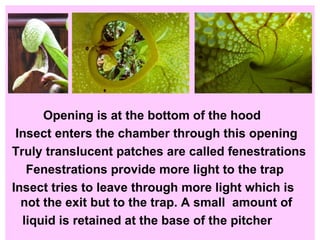
Opening is at the bottom of the hood Insect enters the chamber through this opening Truly translucent patches are called fenestrations  Fenestrations provide more light to the trap Insect tries to leave through more light which is not the exit but to the trap. A small   amount of  liquid is retained at the base of the pitcher
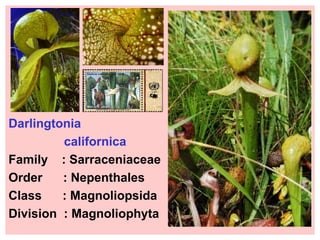
Darlingtonia californica Family  : Sarraceniaceae  Order  : Nepenthales Class  : Magnoliopsida  Division  : Magnoliophyta
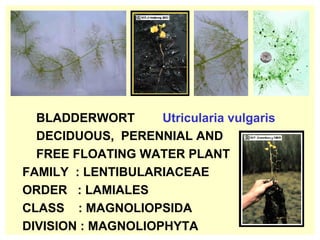
BLADDERWORT  Utricularia vulgaris DECIDUOUS,  PERENNIAL AND FREE FLOATING WATER PLANT FAMILY  : LENTIBULARIACEAE ORDER  : LAMIALES CLASS  : MAGNOLIOPSIDA  DIVISION : MAGNOLIOPHYTA
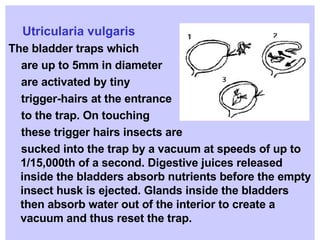
Utricularia vulgaris MINUTE BLADDERS, EACH 2 – 5 mm ACROSS EACH BLADDER HAS INSIDE OPENING LID  PARTIAL VACUUM INSIDE  INSECT ONCE ENTERED CANNOT ESCAPE  TINY GLANDS INSIDE THE BLADDER  ABSORB  THE INTERNAL WATER AND EXPEL IT ON THE OUTSIDE
Utricularia vulgaris The bladder traps which  are up to 5mm in diameter are activated by tiny  trigger-hairs at the entrance  to the trap. On touching  these trigger hairs insects are sucked into the trap by a vacuum at speeds of up to 1/15,000th of a second. Digestive juices released inside the bladders absorb nutrients before the empty insect husk is ejected. Glands inside the bladders then absorb water out of the interior to create a vacuum and thus reset the trap.
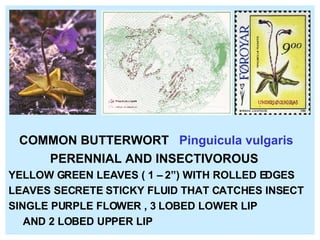
COMMON BUTTERWORT  Pinguicula vulgaris PERENNIAL AND INSECTIVOROUS YELLOW GREEN LEAVES ( 1 – 2”) WITH ROLLED EDGES LEAVES SECRETE STICKY FLUID THAT CATCHES INSECT SINGLE PURPLE FLOWER , 3 LOBED LOWER LIP  AND 2 LOBED UPPER LIP
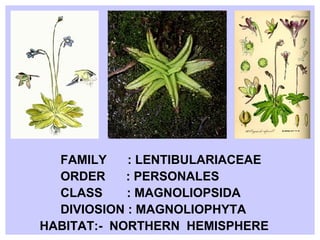
FAMILY  : LENTIBULARIACEAE ORDER  : PERSONALES CLASS  : MAGNOLIOPSIDA DIVIOSION : MAGNOLIOPHYTA HABITAT:-  NORTHERN  HEMISPHERE

Part 1 to 3: Beauty Botany

  • 1.
    BEAUTIFUL AND WONDERFULBOTANY By An Admirer Of Nature
  • 2.
    DEDICATED TO THEOPHRASTUS ( 372 – 287 BC) FATHER OF MODERN BOTANY
  • 3.
    ALSO DEDICATED TO Carl Linnaeus FATHER OF BINOMIAL NOMENCLATURE
  • 4.
    Primitive drawing Sacred Egyptian garden (Right, Date Palm) palm tree Thebes,1450 BC Assyria Ancient Egyptian Garden Transporting a tree
  • 5.
    Plant Kingdom - 400,000 Species Green algae Red algae Brown algae Mosses & Liverworts 6000 4000 2000 25,000 species Ferns Club mosses Horsetails Conifers 12,000 400 36 500
  • 6.
    Flowering plants 300,000 species MONOCOTYLEDONS (60,000) Orchids (2000) Grasses (15,000) DICOTYLEDONS Daisies Roses Teas Cacti Carrots
  • 7.
    Angiosperm Phylogeny Group(2003) angiosperms : magnoliids monocots commelinids eudicots Core eudicots rosids eurosids I eurosids II asterids euasterids I euasterids I
  • 8.
    WELWITSCHIA :Single pair of leaves in 1500 years BRISTLECONE PINE : Oldest Living Plant (4800 years) GIANT REDWOOD: 260 FEET HIGH RAFFLESIA – THE LARGEST FLOWER ( 3’ DIA) GIANT SAGUARO : TWO ELEPHANTS WEIGHT GIANT WATER LILY : LEAVES 6’ DIA. & 5” RIM CRANES BILL : INGENIOUS SEED PROPAGATION PUYA RAIMANDII : A FLOWER SPIKE (10 METRES) WATER HYACINTH : FASTEST GROWING PLANT WOLFFIA : THE SMALLEST FLOWERING PLANT DAFFODILS: WORDSWORTH’S FLOWER CARNIVOROUS PLANTS
  • 9.
    WELWITSCHIA Welwitschia mirabilis DIOECIOUS, EVERGREEN, DESERT GROWING & PERENNIAL Welwitschia: Genus of one species 12’ 18” Named after Friedrich Welwitsch (1806-1872) Coastal Angola & Namibia Produces only single pair of leaves All time record : 8 metres long and 2 metres wide Life of the plant my exceed 1500 years
  • 10.
    Male cone Female cone Fertilized Division: Gnetophyta Class : Gnetopsida Order : Welwitschiales Female Male Family : Welwitschiaceae
  • 11.
  • 12.
    Bristlecone Pine – Oldest Living Plant Slow Growing-1500 Years for 33 Feet 4800 Years old tree Exists USA (ARIZONA) , New Mexico & Colorado Pinus longaeva
  • 13.
    A tree namedMethuselah, discovered in 1957 and dated at 4,767 years. It is so old that it was growing when the Pyramids were being built, centuries before Abraham, tens of centuries before Christ. Milarch and his team came to take cuttings and seeds from the Methuselah Tree in hopes of cloning it for the national Champion Tree Project. Since 1996 more than 70 species of champion trees have been successfully cloned in nurseries
  • 14.
    The male flowers,or catkins are red-purple in color. The female cones are ovoid, or egg-shaped, and dark purple to brown when mature. Each cone is 2.5 to 3.75 inches long and take 2 years to mature. Leaves are in bundles of five Genus of one species 20’ 30’
  • 15.
    BRISTLECONE PINE FAMILY: PINACEAE ORDER: CONIFERALES CLASS: CONIFEROPSIDA DIVISION: GYMNOSPERMAE
  • 16.
    Survival strategies: Needles can live twenty to thirty years and provide a stable photosynthetic capacity to sustain the tree over years of severe stress. Another strategy for surviving is the gradual dieback of bark and the tissue that conducts water (xylem) when the tree is damaged because of fire, lightning, drought or damaging storms. This reduction of tissue that the crown has to supply with nutrients, balances the effect of any damage sustained. The surviving parts remain quite healthy. As an example, "Pine Alpha" at over 4000 years, is nearly four feet in diameter, yet has only a ten inch strip of living bark to support it. Invasions from bacteria, fungus or insects that prey upon most plants are unknown to the bristlecone due to their dense, highly resinous wood. The dry air common in the sub-alpine region can kill by desiccation , but also helps preserve the trees from rotting
  • 17.
    Bristlecones can remainstanding for hundreds of years after death. They fall because the supporting roots finally decay or are undermined by erosion. The oldest bristlecones live in the most exposed sites, with a considerable amount of space between each tree. The longevity of the bristlecone needles and the inability of other plants to grow in the dolomite soil make for little leaf litter or ground cover. This distance in between, combined with the lack of ground cover, is how a tree can sustain a lightning strike, catch fire, and not have the fire spread to surrounding trees. Even the oldest trees have the ability to produce cones with viable seeds
  • 18.
    Giant Tree Giantredwood Sequoiadendron giganteum Family: Taxodiaceae Order : Coniferales Class : Coniferopsida Division: Gymnospermae California’s giant sequoias on the western slopes of Sierra Nevadas at altitudes 4500’ to 8000’
  • 19.
    Longevity: upto 3000 years (Next to Bristlecone Pine) Bark thickness up to 2’ Bark flavored with tannin - prevents attack from any species Spongy and fibrous (fireproof as asbestos) Earthquakes and erosion can upset But its root covers three to four acres of land 300 year old produces seeds with kernels – the size of a pin head 22 – 30’ 80 – 260’
  • 20.
    Rafflesia - TheLargest flower 27 species in this family
  • 21.
    Rafflesia arnoldi: Named after Sir Thomas Stamford Raffles (1781- 1826) and Dr. Arnold 90 cm in diameter and weighs 8 Kg Parasite- growing on roots of various species of Cissus ( vines) Dioecious (male and female flowers on different plants
  • 22.
    Apetalous (flower without petals) Calyx of 5 spreading fleshy lobes Odour of carrion Sumatra, Malaya and Borneo
  • 23.
    Bud – oneday before Two days after opening After two days begins to decay Family: Rafflesiaceae Order: Refflesiales Sub Class: Rosidae Class: Magnoliopside Division: Magnoliophyta
  • 24.
    GIANT SAGUARO OR SAGUARO CACTUS Carnegiea gigantea Family: Cactaceae Order: Cactales 10’ 52’ Division: Lignosae
  • 25.
    Carnegiea gigantea Thick12-24 ribbed, spiny green stem Genus of one species Requires full sun and very well drained soil Propagate by seed in spring or summer One plant weighs as much two elephants and three quarters of this is water Desert areas in S.California, Arizona and N.W. Mexico
  • 26.
    Age Height 10 years 4 cm 14 years 15 cm 35-45 years 180 cm 2.5 metres - Starts flowering 50 years 4.0 metres 65 years 6.0 metres - Develops first arm 85 years 7- 8 metres - Branched adult
  • 27.
    Giant Water Lily Victoria cruziana Deep water aquatic Leaves 4.5’ diameter with rim of 8” height Outer side of the rim is greenish In summer 4” (across) white flower with many petals – South America
  • 28.
    Victoria amazonica Leaves6’ diameter with a rim of 5” Flower: one foot diameter, white initially, dark pink later 20’ Remains open a day or two Sinks under water to ripen the seeds
  • 29.
    Victoria amazonica ( old name Victoria regia ) Hybrids: V. amazonica + V. cruziana Family: Nymphaeaceae South America Order : Nymphaeales - Amazon Class : Magnoliopsida Division: Magnoliophyta
  • 30.
    A young girl(allegedly Joseph Paxton's daughter) was demonstrating the strength of V. amazonica
  • 31.
    10” Cranesbill Stork’s bill Geranium robertianum Erodium cicutarium Family : Geraniaceae Order : Geraniales Class : Magnoliopsida (Dicotyledons) Division : Magnoliophyta (Flowering plant)
  • 32.
  • 33.
  • 34.
    One long "beakedfruits" that point up into the air, is removed from the plant and the top is twisted between thumb and forefinger. The seeds popped from the main part and soon begins to gyrate into spirals. When moisture is added the seed will have more spirals.
  • 35.
    The corkscrew shapedstamen falls from the plant is screwed into the soil by the changes in the atmosphere. Dry and Humid air unwind and rewind the coils. Deep germination is achieved!
  • 36.
    Cranesbill seed landson the ground and the sun shrinks the stem. As the stem shrinks corkscrew action drives the seed underground.
  • 37.
    Puya raimondii is the largest known bromeliad forming a rosette around 3 meters high and reaching 10 to 12 meters in flower.  Legend has it that the plant takes 150 years to flower. More recent estimates reduce the time for maturity to between 80 and 100 years. Puya raimondii grows in the Andes of Peru and Bolivia at around 4,000 meters, and is said to be threatened with extinction.
  • 38.
    Puya raimandii GENUSOF 170 SPECIES TERRESTRIAL, EVERGREEN PERENNIALS 80-90 YEARS TO PRODUCE A MASSIVE FLOWER SPIKE UP TO 10 METRES TALL AFTER PRODUCING FEW SEEDS IT DIES
  • 39.
    FAMILY: BROMDIACEAEORDER: POLES CLASS : LILIOPSIDA DIVISION: MAGNOLIOPHYTA
  • 40.
    WATER HYACINTH Eichhornia crassipes FLOATING AQUATIC PERENNIAL THICK FLOATING STEM BEARING ROSETTES OF ROUNDED TO OVATE LEAVES ( 6” ACROSS) INFLATED SHINY PALE GREEN STALKS
  • 41.
    Fastest growing plantin the world Long purple green roots hang down 12” under water 18” FAMILY : PONTEDERIACEAE 18” ORDER : LILIALES DIVISION : MAGNOLIOPHYTA (Flowering plant) CLASS : LILIOPSIDA (Monocotyledons)
  • 42.
    Eichhornia crassipes A weed with beautiful flower Reproduce asexually very quickly Water pollution filter: Nitrates, phosphates Potassium, Toxic Wastes, Pesticides & Heavy Metals. Bulb like structure contain air pockets
  • 43.
    Some fish includingtetras, rainbow-fish, killifish can use its root as spawning ground Fish can survive there for a short time since the plant grow rapidly cutting off oxygen and suffocating the fish
  • 44.
    Department of Boatingand Waterways, California maintains a program of control of aquatic weeds in the Sacramento-San Joaquin Delta to keep the channels open for navigation and commerce. The weeds grew to choke Delta waterways in the 1980s, interfering with irrigation, agriculture, recreation, and business there.
  • 45.
    A population ofWolffia columbiana (A), W. globosa (B), and W. borealis (C) in the San Dieguito River of San Diego County, California. The smallest plants are W. globosa, some of which are only 0.3 to 0.5 mm in diameter
  • 46.
    THE SMALLEST KNOWNFLOWERING PLANT WOLFFIA A wolffia plant is about 10 20 power larger than a water molecule. The earth is about 10 20 power larger than a wolffia plant. Wolffia plants also produce the world's smallest flower. Two Wolffia angusta plants in full bloom will fit inside a small printed letter “o” in a page of a book
  • 47.
    (California and PacificNorthwest. ) The world's smallest flowering plant also has one of the most rapid rates of vegetative reproduction. The Indian species, Wolffia microscopica, can produce a smaller daughter plant in its basal reproductive pouch by budding every 30-36 hours.
  • 48.
    Wolffia arrhizaFAMILY : LEMNACEAE ORDER : ARALES CLASS : LILIOPSIDA DIVISION : MAGNOLIOPHYTA
  • 49.
    The Daffodils Williams Wordsworth I wandered lonely as a cloud That floats on high o'er vales and hills, When all at once I saw a crowd, A host of golden daffodils; Beside the lake, beneath the trees Fluttering and dancing in the breeze.
  • 50.
    Continuous as thestars that shine And twinkle on the milky way, They stretched in never - ending line Along the margin of a bay; Ten thousand saw I at a glance, Tossing their heads in sprightly dance.
  • 51.
    The waves besidethem danced; but they Out - did the sparkling waves in glee. A poet could not be but gay. In such a jocund company; I gazed - and gazed - but little thought What wealth the show to me had brought;
  • 52.
    Narcissus odorus Foroften when on my couch I lie In vacant or in pensive mood, They flash upon that inward eye Which is the bliss of solitude; And then my heart with pleasure fills, And dances with the daffodils.
  • 53.
    'Cockermouth - WordsworthMemorial' This bronze bust of the poet, unveiled on 7 April 1970, the bicentenary of poet’s birth, by his great-great -grandson. As part of the same celebrations, 27000 daffodils were planted on open spaces and approaches to the town.
  • 54.
    J.W. Waterhouse,1903 Caravaggio,1598 Salvador Dali,1936 ECHO and NARCISSUS Tiresias foretells the fate of Narcissus "He will live a long life if he never knows himself" Beautiful, proud, aloof youth Bernard Lepicie 1771 Rejects all lovers, incl. the nymph Echo, who wastes away Falls in love with his own reflection Dies of love for himself, turned into flower Hence the term: "Narcissism " Nicolas Poussin 1628
  • 55.
    Son of thenymph Liriope and of the sacred river Kiphissos, Narcissus was punished by Nemesis and then fell in love with his reflection in a pool and pined away, becoming the flower that bears his name. Echo, daughter of the Air and the Earth, a lovely nymph fell in love with Narcissus but lacked the power of speech and could only repeat the last syllables of what she heard (punishment made by Zeus’s wife, Juno)
  • 56.
    Narcissus pseudonarcissus Riverside,grassy slopes, damp woods & meadows Northwest Europe to North of England Spain, Portugal & Italy Family : Liliaceae Order : Liliales 6 - 14” Class : Liliopsida Division :Magnoliophyta
  • 57.
    This cloned Narcissus odorus originated as a hybrid of the wild Jonquil ( N. jonquilla ) with the Lent Lily ( N. pseudonarcissus ). Despite that it is a hybrid it is regarded as a botanical narcissus because it was discovered as a wildflower in the eastern Mediterranean region, where spontaneous crosses of wild daffodils & wild jonquils were first reported in 1595 & in 1601.
  • 58.
  • 59.
    350 species ofAristolochia Aristolochia fimbriata Dutchman's pipe native to Argentina. Small flies landing on the erect upper calyx lobe slip down into the inflated, pipe-like chamber below.
  • 60.
    Dutchman's pipe ( Aristolochia californica ) A native to the Coast Ranges of Central and Northern California, and the foothills of the Sierra Nevada. Family : Aristolochiaceae Order : Aristolochiales Class : Magnoliopsida Division : Magnoliophyta
  • 61.
    Small flies afterlanding slip down Wax granules on the inner surface Dense, downward pointing hairs Imprisoned flies get rationed nector Male anthers release pollen several days after the female stigma becomes no longer receptive Hairs wilt and flower tilts horizontally Flies walk out for cross pollination after getting fresh pollen all over the body
  • 62.
    The bizarre flowerof a Brazilian Dutchman's pipe Aristolochia gigantea The front view (left) shows a central yellow spot where an opening leads into an enclosed pouch. The back view (right) superficially resembles a pair of lungs with a canal leading into an inflated, stomach-like pouch. The blossom is over 14 inches (36 cm) long.
  • 63.
      CarnivorousPlants Plants that eat animals Insectivorous plants Moor lands or in logy places Soil lack nitrogen and other minerals Aldrovanda, Byblis, Cephalotus, Darlingtonia, Dionaea, Drosera, Drosophyllum, Genlisea, Heliamphora, Nepenthes, Pinguicula, Sarracenia, Triphyophyllum and Utricularia.
  • 64.
    Nepenthes leaf Normal leaf The basic structure of Nepenthes pitchers
  • 65.
    Nepenthes rajah Capableof holding 2.5 litres of digestive fluid Pitcher is Up to 35 cm high and 18 cm wide Largest pitcher plant
  • 66.
    Karst limestone cliffsoff the east coast of Misool (one of the four big islands of the Raja Ampat group) are the native habitat to Nepenthes treubiana Pitcher plants:- 100 species S E Asia, Madagascar, Australia & N. America
  • 67.
  • 68.
    Nepenthes refflesiana Afemale inflorescence & two male flowers (top) Family : Nepenthaceae Order : Nepenthales Class : Magnoliopsida Division : Magnoliophyta
  • 69.
  • 70.
    VENUS FLY TRAP Dionaea muscipila Ever green , Insectivorous and Perennial Rosettes of six or more with spreading leaves Leaf with two hinged lobes and 15-20 stiff spines Small winter leaf and large summer leaf Leaves: 3” long with 1” trap in winter 6” long with 1.25” trap in summer
  • 71.
    Taking just atenth of a second, the snapping mechanism that a Venus fly trap uses to capture its prey is one of the fastest movements in the plant kingdom. Scientists have long wondered how the plant manages such a feat without muscles or nerves. The answer, according to results published in the journal Nature , is by shape-shifting.
  • 72.
    When trigger hairson the leaves are disturbed, the plant moves moisture in the leaf in response. This, in turn, affects the leaf's curvature. A leaf stretches until reaching a point of instability where it can no longer maintain the strain. Like releasing a reversed plastic lid or part of a cut tennis ball, each leaf folds back in on itself, and in the process of returning to its original shape, ensures the victim in the middle.
  • 73.
    Dionaea muscipula Family: Droseraceae Order : Nepenthales Class : Magnoliopsida Division : Magnoliophyta
  • 74.
    SUNDEW Droseracapensis Evergreen, Insectivorous and Perennial Rosettes of narrow leave with red tiny tentacles If any fly that lands on the hairy leaves of the sticky sundew its legs are entangled in the glue produced by the sundew’s hairs
  • 75.
    Drosera capensis 6” 6-12” Family : Droseraceae Order : Nepenthales Class : Magnoliopsida Division : Magnoliophyta
  • 76.
    Cobra Lilies Darlingtonia californica Family : Sarraceniaceae Order : Sarraceniales Class : Magnoliopsida Division: Magnoliophyta
  • 77.
    Opening is atthe bottom of the hood Insect enters the chamber through this opening Truly translucent patches are called fenestrations Fenestrations provide more light to the trap Insect tries to leave through more light which is not the exit but to the trap. A small amount of liquid is retained at the base of the pitcher
  • 78.
    Darlingtonia californica Family : Sarraceniaceae Order : Nepenthales Class : Magnoliopsida Division : Magnoliophyta
  • 79.
    BLADDERWORT Utriculariavulgaris DECIDUOUS, PERENNIAL AND FREE FLOATING WATER PLANT FAMILY : LENTIBULARIACEAE ORDER : LAMIALES CLASS : MAGNOLIOPSIDA DIVISION : MAGNOLIOPHYTA
  • 80.
    Utricularia vulgaris MINUTEBLADDERS, EACH 2 – 5 mm ACROSS EACH BLADDER HAS INSIDE OPENING LID PARTIAL VACUUM INSIDE INSECT ONCE ENTERED CANNOT ESCAPE TINY GLANDS INSIDE THE BLADDER ABSORB THE INTERNAL WATER AND EXPEL IT ON THE OUTSIDE
  • 81.
    Utricularia vulgaris Thebladder traps which are up to 5mm in diameter are activated by tiny trigger-hairs at the entrance to the trap. On touching these trigger hairs insects are sucked into the trap by a vacuum at speeds of up to 1/15,000th of a second. Digestive juices released inside the bladders absorb nutrients before the empty insect husk is ejected. Glands inside the bladders then absorb water out of the interior to create a vacuum and thus reset the trap.
  • 82.
    COMMON BUTTERWORT Pinguicula vulgaris PERENNIAL AND INSECTIVOROUS YELLOW GREEN LEAVES ( 1 – 2”) WITH ROLLED EDGES LEAVES SECRETE STICKY FLUID THAT CATCHES INSECT SINGLE PURPLE FLOWER , 3 LOBED LOWER LIP AND 2 LOBED UPPER LIP
  • 83.
    FAMILY :LENTIBULARIACEAE ORDER : PERSONALES CLASS : MAGNOLIOPSIDA DIVIOSION : MAGNOLIOPHYTA HABITAT:- NORTHERN HEMISPHERE