Basal ganglia in striatum: Controls movements, balance, & coordination 
Death of cells in Basal ganglia: Uncontrolled movements, loss of smooth 
muscle control 
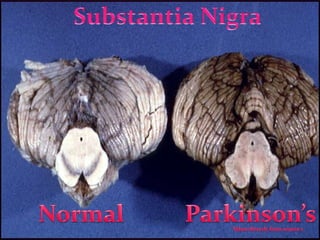
Substantia nigra of brain holds neurons that produce dopamine: 
Communication to perform controlled movements & coordination 
Dopamine degenerating neurons: Loss of dopamine - Communication 
interrupted, irregular and impaired movements 
Is not known as to how dopamine degenerates/decreases 
Norepinephrine: Chemical neurotransmitter related to dopamine-Controls 
automatic functions of body (Ex: heart rate, temp, blood pressure) 
Norepinephrine loss: Fatique, irregular GI tract, postural hypotentsion 
(loss of balance, sudden drop in blood pressure due to standing up) 
Neurotransmitter Dopamine Deficiency: Causes inflammatory changes 
with in basal ganglia - Tremors, slouched posture, masklike facial 
expressions, rhythmic movements
 Neurologist: Specializes in movement/impaired disorders of brain – Balance, 
control, cognitive techniques, and motor/sensory functions 
Initial Physician Exam: Assess symptoms (muscle control, eye movement 
abnormalities, tremor, speech impairment) & compile records/tests for 
diagnosing disease- Carbidopa – levodopa medication may be prescribed 
 Clinical Exam: No single diagnostic test for disease 
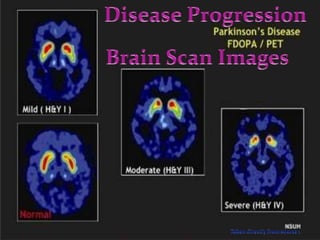
Neuroimaging: Neurological imaging/exam to determine affected nerve cells 
& Progression 
Positron-emission tomography (PET) scan: Levoda radioactive 
scan/imaging-Drug injection enhancing dopamine into brain; highlights loss of 
dopamine cells 
Single photon emission computed tomography(SPECT):Imaging 
measuring metabolic & physiological functions to dopamine cells; measure 
progressive loss of neurons
Progressive disease: 
Life expectancy: Depends on symptoms of disease & initial treatment administered 
Medications 
Levodopa: 
Anticolinergics: 
Brain Surgery 
Deep Brain Stimulation: 
Rehab Therapy 
Speech-Occupational-Physical: 
Alternative Therapy 
Essential oils, herbs, massage, acupuncture: 
Exercise:
 Body weight/diet breakthrough: Eating habits and 
weight change both contribute to progression of 
Parkinson’s patients – Deep brain stimulation in 
Parkinson’s patients was contributing to weight gain 
 Consequently, the weight gain provided increased 
ability in pleasure, regaining cognitive functions, as 
well as increase in smell & taste.
1. www.nihseniorhealth.gov/parkinsonsdisease/symptomsanddiagnosis.01.html 
2. www.emedicine.medscape.com/article/1831191-overview 
3. www.medicalnewstoday.com/releases/285888.php 
4. www.ncbinlm.nih.gov/pubmedhealth/PMH0001762 
5. www.merckmanuals.com/professional/neuroligic_disorders 
6. www.ncbi.nlm.nih.gov/pmc/articles/PMC2528272 
7. www.emedicine.medscape.com/article/1831191-overview 
8. www.mayoclinic.org/disease-conditions/parkinsons-disease/symptoms 
9. http://www.mayoclinic.org/diseases-conditions/parkinsons-disease/ 
basics/causes/con-20028488 
10. www.ncbi.nlm.nih.gov/pubmedhealth/PMH0003683/ 
11. www.ncbi.nlm.nih.gov/pubmed/11948753

Parkinson powerpoint 2 new

  • 2.
    Basal ganglia instriatum: Controls movements, balance, & coordination Death of cells in Basal ganglia: Uncontrolled movements, loss of smooth muscle control Substantia nigra of brain holds neurons that produce dopamine: Communication to perform controlled movements & coordination Dopamine degenerating neurons: Loss of dopamine - Communication interrupted, irregular and impaired movements Is not known as to how dopamine degenerates/decreases Norepinephrine: Chemical neurotransmitter related to dopamine-Controls automatic functions of body (Ex: heart rate, temp, blood pressure) Norepinephrine loss: Fatique, irregular GI tract, postural hypotentsion (loss of balance, sudden drop in blood pressure due to standing up) Neurotransmitter Dopamine Deficiency: Causes inflammatory changes with in basal ganglia - Tremors, slouched posture, masklike facial expressions, rhythmic movements
  • 5.
     Neurologist: Specializesin movement/impaired disorders of brain – Balance, control, cognitive techniques, and motor/sensory functions Initial Physician Exam: Assess symptoms (muscle control, eye movement abnormalities, tremor, speech impairment) & compile records/tests for diagnosing disease- Carbidopa – levodopa medication may be prescribed  Clinical Exam: No single diagnostic test for disease Neuroimaging: Neurological imaging/exam to determine affected nerve cells & Progression Positron-emission tomography (PET) scan: Levoda radioactive scan/imaging-Drug injection enhancing dopamine into brain; highlights loss of dopamine cells Single photon emission computed tomography(SPECT):Imaging measuring metabolic & physiological functions to dopamine cells; measure progressive loss of neurons
  • 7.
    Progressive disease: Lifeexpectancy: Depends on symptoms of disease & initial treatment administered Medications Levodopa: Anticolinergics: Brain Surgery Deep Brain Stimulation: Rehab Therapy Speech-Occupational-Physical: Alternative Therapy Essential oils, herbs, massage, acupuncture: Exercise:
  • 8.
     Body weight/dietbreakthrough: Eating habits and weight change both contribute to progression of Parkinson’s patients – Deep brain stimulation in Parkinson’s patients was contributing to weight gain  Consequently, the weight gain provided increased ability in pleasure, regaining cognitive functions, as well as increase in smell & taste.
  • 11.
    1. www.nihseniorhealth.gov/parkinsonsdisease/symptomsanddiagnosis.01.html 2.www.emedicine.medscape.com/article/1831191-overview 3. www.medicalnewstoday.com/releases/285888.php 4. www.ncbinlm.nih.gov/pubmedhealth/PMH0001762 5. www.merckmanuals.com/professional/neuroligic_disorders 6. www.ncbi.nlm.nih.gov/pmc/articles/PMC2528272 7. www.emedicine.medscape.com/article/1831191-overview 8. www.mayoclinic.org/disease-conditions/parkinsons-disease/symptoms 9. http://www.mayoclinic.org/diseases-conditions/parkinsons-disease/ basics/causes/con-20028488 10. www.ncbi.nlm.nih.gov/pubmedhealth/PMH0003683/ 11. www.ncbi.nlm.nih.gov/pubmed/11948753