Welcome to our collection of speaking games! They are specially made
for online classes, but also work for socially distanced or in-person
classes generally.
Teacher Instructions
Use the menu to navigate, or pick a game with the random game
generator. The instructions for each game are on each slide.
The games start easy (A1 level) and get more difficult (B2 level
and above).
Game List
1. Fish Fingers!
2. What’s the Object?
3. Shopping List
4. Count to 21
5. Categories
6. Find Something...
7. Quick-Change Artist
8. Odd One Out
9. Two Truths and a Lie
10. What Can You Guess about Me?
11. The Two-Minute Weekend
12. Liar, Liar, Pants on Fire
13. Tongue Twisters
14. Map Adventure
15. One-Word Stories
16. Fortunately, Unfortunately
17. The Expert
18. Yes/No Game
19. What Can You Do with It?
20. And Then...
21. Would You Rather?
22. Interview a Celebrity
23. Picture Prompt
24. Roll of the Dice Story
25. Desert Island
26. Riddles
27. The Perfect Party
28. I Am an Alien
29. Mad Libs
30. Mini Role Play
31. Random Debate Picker
Surprise Me!
The Random Game Generator
?
? ? ?
?
? ?
?
?
? ?
?
?
?
?
?
?
?
?
? ?
?
?
?
?
?
?
? ?
?
?
Fish Fingers!
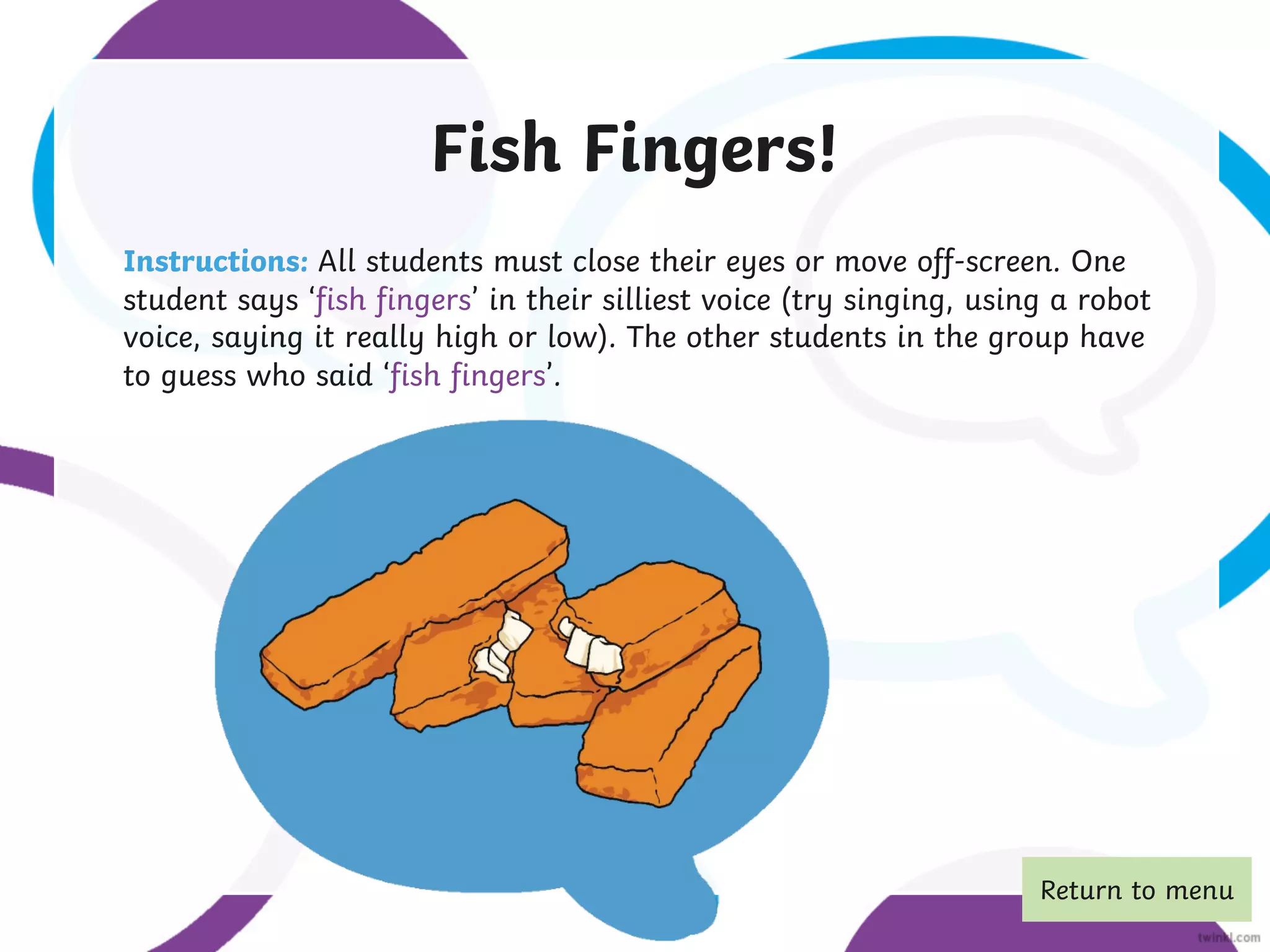
Instructions: All students must close their eyes or move off-screen. One
student says ‘fish fingers’ in their silliest voice (try singing, using a robot
voice, saying it really high or low). The other students in the group have
to guess who said ‘fish fingers’.
Return to menu
What’s the Object?
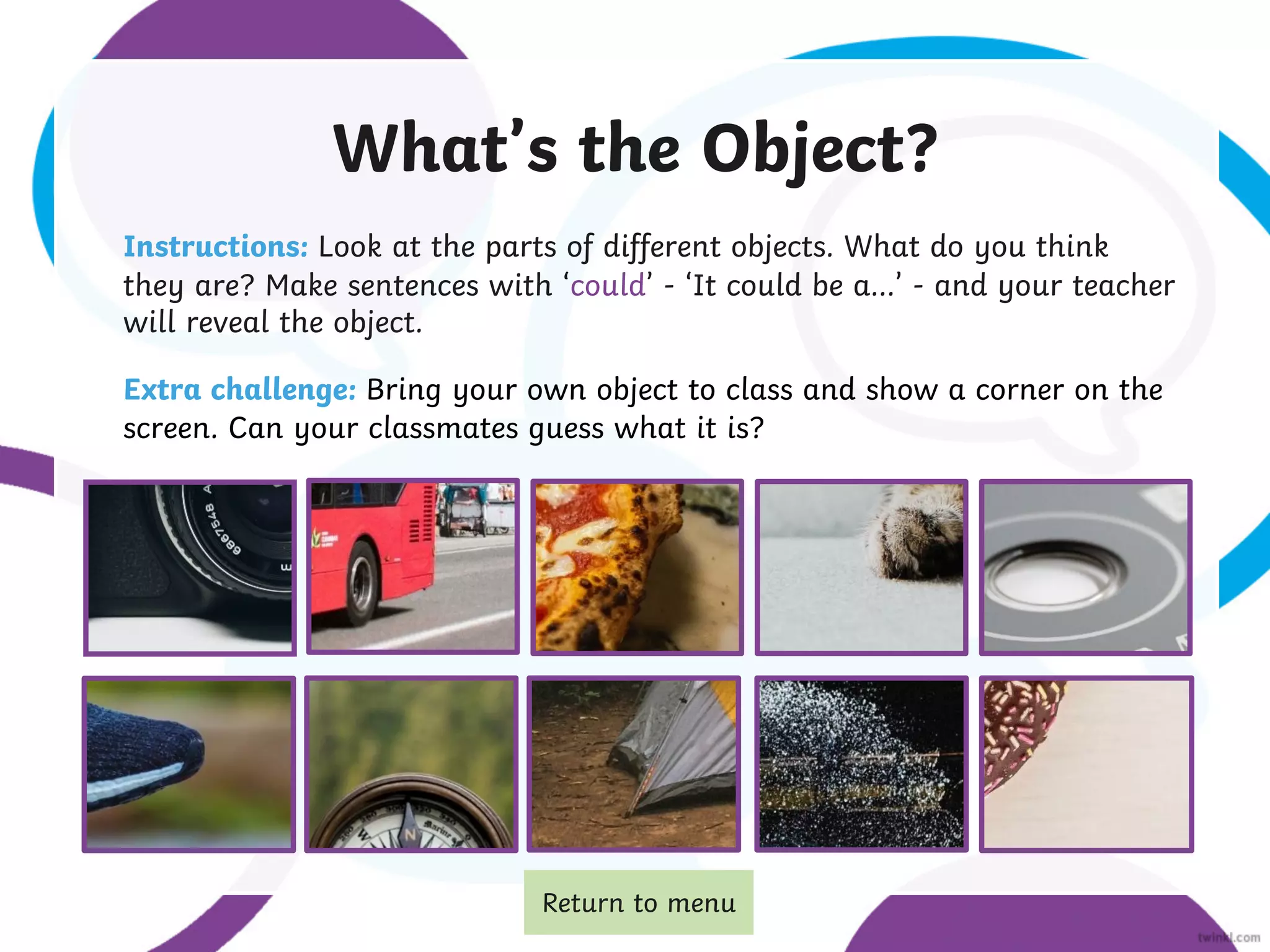
Instructions: Look at the parts of different objects. What do you think
they are? Make sentences with ‘could’ - ‘It could be a…’ - and your teacher
will reveal the object.
Extra challenge: Bring your own object to class and show a corner on the
screen. Can your classmates guess what it is?
Return to menu
Shopping List
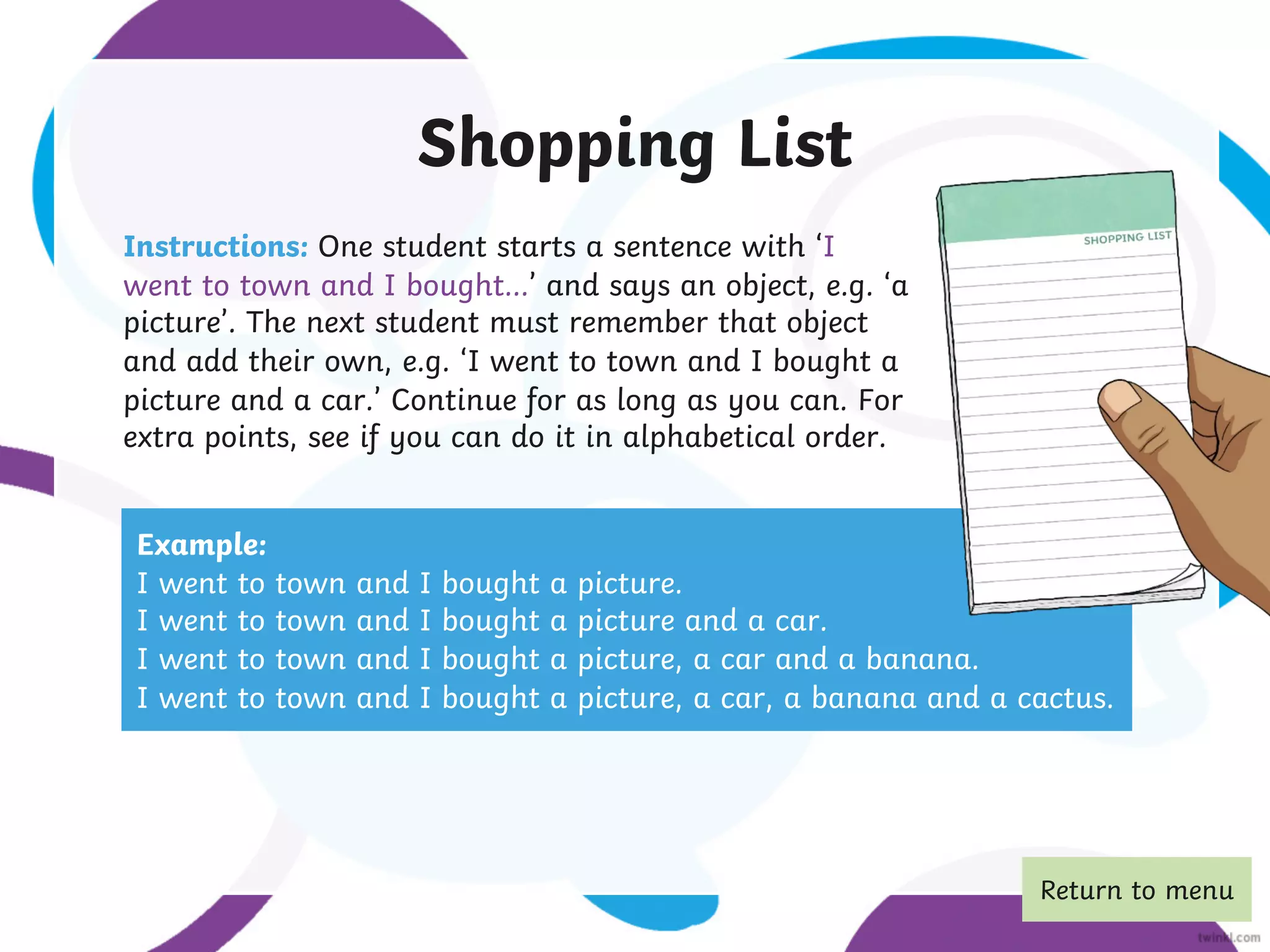
Instructions: One student starts a sentence with ‘I
went to town and I bought…’ and says an object, e.g. ‘a
picture’. The next student must remember that object
and add their own, e.g. ‘I went to town and I bought a
picture and a car.’ Continue for as long as you can. For
extra points, see if you can do it in alphabetical order.
Example:
I went to town and I bought a picture.
I went to town and I bought a picture and a car.
I went to town and I bought a picture, a car and a banana.
I went to town and I bought a picture, a car, a banana and a cactus.
Return to menu
Count to 21
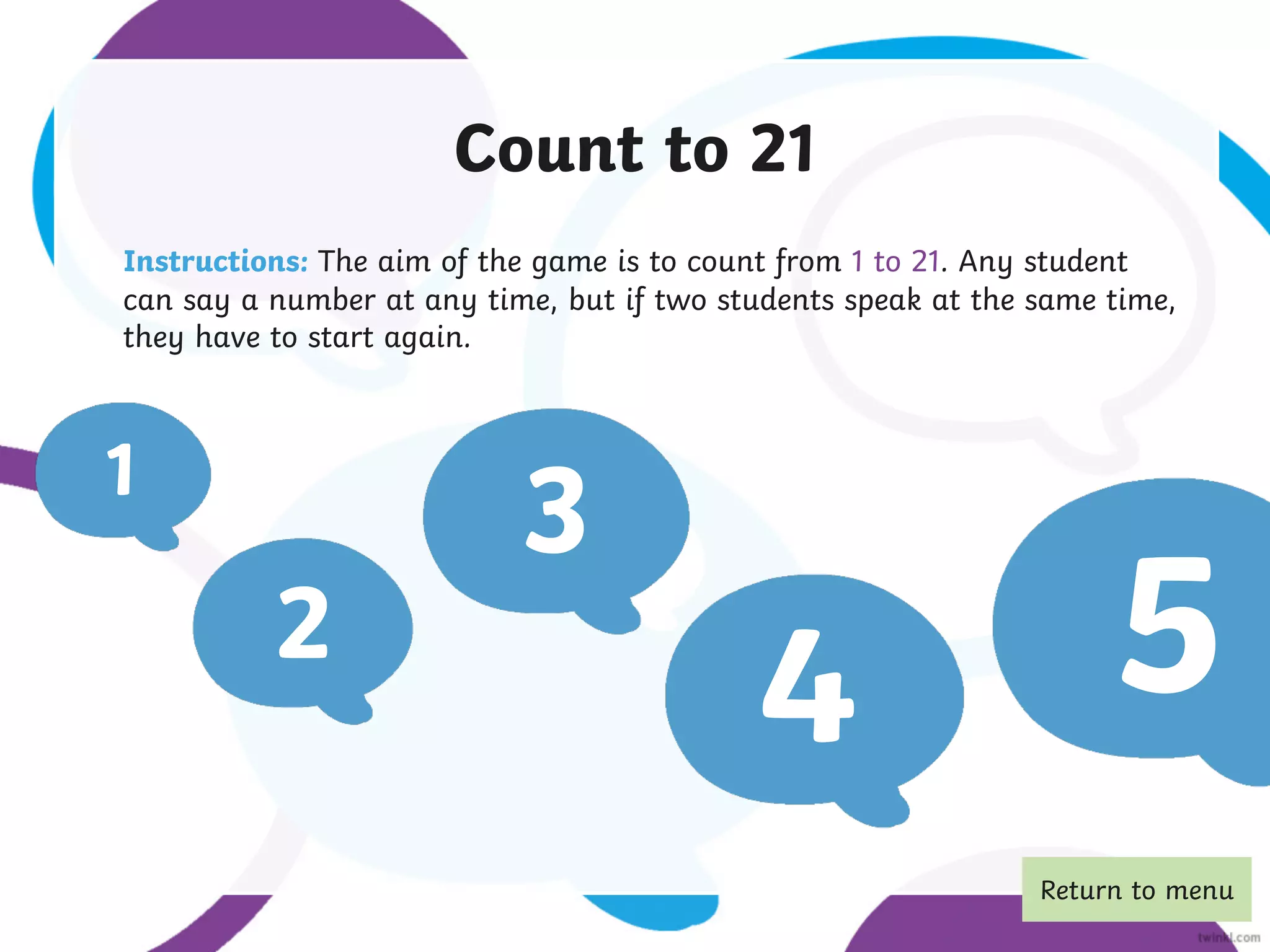
Instructions: The aim of the game is to count from 1 to 21. Any student
can say a number at any time, but if two students speak at the same time,
they have to start again.
1
2
3
4 5
Return to menu
wild animals colours
subjects at
school
objects in the
house
things in your
backpack
superheroes colours
countries capital cities
things you see
at the beach
words beginning
with ‘h’
jobs drinks fruit
pets
Categories
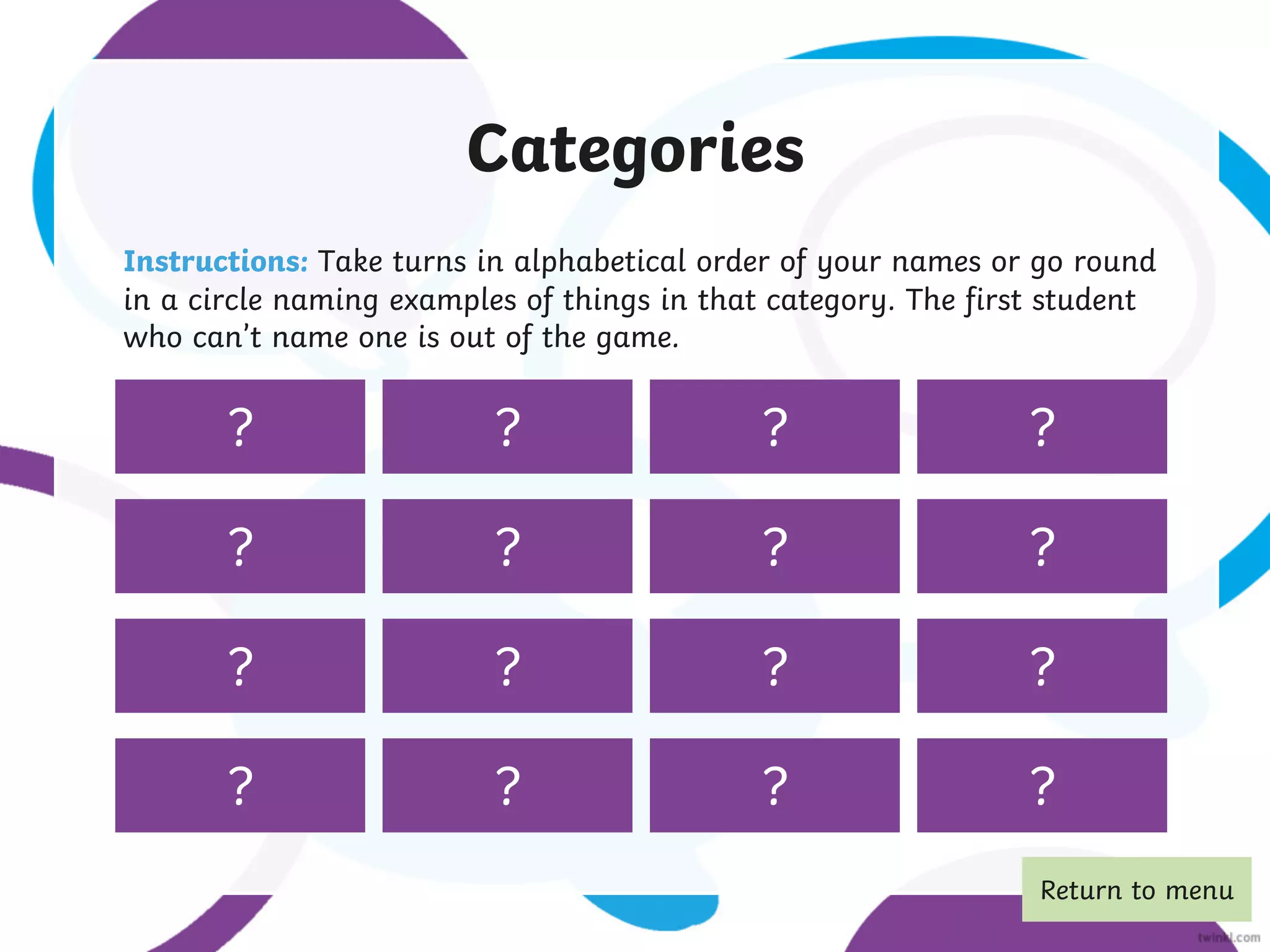
Instructions: Take turns in alphabetical order of your names or go round
in a circle naming examples of things in that category. The first student
who can’t name one is out of the game.
? ? ? ?
? ? ? ?
? ? ? ?
? ? ? vegetables
?
Return to menu
Find something
wooden.
Find a soft toy.
Find a spoon.
Find something you
wear on your head.
Find a
paintbrush.
Find a key. Find a potato.
Find a photo.
Find something
yellow.
Find Something...
Instructions: Click on the box to choose a category. As fast as you can (or
for your next class), find an object that fits that description. Then, answer
the questions. Now, invent your own categories!
? ?
?
? ?
?
? ?
?
What does your object look like?
What can you do with it?
Is it special? Why?
Do you know where it’s from?
Return to menu
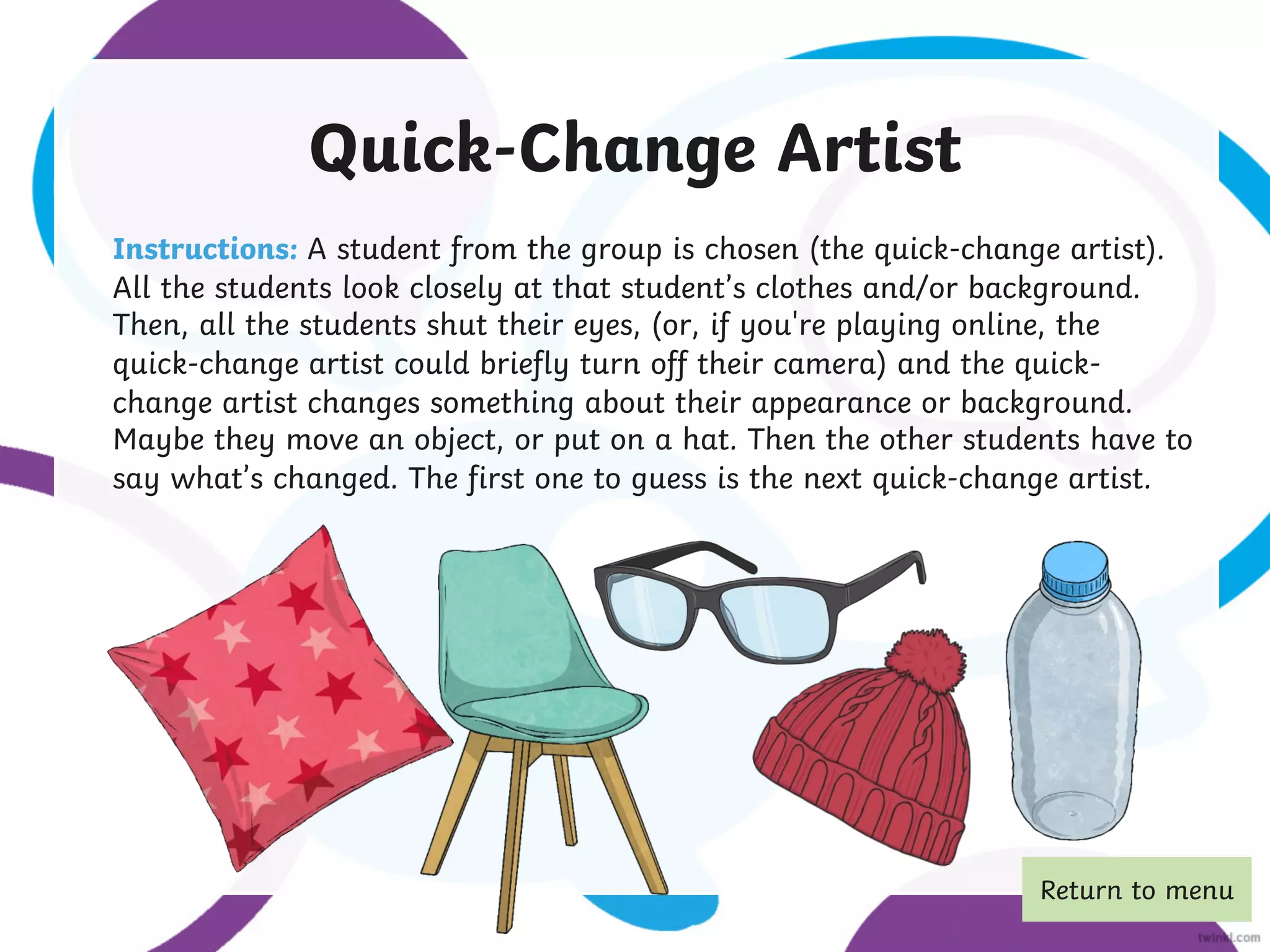
Quick-Change Artist
Instructions: A student from the group is chosen (the quick-change artist).
All the students look closely at that student’s clothes and/or background.
Then, all the students shut their eyes, (or, if you're playing online, the
quick-change artist could briefly turn off their camera) and the quick-
change artist changes something about their appearance or background.
Maybe they move an object, or put on a hat. Then the other students have to
say what’s changed. The first one to guess is the next quick-change artist.
Return to menu
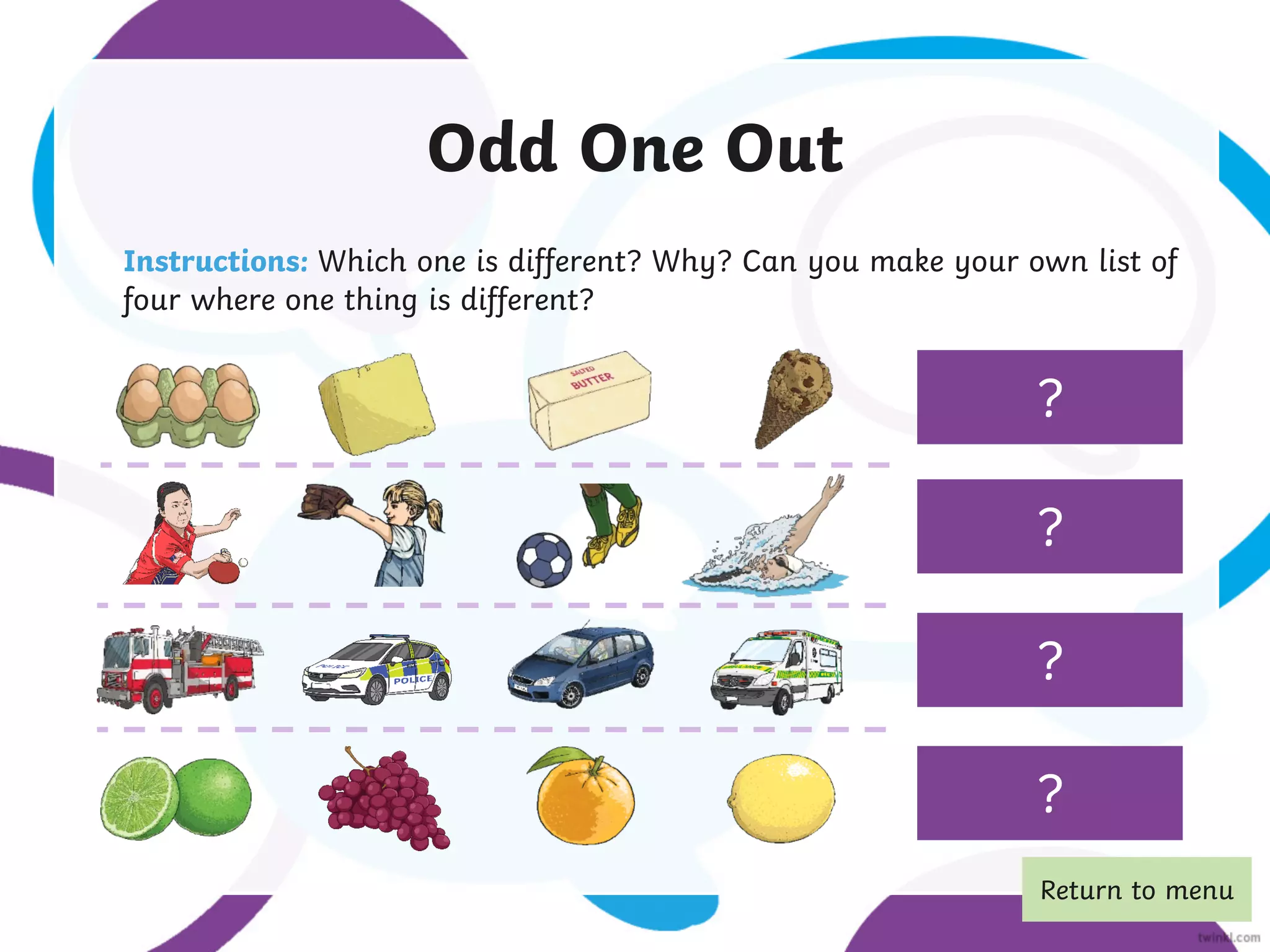
Eggs aren’t made
from milk.
Swimming isn’t a
ball sport.
A car isn’t an
emergency vehicle.
Odd One Out
Instructions: Which one is different? Why? Can you make your own list of
four where one thing is different?
?
?
?
A grape isn’t a
citrus fruit.
?
Return to menu
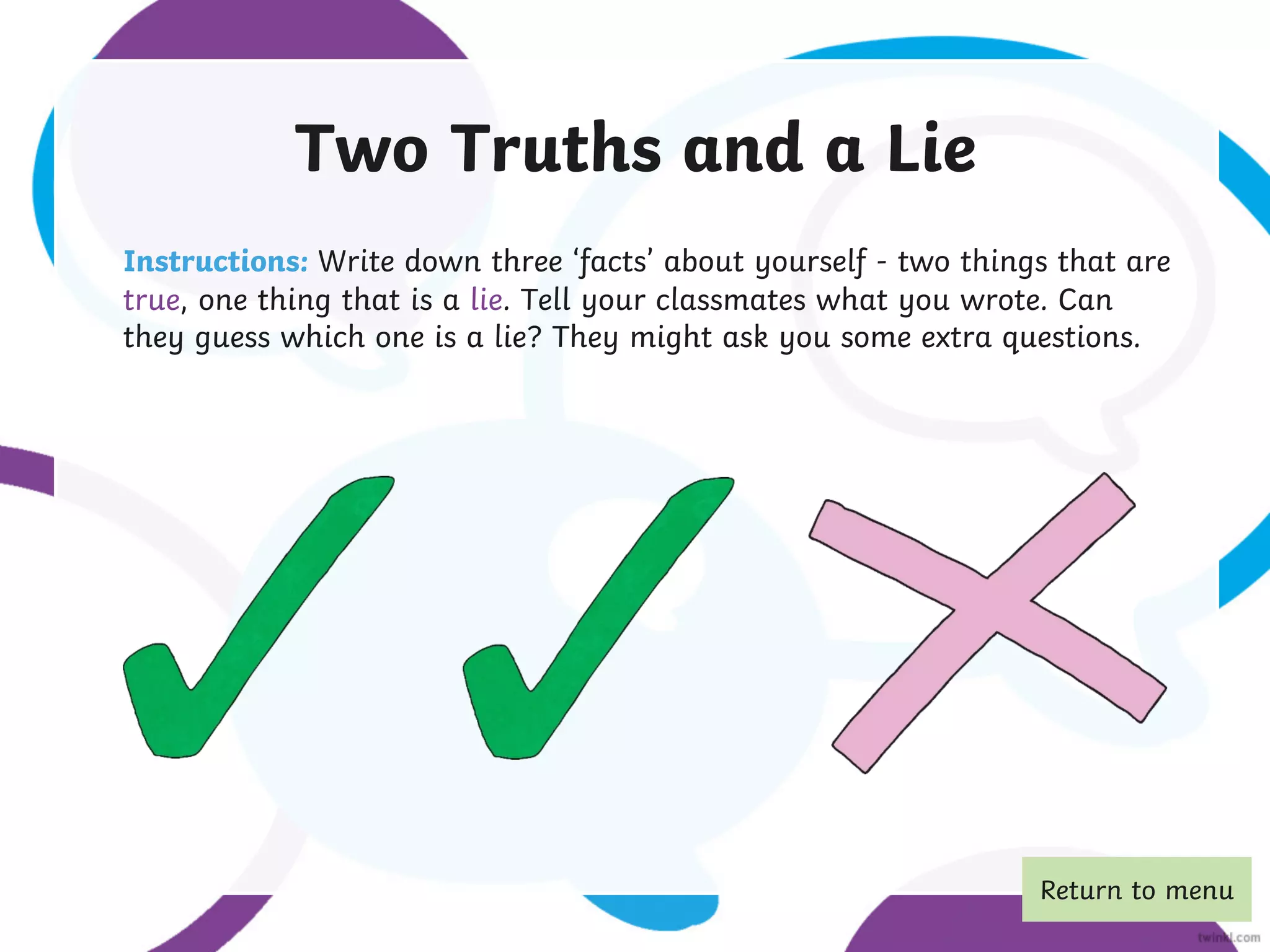
Two Truths and a Lie
Instructions: Write down three ‘facts’ about yourself - two things that are
true, one thing that is a lie. Tell your classmates what you wrote. Can
they guess which one is a lie? They might ask you some extra questions.
Return to menu
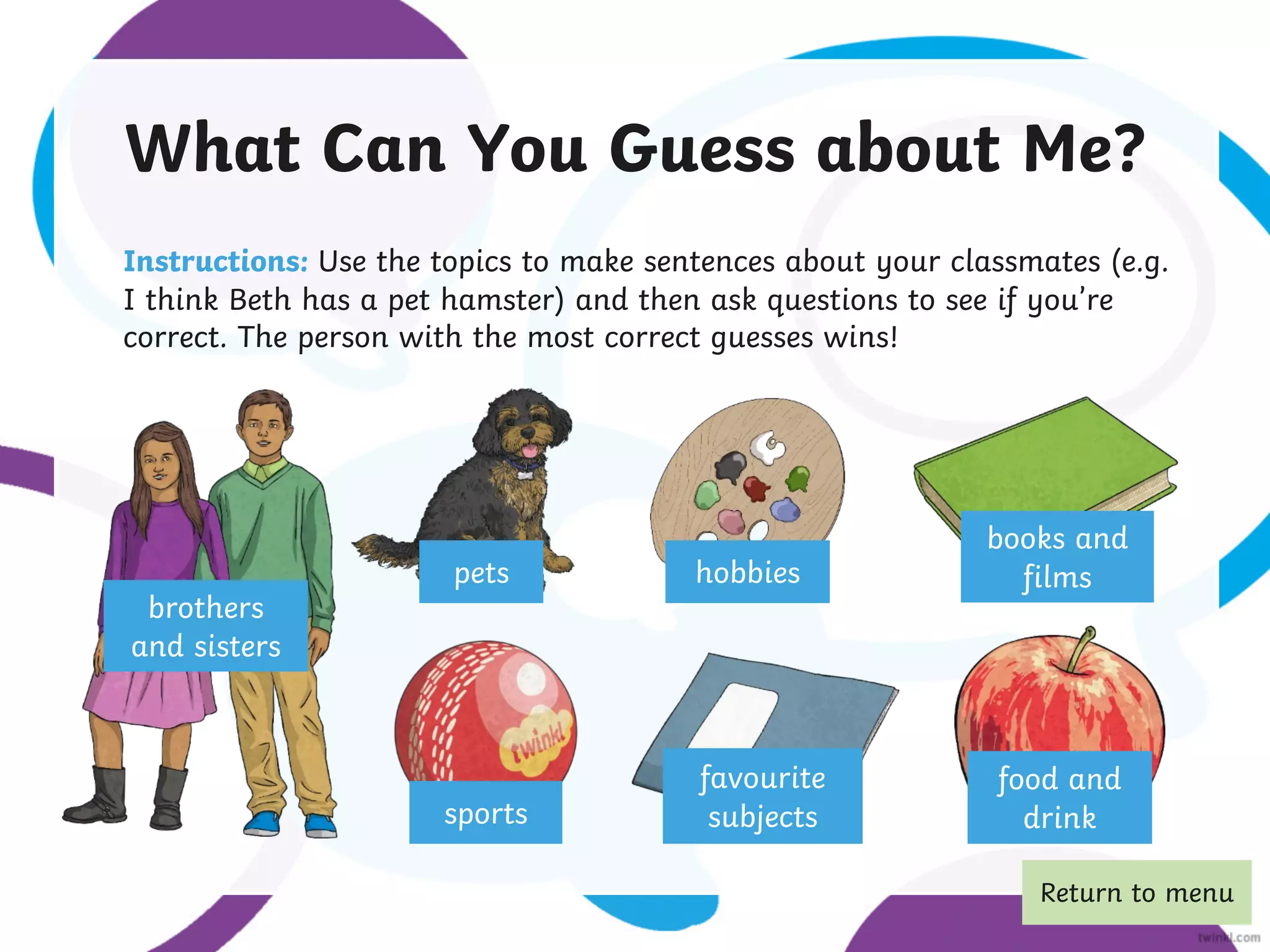
What Can You Guess about Me?
Instructions: Use the topics to make sentences about your classmates (e.g.
I think Beth has a pet hamster) and then ask questions to see if you’re
correct. The person with the most correct guesses wins!
brothers
and sisters
pets
sports
favourite
subjects
hobbies
books and
films
food and
drink
Return to menu
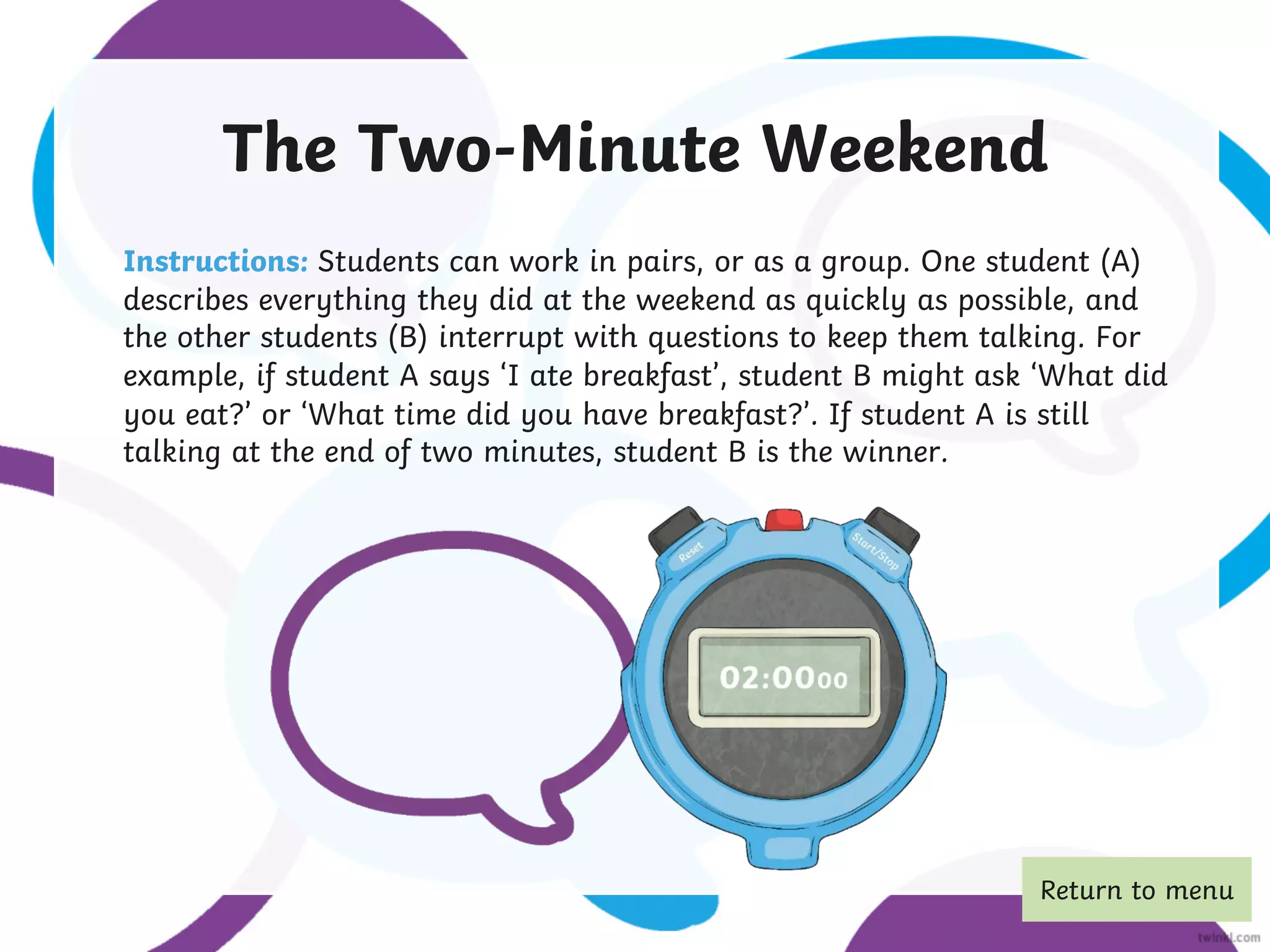
The Two-Minute Weekend
Instructions: Students can work in pairs, or as a group. One student (A)
describes everything they did at the weekend as quickly as possible, and
the other students (B) interrupt with questions to keep them talking. For
example, if student A says ‘I ate breakfast’, student B might ask ‘What did
you eat?’ or ‘What time did you have breakfast?’. If student A is still
talking at the end of two minutes, student B is the winner.
Return to menu
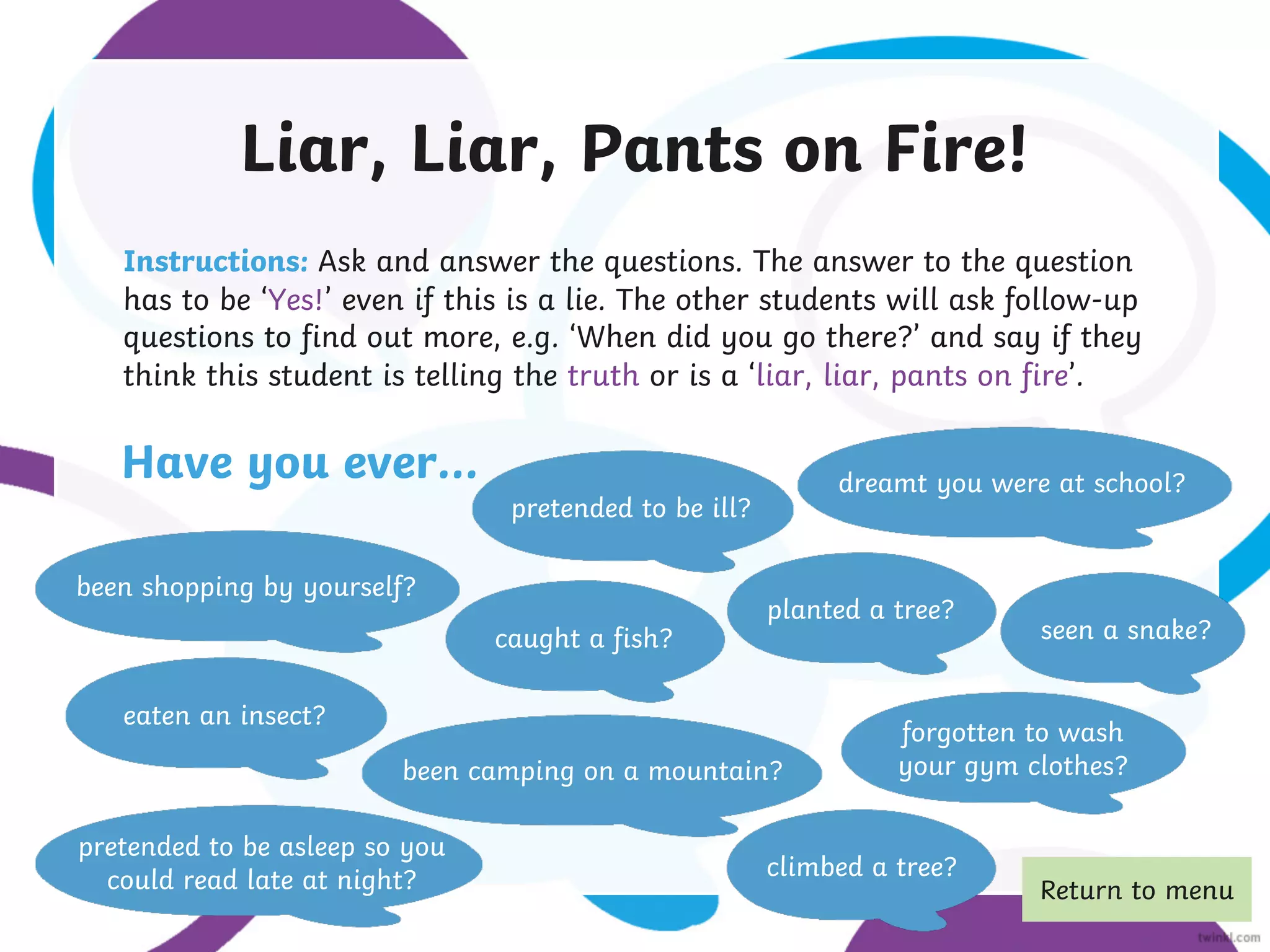
Liar, Liar, Pants on Fire!
Instructions: Ask and answer the questions. The answer to the question
has to be ‘Yes!’ even if this is a lie. The other students will ask follow-up
questions to find out more, e.g. ‘When did you go there?’ and say if they
think this student is telling the truth or is a ‘liar, liar, pants on fire’.
been camping on a mountain?
eaten an insect?
pretended to be ill?
been shopping by yourself?
caught a fish?
dreamt you were at school?
climbed a tree?
planted a tree?
seen a snake?
forgotten to wash
your gym clothes?
pretended to be asleep so you
could read late at night?
Have you ever…
Return to menu
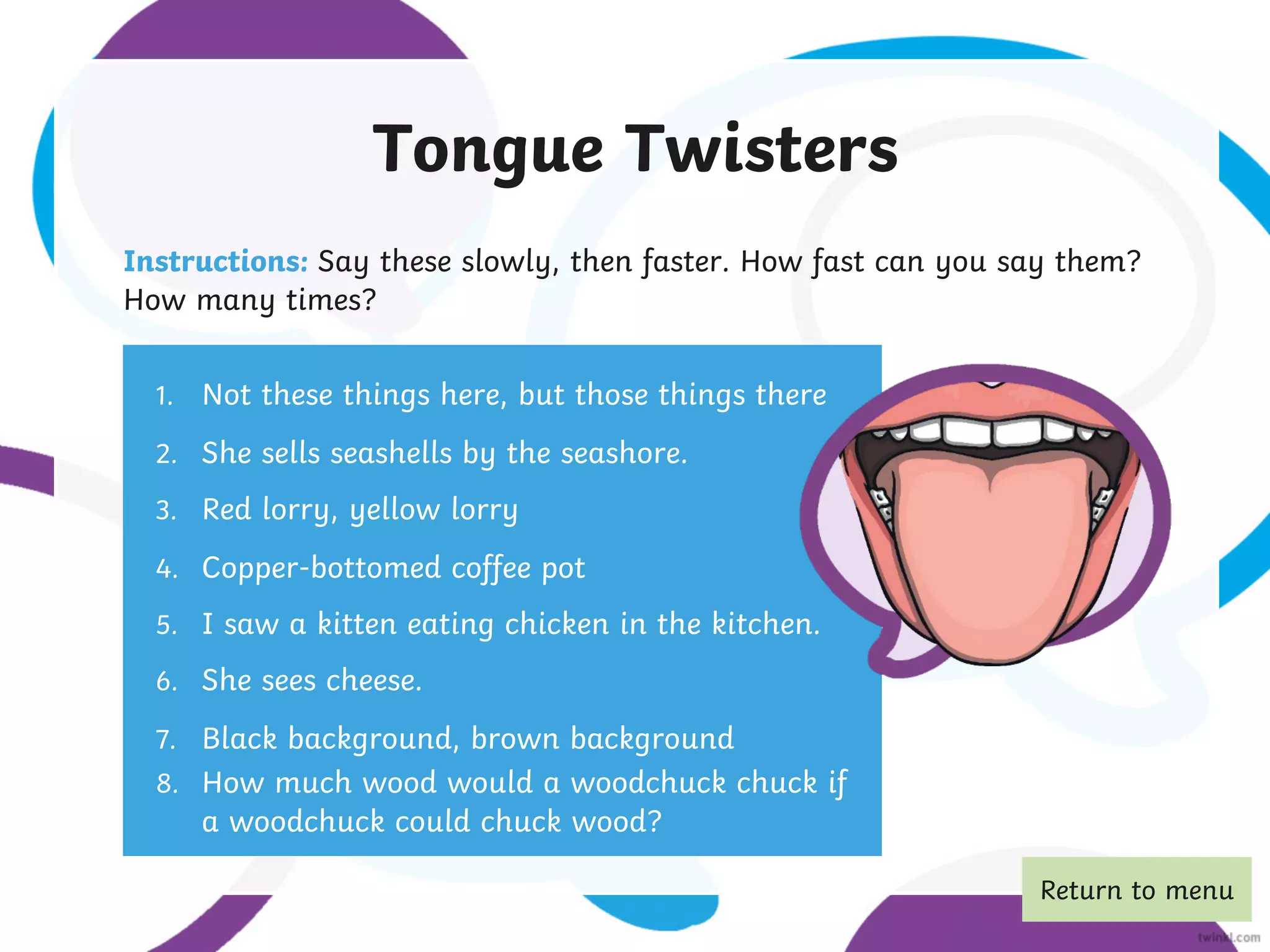
Tongue Twisters
Instructions: Say these slowly, then faster. How fast can you say them?
How many times?
1. Not these things here, but those things there
2. She sells seashells by the seashore.
3. Red lorry, yellow lorry
4. Copper-bottomed coffee pot
5. I saw a kitten eating chicken in the kitchen.
6. She sees cheese.
7. Black background, brown background
8. How much wood would a woodchuck chuck if
a woodchuck could chuck wood?
Return to menu
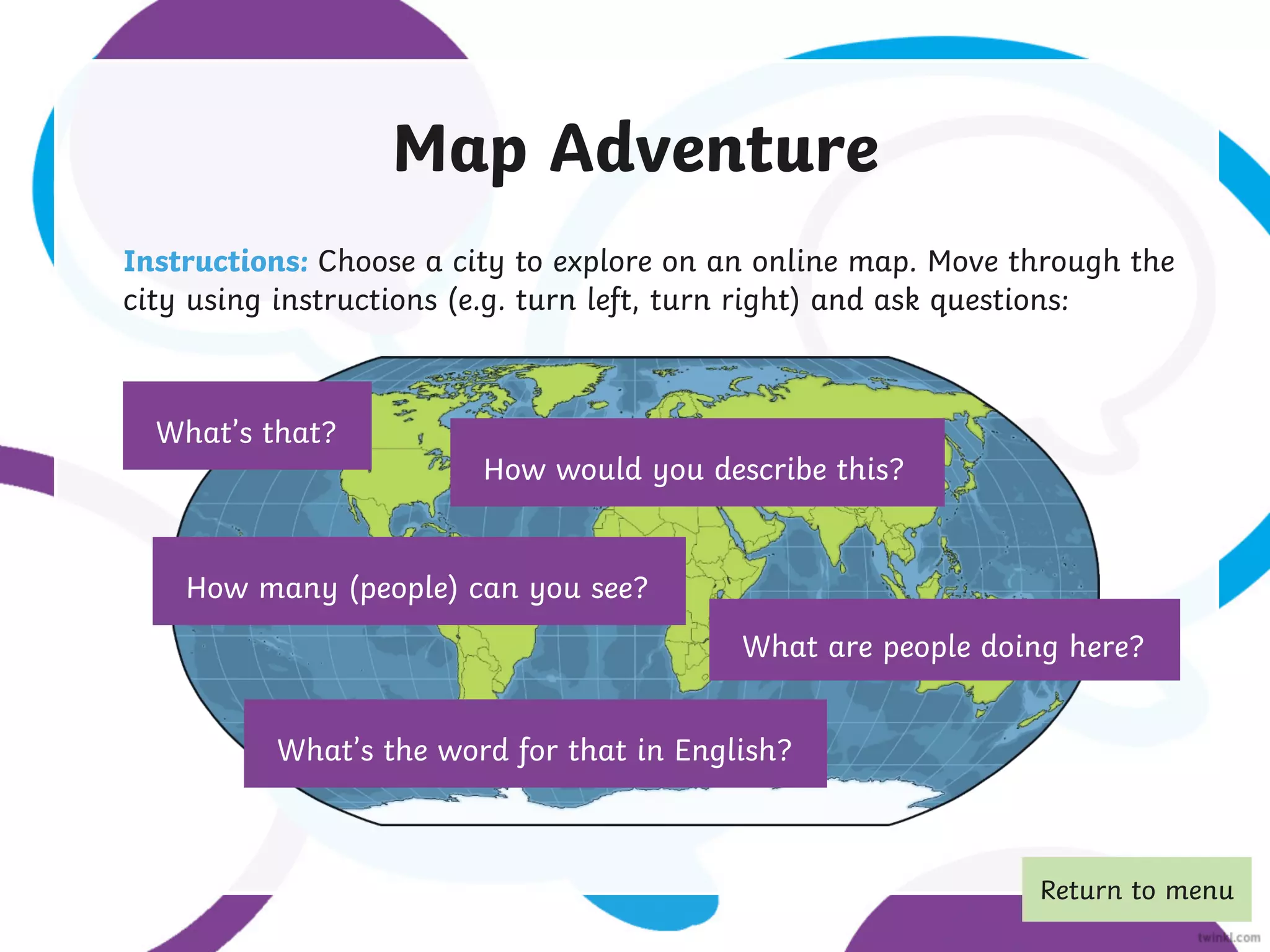
Map Adventure
Instructions: Choose a city to explore on an online map. Move through the
city using instructions (e.g. turn left, turn right) and ask questions:
What’s that?
How many (people) can you see?
How would you describe this?
What’s the word for that in English?
What are people doing here?
Return to menu
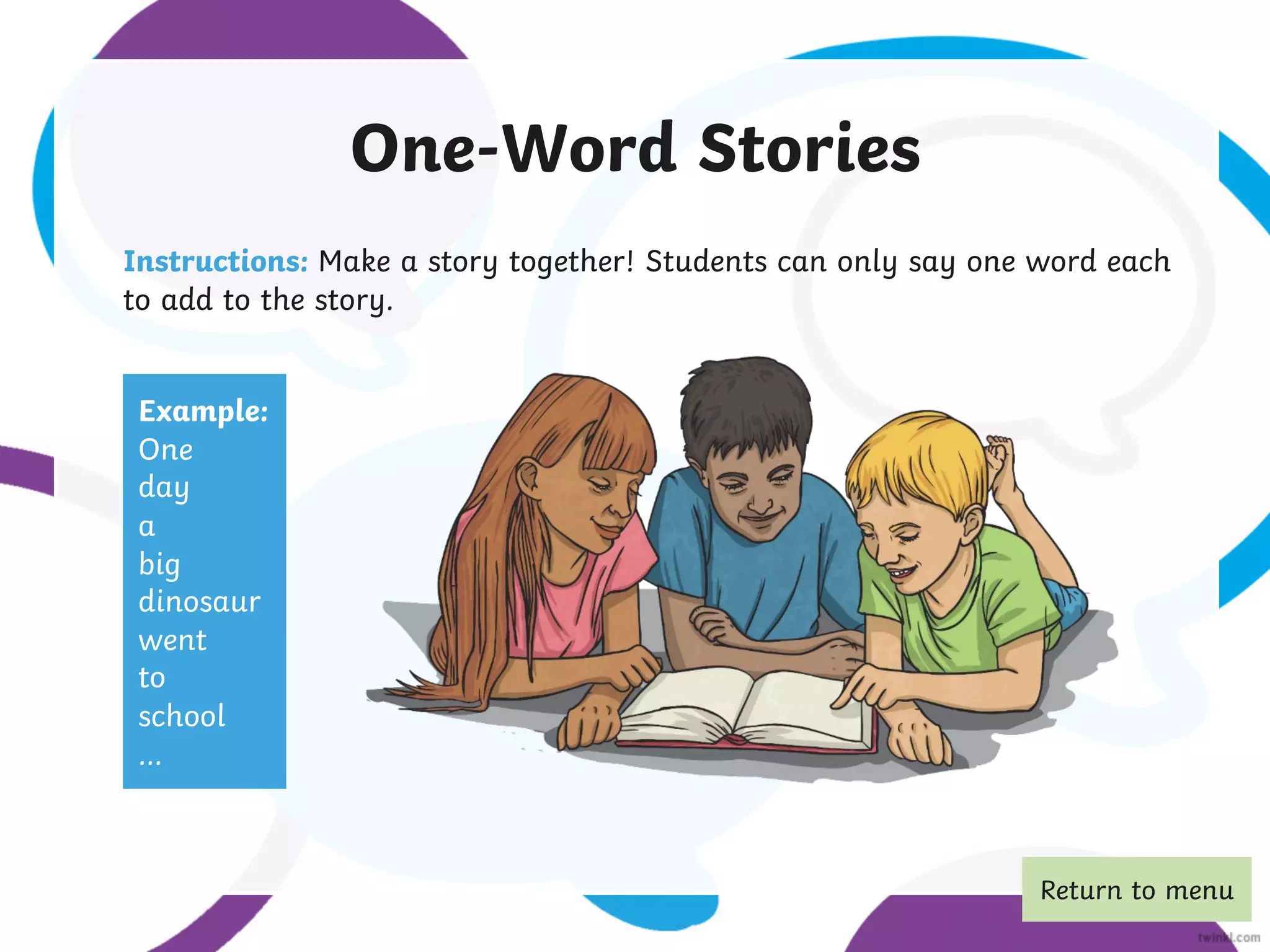
One-Word Stories
Instructions: Make a story together! Students can only say one word each
to add to the story.
Example:
One
day
a
big
dinosaur
went
to
school
...
Return to menu
Fortunately, Unfortunately
Instructions: One student starts a story with just one sentence. The next
student has to continue the story, starting their sentence with
‘fortunately’. The next student continues the story with a new sentence
starting with ‘unfortunately’. Then, back to ‘fortunately’ and so on.
Example:
One day, Bob woke up.
Fortunately, it was a Sunday and he could stay in bed.
Unfortunately, there was a storm outside and water
was pouring in through his window.
Fortunately, all he had to do was get up and close the
window.
Unfortunately, when he got up, he saw that there was
a tiger next to the window!
Fortunately…
Return to menu
The Expert
Instructions: Nominate a student. The student has to choose a topic and
talk about it for 30 seconds (or longer) as if they were the expert. If they
can, they gain a point!
the sea social media
Australian
animals
sleep famous singers Olympic sports superheroes
books shopping languages
pizza
? ? ? ?
? ? ? ?
? ? ?
Return to menu
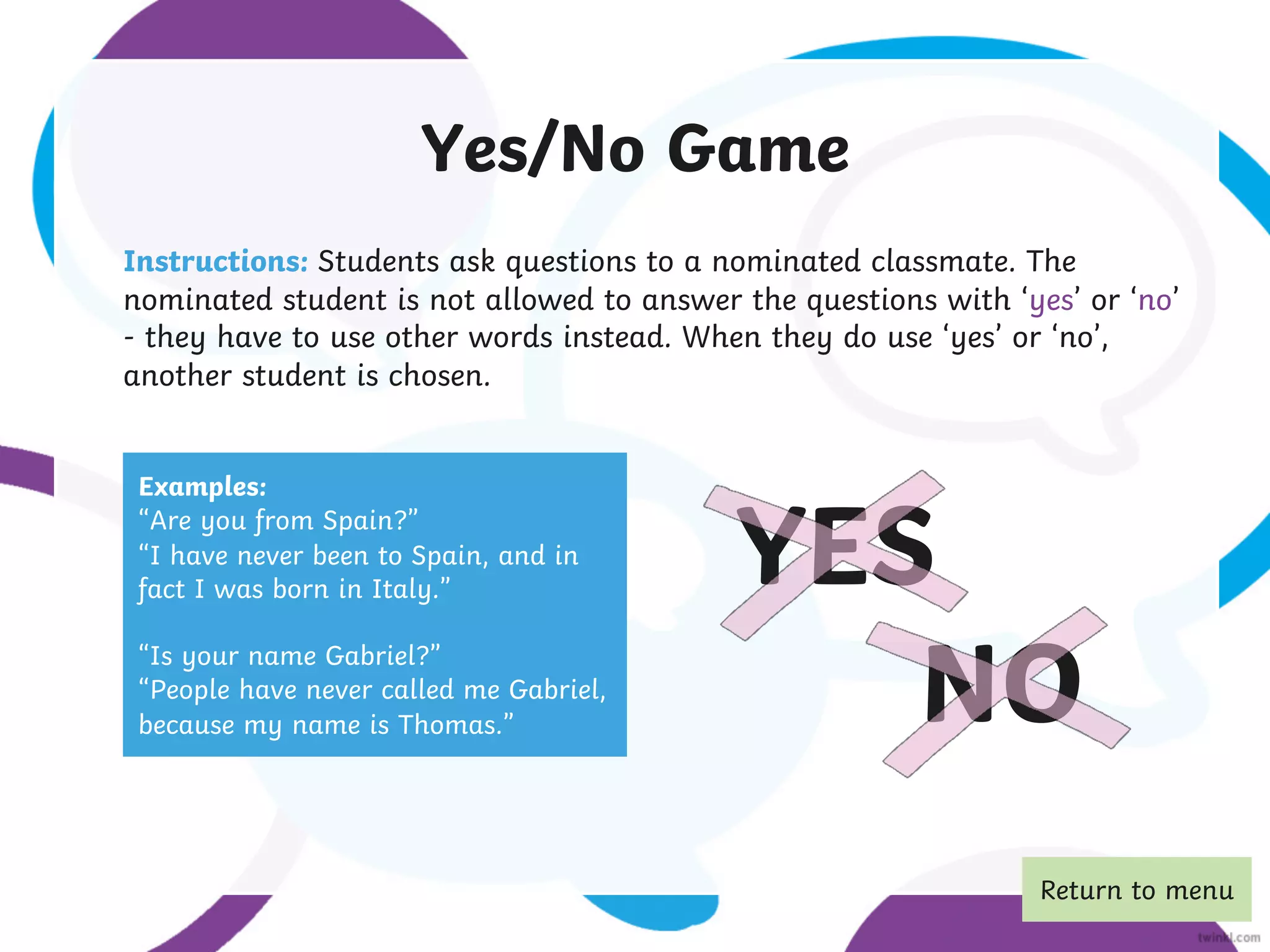
Yes/No Game
Instructions: Students ask questions to a nominated classmate. The
nominated student is not allowed to answer the questions with ‘yes’ or ‘no’
- they have to use other words instead. When they do use ‘yes’ or ‘no’,
another student is chosen.
Examples:
“Are you from Spain?”
“I have never been to Spain, and in
fact I was born in Italy.”
“Is your name Gabriel?”
“People have never called me Gabriel,
because my name is Thomas.”
YES
NO
Return to menu
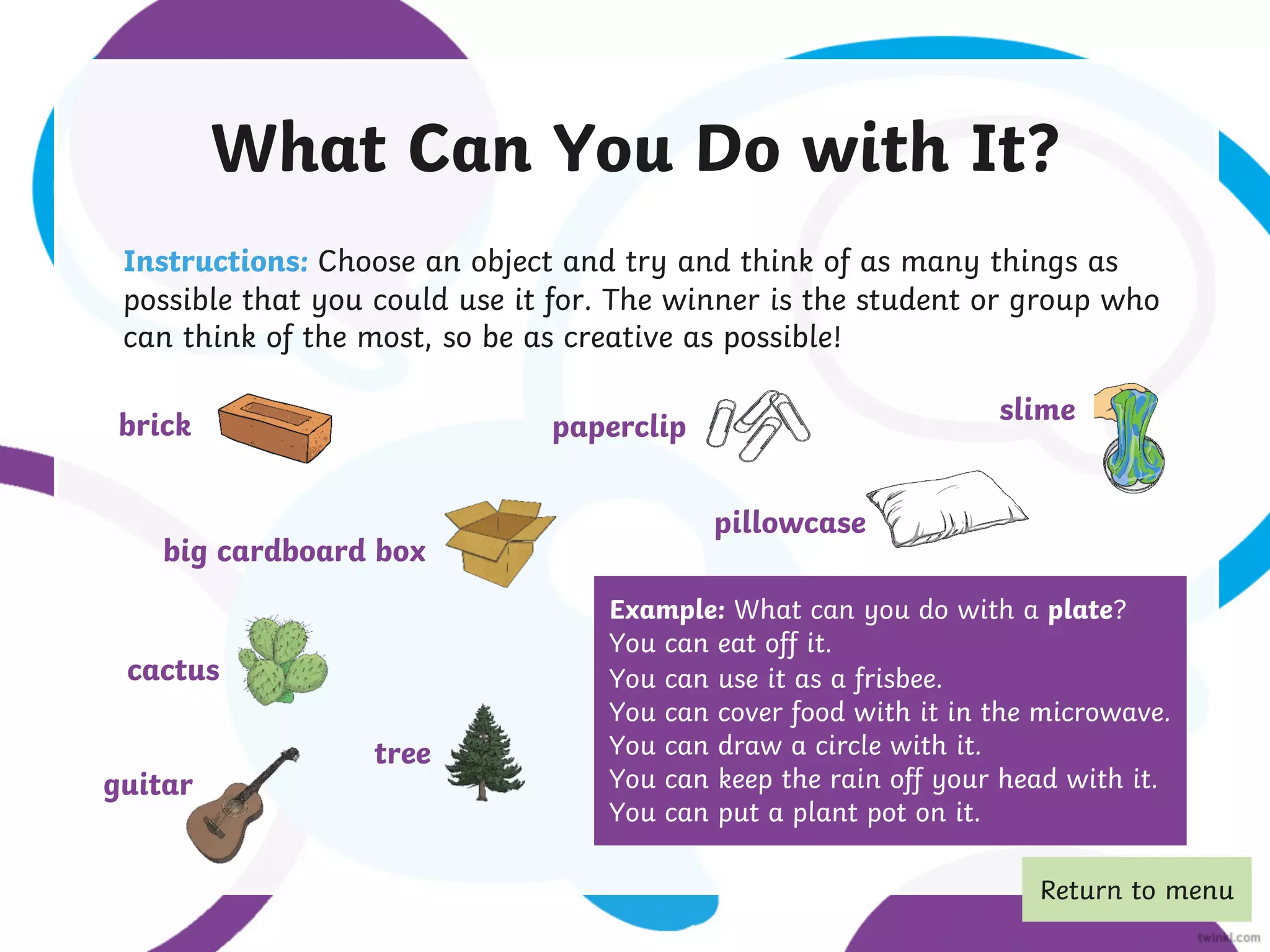
What Can You Do with It?
Instructions: Choose an object and try and think of as many things as
possible that you could use it for. The winner is the student or group who
can think of the most, so be as creative as possible!
Example: What can you do with a plate?
You can eat off it.
You can use it as a frisbee.
You can cover food with it in the microwave.
You can draw a circle with it.
You can keep the rain off your head with it.
You can put a plant pot on it.
brick paperclip
big cardboard box
pillowcase
tree
guitar
slime
cactus
Return to menu
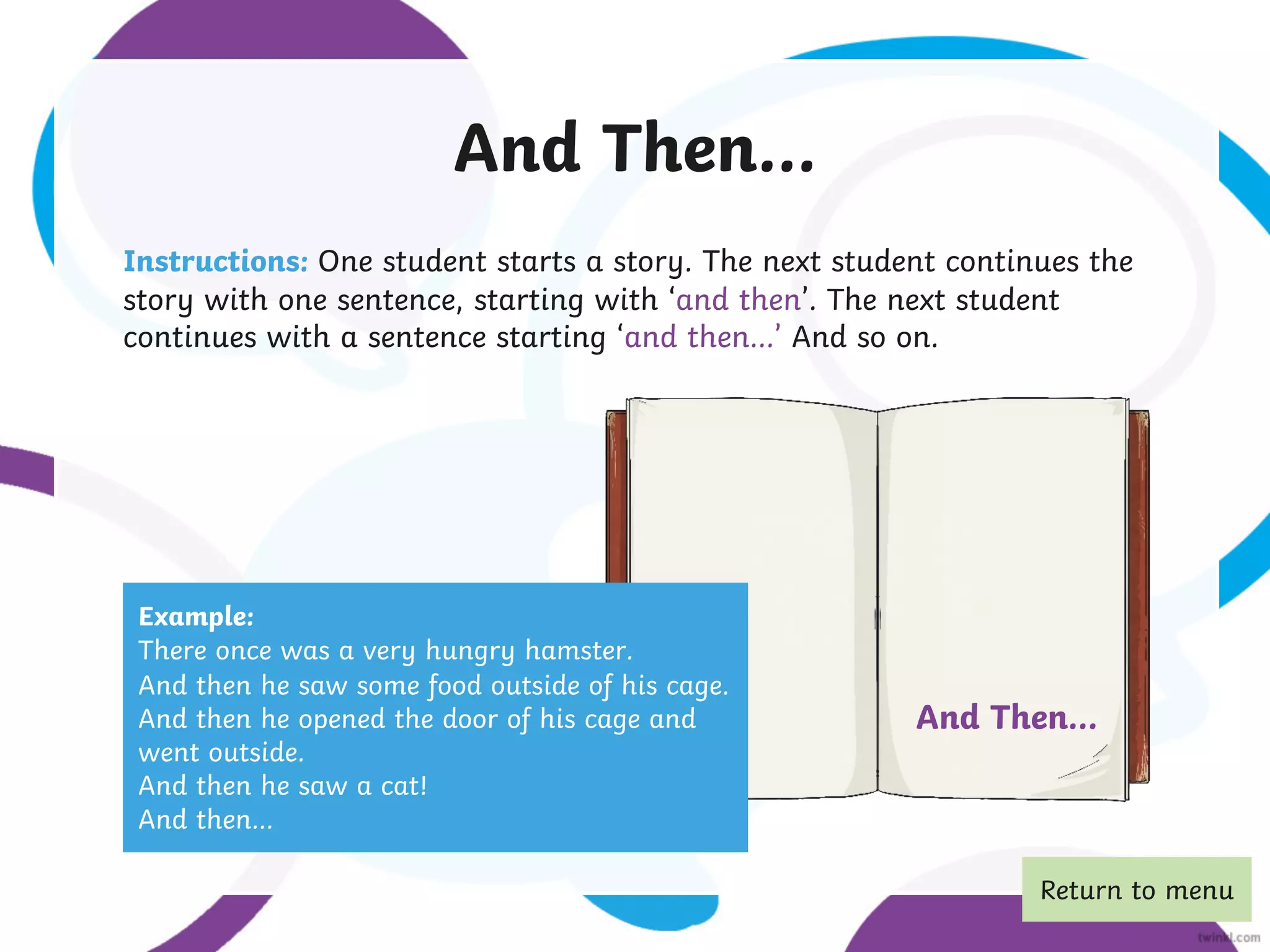
And Then...
Instructions: One student starts a story. The next student continues the
story with one sentence, starting with ‘and then’. The next student
continues with a sentence starting ‘and then…’ And so on.
Example:
There once was a very hungry hamster.
And then he saw some food outside of his cage.
And then he opened the door of his cage and
went outside.
And then he saw a cat!
And then…
And Then...
Return to menu
Would You Rather?
Instructions: Click on the boxes to reveal the questions. Ask and answer
the questions with your partner or class. Give the reasons for your
opinion. Then, think of your own questions.
Would you rather be a hamster the size of a T. rex, or a T. rex the size of a hamster?
?
Would you rather eat worms or a snail?
Would you rather live on a tropical island or in a city?
Would you rather live in a treehouse or underground?
Would you rather be able to fly or be able to become invisible?
Would you rather go to the North Pole or the Sahara?
Would you rather sing on stage or do extra maths homework?
Would you rather have a pet dragon or a pet unicorn?
?
?
?
?
?
?
? Return to menu
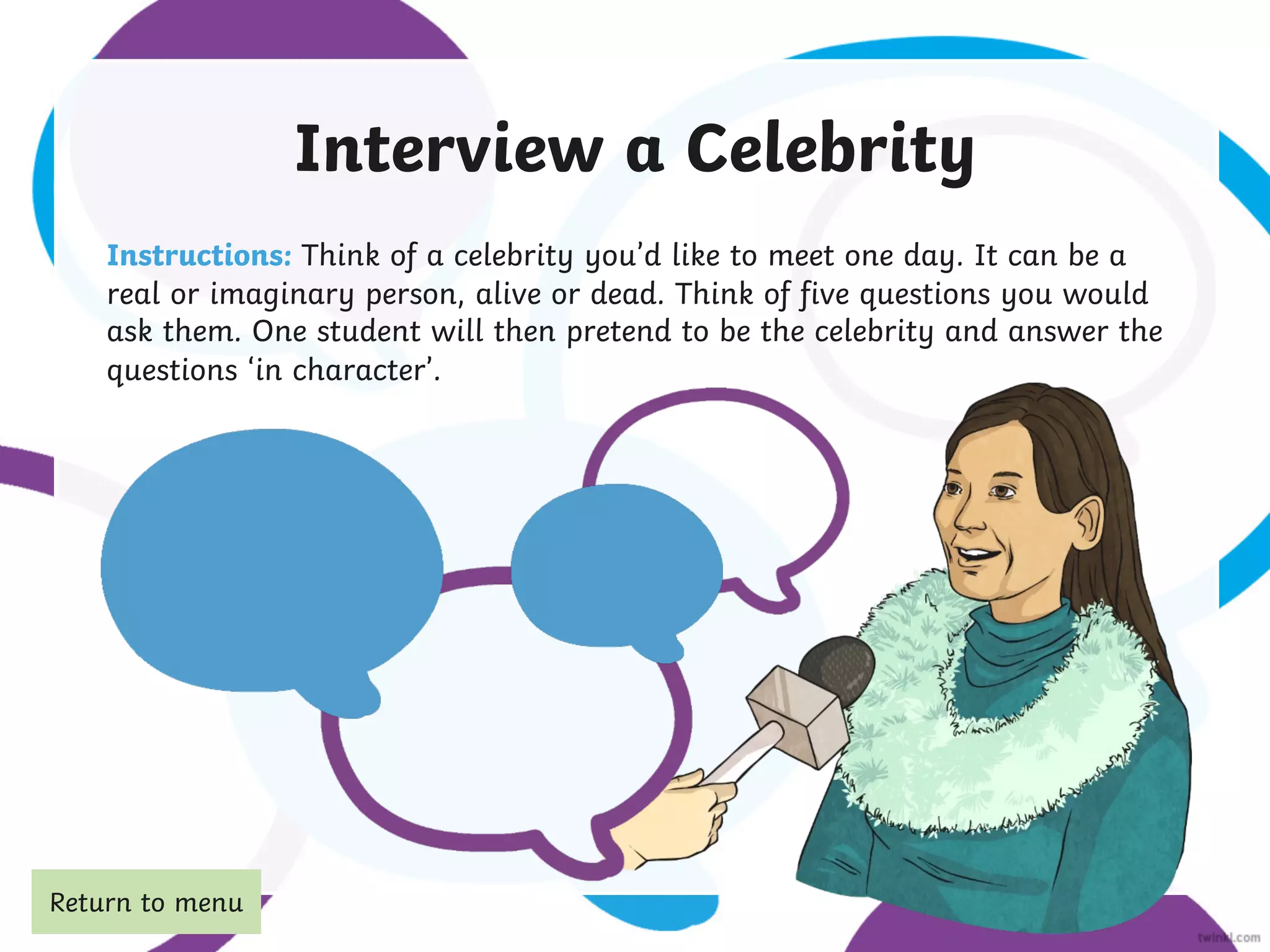
Interview a Celebrity
Instructions: Think of a celebrity you’d like to meet one day. It can be a
real or imaginary person, alive or dead. Think of five questions you would
ask them. One student will then pretend to be the celebrity and answer the
questions ‘in character’.
Return to menu
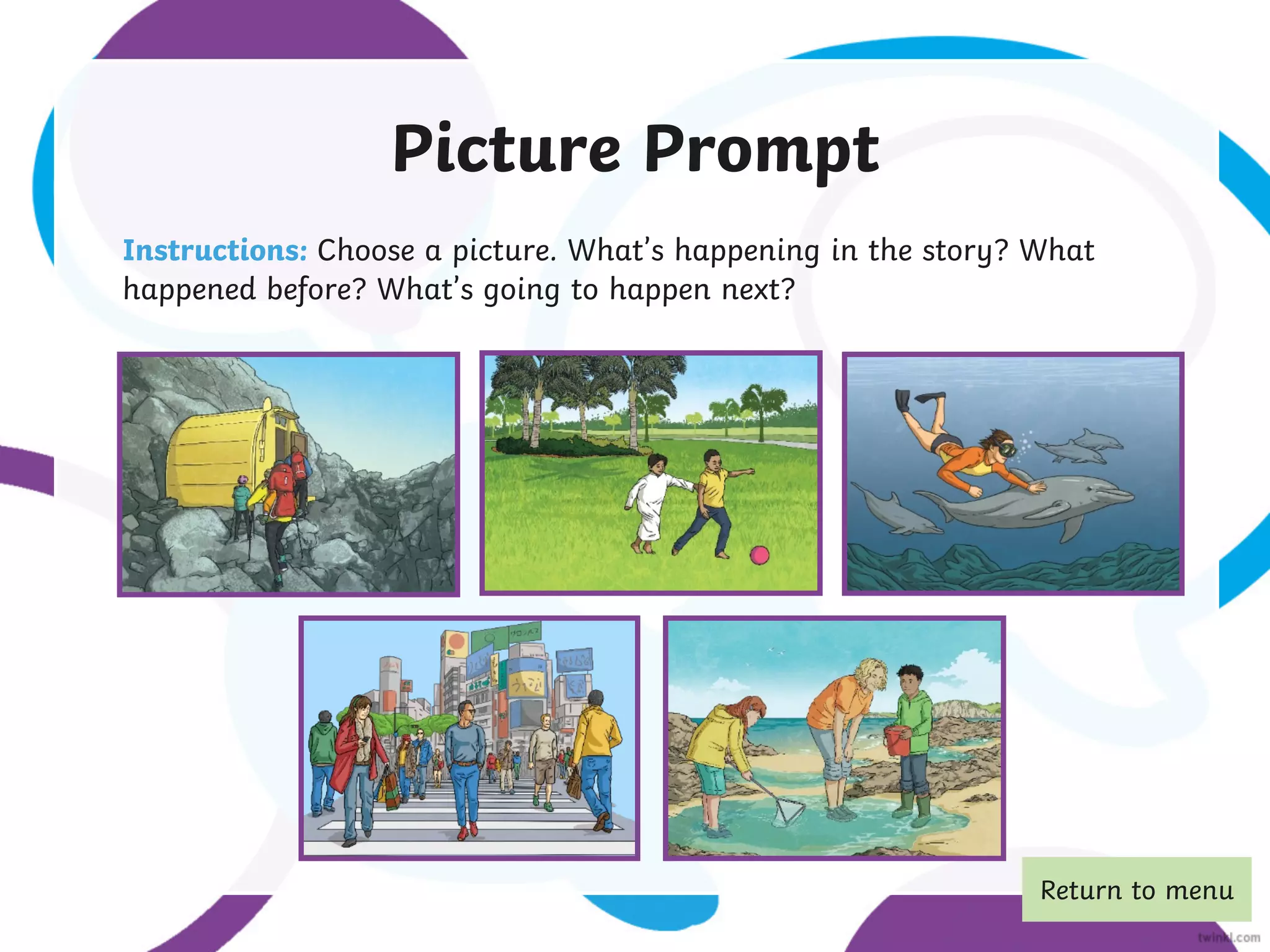
Picture Prompt
Instructions: Choose a picture. What’s happening in the story? What
happened before? What’s going to happen next?
Return to menu
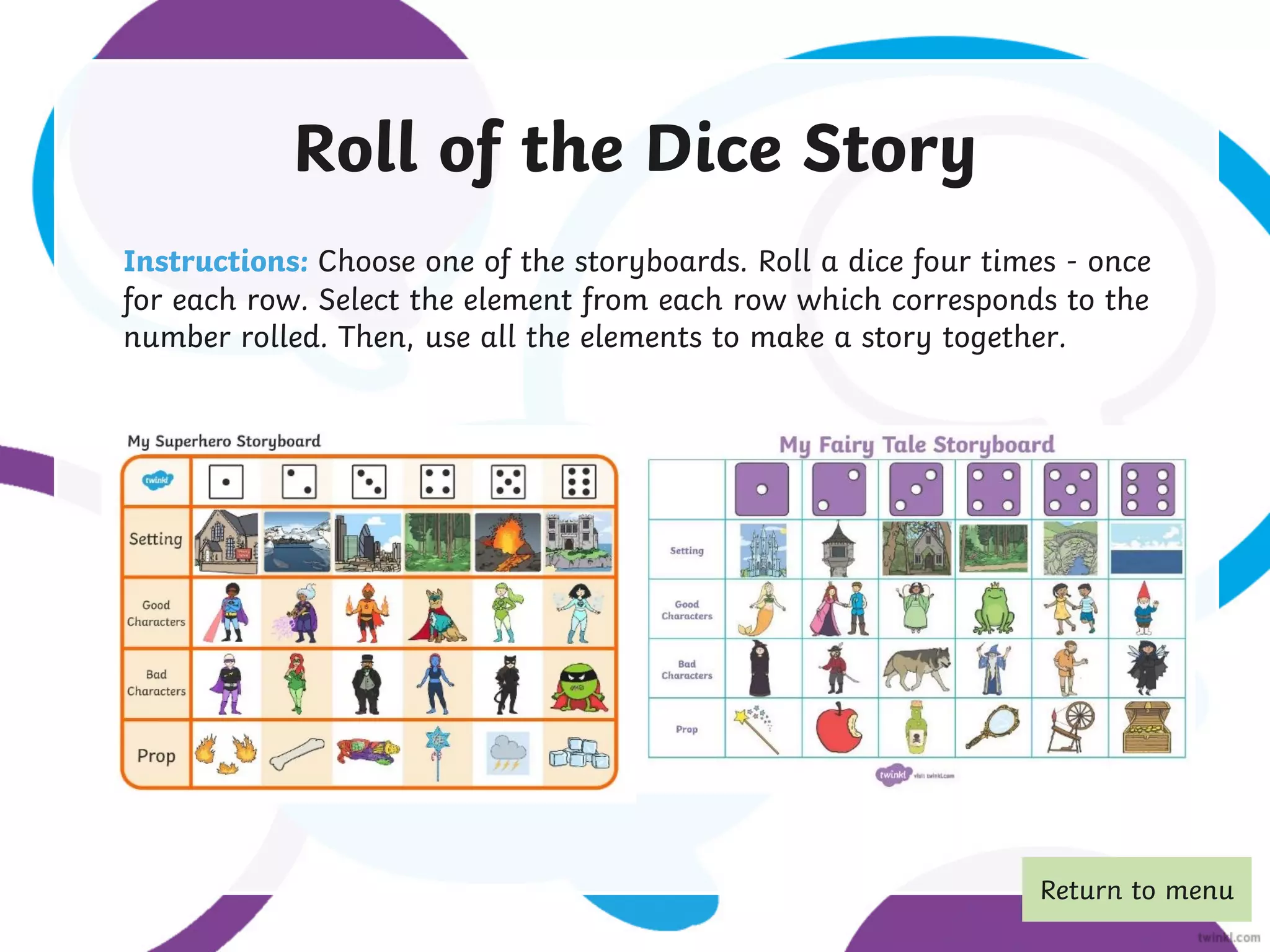
Roll of the Dice Story
Instructions: Choose one of the storyboards. Roll a dice four times - once
for each row. Select the element from each row which corresponds to the
number rolled. Then, use all the elements to make a story together.
Return to menu
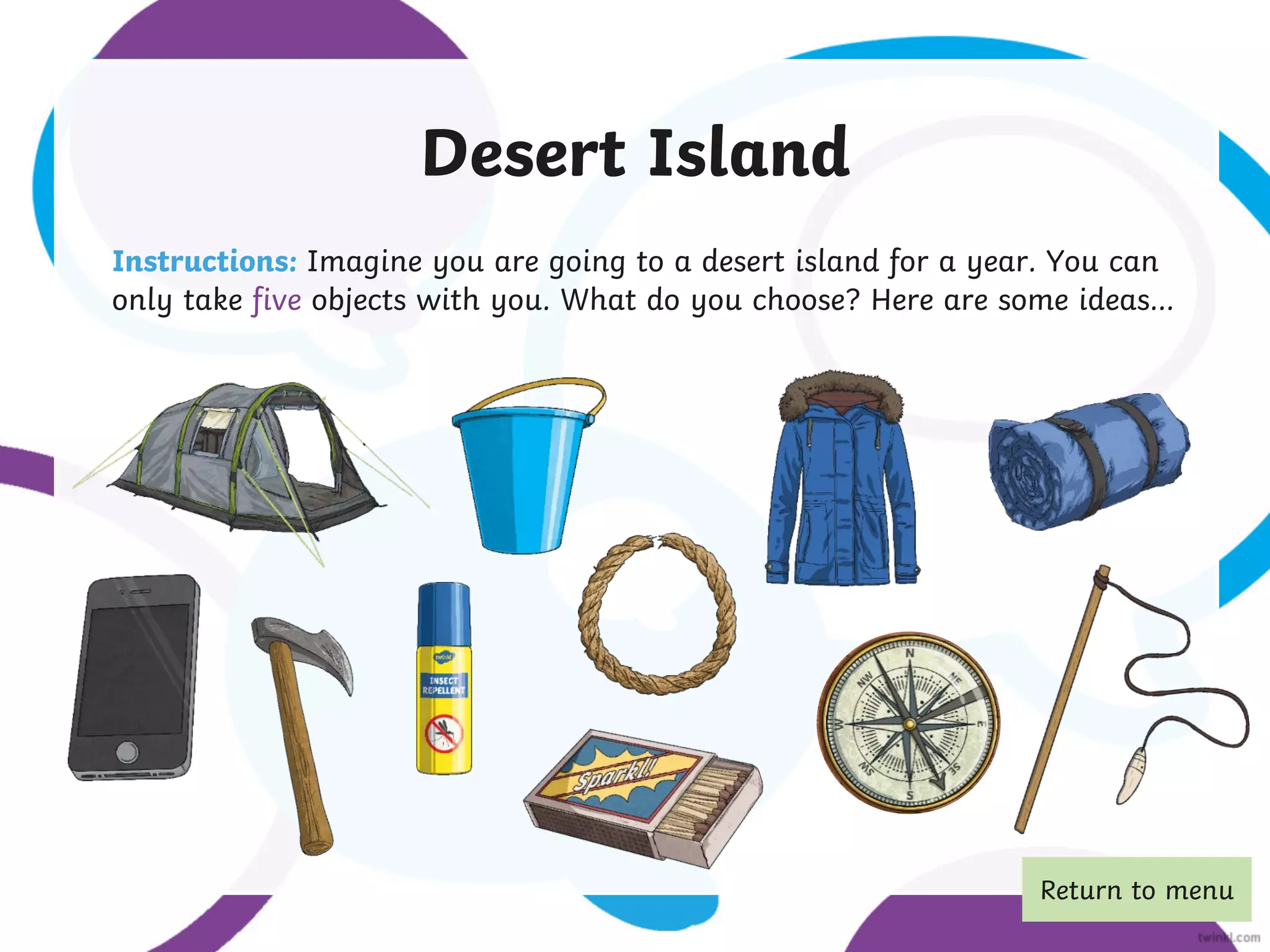
Desert Island
Instructions: Imagine you are going to a desert island for a year. You can
only take five objects with you. What do you choose? Here are some ideas...
Return to menu
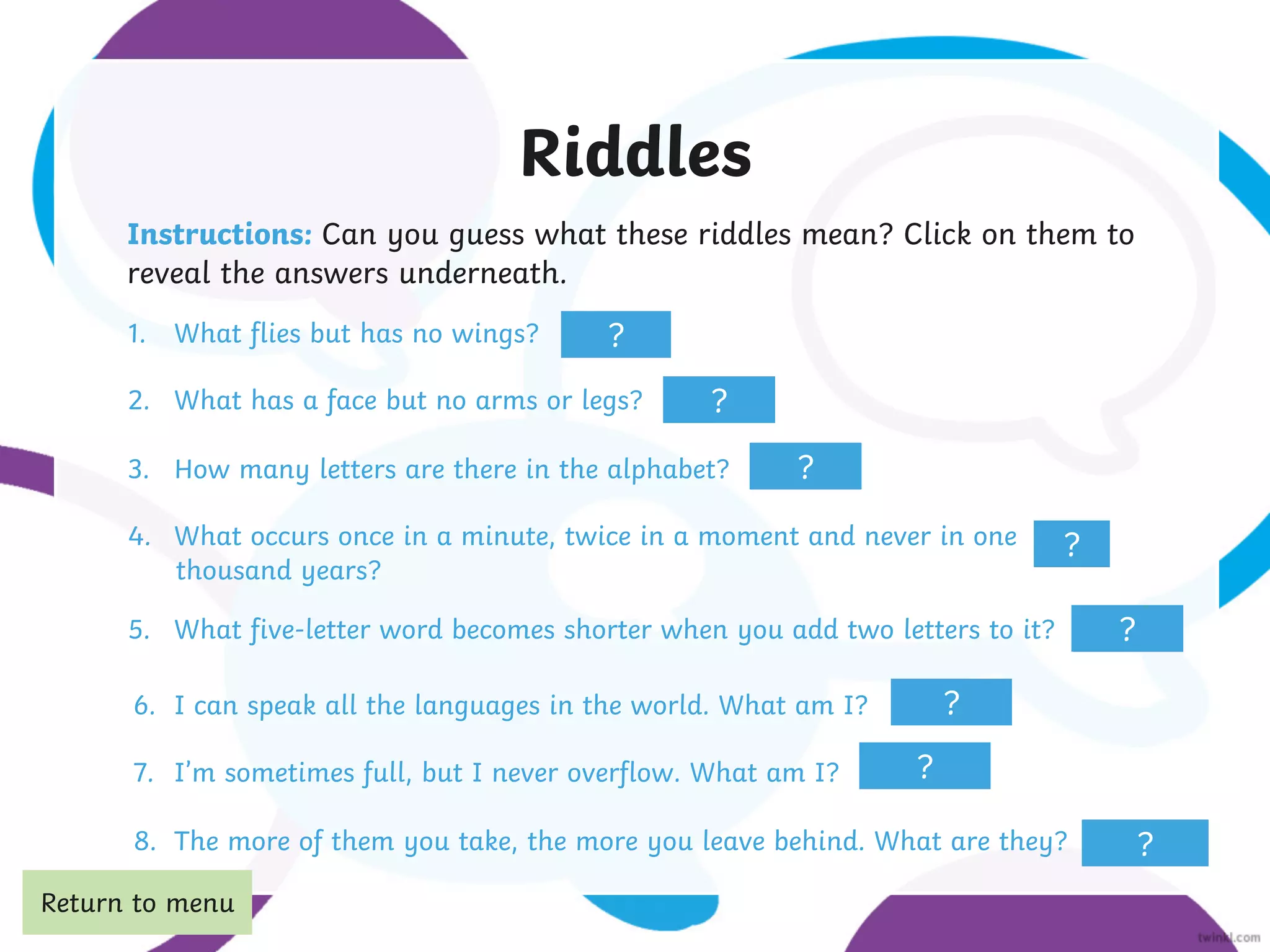
Riddles
Instructions: Can you guess what these riddles mean? Click on them to
reveal the answers underneath.
1. What flies but has no wings?
2. What has a face but no arms or legs?
3. How many letters are there in the alphabet?
4. What occurs once in a minute, twice in a moment and never in one
5. What five-letter word becomes shorter when you add two letters to it?
6. I can speak all the languages in the world. What am I?
7. I’m sometimes full, but I never overflow. What am I?
8. The more of them you take, the more you leave behind. What are they?
time
?
a clock
eleven
thousand years?
m
short
footsteps
the Moon
an echo
?
?
?
?
?
?
?
Return to menu
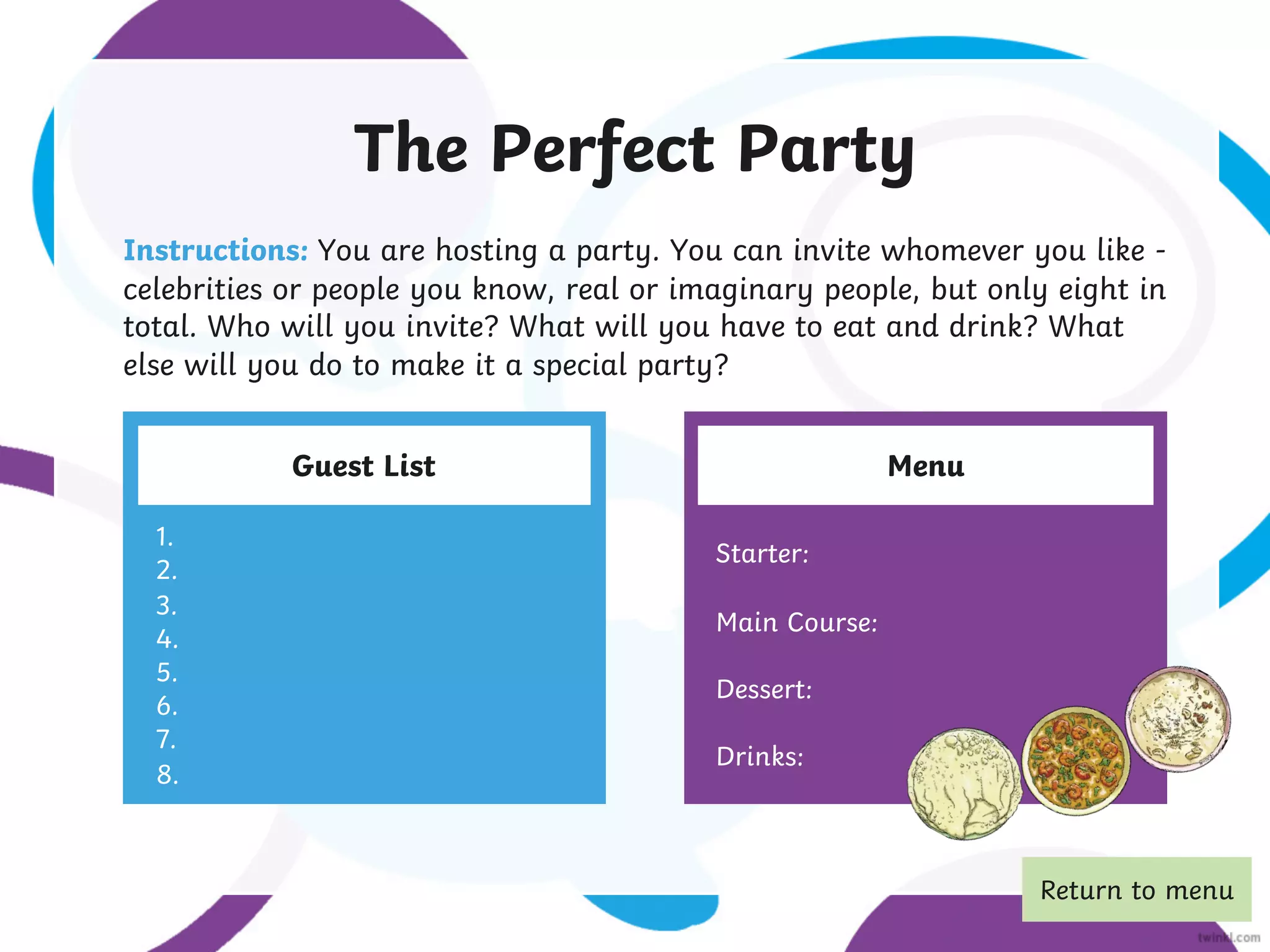
The Perfect Party
Instructions: You are hosting a party. You can invite whomever you like -

celebrities or people you know, real or imaginary people, but only eight in
total. Who will you invite? What will you have to eat and drink? What
else will you do to make it a special party?
Guest List Menu
1.
2.
3.
4.
5.
6.
7.
8.
Starter:
Main Course:
Dessert:
Drinks:
Return to menu
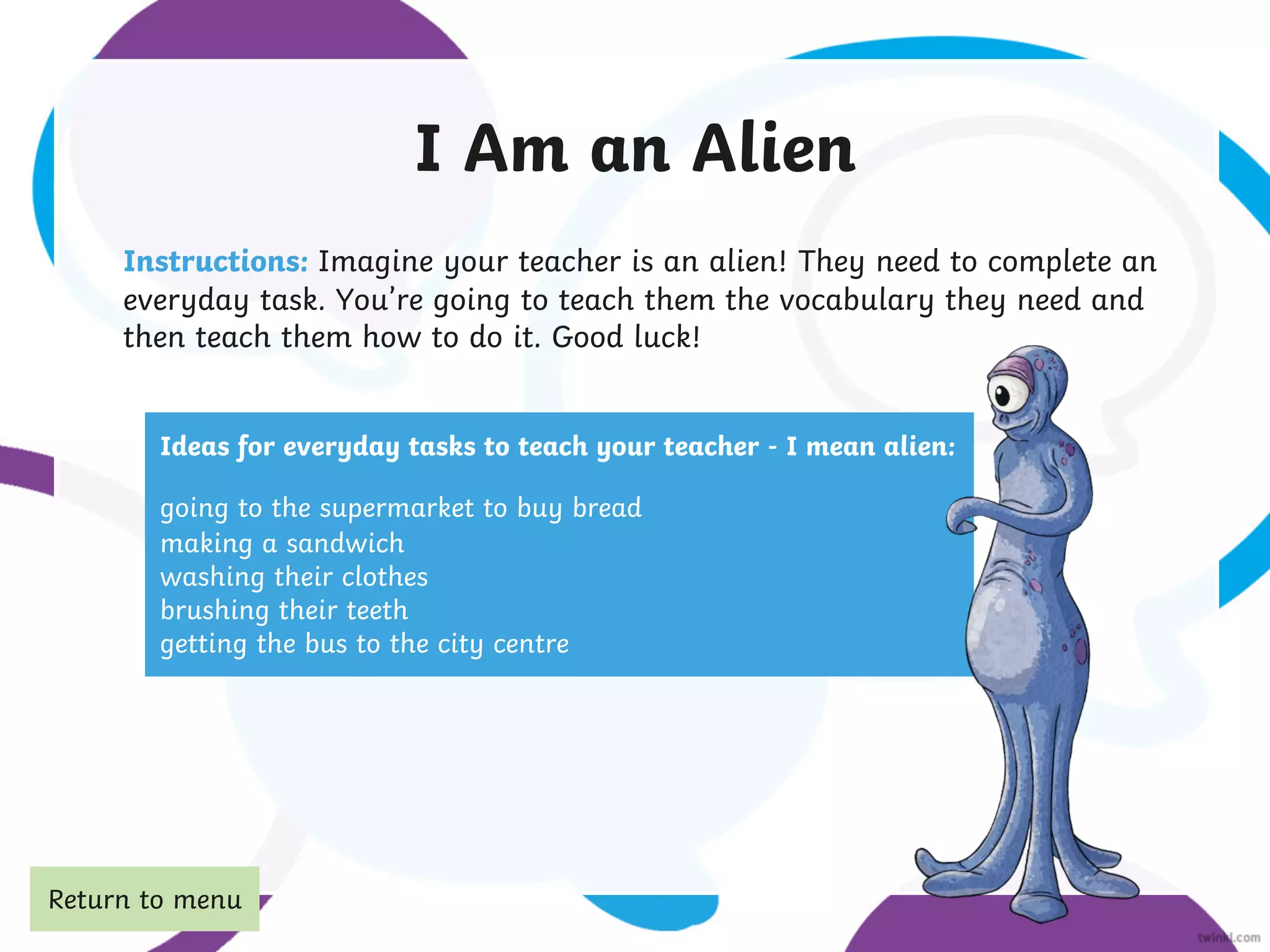
I Am an Alien
Instructions: Imagine your teacher is an alien! They need to complete an
everyday task. You’re going to teach them the vocabulary they need and
then teach them how to do it. Good luck!
Ideas for everyday tasks to teach your teacher - I mean alien:
going to the supermarket to buy bread
making a sandwich
washing their clothes
brushing their teeth
getting the bus to the city centre
Return to menu
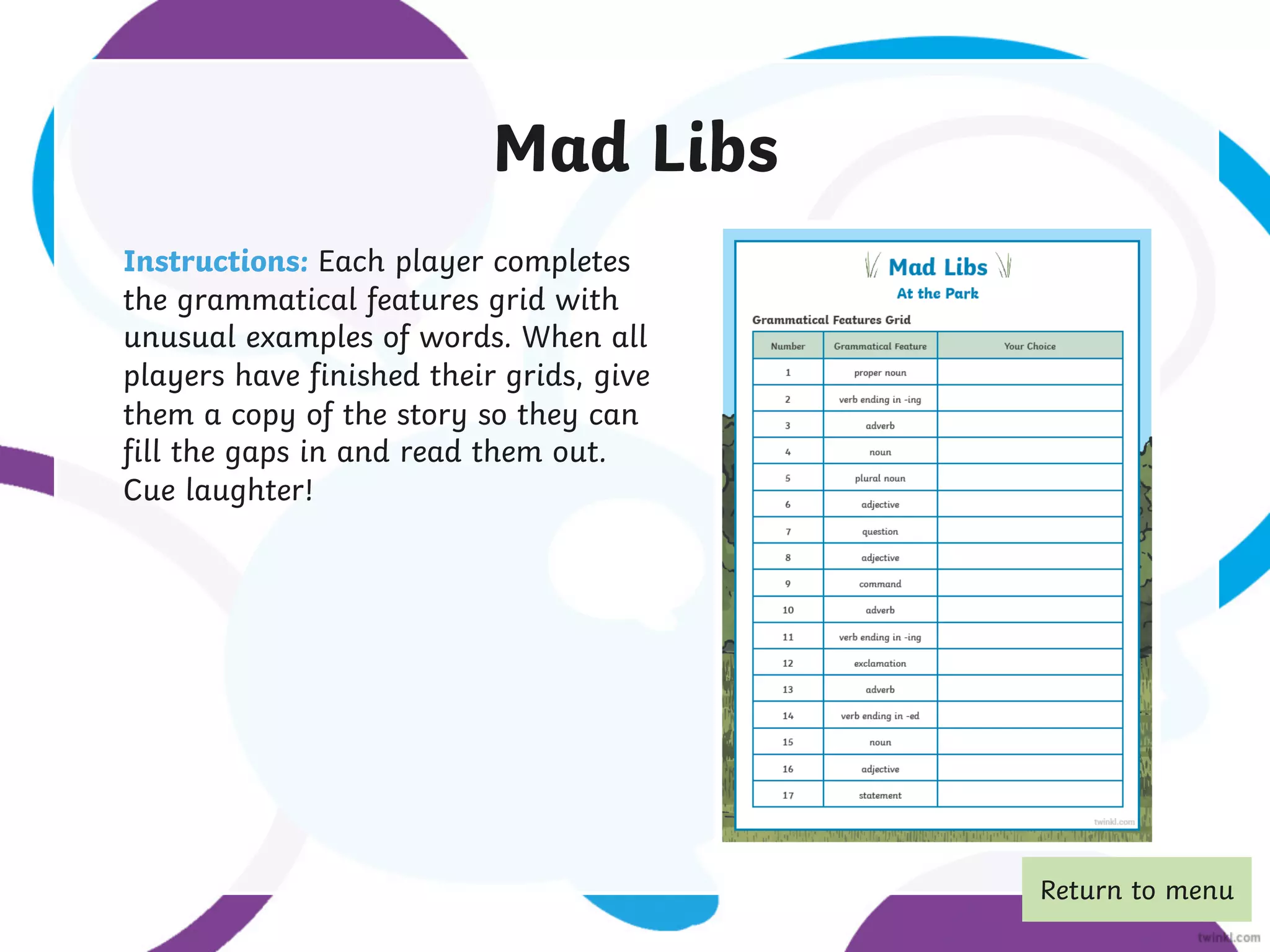
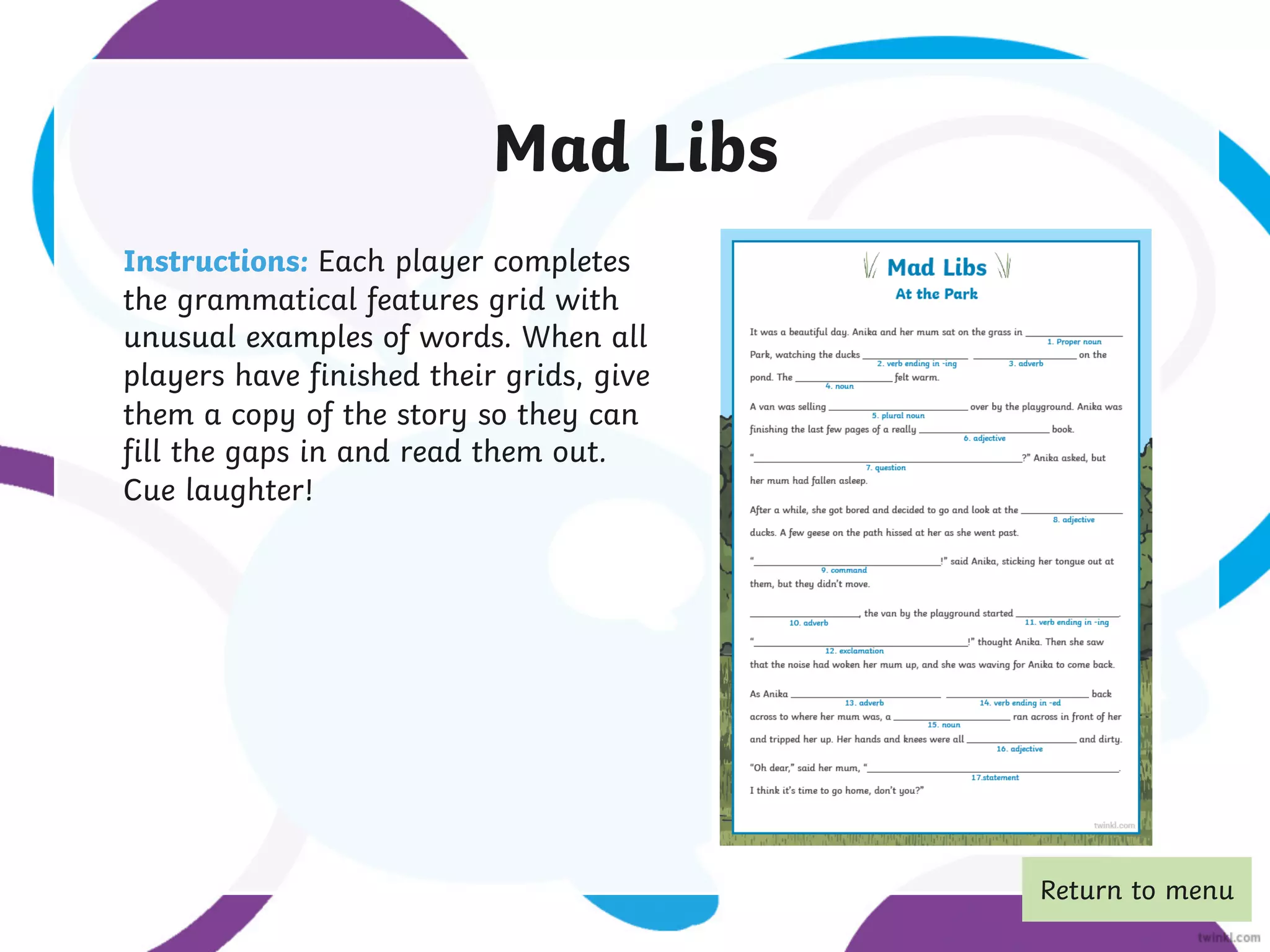
Mad Libs
Instructions: Each player completes
the grammatical features grid with
unusual examples of words. When all
players have finished their grids, give
them a copy of the story so they can
fill the gaps in and read them out.
Cue laughter!
Return to menu
Mad Libs
Instructions: Each player completes
the grammatical features grid with
unusual examples of words. When all
players have finished their grids, give
them a copy of the story so they can
fill the gaps in and read them out.
Cue laughter!
Return to menu
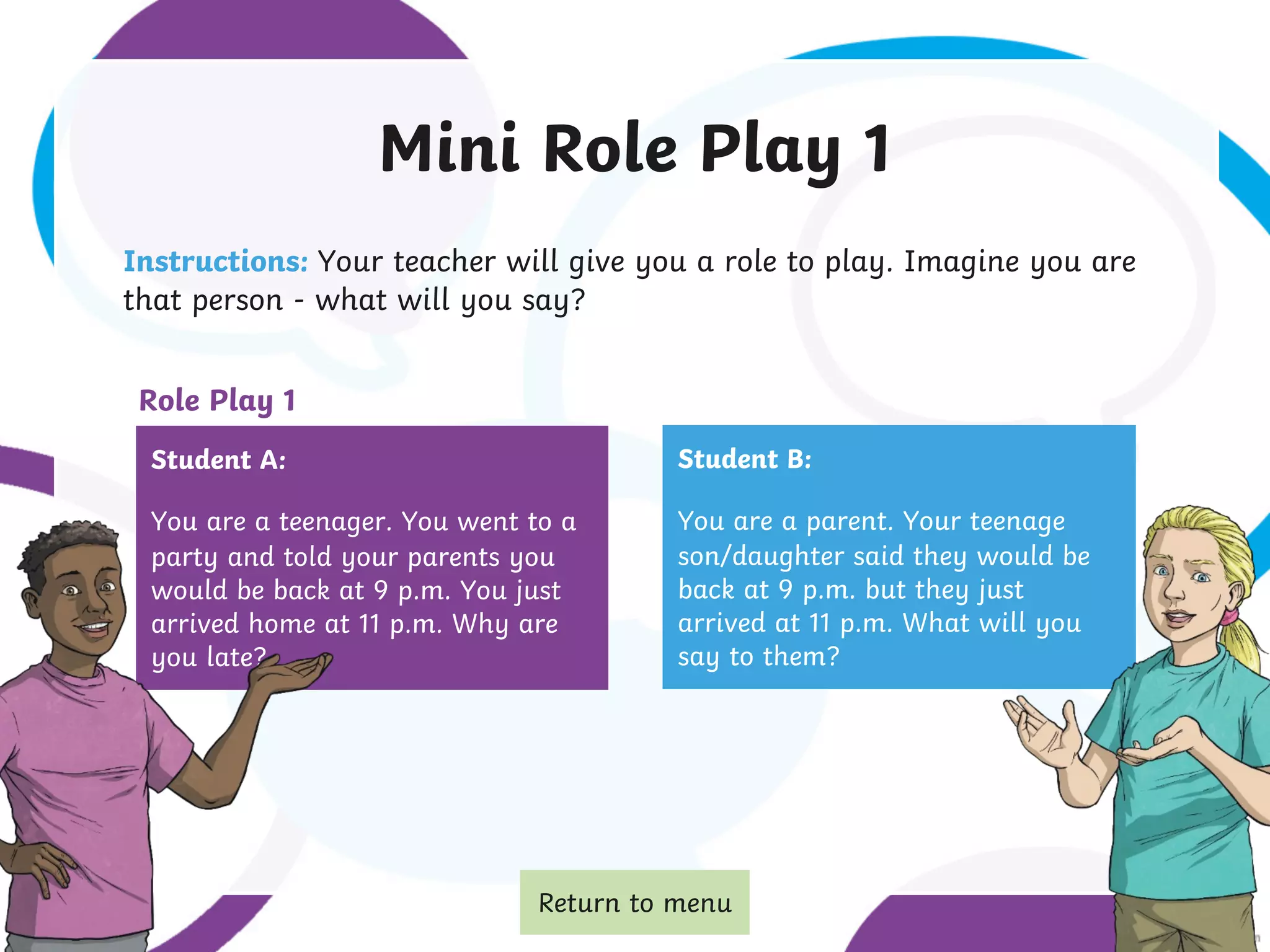
Mini Role Play 1
Instructions: Your teacher will give you a role to play. Imagine you are
that person - what will you say?
Student A:
You are a teenager. You went to a
party and told your parents you
would be back at 9 p.m. You just
arrived home at 11 p.m. Why are
you late?
Student B:
You are a parent. Your teenage
son/daughter said they would be
back at 9 p.m. but they just
arrived at 11 p.m. What will you
say to them?
Role Play 1
Return to menu
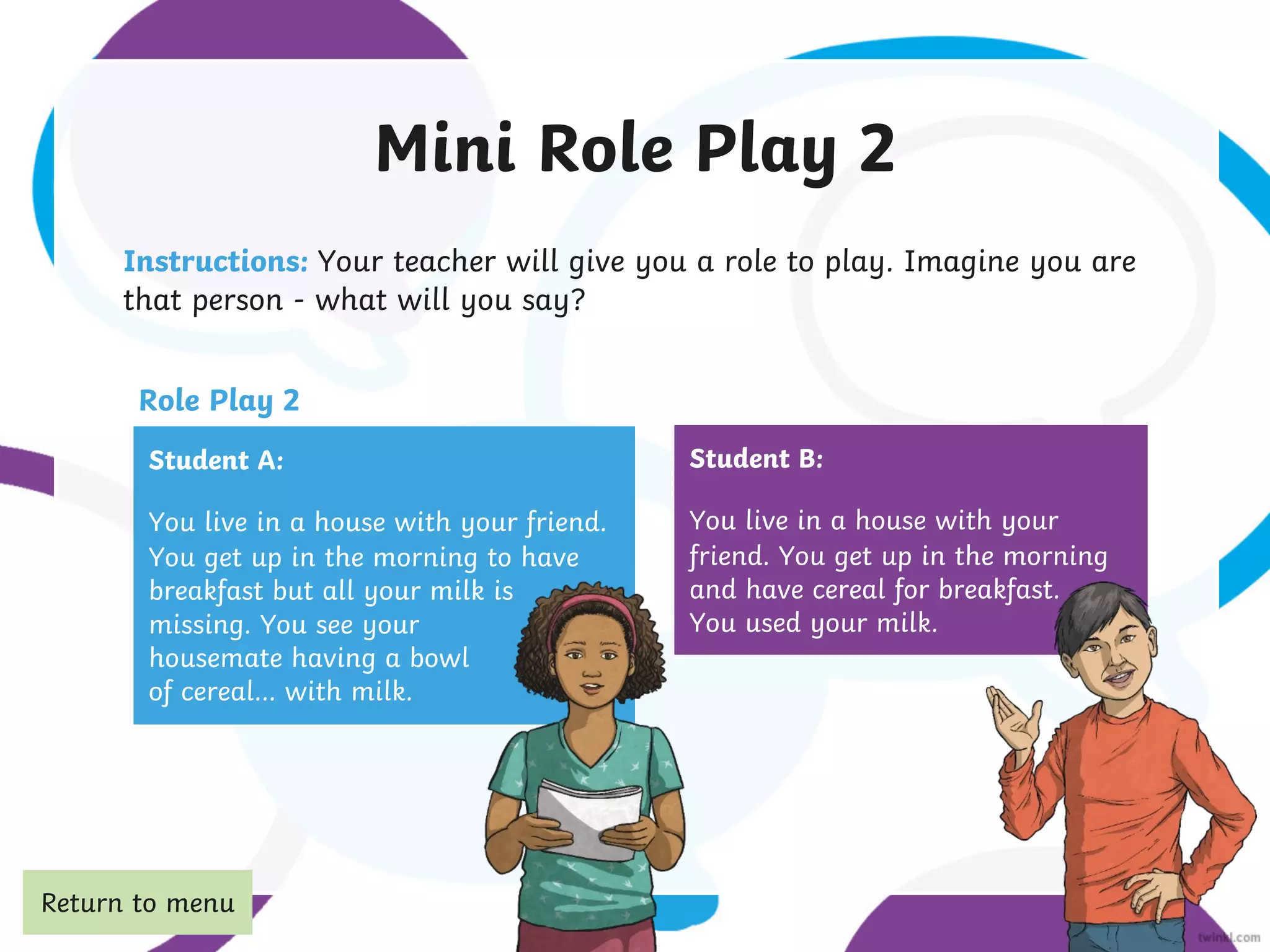
Mini Role Play 2
Instructions: Your teacher will give you a role to play. Imagine you are
that person - what will you say?
Student A:
You live in a house with your friend.
You get up in the morning to have
breakfast but all your milk is
missing. You see your
housemate having a bowl
of cereal… with milk.
Student B:
You live in a house with your
friend. You get up in the morning
and have cereal for breakfast.
You used your milk.
Role Play 2
Return to menu
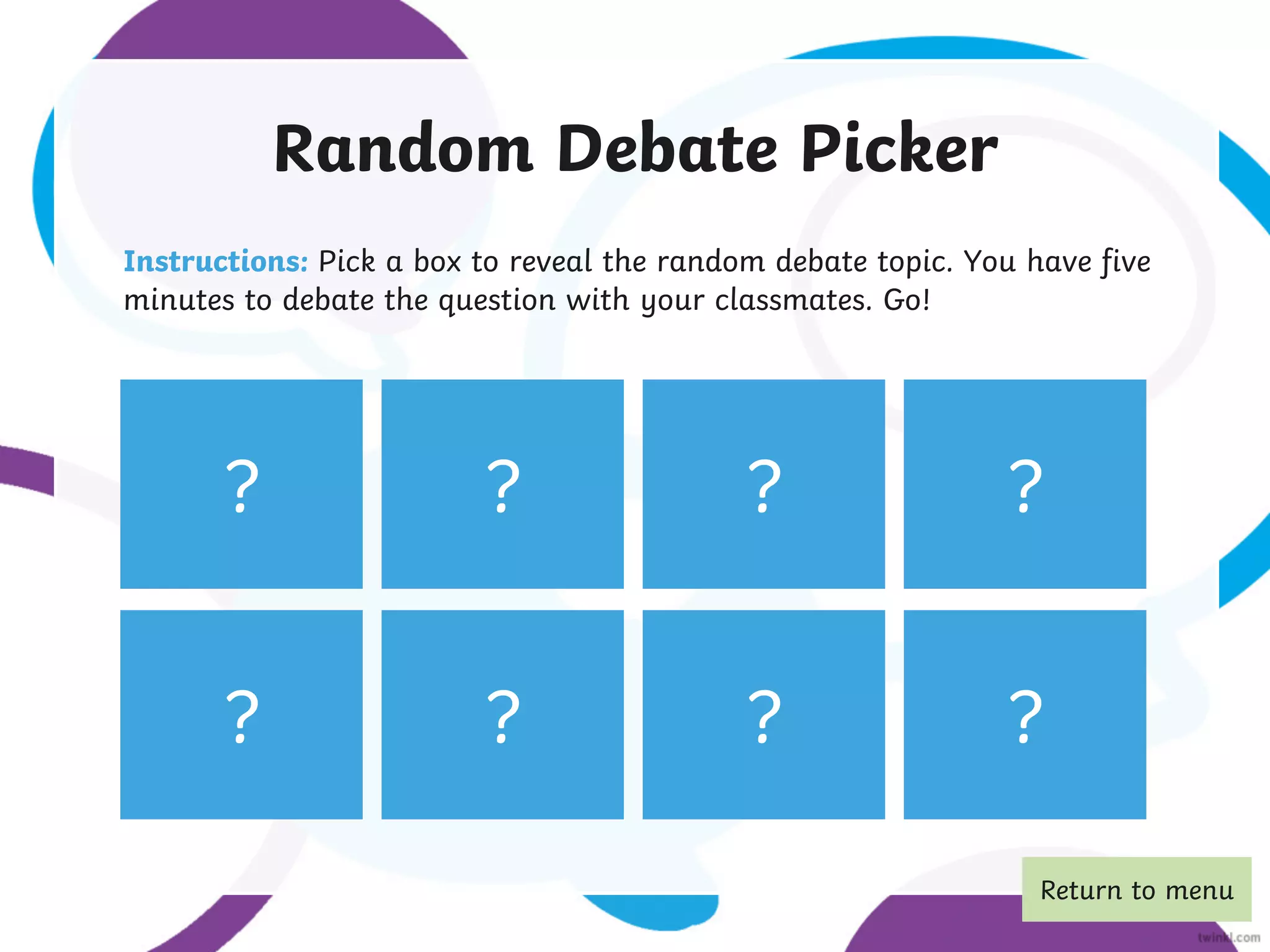
Random Debate Picker
Instructions: Pick a box to reveal the random debate topic. You have five
minutes to debate the question with your classmates. Go!
We should limit
the number of
clothes people are
allowed to buy.
Social media
should be turned
off at 11 p.m. so
people will sleep.
We should release
all animals in zoos
into the wild.
Children should
be allowed to
vote.
Cats are better
pets than dogs.
We should all
become
vegetarian.
We should do all
school outside for
half the day.
We should all
have to learn
three languages.
? ? ? ?
? ? ? ?
Return to menu
speaking-challenges

speaking-challenges

  • 2.
    Welcome to ourcollection of speaking games! They are specially made for online classes, but also work for socially distanced or in-person classes generally. Teacher Instructions Use the menu to navigate, or pick a game with the random game generator. The instructions for each game are on each slide. The games start easy (A1 level) and get more difficult (B2 level and above).
  • 3.
    Game List 1. FishFingers! 2. What’s the Object? 3. Shopping List 4. Count to 21 5. Categories 6. Find Something... 7. Quick-Change Artist 8. Odd One Out 9. Two Truths and a Lie 10. What Can You Guess about Me? 11. The Two-Minute Weekend 12. Liar, Liar, Pants on Fire 13. Tongue Twisters 14. Map Adventure 15. One-Word Stories 16. Fortunately, Unfortunately 17. The Expert 18. Yes/No Game 19. What Can You Do with It? 20. And Then... 21. Would You Rather? 22. Interview a Celebrity 23. Picture Prompt 24. Roll of the Dice Story 25. Desert Island 26. Riddles 27. The Perfect Party 28. I Am an Alien 29. Mad Libs 30. Mini Role Play 31. Random Debate Picker
  • 4.
    Surprise Me! The RandomGame Generator ? ? ? ? ? ? ? ? ? ? ? ? ? ? ? ? ? ? ? ? ? ? ? ? ? ? ? ? ? ? ?
  • 5.
    Fish Fingers! Instructions: Allstudents must close their eyes or move off-screen. One student says ‘fish fingers’ in their silliest voice (try singing, using a robot voice, saying it really high or low). The other students in the group have to guess who said ‘fish fingers’. Return to menu
  • 6.
    What’s the Object? Instructions:Look at the parts of different objects. What do you think they are? Make sentences with ‘could’ - ‘It could be a…’ - and your teacher will reveal the object. Extra challenge: Bring your own object to class and show a corner on the screen. Can your classmates guess what it is? Return to menu
  • 7.
    Shopping List Instructions: Onestudent starts a sentence with ‘I went to town and I bought…’ and says an object, e.g. ‘a picture’. The next student must remember that object and add their own, e.g. ‘I went to town and I bought a picture and a car.’ Continue for as long as you can. For extra points, see if you can do it in alphabetical order. Example: I went to town and I bought a picture. I went to town and I bought a picture and a car. I went to town and I bought a picture, a car and a banana. I went to town and I bought a picture, a car, a banana and a cactus. Return to menu
  • 8.
    Count to 21 Instructions:The aim of the game is to count from 1 to 21. Any student can say a number at any time, but if two students speak at the same time, they have to start again. 1 2 3 4 5 Return to menu
  • 9.
    wild animals colours subjectsat school objects in the house things in your backpack superheroes colours countries capital cities things you see at the beach words beginning with ‘h’ jobs drinks fruit pets Categories Instructions: Take turns in alphabetical order of your names or go round in a circle naming examples of things in that category. The first student who can’t name one is out of the game. ? ? ? ? ? ? ? ? ? ? ? ? ? ? ? vegetables ? Return to menu
  • 10.
    Find something wooden. Find asoft toy. Find a spoon. Find something you wear on your head. Find a paintbrush. Find a key. Find a potato. Find a photo. Find something yellow. Find Something... Instructions: Click on the box to choose a category. As fast as you can (or for your next class), find an object that fits that description. Then, answer the questions. Now, invent your own categories! ? ? ? ? ? ? ? ? ? What does your object look like? What can you do with it? Is it special? Why? Do you know where it’s from? Return to menu
  • 11.
    Quick-Change Artist Instructions: Astudent from the group is chosen (the quick-change artist). All the students look closely at that student’s clothes and/or background. Then, all the students shut their eyes, (or, if you're playing online, the quick-change artist could briefly turn off their camera) and the quick- change artist changes something about their appearance or background. Maybe they move an object, or put on a hat. Then the other students have to say what’s changed. The first one to guess is the next quick-change artist. Return to menu
  • 12.
    Eggs aren’t made frommilk. Swimming isn’t a ball sport. A car isn’t an emergency vehicle. Odd One Out Instructions: Which one is different? Why? Can you make your own list of four where one thing is different? ? ? ? A grape isn’t a citrus fruit. ? Return to menu
  • 13.
    Two Truths anda Lie Instructions: Write down three ‘facts’ about yourself - two things that are true, one thing that is a lie. Tell your classmates what you wrote. Can they guess which one is a lie? They might ask you some extra questions. Return to menu
  • 14.
    What Can YouGuess about Me? Instructions: Use the topics to make sentences about your classmates (e.g. I think Beth has a pet hamster) and then ask questions to see if you’re correct. The person with the most correct guesses wins! brothers and sisters pets sports favourite subjects hobbies books and films food and drink Return to menu
  • 15.
    The Two-Minute Weekend Instructions:Students can work in pairs, or as a group. One student (A) describes everything they did at the weekend as quickly as possible, and the other students (B) interrupt with questions to keep them talking. For example, if student A says ‘I ate breakfast’, student B might ask ‘What did you eat?’ or ‘What time did you have breakfast?’. If student A is still talking at the end of two minutes, student B is the winner. Return to menu
  • 16.
    Liar, Liar, Pantson Fire! Instructions: Ask and answer the questions. The answer to the question has to be ‘Yes!’ even if this is a lie. The other students will ask follow-up questions to find out more, e.g. ‘When did you go there?’ and say if they think this student is telling the truth or is a ‘liar, liar, pants on fire’. been camping on a mountain? eaten an insect? pretended to be ill? been shopping by yourself? caught a fish? dreamt you were at school? climbed a tree? planted a tree? seen a snake? forgotten to wash your gym clothes? pretended to be asleep so you could read late at night? Have you ever… Return to menu
  • 17.
    Tongue Twisters Instructions: Saythese slowly, then faster. How fast can you say them? How many times? 1. Not these things here, but those things there 2. She sells seashells by the seashore. 3. Red lorry, yellow lorry 4. Copper-bottomed coffee pot 5. I saw a kitten eating chicken in the kitchen. 6. She sees cheese. 7. Black background, brown background 8. How much wood would a woodchuck chuck if a woodchuck could chuck wood? Return to menu
  • 18.
    Map Adventure Instructions: Choosea city to explore on an online map. Move through the city using instructions (e.g. turn left, turn right) and ask questions: What’s that? How many (people) can you see? How would you describe this? What’s the word for that in English? What are people doing here? Return to menu
  • 19.
    One-Word Stories Instructions: Makea story together! Students can only say one word each to add to the story. Example: One day a big dinosaur went to school ... Return to menu
  • 20.
    Fortunately, Unfortunately Instructions: Onestudent starts a story with just one sentence. The next student has to continue the story, starting their sentence with ‘fortunately’. The next student continues the story with a new sentence starting with ‘unfortunately’. Then, back to ‘fortunately’ and so on. Example: One day, Bob woke up. Fortunately, it was a Sunday and he could stay in bed. Unfortunately, there was a storm outside and water was pouring in through his window. Fortunately, all he had to do was get up and close the window. Unfortunately, when he got up, he saw that there was a tiger next to the window! Fortunately… Return to menu
  • 21.
    The Expert Instructions: Nominatea student. The student has to choose a topic and talk about it for 30 seconds (or longer) as if they were the expert. If they can, they gain a point! the sea social media Australian animals sleep famous singers Olympic sports superheroes books shopping languages pizza ? ? ? ? ? ? ? ? ? ? ? Return to menu
  • 22.
    Yes/No Game Instructions: Studentsask questions to a nominated classmate. The nominated student is not allowed to answer the questions with ‘yes’ or ‘no’ - they have to use other words instead. When they do use ‘yes’ or ‘no’, another student is chosen. Examples: “Are you from Spain?” “I have never been to Spain, and in fact I was born in Italy.” “Is your name Gabriel?” “People have never called me Gabriel, because my name is Thomas.” YES NO Return to menu
  • 23.
    What Can YouDo with It? Instructions: Choose an object and try and think of as many things as possible that you could use it for. The winner is the student or group who can think of the most, so be as creative as possible! Example: What can you do with a plate? You can eat off it. You can use it as a frisbee. You can cover food with it in the microwave. You can draw a circle with it. You can keep the rain off your head with it. You can put a plant pot on it. brick paperclip big cardboard box pillowcase tree guitar slime cactus Return to menu
  • 24.
    And Then... Instructions: Onestudent starts a story. The next student continues the story with one sentence, starting with ‘and then’. The next student continues with a sentence starting ‘and then…’ And so on. Example: There once was a very hungry hamster. And then he saw some food outside of his cage. And then he opened the door of his cage and went outside. And then he saw a cat! And then… And Then... Return to menu
  • 25.
    Would You Rather? Instructions:Click on the boxes to reveal the questions. Ask and answer the questions with your partner or class. Give the reasons for your opinion. Then, think of your own questions. Would you rather be a hamster the size of a T. rex, or a T. rex the size of a hamster? ? Would you rather eat worms or a snail? Would you rather live on a tropical island or in a city? Would you rather live in a treehouse or underground? Would you rather be able to fly or be able to become invisible? Would you rather go to the North Pole or the Sahara? Would you rather sing on stage or do extra maths homework? Would you rather have a pet dragon or a pet unicorn? ? ? ? ? ? ? ? Return to menu
  • 26.
    Interview a Celebrity Instructions:Think of a celebrity you’d like to meet one day. It can be a real or imaginary person, alive or dead. Think of five questions you would ask them. One student will then pretend to be the celebrity and answer the questions ‘in character’. Return to menu
  • 27.
    Picture Prompt Instructions: Choosea picture. What’s happening in the story? What happened before? What’s going to happen next? Return to menu
  • 28.
    Roll of theDice Story Instructions: Choose one of the storyboards. Roll a dice four times - once for each row. Select the element from each row which corresponds to the number rolled. Then, use all the elements to make a story together. Return to menu
  • 29.
    Desert Island Instructions: Imagineyou are going to a desert island for a year. You can only take five objects with you. What do you choose? Here are some ideas... Return to menu
  • 30.
    Riddles Instructions: Can youguess what these riddles mean? Click on them to reveal the answers underneath. 1. What flies but has no wings? 2. What has a face but no arms or legs? 3. How many letters are there in the alphabet? 4. What occurs once in a minute, twice in a moment and never in one 5. What five-letter word becomes shorter when you add two letters to it? 6. I can speak all the languages in the world. What am I? 7. I’m sometimes full, but I never overflow. What am I? 8. The more of them you take, the more you leave behind. What are they? time ? a clock eleven thousand years? m short footsteps the Moon an echo ? ? ? ? ? ? ? Return to menu
  • 31.
    The Perfect Party Instructions:You are hosting a party. You can invite whomever you like - celebrities or people you know, real or imaginary people, but only eight in total. Who will you invite? What will you have to eat and drink? What else will you do to make it a special party? Guest List Menu 1. 2. 3. 4. 5. 6. 7. 8. Starter: Main Course: Dessert: Drinks: Return to menu
  • 32.
    I Am anAlien Instructions: Imagine your teacher is an alien! They need to complete an everyday task. You’re going to teach them the vocabulary they need and then teach them how to do it. Good luck! Ideas for everyday tasks to teach your teacher - I mean alien: going to the supermarket to buy bread making a sandwich washing their clothes brushing their teeth getting the bus to the city centre Return to menu
  • 33.
    Mad Libs Instructions: Eachplayer completes the grammatical features grid with unusual examples of words. When all players have finished their grids, give them a copy of the story so they can fill the gaps in and read them out. Cue laughter! Return to menu
  • 34.
    Mad Libs Instructions: Eachplayer completes the grammatical features grid with unusual examples of words. When all players have finished their grids, give them a copy of the story so they can fill the gaps in and read them out. Cue laughter! Return to menu
  • 35.
    Mini Role Play1 Instructions: Your teacher will give you a role to play. Imagine you are that person - what will you say? Student A: You are a teenager. You went to a party and told your parents you would be back at 9 p.m. You just arrived home at 11 p.m. Why are you late? Student B: You are a parent. Your teenage son/daughter said they would be back at 9 p.m. but they just arrived at 11 p.m. What will you say to them? Role Play 1 Return to menu
  • 36.
    Mini Role Play2 Instructions: Your teacher will give you a role to play. Imagine you are that person - what will you say? Student A: You live in a house with your friend. You get up in the morning to have breakfast but all your milk is missing. You see your housemate having a bowl of cereal… with milk. Student B: You live in a house with your friend. You get up in the morning and have cereal for breakfast. You used your milk. Role Play 2 Return to menu
  • 37.
    Random Debate Picker Instructions:Pick a box to reveal the random debate topic. You have five minutes to debate the question with your classmates. Go! We should limit the number of clothes people are allowed to buy. Social media should be turned off at 11 p.m. so people will sleep. We should release all animals in zoos into the wild. Children should be allowed to vote. Cats are better pets than dogs. We should all become vegetarian. We should do all school outside for half the day. We should all have to learn three languages. ? ? ? ? ? ? ? ? Return to menu