746ᮊ 2003 Estuarine Research Federation
Estuaries Vol. 26, No. 3, p. 746–758 June 2003
The Effects of Introduced Water Hyacinth on Habitat Structure,
Invertebrate Assemblages, and Fish Diets
JASON D. TOFT1,
*, CHARLES A. SIMENSTAD1
, JEFFERY R. CORDELL1
, and LENNY F. GRIMALDO2
1
School of Aquatic and Fishery Sciences, University of Washington, P. O. Box 355020, Seattle,
Washington 98195-5020
2
California Department of Water Resources, 3251 S Street, Sacramento, California 95816
ABSTRACT: The South American floating aquatic plant water hyacinth (Eichhornia crassipes) has a history of worldwide
invasions, including a 1904 introduction into the Sacramento-San Joaquin Delta, California. The native pennywort (Hy-
drocotyle umbellata) occupies similar habitats in the Delta and is extensively used by resident invertebrates and fish. We
sought to discover if an invader would be functionally equivalent to the native plant, by asking whether the encroaching
hyacinth modified the invertebrate assemblage structure and fish-invertebrate food web relative to pennywort. We sam-
pled epiphytic, epibenthic, and benthic invertebrates, and plant canopy insects in patches of hyacinth and pennywort,
and analyzed fish diets at three sites in the Delta during 1998. We also measured habitat structure (leaf density, root
biomass, and surface area). In 1999, following control and absence of hyacinth, we again measured epiphytic invertebrates
in pennywort. We found differences between hyacinth and pennywort in structure, associated invertebrates, and fish
diets. Most measurements inferred functional non-equivalency between hyacinth and pennywort, although some func-
tional equivalency and natural variation existed. Leaf and insect densities were significantly higher in pennywort and
there were also significant differences in insect assemblage compositions. Hyacinth roots in the water column had sig-
nificantly more surface area. Densities of epibenthic and benthic aquatic invertebrates were typically greater in pennywort
and taxonomic compositions of aquatic invertebrate assemblages showed significant differences. Amphipods and isopods
living epiphytically in the root masses were particularly abundant, including several newly discovered introduced species:
the amphipod Crangonyx floridanus and the isopods Caecidotea racovitzai and Asellus hilgendorfii. The native amphipod
Hyalella azteca was more abundant in pennywort and heavily preyed upon by fish, while the non-indigenous C. floridanus
was more abundant in hyacinth and not prevalent in fish diets. The introduction of hyacinth to the Delta has caused
significant ecological alterations in the surrounding community, due to hyacinth being functionally different from native
patches of pennywort.
Introduction
Ecological theory predicts that non-indigenous
species that will have the most impact are those
that represent something fundamentally new to a
given system (Simberloff 1991; Ruesink et al. 1995;
Parker et al. 1999). Although this appears to be
most often the case, we sought to illuminate wheth-
er an invader that was similar in appearance to a
common native could be non-equivalent in its
function. Floating aquatic vegetation (FAV) cano-
pies of the non-indigenous water hyacinth (Eichhor-
nia crassipes) in the Sacramento-San Joaquin Delta
of California are fundamentally similar to those of
the native pennywort (Hydrocotyle umbellata), as
both form canopies of floating vegetation. Al-
though hyacinth and pennywort form similar
patches of floating vegetation, it is a question
whether or not they are functional equivalents—
providing similar functions to the surrounding bi-
otic community. We compared the habitat struc-
* Corresponding author: tele: 206/221-5460; fax: 206/685-
7471; e-mail: tofty@u.washington.edu.
ture, invertebrate assemblages, and diets of fish as-
sociated with hyacinth and pennywort in order to
determine whether or not they were functional
equivalents.
Comparative studies of functional equivalency
are often used to test how human-altered systems
compare to natural states, such as in restored wet-
lands (Simenstad and Thom 1996) or transplanted
seagrass beds (Williams and Davis 1996). Specific
tests of the functional role of non-indigenous spe-
cies relative to natives are rare. One such test in a
terrestrial system (Stromberg 1998) has shown that
there can be some functional redundancy (West-
man 1990), while other tests show significant alter-
ations (Vitousek 1986). Filling such gaps in our
knowledge is important, as invasive species are of-
ten difficult if not impossible to keep under con-
trol (Drake and Mooney 1989), and the congruent
ecological impacts of specific invaders are not well
known (Parker et al. 1999). If we can uncover such
ecological effects, we can better manage and pre-
dict the fates of current and future biological in-
vasions.
Hyacinth is native to Brazil and has become
The Effects of Introduced Water Hyacinth 747
widespread on a global scale, first being intro-
duced to the Sacramento River in California by or-
namental pond enthusiasts in 1904 (Finlayson
1983; Gopal 1987). Once the plants are introduced
they rapidly increase in coverage, as hyacinth has
the highest growth rate of any saltwater, freshwater,
or terrestrial vascular macrophyte (Wolverton and
McDonald 1978). In the Delta, hyacinth covered
506 ha or 22% of the waterways by 1981 (Finlayson
1983). Such prevalence sparked an extensive
chemical control program headed by the Califor-
nia Department of Boating and Waterways (CDBW
1998), which actively controls coverage of hyacinth
by spraying the chemical 2,4-D. As a result of these
efforts, the extensive mats found especially in trop-
ical climates (Gopal 1987) were controlled during
the course of our study, and patches of hyacinth
and pennywort were similar in coverage.
In many systems hyacinth is an ecosystem engi-
neer (Jones et al. 1997; Crooks and Khim 1999),
modifying the surrounding habitat by providing a
structurally complex canopy. In addition to form-
ing a dense floating mat, roots hanging in the wa-
ter column and leaves projecting above the water
surface provide complex structures that can be in-
habited by other species. Organic deposition from
the canopy can cover the underlying benthic zone,
leading to low dissolved oxygen levels (Gopal
1987). Effects of these characteristics on commu-
nity dynamics when hyacinth coexists with native
FAV counterparts are unknown, and are often a
subject of curiosity among investigators (Gopal
1987; Masifwa et al. 2001).
FAV can be beneficial as a nursery habitat for
juvenile fishes and invertebrates (Werner and Hall
1979; Gopal 1987; Schramm and Jirka 1989; Dibble
et al. 1996). Roots hanging down into the water
column are important as habitat for epiphytic in-
vertebrates, especially amphipods (Schramm et al.
1987). Epiphytic invertebrates are typically much
more abundant than benthic and epibenthic in-
vertebrates, and their densities are positively cor-
related to the amount of FAV surface area available
for colonization (Crowder and Cooper 1982;
Schramm et al. 1987). Fish such as bluegills (Le-
pomis macrochirus) selectively feed on epiphytic in-
vertebrates over other sources of prey (Werner and
Hall 1979; Schramm and Jirka 1989). The effects
of hyacinth on the fish-invertebrate food web in
the Delta could be pervasive due to the promi-
nence of hyacinth in shallow water areas.
Pennywort is the predominant native FAV in the
Delta. Although pennywort and hyacinth both
form floating canopies and tend to occupy similar
habitats, we hypothesize that a hyacinth invasion
could alter key habitat structure components, lead-
ing to surrounding community alterations. Such
effects may not be as readily apparent compared
to invaders that either occupy vacant niches and
substantially modify the existing environment,
such as introductions of fish predators when native
piscivores are absent (Brown and Moyle 1991), or
mussel invasions into mudflats previously uninhab-
ited with mussel mats (Crooks and Khim 1999).
Our research sought to illuminate any community
alterations caused by the hyacinth invasion.
Methods
STUDY AREA
Our three study sites were located in the central
and western Sacramento-San Joaquin Delta of Cal-
ifornia: Site A (Mandeville Tip, 38.0Њ4ЈN,
121Њ32ЈW), Site B (Brown’s Island, 38.0Њ2ЈN,
121Њ52ЈW), and Site C (Mildred Island, 37.0Њ59ЈN,
121Њ31ЈW). These sites were chosen because they
contained discrete patches of both hyacinth and
pennywort. The Delta is heavily influenced by hu-
man activity, including agricultural, recreational,
and industrial activities (Nichols et al. 1986). His-
torically, the Delta was almost all wetlands charac-
terized by tule vegetation (Scirpus spp.) with some
natural levees and riparian habitat (woody vegeta-
tion, mostly Salix spp.; TBI 1998). Approximately
95% of these wetlands have been leveed and
drained predominantly for agricultural purposes,
and the majority of the Delta’s remaining historic
channels are rip-rapped and constrained (TBI
1998). Although salt water historically entered the
Delta, current water management attempts to pre-
vent this, mainly through controlled water flows
that increase freshwater inflow during summer
months to maintain freshwater available for irri-
gation and drinking purposes (Nichols et al. 1986).
Benthic sediments in the Delta are an unconsoli-
dated mixture of sand, silt, and clay (Hymanson et
al. 1994). Tidal influence ranges between 1 to 2 m
(CDWR 1993).
STUDY DESIGN
Healthy FAV patches not chemically controlled
with 2,4-D were sampled in areas that bordered a
marsh. Habitat structure measurements and inver-
tebrate samples were collected in 5 patches of both
hyacinth and pennywort at each site. Patches were
chosen by a random number generator corre-
sponding to the patch number along a transect
drawn parallel to shore (Fig. 1). These patches oc-
cupied indentations in the marsh and were gen-
erally separated by clumps of tule vegetation.
Patches were fairly small and discrete (30.96 m2
average surface area, 3.92 SE) and were used only
if they formed a fringe along the marsh, not if they
occupied an entire channel. Since the overall size
and shape of the patches could not be controlled
748 J. D. Toft et al.
Fig. 1. Illustration of a typical sampling design at a study site.
Shallow water is light gray, tule marsh (Scirpus spp.) is hatched,
H ϭ hyacinth patches, and P ϭ pennywort patches. Circled
patches are those randomly selected for sampling along a tran-
sect south to north (patches 1, 3, 6, 7, 8 for hyacinth; 1, 4, 5,
8, 10 for pennywort). Inset is the specific location of sample
collection, 1 m in from the water’s edge at the center of each
patch.
due to the study design of sampling natural patch-
es, we minimalized the natural variation by desig-
nating sampling to the center of each patch, 1 m
in from the water’s edge (Fig. 1). We focused on
the outer edge as other studies have documented
changes in invertebrate communities between the
edge and interior of patches (Bailey and Litterick
1993; Masifwa et al. 2001). Patch edges also offered
higher association with surrounding fish and ease
of access for sampling by boat. Patches of hyacinth
and pennywort were not intermixed, but occasion-
ally bordered each other. All patches were sampled
in approximately 1 m of water, with the roots hang-
ing freely halfway into the water column.
Description of the habitat structure and inver-
tebrate sampling frequency is summarized in Table
1. In 1998, habitat structure and epiphytic inver-
tebrates were sampled in June at Site A, and in
August at Sites B and C. Epibenthic-benthic inver-
tebrates and terrestrial canopy insects were sam-
pled in April, June, and July at Site A and August
at Site B. Sampling was not conducted at Site A
after July as hyacinth patches were exterminated
with chemical control by CDBW.
Hyacinth was absent at all three study sites in
1999, although residual patches remained in inte-
rior marsh channels and boat marinas in the sur-
rounding area. The lack of hyacinth in 1999 was
attributed to intensive chemical spraying by CDBW
during fall and winter 1998 and spring 1999, sev-
eral cold freezes during the winter that caused
high mortality of overwintering plant material, and
high winter outflows that flushed clumps of hya-
cinth out of the Delta into San Francisco Bay. We
took advantage of this unforeseen hyacinth remov-
al experiment by sampling epiphytic invertebrates
in pennywort at all three sites in June 1999. Such
a plan allowed us to measure interannual variation
and to determine if the invertebrate community
changed with the absence of hyacinth. Although
this was an originally unplanned segment of our
research, the issue of the effect of the removal of
non-indigenous species is a vital question in both
research and management (Westman 1990).
PHYSICAL SAMPLING
Intensive sampling of hyacinth and pennywort
habitat structure was conducted in June 1998 at
Site A and in August 1998 at Sites B and C, con-
gruent with epiphytic invertebrate sampling (Table
1). Entire patch surface area was estimated by mea-
suring the maximum length and width of each
patch. Leaf density was measured at the location
of sampling by counting the number of leaves in a
0.5 m2
quadrat (n ϭ 5 siteϪ1
). Roots collected for
epiphytic invertebrate sampling (described below)
were measured for biomass and surface area. Root
wet biomass was measured by blotting the roots dry
with a towel, allowing to air dry for 10 min, and
weighing to the nearest milligram. Root surface
area was measured using the surfactant technique
originally developed by Harrod and Hall (1962). A
soapy solution consisting of 60 ml of Liquinox soap
in 6 l of water was mixed in a bucket and left over-
night so that the bubbles dispersed. For each root
sample, five 1-g subsamples were dipped in the
soapy solution. The excess soap was shaken off so
that a monolayer of soapy solution was retained
around the root surface. Each subsample was then
reweighed. The surface area of the root samples
was determined by regressing the differences in
weight to those measured from the same process
for known surface areas of tinfoil (25, 100, 225,
400, 625, and 900 cm2
; n ϭ 5).
The Effects of Introduced Water Hyacinth 749
TABLE 1. Invertebrate and habitat structure sampling design. Numbers are sample size, blanks indicate no sampling conducted. H
ϭ hyacinth, P ϭ pennywort. Patches of hyacinth were exterminated with chemical control at Site A (Mandeville Tip) in August 1998,
after which sampling was shifted to Sites B and C (Brown’s Island and Mildred Island, respectively). Patches of hyacinth were absent
at all study sites in 1999 (see text).
1998 1999
April
H P
June
H P
July
H P
August
H P
June
H P
Site A, Mandeville Tip
Epiphytic
Epibenthic-Benthic
Insect
Habitat Structure
5
5
5
5
5
5
5
5
5
5
5
5
5
5
5
5
5
Site B, Brown’s Island
Epiphytic
Epibenthic-Benthic
Insect
Habitat Structure
5
5
5
5
5
5
5
5
5
Site C, Mildred Island
Epiphytic
Habitat Structure
5
5
5
5
5
BIOLOGICAL SAMPLING
Epiphytic Invertebrates
Epiphytic invertebrates living in association with
the root masses of hyacinth and pennywort were
collected in June 1998 at Site A and in August 1998
at Sites B and C, and in pennywort at all three sites
in June 1999 (n ϭ 5 siteϪ1
; Table 1). Epiphytic in-
vertebrates were sampled by manually collecting 1–
2 plants (Յ 0.5 m2
quadrat described above) and
immediately placing them in a bucket (Schramm
et al. 1987; Schramm and Jirka 1989). The bucket
contained a 10% isopropyl alcohol solution, caus-
ing the invertebrates to detach from the root mas-
ses by vigorously shaking each sample. This was
then sieved at 0.5 mm to collect only the macro-
invertebrates and fixed in a 10% buffered formal-
dehyde solution. These samples were later trans-
ferred to 70% isopropanol in the laboratory. The
roots from each sample were retained separately in
70% isopropanol and brought to the laboratory for
measurements of surface area and biomass (de-
scribed above). Any additional invertebrates that
did not detach from the roots in the alcohol so-
lution were later separated in the laboratory. This
technique effectively sampled invertebrates living
in direct association with the roots, as Schramm
and Jirka (1989) found that most invertebrates re-
mained on the roots when disturbed.
We calculated densities of epiphytic inverte-
brates (number above m2
bottom; Schramm and
Jirka 1989) by correlating the number of leaves in
each epiphytic plant sample (Յ 0.5 m2
) to the
leaves in a 0.5 m2
quadrat (described above). In-
vertebrates were counted and identified to the low-
est practical taxonomic level with light microscopy.
Standing stock of invertebrates was estimated by
measuring preserved wet biomass. Each taxonomic
group was blotted dry and weighed to the nearest
0.1 mg. Numbers and standing stock of inverte-
brates were standardized to number above 1 m2
bottom, allowing for comparisons between strata
and with epibenthic-benthic and insect sampling as
density (number mϪ2
bottom) and standing stock
(g mϪ2
bottom; Schramm and Jirka 1989). All es-
timates are based on the same unit definition of
area. Taxa richness (number of taxa) and the
Shannon-Wiener diversity index were also calculat-
ed:
n
HЈ ϭ Ϫ p log p͸ i i
iϭ1
where pi ϭ the proportion of species i in the com-
munity (the # of individuals of species i/the total
# of individuals in the community; Zar 1996).
Epibenthic-Benthic Invertebrates
A 1-m long corer was used to sample epibenthic
and benthic invertebrates beneath hyacinth and
pennywort canopies at Site A in April, June, and
July 1998 and at Site B in August 1998 (n ϭ 5
siteϪ1
; Table 1). Cores with an internal core area
of 0.0024 m2
were taken to a 10 cm depth beneath
the sediment surface. The core was inserted into
each patch at approximately 1 m water depth, sam-
pling both epibenthic invertebrates at the water-
sediment interface and benthic invertebrates in
the sediment. Samples were immediately fixed in
10% buffered formaldehyde solution containing
rose bengal dye, and later transferred to 70% iso-
propanol in the laboratory. Invertebrates were
750 J. D. Toft et al.
counted and identified to the lowest practical tax-
onomic level with light microscopy. Numbers of in-
vertebrates were standardized to number mϪ2
bot-
tom, and taxa richness and the Shannon-Wiener
diversity index calculated (as above for epiphytic
invertebrates).
Insects
Insect fallout traps (Sutherland 1996) were used
to sample insects living in association with hyacinth
and pennywort canopies at Site A in April, June,
and July 1998 and at Site B in August 1998 (n ϭ
5 siteϪ1
; Table 1). These traps consisted of a rect-
angular tray (0.0782 m2
) filled with approximately
3 cm of soapy water. The trays were nestled into
each canopy, so that they floated on the water sur-
face with the leaves of the canopy surrounding the
tray. Trays were tethered to PVC poles at each spe-
cific site, allowing vertical movement with the tides.
The trays were deployed for 24 h, after which the
contents were sieved at 0.106 mm and the insects
preserved in 70% isopropanol. Insects were count-
ed and identified to the lowest practical taxonomic
level with light microscopy. Numbers of insects
were standardized to number mϪ2
bottom, and
taxa richness and the Shannon-Wiener diversity in-
dex were calculated (as above for epiphytic and
epibenthic-benthic invertebrates).
Fish
Fish were sampled directly adjacent to hyacinth
and pennywort patches at Site A during June and
July 1998 in order to see if fish surrounding FAV
incorporate FAV prey into their diet. Rectangular
block-net enclosures (range 30–49 m2
) were used
to collect fishes within intertidal and nearshore
subtidal areas less than 1.3 m wading depth. En-
closure methods are recommended for collecting
small and juvenile fishes because they have high
catch efficiencies and provide quantitative data
useful for comparing fish densities between habi-
tats and sites (Rozas and Minello 1997). Sample
areas were delineated with 4 perimeter stakes at
least 24 h in advance to minimize disturbance of
the area at the time of sampling. The following day
the sampling area was quickly enclosed with block-
nets secured to the perimeter stakes. A minimum
of 4 passes with a beach seine (7.6 ϫ 1.2 m, 3.2
mm mesh) was taken within each enclosure to col-
lect the fish.
A subsample of collected fishes were preserved
in 10% buffered formaldehyde solution and trans-
ferred to the laboratory for diet analysis. We fo-
cused on non-indigenous bluegills (L. macrochirus)
as an indicator species for examining potential ef-
fects of hyacinth on food web dynamics because
they are omnivorous fish that have been shown to
feed opportunistically on invertebrates in FAV hab-
itats (Werner and Hall 1979; Schramm and Jirka
1989), and they accounted for 55% of the numer-
ical fish catch in preliminary sampling directly un-
derneath hyacinth (n ϭ 5 patches sampled) and
were one of the most abundant fish collected in
all fish sampling.
Fish were also sampled in many areas surround-
ing the study sites using the same methods as
above. Additional fish species from these areas
were saved for diet analysis to see if prey items
found in FAV habitats were incorporated at a larg-
er scale into the Delta food web.
Fish saved for diet analysis were measured (fork
length) and weighed (preserved wet weight). The
stomachs were then dissected and the gut contents
removed. Overall gut contents were blotted dry
and weighed. Taxa were then separated and iden-
tified to the lowest possible taxonomic level with
light microscopy. Each taxonomic group was then
counted, blotted dry, and weighed. Levels of stom-
ach content digestion and stomach fullness were
ranked using a standardized system (Terry 1977).
Prey items were then ranked based on modified
Index of Relative Importance values (IRI; Pinkas et
al. 1971; Simenstad et al. 1991):
IRI ϭ % frequency of occurrence
ϫ [% numerical composition
ϩ % gravimetric composition]
Diet overlap with sampled aquatic prey resources
was calculated using a modified Percent Similarity
Index (PSI; Hurlbert 1978):
n
PSI ϭ minimum(p , p )͸ xi yi
iϭ1
where pxi ϭ percentage of prey i in predator x and
pyi ϭ percentage of prey i in the sampled aquatic
prey resources y. Ivlev’s electivity index was used to
compare differences in fish selectivity on the major
amphipod taxa present in the sampled prey re-
sources (Ivlev 1961). The Ivlev electivity index was
chosen as it is easy to interpret and gives similar
results to other indices (Lechowicz 1982; Kline and
Wood 1996).
DATA INTERPRETATION AND STATISTICAL TESTS
Parametric two-sample t-tests were used to statis-
tically compare means for biological and physical
sampling between hyacinth and pennywort at each
study site (␣ ϭ 0.05). For all measurements be-
tween hyacinth and pennywort Ho: ␮1 ϭ ␮2 and Ha:
␮1 ␮2. The parametric t-test is a robust statistic,
meaning it can withstand considerable departures
from its underlying assumptions of normality and
The Effects of Introduced Water Hyacinth 751
Fig. 2. Mean leaf density (number above 1 m2 bottom), sur-
face area of roots (1,000 cm2 above 1 m2 bottom), and biomass
of roots (g wet above 1 m2 bottom) combined for all sites and
dates (n ϭ 15). Error bars show Ϯ 1 SE.
Fig. 3. Cumulative numerical percent of dominant taxa for
epiphytic invertebrates (a), epibenthic-benthic invertebrates
(b), and terrestrial insects (c). H ϭ hyacinth, P ϭ pennywort.
homogeneity of variance. This is especially the case
if n1 ϭ n2 and the test is two-tailed, as is the case
with our study design (Simenstad et al. 1991; Zar
1996).
Results
PHYSICAL SAMPLING
The physical structure of the hyacinth canopy
was significantly different from that of pennywort.
Patches of pennywort had significantly higher leaf
densities than hyacinth (p Ͻ 0.001; Fig. 2). Hya-
cinth had almost 3 times greater root surface areas
than pennywort (p Ͻ 0.005), based on the regres-
sion model of weight differences of known surface
areas (y ϭ 0.0019x ϩ 0.0016, R2
ϭ 0.99). No sig-
nificant differences at p Ͻ 0.05 in root biomass
were detected, although values tended to be great-
er for hyacinth (p Ͻ 0.10).
BIOLOGICAL SAMPLING
Epiphytic Invertebrates
Taxonomic composition of epiphytic root inver-
tebrates was strikingly different depending on the
site and month (Fig. 3a), with total densities show-
ing no significant difference (Fig. 4a). At Site A in
June 1998 there was a dramatic contrast in assem-
blage composition, with the non-indigenous am-
phipod Crangonyx floridanus significantly more
abundant in hyacinth in terms of both density and
standing stock (p Ͻ 0.05) and the native amphipod
Hyalella azteca more abundant in pennywort (p Ͻ
0.01). These amphipods differed in numeric and
gravimetric contributions, as C. floridanus’ density
in hyacinth was 187% that of H. azteca in penny-
wort, but conversely only 62.5% in terms of stand-
ing stock. Density and standing stock of the am-
phipod Corophium spinicorne was significantly more
abundant in hyacinth (p Ͻ 0.05), while the isopod
Caecidotea racovitzai (p Ͻ 0.05) and the oligochaete
Stylaria lacustris (p Ͻ 0.001) were significantly more
abundant in pennywort. C. floridanus and C. racov-
itzai have not been previously reported in the Del-
ta. All of these significant taxon differences ac-
counted for 87.7% of the total invertebrate density
(Table 2). Taxa richness of epiphytic invertebrates
in pennywort was slightly higher than hyacinth,
and diversity was much higher in June (Fig. 4d).
Sites B and C in August 1998 did not show the
same dramatic contrasts in epiphytic invertebrate
assemblages as in Site A (Fig. 3a). At Site B, the
amphipod Gammarus daiberi was the most abun-
dant species in both hyacinth and pennywort. The
only significant difference was higher densities and
752 J. D. Toft et al.
Fig. 4. Mean overall densities, taxa richness, and Shannon-Weiner diversity for epiphytic invertebrates (a and d), epibenthic-benthic
invertebrates (b and e), and terrestrial insects (c and f). * p Ͻ 0.05, error bars show Ϯ 1 SE. H and squares ϭ hyacinth, P and circles
ϭ pennywort.
TABLE 2. Percent of invertebrate densities accounted for by taxon determined to be significantly different (p Ͻ 0.05) between
hyacinth and pennywort. Blanks indicate no sampling conducted.
Site A
Mandeville Tip
April 1998 June 1989 July 1998
Site B
Brown’s Island
August 1998
Site C
Mildred Island
August 1998
Epiphytic
Epibenthic-Benthic
Insect
0%
94.8%
87.7%
60.1%
80.0%
30.3%
88.8%
0.4%
6.7%
17.9%
1.9%
standing stock of the oligochaete S. lacustris in pen-
nywort (p Ͻ 0.05; other details are available from
the authors). At Site C, the amphipod H. azteca was
the most abundant species in both hyacinth and
pennywort. The only significant difference was
higher densities of chironomid larvae in penny-
wort (p Ͻ 0.05). Taxa richness and diversity were
higher in hyacinth at both sites (Fig. 4d).
Hyacinth Removal Experiment
Results of the June 1999 sampling indicated that
there was minimal interannual variation in overall
epiphytic invertebrate assemblages at pennywort
patches, as the most abundant taxon present at
each site was the same between 1998 and 1999
(Fig. 5). However, the amphipod C. floridanus that
was so prevalent in hyacinth in 1998 did not col-
onize pennywort when hyacinth was not present in
1999. C. floridanus was not found in pennywort
patches at Sites A and B in June 1999 and was only
0.23% of the overall invertebrate density at Site C.
Epibenthic-Benthic Invertebrates
At Site A, overall densities of epibenthic and
benthic invertebrates were significantly greater un-
derneath patches of pennywort than hyacinth dur-
ing June (p Ͻ 0.05; Fig. 4b). Oligochaetes were the
most abundant benthic invertebrate in the sedi-
ment under both hyacinth and pennywort (Fig.
3b). Species-specific trends in the epibenthic in-
vertebrates at the water-sediment interface were
similar to those in the epiphytic root invertebrates
(Fig. 3b and data available from authors). H. azteca
was significantly more dense under pennywort
compared to hyacinth during June and July (p Ͻ
0.05), and C. racovitzai (p Ͻ 0.01) and turbellarians
(p Ͻ 0.05) were significantly more dense under
pennywort during June. All of these significant tax-
on differences between hyacinth and pennywort
accounted for 0% to 60.1% of the total inverte-
brate densities depending on the month (Table 2).
Taxa richness and diversity were higher in penny-
The Effects of Introduced Water Hyacinth 753
Fig. 5. Cumulative numerical percent of dominant epiphytic
invertebrates at pennywort in 1998 and 1999.
wort in April, but higher in hyacinth in June and
July (Fig. 4e).
At Site B overall densities were almost equal in
hyacinth and pennywort during August 1998 (Fig.
4b). Oligochaetes were once again the most abun-
dant benthic invertebrate in the sediment (Fig.
3b). The most striking difference was that there
were no amphipods or isopods underneath hya-
cinth patches at all, so overall densities of amphi-
pods and isopods were significantly higher under
pennywort (p Ͻ 0.015; Fig. 3b). As with the epi-
phytic invertebrates, G. daiberi was the major epi-
benthic taxon under pennywort. Taxa richness and
diversity was much higher in pennywort due to hy-
acinth being devoid of amphipods and isopods
(Fig. 4e).
Insects
Overall densities of canopy insects were signifi-
cantly greater in pennywort than hyacinth at Site
A in April (p Ͻ 0.05), June (p Ͻ 0.0005), and July
(p Ͻ 0.05; Fig. 4c). Taxonomic composition was
markedly different as well (Fig. 3c and data avail-
able from authors). In April, Ephydridae were sig-
nificantly more abundant in hyacinth than penny-
wort (p Ͻ 0.05), and Psychodidae were signifi-
cantly more abundant in pennywort (p Ͻ 0.005).
These insects both decreased in later months,
when Collembola became significantly more abun-
dant in hyacinth in July (p Ͻ 0.05) and Cicadelli-
dae significantly more abundant in pennywort in
June (p Ͻ 0.001) and July (p Ͻ 0.0005). Chiron-
omidae were significantly more abundant in hya-
cinth in April (p Ͻ 0.01), but were significantly
more abundant in pennywort in June (p Ͻ 0.001)
and July (p Ͻ 0.0005). Eleven less abundant taxa
also had significant density differences between hy-
acinth and pennywort (data available from au-
thors). The combined significant taxa differences
between hyacinth and pennywort accounted for
80% to 94.8% of the total insect densities depend-
ing on the month (Table 2). Taxa richness was
higher in pennywort, while diversity was higher in
hyacinth throughout all months (Fig. 4f).
At Site B, overall insect densities were not statis-
tically greater in pennywort than hyacinth in Au-
gust 1998 (p Ͻ 0.15; Fig. 4c). Taxonomic assem-
blages were similar to those found at Site A in July
1998 (Fig. 3c), although the only significant differ-
ences were greater densities of Chironomidae (p
Ͻ 0.05) and Araneae (p Ͻ 0.05) in pennywort than
hyacinth (data available from authors). Taxa rich-
ness and diversity were both higher in hyacinth
(Fig. 4f).
Fish Assemblages and Diet Analysis
Most of the fish captured adjacent to patches of
hyacinth and pennywort at Site A in June and July
1998 were juveniles and non-indigenous to the Del-
ta (Table 3). The native splittail (Pogonichthys ma-
crolepidotus), tule perch (Hysterocarpus traski), and
prickly sculpin (Cottus asper) accounted for only
8.2% of the numerical catch. Also captured in low
abundance was the non-indigenous mitten crab
(Eriocheir sinensis).
Bluegill feeding differed between fish caught ad-
jacent to hyacinth and pennywort (Table 4). Based
on percent total importance (IRI), the predomi-
nant prey item for bluegills adjacent to pennywort
in both June and July was the native amphipod H.
azteca, which was also the most common epiphytic
and epibenthic invertebrate found in those pen-
nywort patches. This was not the case in hyacinth,
where the dominant fish prey items were not the
same as the most abundant aquatic invertebrates.
In hyacinth, the non-indigenous amphipod C. flor-
idanus was the major epiphytic and epibenthic in-
vertebrate, but was only the ninth ranked prey item
in June and was not in the prey items at all in July
(Table 4). Lower Ivlev electivity index values for C.
floridanus in hyacinth compared to H. azteca in pen-
nywort also reflect differences in preference for
these two major prey resources (Table 4).
Similarity (PSI) between fish prey items and sam-
pled invertebrates was also higher in pennywort
(Table 4). Similarity in pennywort was 23.7% for
epiphytic and 24.3% for epibenthic invertebrates
during June, and 69.5% for epibenthic inverte-
brates in July. Similarity in hyacinth was 4.9% for
epiphytic and 11.1% for epibenthic invertebrates
during June, and 10.7% for epibenthic inverte-
brates in July. Most of the overlap between inver-
tebrate prey items and resources was due to am-
754 J. D. Toft et al.
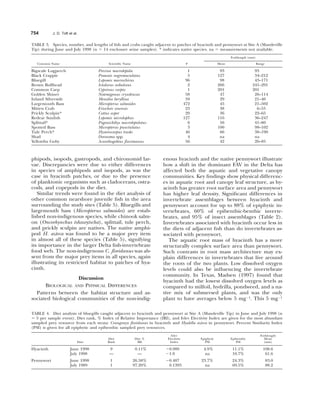
TABLE 3. Species, number, and lengths of fish and crabs caught adjacent to patches of hyacinth and pennywort at Site A (Mandeville
Tip) during June and July 1998 (n ϭ 14 enclosure seine samples). * indicates native species. na ϭ measurements not available.
Common Name Scientific Name #
Forklength (mm)
Mean Range
Bigscale Logperch
Black Crappie
Bluegill
Brown Bullhead
Common Carp
Golden Shiner
Inland Silverside
Percina macrolepida
Pomoxis negromaculatus
Lepomis macrochirus
Ictalarus nebulosus
Cyprinus carpio
Notemigonus crysoleucas
Menidia beryllina
1
5
96
2
1
58
59
93
127
98
266
201
47
29
93
34–212
43–171
241–291
201
26–114
21–40
Largemouth Bass
Mitten Crab
Prickly Sculpin*
Redear Sunfish
Splittail*
Spotted Bass
Tule Perch*
Shad
Yellowfin Goby
Micropterus salmoides
Eriocheir sinensis
Cottus asper
Lepomis microlophus
Pogonichthys macrolepidotus
Micropterus punctulatus
Hysterocarpus traski
Dorosoma spp.
Acanthogobius flavimanus
472
23
29
127
6
3
46
4
56
45
38
36
116
56
100
66
na
42
21–502
6–55
22–65
36–247
41–80
98–102
38–190
na
26–85
TABLE 4. Diet analysis of bluegills caught adjacent to hyacinth and pennywort at Site A (Mandeville Tip) in June and July 1998 (n
ϭ 5 per sample event). Diet rank, % Index of Relative Importance (IRI), and Ivlev Electivity Index are given for the most abundant
sampled prey resource from each strata: Crangonyx floridanus in hyacinth and Hyalella azteca in pennywort. Percent Similarity Index
(PSI) is given for all epiphytic and epibenthic sampled prey resources.
Date
Diet
Rank
Diet %
IRI
Ivlev
Electivity
Index
Epiphytic
PSI
Epibenthic
PSI
Forklength
Mean
(mm)
Hyacinth June 1998
July 1998
9
—
0.11%
—
Ϫ0.989
Ϫ1.0
4.9%
na
11.1%
10.7%
108.6
61.6
Pennywort June 1998
July 1989
1
1
26.58%
97.20%
Ϫ0.487
0.1393
23.7%
na
24.3%
69.5%
83.0
88.2
phipods, isopods, gastropods, and chironomid lar-
vae. Discrepancies were due to either differences
in species of amphipods and isopods, as was the
case in hyacinth patches, or due to the presence
of planktonic organisms such as cladocerans, ostra-
cods, and copepods in the diet.
Similar trends were found in the diet analysis of
other common nearshore juvenile fish in the area
surrounding the study sites (Table 5). Bluegills and
largemouth bass (Micropterus salmoides) are estab-
lished non-indigenous species, while chinook salm-
on (Oncorhynchus tshawytscha), splittail, tule perch,
and prickly sculpin are natives. The native amphi-
pod H. azteca was found to be a major prey item
in almost all of these species (Table 5), signifying
its importance in the larger Delta fish-invertebrate
food web. The non-indigenous C. floridanus was ab-
sent from the major prey items in all species, again
illustrating its restricted habitat to patches of hya-
cinth.
Discussion
BIOLOGICAL AND PHYSICAL DIFFERENCES
Patterns between the habitat structure and as-
sociated biological communities of the non-indig-
enous hyacinth and the native pennywort illustrate
how a shift in the dominant FAV in the Delta has
affected both the aquatic and vegetative canopy
communities. Key findings show physical differenc-
es in aquatic root and canopy leaf structure, as hy-
acinth has greater root surface area and pennywort
has higher leaf density. Significant differences in
invertebrate assemblages between hyacinth and
pennywort account for up to 88% of epiphytic in-
vertebrates, 60% of epibenthic-benthic inverte-
brates, and 95% of insect assemblages (Table 2).
Invertebrates associated with hyacinth occur less in
the diets of adjacent fish than do invertebrates as-
sociated with pennywort.
The aquatic root mass of hyacinth has a more
structurally complex surface area than pennywort.
Such contrasts in root mass architecture may ex-
plain differences in invertebrates that live around
the roots of the two plants. Low dissolved oxygen
levels could also be influencing the invertebrate
community. In Texas, Madsen (1997) found that
hyacinth had the lowest dissolved oxygen levels as
compared to milfoil, hydrilla, pondweed, and a na-
tive mix of submersed plants, and was the only
plant to have averages below 5 mgϪ1
. This 5 mgϪ1
The Effects of Introduced Water Hyacinth 755
TABLE 5. Percent Index of Relative Importance (IRI) of Hy-
alella azteca and Crangonyx floridanus in diets of common near-
shore juvenile fish in the area surrounding the study sites.
Species
% IRI of
H. azteca
% IRI of
C.
floridanus
Sample
Size
Forklength
Mean
(mm)
Bluegill
Chinook Salmon
Largemouth Bass
Prickly Sculpin
Splittail
Tule Perch
27.85
15.04
19.38
67.13
5.60
22.47
0.015
—
0.024
—
—
—
90
29
50
16
21
30
78.6
46.1
96.3
40.2
51.9
60.2
separation is notable because it represents the level
at which many fish start to experience oxygen
stress (Madsen 1997). Lower levels of dissolved ox-
ygen were likely the reason that we found no epi-
benthic amphipods and isopods beneath the hya-
cinth canopy at Site B in August 1998. These hya-
cinth patches did have an abundance of amphi-
pods and isopods living epiphytically amongst the
roots that suggests that these invertebrates could
potentially be taking refuge in the root mass from
underlying hypoxia (Gopal 1987). Pennywort at
the same site did have amphipods and isopods liv-
ing both epibenthically underneath the canopies
and epiphytically among the roots. Overall densi-
ties of epibenthic and benthic invertebrates were
generally greater in pennywort than hyacinth
throughout all sampling.
Patterns of taxa richness and diversity for all
aquatic invertebrates tended to follow a seasonal
trend. Both taxa richness and Shannon-Weiner di-
versity indices were higher in pennywort during
the first month of sampling (June for epiphytic,
April for epibenthic-benthic), but were higher in
hyacinth for subsequent months (August for epi-
phytic, June and July for epibenthic-benthic; Fig.
4d,e). The exception was higher richness and di-
versity for epibenthic-benthic invertebrates in pen-
nywort at Site B in August, but as discussed above
this is likely due to hyacinth being almost devoid
of epibenthic invertebrates, presumably caused by
low dissolved oxygen levels. Higher richness and
diversity in hyacinth later in the season could be
related to its extensive growth rate, providing more
colonizable substrate later in the year (Gopal
1987). In Florida, Jantrarotai (1990) found that
overall dry biomass of hyacinth was 161% greater
than pennywort (Hydrocotyle ranunculodies), and
maximum root length 164% greater, maximized in
late summer.
Pennywort patches have more leaves per unit
area than hyacinth. The structurally dense canopy
may explain the greater overall density of insects
in pennywort as well as taxonomic differences of
the insect assemblages. Pennywort was also richest
in taxa throughout all sampling except for August
at Site B, and was lower in diversity throughout all
months (Fig. 4f).
Amphipods clearly dominate aquatic inverte-
brate assemblages in FAV and are important fish
prey. Numerous studies have shown that amphi-
pods such as H. azteca are vulnerable to bluegill
predation (Crowder and Cooper 1982; Schramm
and Jirka 1989). Amphipods were found to be pro-
portionally more abundant in the FAV canopies
than in the fish diets, presumably due to the refuge
provided by the root mass structure. This agrees
with results from Florida lakes, where amphipods
were most abundant epiphytically and less abun-
dant benthically and in fish diets (Schramm and
Jirka 1989). The same study also found that hya-
cinth roots provided a refuge from fish predation
for H. azteca, with H. azteca accounting for 69% to
86% of invertebrate densities (Schramm et al.
1987).
The major difference in amphipods between hy-
acinth and pennywort was the prevalence of the
non-indigenous C. floridanus in hyacinth. C. flori-
danus was reduced to barely detectable levels with
the absence of hyacinth in 1999, lending even
more credence that C. floridanus is preferentially
associated with hyacinth. This also suggests that
once an invader is removed from a system, aspects
of the community can return to a more natural
pre-invasion state (Westman 1990).
IRI and Ivlev electivity index values indicate that
C. floridanus is not abundant in fish diets (Tables
3 and 4). This is in contrast to the native H. azteca,
which was significantly more abundant in penny-
wort at Site A and a common prey in fish diets. C.
floridanus may not be abundant in fish diets for a
variety of reasons, including refuge function of hy-
acinth roots from fish predation, low caloric value
and small size of C. floridanus, and poor taste of C.
floridanus. Refuge function is the most likely con-
tribution to its low abundance in fish diets, given
research in Florida showing that hyacinth roots can
provide a refuge for invertebrates from fish pre-
dation (Schramm and Jirka 1989). We consider low
caloric value to also be influential, as the standing
stock of one C. floridanus is 0.343 mg, and that of
one H. azteca is 1.056 mg (calculated from values
in authors’ data). C. floridanus has 33.43% less
gravimetric value than H. azteca. We consider poor
taste not to be much of an influence, as it is not
likely that C. floridanus is unpalatable to fish. Work
has not been done specific to C. floridanus, but re-
search has shown that a close congener Crangonyx
richmondensis is eaten by chum, chinook, and sock-
eye salmon fry in freshwater tidal creeks of the low-
er Fraser River in British Columbia (Levings et al.
1995).
756 J. D. Toft et al.
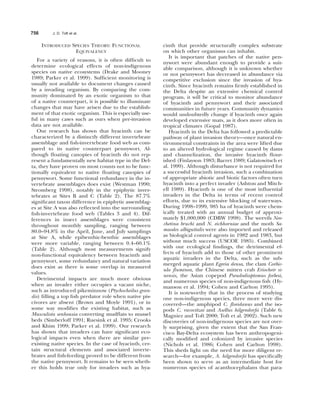
INTRODUCED SPECIES THEORY: FUNCTIONAL
EQUIVALENCY
For a variety of reasons, it is often difficult to
determine ecological effects of non-indigenous
species on native ecosystems (Drake and Mooney
1989; Parker et al. 1999). Sufficient monitoring is
usually not available to document changes caused
by a invading organism. By comparing the com-
munity dominated by an exotic organism to that
of a native counterpart, it is possible to illuminate
changes that may have arisen due to the establish-
ment of that exotic organism. This is especially use-
ful in many cases such as ours when pre-invasion
data are not available.
Our research has shown that hyacinth can be
characterized by a distinctly different invertebrate
assemblage and fish-invertebrate food web as com-
pared to its native counterpart pennywort. Al-
though floating canopies of hyacinth do not rep-
resent a fundamentally new habitat type in the Del-
ta, they have proven on most counts not to be func-
tionally equivalent to native floating canopies of
pennywort. Some functional redundancy in the in-
vertebrate assemblages does exist (Westman 1990;
Stromberg 1998), notably in the epiphytic inver-
tebrates at Sites B and C (Table 2). The 87.7%
significant taxon difference in epiphytic assemblag-
es at Site A was also reflected into the surrounding
fish-invertebrate food web (Tables 3 and 4). Dif-
ferences in insect assemblages were consistent
throughout monthly sampling, ranging between
80.0–94.8% in the April, June, and July samplings
at Site A, while epibenthic-benthic assemblages
were more variable, ranging between 0.4–60.1%
(Table 2). Although most measurements signify
non-functional equivalency between hyacinth and
pennywort, some redundancy and natural variation
does exist as there is some overlap in measured
values.
Detrimental impacts are much more obvious
when an invader either occupies a vacant niche,
such as introduced pikeminnow (Ptychocheilus gran-
dis) filling a top fish predator role when native pis-
civores are absent (Brown and Moyle 1991), or in
some way modifies the existing habitat, such as
Musculista senhousia converting mudflats to mussel
beds (Simberloff 1991; Ruesink et al. 1995; Crooks
and Khim 1999; Parker et al. 1999). Our research
has shown that invaders can have significant eco-
logical impacts even when there are similar pre-
existing native species. In the case of hyacinth, cer-
tain structural elements and associated inverte-
brates and fish-feeding proved to be different from
the native pennywort. It remains to be seen wheth-
er this holds true only for invaders such as hya-
cinth that provide structurally complex substrate
on which other organisms can inhabit.
It is important that patches of the native pen-
nywort were abundant enough to provide a suit-
able comparison, although it is unknown whether
or not pennywort has decreased in abundance via
competitive exclusion since the invasion of hya-
cinth. Since hyacinth remains firmly established in
the Delta despite an extensive chemical control
program, it will be critical to monitor abundance
of hyacinth and pennywort and their associated
communities in future years. Community dynamics
would undoubtedly change if hyacinth once again
developed extensive mats, as it does more often in
tropical climates (Gopal 1987).
Hyacinth in the Delta has followed a predictable
pathway of plant invasion theory—once natural en-
vironmental constraints in the area were lifted due
to an altered hydrological regime caused by dams
and channelization, the invasive hyacinth flour-
ished (Finlayson 1983; Barret 1989; Galatowitsch et
al. 1999). Although disturbance is not required for
a successful hyacinth invasion, such a combination
of appropriate abiotic and biotic factors often turn
hyacinth into a perfect invader (Ashton and Mitch-
ell 1989). Hyacinth is one of the most influential
invaders in the Delta in terms of recent control
efforts, due to its extensive blocking of waterways.
During 1998–1999, 985 ha of hyacinth were chem-
ically treated with an annual budget of approxi-
mately $1,000,000 (CDBW 1998). The weevils Neo-
chetina bruchi and N. eichhorniae and the moth Sa-
maodes albiguttalis were also imported and released
as biological control agents in 1982 and 1983, but
without much success (USCOE 1985). Combined
with our ecological findings, the detrimental ef-
fects of hyacinth add to those of other prominent
aquatic invaders in the Delta, such as the sub-
merged aquatic plant Egeria densa, the clam Corbic-
ula fluminea, the Chinese mitten crab Eriocheir si-
nensis, the Asian copepod Pseudodiaptomus forbesi,
and numerous species of non-indigenous fish (Hy-
manson et al. 1994; Cohen and Carlton 1995).
It is noteworthy that in the process of studying
one non-indigenous species, three more were dis-
covered—the amphipod C. floridanus and the iso-
pods C. racovitzai and Asellus hilgendorfii (Table 6;
Magniez and Toft 2000; Toft et al. 2002). Such new
discoveries of non-indigenous species are not over-
ly surprising, given the extent that the San Fran-
cisco Bay-Delta ecosystem has been anthropogeni-
cally modified and colonized by invasive species
(Nichols et al. 1986; Cohen and Carlton 1998).
This sheds light on the need for more diligent re-
search—for example, A. hilgendorfii has specifically
been shown to serve as an intermediate host for
numerous species of acanthocephalans that para-
The Effects of Introduced Water Hyacinth 757
TABLE 6. Native range and non-indigenous populations of the
amphipod Crangonyx floridanus and the isopods Caecidotea raco-
vitzai and Asellus hilgendorfii. See Toft et al. (2002) for a more
detailed discussion of non-indigenous status.
Species
Described
Native Range
Non-Indigenous
Populations
C. floridanus Eastern and east-cen-
tral U.S. (Holsinger
1972; Zhang 1997)
Colorado and
Oregon, U.S., and
Japan (Zhang
1997), California
(this study)
C. racovitzai Northeastern U.S.
and southeastern
Canada, Florida,
and Georgia, U.S.
(Williams 1970)
Washington and
Utah, U.S. (Wil-
liams 1970, Bow-
man 1974), Califor-
nia (this study)
A. hilgendorfii Eastern Siberia, Chi-
na, and Japan
(Henry and Mag-
niez 1995)
California (this study;
Magniez and Toft
2000)
sitize salmonids and other fish in its native waters
of Japan (Nagasawa et al. 1983). It is possible that
hyacinth may have been the vector of introduction
for these crustaceans, and facilitated their inva-
sions as a function of its habitat-providing charac-
teristics. As a general test of this vector, we ordered
4 hyacinth plants from an ornamental pond supply
company, and they arrived teeming with live inver-
tebrates including many amphipods (Hyalella
spp.). Hyacinth does seem like a viable vector of
introduction especially for C. floridanus due to its
prevalence in the hyacinth community, although
other methods of introduction are certainly avail-
able (Cohen and Carlton 1998). The discovery of
these three new species adds to the already lengthy
list of 84 documented non-indigenous species in
the Delta, and keeps pace with calculations that
one new invasive species is currently established ev-
ery 14 wk in this system (Cohen and Carlton 1998).
Given that many of these species may already be
well established by the time they are discovered,
future research should focus not only on docu-
menting their occurrence but also on assessing
their ecological roles in the surrounding commu-
nity.
ACKNOWLEDGMENTS
Financial support was provided by a California Federal Bay/
Delta Program Category III grant through the Metropolitan Wa-
ter District of Southern California, contract number 14318.
Wayne Fields, John Holsinger, Guy Magniez, Doug Smith, No-
boru Nunomura, and Julian J. Lewis provided valuable inverte-
brate taxonomy guidance. Special thanks to David Armstrong,
Christian Grue, Daniel Schindler, Marjorie Wonham, Sarah
Morley, and two reviewers for commenting on previous versions
of this manuscript. Field and laboratory assistance was provided
by Heather Higgins, Peter Moyle, Scott Matern, Zach Hyman-
son, Rob Miller, Chris Peregrin, Eric Santos, Denise Reed, Greg
Cain, Kemper Kurowski, and other members of the Wetland
Ecosystem Team (University of Washington).
LITERATURE CITED
ASHTON, P. J. AND D. S. MITCHELL. 1989. Aquatic plants: Patterns
and modes of invasion, attributes of invading species and as-
sessment of control programmes, p. 111–154. In J. A. Drake
and H. A. Mooney (eds.), Biological Invasions: A Global Per-
spective. Scope 37. John Wiley and Sons, Chichester, New
York.
BAILEY, R. G. AND M. R. LITTERICK. 1993. The macroinvertebrate
fauna of water hyacinth fringes in the Sudd swamps (River
Nile, southern Sudan). Hydrobiologia 250:97–103.
BARRET, S. C. H. 1989. Waterweed invasions. Scientific American
261:90–97.
BOWMAN, T. E. 1974. The Californian freshwater isopod, Asellus
tomalensis, rediscovered and compared with Asellus occidentalis.
Hydrobiologia 44:431–441.
BROWN, L. R. AND P. B. MOYLE. 1991. Changes in habitat and
microhabitat partitioning within an assemblage of stream fish-
es in response to predation by Sacramento squawfish (Ptych-
ocheilus grandis). Canadian Journal of Fisheries and Aquatic Sci-
ences 48:849–856.
CALIFORNIA DEPARTMENT OF BOATING AND WATERWAYS (CDBW).
1998. 1998 Summary of Operations Waterhyacinth Chemical
Control Program. CDBW, Sacramento, California.
CALIFORNIA DEPARTMENT OF WATER RESOURCES (CDWR). 1993.
The Sacramento/San Joaquin Delta Atlas. CDWR, Sacramen-
to, California.
COHEN, A. N. AND J. T. CARLTON. 1995. Nonindigenous aquatic
species in a United States estuary: A case study of the biolog-
ical invasions of the San Francisco Bay and Delta. A report
for the U.S. Fish and Wildlife Service and the National Sea
Grant College Program. University of California at Berkeley,
Williams College-Mystic Seaport, Berkeley, California.
COHEN, A. N. AND J. T. CARLTON. 1998. Accelerating invasion
rate in a highly invaded estuary. Science 279:555–558.
CROOKS, J. A. AND H. S. KHIM. 1999. Architectural vs. biological
effects of a habitat-altering, exotic mussel, Musculista senhou-
sia. Journal of Experimental Marine Biology and Ecology 240:53–
75.
CROWDER, L. B. AND W. E. COOPER. 1982. Habitat structural com-
plexity and the interaction between bluegills and their prey.
Ecology 63:1802–1813.
DIBBLE, E. D., K. J. KILLGORE, AND G. O. DICK. 1996. Measure-
ments of plant architecture in seven aquatic plants. Journal of
Freshwater Ecology 11:311–318.
DRAKE, J. A. AND H. A. MOONEY (EDS.). 1989. Biological Inva-
sions: A Global Perspective. Scope 37. John Wiley and Sons,
Chichester, New York.
FINLAYSON, B. J. 1983. Water hyacinth: Threat to the Delta? Out-
door California 44:10–14.
GALATOWITSCH, S. M., N. O. ANDERSON, AND P. D. ASCHER. 1999.
Invasiveness in wetland plants in temperate North America.
Wetlands 19:733–755.
GOPAL, B. 1987. Aquatic Plant Studies 1. Water Hyacinth. Elsev-
ier Publishing, New York.
HARROD, J. J. AND R. E. HALL. 1962. A method for determining
the surface areas of various aquatic plants. Hydrobiologia 20:
173–178.
HENRY, J. P. AND G. MAGNIEZ. 1995. Nouvelles donne´es sur les
Asellidae e´pige´s d’Extreˆme-Orient (Crustacea, Isopoda, Asel-
lota). Contributions to Zoology 65:101–122.
HOLSINGER, J. R. 1972. Biota of Freshwater Systems, Identifica-
tion Manual No. 5. The Freshwater amphipod crustaceans
(Gammaridae) of North America. Environmental Protection
Agency, Washington, D.C.
HURLBERT, S. H. 1978. The measurement of niche overlap and
some relatives. Ecology 59:67–77.
758 J. D. Toft et al.
HYMANSON, Z., D. MAYER, AND J. STEINBECK. 1994. Long-term
trends in benthos abundance and persistence in the upper
Sacramento-San Joaquin estuary, summary report: 1980–1990.
Technical Report 38 (FWQ/BIO/IATR/94-38). Interagency
Ecological Program for the San Francisco Bay/Delta Estuary,
California Department of Water Resources, Sacramento, Cal-
ifornia.
IVLEV, V. S. 1961. Experimental Ecology of the Feeding of Fish-
es. Translated from Russian. Yale University Press, New Ha-
ven, Connecticut.
JANTRAROTAI, P. 1990. Water hyacinth (Eichhornia crassipes) and
water pennywort (Hydrocotyle ranunculodies) use in treatment
of poultry wastewater. Ph.D. Dissertation, Auburn University,
Auburn, Alabama.
JONES, C. G., J. H. LAWTON, AND M. CHACHAK. 1997. Positive and
negative effects of organisms as physical ecosystem engineers.
Ecology 78:1946–1957.
KLINE, J. L. AND B. M. WOOD. 1996. Food habitats and diet se-
lectivity of the brown bullhead. Journal of Freshwater Ecology 11:
145–151.
LECHOWICZ, M. J. 1982. The sampling characteristics of electivity
indices. Oecologia 52:22–30.
LEVINGS, C. D., D. E. BOYLE, AND T. R. WHITEHOUSE. 1995. Dis-
tribution and feeding of juvenile Pacific salmon in freshwater
tidal creeks of the lower Fraser River, British Columbia. Fish-
eries Management and Ecology 2:299–308.
MADSEN, J. D. 1997. Methods for management of nonindige-
nous aquatic plants, p 145–171. In J. O. Luken and J. W.
Thieret (eds.), Assessment and Management of Plant Inva-
sions. Springer, New York.
MAGNIEZ, G. AND J. TOFT. 2000. Pre´sence d’un Asellide e´pige´
originaire d’Extreˆme-Orient en Californie. Bulletin mensuel de
la Socie´te´ Linne´enne de Lyon 69:127–132.
MASIFWA, W. F., T. TWONGO, AND P. DENNY. 2001. The impact of
water hyacinth, Eichhornia crassipes (Mart) Solms on the abun-
dance and diversity of aquatic macroinvertebrates along the
shores of northern Lake Victoria, Uganda. Hydrobiologia 452:
79–88.
NAGASAWA, K., S. EGUSA, T. HARA, AND I. YAGISAWA. 1983. Eco-
logical factors influencing the infection levels of salmonids by
Acanthocephalus opsariichthydis (Acanthocephala: Echinorhyn-
chidae) in Lake Yunoko, Japan. Fish Pathology 18:53–60.
NICHOLS, F. H., J. E. CLOERN, S. N. LUOMA, AND D. H. PETERSON.
1986. The modification of an estuary. Science 231:567–573.
PARKER, I. M., D. SIMBERLOFF, W. M. LONSDALE, K. GOODELL, M.
WONHAM, P. M. KAREIVA, M. H. WILLIAMSON, B. VON HOLLE,
P. B. MOYLE, J. E. BYERS, AND L. GOLDWASSER. 1999. Impact:
Toward a framework for understanding the ecological effects
of invaders. Biological Invasions 1:3–19.
PINKAS, L., M. S. OLIPHANT, AND I. L. K. IVERSON. 1971. Food
habits of albacore, bluefin tuna, and bonito in California wa-
ter. California Department of Fish and Game Fish Bulletin 152:1–
105.
ROZAS, L. P. AND T. J. MINELLO. 1997. Estimating densities of
small fishes and decapod crustaceans in shallow estuarine
habitats: A review of sampling design with focus on gear se-
lection. Estuaries 20:199–213.
RUESINK, J. L., I. M. PARKER, M. J. GROOM, AND P. M. KAREIVA.
1995. Reducing the risks of nonindigenous species introduc-
tions: Guilty until proven innocent. Bioscience 45:465–477.
SCHRAMM, H. L. AND K. J. JIRKA. 1989. Epiphytic macroinverte-
brates as a food resource for bluegills in Florida Lakes. Trans-
actions of the American Fisheries Society 118:416–426.
SCHRAMM, H. L., K. J. JIRKA, AND M. V. HOYER. 1987. Epiphytic
macroinvertebrates on dominant macrophytes in two central
Florida Lakes. Journal of Freshwater Ecology 4:151–161.
SIMBERLOFF, D. 1991. Keystone species and community effects
of biological introductions, p. 1–19. In L. R. Ginzburg (ed.),
Assessing Ecological Risks of Biotechnology. Butterworth-Hei-
nemann, Boston, Massachusetts.
SIMENSTAD, C. A., C. D. TANNER, R. M. THOM, AND L. L. CON-
QUEST. 1991. Estuarine habitat assessment protocol. U.S. En-
vironmental Protection Agency, Seattle, Washington.
SIMENSTAD, C. A. AND R. M. THOM. 1996. Functional equivalency
trajectories of the restored Gog-Le-Hi-Te estuarine wetland.
Ecological Applications 6:38–56.
STROMBERG, J. C. 1998. Functional equivalency of saltcedar (Ta-
marix chinensis) and fremont cottonwood (Populus fremontii)
along a free-flowing river. Wetlands 18:675–686.
SUTHERLAND, W. J. 1996. Ecological Census Techniques: A
Handbook. Cambridge University Press, New York.
TERRY, C. 1977. Stomach contents methodology: Still lots of
questions, p. 87–92. In C. A. Simenstad and S. J. Lipovsky
(eds.), Fish Food Habits Studies, Proceedings 1st Pacific
Northwest Technical Workshop, 13–15 October 1976, Astoria,
Oregon. Washington Sea Grant WSG-WO-77-2, Seattle, Wash-
ington.
THE BAY INSTITUTE (TBI). 1998. From the Sierra to the Sea: The
Ecological History of the San Francisco Bay-Delta Watershed.
The Bay Institute, San Francisco, California.
TOFT, J. D., J. C. CORDELL, AND W. C. FIELDS. 2002. New records
of crustaceans (amphipoda, isopoda) in the Sacramento/San
Joaquin Delta, California and application of criteria for intro-
duced species. Journal of Crustacean Biology 22:200–210.
U.S. ARMY CORPS OF ENGINEERS (USCOE). 1985. Waterhyacinth,
Sacramento-San Joaquin Delta, California. State Design Mem-
orandum Report. USCOE, Sacramento, California.
VITOUSEK, P. M. 1986. Biological invasions and ecosystem prop-
erties, can species make a difference?, p. 163–176. In H. A.
Mooney and J. A. Drake (eds.), Ecology of Biological Inva-
sions of North America and Hawaii. Springer-Verlag, New
York.
WERNER, E. E. AND D. J. HALL. 1979. Foraging efficiency and
habitat switching in competing sunfishes. Ecology 60:256–264.
WESTMAN, W. E. 1990. Park management of exotic plant species:
Problems and issues. Conservation Biology 4:251–260.
WILLIAMS, S. L. AND C. A. DAVIS. 1996. Population genetic anal-
yses of transplanted eelgrass (Zostera marina) beds reveal re-
duced genetic diversity in Southern California. Restoration
Ecology 4:163–180.
WILLIAMS, W. D. 1970. A revision of North American epigean
species of Asellus (Crustacea:Isopoda). Smithsonian Contribu-
tions to Zoology 49:1–80.
WOLVERTON, B. C. AND R. C. MCDONALD. 1978. Waterhyacinth
(Eichhornia crassipes) productivity and harvesting studies. Eco-
nomic Botany 33:1–10.
ZAR, J. H. 1996. Biostatistical Analysis, 3rd edition. Prentice Hall,
New Jersey.
ZHANG, J. 1997. Systematics of the freshwater amphipod genus
Crangonyx (Crangonyctidae) in North America. Ph.D. Disser-
tation, Old Dominion University, Norfolk, Virginia.
Received for consideration, February 13, 2002
Revised, July 12, 2002
Accepted for publication, July 23, 2002

Toft et al

  • 1.
    746ᮊ 2003 EstuarineResearch Federation Estuaries Vol. 26, No. 3, p. 746–758 June 2003 The Effects of Introduced Water Hyacinth on Habitat Structure, Invertebrate Assemblages, and Fish Diets JASON D. TOFT1, *, CHARLES A. SIMENSTAD1 , JEFFERY R. CORDELL1 , and LENNY F. GRIMALDO2 1 School of Aquatic and Fishery Sciences, University of Washington, P. O. Box 355020, Seattle, Washington 98195-5020 2 California Department of Water Resources, 3251 S Street, Sacramento, California 95816 ABSTRACT: The South American floating aquatic plant water hyacinth (Eichhornia crassipes) has a history of worldwide invasions, including a 1904 introduction into the Sacramento-San Joaquin Delta, California. The native pennywort (Hy- drocotyle umbellata) occupies similar habitats in the Delta and is extensively used by resident invertebrates and fish. We sought to discover if an invader would be functionally equivalent to the native plant, by asking whether the encroaching hyacinth modified the invertebrate assemblage structure and fish-invertebrate food web relative to pennywort. We sam- pled epiphytic, epibenthic, and benthic invertebrates, and plant canopy insects in patches of hyacinth and pennywort, and analyzed fish diets at three sites in the Delta during 1998. We also measured habitat structure (leaf density, root biomass, and surface area). In 1999, following control and absence of hyacinth, we again measured epiphytic invertebrates in pennywort. We found differences between hyacinth and pennywort in structure, associated invertebrates, and fish diets. Most measurements inferred functional non-equivalency between hyacinth and pennywort, although some func- tional equivalency and natural variation existed. Leaf and insect densities were significantly higher in pennywort and there were also significant differences in insect assemblage compositions. Hyacinth roots in the water column had sig- nificantly more surface area. Densities of epibenthic and benthic aquatic invertebrates were typically greater in pennywort and taxonomic compositions of aquatic invertebrate assemblages showed significant differences. Amphipods and isopods living epiphytically in the root masses were particularly abundant, including several newly discovered introduced species: the amphipod Crangonyx floridanus and the isopods Caecidotea racovitzai and Asellus hilgendorfii. The native amphipod Hyalella azteca was more abundant in pennywort and heavily preyed upon by fish, while the non-indigenous C. floridanus was more abundant in hyacinth and not prevalent in fish diets. The introduction of hyacinth to the Delta has caused significant ecological alterations in the surrounding community, due to hyacinth being functionally different from native patches of pennywort. Introduction Ecological theory predicts that non-indigenous species that will have the most impact are those that represent something fundamentally new to a given system (Simberloff 1991; Ruesink et al. 1995; Parker et al. 1999). Although this appears to be most often the case, we sought to illuminate wheth- er an invader that was similar in appearance to a common native could be non-equivalent in its function. Floating aquatic vegetation (FAV) cano- pies of the non-indigenous water hyacinth (Eichhor- nia crassipes) in the Sacramento-San Joaquin Delta of California are fundamentally similar to those of the native pennywort (Hydrocotyle umbellata), as both form canopies of floating vegetation. Al- though hyacinth and pennywort form similar patches of floating vegetation, it is a question whether or not they are functional equivalents— providing similar functions to the surrounding bi- otic community. We compared the habitat struc- * Corresponding author: tele: 206/221-5460; fax: 206/685- 7471; e-mail: tofty@u.washington.edu. ture, invertebrate assemblages, and diets of fish as- sociated with hyacinth and pennywort in order to determine whether or not they were functional equivalents. Comparative studies of functional equivalency are often used to test how human-altered systems compare to natural states, such as in restored wet- lands (Simenstad and Thom 1996) or transplanted seagrass beds (Williams and Davis 1996). Specific tests of the functional role of non-indigenous spe- cies relative to natives are rare. One such test in a terrestrial system (Stromberg 1998) has shown that there can be some functional redundancy (West- man 1990), while other tests show significant alter- ations (Vitousek 1986). Filling such gaps in our knowledge is important, as invasive species are of- ten difficult if not impossible to keep under con- trol (Drake and Mooney 1989), and the congruent ecological impacts of specific invaders are not well known (Parker et al. 1999). If we can uncover such ecological effects, we can better manage and pre- dict the fates of current and future biological in- vasions. Hyacinth is native to Brazil and has become
  • 2.
    The Effects ofIntroduced Water Hyacinth 747 widespread on a global scale, first being intro- duced to the Sacramento River in California by or- namental pond enthusiasts in 1904 (Finlayson 1983; Gopal 1987). Once the plants are introduced they rapidly increase in coverage, as hyacinth has the highest growth rate of any saltwater, freshwater, or terrestrial vascular macrophyte (Wolverton and McDonald 1978). In the Delta, hyacinth covered 506 ha or 22% of the waterways by 1981 (Finlayson 1983). Such prevalence sparked an extensive chemical control program headed by the Califor- nia Department of Boating and Waterways (CDBW 1998), which actively controls coverage of hyacinth by spraying the chemical 2,4-D. As a result of these efforts, the extensive mats found especially in trop- ical climates (Gopal 1987) were controlled during the course of our study, and patches of hyacinth and pennywort were similar in coverage. In many systems hyacinth is an ecosystem engi- neer (Jones et al. 1997; Crooks and Khim 1999), modifying the surrounding habitat by providing a structurally complex canopy. In addition to form- ing a dense floating mat, roots hanging in the wa- ter column and leaves projecting above the water surface provide complex structures that can be in- habited by other species. Organic deposition from the canopy can cover the underlying benthic zone, leading to low dissolved oxygen levels (Gopal 1987). Effects of these characteristics on commu- nity dynamics when hyacinth coexists with native FAV counterparts are unknown, and are often a subject of curiosity among investigators (Gopal 1987; Masifwa et al. 2001). FAV can be beneficial as a nursery habitat for juvenile fishes and invertebrates (Werner and Hall 1979; Gopal 1987; Schramm and Jirka 1989; Dibble et al. 1996). Roots hanging down into the water column are important as habitat for epiphytic in- vertebrates, especially amphipods (Schramm et al. 1987). Epiphytic invertebrates are typically much more abundant than benthic and epibenthic in- vertebrates, and their densities are positively cor- related to the amount of FAV surface area available for colonization (Crowder and Cooper 1982; Schramm et al. 1987). Fish such as bluegills (Le- pomis macrochirus) selectively feed on epiphytic in- vertebrates over other sources of prey (Werner and Hall 1979; Schramm and Jirka 1989). The effects of hyacinth on the fish-invertebrate food web in the Delta could be pervasive due to the promi- nence of hyacinth in shallow water areas. Pennywort is the predominant native FAV in the Delta. Although pennywort and hyacinth both form floating canopies and tend to occupy similar habitats, we hypothesize that a hyacinth invasion could alter key habitat structure components, lead- ing to surrounding community alterations. Such effects may not be as readily apparent compared to invaders that either occupy vacant niches and substantially modify the existing environment, such as introductions of fish predators when native piscivores are absent (Brown and Moyle 1991), or mussel invasions into mudflats previously uninhab- ited with mussel mats (Crooks and Khim 1999). Our research sought to illuminate any community alterations caused by the hyacinth invasion. Methods STUDY AREA Our three study sites were located in the central and western Sacramento-San Joaquin Delta of Cal- ifornia: Site A (Mandeville Tip, 38.0Њ4ЈN, 121Њ32ЈW), Site B (Brown’s Island, 38.0Њ2ЈN, 121Њ52ЈW), and Site C (Mildred Island, 37.0Њ59ЈN, 121Њ31ЈW). These sites were chosen because they contained discrete patches of both hyacinth and pennywort. The Delta is heavily influenced by hu- man activity, including agricultural, recreational, and industrial activities (Nichols et al. 1986). His- torically, the Delta was almost all wetlands charac- terized by tule vegetation (Scirpus spp.) with some natural levees and riparian habitat (woody vegeta- tion, mostly Salix spp.; TBI 1998). Approximately 95% of these wetlands have been leveed and drained predominantly for agricultural purposes, and the majority of the Delta’s remaining historic channels are rip-rapped and constrained (TBI 1998). Although salt water historically entered the Delta, current water management attempts to pre- vent this, mainly through controlled water flows that increase freshwater inflow during summer months to maintain freshwater available for irri- gation and drinking purposes (Nichols et al. 1986). Benthic sediments in the Delta are an unconsoli- dated mixture of sand, silt, and clay (Hymanson et al. 1994). Tidal influence ranges between 1 to 2 m (CDWR 1993). STUDY DESIGN Healthy FAV patches not chemically controlled with 2,4-D were sampled in areas that bordered a marsh. Habitat structure measurements and inver- tebrate samples were collected in 5 patches of both hyacinth and pennywort at each site. Patches were chosen by a random number generator corre- sponding to the patch number along a transect drawn parallel to shore (Fig. 1). These patches oc- cupied indentations in the marsh and were gen- erally separated by clumps of tule vegetation. Patches were fairly small and discrete (30.96 m2 average surface area, 3.92 SE) and were used only if they formed a fringe along the marsh, not if they occupied an entire channel. Since the overall size and shape of the patches could not be controlled
  • 3.
    748 J. D.Toft et al. Fig. 1. Illustration of a typical sampling design at a study site. Shallow water is light gray, tule marsh (Scirpus spp.) is hatched, H ϭ hyacinth patches, and P ϭ pennywort patches. Circled patches are those randomly selected for sampling along a tran- sect south to north (patches 1, 3, 6, 7, 8 for hyacinth; 1, 4, 5, 8, 10 for pennywort). Inset is the specific location of sample collection, 1 m in from the water’s edge at the center of each patch. due to the study design of sampling natural patch- es, we minimalized the natural variation by desig- nating sampling to the center of each patch, 1 m in from the water’s edge (Fig. 1). We focused on the outer edge as other studies have documented changes in invertebrate communities between the edge and interior of patches (Bailey and Litterick 1993; Masifwa et al. 2001). Patch edges also offered higher association with surrounding fish and ease of access for sampling by boat. Patches of hyacinth and pennywort were not intermixed, but occasion- ally bordered each other. All patches were sampled in approximately 1 m of water, with the roots hang- ing freely halfway into the water column. Description of the habitat structure and inver- tebrate sampling frequency is summarized in Table 1. In 1998, habitat structure and epiphytic inver- tebrates were sampled in June at Site A, and in August at Sites B and C. Epibenthic-benthic inver- tebrates and terrestrial canopy insects were sam- pled in April, June, and July at Site A and August at Site B. Sampling was not conducted at Site A after July as hyacinth patches were exterminated with chemical control by CDBW. Hyacinth was absent at all three study sites in 1999, although residual patches remained in inte- rior marsh channels and boat marinas in the sur- rounding area. The lack of hyacinth in 1999 was attributed to intensive chemical spraying by CDBW during fall and winter 1998 and spring 1999, sev- eral cold freezes during the winter that caused high mortality of overwintering plant material, and high winter outflows that flushed clumps of hya- cinth out of the Delta into San Francisco Bay. We took advantage of this unforeseen hyacinth remov- al experiment by sampling epiphytic invertebrates in pennywort at all three sites in June 1999. Such a plan allowed us to measure interannual variation and to determine if the invertebrate community changed with the absence of hyacinth. Although this was an originally unplanned segment of our research, the issue of the effect of the removal of non-indigenous species is a vital question in both research and management (Westman 1990). PHYSICAL SAMPLING Intensive sampling of hyacinth and pennywort habitat structure was conducted in June 1998 at Site A and in August 1998 at Sites B and C, con- gruent with epiphytic invertebrate sampling (Table 1). Entire patch surface area was estimated by mea- suring the maximum length and width of each patch. Leaf density was measured at the location of sampling by counting the number of leaves in a 0.5 m2 quadrat (n ϭ 5 siteϪ1 ). Roots collected for epiphytic invertebrate sampling (described below) were measured for biomass and surface area. Root wet biomass was measured by blotting the roots dry with a towel, allowing to air dry for 10 min, and weighing to the nearest milligram. Root surface area was measured using the surfactant technique originally developed by Harrod and Hall (1962). A soapy solution consisting of 60 ml of Liquinox soap in 6 l of water was mixed in a bucket and left over- night so that the bubbles dispersed. For each root sample, five 1-g subsamples were dipped in the soapy solution. The excess soap was shaken off so that a monolayer of soapy solution was retained around the root surface. Each subsample was then reweighed. The surface area of the root samples was determined by regressing the differences in weight to those measured from the same process for known surface areas of tinfoil (25, 100, 225, 400, 625, and 900 cm2 ; n ϭ 5).
  • 4.
    The Effects ofIntroduced Water Hyacinth 749 TABLE 1. Invertebrate and habitat structure sampling design. Numbers are sample size, blanks indicate no sampling conducted. H ϭ hyacinth, P ϭ pennywort. Patches of hyacinth were exterminated with chemical control at Site A (Mandeville Tip) in August 1998, after which sampling was shifted to Sites B and C (Brown’s Island and Mildred Island, respectively). Patches of hyacinth were absent at all study sites in 1999 (see text). 1998 1999 April H P June H P July H P August H P June H P Site A, Mandeville Tip Epiphytic Epibenthic-Benthic Insect Habitat Structure 5 5 5 5 5 5 5 5 5 5 5 5 5 5 5 5 5 Site B, Brown’s Island Epiphytic Epibenthic-Benthic Insect Habitat Structure 5 5 5 5 5 5 5 5 5 Site C, Mildred Island Epiphytic Habitat Structure 5 5 5 5 5 BIOLOGICAL SAMPLING Epiphytic Invertebrates Epiphytic invertebrates living in association with the root masses of hyacinth and pennywort were collected in June 1998 at Site A and in August 1998 at Sites B and C, and in pennywort at all three sites in June 1999 (n ϭ 5 siteϪ1 ; Table 1). Epiphytic in- vertebrates were sampled by manually collecting 1– 2 plants (Յ 0.5 m2 quadrat described above) and immediately placing them in a bucket (Schramm et al. 1987; Schramm and Jirka 1989). The bucket contained a 10% isopropyl alcohol solution, caus- ing the invertebrates to detach from the root mas- ses by vigorously shaking each sample. This was then sieved at 0.5 mm to collect only the macro- invertebrates and fixed in a 10% buffered formal- dehyde solution. These samples were later trans- ferred to 70% isopropanol in the laboratory. The roots from each sample were retained separately in 70% isopropanol and brought to the laboratory for measurements of surface area and biomass (de- scribed above). Any additional invertebrates that did not detach from the roots in the alcohol so- lution were later separated in the laboratory. This technique effectively sampled invertebrates living in direct association with the roots, as Schramm and Jirka (1989) found that most invertebrates re- mained on the roots when disturbed. We calculated densities of epiphytic inverte- brates (number above m2 bottom; Schramm and Jirka 1989) by correlating the number of leaves in each epiphytic plant sample (Յ 0.5 m2 ) to the leaves in a 0.5 m2 quadrat (described above). In- vertebrates were counted and identified to the low- est practical taxonomic level with light microscopy. Standing stock of invertebrates was estimated by measuring preserved wet biomass. Each taxonomic group was blotted dry and weighed to the nearest 0.1 mg. Numbers and standing stock of inverte- brates were standardized to number above 1 m2 bottom, allowing for comparisons between strata and with epibenthic-benthic and insect sampling as density (number mϪ2 bottom) and standing stock (g mϪ2 bottom; Schramm and Jirka 1989). All es- timates are based on the same unit definition of area. Taxa richness (number of taxa) and the Shannon-Wiener diversity index were also calculat- ed: n HЈ ϭ Ϫ p log p͸ i i iϭ1 where pi ϭ the proportion of species i in the com- munity (the # of individuals of species i/the total # of individuals in the community; Zar 1996). Epibenthic-Benthic Invertebrates A 1-m long corer was used to sample epibenthic and benthic invertebrates beneath hyacinth and pennywort canopies at Site A in April, June, and July 1998 and at Site B in August 1998 (n ϭ 5 siteϪ1 ; Table 1). Cores with an internal core area of 0.0024 m2 were taken to a 10 cm depth beneath the sediment surface. The core was inserted into each patch at approximately 1 m water depth, sam- pling both epibenthic invertebrates at the water- sediment interface and benthic invertebrates in the sediment. Samples were immediately fixed in 10% buffered formaldehyde solution containing rose bengal dye, and later transferred to 70% iso- propanol in the laboratory. Invertebrates were
  • 5.
    750 J. D.Toft et al. counted and identified to the lowest practical tax- onomic level with light microscopy. Numbers of in- vertebrates were standardized to number mϪ2 bot- tom, and taxa richness and the Shannon-Wiener diversity index calculated (as above for epiphytic invertebrates). Insects Insect fallout traps (Sutherland 1996) were used to sample insects living in association with hyacinth and pennywort canopies at Site A in April, June, and July 1998 and at Site B in August 1998 (n ϭ 5 siteϪ1 ; Table 1). These traps consisted of a rect- angular tray (0.0782 m2 ) filled with approximately 3 cm of soapy water. The trays were nestled into each canopy, so that they floated on the water sur- face with the leaves of the canopy surrounding the tray. Trays were tethered to PVC poles at each spe- cific site, allowing vertical movement with the tides. The trays were deployed for 24 h, after which the contents were sieved at 0.106 mm and the insects preserved in 70% isopropanol. Insects were count- ed and identified to the lowest practical taxonomic level with light microscopy. Numbers of insects were standardized to number mϪ2 bottom, and taxa richness and the Shannon-Wiener diversity in- dex were calculated (as above for epiphytic and epibenthic-benthic invertebrates). Fish Fish were sampled directly adjacent to hyacinth and pennywort patches at Site A during June and July 1998 in order to see if fish surrounding FAV incorporate FAV prey into their diet. Rectangular block-net enclosures (range 30–49 m2 ) were used to collect fishes within intertidal and nearshore subtidal areas less than 1.3 m wading depth. En- closure methods are recommended for collecting small and juvenile fishes because they have high catch efficiencies and provide quantitative data useful for comparing fish densities between habi- tats and sites (Rozas and Minello 1997). Sample areas were delineated with 4 perimeter stakes at least 24 h in advance to minimize disturbance of the area at the time of sampling. The following day the sampling area was quickly enclosed with block- nets secured to the perimeter stakes. A minimum of 4 passes with a beach seine (7.6 ϫ 1.2 m, 3.2 mm mesh) was taken within each enclosure to col- lect the fish. A subsample of collected fishes were preserved in 10% buffered formaldehyde solution and trans- ferred to the laboratory for diet analysis. We fo- cused on non-indigenous bluegills (L. macrochirus) as an indicator species for examining potential ef- fects of hyacinth on food web dynamics because they are omnivorous fish that have been shown to feed opportunistically on invertebrates in FAV hab- itats (Werner and Hall 1979; Schramm and Jirka 1989), and they accounted for 55% of the numer- ical fish catch in preliminary sampling directly un- derneath hyacinth (n ϭ 5 patches sampled) and were one of the most abundant fish collected in all fish sampling. Fish were also sampled in many areas surround- ing the study sites using the same methods as above. Additional fish species from these areas were saved for diet analysis to see if prey items found in FAV habitats were incorporated at a larg- er scale into the Delta food web. Fish saved for diet analysis were measured (fork length) and weighed (preserved wet weight). The stomachs were then dissected and the gut contents removed. Overall gut contents were blotted dry and weighed. Taxa were then separated and iden- tified to the lowest possible taxonomic level with light microscopy. Each taxonomic group was then counted, blotted dry, and weighed. Levels of stom- ach content digestion and stomach fullness were ranked using a standardized system (Terry 1977). Prey items were then ranked based on modified Index of Relative Importance values (IRI; Pinkas et al. 1971; Simenstad et al. 1991): IRI ϭ % frequency of occurrence ϫ [% numerical composition ϩ % gravimetric composition] Diet overlap with sampled aquatic prey resources was calculated using a modified Percent Similarity Index (PSI; Hurlbert 1978): n PSI ϭ minimum(p , p )͸ xi yi iϭ1 where pxi ϭ percentage of prey i in predator x and pyi ϭ percentage of prey i in the sampled aquatic prey resources y. Ivlev’s electivity index was used to compare differences in fish selectivity on the major amphipod taxa present in the sampled prey re- sources (Ivlev 1961). The Ivlev electivity index was chosen as it is easy to interpret and gives similar results to other indices (Lechowicz 1982; Kline and Wood 1996). DATA INTERPRETATION AND STATISTICAL TESTS Parametric two-sample t-tests were used to statis- tically compare means for biological and physical sampling between hyacinth and pennywort at each study site (␣ ϭ 0.05). For all measurements be- tween hyacinth and pennywort Ho: ␮1 ϭ ␮2 and Ha: ␮1 ␮2. The parametric t-test is a robust statistic, meaning it can withstand considerable departures from its underlying assumptions of normality and
  • 6.
    The Effects ofIntroduced Water Hyacinth 751 Fig. 2. Mean leaf density (number above 1 m2 bottom), sur- face area of roots (1,000 cm2 above 1 m2 bottom), and biomass of roots (g wet above 1 m2 bottom) combined for all sites and dates (n ϭ 15). Error bars show Ϯ 1 SE. Fig. 3. Cumulative numerical percent of dominant taxa for epiphytic invertebrates (a), epibenthic-benthic invertebrates (b), and terrestrial insects (c). H ϭ hyacinth, P ϭ pennywort. homogeneity of variance. This is especially the case if n1 ϭ n2 and the test is two-tailed, as is the case with our study design (Simenstad et al. 1991; Zar 1996). Results PHYSICAL SAMPLING The physical structure of the hyacinth canopy was significantly different from that of pennywort. Patches of pennywort had significantly higher leaf densities than hyacinth (p Ͻ 0.001; Fig. 2). Hya- cinth had almost 3 times greater root surface areas than pennywort (p Ͻ 0.005), based on the regres- sion model of weight differences of known surface areas (y ϭ 0.0019x ϩ 0.0016, R2 ϭ 0.99). No sig- nificant differences at p Ͻ 0.05 in root biomass were detected, although values tended to be great- er for hyacinth (p Ͻ 0.10). BIOLOGICAL SAMPLING Epiphytic Invertebrates Taxonomic composition of epiphytic root inver- tebrates was strikingly different depending on the site and month (Fig. 3a), with total densities show- ing no significant difference (Fig. 4a). At Site A in June 1998 there was a dramatic contrast in assem- blage composition, with the non-indigenous am- phipod Crangonyx floridanus significantly more abundant in hyacinth in terms of both density and standing stock (p Ͻ 0.05) and the native amphipod Hyalella azteca more abundant in pennywort (p Ͻ 0.01). These amphipods differed in numeric and gravimetric contributions, as C. floridanus’ density in hyacinth was 187% that of H. azteca in penny- wort, but conversely only 62.5% in terms of stand- ing stock. Density and standing stock of the am- phipod Corophium spinicorne was significantly more abundant in hyacinth (p Ͻ 0.05), while the isopod Caecidotea racovitzai (p Ͻ 0.05) and the oligochaete Stylaria lacustris (p Ͻ 0.001) were significantly more abundant in pennywort. C. floridanus and C. racov- itzai have not been previously reported in the Del- ta. All of these significant taxon differences ac- counted for 87.7% of the total invertebrate density (Table 2). Taxa richness of epiphytic invertebrates in pennywort was slightly higher than hyacinth, and diversity was much higher in June (Fig. 4d). Sites B and C in August 1998 did not show the same dramatic contrasts in epiphytic invertebrate assemblages as in Site A (Fig. 3a). At Site B, the amphipod Gammarus daiberi was the most abun- dant species in both hyacinth and pennywort. The only significant difference was higher densities and
  • 7.
    752 J. D.Toft et al. Fig. 4. Mean overall densities, taxa richness, and Shannon-Weiner diversity for epiphytic invertebrates (a and d), epibenthic-benthic invertebrates (b and e), and terrestrial insects (c and f). * p Ͻ 0.05, error bars show Ϯ 1 SE. H and squares ϭ hyacinth, P and circles ϭ pennywort. TABLE 2. Percent of invertebrate densities accounted for by taxon determined to be significantly different (p Ͻ 0.05) between hyacinth and pennywort. Blanks indicate no sampling conducted. Site A Mandeville Tip April 1998 June 1989 July 1998 Site B Brown’s Island August 1998 Site C Mildred Island August 1998 Epiphytic Epibenthic-Benthic Insect 0% 94.8% 87.7% 60.1% 80.0% 30.3% 88.8% 0.4% 6.7% 17.9% 1.9% standing stock of the oligochaete S. lacustris in pen- nywort (p Ͻ 0.05; other details are available from the authors). At Site C, the amphipod H. azteca was the most abundant species in both hyacinth and pennywort. The only significant difference was higher densities of chironomid larvae in penny- wort (p Ͻ 0.05). Taxa richness and diversity were higher in hyacinth at both sites (Fig. 4d). Hyacinth Removal Experiment Results of the June 1999 sampling indicated that there was minimal interannual variation in overall epiphytic invertebrate assemblages at pennywort patches, as the most abundant taxon present at each site was the same between 1998 and 1999 (Fig. 5). However, the amphipod C. floridanus that was so prevalent in hyacinth in 1998 did not col- onize pennywort when hyacinth was not present in 1999. C. floridanus was not found in pennywort patches at Sites A and B in June 1999 and was only 0.23% of the overall invertebrate density at Site C. Epibenthic-Benthic Invertebrates At Site A, overall densities of epibenthic and benthic invertebrates were significantly greater un- derneath patches of pennywort than hyacinth dur- ing June (p Ͻ 0.05; Fig. 4b). Oligochaetes were the most abundant benthic invertebrate in the sedi- ment under both hyacinth and pennywort (Fig. 3b). Species-specific trends in the epibenthic in- vertebrates at the water-sediment interface were similar to those in the epiphytic root invertebrates (Fig. 3b and data available from authors). H. azteca was significantly more dense under pennywort compared to hyacinth during June and July (p Ͻ 0.05), and C. racovitzai (p Ͻ 0.01) and turbellarians (p Ͻ 0.05) were significantly more dense under pennywort during June. All of these significant tax- on differences between hyacinth and pennywort accounted for 0% to 60.1% of the total inverte- brate densities depending on the month (Table 2). Taxa richness and diversity were higher in penny-
  • 8.
    The Effects ofIntroduced Water Hyacinth 753 Fig. 5. Cumulative numerical percent of dominant epiphytic invertebrates at pennywort in 1998 and 1999. wort in April, but higher in hyacinth in June and July (Fig. 4e). At Site B overall densities were almost equal in hyacinth and pennywort during August 1998 (Fig. 4b). Oligochaetes were once again the most abun- dant benthic invertebrate in the sediment (Fig. 3b). The most striking difference was that there were no amphipods or isopods underneath hya- cinth patches at all, so overall densities of amphi- pods and isopods were significantly higher under pennywort (p Ͻ 0.015; Fig. 3b). As with the epi- phytic invertebrates, G. daiberi was the major epi- benthic taxon under pennywort. Taxa richness and diversity was much higher in pennywort due to hy- acinth being devoid of amphipods and isopods (Fig. 4e). Insects Overall densities of canopy insects were signifi- cantly greater in pennywort than hyacinth at Site A in April (p Ͻ 0.05), June (p Ͻ 0.0005), and July (p Ͻ 0.05; Fig. 4c). Taxonomic composition was markedly different as well (Fig. 3c and data avail- able from authors). In April, Ephydridae were sig- nificantly more abundant in hyacinth than penny- wort (p Ͻ 0.05), and Psychodidae were signifi- cantly more abundant in pennywort (p Ͻ 0.005). These insects both decreased in later months, when Collembola became significantly more abun- dant in hyacinth in July (p Ͻ 0.05) and Cicadelli- dae significantly more abundant in pennywort in June (p Ͻ 0.001) and July (p Ͻ 0.0005). Chiron- omidae were significantly more abundant in hya- cinth in April (p Ͻ 0.01), but were significantly more abundant in pennywort in June (p Ͻ 0.001) and July (p Ͻ 0.0005). Eleven less abundant taxa also had significant density differences between hy- acinth and pennywort (data available from au- thors). The combined significant taxa differences between hyacinth and pennywort accounted for 80% to 94.8% of the total insect densities depend- ing on the month (Table 2). Taxa richness was higher in pennywort, while diversity was higher in hyacinth throughout all months (Fig. 4f). At Site B, overall insect densities were not statis- tically greater in pennywort than hyacinth in Au- gust 1998 (p Ͻ 0.15; Fig. 4c). Taxonomic assem- blages were similar to those found at Site A in July 1998 (Fig. 3c), although the only significant differ- ences were greater densities of Chironomidae (p Ͻ 0.05) and Araneae (p Ͻ 0.05) in pennywort than hyacinth (data available from authors). Taxa rich- ness and diversity were both higher in hyacinth (Fig. 4f). Fish Assemblages and Diet Analysis Most of the fish captured adjacent to patches of hyacinth and pennywort at Site A in June and July 1998 were juveniles and non-indigenous to the Del- ta (Table 3). The native splittail (Pogonichthys ma- crolepidotus), tule perch (Hysterocarpus traski), and prickly sculpin (Cottus asper) accounted for only 8.2% of the numerical catch. Also captured in low abundance was the non-indigenous mitten crab (Eriocheir sinensis). Bluegill feeding differed between fish caught ad- jacent to hyacinth and pennywort (Table 4). Based on percent total importance (IRI), the predomi- nant prey item for bluegills adjacent to pennywort in both June and July was the native amphipod H. azteca, which was also the most common epiphytic and epibenthic invertebrate found in those pen- nywort patches. This was not the case in hyacinth, where the dominant fish prey items were not the same as the most abundant aquatic invertebrates. In hyacinth, the non-indigenous amphipod C. flor- idanus was the major epiphytic and epibenthic in- vertebrate, but was only the ninth ranked prey item in June and was not in the prey items at all in July (Table 4). Lower Ivlev electivity index values for C. floridanus in hyacinth compared to H. azteca in pen- nywort also reflect differences in preference for these two major prey resources (Table 4). Similarity (PSI) between fish prey items and sam- pled invertebrates was also higher in pennywort (Table 4). Similarity in pennywort was 23.7% for epiphytic and 24.3% for epibenthic invertebrates during June, and 69.5% for epibenthic inverte- brates in July. Similarity in hyacinth was 4.9% for epiphytic and 11.1% for epibenthic invertebrates during June, and 10.7% for epibenthic inverte- brates in July. Most of the overlap between inver- tebrate prey items and resources was due to am-
  • 9.
    754 J. D.Toft et al. TABLE 3. Species, number, and lengths of fish and crabs caught adjacent to patches of hyacinth and pennywort at Site A (Mandeville Tip) during June and July 1998 (n ϭ 14 enclosure seine samples). * indicates native species. na ϭ measurements not available. Common Name Scientific Name # Forklength (mm) Mean Range Bigscale Logperch Black Crappie Bluegill Brown Bullhead Common Carp Golden Shiner Inland Silverside Percina macrolepida Pomoxis negromaculatus Lepomis macrochirus Ictalarus nebulosus Cyprinus carpio Notemigonus crysoleucas Menidia beryllina 1 5 96 2 1 58 59 93 127 98 266 201 47 29 93 34–212 43–171 241–291 201 26–114 21–40 Largemouth Bass Mitten Crab Prickly Sculpin* Redear Sunfish Splittail* Spotted Bass Tule Perch* Shad Yellowfin Goby Micropterus salmoides Eriocheir sinensis Cottus asper Lepomis microlophus Pogonichthys macrolepidotus Micropterus punctulatus Hysterocarpus traski Dorosoma spp. Acanthogobius flavimanus 472 23 29 127 6 3 46 4 56 45 38 36 116 56 100 66 na 42 21–502 6–55 22–65 36–247 41–80 98–102 38–190 na 26–85 TABLE 4. Diet analysis of bluegills caught adjacent to hyacinth and pennywort at Site A (Mandeville Tip) in June and July 1998 (n ϭ 5 per sample event). Diet rank, % Index of Relative Importance (IRI), and Ivlev Electivity Index are given for the most abundant sampled prey resource from each strata: Crangonyx floridanus in hyacinth and Hyalella azteca in pennywort. Percent Similarity Index (PSI) is given for all epiphytic and epibenthic sampled prey resources. Date Diet Rank Diet % IRI Ivlev Electivity Index Epiphytic PSI Epibenthic PSI Forklength Mean (mm) Hyacinth June 1998 July 1998 9 — 0.11% — Ϫ0.989 Ϫ1.0 4.9% na 11.1% 10.7% 108.6 61.6 Pennywort June 1998 July 1989 1 1 26.58% 97.20% Ϫ0.487 0.1393 23.7% na 24.3% 69.5% 83.0 88.2 phipods, isopods, gastropods, and chironomid lar- vae. Discrepancies were due to either differences in species of amphipods and isopods, as was the case in hyacinth patches, or due to the presence of planktonic organisms such as cladocerans, ostra- cods, and copepods in the diet. Similar trends were found in the diet analysis of other common nearshore juvenile fish in the area surrounding the study sites (Table 5). Bluegills and largemouth bass (Micropterus salmoides) are estab- lished non-indigenous species, while chinook salm- on (Oncorhynchus tshawytscha), splittail, tule perch, and prickly sculpin are natives. The native amphi- pod H. azteca was found to be a major prey item in almost all of these species (Table 5), signifying its importance in the larger Delta fish-invertebrate food web. The non-indigenous C. floridanus was ab- sent from the major prey items in all species, again illustrating its restricted habitat to patches of hya- cinth. Discussion BIOLOGICAL AND PHYSICAL DIFFERENCES Patterns between the habitat structure and as- sociated biological communities of the non-indig- enous hyacinth and the native pennywort illustrate how a shift in the dominant FAV in the Delta has affected both the aquatic and vegetative canopy communities. Key findings show physical differenc- es in aquatic root and canopy leaf structure, as hy- acinth has greater root surface area and pennywort has higher leaf density. Significant differences in invertebrate assemblages between hyacinth and pennywort account for up to 88% of epiphytic in- vertebrates, 60% of epibenthic-benthic inverte- brates, and 95% of insect assemblages (Table 2). Invertebrates associated with hyacinth occur less in the diets of adjacent fish than do invertebrates as- sociated with pennywort. The aquatic root mass of hyacinth has a more structurally complex surface area than pennywort. Such contrasts in root mass architecture may ex- plain differences in invertebrates that live around the roots of the two plants. Low dissolved oxygen levels could also be influencing the invertebrate community. In Texas, Madsen (1997) found that hyacinth had the lowest dissolved oxygen levels as compared to milfoil, hydrilla, pondweed, and a na- tive mix of submersed plants, and was the only plant to have averages below 5 mgϪ1 . This 5 mgϪ1
  • 10.
    The Effects ofIntroduced Water Hyacinth 755 TABLE 5. Percent Index of Relative Importance (IRI) of Hy- alella azteca and Crangonyx floridanus in diets of common near- shore juvenile fish in the area surrounding the study sites. Species % IRI of H. azteca % IRI of C. floridanus Sample Size Forklength Mean (mm) Bluegill Chinook Salmon Largemouth Bass Prickly Sculpin Splittail Tule Perch 27.85 15.04 19.38 67.13 5.60 22.47 0.015 — 0.024 — — — 90 29 50 16 21 30 78.6 46.1 96.3 40.2 51.9 60.2 separation is notable because it represents the level at which many fish start to experience oxygen stress (Madsen 1997). Lower levels of dissolved ox- ygen were likely the reason that we found no epi- benthic amphipods and isopods beneath the hya- cinth canopy at Site B in August 1998. These hya- cinth patches did have an abundance of amphi- pods and isopods living epiphytically amongst the roots that suggests that these invertebrates could potentially be taking refuge in the root mass from underlying hypoxia (Gopal 1987). Pennywort at the same site did have amphipods and isopods liv- ing both epibenthically underneath the canopies and epiphytically among the roots. Overall densi- ties of epibenthic and benthic invertebrates were generally greater in pennywort than hyacinth throughout all sampling. Patterns of taxa richness and diversity for all aquatic invertebrates tended to follow a seasonal trend. Both taxa richness and Shannon-Weiner di- versity indices were higher in pennywort during the first month of sampling (June for epiphytic, April for epibenthic-benthic), but were higher in hyacinth for subsequent months (August for epi- phytic, June and July for epibenthic-benthic; Fig. 4d,e). The exception was higher richness and di- versity for epibenthic-benthic invertebrates in pen- nywort at Site B in August, but as discussed above this is likely due to hyacinth being almost devoid of epibenthic invertebrates, presumably caused by low dissolved oxygen levels. Higher richness and diversity in hyacinth later in the season could be related to its extensive growth rate, providing more colonizable substrate later in the year (Gopal 1987). In Florida, Jantrarotai (1990) found that overall dry biomass of hyacinth was 161% greater than pennywort (Hydrocotyle ranunculodies), and maximum root length 164% greater, maximized in late summer. Pennywort patches have more leaves per unit area than hyacinth. The structurally dense canopy may explain the greater overall density of insects in pennywort as well as taxonomic differences of the insect assemblages. Pennywort was also richest in taxa throughout all sampling except for August at Site B, and was lower in diversity throughout all months (Fig. 4f). Amphipods clearly dominate aquatic inverte- brate assemblages in FAV and are important fish prey. Numerous studies have shown that amphi- pods such as H. azteca are vulnerable to bluegill predation (Crowder and Cooper 1982; Schramm and Jirka 1989). Amphipods were found to be pro- portionally more abundant in the FAV canopies than in the fish diets, presumably due to the refuge provided by the root mass structure. This agrees with results from Florida lakes, where amphipods were most abundant epiphytically and less abun- dant benthically and in fish diets (Schramm and Jirka 1989). The same study also found that hya- cinth roots provided a refuge from fish predation for H. azteca, with H. azteca accounting for 69% to 86% of invertebrate densities (Schramm et al. 1987). The major difference in amphipods between hy- acinth and pennywort was the prevalence of the non-indigenous C. floridanus in hyacinth. C. flori- danus was reduced to barely detectable levels with the absence of hyacinth in 1999, lending even more credence that C. floridanus is preferentially associated with hyacinth. This also suggests that once an invader is removed from a system, aspects of the community can return to a more natural pre-invasion state (Westman 1990). IRI and Ivlev electivity index values indicate that C. floridanus is not abundant in fish diets (Tables 3 and 4). This is in contrast to the native H. azteca, which was significantly more abundant in penny- wort at Site A and a common prey in fish diets. C. floridanus may not be abundant in fish diets for a variety of reasons, including refuge function of hy- acinth roots from fish predation, low caloric value and small size of C. floridanus, and poor taste of C. floridanus. Refuge function is the most likely con- tribution to its low abundance in fish diets, given research in Florida showing that hyacinth roots can provide a refuge for invertebrates from fish pre- dation (Schramm and Jirka 1989). We consider low caloric value to also be influential, as the standing stock of one C. floridanus is 0.343 mg, and that of one H. azteca is 1.056 mg (calculated from values in authors’ data). C. floridanus has 33.43% less gravimetric value than H. azteca. We consider poor taste not to be much of an influence, as it is not likely that C. floridanus is unpalatable to fish. Work has not been done specific to C. floridanus, but re- search has shown that a close congener Crangonyx richmondensis is eaten by chum, chinook, and sock- eye salmon fry in freshwater tidal creeks of the low- er Fraser River in British Columbia (Levings et al. 1995).
  • 11.
    756 J. D.Toft et al. INTRODUCED SPECIES THEORY: FUNCTIONAL EQUIVALENCY For a variety of reasons, it is often difficult to determine ecological effects of non-indigenous species on native ecosystems (Drake and Mooney 1989; Parker et al. 1999). Sufficient monitoring is usually not available to document changes caused by a invading organism. By comparing the com- munity dominated by an exotic organism to that of a native counterpart, it is possible to illuminate changes that may have arisen due to the establish- ment of that exotic organism. This is especially use- ful in many cases such as ours when pre-invasion data are not available. Our research has shown that hyacinth can be characterized by a distinctly different invertebrate assemblage and fish-invertebrate food web as com- pared to its native counterpart pennywort. Al- though floating canopies of hyacinth do not rep- resent a fundamentally new habitat type in the Del- ta, they have proven on most counts not to be func- tionally equivalent to native floating canopies of pennywort. Some functional redundancy in the in- vertebrate assemblages does exist (Westman 1990; Stromberg 1998), notably in the epiphytic inver- tebrates at Sites B and C (Table 2). The 87.7% significant taxon difference in epiphytic assemblag- es at Site A was also reflected into the surrounding fish-invertebrate food web (Tables 3 and 4). Dif- ferences in insect assemblages were consistent throughout monthly sampling, ranging between 80.0–94.8% in the April, June, and July samplings at Site A, while epibenthic-benthic assemblages were more variable, ranging between 0.4–60.1% (Table 2). Although most measurements signify non-functional equivalency between hyacinth and pennywort, some redundancy and natural variation does exist as there is some overlap in measured values. Detrimental impacts are much more obvious when an invader either occupies a vacant niche, such as introduced pikeminnow (Ptychocheilus gran- dis) filling a top fish predator role when native pis- civores are absent (Brown and Moyle 1991), or in some way modifies the existing habitat, such as Musculista senhousia converting mudflats to mussel beds (Simberloff 1991; Ruesink et al. 1995; Crooks and Khim 1999; Parker et al. 1999). Our research has shown that invaders can have significant eco- logical impacts even when there are similar pre- existing native species. In the case of hyacinth, cer- tain structural elements and associated inverte- brates and fish-feeding proved to be different from the native pennywort. It remains to be seen wheth- er this holds true only for invaders such as hya- cinth that provide structurally complex substrate on which other organisms can inhabit. It is important that patches of the native pen- nywort were abundant enough to provide a suit- able comparison, although it is unknown whether or not pennywort has decreased in abundance via competitive exclusion since the invasion of hya- cinth. Since hyacinth remains firmly established in the Delta despite an extensive chemical control program, it will be critical to monitor abundance of hyacinth and pennywort and their associated communities in future years. Community dynamics would undoubtedly change if hyacinth once again developed extensive mats, as it does more often in tropical climates (Gopal 1987). Hyacinth in the Delta has followed a predictable pathway of plant invasion theory—once natural en- vironmental constraints in the area were lifted due to an altered hydrological regime caused by dams and channelization, the invasive hyacinth flour- ished (Finlayson 1983; Barret 1989; Galatowitsch et al. 1999). Although disturbance is not required for a successful hyacinth invasion, such a combination of appropriate abiotic and biotic factors often turn hyacinth into a perfect invader (Ashton and Mitch- ell 1989). Hyacinth is one of the most influential invaders in the Delta in terms of recent control efforts, due to its extensive blocking of waterways. During 1998–1999, 985 ha of hyacinth were chem- ically treated with an annual budget of approxi- mately $1,000,000 (CDBW 1998). The weevils Neo- chetina bruchi and N. eichhorniae and the moth Sa- maodes albiguttalis were also imported and released as biological control agents in 1982 and 1983, but without much success (USCOE 1985). Combined with our ecological findings, the detrimental ef- fects of hyacinth add to those of other prominent aquatic invaders in the Delta, such as the sub- merged aquatic plant Egeria densa, the clam Corbic- ula fluminea, the Chinese mitten crab Eriocheir si- nensis, the Asian copepod Pseudodiaptomus forbesi, and numerous species of non-indigenous fish (Hy- manson et al. 1994; Cohen and Carlton 1995). It is noteworthy that in the process of studying one non-indigenous species, three more were dis- covered—the amphipod C. floridanus and the iso- pods C. racovitzai and Asellus hilgendorfii (Table 6; Magniez and Toft 2000; Toft et al. 2002). Such new discoveries of non-indigenous species are not over- ly surprising, given the extent that the San Fran- cisco Bay-Delta ecosystem has been anthropogeni- cally modified and colonized by invasive species (Nichols et al. 1986; Cohen and Carlton 1998). This sheds light on the need for more diligent re- search—for example, A. hilgendorfii has specifically been shown to serve as an intermediate host for numerous species of acanthocephalans that para-
  • 12.
    The Effects ofIntroduced Water Hyacinth 757 TABLE 6. Native range and non-indigenous populations of the amphipod Crangonyx floridanus and the isopods Caecidotea raco- vitzai and Asellus hilgendorfii. See Toft et al. (2002) for a more detailed discussion of non-indigenous status. Species Described Native Range Non-Indigenous Populations C. floridanus Eastern and east-cen- tral U.S. (Holsinger 1972; Zhang 1997) Colorado and Oregon, U.S., and Japan (Zhang 1997), California (this study) C. racovitzai Northeastern U.S. and southeastern Canada, Florida, and Georgia, U.S. (Williams 1970) Washington and Utah, U.S. (Wil- liams 1970, Bow- man 1974), Califor- nia (this study) A. hilgendorfii Eastern Siberia, Chi- na, and Japan (Henry and Mag- niez 1995) California (this study; Magniez and Toft 2000) sitize salmonids and other fish in its native waters of Japan (Nagasawa et al. 1983). It is possible that hyacinth may have been the vector of introduction for these crustaceans, and facilitated their inva- sions as a function of its habitat-providing charac- teristics. As a general test of this vector, we ordered 4 hyacinth plants from an ornamental pond supply company, and they arrived teeming with live inver- tebrates including many amphipods (Hyalella spp.). Hyacinth does seem like a viable vector of introduction especially for C. floridanus due to its prevalence in the hyacinth community, although other methods of introduction are certainly avail- able (Cohen and Carlton 1998). The discovery of these three new species adds to the already lengthy list of 84 documented non-indigenous species in the Delta, and keeps pace with calculations that one new invasive species is currently established ev- ery 14 wk in this system (Cohen and Carlton 1998). Given that many of these species may already be well established by the time they are discovered, future research should focus not only on docu- menting their occurrence but also on assessing their ecological roles in the surrounding commu- nity. ACKNOWLEDGMENTS Financial support was provided by a California Federal Bay/ Delta Program Category III grant through the Metropolitan Wa- ter District of Southern California, contract number 14318. Wayne Fields, John Holsinger, Guy Magniez, Doug Smith, No- boru Nunomura, and Julian J. Lewis provided valuable inverte- brate taxonomy guidance. Special thanks to David Armstrong, Christian Grue, Daniel Schindler, Marjorie Wonham, Sarah Morley, and two reviewers for commenting on previous versions of this manuscript. Field and laboratory assistance was provided by Heather Higgins, Peter Moyle, Scott Matern, Zach Hyman- son, Rob Miller, Chris Peregrin, Eric Santos, Denise Reed, Greg Cain, Kemper Kurowski, and other members of the Wetland Ecosystem Team (University of Washington). LITERATURE CITED ASHTON, P. J. AND D. S. MITCHELL. 1989. Aquatic plants: Patterns and modes of invasion, attributes of invading species and as- sessment of control programmes, p. 111–154. In J. A. Drake and H. A. Mooney (eds.), Biological Invasions: A Global Per- spective. Scope 37. John Wiley and Sons, Chichester, New York. BAILEY, R. G. AND M. R. LITTERICK. 1993. The macroinvertebrate fauna of water hyacinth fringes in the Sudd swamps (River Nile, southern Sudan). Hydrobiologia 250:97–103. BARRET, S. C. H. 1989. Waterweed invasions. Scientific American 261:90–97. BOWMAN, T. E. 1974. The Californian freshwater isopod, Asellus tomalensis, rediscovered and compared with Asellus occidentalis. Hydrobiologia 44:431–441. BROWN, L. R. AND P. B. MOYLE. 1991. Changes in habitat and microhabitat partitioning within an assemblage of stream fish- es in response to predation by Sacramento squawfish (Ptych- ocheilus grandis). Canadian Journal of Fisheries and Aquatic Sci- ences 48:849–856. CALIFORNIA DEPARTMENT OF BOATING AND WATERWAYS (CDBW). 1998. 1998 Summary of Operations Waterhyacinth Chemical Control Program. CDBW, Sacramento, California. CALIFORNIA DEPARTMENT OF WATER RESOURCES (CDWR). 1993. The Sacramento/San Joaquin Delta Atlas. CDWR, Sacramen- to, California. COHEN, A. N. AND J. T. CARLTON. 1995. Nonindigenous aquatic species in a United States estuary: A case study of the biolog- ical invasions of the San Francisco Bay and Delta. A report for the U.S. Fish and Wildlife Service and the National Sea Grant College Program. University of California at Berkeley, Williams College-Mystic Seaport, Berkeley, California. COHEN, A. N. AND J. T. CARLTON. 1998. Accelerating invasion rate in a highly invaded estuary. Science 279:555–558. CROOKS, J. A. AND H. S. KHIM. 1999. Architectural vs. biological effects of a habitat-altering, exotic mussel, Musculista senhou- sia. Journal of Experimental Marine Biology and Ecology 240:53– 75. CROWDER, L. B. AND W. E. COOPER. 1982. Habitat structural com- plexity and the interaction between bluegills and their prey. Ecology 63:1802–1813. DIBBLE, E. D., K. J. KILLGORE, AND G. O. DICK. 1996. Measure- ments of plant architecture in seven aquatic plants. Journal of Freshwater Ecology 11:311–318. DRAKE, J. A. AND H. A. MOONEY (EDS.). 1989. Biological Inva- sions: A Global Perspective. Scope 37. John Wiley and Sons, Chichester, New York. FINLAYSON, B. J. 1983. Water hyacinth: Threat to the Delta? Out- door California 44:10–14. GALATOWITSCH, S. M., N. O. ANDERSON, AND P. D. ASCHER. 1999. Invasiveness in wetland plants in temperate North America. Wetlands 19:733–755. GOPAL, B. 1987. Aquatic Plant Studies 1. Water Hyacinth. Elsev- ier Publishing, New York. HARROD, J. J. AND R. E. HALL. 1962. A method for determining the surface areas of various aquatic plants. Hydrobiologia 20: 173–178. HENRY, J. P. AND G. MAGNIEZ. 1995. Nouvelles donne´es sur les Asellidae e´pige´s d’Extreˆme-Orient (Crustacea, Isopoda, Asel- lota). Contributions to Zoology 65:101–122. HOLSINGER, J. R. 1972. Biota of Freshwater Systems, Identifica- tion Manual No. 5. The Freshwater amphipod crustaceans (Gammaridae) of North America. Environmental Protection Agency, Washington, D.C. HURLBERT, S. H. 1978. The measurement of niche overlap and some relatives. Ecology 59:67–77.
  • 13.
    758 J. D.Toft et al. HYMANSON, Z., D. MAYER, AND J. STEINBECK. 1994. Long-term trends in benthos abundance and persistence in the upper Sacramento-San Joaquin estuary, summary report: 1980–1990. Technical Report 38 (FWQ/BIO/IATR/94-38). Interagency Ecological Program for the San Francisco Bay/Delta Estuary, California Department of Water Resources, Sacramento, Cal- ifornia. IVLEV, V. S. 1961. Experimental Ecology of the Feeding of Fish- es. Translated from Russian. Yale University Press, New Ha- ven, Connecticut. JANTRAROTAI, P. 1990. Water hyacinth (Eichhornia crassipes) and water pennywort (Hydrocotyle ranunculodies) use in treatment of poultry wastewater. Ph.D. Dissertation, Auburn University, Auburn, Alabama. JONES, C. G., J. H. LAWTON, AND M. CHACHAK. 1997. Positive and negative effects of organisms as physical ecosystem engineers. Ecology 78:1946–1957. KLINE, J. L. AND B. M. WOOD. 1996. Food habitats and diet se- lectivity of the brown bullhead. Journal of Freshwater Ecology 11: 145–151. LECHOWICZ, M. J. 1982. The sampling characteristics of electivity indices. Oecologia 52:22–30. LEVINGS, C. D., D. E. BOYLE, AND T. R. WHITEHOUSE. 1995. Dis- tribution and feeding of juvenile Pacific salmon in freshwater tidal creeks of the lower Fraser River, British Columbia. Fish- eries Management and Ecology 2:299–308. MADSEN, J. D. 1997. Methods for management of nonindige- nous aquatic plants, p 145–171. In J. O. Luken and J. W. Thieret (eds.), Assessment and Management of Plant Inva- sions. Springer, New York. MAGNIEZ, G. AND J. TOFT. 2000. Pre´sence d’un Asellide e´pige´ originaire d’Extreˆme-Orient en Californie. Bulletin mensuel de la Socie´te´ Linne´enne de Lyon 69:127–132. MASIFWA, W. F., T. TWONGO, AND P. DENNY. 2001. The impact of water hyacinth, Eichhornia crassipes (Mart) Solms on the abun- dance and diversity of aquatic macroinvertebrates along the shores of northern Lake Victoria, Uganda. Hydrobiologia 452: 79–88. NAGASAWA, K., S. EGUSA, T. HARA, AND I. YAGISAWA. 1983. Eco- logical factors influencing the infection levels of salmonids by Acanthocephalus opsariichthydis (Acanthocephala: Echinorhyn- chidae) in Lake Yunoko, Japan. Fish Pathology 18:53–60. NICHOLS, F. H., J. E. CLOERN, S. N. LUOMA, AND D. H. PETERSON. 1986. The modification of an estuary. Science 231:567–573. PARKER, I. M., D. SIMBERLOFF, W. M. LONSDALE, K. GOODELL, M. WONHAM, P. M. KAREIVA, M. H. WILLIAMSON, B. VON HOLLE, P. B. MOYLE, J. E. BYERS, AND L. GOLDWASSER. 1999. Impact: Toward a framework for understanding the ecological effects of invaders. Biological Invasions 1:3–19. PINKAS, L., M. S. OLIPHANT, AND I. L. K. IVERSON. 1971. Food habits of albacore, bluefin tuna, and bonito in California wa- ter. California Department of Fish and Game Fish Bulletin 152:1– 105. ROZAS, L. P. AND T. J. MINELLO. 1997. Estimating densities of small fishes and decapod crustaceans in shallow estuarine habitats: A review of sampling design with focus on gear se- lection. Estuaries 20:199–213. RUESINK, J. L., I. M. PARKER, M. J. GROOM, AND P. M. KAREIVA. 1995. Reducing the risks of nonindigenous species introduc- tions: Guilty until proven innocent. Bioscience 45:465–477. SCHRAMM, H. L. AND K. J. JIRKA. 1989. Epiphytic macroinverte- brates as a food resource for bluegills in Florida Lakes. Trans- actions of the American Fisheries Society 118:416–426. SCHRAMM, H. L., K. J. JIRKA, AND M. V. HOYER. 1987. Epiphytic macroinvertebrates on dominant macrophytes in two central Florida Lakes. Journal of Freshwater Ecology 4:151–161. SIMBERLOFF, D. 1991. Keystone species and community effects of biological introductions, p. 1–19. In L. R. Ginzburg (ed.), Assessing Ecological Risks of Biotechnology. Butterworth-Hei- nemann, Boston, Massachusetts. SIMENSTAD, C. A., C. D. TANNER, R. M. THOM, AND L. L. CON- QUEST. 1991. Estuarine habitat assessment protocol. U.S. En- vironmental Protection Agency, Seattle, Washington. SIMENSTAD, C. A. AND R. M. THOM. 1996. Functional equivalency trajectories of the restored Gog-Le-Hi-Te estuarine wetland. Ecological Applications 6:38–56. STROMBERG, J. C. 1998. Functional equivalency of saltcedar (Ta- marix chinensis) and fremont cottonwood (Populus fremontii) along a free-flowing river. Wetlands 18:675–686. SUTHERLAND, W. J. 1996. Ecological Census Techniques: A Handbook. Cambridge University Press, New York. TERRY, C. 1977. Stomach contents methodology: Still lots of questions, p. 87–92. In C. A. Simenstad and S. J. Lipovsky (eds.), Fish Food Habits Studies, Proceedings 1st Pacific Northwest Technical Workshop, 13–15 October 1976, Astoria, Oregon. Washington Sea Grant WSG-WO-77-2, Seattle, Wash- ington. THE BAY INSTITUTE (TBI). 1998. From the Sierra to the Sea: The Ecological History of the San Francisco Bay-Delta Watershed. The Bay Institute, San Francisco, California. TOFT, J. D., J. C. CORDELL, AND W. C. FIELDS. 2002. New records of crustaceans (amphipoda, isopoda) in the Sacramento/San Joaquin Delta, California and application of criteria for intro- duced species. Journal of Crustacean Biology 22:200–210. U.S. ARMY CORPS OF ENGINEERS (USCOE). 1985. Waterhyacinth, Sacramento-San Joaquin Delta, California. State Design Mem- orandum Report. USCOE, Sacramento, California. VITOUSEK, P. M. 1986. Biological invasions and ecosystem prop- erties, can species make a difference?, p. 163–176. In H. A. Mooney and J. A. Drake (eds.), Ecology of Biological Inva- sions of North America and Hawaii. Springer-Verlag, New York. WERNER, E. E. AND D. J. HALL. 1979. Foraging efficiency and habitat switching in competing sunfishes. Ecology 60:256–264. WESTMAN, W. E. 1990. Park management of exotic plant species: Problems and issues. Conservation Biology 4:251–260. WILLIAMS, S. L. AND C. A. DAVIS. 1996. Population genetic anal- yses of transplanted eelgrass (Zostera marina) beds reveal re- duced genetic diversity in Southern California. Restoration Ecology 4:163–180. WILLIAMS, W. D. 1970. A revision of North American epigean species of Asellus (Crustacea:Isopoda). Smithsonian Contribu- tions to Zoology 49:1–80. WOLVERTON, B. C. AND R. C. MCDONALD. 1978. Waterhyacinth (Eichhornia crassipes) productivity and harvesting studies. Eco- nomic Botany 33:1–10. ZAR, J. H. 1996. Biostatistical Analysis, 3rd edition. Prentice Hall, New Jersey. ZHANG, J. 1997. Systematics of the freshwater amphipod genus Crangonyx (Crangonyctidae) in North America. Ph.D. Disser- tation, Old Dominion University, Norfolk, Virginia. Received for consideration, February 13, 2002 Revised, July 12, 2002 Accepted for publication, July 23, 2002