PROJECT TITLE :- ABRIEFSURVEYONAZODYES:APPLICATIONS
ANDUSES.
OBJECTIVES
 Investigate Azo Dyes Usage: Conduct a comprehensive survey to identify the
industries and applications where azo dyes are commonly used. This includes
Medicine, textiles, printing, food, cosmetics, and more.
 Assess Environmental Impact: Analyze the potential adverse effects of azo dyes on
the environment, particularly concerning water bodies, soil, and overall ecosystem
health.
 Evaluate Health Implications: Investigate the potential health risks associated with
exposure to azo dyes, such as skin irritation, respiratory issues, and potential
carcinogenicity.
INTRODUCTION
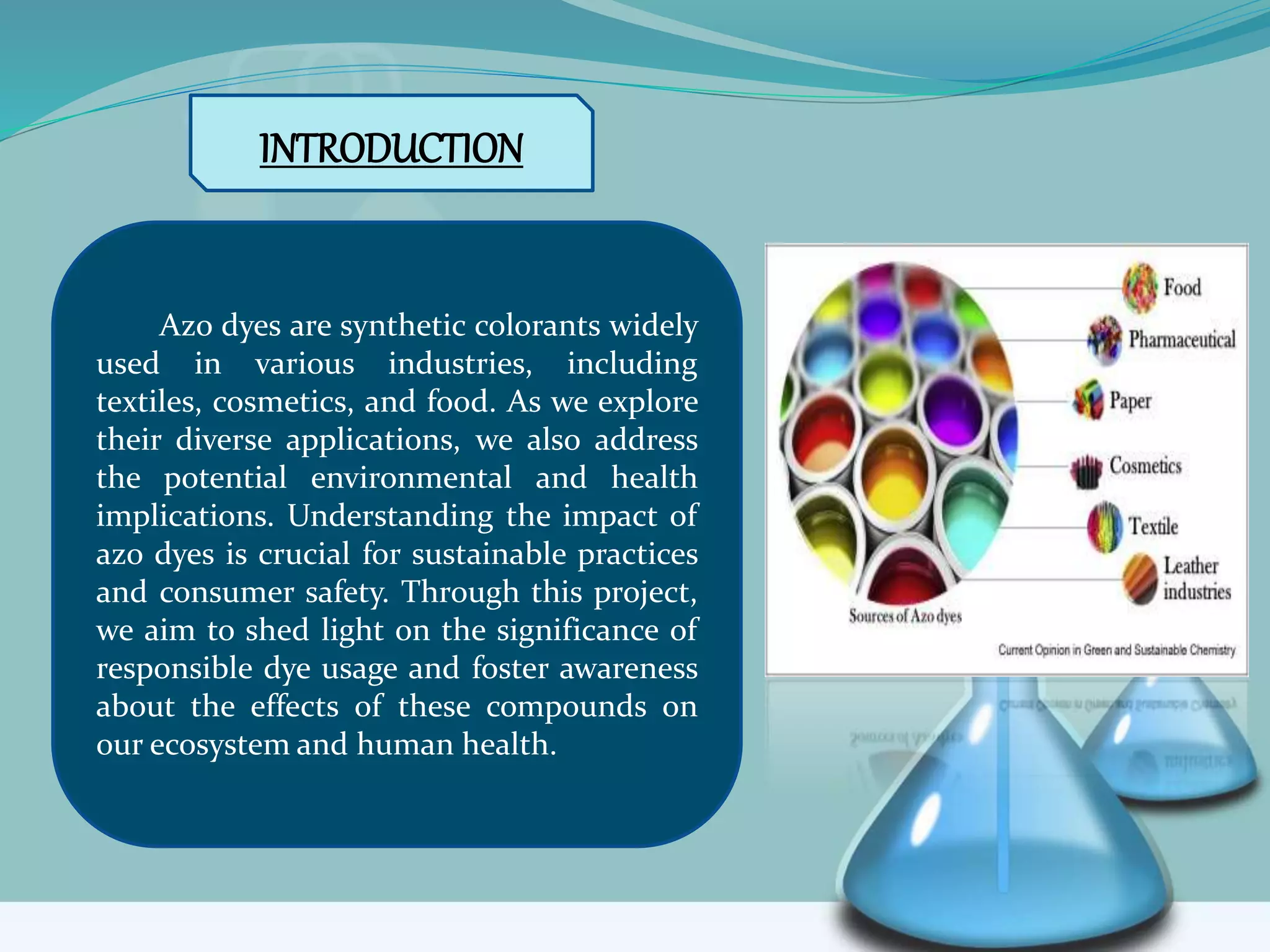
Azo dyes are synthetic colorants widely
used in various industries, including
textiles, cosmetics, and food. As we explore
their diverse applications, we also address
the potential environmental and health
implications. Understanding the impact of
azo dyes is crucial for sustainable practices
and consumer safety. Through this project,
we aim to shed light on the significance of
responsible dye usage and foster awareness
about the effects of these compounds on
our ecosystem and human health.
 What is Azo Dyes ?
 Azo dyes are a class of synthetic colorants characterized by the presence
of azo ( –N=N-) functional groups.
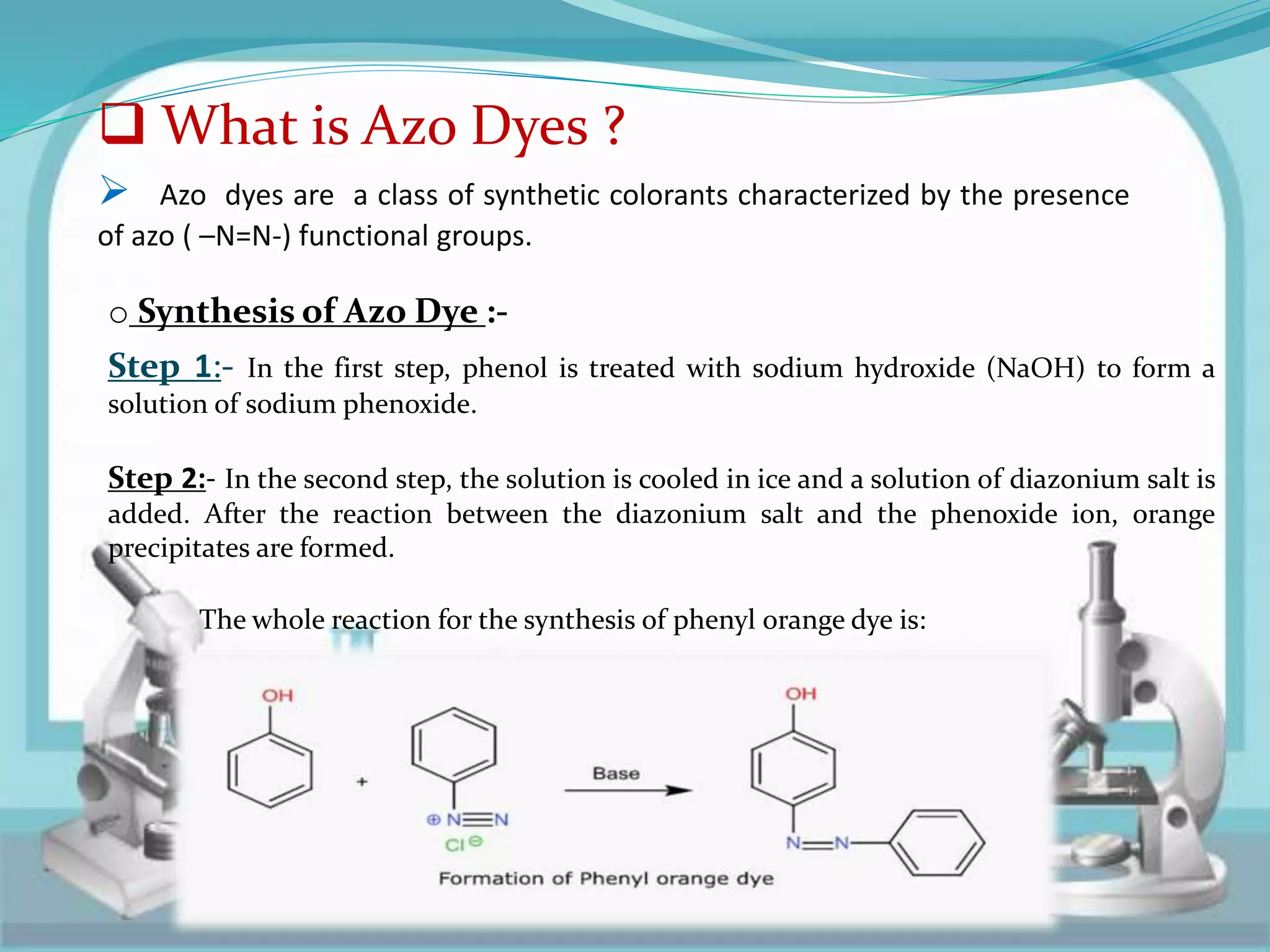
Step 1:- In the first step, phenol is treated with sodium hydroxide (NaOH) to form a
solution of sodium phenoxide.
Step 2:- In the second step, the solution is cooled in ice and a solution of diazonium salt is
added. After the reaction between the diazonium salt and the phenoxide ion, orange
precipitates are formed.
The whole reaction for the synthesis of phenyl orange dye is:
o Synthesis of Azo Dye :-
CLASSIFICATION OF AZO DYES
A. According to Azo Grouping Number
The azo dyes are distributed according to
the number of azo linkages which is in the same
molecule of the dye such as monoazo, disazo,
trisazo, polyazo and azoic. In the Color Index (CI)
system, azo dyes are supplied with numbers ranging
from 11,000 to 39,999 in correspondence with the
chemical structure (Table 1). The color index
number, developed by the society of dyers and
colorists, is used for dye classification .
The Classifications Are :- (a) Monoazo.
(b) Disazo.
(c) Triazo.
(d) Polyazo.
(e) Azoic.
B. According to reactive functional group-
ings:-
(a) Mono and dichlorotriazine.
(b) Mono-amino-chlorotriazine.
(c) Pyrimidines.
Table 1 :- Classification of azo dyes in
Colour Index.
 Applications of Azo Dyes
Azo dyes have been an integral part of human
civilization for centuries, revolutionizing the textile and
printing industries, among others. These dyes owe their
brilliant hues to the presence of azo (-N=N-) functional
groups, which enable them to produce an extensive range of
colors with exceptional color fastness. Let's begin by looking
at some of the primary applications of azo dyes.
(i) Textile Industry:
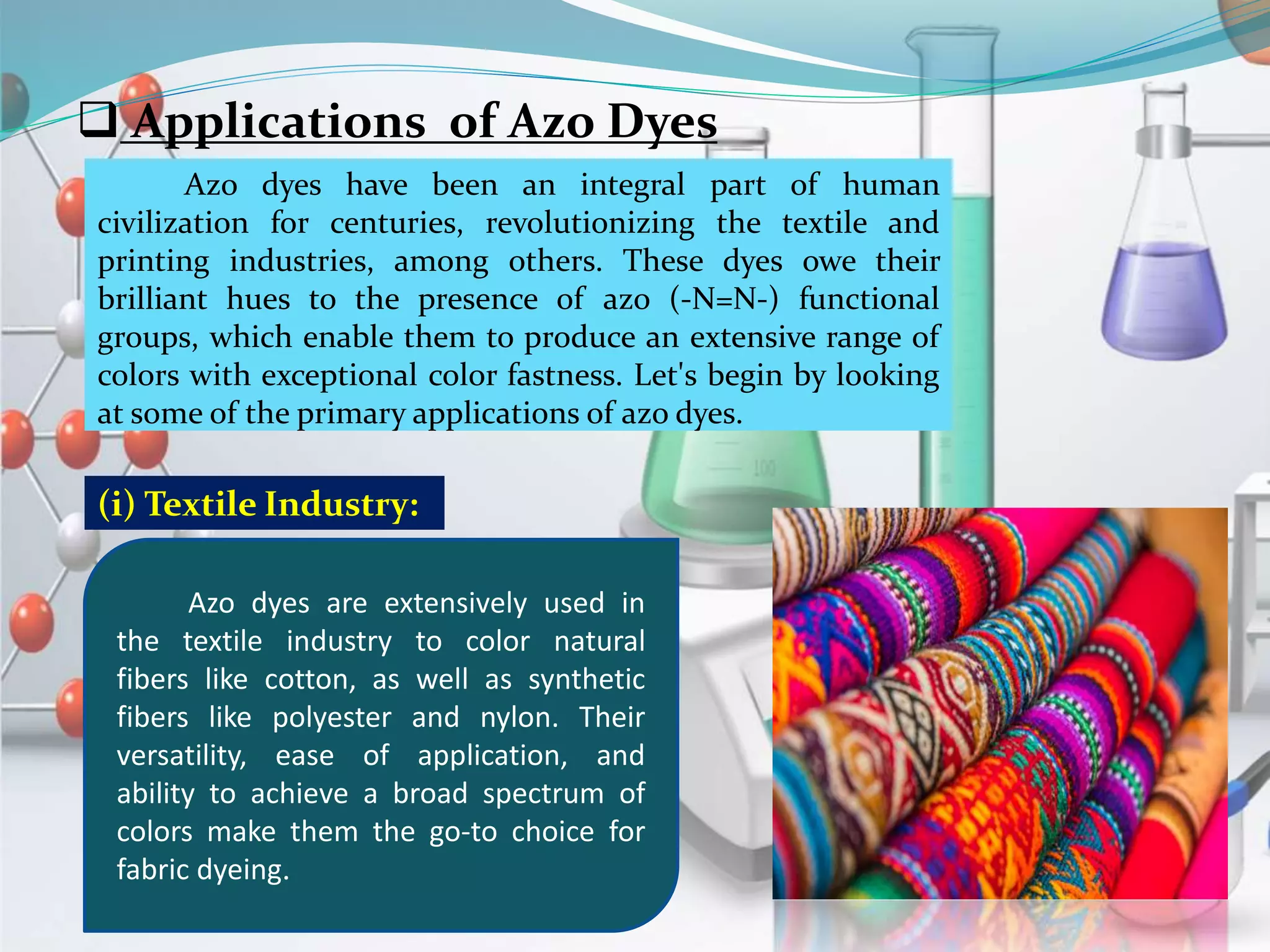
Azo dyes are extensively used in
the textile industry to color natural
fibers like cotton, as well as synthetic
fibers like polyester and nylon. Their
versatility, ease of application, and
ability to achieve a broad spectrum of
colors make them the go-to choice for
fabric dyeing.
(ii) Printing and Ink:
In the printing domain, azo dyes
are employed for producing vivid inks
used in various printing techniques,
such as inkjet and screen printing.
These inks ensure high-quality prints
with excellent color reproduction.
(iii) Pharmaceuticals:
Azo dyes are employed in
pharmaceutical formulations as color-
ants to distinguish between different
medications or to enhance patient
compliance by making the drugs more
visually appealing.
(iv) Cosmetics:
Azo dyes are found in various
cosmetic products, including hair dyes,
lip-sticks, and nail polishes, to provide
an array of attractive colors. However,
there are strict regulations to
ensure consumer safety and
prevent any potential health risks.
(v) Paints and Coatings:
Azo dyes are utilized in the
production of paints and coatings,
offering a broad spectrum of colors for
decorative and protective applications.
 Effects of Azo Dyes
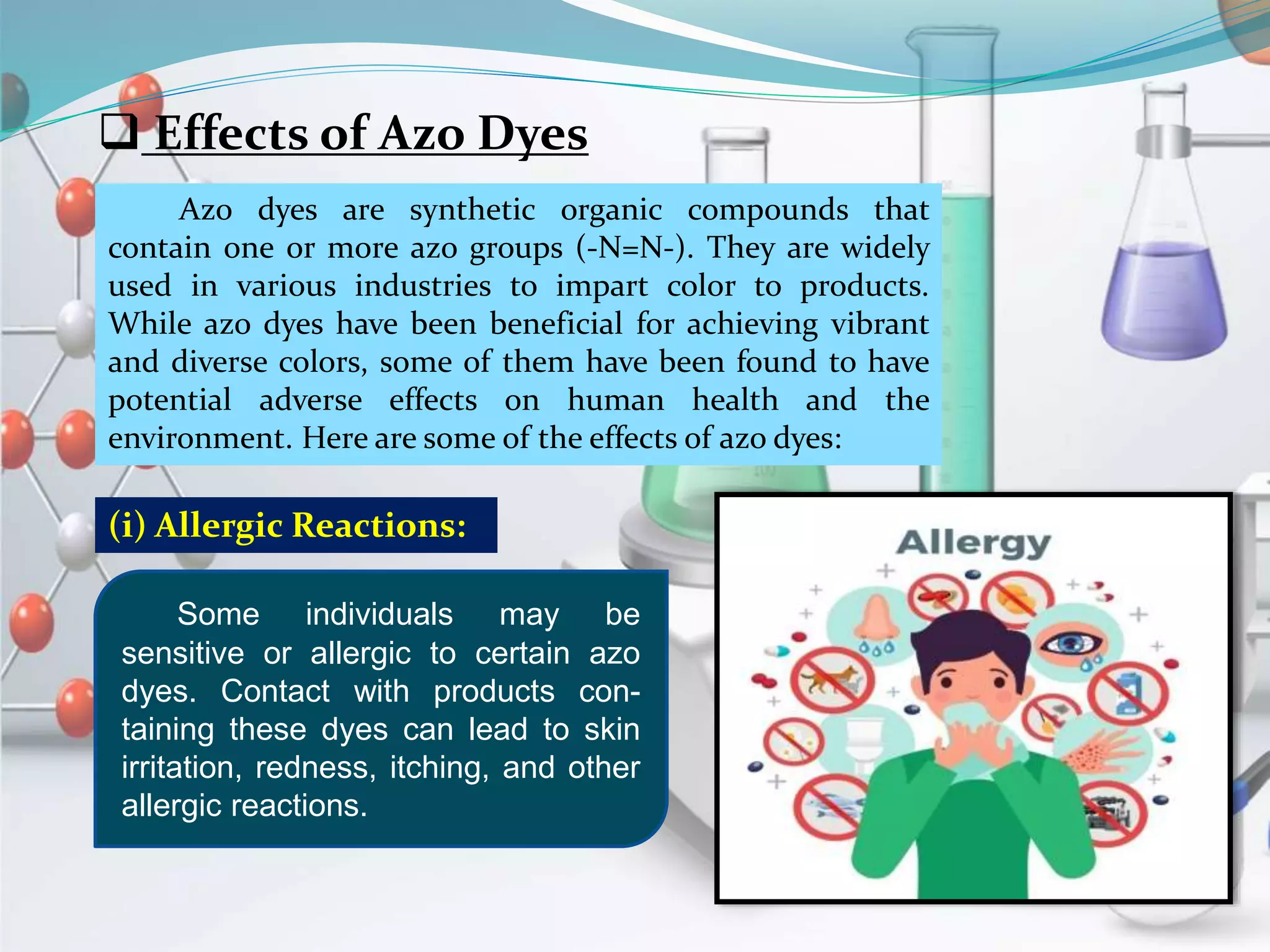
Some individuals may be
sensitive or allergic to certain azo
dyes. Contact with products con-
taining these dyes can lead to skin
irritation, redness, itching, and other
allergic reactions.
Azo dyes are synthetic organic compounds that
contain one or more azo groups (-N=N-). They are widely
used in various industries to impart color to products.
While azo dyes have been beneficial for achieving vibrant
and diverse colors, some of them have been found to have
potential adverse effects on human health and the
environment. Here are some of the effects of azo dyes:
(i) Allergic Reactions:
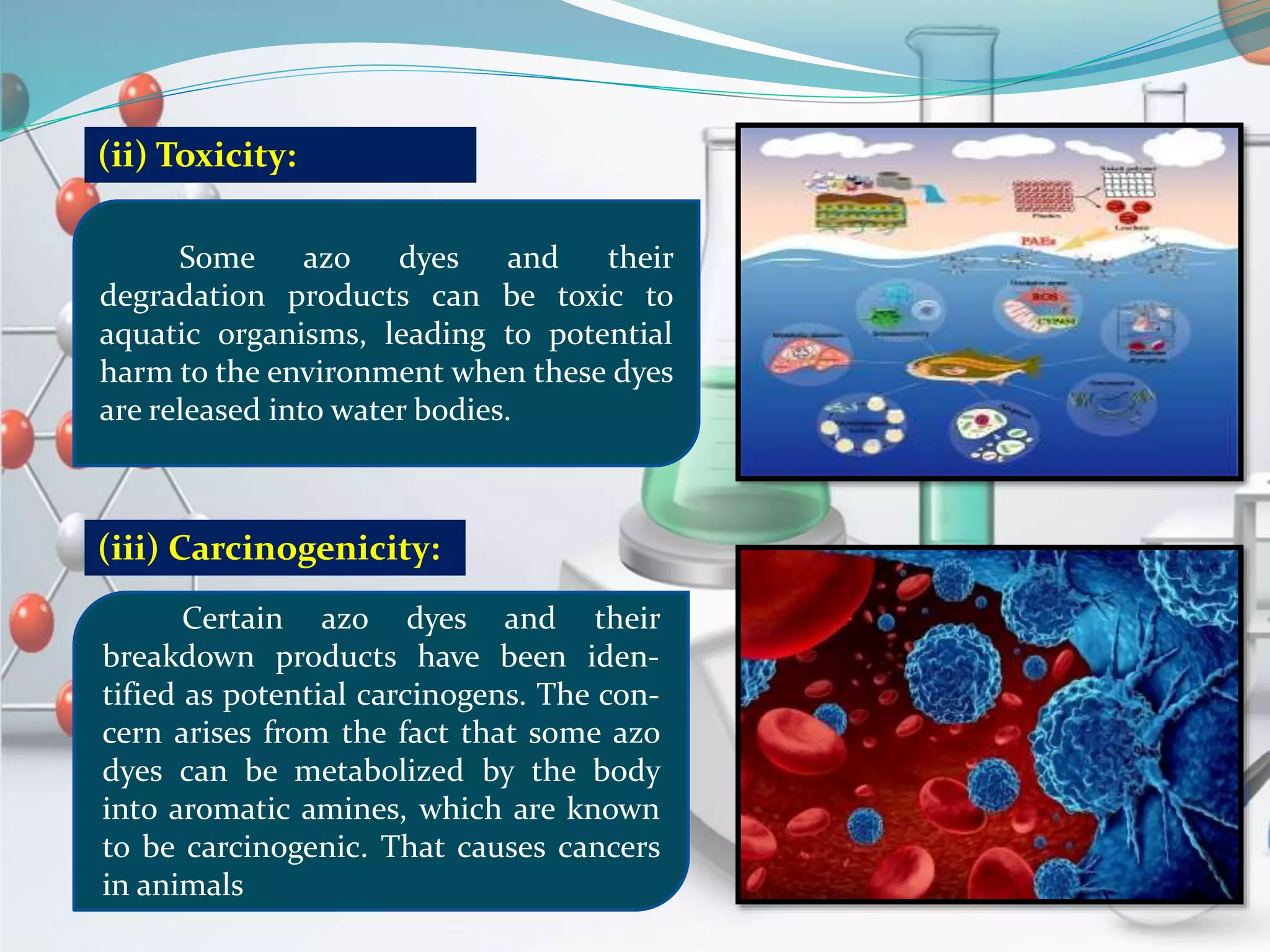
Some azo dyes and their
degradation products can be toxic to
aquatic organisms, leading to potential
harm to the environment when these dyes
are released into water bodies.
(ii) Toxicity:
Certain azo dyes and their
breakdown products have been iden-
tified as potential carcinogens. The con-
cern arises from the fact that some azo
dyes can be metabolized by the body
into aromatic amines, which are known
to be carcinogenic. That causes cancers
in animals
(iii) Carcinogenicity:
A significant environmental concern arises from the release of untreated
dye wastewater into water bodies. The non-biodegradable nature of some azo
dyes can lead to water pollution and adverse effects on aquatic life.This
persistence can further contribute to long-term environmental pollution.
(iv) Environmental Persistence:
Azo dyes can contaminate soil, posing environmental risks. Their
persistence and potential toxicity may harm soil organisms and disrupt
ecosystems. Proper disposal and safer dye alternatives are essential to
mitigate soil contamination.
(v) Soil Contamination:
 Regulations and Sustainable Alternatives:
To combat the negative effects of azo dyes, governments and industries
have implemented regulations to restrict the use of harmful dyes and
promote more sustainable practices. We'll discuss some of the measures
taken to reduce the environmental impact of azo dyes and promote safer
alternatives.
Eco-friendly Dyes: Researchers have been actively exploring eco-friendly
alternatives to azo dyes, such as natural dyes derived from plants and
microorganisms. These alternatives offer biodegradability and lower toxicity.
Conclusion
In conclusion, azo dyes have revolutionized the world of color
and design, enhancing our lives in various ways, but their
potential adverse effects on human health and the environment
are a matter of concern.
This project will help to spread awareness among consumers,
industries, and policymakers is crucial to promote responsible
use, disposal, and sustainable practices related to azo dyes. We
must work together to strike a balance between the advantages
of azo dyes and their impact on our planet.
I am highly grateful to Dr. Atanu Purkayastha, , Dept.
of Chemistry, Govt Degree College, Dharmanagar for guiding
me to prepare this project.
I am grateful to all the teachers of the Dept. of
Chemistry as well as the supporting Staff for their valuable
suggestion for preparing this project.
I am thankful to my classmates and friends for help and
hearty cooperation in this regard.
I am indebted to the authority, College Library, Govt.
Degree College, Dharmanagar, Tripura for permitting me to
borrow books from the library.
AKNOWLEDGEMENT
Azo Dyes Application and Effects

Azo Dyes Application and Effects

  • 1.
    PROJECT TITLE :-ABRIEFSURVEYONAZODYES:APPLICATIONS ANDUSES.
  • 2.
    OBJECTIVES  Investigate AzoDyes Usage: Conduct a comprehensive survey to identify the industries and applications where azo dyes are commonly used. This includes Medicine, textiles, printing, food, cosmetics, and more.  Assess Environmental Impact: Analyze the potential adverse effects of azo dyes on the environment, particularly concerning water bodies, soil, and overall ecosystem health.  Evaluate Health Implications: Investigate the potential health risks associated with exposure to azo dyes, such as skin irritation, respiratory issues, and potential carcinogenicity.
  • 3.
    INTRODUCTION Azo dyes aresynthetic colorants widely used in various industries, including textiles, cosmetics, and food. As we explore their diverse applications, we also address the potential environmental and health implications. Understanding the impact of azo dyes is crucial for sustainable practices and consumer safety. Through this project, we aim to shed light on the significance of responsible dye usage and foster awareness about the effects of these compounds on our ecosystem and human health.
  • 4.
     What isAzo Dyes ?  Azo dyes are a class of synthetic colorants characterized by the presence of azo ( –N=N-) functional groups. Step 1:- In the first step, phenol is treated with sodium hydroxide (NaOH) to form a solution of sodium phenoxide. Step 2:- In the second step, the solution is cooled in ice and a solution of diazonium salt is added. After the reaction between the diazonium salt and the phenoxide ion, orange precipitates are formed. The whole reaction for the synthesis of phenyl orange dye is: o Synthesis of Azo Dye :-
  • 5.
    CLASSIFICATION OF AZODYES A. According to Azo Grouping Number The azo dyes are distributed according to the number of azo linkages which is in the same molecule of the dye such as monoazo, disazo, trisazo, polyazo and azoic. In the Color Index (CI) system, azo dyes are supplied with numbers ranging from 11,000 to 39,999 in correspondence with the chemical structure (Table 1). The color index number, developed by the society of dyers and colorists, is used for dye classification . The Classifications Are :- (a) Monoazo. (b) Disazo. (c) Triazo. (d) Polyazo. (e) Azoic. B. According to reactive functional group- ings:- (a) Mono and dichlorotriazine. (b) Mono-amino-chlorotriazine. (c) Pyrimidines. Table 1 :- Classification of azo dyes in Colour Index.
  • 6.
     Applications ofAzo Dyes Azo dyes have been an integral part of human civilization for centuries, revolutionizing the textile and printing industries, among others. These dyes owe their brilliant hues to the presence of azo (-N=N-) functional groups, which enable them to produce an extensive range of colors with exceptional color fastness. Let's begin by looking at some of the primary applications of azo dyes. (i) Textile Industry: Azo dyes are extensively used in the textile industry to color natural fibers like cotton, as well as synthetic fibers like polyester and nylon. Their versatility, ease of application, and ability to achieve a broad spectrum of colors make them the go-to choice for fabric dyeing.
  • 7.
    (ii) Printing andInk: In the printing domain, azo dyes are employed for producing vivid inks used in various printing techniques, such as inkjet and screen printing. These inks ensure high-quality prints with excellent color reproduction. (iii) Pharmaceuticals: Azo dyes are employed in pharmaceutical formulations as color- ants to distinguish between different medications or to enhance patient compliance by making the drugs more visually appealing.
  • 8.
    (iv) Cosmetics: Azo dyesare found in various cosmetic products, including hair dyes, lip-sticks, and nail polishes, to provide an array of attractive colors. However, there are strict regulations to ensure consumer safety and prevent any potential health risks. (v) Paints and Coatings: Azo dyes are utilized in the production of paints and coatings, offering a broad spectrum of colors for decorative and protective applications.
  • 9.
     Effects ofAzo Dyes Some individuals may be sensitive or allergic to certain azo dyes. Contact with products con- taining these dyes can lead to skin irritation, redness, itching, and other allergic reactions. Azo dyes are synthetic organic compounds that contain one or more azo groups (-N=N-). They are widely used in various industries to impart color to products. While azo dyes have been beneficial for achieving vibrant and diverse colors, some of them have been found to have potential adverse effects on human health and the environment. Here are some of the effects of azo dyes: (i) Allergic Reactions:
  • 10.
    Some azo dyesand their degradation products can be toxic to aquatic organisms, leading to potential harm to the environment when these dyes are released into water bodies. (ii) Toxicity: Certain azo dyes and their breakdown products have been iden- tified as potential carcinogens. The con- cern arises from the fact that some azo dyes can be metabolized by the body into aromatic amines, which are known to be carcinogenic. That causes cancers in animals (iii) Carcinogenicity:
  • 11.
    A significant environmentalconcern arises from the release of untreated dye wastewater into water bodies. The non-biodegradable nature of some azo dyes can lead to water pollution and adverse effects on aquatic life.This persistence can further contribute to long-term environmental pollution. (iv) Environmental Persistence:
  • 12.
    Azo dyes cancontaminate soil, posing environmental risks. Their persistence and potential toxicity may harm soil organisms and disrupt ecosystems. Proper disposal and safer dye alternatives are essential to mitigate soil contamination. (v) Soil Contamination:
  • 13.
     Regulations andSustainable Alternatives: To combat the negative effects of azo dyes, governments and industries have implemented regulations to restrict the use of harmful dyes and promote more sustainable practices. We'll discuss some of the measures taken to reduce the environmental impact of azo dyes and promote safer alternatives. Eco-friendly Dyes: Researchers have been actively exploring eco-friendly alternatives to azo dyes, such as natural dyes derived from plants and microorganisms. These alternatives offer biodegradability and lower toxicity.
  • 14.
    Conclusion In conclusion, azodyes have revolutionized the world of color and design, enhancing our lives in various ways, but their potential adverse effects on human health and the environment are a matter of concern. This project will help to spread awareness among consumers, industries, and policymakers is crucial to promote responsible use, disposal, and sustainable practices related to azo dyes. We must work together to strike a balance between the advantages of azo dyes and their impact on our planet.
  • 15.
    I am highlygrateful to Dr. Atanu Purkayastha, , Dept. of Chemistry, Govt Degree College, Dharmanagar for guiding me to prepare this project. I am grateful to all the teachers of the Dept. of Chemistry as well as the supporting Staff for their valuable suggestion for preparing this project. I am thankful to my classmates and friends for help and hearty cooperation in this regard. I am indebted to the authority, College Library, Govt. Degree College, Dharmanagar, Tripura for permitting me to borrow books from the library. AKNOWLEDGEMENT