한국해양과학기술진흥원
Introduction to Parallel
Computing
Sayed Chhattan Shah,
PhD Senior Researcher
Electronics and Telecommunications
Research Institute, Korea
2
한국해양과학기술진흥원
Acknowledgement
s
Blaise Barney, Lawrence Livermore National
Laboratory,
“Introduction to Parallel Computing”
Jim Demmel, Parallel Computing Lab at UC
Berkeley,
“ Parallel Computing”
Outlin
e
한국해양과학기술진흥원
 Introduction
 Parallel Computer Memory
Architectures
 Shared Memory
 Distributed Memory
 Hybrid Distributed-Shared Memory
 Parallel Programming Models
 Shared Memory Model
 Threads Model
 Message Passing Model
 Data Parallel Model
 Design Parallel Programs
Overvie
w
What is Parallel
Computing?
한국해양과학기술진흥원
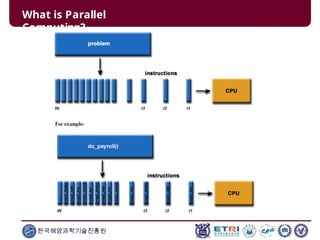
 Traditionally, software has been
written for serial computation
 To be run on a single computer having a single
Central Processing Unit
 A problem is broken into a discrete series of
instructions
 Instructions are executed one after another
 Only one instruction may execute at any moment in
time
What is Parallel
Computing?
한국해양과학기술진흥원
What is Parallel
Computing?
한국해양과학기술진흥원
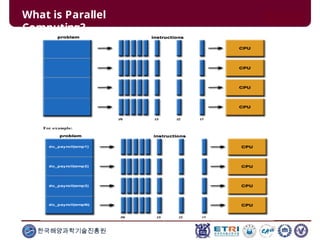
Parallel computing is the simultaneous use of
multiple compute resources to solve a
computational problem
 Accomplished by breaking the problem into independent
parts so that each processing element can execute its
part of the algorithm simultaneously with the others
What is Parallel
Computing?
한국해양과학기술진흥원
What is Parallel
Computing?
한국해양과학기술진흥원
The computational problem should be:
 Solved in less time with multiple compute resources than
with a
single compute resource
The compute resources might be
 A single computer with multiple processors
 Several networked computers
 A combination of both
What is Parallel
Computing?
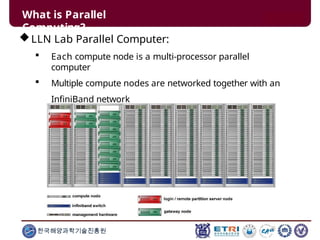
LLN Lab Parallel Computer:
 Each compute node is a multi-processor parallel
computer
 Multiple compute nodes are networked together with an
InfiniBand network
한국해양과학기술진흥원
What is Parallel
Computing?
한국해양과학기술진흥원
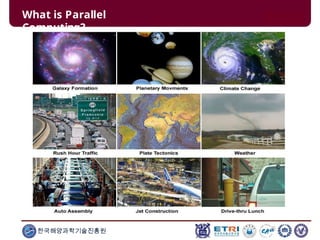
The Real World is Massively Parallel
 In the natural world, many complex, interrelated events
are happening at the same time, yet within a temporal
sequence
 Compared to serial computing, parallel computing is
much better suited for modeling, simulating and
understanding complex, real world phenomena
What is Parallel
Computing?
한국해양과학기술진흥원
Uses for Parallel
Computing
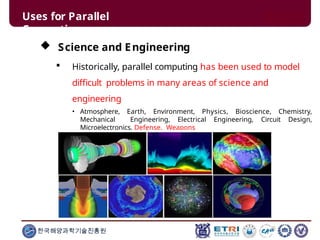
 Science and Engineering
 Historically, parallel computing has been used to model
difficult problems in many areas of science and
engineering
• Atmosphere, Earth, Environment, Physics, Bioscience, Chemistry,
Mechanical Engineering, Electrical Engineering, Circuit Design,
Microelectronics, Defense, Weapons
한국해양과학기술진흥원
Uses for Parallel
Computing
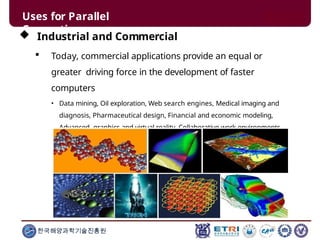
 Industrial and Commercial
 Today, commercial applications provide an equal or
greater driving force in the development of faster
computers
• Data mining, Oil exploration, Web search engines, Medical imaging and
diagnosis, Pharmaceutical design, Financial and economic modeling,
Advanced graphics and virtual reality, Collaborative work environments
한국해양과학기술진흥원
Why Use Parallel
Computing?
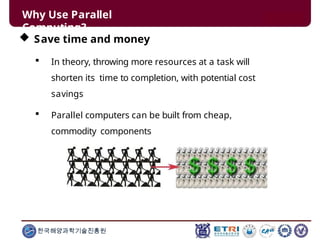
 Save time and money
 In theory, throwing more resources at a task will
shorten its time to completion, with potential cost
savings
 Parallel computers can be built from cheap,
commodity components
한국해양과학기술진흥원
Why Use Parallel
Computing?
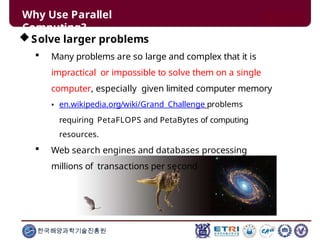
Solve larger problems
 Many problems are so large and complex that it is
impractical or impossible to solve them on a single
computer, especially given limited computer memory
• en.wikipedia.org/wiki/Grand_Challenge problems
requiring PetaFLOPS and PetaBytes of computing
resources.
 Web search engines and databases processing
millions of transactions per second
한국해양과학기술진흥원
Why Use Parallel
Computing?
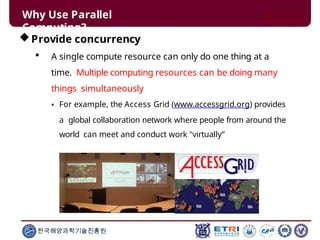
Provide concurrency
 A single compute resource can only do one thing at a
time. Multiple computing resources can be doing many
things simultaneously
• For example, the Access Grid (www.accessgrid.org) provides
a global collaboration network where people from around the
world can meet and conduct work "virtually”
한국해양과학기술진흥원
Why Use Parallel
Computing?
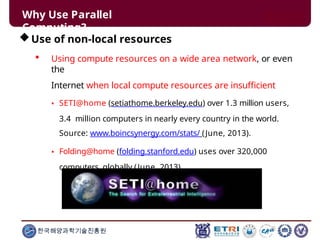
Use of non-local resources
 Using compute resources on a wide area network, or even
the
Internet when local compute resources are insufficient
• SETI@home (setiathome.berkeley.edu) over 1.3 million users,
3.4 million computers in nearly every country in the world.
Source: www.boincsynergy.com/stats/ (June, 2013).
• Folding@home (folding.stanford.edu) uses over 320,000
computers globally (June, 2013)
한국해양과학기술진흥원
Why Use Parallel
Computing?
한국해양과학기술진흥원
Limits to serial computing
 Transmission speeds
• The speed of a serial computer is directly dependent upon how
fast data can move through hardware.
• Absolute limits are the speed of light and the transmission limit
of
copper wire
• Increasing speeds necessitate increasing proximity of
processing
elements
 Limits to miniaturization
• Processor technology is allowing an increasing number
of transistors to be placed on a chip
• However, even with molecular or atomic-level components, a
limit will be reached on how small components can be
Why Use Parallel
Computing?
한국해양과학기술진흥원
Limits to serial computing
 Economic limitations
• It is increasingly expensive to make a single processor faster
• Using a larger number of moderately fast commodity
processors to achieve the same or better performance is less
expensive
 Current computer architectures are increasingly relying
upon hardware level parallelism to improve performance
• Multiple execution units
• Pipelined instructions
• Multi-core
The
Future
한국해양과학기술진흥원
 Trends indicated by ever faster networks,
distributed systems, and multi-processor computer
architectures clearly show that parallelism is the
future of computing
The
Future
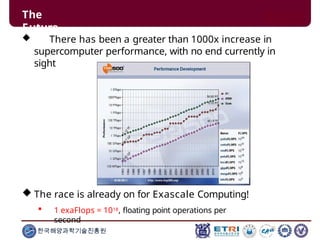
 There has been a greater than 1000x increase in
supercomputer performance, with no end currently in
sight
한국해양과학기술진흥원
 The race is already on for Exascale Computing!
 1 exaFlops = 1018, floating point operations per
second
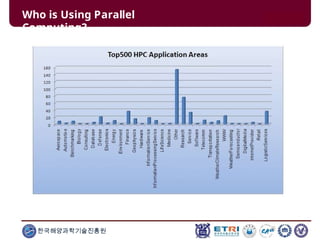
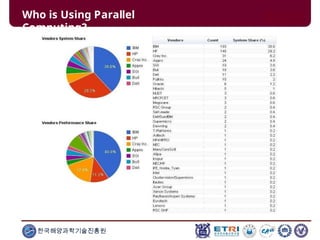
Who is Using Parallel
Computing?
한국해양과학기술진흥원
Who is Using Parallel
Computing?
한국해양과학기술진흥원
Concepts and
Terminology
von Neumann
Architecture
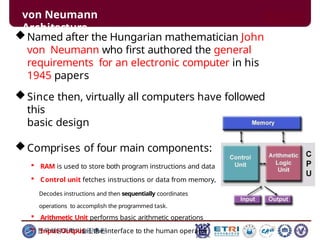
Named after the Hungarian mathematician John
von Neumann who first authored the general
requirements for an electronic computer in his
1945 papers
Since then, virtually all computers have followed
this
basic design
Comprises of four main components:
 RAM is used to store both program instructions and data
 Control unit fetches instructions or data from memory,
Decodes instructions and then sequentially coordinates
operations to accomplish the programmed task.
 Arithmetic Unit performs basic arithmetic operations
 Input-Output is the interface to the human operator
한국해양과학기술진흥원
Flynn's Classical
Taxonomy
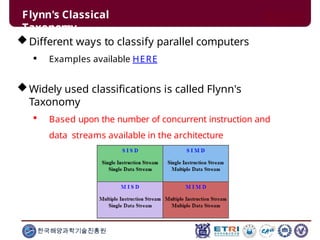
Different ways to classify parallel computers
 Examples available HERE
Widely used classifications is called Flynn's
Taxonomy
 Based upon the number of concurrent instruction and
data streams available in the architecture
한국해양과학기술진흥원
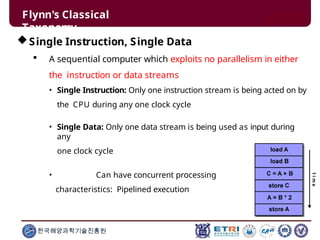
Single Instruction, Single Data
 A sequential computer which exploits no parallelism in either
the instruction or data streams
• Single Instruction: Only one instruction stream is being acted on by
the CPU during any one clock cycle
• Single Data: Only one data stream is being used as input during
any
one clock cycle
• Can have concurrent processing
characteristics: Pipelined execution
Flynn's Classical
Taxonomy
한국해양과학기술진흥원
Flynn's Classical
Taxonomy
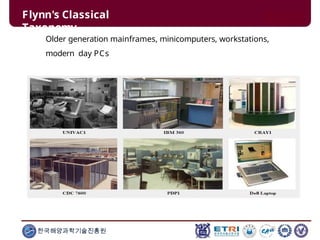
Older generation mainframes, minicomputers, workstations,
modern day PCs
한국해양과학기술진흥원
Flynn's Classical
Taxonomy
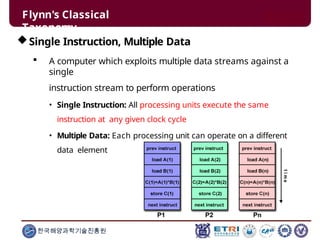
Single Instruction, Multiple Data
 A computer which exploits multiple data streams against a
single
instruction stream to perform operations
• Single Instruction: All processing units execute the same
instruction at any given clock cycle
• Multiple Data: Each processing unit can operate on a different
data element
한국해양과학기술진흥원
Flynn's Classical
Taxonomy
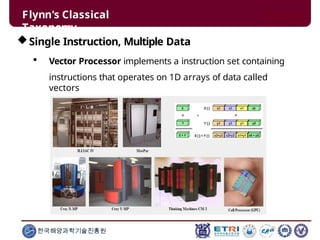
Single Instruction, Multiple Data
 Vector Processor implements a instruction set containing
instructions that operates on 1D arrays of data called
vectors
한국해양과학기술진흥원
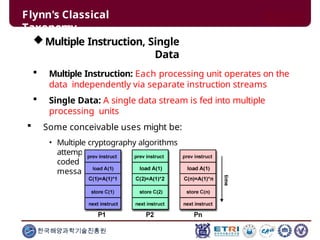
Multiple Instruction, Single
Data
 Multiple Instruction: Each processing unit operates on the
data independently via separate instruction streams
 Single Data: A single data stream is fed into multiple
processing units
 Some conceivable uses might be:
• Multiple cryptography algorithms
attempting to crack a single
coded
message
Flynn's Classical
Taxonomy
한국해양과학기술진흥원
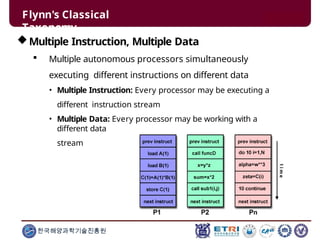
Multiple Instruction, Multiple Data
 Multiple autonomous processors simultaneously
executing different instructions on different data
• Multiple Instruction: Every processor may be executing a
different instruction stream
• Multiple Data: Every processor may be working with a
different data
stream
Flynn's Classical
Taxonomy
한국해양과학기술진흥원
Flynn's Classical
Taxonomy
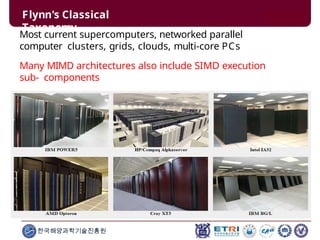
Most current supercomputers, networked parallel
computer clusters, grids, clouds, multi-core PCs
Many MIMD architectures also include SIMD execution
sub- components
한국해양과학기술진흥원
Some General Parallel
Terminology
한국해양과학기술진흥원
Parallel computing
 Using parallel computer to solve single problems faster
Parallel computer
 Multiple-processor or multi-core system supporting
parallel programming
Parallel programming
 Programming in a language that supports
concurrency explicitly
Supercomputing or High Performance
Computing
 Using the world's fastest and largest computers to solve
large problems
Some General Parallel
Terminology
한국해양과학기술진흥원
Task
 A logically discrete section of computational work.
 A task is typically a program or program-like set of instructions
that is executed by a processor
 A parallel program consists of multiple tasks running on
multiple processors
Shared Memory
 Hardware point of view, describes a computer architecture
where all processors have direct access to common physical
memory
 In a programming sense, it describes a model where all parallel
tasks have the same "picture" of memory and can directly
address and access the same logical memory locations
regardless of where the physical memory actually exists
Some General Parallel
Terminology
한국해양과학기술진흥원
Symmetric Multi-Processor (SMP)
 Hardware architecture where multiple processors
share a single address space and access to all
resources; shared memory computing
Distributed Memory
 In hardware, refers to network based memory
access for physical memory that is not common
 As a programming model, tasks can only logically "see"
local machine memory and must use communications to
access memory on other machines where other tasks
are executing
Some General Parallel
Terminology
한국해양과학기술진흥원
Communications
 Parallel tasks typically need to exchange data. There are several ways this
can be accomplished, such as through a shared memory bus or over a
network, however the actual event of data exchange is commonly referred
to as communications regardless of the method employed
Synchronization
 Coordination of parallel tasks in real time, very often associated
with communications
 Often implemented by establishing a synchronization point within an
application where a task may not proceed further until another task(s)
reaches the same or logically equivalent point
 Synchronization usually involves waiting by at least one task, and can
therefore cause a parallel application's wall clock execution time to increase
Some General Parallel
Terminology
한국해양과학기술진흥원
Parallel Overhead
 The amount of time required to coordinate parallel
tasks, as opposed to doing useful work.
 Parallel overhead can include factors such as:
• Task start-up time
• Synchronizations
• Data communications
• Software overhead imposed by parallel languages,
libraries, operating system, etc.
• Task termination time
Massively Parallel
 Refers to the hardware that comprises a given parallel system - having
many processors.
 The meaning of "many" keeps increasing, but currently, the largest
parallel computers can be comprised of processors numbering in the
hundreds of thousands
Some General Parallel
Terminology
한국해양과학기술진흥원
Embarrassingly Parallel
 Solving many similar, but independent tasks
simultaneously; little to no need for coordination
between the tasks
Scalability
 A parallel system's ability to demonstrate a
proportionate increase in parallel speedup with the
addition of more resources
Some General Parallel
Terminology
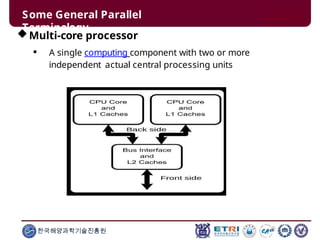
Multi-core processor
 A single computing component with two or more
independent actual central processing units
한국해양과학기술진흥원
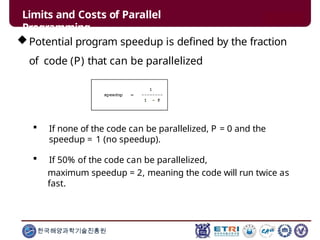
Potential program speedup is defined by the fraction
of code (P) that can be parallelized
 If none of the code can be parallelized, P = 0 and the
speedup = 1 (no speedup).
 If 50% of the code can be parallelized,
maximum speedup = 2, meaning the code will run twice as
fast.
Limits and Costs of Parallel
Programming
한국해양과학기술진흥원
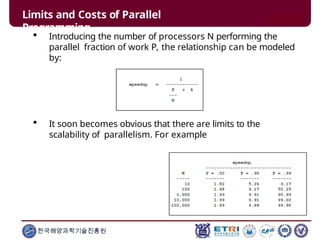
 Introducing the number of processors N performing the
parallel fraction of work P, the relationship can be modeled
by:
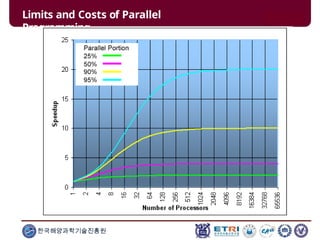
 It soon becomes obvious that there are limits to the
scalability of parallelism. For example
Limits and Costs of Parallel
Programming
한국해양과학기술진흥원
Limits and Costs of Parallel
Programming
한국해양과학기술진흥원
Some General Parallel
Terminology
한국해양과학기술진흥원
Complexity
 Parallel applications are much more complex
than corresponding serial applications
• Not only do you have multiple instruction streams executing at
the same time, but you also have data flowing between them
 The costs of complexity are measured in programmer
time in virtually every aspect of the software
development cycle:
• Design
• Coding
• Debugging
• Tuning
• Maintenance
Some General Parallel
Terminology
한국해양과학기술진흥원
Portability
 Portability issues with parallel programs are not as
serious as in years past due to standardization in several
APIs, such as MPI, POSIX threads, and OpenMP
 All of the usual portability issues associated with
serial programs apply to parallel programs
• Hardware architectures are characteristically highly variable
and can affect portability
Some General Parallel
Terminology
한국해양과학기술진흥원
Resource Requirements
 Amount of memory required can be greater for parallel
codes than serial codes, due to the need to replicate data
and for overheads associated with parallel support
libraries and subsystems
 For short running parallel programs, there can actually
be a decrease in performance compared to a similar
serial implementation
• The overhead costs associated with setting up the parallel
environment, task creation, communications and task
termination can comprise a significant portion of the total
execution time for short runs
Some General Parallel
Terminology
한국해양과학기술진흥원
Scalability
 Ability of a parallel program's performance to scale is a
result of a number of interrelated factors. Simply adding
more processors is rarely the answer
 Algorithm may have inherent limits to scalability
 Hardware factors play a significant role in
scalability. Examples:
• Memory-CPU bus bandwidth on an SMP machine
• Communications network bandwidth
• Amount of memory available on any given machine or
set of machines
• Processor clock speed
Parallel Computer Memory
Architectures
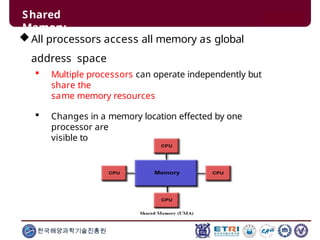
All processors access all memory as global
address space
 Multiple processors can operate independently but
share the
same memory resources
 Changes in a memory location effected by one
processor are
visible to all other processors
Shared
Memory
한국해양과학기술진흥원
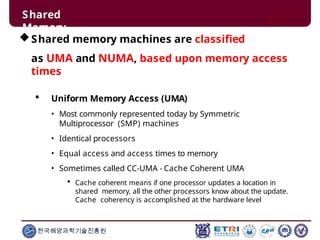
Shared memory machines are classified
as UMA and NUMA, based upon memory access
times
 Uniform Memory Access (UMA)
• Most commonly represented today by Symmetric
Multiprocessor (SMP) machines
• Identical processors
• Equal access and access times to memory
• Sometimes called CC-UMA - Cache Coherent UMA
 Cache coherent means if one processor updates a location in
shared memory, all the other processors know about the update.
Cache coherency is accomplished at the hardware level
한국해양과학기술진흥원
Shared
Memory
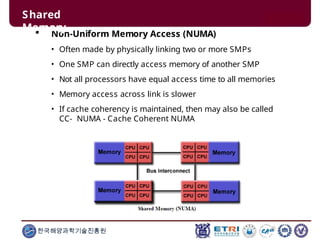
 Non-Uniform Memory Access (NUMA)
• Often made by physically linking two or more SMPs
• One SMP can directly access memory of another SMP
• Not all processors have equal access time to all memories
• Memory access across link is slower
• If cache coherency is maintained, then may also be called
CC- NUMA - Cache Coherent NUMA
Shared
Memory
한국해양과학기술진흥원
Advantages
 Global address space provides a user-friendly programming
perspective to memory
 Data sharing between tasks is both fast and uniform due to
the proximity of memory to CPUs
Disadvantages
 Primary disadvantage is the lack of scalability between
memory and CPUs
• Adding more CPUs can geometrically increases traffic on
the shared memory-CPU path, and for cache coherent
systems, geometrically increase traffic associated with
cache/memory management
 Programmer responsibility for synchronization constructs
that ensure "correct" access of global memory
한국해양과학기술진흥원
Shared
Memory
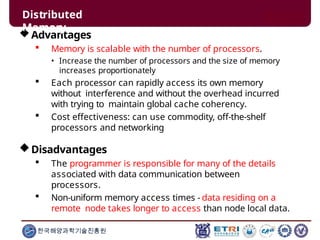
Processors have their own local memory
 Changes to processor’s local memory have no effect on
the memory of other processors
 When a processor needs access to data in another
processor, it is usually the task of the programmer to
explicitly define how and when data is communicated
 Synchronization between tasks is likewise the
programmer's responsibility
 The network "fabric" used for data transfer varies widely,
though it can be as simple as Ethernet
Distributed
Memory
한국해양과학기술진흥원
Advantages
 Memory is scalable with the number of processors.
• Increase the number of processors and the size of memory
increases proportionately
 Each processor can rapidly access its own memory
without interference and without the overhead incurred
with trying to maintain global cache coherency.
 Cost effectiveness: can use commodity, off-the-shelf
processors and networking
Disadvantages
 The programmer is responsible for many of the details
associated with data communication between
processors.
 Non-uniform memory access times - data residing on a
remote node takes longer to access than node local data.
한국해양과학기술진흥원
Distributed
Memory
Hybrid Distributed-Shared
Memory
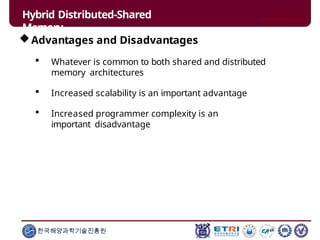
The largest and fastest computers in the world
today employ both shared and distributed
memory architectures
 The shared memory component can be a shared
memory
machine or graphics processing units
 The distributed memory component is the networking
of
multiple shared memory or GPU machines
한국해양과학기술진흥원
Advantages and Disadvantages
 Whatever is common to both shared and distributed
memory architectures
 Increased scalability is an important advantage
 Increased programmer complexity is an
important disadvantage
한국해양과학기술진흥원
Hybrid Distributed-Shared
Memory
Parallel Programming
Models
Parallel Programming
Model
한국해양과학기술진흥원
Programming model provides an abstract view
of computing system
 Abstraction above hardware and memory
architectures
 Value of a programming model is usually judged on
its generality
• how well a range of different problems can be
expressed and
• how well they execute on a range of different
architectures
 The implementation of a programming model can take
several forms such as libraries invoked from traditional
sequential languages, language extensions, or complete
new execution models
Parallel Programming
Model
한국해양과학기술진흥원
Parallel programming models in common use:
 Shared Memory (without threads)
 Threads
 Distributed Memory / Message Passing
 Data Parallel
 Hybrid
 Single Program Multiple Data (SPMD)
 Multiple Program Multiple Data (MPMD)
These models are NOT specific to a particular
type of machine or memory architecture
 Any of these models can be implemented on any
underlying hardware
Parallel Programming
Model
한국해양과학기술진흥원
SHARED memory model on a DISTRIBUTED
memory machine
 Machine memory was physically distributed across
networked machines, but appeared to the user as a single
shared memory (global address space).
 This approach is referred to as virtual shared memory
DISTRIBUTED memory model on a SHARED memory
machine
 The SGI Origin 2000 employed the CC-NUMA type of
shared memory architecture, where every task has direct
access to global address space spread across all
machines.
 However, the ability to send and receive messages using MPI,
as is commonly done over a network of distributed memory
machines, was implemented and commonly used
Shared Memory Model - Without
Threads
한국해양과학기술진흥원
Tasks share a common address space
 Efficient means of passing data between programs
 Various mechanisms such as locks / semaphores may be
used to control access to the shared memory
 Programmer's point of view
• The notion of data "ownership" is lacking, so there is no need
to specify explicitly the communication of data between
tasks
• Program development can often be simplified
Disadvantage in terms of performance
 It becomes more difficult to understand and manage
data locality:
• Keeping data local to the processor that works on it conserves
memory accesses, cache refreshes and bus traffic that occurs
when multiple processors use the same data
Shared Memory Model - Without
Threads
한국해양과학기술진흥원
Implementations
 Native compilers or hardware translate user program
variables into actual memory addresses, which are global
• On stand-alone shared memory machines, this is
straightforward.
• On distributed shared memory machines, memory is physically
distributed across a network of machines, but made global
through specialized hardware and software
Threads
Model
Type of shared memory programming model
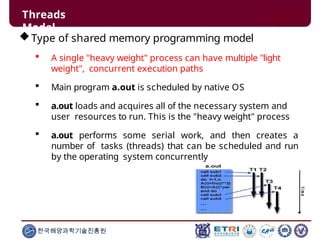
 A single "heavy weight" process can have multiple "light
weight", concurrent execution paths
 Main program a.out is scheduled by native OS
 a.out loads and acquires all of the necessary system and
user resources to run. This is the "heavy weight" process
 a.out performs some serial work, and then creates a
number of tasks (threads) that can be scheduled and run
by the operating system concurrently
한국해양과학기술진흥원
Threads
Model
한국해양과학기술진흥원
 Each thread has local data, but also, shares the entire
resources of a.out
 This saves the overhead associated with replicating a
program's resources for each thread ("light weight"). Each
thread also benefits from a global memory view because it
shares the memory space of a.out
 Threads communicate with each other through global
memory (updating address locations). This requires
synchronization constructs to ensure that more than one
thread is not updating the same global address at any
time
 Threads can come and go, but a.out remains present to
provide the necessary shared resources until the
application has completed
Threads
Model
한국해양과학기술진흥원
Implementations
• POSIX Threads
 Library based; requires parallel coding
 C Language only
 Commonly referred to as Pthreads.
 Most hardware vendors now offer Pthreads in addition to their
proprietary threads implementations.
 Very explicit parallelism; requires significant programmer attention
to detail.
• OpenMP
 Compiler directive based; can use serial code
 Portable / multi-platform, including Unix and Windows platforms
 Available in C/C++ and Fortran implementations
 Can be very easy and simple to use
Distributed Memory / Message Passing
Model
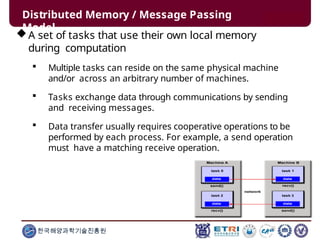
A set of tasks that use their own local memory
during computation
 Multiple tasks can reside on the same physical machine
and/or across an arbitrary number of machines.
 Tasks exchange data through communications by sending
and receiving messages.
 Data transfer usually requires cooperative operations to be
performed by each process. For example, a send operation
must have a matching receive operation.
한국해양과학기술진흥원
Distributed Memory / Message Passing
Model
Implementations
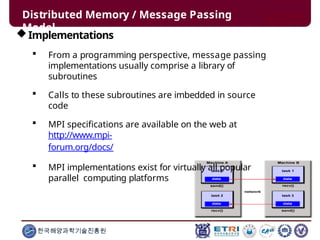
 From a programming perspective, message passing
implementations usually comprise a library of
subroutines
 Calls to these subroutines are imbedded in source
code
 MPI specifications are available on the web at
http://www.mpi-
forum.org/docs/
 MPI implementations exist for virtually all popular
parallel computing platforms
한국해양과학기술진흥원
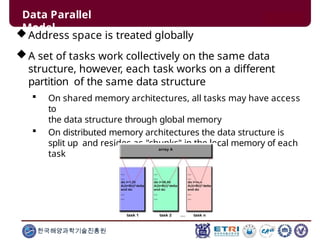
Address space is treated globally
A set of tasks work collectively on the same data
structure, however, each task works on a different
partition of the same data structure
 On shared memory architectures, all tasks may have access
to
the data structure through global memory
 On distributed memory architectures the data structure is
split up and resides as "chunks" in the local memory of each
task
Data Parallel
Model
한국해양과학기술진흥원
Implementations
 Unified Parallel C (UPC): an extension to the C
programming language for SPMD parallel programming.
Compiler dependent. More information: http://upc.lbl.gov/
 Global Arrays: provides a shared memory style
programming environment in the context of distributed
array data structures. Public domain library with C and
Fortran77 bindings. More information:
http://www.emsl.pnl.gov/docs/global/
 X10: a PGAS based parallel programming language being
developed by IBM at the Thomas J. Watson Research
Center. More information: http://x10-lang.org/
한국해양과학기술진흥원
Data Parallel
Model
Hybrid
Model
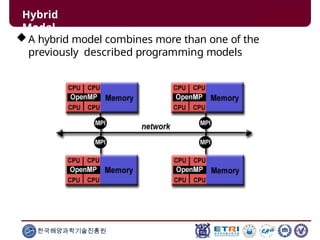
A hybrid model combines more than one of the
previously described programming models
한국해양과학기술진흥원
Single Program Multiple
Data
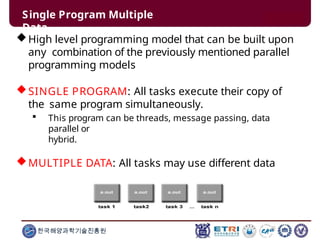
High level programming model that can be built upon
any combination of the previously mentioned parallel
programming models
SINGLE PROGRAM: All tasks execute their copy of
the same program simultaneously.
 This program can be threads, message passing, data
parallel or
hybrid.
MULTIPLE DATA: All tasks may use different data
한국해양과학기술진흥원
Multiple Program Multiple Data
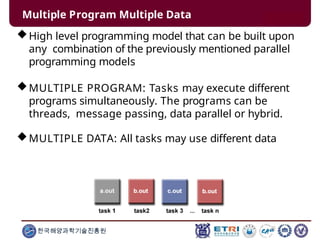
High level programming model that can be built upon
any combination of the previously mentioned parallel
programming models
MULTIPLE PROGRAM: Tasks may execute different
programs simultaneously. The programs can be
threads, message passing, data parallel or hybrid.
MULTIPLE DATA: All tasks may use different data
한국해양과학기술진흥원
Designing Parallel
Programs
Determine whether the problem can be parallelized
Calculate the potential energy for each of several
thousand independent conformations of a molecule.
When done, find the minimum energy
conformation
 This problem can be solved in parallel.
• Each of the molecular conformations is independently
determinable
• The calculation of the minimum energy conformation is
also a parallelizable problem.
한국해양과학기술진흥원
Understand the Problem and the
Program
Calculation of the series (0,1,1,2,3,5,8,13,21,...) by
use of the formula: F(n) = F(n-1) + F(n-2)
 This problem can't be solved in parallel
• Calculation of the Fibonacci sequence as shown would
entail dependent calculations rather than independent
ones.
• The calculation of the F(n) value uses those of both F(n-1) and F(n-
2). These three terms cannot be calculated independently and
therefore, not in parallel
한국해양과학기술진흥원
Understand the Problem and the
Program
Understand the Problem and the
Program
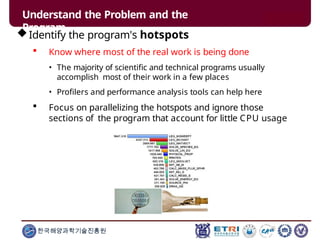
Identify the program's hotspots
 Know where most of the real work is being done
• The majority of scientific and technical programs usually
accomplish most of their work in a few places
• Profilers and performance analysis tools can help here
 Focus on parallelizing the hotspots and ignore those
sections of the program that account for little CPU usage
한국해양과학기술진흥원
Understand the Problem and the
Program
한국해양과학기술진흥원
Identify bottlenecks in the program
 Are there areas that are disproportionately slow, or
cause parallelizable work to halt or be deferred?
• For example, I/O is usually something that slows a
program down
 May be possible to restructure the program or use a
different algorithm to reduce or eliminate unnecessary
slow areas
Identify inhibitors to parallelism
 One common class of inhibitor is data dependence
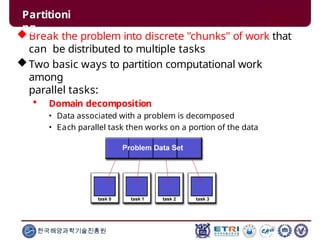
Break the problem into discrete "chunks" of work that
can be distributed to multiple tasks
Two basic ways to partition computational work
among
parallel tasks:
 Domain decomposition
• Data associated with a problem is decomposed
• Each parallel task then works on a portion of the data
Partitioni
ng
한국해양과학기술진흥원
Partitioni
ng
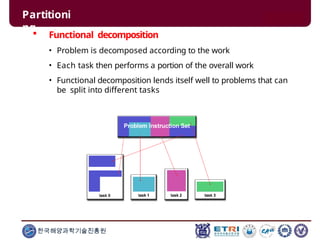
 Functional decomposition
• Problem is decomposed according to the work
• Each task then performs a portion of the overall work
• Functional decomposition lends itself well to problems that can
be split into different tasks
한국해양과학기술진흥원
Partitioni
ng
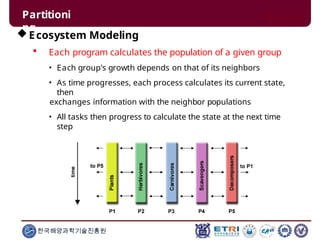
Ecosystem Modeling
 Each program calculates the population of a given group
• Each group's growth depends on that of its neighbors
• As time progresses, each process calculates its current state,
then
exchanges information with the neighbor populations
• All tasks then progress to calculate the state at the next time
step
한국해양과학기술진흥원
Partitioni
ng
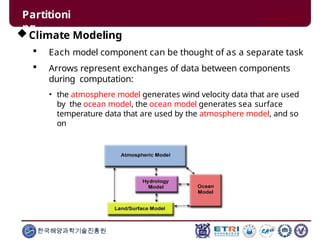
Climate Modeling
 Each model component can be thought of as a separate task
 Arrows represent exchanges of data between components
during computation:
• the atmosphere model generates wind velocity data that are used
by the ocean model, the ocean model generates sea surface
temperature data that are used by the atmosphere model, and so
on
한국해양과학기술진흥원
Communication
s
한국해양과학기술진흥원
Some types of problems can be decomposed and
executed in parallel with virtually no need for
tasks to share data
 For example, imagine an image processing operation
where every pixel in a black and white image needs to
have its color reversed
 The image data can easily be distributed to multiple tasks
that then act independently of each other to do their
portion of the work
Most parallel applications require tasks to share data
with each other
 For example, a 3-D heat diffusion problem requires a
task to know the temperatures calculated by the tasks
that have neighboring data
 Changes to neighboring data has a direct effect on that
task's
data
Communication
s
한국해양과학기술진흥원
Factors to Consider when designing your program's
inter- task communications
 Cost of communications
• Inter-task communication virtually always implies overhead
• Communications frequently require some type of synchronization
between tasks
• Competing communication traffic can saturate the available
network bandwidth, further aggravating performance problems
 Latency vs. Bandwidth
• latency is the time it takes to send a message from point A to B
• bandwidth is the amount of data that can be communicated per
unit of
time
• Sending many small messages can cause latency to
dominate communication overheads
• Often it is more efficient to package small messages into a
larger
message, thus increasing the effective communications
bandwidth
Communication
s
한국해양과학기술진흥원
 Visibility of communications
• With the Message Passing Model, communications are explicit and
generally quite visible and under the control of the programmer
• With the Data Parallel Model, communications often occur
transparently to the programmer, particularly on distributed
memory architectures
• The programmer may not even be able to know exactly how
inter-task
communications are being accomplished
 Synchronous vs. asynchronous communications
• Synchronous communications are often referred to
as blocking communications since other work must wait until
the communications have completed
• Asynchronous communications allow tasks to transfer
data independently from one another
• Interleaving computation with communication is the single
greatest benefit for using asynchronous communications
Communication
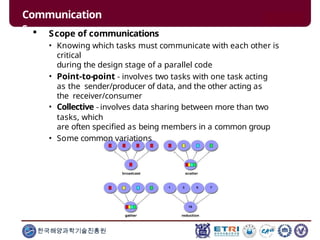
s  Scope of communications
• Knowing which tasks must communicate with each other is
critical
during the design stage of a parallel code
• Point-to-point - involves two tasks with one task acting
as the sender/producer of data, and the other acting as
the receiver/consumer
• Collective - involves data sharing between more than two
tasks, which
are often specified as being members in a common group
• Some common variations
한국해양과학기술진흥원
Communication
s
한국해양과학기술진흥원
Efficiency of communications
 Which implementation for a given model should be used?
• Using the Message Passing Model as an example, one MPI
implementation may be faster on a given hardware platform
than another
• What type of communication operations should be used?
• asynchronous communication operations can improve overall
program performance
Communication
s
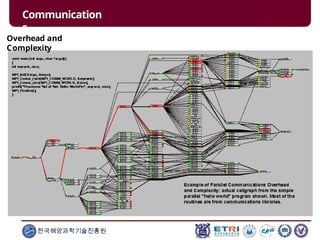
Overhead and
Complexity
한국해양과학기술진흥원
Synchronizatio
n
한국해양과학기술진흥원
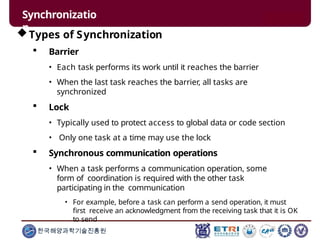
Types of Synchronization
 Barrier
• Each task performs its work until it reaches the barrier
• When the last task reaches the barrier, all tasks are
synchronized
 Lock
• Typically used to protect access to global data or code section
• Only one task at a time may use the lock
 Synchronous communication operations
• When a task performs a communication operation, some
form of coordination is required with the other task
participating in the communication
• For example, before a task can perform a send operation, it must
first receive an acknowledgment from the receiving task that it is OK
to send
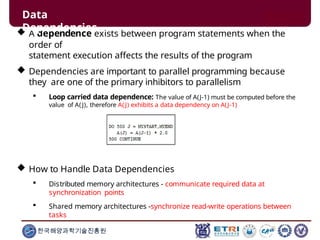
 A dependence exists between program statements when the
order of
statement execution affects the results of the program
 Dependencies are important to parallel programming because
they are one of the primary inhibitors to parallelism
 Loop carried data dependence: The value of A(J-1) must be computed before the
value of A(J), therefore A(J) exhibits a data dependency on A(J-1)
 How to Handle Data Dependencies
 Distributed memory architectures - communicate required data at
synchronization points
 Shared memory architectures -synchronize read-write operations between
tasks
Data
Dependencies
한국해양과학기술진흥원
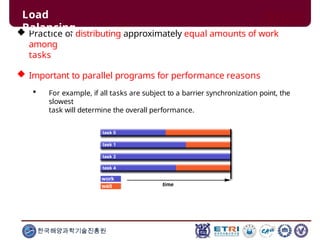
 Practice of distributing approximately equal amounts of work
among
tasks
 Important to parallel programs for performance reasons
 For example, if all tasks are subject to a barrier synchronization point, the
slowest
task will determine the overall performance.
Load
Balancing
한국해양과학기술진흥원
How to Achieve Load Balance
 Equally partition the work each task receives
• For array operations where each task performs similar work,
evenly distribute the data set among the tasks
• For loop iterations where the work done in each iteration is
similar, evenly distribute the iterations across the tasks
• If a heterogeneous mix of machines, use performance
analysis tool to
detect any load imbalances and adjust work accordingly
 Use dynamic work assignment
• When the amount of work each task will perform is
intentionally variable, or is unable to be predicted, it may be
helpful to use
a scheduler - task pool approach
 As each task finishes its work, it queues to get a new piece of
work.
• It may become necessary to design an algorithm which detects
and handles load imbalances as they occur dynamically within
the code
한국해양과학기술진흥원
Load
Balancing
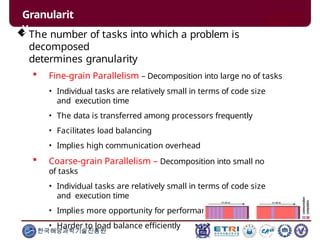
 The number of tasks into which a problem is
decomposed
determines granularity
 Fine-grain Parallelism – Decomposition into large no of tasks
• Individual tasks are relatively small in terms of code size
and execution time
• The data is transferred among processors frequently
• Facilitates load balancing
• Implies high communication overhead
 Coarse-grain Parallelism – Decomposition into small no
of tasks
• Individual tasks are relatively small in terms of code size
and execution time
• Implies more opportunity for performance increase
• Harder to load balance efficiently
Granularit
y
한국해양과학기술진흥원
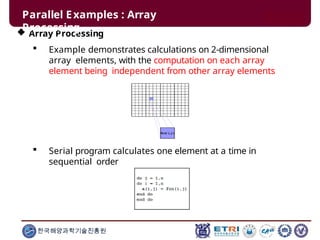
 Array Processing
 Example demonstrates calculations on 2-dimensional
array elements, with the computation on each array
element being independent from other array elements
 Serial program calculates one element at a time in
sequential order
Parallel Examples : Array
Processing
한국해양과학기술진흥원
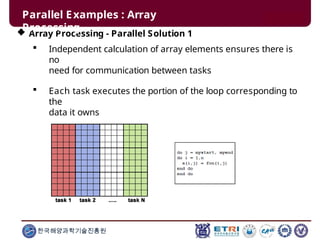
 Array Processing - Parallel Solution 1
 Independent calculation of array elements ensures there is
no
need for communication between tasks
 Each task executes the portion of the loop corresponding to
the
data it owns
Parallel Examples : Array
Processing
한국해양과학기술진흥원
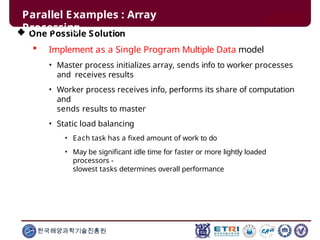
 One Possible Solution
 Implement as a Single Program Multiple Data model
• Master process initializes array, sends info to worker processes
and receives results
• Worker process receives info, performs its share of computation
and
sends results to master
• Static load balancing
• Each task has a fixed amount of work to do
• May be significant idle time for faster or more lightly loaded
processors -
slowest tasks determines overall performance
한국해양과학기술진흥원
Parallel Examples : Array
Processing
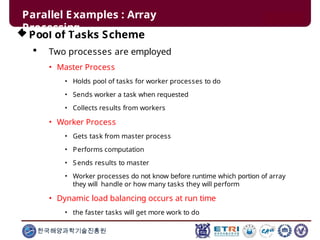
Pool of Tasks Scheme
 Two processes are employed
• Master Process
• Holds pool of tasks for worker processes to do
• Sends worker a task when requested
• Collects results from workers
• Worker Process
• Gets task from master process
• Performs computation
• Sends results to master
• Worker processes do not know before runtime which portion of array
they will handle or how many tasks they will perform
• Dynamic load balancing occurs at run time
• the faster tasks will get more work to do
한국해양과학기술진흥원
Parallel Examples : Array
Processing
Multicore computing
 A Multicore processor is a processor that
includes multiple execution units ("cores") on
the same chip
Symmetric multiprocessing
 A computer system with multiple identical processors
that share memory and connect via a bus than node
local data.
Distributed System
 A software system in which components located on
networked computers communicate and coordinate their
actions by passing messages
 An important goal and challenge of distributed
systems is location transparency
한국해양과학기술진흥원
Classes of Parallel
Computers
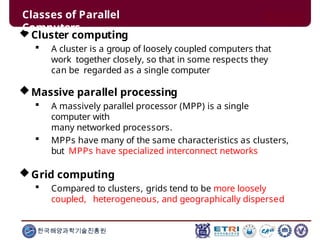
Cluster computing
 A cluster is a group of loosely coupled computers that
work together closely, so that in some respects they
can be regarded as a single computer
Massive parallel processing
 A massively parallel processor (MPP) is a single
computer with
many networked processors.
 MPPs have many of the same characteristics as clusters,
but MPPs have specialized interconnect networks
Grid computing
 Compared to clusters, grids tend to be more loosely
coupled, heterogeneous, and geographically dispersed
한국해양과학기술진흥원
Classes of Parallel
Computers
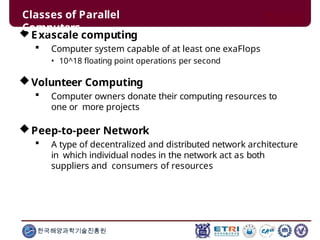
Exascale computing
 Computer system capable of at least one exaFlops
• 10^18 floating point operations per second
Volunteer Computing
 Computer owners donate their computing resources to
one or more projects
Peep-to-peer Network
 A type of decentralized and distributed network architecture
in which individual nodes in the network act as both
suppliers and consumers of resources
한국해양과학기술진흥원
Classes of Parallel
Computers
Distributed
Systems
A collection of independent computers that appear to
the users of the system as a single computer
한국해양과학기술진흥원
A collection of autonomous computers, connected
through a network and distribution middleware
which enables computers to coordinate their
activities and to share the resources of the system,
so that users perceive the system as a single,
integrated computing facility
Distributed
Systems
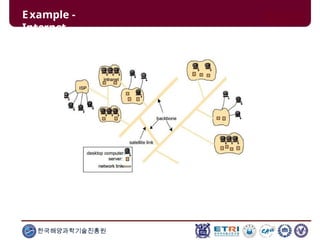
Example -
Internet
한국해양과학기술진흥원
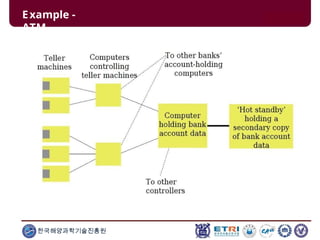
Example -
ATM
한국해양과학기술진흥원
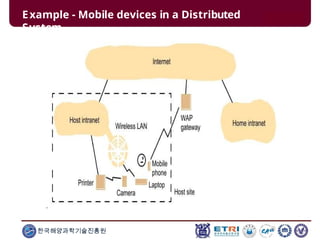
Example - Mobile devices in a Distributed
System
한국해양과학기술진흥원
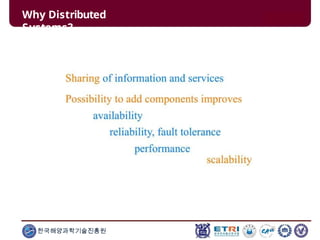
Why Distributed
Systems?
한국해양과학기술진흥원
Basic problems and challenges
Transparency
Scalability
Fault tolerance
Concurrency
Openness
These challenges can also be seen as the goals
or desired properties of a distributed system
한국해양과학기술진흥원
 Concealment from the user and the application
programmer of the separation of the components of a
distributed system
 Access Transparency - Local and remote resources are
accessed in
same way
 Location Transparency - Users are unaware of the location
of resources
 Migration Transparency - Resources can migrate without
name
change
 Replication Transparency - Users are unaware of the
existence of multiple copies of resources
 Failure Transparency - Users are unaware of the failure of
individual components
 Concurrency Transparency - Users are unaware of sharing
resources with others
한국해양과학기술진흥원
Transparenc
y
 Addition of users and resources without suffering a
noticeable loss of performance or increase in
administrative complexity
 Adding users and resources causes a system to grow:
 Size - growth with regards to the number of users or resources
• System may become overloaded
• May increase administration cost
 Geography - growth with regards to geography or the
distance between nodes
• Greater communication delays
 Administration – increase in administrative cost
한국해양과학기술진흥원
Scalabilit
y
Whether the system can be extended in various
ways without disrupting existing system and
services
 Hardware extensions
• adding peripherals, memory, communication interfaces
 Software extensions
• Operating System features
• Communication protocols
Openness is supported by:
 Public interfaces
 Standardized communication protocols
한국해양과학기술진흥원
Opennes
s
In a single system several processes are interleaved
In distributed systems - there are many systems with
one or more processors
Many users simultaneously invoke commands
or applications, access and update shared
data
 Mutual exclusion
 Synchronization
 No global clock
한국해양과학기술진흥원
Concurrenc
y
Hardware, software and networks fail
Distributed systems must maintain availability
even at low levels of hardware, software, network
reliability
Fault tolerance is achieved by
 Recovery
 Redundancy
Issues
 Detecting failures
 Masking failures
 Recovery from failures
 Redundancy
한국해양과학기술진흥원
Fault
tolerance
Fault
tolerance
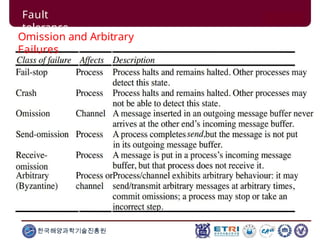
Omission and Arbitrary
Failures
한국해양과학기술진흥원
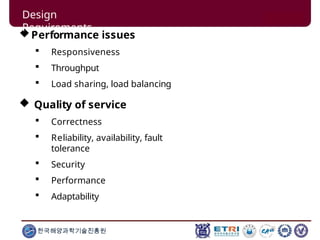
Performance issues
 Responsiveness
 Throughput
 Load sharing, load balancing
 Quality of service
 Correctness
 Reliability, availability, fault
tolerance
 Security
 Performance
 Adaptability
한국해양과학기술진흥원
Design
Requirements

parallelprogramming-130823023925-phpapp01.pptx

  • 1.
    한국해양과학기술진흥원 Introduction to Parallel Computing SayedChhattan Shah, PhD Senior Researcher Electronics and Telecommunications Research Institute, Korea
  • 2.
    2 한국해양과학기술진흥원 Acknowledgement s Blaise Barney, LawrenceLivermore National Laboratory, “Introduction to Parallel Computing” Jim Demmel, Parallel Computing Lab at UC Berkeley, “ Parallel Computing”
  • 3.
    Outlin e 한국해양과학기술진흥원  Introduction  ParallelComputer Memory Architectures  Shared Memory  Distributed Memory  Hybrid Distributed-Shared Memory  Parallel Programming Models  Shared Memory Model  Threads Model  Message Passing Model  Data Parallel Model  Design Parallel Programs
  • 4.
  • 5.
    What is Parallel Computing? 한국해양과학기술진흥원 Traditionally, software has been written for serial computation  To be run on a single computer having a single Central Processing Unit  A problem is broken into a discrete series of instructions  Instructions are executed one after another  Only one instruction may execute at any moment in time
  • 6.
  • 7.
    What is Parallel Computing? 한국해양과학기술진흥원 Parallelcomputing is the simultaneous use of multiple compute resources to solve a computational problem  Accomplished by breaking the problem into independent parts so that each processing element can execute its part of the algorithm simultaneously with the others
  • 8.
  • 9.
    What is Parallel Computing? 한국해양과학기술진흥원 Thecomputational problem should be:  Solved in less time with multiple compute resources than with a single compute resource The compute resources might be  A single computer with multiple processors  Several networked computers  A combination of both
  • 10.
    What is Parallel Computing? LLNLab Parallel Computer:  Each compute node is a multi-processor parallel computer  Multiple compute nodes are networked together with an InfiniBand network 한국해양과학기술진흥원
  • 11.
    What is Parallel Computing? 한국해양과학기술진흥원 TheReal World is Massively Parallel  In the natural world, many complex, interrelated events are happening at the same time, yet within a temporal sequence  Compared to serial computing, parallel computing is much better suited for modeling, simulating and understanding complex, real world phenomena
  • 12.
  • 13.
    Uses for Parallel Computing Science and Engineering  Historically, parallel computing has been used to model difficult problems in many areas of science and engineering • Atmosphere, Earth, Environment, Physics, Bioscience, Chemistry, Mechanical Engineering, Electrical Engineering, Circuit Design, Microelectronics, Defense, Weapons 한국해양과학기술진흥원
  • 14.
    Uses for Parallel Computing Industrial and Commercial  Today, commercial applications provide an equal or greater driving force in the development of faster computers • Data mining, Oil exploration, Web search engines, Medical imaging and diagnosis, Pharmaceutical design, Financial and economic modeling, Advanced graphics and virtual reality, Collaborative work environments 한국해양과학기술진흥원
  • 15.
    Why Use Parallel Computing? Save time and money  In theory, throwing more resources at a task will shorten its time to completion, with potential cost savings  Parallel computers can be built from cheap, commodity components 한국해양과학기술진흥원
  • 16.
    Why Use Parallel Computing? Solvelarger problems  Many problems are so large and complex that it is impractical or impossible to solve them on a single computer, especially given limited computer memory • en.wikipedia.org/wiki/Grand_Challenge problems requiring PetaFLOPS and PetaBytes of computing resources.  Web search engines and databases processing millions of transactions per second 한국해양과학기술진흥원
  • 17.
    Why Use Parallel Computing? Provideconcurrency  A single compute resource can only do one thing at a time. Multiple computing resources can be doing many things simultaneously • For example, the Access Grid (www.accessgrid.org) provides a global collaboration network where people from around the world can meet and conduct work "virtually” 한국해양과학기술진흥원
  • 18.
    Why Use Parallel Computing? Useof non-local resources  Using compute resources on a wide area network, or even the Internet when local compute resources are insufficient • SETI@home (setiathome.berkeley.edu) over 1.3 million users, 3.4 million computers in nearly every country in the world. Source: www.boincsynergy.com/stats/ (June, 2013). • Folding@home (folding.stanford.edu) uses over 320,000 computers globally (June, 2013) 한국해양과학기술진흥원
  • 19.
    Why Use Parallel Computing? 한국해양과학기술진흥원 Limitsto serial computing  Transmission speeds • The speed of a serial computer is directly dependent upon how fast data can move through hardware. • Absolute limits are the speed of light and the transmission limit of copper wire • Increasing speeds necessitate increasing proximity of processing elements  Limits to miniaturization • Processor technology is allowing an increasing number of transistors to be placed on a chip • However, even with molecular or atomic-level components, a limit will be reached on how small components can be
  • 20.
    Why Use Parallel Computing? 한국해양과학기술진흥원 Limitsto serial computing  Economic limitations • It is increasingly expensive to make a single processor faster • Using a larger number of moderately fast commodity processors to achieve the same or better performance is less expensive  Current computer architectures are increasingly relying upon hardware level parallelism to improve performance • Multiple execution units • Pipelined instructions • Multi-core
  • 21.
    The Future 한국해양과학기술진흥원  Trends indicatedby ever faster networks, distributed systems, and multi-processor computer architectures clearly show that parallelism is the future of computing
  • 22.
    The Future  There hasbeen a greater than 1000x increase in supercomputer performance, with no end currently in sight 한국해양과학기술진흥원  The race is already on for Exascale Computing!  1 exaFlops = 1018, floating point operations per second
  • 23.
    Who is UsingParallel Computing? 한국해양과학기술진흥원
  • 24.
    Who is UsingParallel Computing? 한국해양과학기술진흥원
  • 25.
  • 26.
    von Neumann Architecture Named afterthe Hungarian mathematician John von Neumann who first authored the general requirements for an electronic computer in his 1945 papers Since then, virtually all computers have followed this basic design Comprises of four main components:  RAM is used to store both program instructions and data  Control unit fetches instructions or data from memory, Decodes instructions and then sequentially coordinates operations to accomplish the programmed task.  Arithmetic Unit performs basic arithmetic operations  Input-Output is the interface to the human operator 한국해양과학기술진흥원
  • 27.
    Flynn's Classical Taxonomy Different waysto classify parallel computers  Examples available HERE Widely used classifications is called Flynn's Taxonomy  Based upon the number of concurrent instruction and data streams available in the architecture 한국해양과학기술진흥원
  • 28.
    Single Instruction, SingleData  A sequential computer which exploits no parallelism in either the instruction or data streams • Single Instruction: Only one instruction stream is being acted on by the CPU during any one clock cycle • Single Data: Only one data stream is being used as input during any one clock cycle • Can have concurrent processing characteristics: Pipelined execution Flynn's Classical Taxonomy 한국해양과학기술진흥원
  • 29.
    Flynn's Classical Taxonomy Older generationmainframes, minicomputers, workstations, modern day PCs 한국해양과학기술진흥원
  • 30.
    Flynn's Classical Taxonomy Single Instruction,Multiple Data  A computer which exploits multiple data streams against a single instruction stream to perform operations • Single Instruction: All processing units execute the same instruction at any given clock cycle • Multiple Data: Each processing unit can operate on a different data element 한국해양과학기술진흥원
  • 31.
    Flynn's Classical Taxonomy Single Instruction,Multiple Data  Vector Processor implements a instruction set containing instructions that operates on 1D arrays of data called vectors 한국해양과학기술진흥원
  • 32.
    Multiple Instruction, Single Data Multiple Instruction: Each processing unit operates on the data independently via separate instruction streams  Single Data: A single data stream is fed into multiple processing units  Some conceivable uses might be: • Multiple cryptography algorithms attempting to crack a single coded message Flynn's Classical Taxonomy 한국해양과학기술진흥원
  • 33.
    Multiple Instruction, MultipleData  Multiple autonomous processors simultaneously executing different instructions on different data • Multiple Instruction: Every processor may be executing a different instruction stream • Multiple Data: Every processor may be working with a different data stream Flynn's Classical Taxonomy 한국해양과학기술진흥원
  • 34.
    Flynn's Classical Taxonomy Most currentsupercomputers, networked parallel computer clusters, grids, clouds, multi-core PCs Many MIMD architectures also include SIMD execution sub- components 한국해양과학기술진흥원
  • 35.
    Some General Parallel Terminology 한국해양과학기술진흥원 Parallelcomputing  Using parallel computer to solve single problems faster Parallel computer  Multiple-processor or multi-core system supporting parallel programming Parallel programming  Programming in a language that supports concurrency explicitly Supercomputing or High Performance Computing  Using the world's fastest and largest computers to solve large problems
  • 36.
    Some General Parallel Terminology 한국해양과학기술진흥원 Task A logically discrete section of computational work.  A task is typically a program or program-like set of instructions that is executed by a processor  A parallel program consists of multiple tasks running on multiple processors Shared Memory  Hardware point of view, describes a computer architecture where all processors have direct access to common physical memory  In a programming sense, it describes a model where all parallel tasks have the same "picture" of memory and can directly address and access the same logical memory locations regardless of where the physical memory actually exists
  • 37.
    Some General Parallel Terminology 한국해양과학기술진흥원 SymmetricMulti-Processor (SMP)  Hardware architecture where multiple processors share a single address space and access to all resources; shared memory computing Distributed Memory  In hardware, refers to network based memory access for physical memory that is not common  As a programming model, tasks can only logically "see" local machine memory and must use communications to access memory on other machines where other tasks are executing
  • 38.
    Some General Parallel Terminology 한국해양과학기술진흥원 Communications Parallel tasks typically need to exchange data. There are several ways this can be accomplished, such as through a shared memory bus or over a network, however the actual event of data exchange is commonly referred to as communications regardless of the method employed Synchronization  Coordination of parallel tasks in real time, very often associated with communications  Often implemented by establishing a synchronization point within an application where a task may not proceed further until another task(s) reaches the same or logically equivalent point  Synchronization usually involves waiting by at least one task, and can therefore cause a parallel application's wall clock execution time to increase
  • 39.
    Some General Parallel Terminology 한국해양과학기술진흥원 ParallelOverhead  The amount of time required to coordinate parallel tasks, as opposed to doing useful work.  Parallel overhead can include factors such as: • Task start-up time • Synchronizations • Data communications • Software overhead imposed by parallel languages, libraries, operating system, etc. • Task termination time Massively Parallel  Refers to the hardware that comprises a given parallel system - having many processors.  The meaning of "many" keeps increasing, but currently, the largest parallel computers can be comprised of processors numbering in the hundreds of thousands
  • 40.
    Some General Parallel Terminology 한국해양과학기술진흥원 EmbarrassinglyParallel  Solving many similar, but independent tasks simultaneously; little to no need for coordination between the tasks Scalability  A parallel system's ability to demonstrate a proportionate increase in parallel speedup with the addition of more resources
  • 41.
    Some General Parallel Terminology Multi-coreprocessor  A single computing component with two or more independent actual central processing units 한국해양과학기술진흥원
  • 42.
    Potential program speedupis defined by the fraction of code (P) that can be parallelized  If none of the code can be parallelized, P = 0 and the speedup = 1 (no speedup).  If 50% of the code can be parallelized, maximum speedup = 2, meaning the code will run twice as fast. Limits and Costs of Parallel Programming 한국해양과학기술진흥원
  • 43.
     Introducing thenumber of processors N performing the parallel fraction of work P, the relationship can be modeled by:  It soon becomes obvious that there are limits to the scalability of parallelism. For example Limits and Costs of Parallel Programming 한국해양과학기술진흥원
  • 44.
    Limits and Costsof Parallel Programming 한국해양과학기술진흥원
  • 45.
    Some General Parallel Terminology 한국해양과학기술진흥원 Complexity Parallel applications are much more complex than corresponding serial applications • Not only do you have multiple instruction streams executing at the same time, but you also have data flowing between them  The costs of complexity are measured in programmer time in virtually every aspect of the software development cycle: • Design • Coding • Debugging • Tuning • Maintenance
  • 46.
    Some General Parallel Terminology 한국해양과학기술진흥원 Portability Portability issues with parallel programs are not as serious as in years past due to standardization in several APIs, such as MPI, POSIX threads, and OpenMP  All of the usual portability issues associated with serial programs apply to parallel programs • Hardware architectures are characteristically highly variable and can affect portability
  • 47.
    Some General Parallel Terminology 한국해양과학기술진흥원 ResourceRequirements  Amount of memory required can be greater for parallel codes than serial codes, due to the need to replicate data and for overheads associated with parallel support libraries and subsystems  For short running parallel programs, there can actually be a decrease in performance compared to a similar serial implementation • The overhead costs associated with setting up the parallel environment, task creation, communications and task termination can comprise a significant portion of the total execution time for short runs
  • 48.
    Some General Parallel Terminology 한국해양과학기술진흥원 Scalability Ability of a parallel program's performance to scale is a result of a number of interrelated factors. Simply adding more processors is rarely the answer  Algorithm may have inherent limits to scalability  Hardware factors play a significant role in scalability. Examples: • Memory-CPU bus bandwidth on an SMP machine • Communications network bandwidth • Amount of memory available on any given machine or set of machines • Processor clock speed
  • 49.
  • 50.
    All processors accessall memory as global address space  Multiple processors can operate independently but share the same memory resources  Changes in a memory location effected by one processor are visible to all other processors Shared Memory 한국해양과학기술진흥원
  • 51.
    Shared memory machinesare classified as UMA and NUMA, based upon memory access times  Uniform Memory Access (UMA) • Most commonly represented today by Symmetric Multiprocessor (SMP) machines • Identical processors • Equal access and access times to memory • Sometimes called CC-UMA - Cache Coherent UMA  Cache coherent means if one processor updates a location in shared memory, all the other processors know about the update. Cache coherency is accomplished at the hardware level 한국해양과학기술진흥원 Shared Memory
  • 52.
     Non-Uniform MemoryAccess (NUMA) • Often made by physically linking two or more SMPs • One SMP can directly access memory of another SMP • Not all processors have equal access time to all memories • Memory access across link is slower • If cache coherency is maintained, then may also be called CC- NUMA - Cache Coherent NUMA Shared Memory 한국해양과학기술진흥원
  • 53.
    Advantages  Global addressspace provides a user-friendly programming perspective to memory  Data sharing between tasks is both fast and uniform due to the proximity of memory to CPUs Disadvantages  Primary disadvantage is the lack of scalability between memory and CPUs • Adding more CPUs can geometrically increases traffic on the shared memory-CPU path, and for cache coherent systems, geometrically increase traffic associated with cache/memory management  Programmer responsibility for synchronization constructs that ensure "correct" access of global memory 한국해양과학기술진흥원 Shared Memory
  • 54.
    Processors have theirown local memory  Changes to processor’s local memory have no effect on the memory of other processors  When a processor needs access to data in another processor, it is usually the task of the programmer to explicitly define how and when data is communicated  Synchronization between tasks is likewise the programmer's responsibility  The network "fabric" used for data transfer varies widely, though it can be as simple as Ethernet Distributed Memory 한국해양과학기술진흥원
  • 55.
    Advantages  Memory isscalable with the number of processors. • Increase the number of processors and the size of memory increases proportionately  Each processor can rapidly access its own memory without interference and without the overhead incurred with trying to maintain global cache coherency.  Cost effectiveness: can use commodity, off-the-shelf processors and networking Disadvantages  The programmer is responsible for many of the details associated with data communication between processors.  Non-uniform memory access times - data residing on a remote node takes longer to access than node local data. 한국해양과학기술진흥원 Distributed Memory
  • 56.
    Hybrid Distributed-Shared Memory The largestand fastest computers in the world today employ both shared and distributed memory architectures  The shared memory component can be a shared memory machine or graphics processing units  The distributed memory component is the networking of multiple shared memory or GPU machines 한국해양과학기술진흥원
  • 57.
    Advantages and Disadvantages Whatever is common to both shared and distributed memory architectures  Increased scalability is an important advantage  Increased programmer complexity is an important disadvantage 한국해양과학기술진흥원 Hybrid Distributed-Shared Memory
  • 58.
  • 59.
    Parallel Programming Model 한국해양과학기술진흥원 Programming modelprovides an abstract view of computing system  Abstraction above hardware and memory architectures  Value of a programming model is usually judged on its generality • how well a range of different problems can be expressed and • how well they execute on a range of different architectures  The implementation of a programming model can take several forms such as libraries invoked from traditional sequential languages, language extensions, or complete new execution models
  • 60.
    Parallel Programming Model 한국해양과학기술진흥원 Parallel programmingmodels in common use:  Shared Memory (without threads)  Threads  Distributed Memory / Message Passing  Data Parallel  Hybrid  Single Program Multiple Data (SPMD)  Multiple Program Multiple Data (MPMD) These models are NOT specific to a particular type of machine or memory architecture  Any of these models can be implemented on any underlying hardware
  • 61.
    Parallel Programming Model 한국해양과학기술진흥원 SHARED memorymodel on a DISTRIBUTED memory machine  Machine memory was physically distributed across networked machines, but appeared to the user as a single shared memory (global address space).  This approach is referred to as virtual shared memory DISTRIBUTED memory model on a SHARED memory machine  The SGI Origin 2000 employed the CC-NUMA type of shared memory architecture, where every task has direct access to global address space spread across all machines.  However, the ability to send and receive messages using MPI, as is commonly done over a network of distributed memory machines, was implemented and commonly used
  • 62.
    Shared Memory Model- Without Threads 한국해양과학기술진흥원 Tasks share a common address space  Efficient means of passing data between programs  Various mechanisms such as locks / semaphores may be used to control access to the shared memory  Programmer's point of view • The notion of data "ownership" is lacking, so there is no need to specify explicitly the communication of data between tasks • Program development can often be simplified Disadvantage in terms of performance  It becomes more difficult to understand and manage data locality: • Keeping data local to the processor that works on it conserves memory accesses, cache refreshes and bus traffic that occurs when multiple processors use the same data
  • 63.
    Shared Memory Model- Without Threads 한국해양과학기술진흥원 Implementations  Native compilers or hardware translate user program variables into actual memory addresses, which are global • On stand-alone shared memory machines, this is straightforward. • On distributed shared memory machines, memory is physically distributed across a network of machines, but made global through specialized hardware and software
  • 64.
    Threads Model Type of sharedmemory programming model  A single "heavy weight" process can have multiple "light weight", concurrent execution paths  Main program a.out is scheduled by native OS  a.out loads and acquires all of the necessary system and user resources to run. This is the "heavy weight" process  a.out performs some serial work, and then creates a number of tasks (threads) that can be scheduled and run by the operating system concurrently 한국해양과학기술진흥원
  • 65.
    Threads Model 한국해양과학기술진흥원  Each threadhas local data, but also, shares the entire resources of a.out  This saves the overhead associated with replicating a program's resources for each thread ("light weight"). Each thread also benefits from a global memory view because it shares the memory space of a.out  Threads communicate with each other through global memory (updating address locations). This requires synchronization constructs to ensure that more than one thread is not updating the same global address at any time  Threads can come and go, but a.out remains present to provide the necessary shared resources until the application has completed
  • 66.
    Threads Model 한국해양과학기술진흥원 Implementations • POSIX Threads Library based; requires parallel coding  C Language only  Commonly referred to as Pthreads.  Most hardware vendors now offer Pthreads in addition to their proprietary threads implementations.  Very explicit parallelism; requires significant programmer attention to detail. • OpenMP  Compiler directive based; can use serial code  Portable / multi-platform, including Unix and Windows platforms  Available in C/C++ and Fortran implementations  Can be very easy and simple to use
  • 67.
    Distributed Memory /Message Passing Model A set of tasks that use their own local memory during computation  Multiple tasks can reside on the same physical machine and/or across an arbitrary number of machines.  Tasks exchange data through communications by sending and receiving messages.  Data transfer usually requires cooperative operations to be performed by each process. For example, a send operation must have a matching receive operation. 한국해양과학기술진흥원
  • 68.
    Distributed Memory /Message Passing Model Implementations  From a programming perspective, message passing implementations usually comprise a library of subroutines  Calls to these subroutines are imbedded in source code  MPI specifications are available on the web at http://www.mpi- forum.org/docs/  MPI implementations exist for virtually all popular parallel computing platforms 한국해양과학기술진흥원
  • 69.
    Address space istreated globally A set of tasks work collectively on the same data structure, however, each task works on a different partition of the same data structure  On shared memory architectures, all tasks may have access to the data structure through global memory  On distributed memory architectures the data structure is split up and resides as "chunks" in the local memory of each task Data Parallel Model 한국해양과학기술진흥원
  • 70.
    Implementations  Unified ParallelC (UPC): an extension to the C programming language for SPMD parallel programming. Compiler dependent. More information: http://upc.lbl.gov/  Global Arrays: provides a shared memory style programming environment in the context of distributed array data structures. Public domain library with C and Fortran77 bindings. More information: http://www.emsl.pnl.gov/docs/global/  X10: a PGAS based parallel programming language being developed by IBM at the Thomas J. Watson Research Center. More information: http://x10-lang.org/ 한국해양과학기술진흥원 Data Parallel Model
  • 71.
    Hybrid Model A hybrid modelcombines more than one of the previously described programming models 한국해양과학기술진흥원
  • 72.
    Single Program Multiple Data Highlevel programming model that can be built upon any combination of the previously mentioned parallel programming models SINGLE PROGRAM: All tasks execute their copy of the same program simultaneously.  This program can be threads, message passing, data parallel or hybrid. MULTIPLE DATA: All tasks may use different data 한국해양과학기술진흥원
  • 73.
    Multiple Program MultipleData High level programming model that can be built upon any combination of the previously mentioned parallel programming models MULTIPLE PROGRAM: Tasks may execute different programs simultaneously. The programs can be threads, message passing, data parallel or hybrid. MULTIPLE DATA: All tasks may use different data 한국해양과학기술진흥원
  • 74.
  • 75.
    Determine whether theproblem can be parallelized Calculate the potential energy for each of several thousand independent conformations of a molecule. When done, find the minimum energy conformation  This problem can be solved in parallel. • Each of the molecular conformations is independently determinable • The calculation of the minimum energy conformation is also a parallelizable problem. 한국해양과학기술진흥원 Understand the Problem and the Program
  • 76.
    Calculation of theseries (0,1,1,2,3,5,8,13,21,...) by use of the formula: F(n) = F(n-1) + F(n-2)  This problem can't be solved in parallel • Calculation of the Fibonacci sequence as shown would entail dependent calculations rather than independent ones. • The calculation of the F(n) value uses those of both F(n-1) and F(n- 2). These three terms cannot be calculated independently and therefore, not in parallel 한국해양과학기술진흥원 Understand the Problem and the Program
  • 77.
    Understand the Problemand the Program Identify the program's hotspots  Know where most of the real work is being done • The majority of scientific and technical programs usually accomplish most of their work in a few places • Profilers and performance analysis tools can help here  Focus on parallelizing the hotspots and ignore those sections of the program that account for little CPU usage 한국해양과학기술진흥원
  • 78.
    Understand the Problemand the Program 한국해양과학기술진흥원 Identify bottlenecks in the program  Are there areas that are disproportionately slow, or cause parallelizable work to halt or be deferred? • For example, I/O is usually something that slows a program down  May be possible to restructure the program or use a different algorithm to reduce or eliminate unnecessary slow areas Identify inhibitors to parallelism  One common class of inhibitor is data dependence
  • 79.
    Break the probleminto discrete "chunks" of work that can be distributed to multiple tasks Two basic ways to partition computational work among parallel tasks:  Domain decomposition • Data associated with a problem is decomposed • Each parallel task then works on a portion of the data Partitioni ng 한국해양과학기술진흥원
  • 80.
    Partitioni ng  Functional decomposition •Problem is decomposed according to the work • Each task then performs a portion of the overall work • Functional decomposition lends itself well to problems that can be split into different tasks 한국해양과학기술진흥원
  • 81.
    Partitioni ng Ecosystem Modeling  Eachprogram calculates the population of a given group • Each group's growth depends on that of its neighbors • As time progresses, each process calculates its current state, then exchanges information with the neighbor populations • All tasks then progress to calculate the state at the next time step 한국해양과학기술진흥원
  • 82.
    Partitioni ng Climate Modeling  Eachmodel component can be thought of as a separate task  Arrows represent exchanges of data between components during computation: • the atmosphere model generates wind velocity data that are used by the ocean model, the ocean model generates sea surface temperature data that are used by the atmosphere model, and so on 한국해양과학기술진흥원
  • 83.
    Communication s 한국해양과학기술진흥원 Some types ofproblems can be decomposed and executed in parallel with virtually no need for tasks to share data  For example, imagine an image processing operation where every pixel in a black and white image needs to have its color reversed  The image data can easily be distributed to multiple tasks that then act independently of each other to do their portion of the work Most parallel applications require tasks to share data with each other  For example, a 3-D heat diffusion problem requires a task to know the temperatures calculated by the tasks that have neighboring data  Changes to neighboring data has a direct effect on that task's data
  • 84.
    Communication s 한국해양과학기술진흥원 Factors to Considerwhen designing your program's inter- task communications  Cost of communications • Inter-task communication virtually always implies overhead • Communications frequently require some type of synchronization between tasks • Competing communication traffic can saturate the available network bandwidth, further aggravating performance problems  Latency vs. Bandwidth • latency is the time it takes to send a message from point A to B • bandwidth is the amount of data that can be communicated per unit of time • Sending many small messages can cause latency to dominate communication overheads • Often it is more efficient to package small messages into a larger message, thus increasing the effective communications bandwidth
  • 85.
    Communication s 한국해양과학기술진흥원  Visibility ofcommunications • With the Message Passing Model, communications are explicit and generally quite visible and under the control of the programmer • With the Data Parallel Model, communications often occur transparently to the programmer, particularly on distributed memory architectures • The programmer may not even be able to know exactly how inter-task communications are being accomplished  Synchronous vs. asynchronous communications • Synchronous communications are often referred to as blocking communications since other work must wait until the communications have completed • Asynchronous communications allow tasks to transfer data independently from one another • Interleaving computation with communication is the single greatest benefit for using asynchronous communications
  • 86.
    Communication s  Scopeof communications • Knowing which tasks must communicate with each other is critical during the design stage of a parallel code • Point-to-point - involves two tasks with one task acting as the sender/producer of data, and the other acting as the receiver/consumer • Collective - involves data sharing between more than two tasks, which are often specified as being members in a common group • Some common variations 한국해양과학기술진흥원
  • 87.
    Communication s 한국해양과학기술진흥원 Efficiency of communications Which implementation for a given model should be used? • Using the Message Passing Model as an example, one MPI implementation may be faster on a given hardware platform than another • What type of communication operations should be used? • asynchronous communication operations can improve overall program performance
  • 88.
  • 89.
    Synchronizatio n 한국해양과학기술진흥원 Types of Synchronization Barrier • Each task performs its work until it reaches the barrier • When the last task reaches the barrier, all tasks are synchronized  Lock • Typically used to protect access to global data or code section • Only one task at a time may use the lock  Synchronous communication operations • When a task performs a communication operation, some form of coordination is required with the other task participating in the communication • For example, before a task can perform a send operation, it must first receive an acknowledgment from the receiving task that it is OK to send
  • 90.
     A dependenceexists between program statements when the order of statement execution affects the results of the program  Dependencies are important to parallel programming because they are one of the primary inhibitors to parallelism  Loop carried data dependence: The value of A(J-1) must be computed before the value of A(J), therefore A(J) exhibits a data dependency on A(J-1)  How to Handle Data Dependencies  Distributed memory architectures - communicate required data at synchronization points  Shared memory architectures -synchronize read-write operations between tasks Data Dependencies 한국해양과학기술진흥원
  • 91.
     Practice ofdistributing approximately equal amounts of work among tasks  Important to parallel programs for performance reasons  For example, if all tasks are subject to a barrier synchronization point, the slowest task will determine the overall performance. Load Balancing 한국해양과학기술진흥원
  • 92.
    How to AchieveLoad Balance  Equally partition the work each task receives • For array operations where each task performs similar work, evenly distribute the data set among the tasks • For loop iterations where the work done in each iteration is similar, evenly distribute the iterations across the tasks • If a heterogeneous mix of machines, use performance analysis tool to detect any load imbalances and adjust work accordingly  Use dynamic work assignment • When the amount of work each task will perform is intentionally variable, or is unable to be predicted, it may be helpful to use a scheduler - task pool approach  As each task finishes its work, it queues to get a new piece of work. • It may become necessary to design an algorithm which detects and handles load imbalances as they occur dynamically within the code 한국해양과학기술진흥원 Load Balancing
  • 93.
     The numberof tasks into which a problem is decomposed determines granularity  Fine-grain Parallelism – Decomposition into large no of tasks • Individual tasks are relatively small in terms of code size and execution time • The data is transferred among processors frequently • Facilitates load balancing • Implies high communication overhead  Coarse-grain Parallelism – Decomposition into small no of tasks • Individual tasks are relatively small in terms of code size and execution time • Implies more opportunity for performance increase • Harder to load balance efficiently Granularit y 한국해양과학기술진흥원
  • 94.
     Array Processing Example demonstrates calculations on 2-dimensional array elements, with the computation on each array element being independent from other array elements  Serial program calculates one element at a time in sequential order Parallel Examples : Array Processing 한국해양과학기술진흥원
  • 95.
     Array Processing- Parallel Solution 1  Independent calculation of array elements ensures there is no need for communication between tasks  Each task executes the portion of the loop corresponding to the data it owns Parallel Examples : Array Processing 한국해양과학기술진흥원
  • 96.
     One PossibleSolution  Implement as a Single Program Multiple Data model • Master process initializes array, sends info to worker processes and receives results • Worker process receives info, performs its share of computation and sends results to master • Static load balancing • Each task has a fixed amount of work to do • May be significant idle time for faster or more lightly loaded processors - slowest tasks determines overall performance 한국해양과학기술진흥원 Parallel Examples : Array Processing
  • 97.
    Pool of TasksScheme  Two processes are employed • Master Process • Holds pool of tasks for worker processes to do • Sends worker a task when requested • Collects results from workers • Worker Process • Gets task from master process • Performs computation • Sends results to master • Worker processes do not know before runtime which portion of array they will handle or how many tasks they will perform • Dynamic load balancing occurs at run time • the faster tasks will get more work to do 한국해양과학기술진흥원 Parallel Examples : Array Processing
  • 98.
    Multicore computing  AMulticore processor is a processor that includes multiple execution units ("cores") on the same chip Symmetric multiprocessing  A computer system with multiple identical processors that share memory and connect via a bus than node local data. Distributed System  A software system in which components located on networked computers communicate and coordinate their actions by passing messages  An important goal and challenge of distributed systems is location transparency 한국해양과학기술진흥원 Classes of Parallel Computers
  • 99.
    Cluster computing  Acluster is a group of loosely coupled computers that work together closely, so that in some respects they can be regarded as a single computer Massive parallel processing  A massively parallel processor (MPP) is a single computer with many networked processors.  MPPs have many of the same characteristics as clusters, but MPPs have specialized interconnect networks Grid computing  Compared to clusters, grids tend to be more loosely coupled, heterogeneous, and geographically dispersed 한국해양과학기술진흥원 Classes of Parallel Computers
  • 100.
    Exascale computing  Computersystem capable of at least one exaFlops • 10^18 floating point operations per second Volunteer Computing  Computer owners donate their computing resources to one or more projects Peep-to-peer Network  A type of decentralized and distributed network architecture in which individual nodes in the network act as both suppliers and consumers of resources 한국해양과학기술진흥원 Classes of Parallel Computers
  • 101.
  • 102.
    A collection ofindependent computers that appear to the users of the system as a single computer 한국해양과학기술진흥원 A collection of autonomous computers, connected through a network and distribution middleware which enables computers to coordinate their activities and to share the resources of the system, so that users perceive the system as a single, integrated computing facility Distributed Systems
  • 103.
  • 104.
  • 105.
    Example - Mobiledevices in a Distributed System 한국해양과학기술진흥원
  • 106.
  • 107.
    Basic problems andchallenges Transparency Scalability Fault tolerance Concurrency Openness These challenges can also be seen as the goals or desired properties of a distributed system 한국해양과학기술진흥원
  • 108.
     Concealment fromthe user and the application programmer of the separation of the components of a distributed system  Access Transparency - Local and remote resources are accessed in same way  Location Transparency - Users are unaware of the location of resources  Migration Transparency - Resources can migrate without name change  Replication Transparency - Users are unaware of the existence of multiple copies of resources  Failure Transparency - Users are unaware of the failure of individual components  Concurrency Transparency - Users are unaware of sharing resources with others 한국해양과학기술진흥원 Transparenc y
  • 109.
     Addition ofusers and resources without suffering a noticeable loss of performance or increase in administrative complexity  Adding users and resources causes a system to grow:  Size - growth with regards to the number of users or resources • System may become overloaded • May increase administration cost  Geography - growth with regards to geography or the distance between nodes • Greater communication delays  Administration – increase in administrative cost 한국해양과학기술진흥원 Scalabilit y
  • 110.
    Whether the systemcan be extended in various ways without disrupting existing system and services  Hardware extensions • adding peripherals, memory, communication interfaces  Software extensions • Operating System features • Communication protocols Openness is supported by:  Public interfaces  Standardized communication protocols 한국해양과학기술진흥원 Opennes s
  • 111.
    In a singlesystem several processes are interleaved In distributed systems - there are many systems with one or more processors Many users simultaneously invoke commands or applications, access and update shared data  Mutual exclusion  Synchronization  No global clock 한국해양과학기술진흥원 Concurrenc y
  • 112.
    Hardware, software andnetworks fail Distributed systems must maintain availability even at low levels of hardware, software, network reliability Fault tolerance is achieved by  Recovery  Redundancy Issues  Detecting failures  Masking failures  Recovery from failures  Redundancy 한국해양과학기술진흥원 Fault tolerance
  • 113.
  • 114.
    Performance issues  Responsiveness Throughput  Load sharing, load balancing  Quality of service  Correctness  Reliability, availability, fault tolerance  Security  Performance  Adaptability 한국해양과학기술진흥원 Design Requirements