Dose
Multiverse Or
Parallel
Universe exist
Submitted by :
Lokesh Soni
1801639
What is Multiverse or
parallel Universe?
• The multiverse is a hypothetical group of multiple universes that together
comprise everything that exists: the entirety of space, time, matter, energy
and phenomena.
• In other words – it includes our universe, but also theoretically infinite
other universes outside of our own existence. It is still very much a
theory (albeit an intriguing one) and scientists have yet to discover any
concrete evidence to support its possibility.
• it is the cosmological theory of everything. A typical multiverse consists of
pocket universes called alternate worlds, or parallel universes. These are
based on theories such as quantum mechanics and string theory, which
suggest that there are other worlds with different laws than our own
universe. So far, there is no empirical evidence to support theories like
quantum parallelism, although there have been proposals for experiments
to test them—with inconclusive results so far.
Continued.....
• In quantum mechanics, multiple states of existence for
tiny particles are all possible at the same time — a
"wave function" encapsulates all of those possibilities.
However, when we actually look, we only ever observe
one of the possibilities. we observe an outcome when
the wave function "collapses" into a single reality.
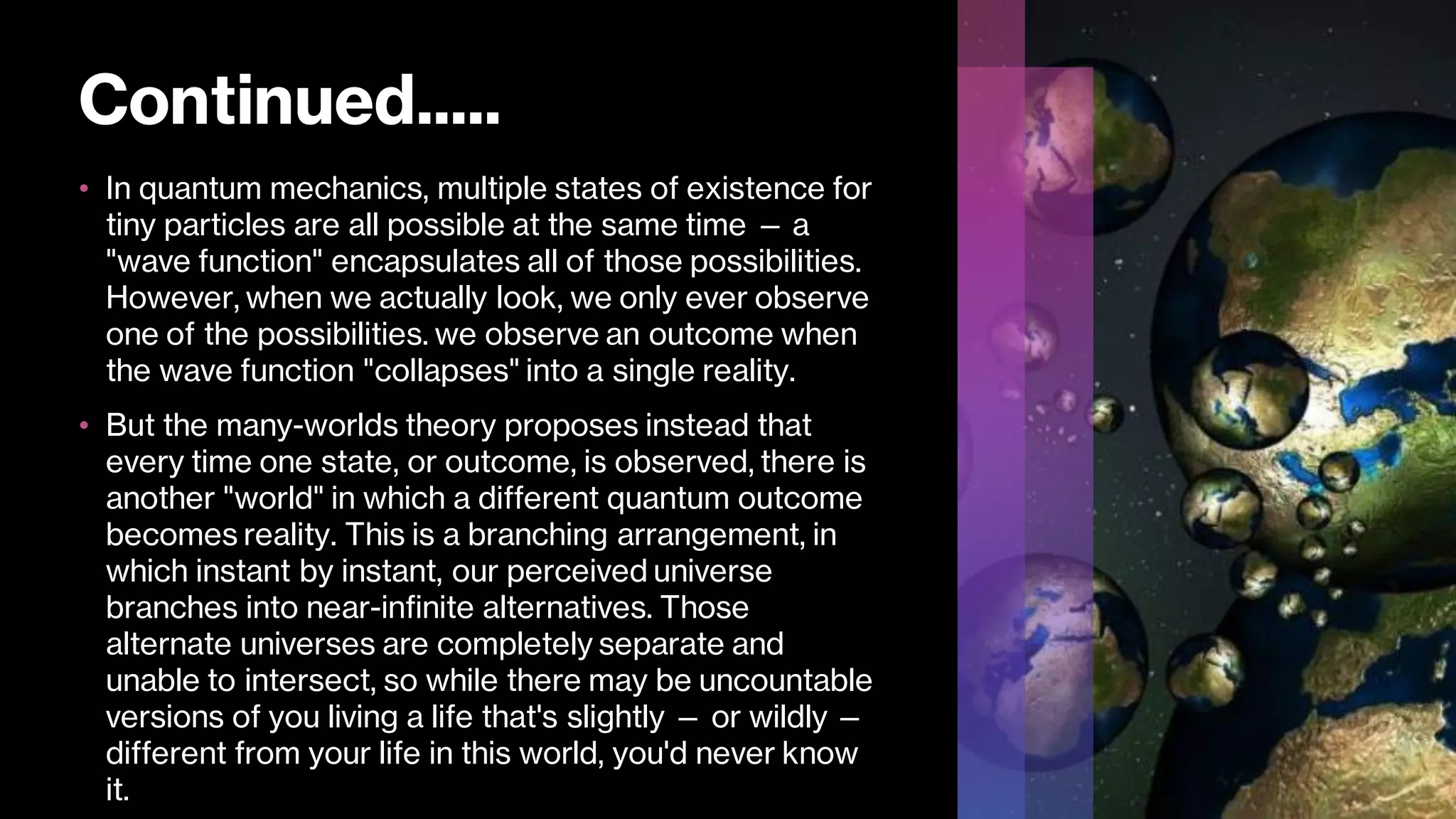
• But the many-worlds theory proposes instead that
every time one state, or outcome, is observed, there is
another "world" in which a different quantum outcome
becomes reality. This is a branching arrangement, in
which instant by instant, our perceived universe
branches into near-infinite alternatives. Those
alternate universes are completely separate and
unable to intersect, so while there may be uncountable
versions of you living a life that's slightly — or wildly —
different from your life in this world, you'd never know
it.
Some sort of history
about that
• the theory that we inhabit a parallel universe is the
most exciting — and unsettling — concepts in modern
cosmology . “There are vibrations of different
universes right here, right now".
• This is the modern interpretation of quantum theory,
that many worlds represent reality,” says Michio Kaku,
professor of theoretical physics at New York
University and author of Parallel Worlds: A Journey
Through Creation, Higher Dimensions, and the Future
of the Cosmos.
Continued...
• The concept of parallel universes may be novel and disconcerting to
scientists, but it rests very comfortably in ancient Hindu cosmology. The
Puranas, Hindu religious texts thought to date back to between 500 B.C. to
1500 B.C., are replete with descriptions of many worlds whose inhabitants
are ruled by kings in the human plane and gods in a higher plane. The many
gods, in turn, belong to many different worlds and planes of existence. At
the highest level of the hierarchy are the trinity, namely, Brahma, Vishnu, and
Mahesha, ruling the divine kingdoms.
• The Hindu timeline is considered by some to be the closest to modern
scientific timelines. It suggests that the Big Bang is not the beginning of
everything, but is just the start of a present cycle preceded by an infinite
number of universes and to be followed by another infinite number of
universes.
Big Bang Theory
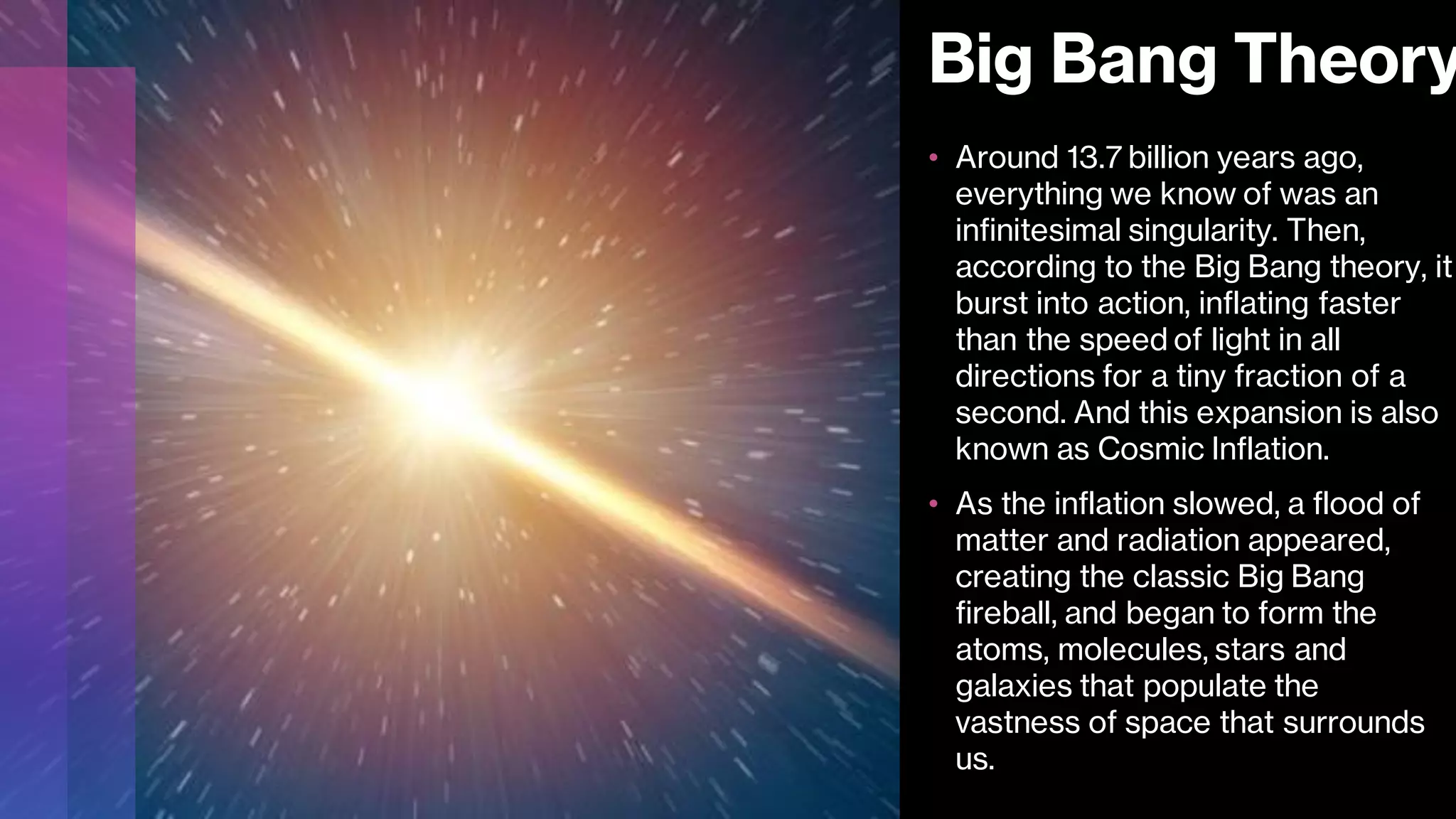
• Around 13.7 billion years ago,
everything we know of was an
infinitesimal singularity. Then,
according to the Big Bang theory, it
burst into action, inflating faster
than the speed of light in all
directions for a tiny fraction of a
second. And this expansion is also
known as Cosmic Inflation.
• As the inflation slowed, a flood of
matter and radiation appeared,
creating the classic Big Bang
fireball, and began to form the
atoms, molecules, stars and
galaxies that populate the
vastness of space that surrounds
us.
Continued....
• That mysterious process of inflation and the Big Bang have
convinced some researchers those multiple universes are possible, or
even very likely.
• According to theoretical physicist Alexander Vilenkin of Tufts
University says inflation didn't end everywhere at the same time.
While it ended for everything that we can detect from Earth 13.8
billion years ago, cosmic inflation in fact continues in other places.
This is called the theory of eternal inflation. And as inflation ends in a
particular place, a new bubble universe forms,
Dose multiverse or parallel
universe exist?
• So It's a pretty huge topic of debate in the scientific community, does
the multiverse exist or not?
• Until 1954,scientists were sure there was only one universe that
contained everything like entirety of space, time, matter, energy and
phenomena.
• But one day back in 1954, a U.S. physicist Hugh Everett, came up with
the first theory of multiverses.
Continued.....
• He believed that the universe was constantly splitting and
that each of these splits became its own universe this is
known as Multiple Worlds theory.
• The multiverse theory is the inevitable result of quantum
mechanics, which represents a set of multiple “probable”
states for a particle. When an observation is made, the
particle chooses one of the multiple states measured by the
observer and the other states collapse. This is the most basic
principle behind the existence of many universes or
multiverses.
• There are different views among all the proponents of
multiverses, and Everett's is just one of many.
• According to the Multiple Worlds
theory , there's version of me
which giving this seminar and there
is also the probability that I already
had given this seminar in another
world.
• In fact there are infinite me' s and
you' s each in their own universe!
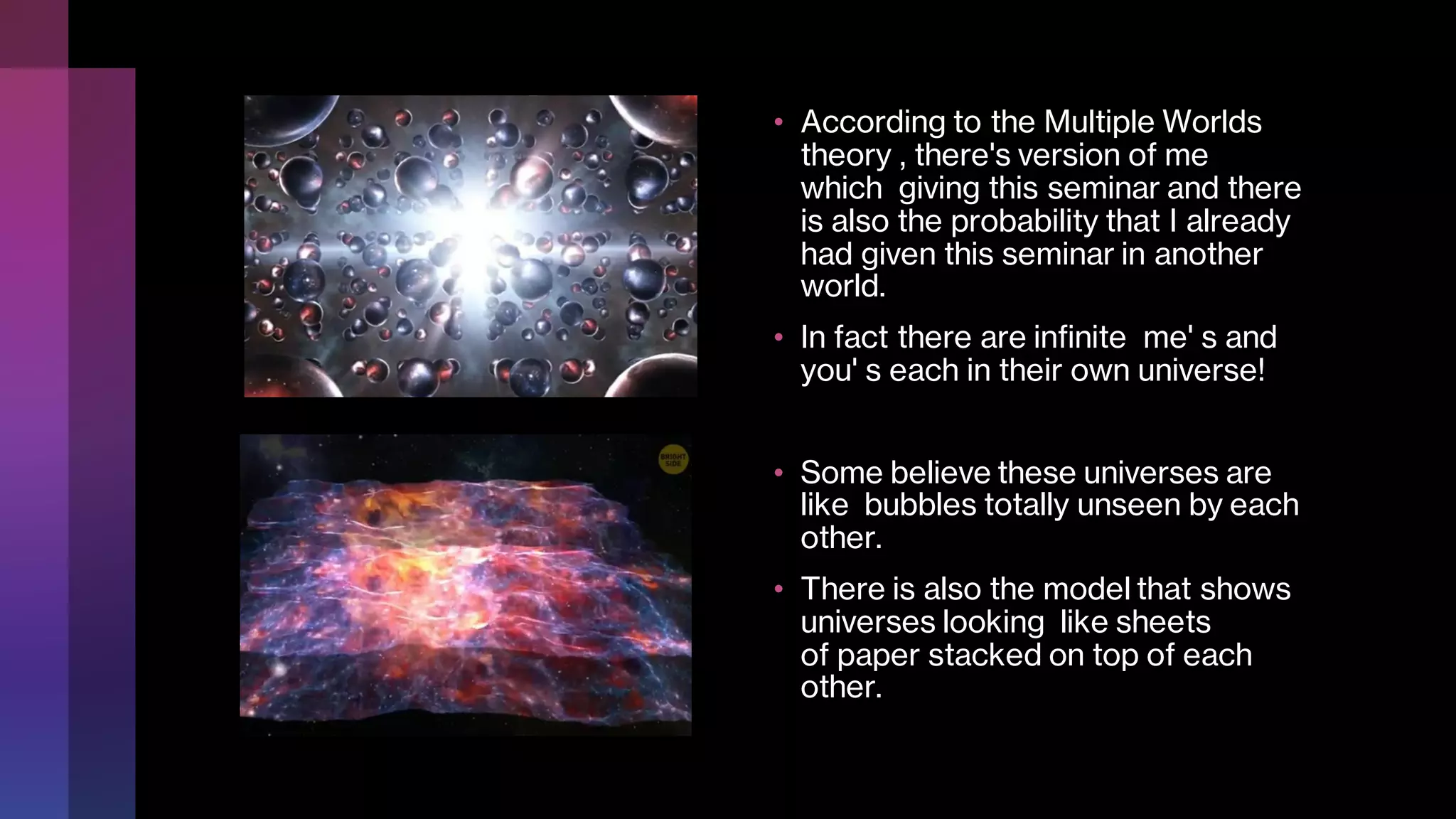
• Some believe these universes are
like bubbles totally unseen by each
other.
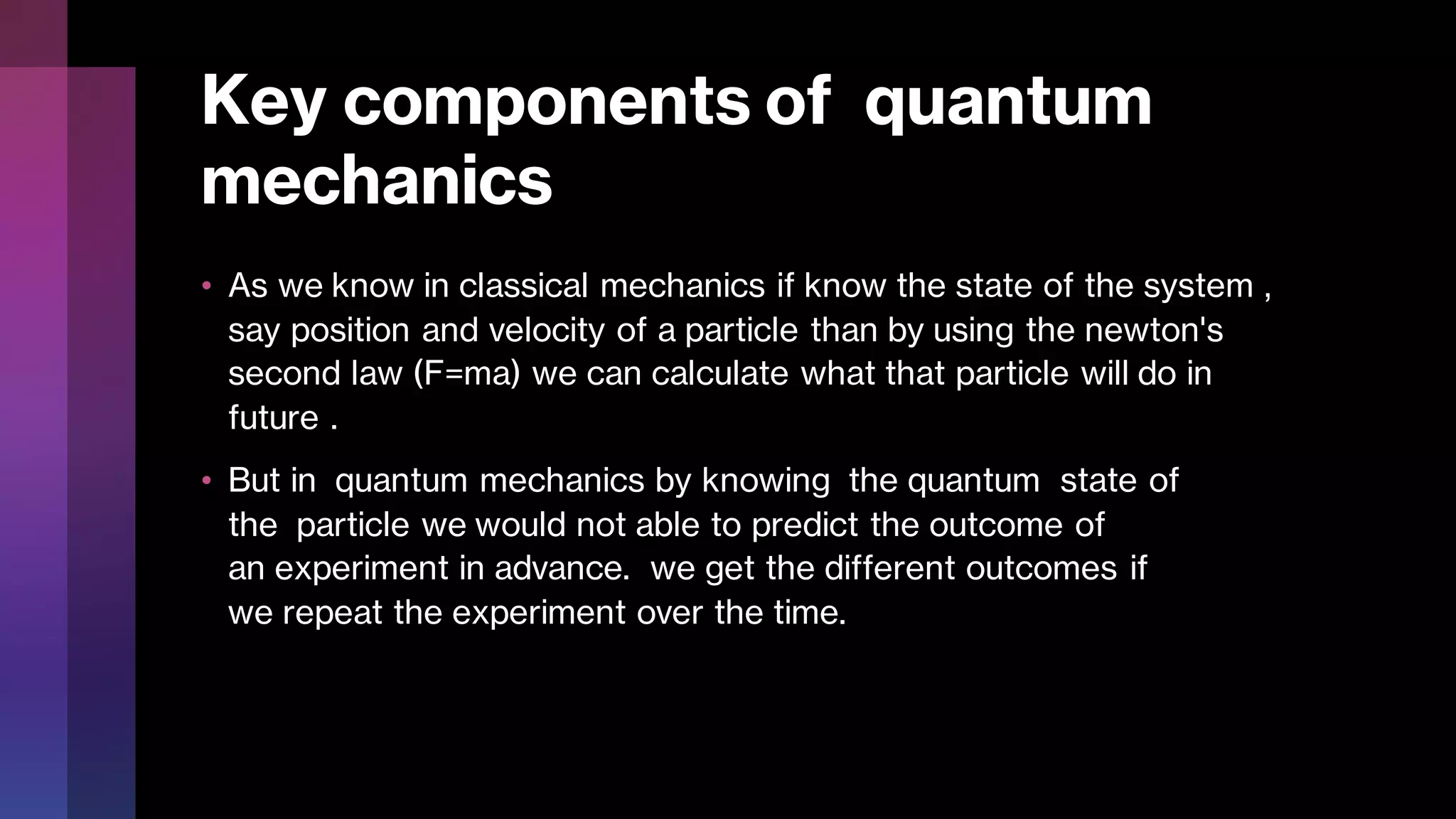
• There is also the model that shows
universes looking like sheets
of paper stacked on top of each
other.
Key components of quantum
mechanics
• As we know in classical mechanics if know the state of the system ,
say position and velocity of a particle than by using the newton's
second law (F=ma) we can calculate what that particle will do in
future .
• But in quantum mechanics by knowing the quantum state of
the particle we would not able to predict the outcome of
an experiment in advance. we get the different outcomes if
we repeat the experiment over the time.
1. Superposition
• The key concept for not able to
predict the outcome in advance is
due to superposition
nature of the particles.
• Superposition is the idea
that quantum objects can be in
two different state at the same time.
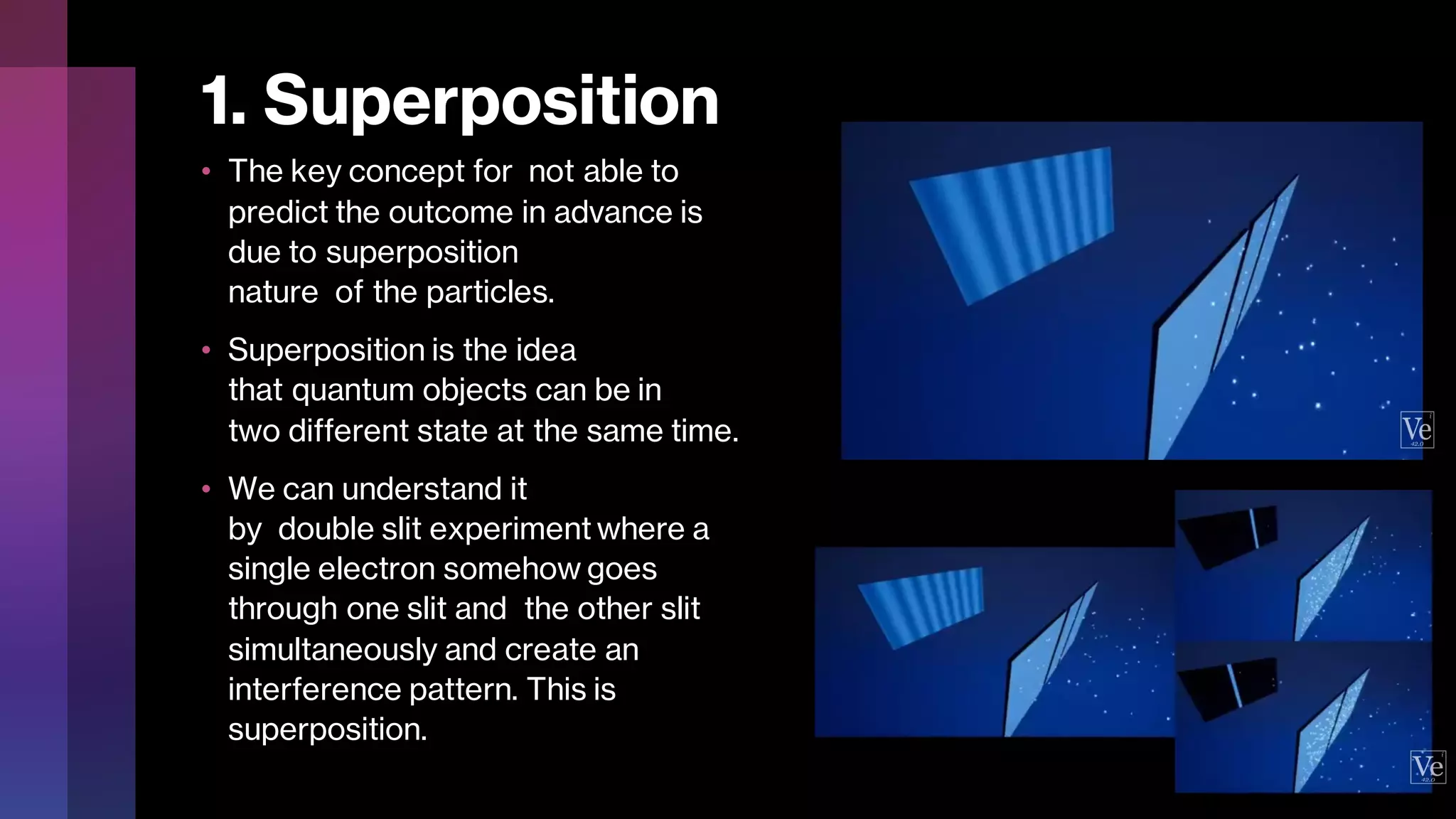
• We can understand it
by double slit experiment where a
single electron somehow goes
through one slit and the other slit
simultaneously and create an
interference pattern. This is
superposition.
2. Entanglement
Consider there is two electrons and the momentum of each in
superposition of states before the measurement and if we try
to measuring the one, wave function of the other one is
collapsed instantaneously and this would we true even if those
electrons were light-years apart.
Than we can say these electrons are entangled and after
interacting they do not have separate wave function at
all they are described by a single wavefunction and this is
what it means to be entangled.
Or we can say by measuring one immediately affects
the state of the other one because the single wave function
is collapsed. Or there is only one wavefunction.
3. Measurement
• In quantum mechanics there is two rule :
• one rule for how system evolve when we are not looking or not
observed it and the other rule when we are looking it.
• Measurement is just the interaction of one quantum system with
another quantum system.
• We can understand it by schrodinger' s cat experiment .
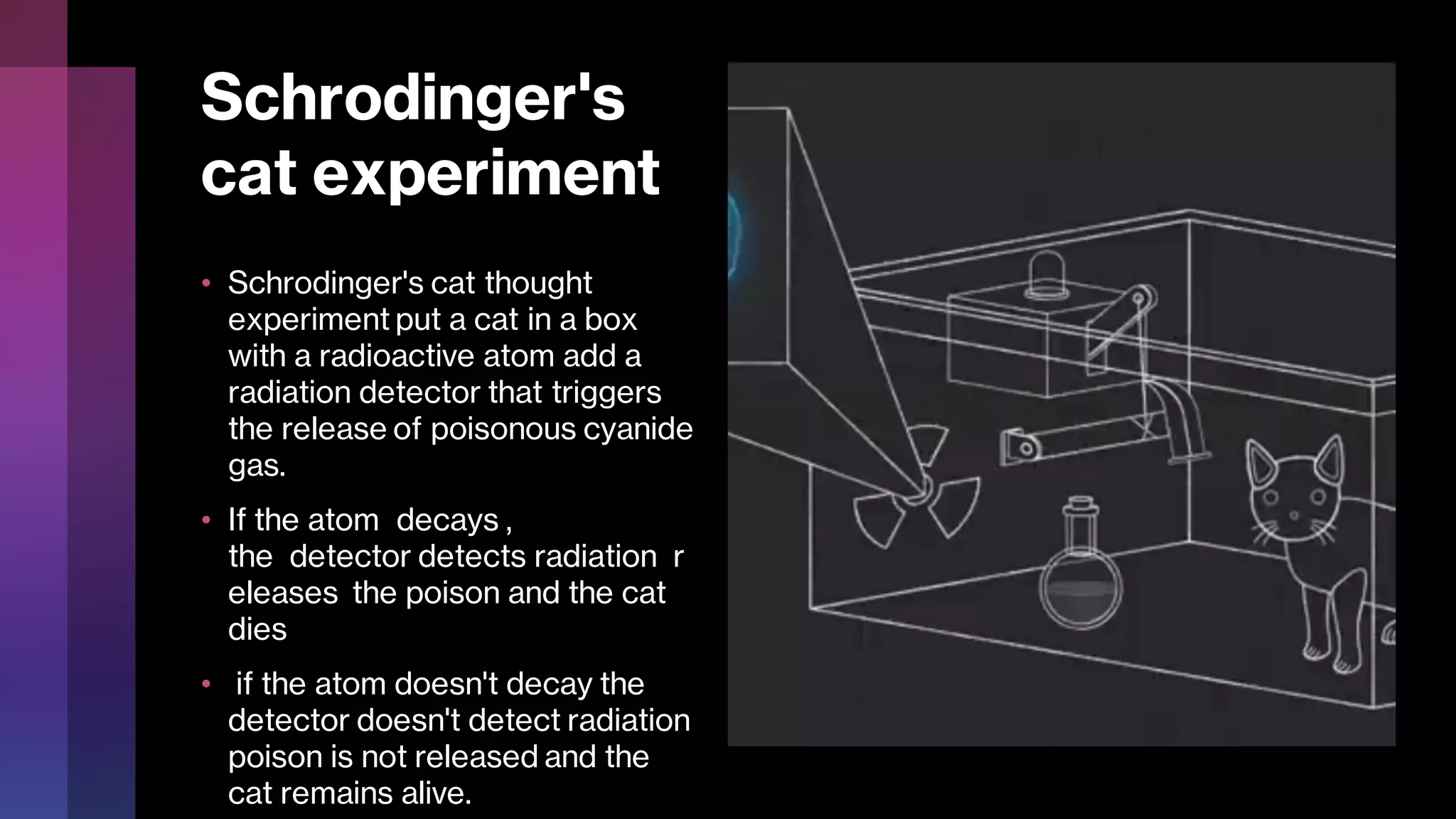
Schrodinger's
cat experiment
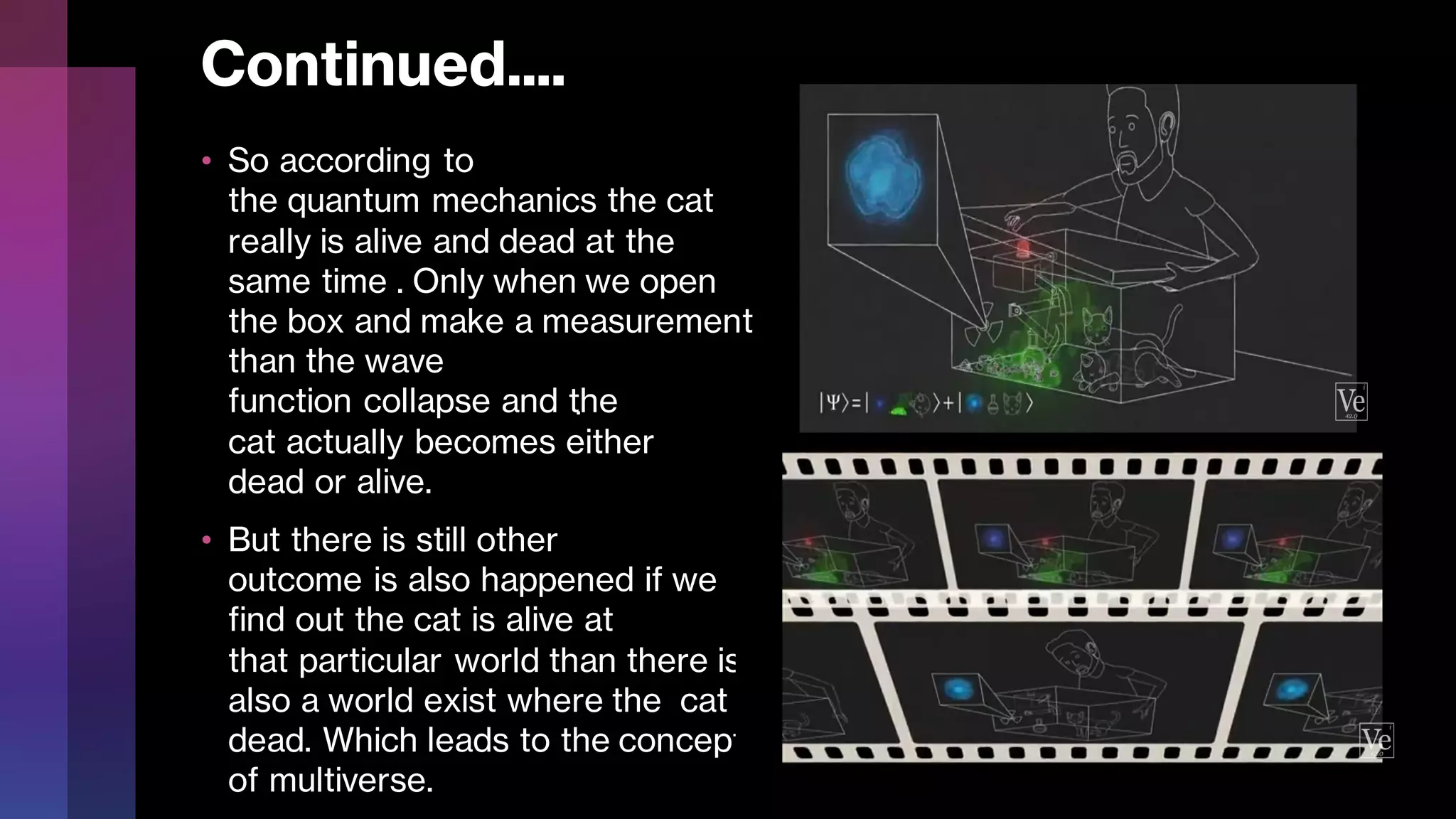
• Schrodinger's cat thought
experiment put a cat in a box
with a radioactive atom add a
radiation detector that triggers
the release of poisonous cyanide
gas.
• If the atom decays ,
the detector detects radiation r
eleases the poison and the cat
dies
• if the atom doesn't decay the
detector doesn't detect radiation
poison is not released and the
cat remains alive.
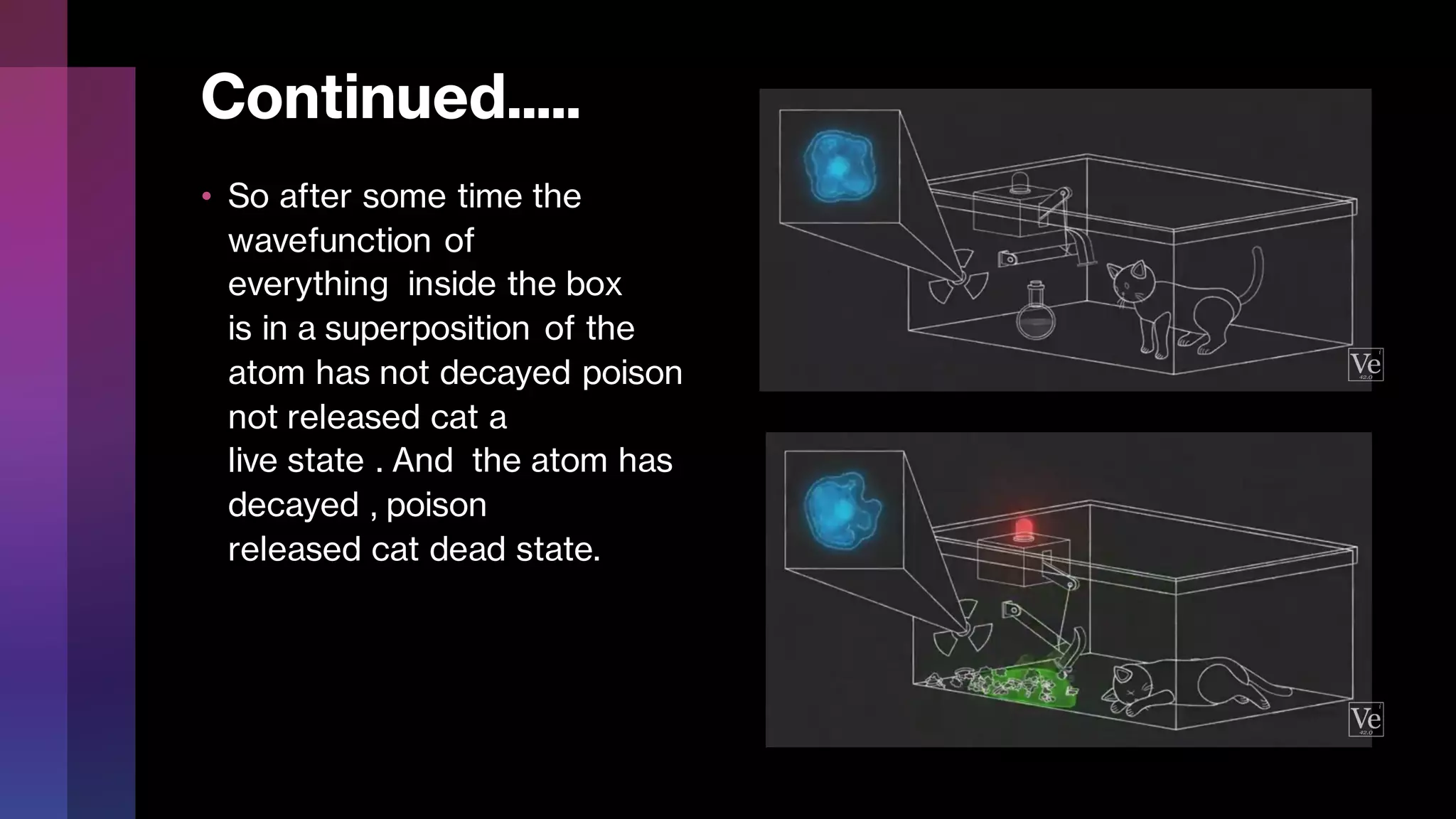
Continued.....
• So after some time the
wavefunction of
everything inside the box
is in a superposition of the
atom has not decayed poison
not released cat a
live state . And the atom has
decayed , poison
released cat dead state.
Continued....
• So according to
the quantum mechanics the cat
really is alive and dead at the
same time . Only when we open
the box and make a measurement
than the wave
function collapse and the
cat actually becomes either
dead or alive.
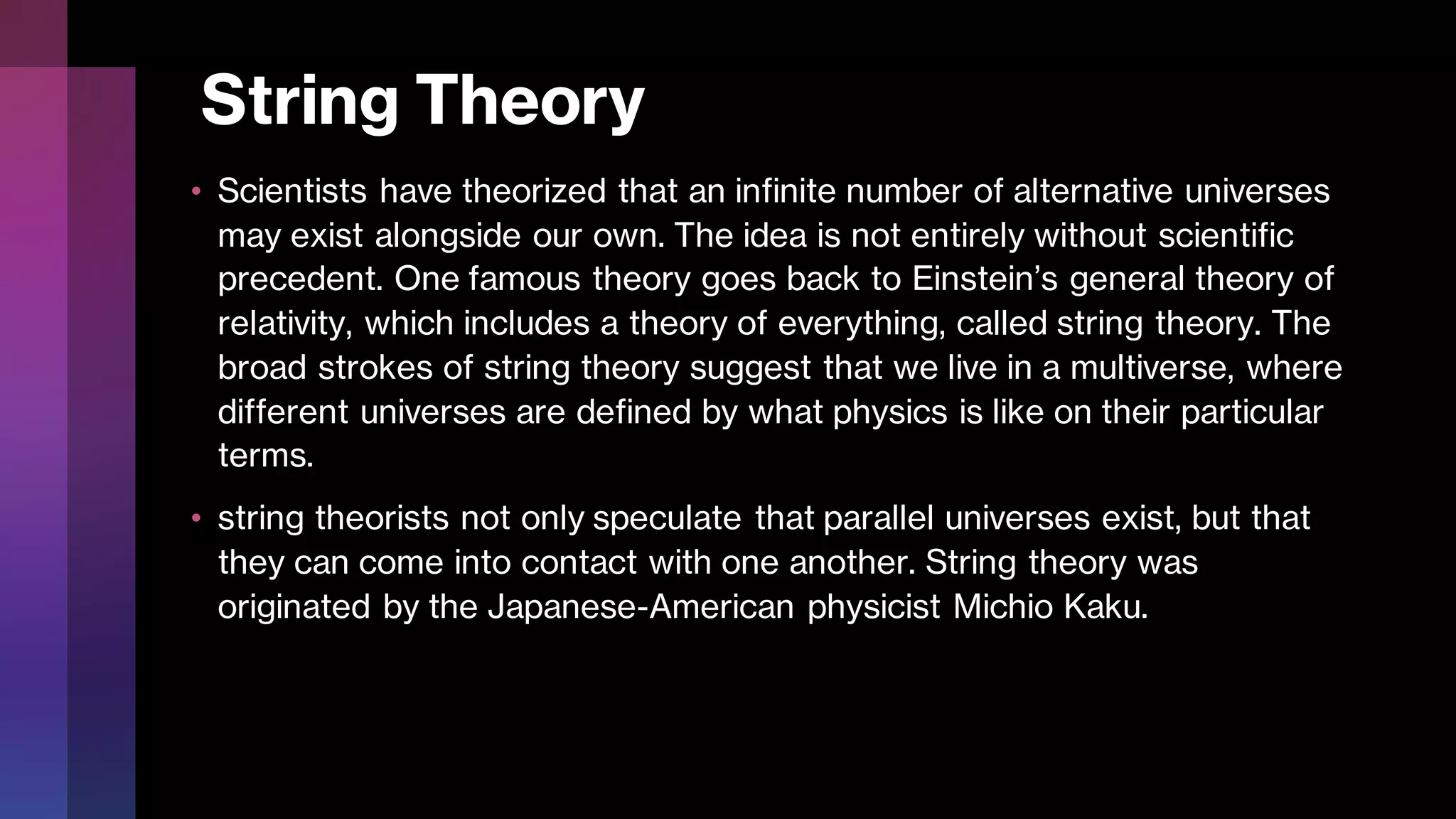
• But there is still other
outcome is also happened if we
find out the cat is alive at
that particular world than there is
also a world exist where the cat is
dead. Which leads to the concept
of multiverse.
.
String Theory
• Scientists have theorized that an infinite number of alternative universes
may exist alongside our own. The idea is not entirely without scientific
precedent. One famous theory goes back to Einstein’s general theory of
relativity, which includes a theory of everything, called string theory. The
broad strokes of string theory suggest that we live in a multiverse, where
different universes are defined by what physics is like on their particular
terms.
• string theorists not only speculate that parallel universes exist, but that
they can come into contact with one another. String theory was
originated by the Japanese-American physicist Michio Kaku.
String theory
• His theory says that
the essential building blocks of all
matter as well as all of the physical
forces in the universe — like
gravity — exist on a subquantum
level. These building blocks
resemble tiny rubber bands —
or strings — that make up
quarks (quantum particles), and
in turn electrons, and atoms, and
cells and so on. Exactly what kind
of matter is created by the strings
and how that matter behaves
depends on the vibration of these
strings. It is in this manner that our
entire universe is composed.
And according to string theory,
this composition takes
place across 11
separate dimensions.
Arguments for the multiverse theory
Cosmic inflation
• Our universe grew exponentially in the first moments of its existence,
but was this expansion uniform? If not, it suggests different regions of
space grew at different rates — and may be isolated from one
another.
Mathematical constants
• How are the laws of the universe so exact? Some propose that this
happened only by chance — we are the one universe out of many that
happened to get the numbers right.
The observable universe
• What is beyond the edge of the observable space around us? No one
knows for sure, and until we do (which could be never), the thought
that our universe extends indefinitely is an interesting one.
Arguments against the multiverse theory
Falsifiability
• There is no way for us to ever test theories of the multiverse. We will never see
beyond the observable universe, so if there is no way to disprove the theories,
should they even be given credence?
Occam's razor
• Sometimes, the simplest ideas are the best. Some physicists argue that we
don't need the multiverse theory at all. It doesn't solve any paradoxes, and only
creates complications.
No evidence
• Not only can we not disprove any multiverse theory, we can't prove them either.
We currently have no evidence that multiverses exists, and everything we can
see suggests there is just one universe — our own.
Thank you

Parallel Universe.pdf

  • 1.
  • 2.
    What is Multiverseor parallel Universe? • The multiverse is a hypothetical group of multiple universes that together comprise everything that exists: the entirety of space, time, matter, energy and phenomena. • In other words – it includes our universe, but also theoretically infinite other universes outside of our own existence. It is still very much a theory (albeit an intriguing one) and scientists have yet to discover any concrete evidence to support its possibility. • it is the cosmological theory of everything. A typical multiverse consists of pocket universes called alternate worlds, or parallel universes. These are based on theories such as quantum mechanics and string theory, which suggest that there are other worlds with different laws than our own universe. So far, there is no empirical evidence to support theories like quantum parallelism, although there have been proposals for experiments to test them—with inconclusive results so far.
  • 3.
    Continued..... • In quantummechanics, multiple states of existence for tiny particles are all possible at the same time — a "wave function" encapsulates all of those possibilities. However, when we actually look, we only ever observe one of the possibilities. we observe an outcome when the wave function "collapses" into a single reality. • But the many-worlds theory proposes instead that every time one state, or outcome, is observed, there is another "world" in which a different quantum outcome becomes reality. This is a branching arrangement, in which instant by instant, our perceived universe branches into near-infinite alternatives. Those alternate universes are completely separate and unable to intersect, so while there may be uncountable versions of you living a life that's slightly — or wildly — different from your life in this world, you'd never know it.
  • 4.
    Some sort ofhistory about that • the theory that we inhabit a parallel universe is the most exciting — and unsettling — concepts in modern cosmology . “There are vibrations of different universes right here, right now". • This is the modern interpretation of quantum theory, that many worlds represent reality,” says Michio Kaku, professor of theoretical physics at New York University and author of Parallel Worlds: A Journey Through Creation, Higher Dimensions, and the Future of the Cosmos.
  • 5.
    Continued... • The conceptof parallel universes may be novel and disconcerting to scientists, but it rests very comfortably in ancient Hindu cosmology. The Puranas, Hindu religious texts thought to date back to between 500 B.C. to 1500 B.C., are replete with descriptions of many worlds whose inhabitants are ruled by kings in the human plane and gods in a higher plane. The many gods, in turn, belong to many different worlds and planes of existence. At the highest level of the hierarchy are the trinity, namely, Brahma, Vishnu, and Mahesha, ruling the divine kingdoms. • The Hindu timeline is considered by some to be the closest to modern scientific timelines. It suggests that the Big Bang is not the beginning of everything, but is just the start of a present cycle preceded by an infinite number of universes and to be followed by another infinite number of universes.
  • 6.
    Big Bang Theory •Around 13.7 billion years ago, everything we know of was an infinitesimal singularity. Then, according to the Big Bang theory, it burst into action, inflating faster than the speed of light in all directions for a tiny fraction of a second. And this expansion is also known as Cosmic Inflation. • As the inflation slowed, a flood of matter and radiation appeared, creating the classic Big Bang fireball, and began to form the atoms, molecules, stars and galaxies that populate the vastness of space that surrounds us.
  • 7.
    Continued.... • That mysteriousprocess of inflation and the Big Bang have convinced some researchers those multiple universes are possible, or even very likely. • According to theoretical physicist Alexander Vilenkin of Tufts University says inflation didn't end everywhere at the same time. While it ended for everything that we can detect from Earth 13.8 billion years ago, cosmic inflation in fact continues in other places. This is called the theory of eternal inflation. And as inflation ends in a particular place, a new bubble universe forms,
  • 8.
    Dose multiverse orparallel universe exist? • So It's a pretty huge topic of debate in the scientific community, does the multiverse exist or not? • Until 1954,scientists were sure there was only one universe that contained everything like entirety of space, time, matter, energy and phenomena. • But one day back in 1954, a U.S. physicist Hugh Everett, came up with the first theory of multiverses.
  • 9.
    Continued..... • He believedthat the universe was constantly splitting and that each of these splits became its own universe this is known as Multiple Worlds theory. • The multiverse theory is the inevitable result of quantum mechanics, which represents a set of multiple “probable” states for a particle. When an observation is made, the particle chooses one of the multiple states measured by the observer and the other states collapse. This is the most basic principle behind the existence of many universes or multiverses. • There are different views among all the proponents of multiverses, and Everett's is just one of many.
  • 10.
    • According tothe Multiple Worlds theory , there's version of me which giving this seminar and there is also the probability that I already had given this seminar in another world. • In fact there are infinite me' s and you' s each in their own universe! • Some believe these universes are like bubbles totally unseen by each other. • There is also the model that shows universes looking like sheets of paper stacked on top of each other.
  • 11.
    Key components ofquantum mechanics • As we know in classical mechanics if know the state of the system , say position and velocity of a particle than by using the newton's second law (F=ma) we can calculate what that particle will do in future . • But in quantum mechanics by knowing the quantum state of the particle we would not able to predict the outcome of an experiment in advance. we get the different outcomes if we repeat the experiment over the time.
  • 12.
    1. Superposition • Thekey concept for not able to predict the outcome in advance is due to superposition nature of the particles. • Superposition is the idea that quantum objects can be in two different state at the same time. • We can understand it by double slit experiment where a single electron somehow goes through one slit and the other slit simultaneously and create an interference pattern. This is superposition.
  • 13.
    2. Entanglement Consider thereis two electrons and the momentum of each in superposition of states before the measurement and if we try to measuring the one, wave function of the other one is collapsed instantaneously and this would we true even if those electrons were light-years apart. Than we can say these electrons are entangled and after interacting they do not have separate wave function at all they are described by a single wavefunction and this is what it means to be entangled. Or we can say by measuring one immediately affects the state of the other one because the single wave function is collapsed. Or there is only one wavefunction.
  • 14.
    3. Measurement • Inquantum mechanics there is two rule : • one rule for how system evolve when we are not looking or not observed it and the other rule when we are looking it. • Measurement is just the interaction of one quantum system with another quantum system. • We can understand it by schrodinger' s cat experiment .
  • 15.
    Schrodinger's cat experiment • Schrodinger'scat thought experiment put a cat in a box with a radioactive atom add a radiation detector that triggers the release of poisonous cyanide gas. • If the atom decays , the detector detects radiation r eleases the poison and the cat dies • if the atom doesn't decay the detector doesn't detect radiation poison is not released and the cat remains alive.
  • 16.
    Continued..... • So aftersome time the wavefunction of everything inside the box is in a superposition of the atom has not decayed poison not released cat a live state . And the atom has decayed , poison released cat dead state.
  • 17.
    Continued.... • So accordingto the quantum mechanics the cat really is alive and dead at the same time . Only when we open the box and make a measurement than the wave function collapse and the cat actually becomes either dead or alive. • But there is still other outcome is also happened if we find out the cat is alive at that particular world than there is also a world exist where the cat is dead. Which leads to the concept of multiverse. .
  • 18.
    String Theory • Scientistshave theorized that an infinite number of alternative universes may exist alongside our own. The idea is not entirely without scientific precedent. One famous theory goes back to Einstein’s general theory of relativity, which includes a theory of everything, called string theory. The broad strokes of string theory suggest that we live in a multiverse, where different universes are defined by what physics is like on their particular terms. • string theorists not only speculate that parallel universes exist, but that they can come into contact with one another. String theory was originated by the Japanese-American physicist Michio Kaku.
  • 19.
    String theory • Histheory says that the essential building blocks of all matter as well as all of the physical forces in the universe — like gravity — exist on a subquantum level. These building blocks resemble tiny rubber bands — or strings — that make up quarks (quantum particles), and in turn electrons, and atoms, and cells and so on. Exactly what kind of matter is created by the strings and how that matter behaves depends on the vibration of these strings. It is in this manner that our entire universe is composed. And according to string theory, this composition takes place across 11 separate dimensions.
  • 20.
    Arguments for themultiverse theory Cosmic inflation • Our universe grew exponentially in the first moments of its existence, but was this expansion uniform? If not, it suggests different regions of space grew at different rates — and may be isolated from one another. Mathematical constants • How are the laws of the universe so exact? Some propose that this happened only by chance — we are the one universe out of many that happened to get the numbers right. The observable universe • What is beyond the edge of the observable space around us? No one knows for sure, and until we do (which could be never), the thought that our universe extends indefinitely is an interesting one.
  • 21.
    Arguments against themultiverse theory Falsifiability • There is no way for us to ever test theories of the multiverse. We will never see beyond the observable universe, so if there is no way to disprove the theories, should they even be given credence? Occam's razor • Sometimes, the simplest ideas are the best. Some physicists argue that we don't need the multiverse theory at all. It doesn't solve any paradoxes, and only creates complications. No evidence • Not only can we not disprove any multiverse theory, we can't prove them either. We currently have no evidence that multiverses exists, and everything we can see suggests there is just one universe — our own.
  • 22.