Overview of Parallel HDF5

-1-
Outline
• Overview of Parallel HDF5 design
• Setting up parallel environment
• Programming model for
– Creating and accessing a File
– Creating and accessing a Dataset
– Writing and reading Hyperslabs

• Parallel tutorial available at

– http://hdf.ncsa.uiuc.edu/HDF5/doc/Tutor
-4-
PHDF5 Initial Target
• Support for MPI programming
• Not for shared memory programming
– Threads
– OpenMP

• Has some experiments with

– Thread-safe support for Pthreads
– OpenMP if called “correctly”

-5-
PHDF5 Requirements
• PHDF5 files compatible with serial HDF5 files
– Shareable between different serial or parallel
platforms

• Single file image to all processes

– One file per process design is undesirable
• Expensive post processing
• Not useable by different number of processes

• Standard parallel I/O interface

– Must be portable to different platforms

-6-
Implementation Requirements
• No use of Threads

– Not commonly supported (1998)

• No reserved process

– May interfere with parallel algorithms

• No spawn process

– Not commonly supported even now

-7-
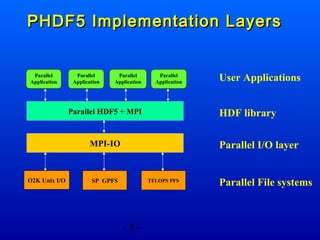
PHDF5 Implementation Layers

Parallel
Application

Parallel
Application

Parallel
Application

Parallel
Application

HDF library

Parallel HDF5 + MPI

MPI-IO

O2K Unix I/O

User Applications

Parallel I/O layer

SP GPFS

TFLOPS PFS

-8-

Parallel File systems
Parallel Environment
Requirements
• MPI with MPI-IO

– Argonne ROMIO
– Vendor’s MPI-IO

• Parallel file system
– IBM GPFS
– PVFS

-9-
How to Compile PHDF5
• h5pcc – HDF5 C compiler command
– Similar to mpicc

• h5pfc – HDF5 F90 compiler command
– Similar to mpif90

• To compile:
% h5pcc h5prog.c
% h5pfc h5prog.f90
• Show the compiler commands without
executing them (i.e., dry run):
% h5pcc –show h5prog.c
% h5pfc –show h5prog.f90
- 10 -
Collective vs. Independent
Calls
• MPI definition of collective call

– All processes of the communicator must
participate in the right order

• Independent means not collective
• Collective is not necessarily synchronous

- 11 -
Programming Restrictions
• Most PHDF5 APIs are collective
• PHDF5 opens a parallel file with a
communicator

– Returns a file-handle
– Future access to the file via the file-handle
– All processes must participate in collective
PHDF5 APIs
– Different files can be opened via different
communicators
- 12 -
Examples of PHDF5 API
• Examples of PHDF5 collective API

– File operations: H5Fcreate, H5Fopen, H5Fclose
– Objects creation: H5Dcreate, H5Dopen, H5Dclose
– Objects structure: H5Dextend (increase dimension
sizes)

• Array data transfer can be collective or
independent
– Dataset operations: H5Dwrite, H5Dread

- 13 -
What Does PHDF5 Support ?
• After a file is opened by the processes of a
communicator

– All parts of file are accessible by all processes
– All objects in the file are accessible by all
processes
– Multiple processes write to the same data array
– Each process writes to individual data array

- 14 -
PHDF5 API Languages
• C and F90 language interfaces
• Platforms supported:
–
–
–
–
–
–
–
–

IBM SP2 and SP3
Intel TFLOPS
SGI Origin 2000
HP-UX 11.00 System V
Alpha Compaq Clusters
Linux clusters
SUN clusters
Cray T3E

- 15 -
Creating and Accessing a File
Programming model
• HDF5 uses access template object
(property list) to control the file access
mechanism
• General model to access HDF5 file in
parallel:
– Setup MPI-IO access template (access
property list)
– Open File
– Close File
- 16 -
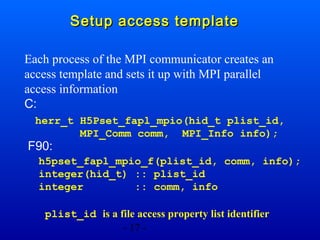
Setup access template
Each process of the MPI communicator creates an
access template and sets it up with MPI parallel
access information
C:
herr_t H5Pset_fapl_mpio(hid_t plist_id,
MPI_Comm comm, MPI_Info info);

F90:
h5pset_fapl_mpio_f(plist_id, comm, info);
integer(hid_t) :: plist_id
integer
:: comm, info
plist_id is a file access property list identifier
- 17 -
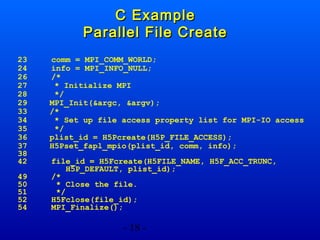
C Example
Parallel File Create
23
24
26
27
28
29
33
34
35
36
37
38
42
49
50
51
52
54

comm = MPI_COMM_WORLD;
info = MPI_INFO_NULL;
/*
* Initialize MPI
*/
MPI_Init(&argc, &argv);
/*
* Set up file access property list for MPI-IO access
*/
plist_id = H5Pcreate(H5P_FILE_ACCESS);
H5Pset_fapl_mpio(plist_id, comm, info);
file_id = H5Fcreate(H5FILE_NAME, H5F_ACC_TRUNC,
H5P_DEFAULT, plist_id);
/*
* Close the file.
*/
H5Fclose(file_id);
MPI_Finalize();

- 18 -
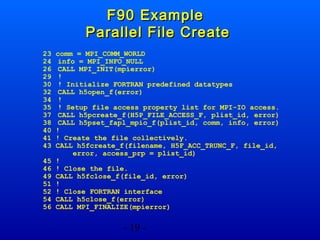
F90 Example
Parallel File Create
23
24
26
29
30
32
34
35
37
38
40
41
43
45
46
49
51
52
54
56

comm = MPI_COMM_WORLD
info = MPI_INFO_NULL
CALL MPI_INIT(mpierror)
!
! Initialize FORTRAN predefined datatypes
CALL h5open_f(error)
!
! Setup file access property list for MPI-IO access.
CALL h5pcreate_f(H5P_FILE_ACCESS_F, plist_id, error)
CALL h5pset_fapl_mpio_f(plist_id, comm, info, error)
!
! Create the file collectively.
CALL h5fcreate_f(filename, H5F_ACC_TRUNC_F, file_id,
error, access_prp = plist_id)
!
! Close the file.
CALL h5fclose_f(file_id, error)
!
! Close FORTRAN interface
CALL h5close_f(error)
CALL MPI_FINALIZE(mpierror)

- 19 -
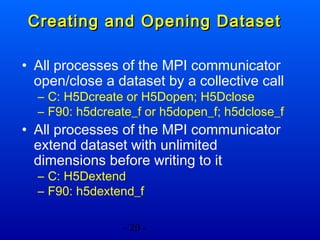
Creating and Opening Dataset
• All processes of the MPI communicator
open/close a dataset by a collective call
– C: H5Dcreate or H5Dopen; H5Dclose
– F90: h5dcreate_f or h5dopen_f; h5dclose_f

• All processes of the MPI communicator
extend dataset with unlimited
dimensions before writing to it
– C: H5Dextend
– F90: h5dextend_f

- 20 -
C Example
Parallel Dataset Create
56
57
58
59
60
61
62
63
64
65
66
67
68

file_id = H5Fcreate(…);
/*
* Create the dataspace for the dataset.
*/
dimsf[0] = NX;
dimsf[1] = NY;
filespace = H5Screate_simple(RANK, dimsf, NULL);

70
71
72
73
74

H5Dclose(dset_id);
/*
* Close the file.
*/
H5Fclose(file_id);

/*
* Create the dataset with default properties collective.
*/
dset_id = H5Dcreate(file_id, “dataset1”, H5T_NATIVE_INT,
filespace, H5P_DEFAULT);

- 21 -
F90 Example
Parallel Dataset Create
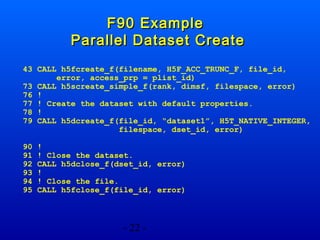
43 CALL h5fcreate_f(filename, H5F_ACC_TRUNC_F, file_id,
error, access_prp = plist_id)
73 CALL h5screate_simple_f(rank, dimsf, filespace, error)
76 !
77 ! Create the dataset with default properties.
78 !
79 CALL h5dcreate_f(file_id, “dataset1”, H5T_NATIVE_INTEGER,
filespace, dset_id, error)
90
91
92
93
94
95

!
! Close the dataset.
CALL h5dclose_f(dset_id, error)
!
! Close the file.
CALL h5fclose_f(file_id, error)

- 22 -
Accessing a Dataset
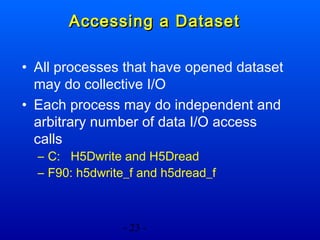
• All processes that have opened dataset
may do collective I/O
• Each process may do independent and
arbitrary number of data I/O access
calls
– C: H5Dwrite and H5Dread
– F90: h5dwrite_f and h5dread_f

- 23 -
Accessing a Dataset
Programming model
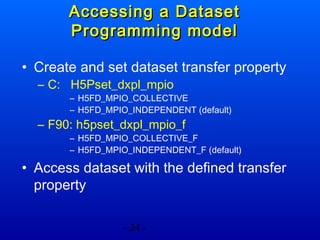
• Create and set dataset transfer property
– C: H5Pset_dxpl_mpio

– H5FD_MPIO_COLLECTIVE
– H5FD_MPIO_INDEPENDENT (default)

– F90: h5pset_dxpl_mpio_f

– H5FD_MPIO_COLLECTIVE_F
– H5FD_MPIO_INDEPENDENT_F (default)

• Access dataset with the defined transfer
property
- 24 -
C Example: Collective write

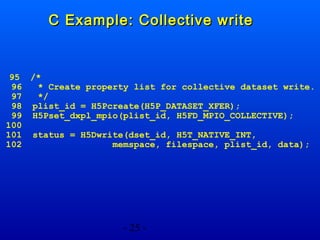
95 /*
96
* Create property list for collective dataset write.
97
*/
98 plist_id = H5Pcreate(H5P_DATASET_XFER);
99 H5Pset_dxpl_mpio(plist_id, H5FD_MPIO_COLLECTIVE);
100
101 status = H5Dwrite(dset_id, H5T_NATIVE_INT,
102
memspace, filespace, plist_id, data);

- 25 -
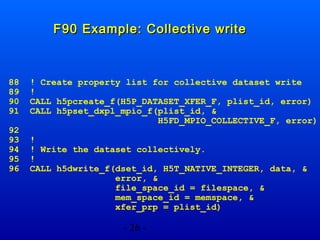
F90 Example: Collective write

88
89
90
91
92
93
94
95
96

! Create property list for collective dataset write
!
CALL h5pcreate_f(H5P_DATASET_XFER_F, plist_id, error)
CALL h5pset_dxpl_mpio_f(plist_id, &
H5FD_MPIO_COLLECTIVE_F, error)
!
! Write the dataset collectively.
!
CALL h5dwrite_f(dset_id, H5T_NATIVE_INTEGER, data, &
error, &
file_space_id = filespace, &
mem_space_id = memspace, &
xfer_prp = plist_id)

- 26 -
Writing and Reading
Hyperslabs
Programming model
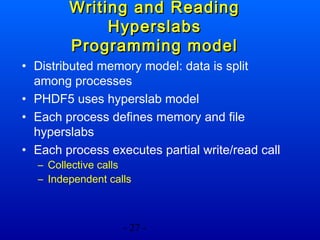
• Distributed memory model: data is split
among processes
• PHDF5 uses hyperslab model
• Each process defines memory and file
hyperslabs
• Each process executes partial write/read call
– Collective calls
– Independent calls

- 27 -
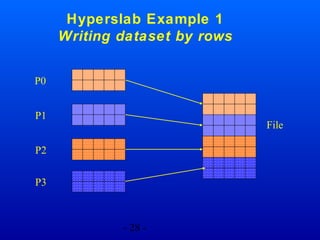
Hyperslab Example 1
Writing dataset by rows
P0
P1

File

P2
P3

- 28 -
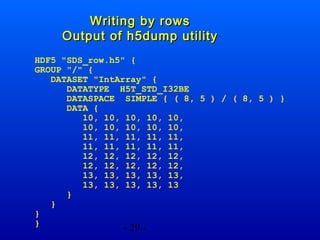
Writing by rows
Output of h5dump utility
HDF5 "SDS_row.h5" {
GROUP "/" {
DATASET "IntArray" {
DATATYPE H5T_STD_I32BE
DATASPACE SIMPLE { ( 8, 5 ) / ( 8, 5 ) }
DATA {
10, 10, 10, 10, 10,
10, 10, 10, 10, 10,
11, 11, 11, 11, 11,
11, 11, 11, 11, 11,
12, 12, 12, 12, 12,
12, 12, 12, 12, 12,
13, 13, 13, 13, 13,
13, 13, 13, 13, 13
}
}
}
}

- 29 -
Example 1
Writing dataset by rows
File

P1 (memory space)

offset[1]

count[1]
count[0]

offset[0]

count[0] = dimsf[0]/mpi_size
count[1] = dimsf[1];
offset[0] = mpi_rank * count[0];
offset[1] = 0;
- 30 -

/* = 2 */
C Example 1
71 /*
72
* Each process defines dataset in memory and
* writes it to the hyperslab
73
* in the file.
74
*/
75
count[0] = dimsf[0]/mpi_size;
76
count[1] = dimsf[1];
77
offset[0] = mpi_rank * count[0];
78
offset[1] = 0;
79
memspace = H5Screate_simple(RANK,count,NULL);
80
81 /*
82
* Select hyperslab in the file.
83
*/
84
filespace = H5Dget_space(dset_id);
85
H5Sselect_hyperslab(filespace,
H5S_SELECT_SET,offset,NULL,count,NULL);

- 31 -
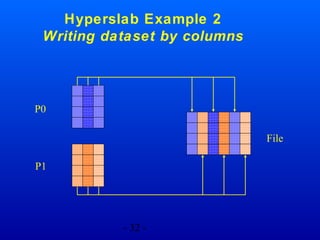
Hyperslab Example 2
Writing dataset by columns

P0
File
P1

- 32 -
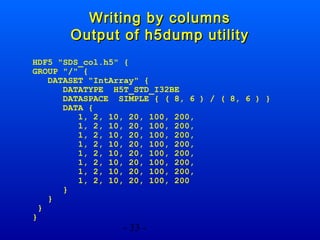
Writing by columns
Output of h5dump utility
HDF5 "SDS_col.h5" {
GROUP "/" {
DATASET "IntArray" {
DATATYPE H5T_STD_I32BE
DATASPACE SIMPLE { ( 8, 6 ) / ( 8, 6 ) }
DATA {
1, 2, 10, 20, 100, 200,
1, 2, 10, 20, 100, 200,
1, 2, 10, 20, 100, 200,
1, 2, 10, 20, 100, 200,
1, 2, 10, 20, 100, 200,
1, 2, 10, 20, 100, 200,
1, 2, 10, 20, 100, 200,
1, 2, 10, 20, 100, 200
}
}
}
}

- 33 -
Example 2
Writing Dataset by Column
Memory

P0 offset[1]

P0
dimsm[0]
dimsm[1]

File
block[0]

P1 offset[1]

block[1]
stride[1]

P1
- 34 -
C Example 2
85
86
88
89
90
91
92
93
94
95
96
97
98
99
100
101
102

/*
* Each process defines hyperslab in
* the file
*/
count[0] = 1;
count[1] = dimsm[1];
offset[0] = 0;
offset[1] = mpi_rank;
stride[0] = 1;
stride[1] = 2;
block[0] = dimsf[0];
block[1] = 1;
/*
* Each process selects hyperslab.
*/
filespace = H5Dget_space(dset_id);
H5Sselect_hyperslab(filespace,
H5S_SELECT_SET, offset, stride,
count, block);

- 35 -
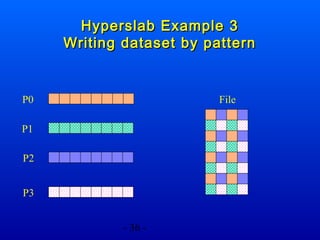
Hyperslab Example 3
Writing dataset by pattern

P0

File

P1
P2
P3
- 36 -
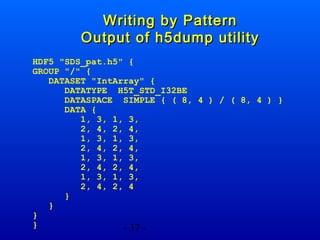
Writing by Pattern
Output of h5dump utility
HDF5 "SDS_pat.h5" {
GROUP "/" {
DATASET "IntArray" {
DATATYPE H5T_STD_I32BE
DATASPACE SIMPLE { ( 8, 4 ) / ( 8, 4 ) }
DATA {
1, 3, 1, 3,
2, 4, 2, 4,
1, 3, 1, 3,
2, 4, 2, 4,
1, 3, 1, 3,
2, 4, 2, 4,
1, 3, 1, 3,
2, 4, 2, 4
}
}
}
}
- 37 -
Example 3
Writing dataset by pattern
Memory

File
stride[1]

P2
stride[0]
count[1]
offset[0] = 0;
offset[1] = 1;
count[0] = 4;
count[1] = 2;
stride[0] = 2;
stride[1] = 2;

offset[1]

- 38 -
90
91
92
93
94
95
96
97
98
99
100
101
102
103
104
105
106
107
108
109
110
111
112

C Example 3: Writing by
pattern

/* Each process defines dataset in memory and
* writes it to the hyperslab
* in the file.
*/
count[0] = 4;
count[1] = 2;
stride[0] = 2;
stride[1] = 2;
if(mpi_rank == 0) {
offset[0] = 0;
offset[1] = 0;
}
if(mpi_rank == 1) {
offset[0] = 1;
offset[1] = 0;
}
if(mpi_rank == 2) {
offset[0] = 0;
offset[1] = 1;
}
if(mpi_rank == 3) {
offset[0] = 1;
offset[1] = 1;
}

- 39 -
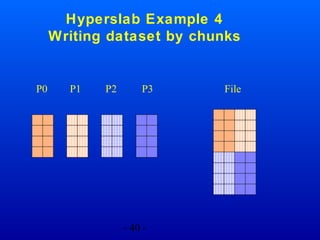
Hyperslab Example 4
Writing dataset by chunks

P0

P1

P2

P3

- 40 -

File
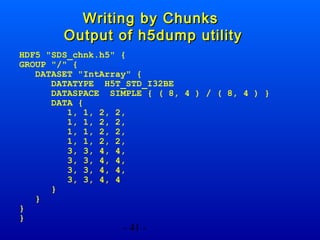
Writing by Chunks
Output of h5dump utility
HDF5 "SDS_chnk.h5" {
GROUP "/" {
DATASET "IntArray" {
DATATYPE H5T_STD_I32BE
DATASPACE SIMPLE { ( 8, 4 ) / ( 8, 4 ) }
DATA {
1, 1, 2, 2,
1, 1, 2, 2,
1, 1, 2, 2,
1, 1, 2, 2,
3, 3, 4, 4,
3, 3, 4, 4,
3, 3, 4, 4,
3, 3, 4, 4
}
}
}
}

- 41 -
Example 4
Writing dataset by chunks
File

Memory
P2

offset[1]

chunk_dims[1]
offset[0]
chunk_dims[0]
block[0]
block[0] = chunk_dims[0];
block[1] = chunk_dims[1];
offset[0] = chunk_dims[0];
offset[1] = 0;

- 42 -

block[1]
C Example 4
Writing by chunks
97
98
99
100
101
102
103
104
105
106
107
108
109
110
111
112
113
114
115
116
117
118

count[0] = 1;
count[1] = 1 ;
stride[0] = 1;
stride[1] = 1;
block[0] = chunk_dims[0];
block[1] = chunk_dims[1];
if(mpi_rank == 0) {
offset[0] = 0;
offset[1] = 0;
}
if(mpi_rank == 1) {
offset[0] = 0;
offset[1] = chunk_dims[1];
}
if(mpi_rank == 2) {
offset[0] = chunk_dims[0];
offset[1] = 0;
}
if(mpi_rank == 3) {
offset[0] = chunk_dims[0];
offset[1] = chunk_dims[1];
}

- 43 -
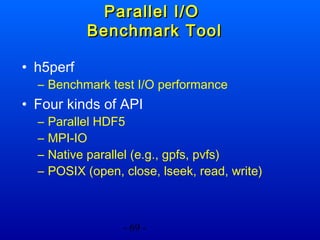
Parallel I/O
Benchmark Tool
• h5perf

– Benchmark test I/O performance

• Four kinds of API
–
–
–
–

Parallel HDF5
MPI-IO
Native parallel (e.g., gpfs, pvfs)
POSIX (open, close, lseek, read, write)

- 69 -
Useful Parallel HDF Links
• Parallel HDF information site

– http://hdf.ncsa.uiuc.edu/Parallel_HDF/

• Parallel HDF mailing list

– hdfparallel@ncsa.uiuc.edu

• Parallel HDF5 tutorial available at

– http://hdf.ncsa.uiuc.edu/HDF5/doc/Tutor

- 70 -

Overview of Parallel HDF5

  • 1.
  • 2.
    Outline • Overview ofParallel HDF5 design • Setting up parallel environment • Programming model for – Creating and accessing a File – Creating and accessing a Dataset – Writing and reading Hyperslabs • Parallel tutorial available at – http://hdf.ncsa.uiuc.edu/HDF5/doc/Tutor -4-
  • 3.
    PHDF5 Initial Target •Support for MPI programming • Not for shared memory programming – Threads – OpenMP • Has some experiments with – Thread-safe support for Pthreads – OpenMP if called “correctly” -5-
  • 4.
    PHDF5 Requirements • PHDF5files compatible with serial HDF5 files – Shareable between different serial or parallel platforms • Single file image to all processes – One file per process design is undesirable • Expensive post processing • Not useable by different number of processes • Standard parallel I/O interface – Must be portable to different platforms -6-
  • 5.
    Implementation Requirements • Nouse of Threads – Not commonly supported (1998) • No reserved process – May interfere with parallel algorithms • No spawn process – Not commonly supported even now -7-
  • 6.
    PHDF5 Implementation Layers Parallel Application Parallel Application Parallel Application Parallel Application HDFlibrary Parallel HDF5 + MPI MPI-IO O2K Unix I/O User Applications Parallel I/O layer SP GPFS TFLOPS PFS -8- Parallel File systems
  • 7.
    Parallel Environment Requirements • MPIwith MPI-IO – Argonne ROMIO – Vendor’s MPI-IO • Parallel file system – IBM GPFS – PVFS -9-
  • 8.
    How to CompilePHDF5 • h5pcc – HDF5 C compiler command – Similar to mpicc • h5pfc – HDF5 F90 compiler command – Similar to mpif90 • To compile: % h5pcc h5prog.c % h5pfc h5prog.f90 • Show the compiler commands without executing them (i.e., dry run): % h5pcc –show h5prog.c % h5pfc –show h5prog.f90 - 10 -
  • 9.
    Collective vs. Independent Calls •MPI definition of collective call – All processes of the communicator must participate in the right order • Independent means not collective • Collective is not necessarily synchronous - 11 -
  • 10.
    Programming Restrictions • MostPHDF5 APIs are collective • PHDF5 opens a parallel file with a communicator – Returns a file-handle – Future access to the file via the file-handle – All processes must participate in collective PHDF5 APIs – Different files can be opened via different communicators - 12 -
  • 11.
    Examples of PHDF5API • Examples of PHDF5 collective API – File operations: H5Fcreate, H5Fopen, H5Fclose – Objects creation: H5Dcreate, H5Dopen, H5Dclose – Objects structure: H5Dextend (increase dimension sizes) • Array data transfer can be collective or independent – Dataset operations: H5Dwrite, H5Dread - 13 -
  • 12.
    What Does PHDF5Support ? • After a file is opened by the processes of a communicator – All parts of file are accessible by all processes – All objects in the file are accessible by all processes – Multiple processes write to the same data array – Each process writes to individual data array - 14 -
  • 13.
    PHDF5 API Languages •C and F90 language interfaces • Platforms supported: – – – – – – – – IBM SP2 and SP3 Intel TFLOPS SGI Origin 2000 HP-UX 11.00 System V Alpha Compaq Clusters Linux clusters SUN clusters Cray T3E - 15 -
  • 14.
    Creating and Accessinga File Programming model • HDF5 uses access template object (property list) to control the file access mechanism • General model to access HDF5 file in parallel: – Setup MPI-IO access template (access property list) – Open File – Close File - 16 -
  • 15.
    Setup access template Eachprocess of the MPI communicator creates an access template and sets it up with MPI parallel access information C: herr_t H5Pset_fapl_mpio(hid_t plist_id, MPI_Comm comm, MPI_Info info); F90: h5pset_fapl_mpio_f(plist_id, comm, info); integer(hid_t) :: plist_id integer :: comm, info plist_id is a file access property list identifier - 17 -
  • 16.
    C Example Parallel FileCreate 23 24 26 27 28 29 33 34 35 36 37 38 42 49 50 51 52 54 comm = MPI_COMM_WORLD; info = MPI_INFO_NULL; /* * Initialize MPI */ MPI_Init(&argc, &argv); /* * Set up file access property list for MPI-IO access */ plist_id = H5Pcreate(H5P_FILE_ACCESS); H5Pset_fapl_mpio(plist_id, comm, info); file_id = H5Fcreate(H5FILE_NAME, H5F_ACC_TRUNC, H5P_DEFAULT, plist_id); /* * Close the file. */ H5Fclose(file_id); MPI_Finalize(); - 18 -
  • 17.
    F90 Example Parallel FileCreate 23 24 26 29 30 32 34 35 37 38 40 41 43 45 46 49 51 52 54 56 comm = MPI_COMM_WORLD info = MPI_INFO_NULL CALL MPI_INIT(mpierror) ! ! Initialize FORTRAN predefined datatypes CALL h5open_f(error) ! ! Setup file access property list for MPI-IO access. CALL h5pcreate_f(H5P_FILE_ACCESS_F, plist_id, error) CALL h5pset_fapl_mpio_f(plist_id, comm, info, error) ! ! Create the file collectively. CALL h5fcreate_f(filename, H5F_ACC_TRUNC_F, file_id, error, access_prp = plist_id) ! ! Close the file. CALL h5fclose_f(file_id, error) ! ! Close FORTRAN interface CALL h5close_f(error) CALL MPI_FINALIZE(mpierror) - 19 -
  • 18.
    Creating and OpeningDataset • All processes of the MPI communicator open/close a dataset by a collective call – C: H5Dcreate or H5Dopen; H5Dclose – F90: h5dcreate_f or h5dopen_f; h5dclose_f • All processes of the MPI communicator extend dataset with unlimited dimensions before writing to it – C: H5Dextend – F90: h5dextend_f - 20 -
  • 19.
    C Example Parallel DatasetCreate 56 57 58 59 60 61 62 63 64 65 66 67 68 file_id = H5Fcreate(…); /* * Create the dataspace for the dataset. */ dimsf[0] = NX; dimsf[1] = NY; filespace = H5Screate_simple(RANK, dimsf, NULL); 70 71 72 73 74 H5Dclose(dset_id); /* * Close the file. */ H5Fclose(file_id); /* * Create the dataset with default properties collective. */ dset_id = H5Dcreate(file_id, “dataset1”, H5T_NATIVE_INT, filespace, H5P_DEFAULT); - 21 -
  • 20.
    F90 Example Parallel DatasetCreate 43 CALL h5fcreate_f(filename, H5F_ACC_TRUNC_F, file_id, error, access_prp = plist_id) 73 CALL h5screate_simple_f(rank, dimsf, filespace, error) 76 ! 77 ! Create the dataset with default properties. 78 ! 79 CALL h5dcreate_f(file_id, “dataset1”, H5T_NATIVE_INTEGER, filespace, dset_id, error) 90 91 92 93 94 95 ! ! Close the dataset. CALL h5dclose_f(dset_id, error) ! ! Close the file. CALL h5fclose_f(file_id, error) - 22 -
  • 21.
    Accessing a Dataset •All processes that have opened dataset may do collective I/O • Each process may do independent and arbitrary number of data I/O access calls – C: H5Dwrite and H5Dread – F90: h5dwrite_f and h5dread_f - 23 -
  • 22.
    Accessing a Dataset Programmingmodel • Create and set dataset transfer property – C: H5Pset_dxpl_mpio – H5FD_MPIO_COLLECTIVE – H5FD_MPIO_INDEPENDENT (default) – F90: h5pset_dxpl_mpio_f – H5FD_MPIO_COLLECTIVE_F – H5FD_MPIO_INDEPENDENT_F (default) • Access dataset with the defined transfer property - 24 -
  • 23.
    C Example: Collectivewrite 95 /* 96 * Create property list for collective dataset write. 97 */ 98 plist_id = H5Pcreate(H5P_DATASET_XFER); 99 H5Pset_dxpl_mpio(plist_id, H5FD_MPIO_COLLECTIVE); 100 101 status = H5Dwrite(dset_id, H5T_NATIVE_INT, 102 memspace, filespace, plist_id, data); - 25 -
  • 24.
    F90 Example: Collectivewrite 88 89 90 91 92 93 94 95 96 ! Create property list for collective dataset write ! CALL h5pcreate_f(H5P_DATASET_XFER_F, plist_id, error) CALL h5pset_dxpl_mpio_f(plist_id, & H5FD_MPIO_COLLECTIVE_F, error) ! ! Write the dataset collectively. ! CALL h5dwrite_f(dset_id, H5T_NATIVE_INTEGER, data, & error, & file_space_id = filespace, & mem_space_id = memspace, & xfer_prp = plist_id) - 26 -
  • 25.
    Writing and Reading Hyperslabs Programmingmodel • Distributed memory model: data is split among processes • PHDF5 uses hyperslab model • Each process defines memory and file hyperslabs • Each process executes partial write/read call – Collective calls – Independent calls - 27 -
  • 26.
    Hyperslab Example 1 Writingdataset by rows P0 P1 File P2 P3 - 28 -
  • 27.
    Writing by rows Outputof h5dump utility HDF5 "SDS_row.h5" { GROUP "/" { DATASET "IntArray" { DATATYPE H5T_STD_I32BE DATASPACE SIMPLE { ( 8, 5 ) / ( 8, 5 ) } DATA { 10, 10, 10, 10, 10, 10, 10, 10, 10, 10, 11, 11, 11, 11, 11, 11, 11, 11, 11, 11, 12, 12, 12, 12, 12, 12, 12, 12, 12, 12, 13, 13, 13, 13, 13, 13, 13, 13, 13, 13 } } } } - 29 -
  • 28.
    Example 1 Writing datasetby rows File P1 (memory space) offset[1] count[1] count[0] offset[0] count[0] = dimsf[0]/mpi_size count[1] = dimsf[1]; offset[0] = mpi_rank * count[0]; offset[1] = 0; - 30 - /* = 2 */
  • 29.
    C Example 1 71/* 72 * Each process defines dataset in memory and * writes it to the hyperslab 73 * in the file. 74 */ 75 count[0] = dimsf[0]/mpi_size; 76 count[1] = dimsf[1]; 77 offset[0] = mpi_rank * count[0]; 78 offset[1] = 0; 79 memspace = H5Screate_simple(RANK,count,NULL); 80 81 /* 82 * Select hyperslab in the file. 83 */ 84 filespace = H5Dget_space(dset_id); 85 H5Sselect_hyperslab(filespace, H5S_SELECT_SET,offset,NULL,count,NULL); - 31 -
  • 30.
    Hyperslab Example 2 Writingdataset by columns P0 File P1 - 32 -
  • 31.
    Writing by columns Outputof h5dump utility HDF5 "SDS_col.h5" { GROUP "/" { DATASET "IntArray" { DATATYPE H5T_STD_I32BE DATASPACE SIMPLE { ( 8, 6 ) / ( 8, 6 ) } DATA { 1, 2, 10, 20, 100, 200, 1, 2, 10, 20, 100, 200, 1, 2, 10, 20, 100, 200, 1, 2, 10, 20, 100, 200, 1, 2, 10, 20, 100, 200, 1, 2, 10, 20, 100, 200, 1, 2, 10, 20, 100, 200, 1, 2, 10, 20, 100, 200 } } } } - 33 -
  • 32.
    Example 2 Writing Datasetby Column Memory P0 offset[1] P0 dimsm[0] dimsm[1] File block[0] P1 offset[1] block[1] stride[1] P1 - 34 -
  • 33.
    C Example 2 85 86 88 89 90 91 92 93 94 95 96 97 98 99 100 101 102 /* *Each process defines hyperslab in * the file */ count[0] = 1; count[1] = dimsm[1]; offset[0] = 0; offset[1] = mpi_rank; stride[0] = 1; stride[1] = 2; block[0] = dimsf[0]; block[1] = 1; /* * Each process selects hyperslab. */ filespace = H5Dget_space(dset_id); H5Sselect_hyperslab(filespace, H5S_SELECT_SET, offset, stride, count, block); - 35 -
  • 34.
    Hyperslab Example 3 Writingdataset by pattern P0 File P1 P2 P3 - 36 -
  • 35.
    Writing by Pattern Outputof h5dump utility HDF5 "SDS_pat.h5" { GROUP "/" { DATASET "IntArray" { DATATYPE H5T_STD_I32BE DATASPACE SIMPLE { ( 8, 4 ) / ( 8, 4 ) } DATA { 1, 3, 1, 3, 2, 4, 2, 4, 1, 3, 1, 3, 2, 4, 2, 4, 1, 3, 1, 3, 2, 4, 2, 4, 1, 3, 1, 3, 2, 4, 2, 4 } } } } - 37 -
  • 36.
    Example 3 Writing datasetby pattern Memory File stride[1] P2 stride[0] count[1] offset[0] = 0; offset[1] = 1; count[0] = 4; count[1] = 2; stride[0] = 2; stride[1] = 2; offset[1] - 38 -
  • 37.
    90 91 92 93 94 95 96 97 98 99 100 101 102 103 104 105 106 107 108 109 110 111 112 C Example 3:Writing by pattern /* Each process defines dataset in memory and * writes it to the hyperslab * in the file. */ count[0] = 4; count[1] = 2; stride[0] = 2; stride[1] = 2; if(mpi_rank == 0) { offset[0] = 0; offset[1] = 0; } if(mpi_rank == 1) { offset[0] = 1; offset[1] = 0; } if(mpi_rank == 2) { offset[0] = 0; offset[1] = 1; } if(mpi_rank == 3) { offset[0] = 1; offset[1] = 1; } - 39 -
  • 38.
    Hyperslab Example 4 Writingdataset by chunks P0 P1 P2 P3 - 40 - File
  • 39.
    Writing by Chunks Outputof h5dump utility HDF5 "SDS_chnk.h5" { GROUP "/" { DATASET "IntArray" { DATATYPE H5T_STD_I32BE DATASPACE SIMPLE { ( 8, 4 ) / ( 8, 4 ) } DATA { 1, 1, 2, 2, 1, 1, 2, 2, 1, 1, 2, 2, 1, 1, 2, 2, 3, 3, 4, 4, 3, 3, 4, 4, 3, 3, 4, 4, 3, 3, 4, 4 } } } } - 41 -
  • 40.
    Example 4 Writing datasetby chunks File Memory P2 offset[1] chunk_dims[1] offset[0] chunk_dims[0] block[0] block[0] = chunk_dims[0]; block[1] = chunk_dims[1]; offset[0] = chunk_dims[0]; offset[1] = 0; - 42 - block[1]
  • 41.
    C Example 4 Writingby chunks 97 98 99 100 101 102 103 104 105 106 107 108 109 110 111 112 113 114 115 116 117 118 count[0] = 1; count[1] = 1 ; stride[0] = 1; stride[1] = 1; block[0] = chunk_dims[0]; block[1] = chunk_dims[1]; if(mpi_rank == 0) { offset[0] = 0; offset[1] = 0; } if(mpi_rank == 1) { offset[0] = 0; offset[1] = chunk_dims[1]; } if(mpi_rank == 2) { offset[0] = chunk_dims[0]; offset[1] = 0; } if(mpi_rank == 3) { offset[0] = chunk_dims[0]; offset[1] = chunk_dims[1]; } - 43 -
  • 42.
    Parallel I/O Benchmark Tool •h5perf – Benchmark test I/O performance • Four kinds of API – – – – Parallel HDF5 MPI-IO Native parallel (e.g., gpfs, pvfs) POSIX (open, close, lseek, read, write) - 69 -
  • 43.
    Useful Parallel HDFLinks • Parallel HDF information site – http://hdf.ncsa.uiuc.edu/Parallel_HDF/ • Parallel HDF mailing list – hdfparallel@ncsa.uiuc.edu • Parallel HDF5 tutorial available at – http://hdf.ncsa.uiuc.edu/HDF5/doc/Tutor - 70 -