The African Literature
Prepared by
Monika Makwana
Department of English
• Themes in Things Fall Apart
• Name:- Monika Makwana
• Roll no:- 19
• Paper No:- 13 The African Literature
• Topic:- Themes in Things Fall Apart
• Enrollment No:- 206908420190027
• Email I’d:- makwanamonika26@gmail.com
• Submitted to:- S. B. Gardi department of
English
• Introduction of the novel
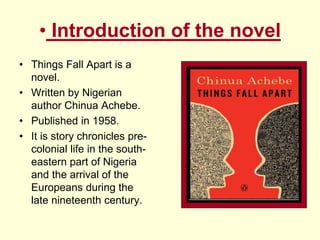
• Things Fall Apart is a
novel.
• Written by Nigerian
author Chinua Achebe.
• Published in 1958.
• It is story chronicles pre-
colonial life in the south-
eastern part of Nigeria
and the arrival of the
Europeans during the
late nineteenth century.
•About the Author
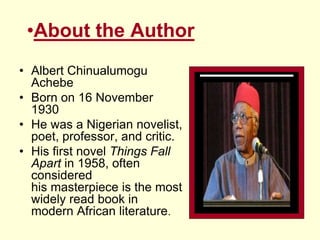
• Albert Chinualumogu
Achebe
• Born on 16 November
1930
• He was a Nigerian novelist,
poet, professor, and critic.
• His first novel Things Fall
Apart in 1958, often
considered
his masterpiece is the most
widely read book in
modern African literature.
•Things Fall apart
The struggle between change
and tradition
Varying interpretations
of Masculinity
Language as a sign of
culture difference
Generational divide
Pride
Repression
Drum language
Ethnographic distance
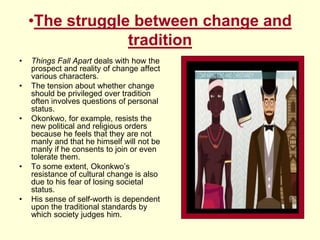
•The struggle between change and
tradition
• Things Fall Apart deals with how the
prospect and reality of change affect
various characters.
• The tension about whether change
should be privileged over tradition
often involves questions of personal
status.
• Okonkwo, for example, resists the
new political and religious orders
because he feels that they are not
manly and that he himself will not be
manly if he consents to join or even
tolerate them.
• To some extent, Okonkwo’s
resistance of cultural change is also
due to his fear of losing societal
status.
• His sense of self-worth is dependent
upon the traditional standards by
which society judges him.
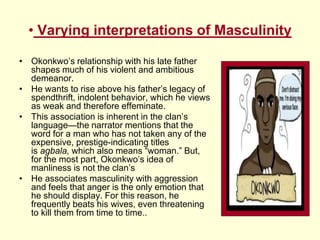
• Varying interpretations of Masculinity
• Okonkwo’s relationship with his late father
shapes much of his violent and ambitious
demeanor.
• He wants to rise above his father’s legacy of
spendthrift, indolent behavior, which he views
as weak and therefore effeminate.
• This association is inherent in the clan’s
language—the narrator mentions that the
word for a man who has not taken any of the
expensive, prestige-indicating titles
is agbala, which also means “woman.” But,
for the most part, Okonkwo’s idea of
manliness is not the clan’s
• He associates masculinity with aggression
and feels that anger is the only emotion that
he should display. For this reason, he
frequently beats his wives, even threatening
to kill them from time to time..
• Language as a sign of culture
difference
• Language is an important theme in Things Fall
Apart on several levels.
• In demonstrating the imaginative, often formal
language of the Igbo, Achebe emphasizes that
Africa is not the silent or incomprehensible
continent that books such as Heart of
Darkness made it out to be.
• Rather, by peppering the novel with Igbo words,
Achebe shows that the Igbo language is too
complex for direct translation into English.
• Similarly, Igbo culture cannot be understood
within the framework of European colonialist
values.
• Achebe also points out that Africa has
many different languages: the villagers of
Umuofia, for example, make fun of Mr. Brown’s
translator because his language is slightly
different from their own.
• Generational divide
• Things Fall Apart spotlights two significant
generational divides.
• The first divide separates Okonkwo from his father,
Unoka.
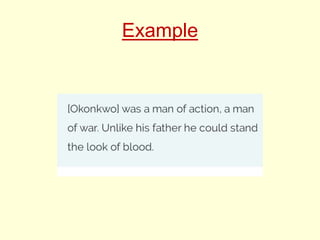
• Unlike his son, Unoka is not a warrior, nor has he
distinguished himself as a man in any other way.
• Instead, Unoka prefers to drink and play music with
friends.
• For a hypermasculine man like Okonkwo, Unoka’s
lack of drive is shameful, and Okonkwo dismisses
his father as a coward.
• Just as Okonkwo is divided from his father, he is
also divided from his eldest son, Nwoye.
Example
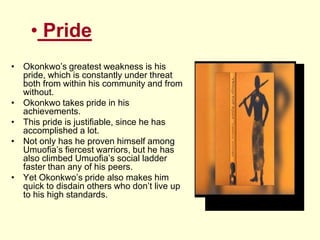
• Pride
• Okonkwo’s greatest weakness is his
pride, which is constantly under threat
both from within his community and from
without.
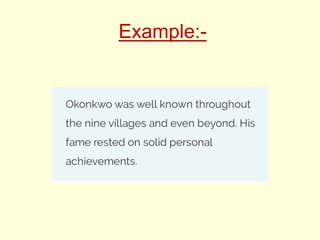
• Okonkwo takes pride in his
achievements.
• This pride is justifiable, since he has
accomplished a lot.
• Not only has he proven himself among
Umuofia’s fiercest warriors, but he has
also climbed Umuofia’s social ladder
faster than any of his peers.
• Yet Okonkwo’s pride also makes him
quick to disdain others who don’t live up
to his high standards.
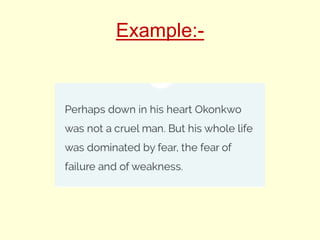
Example:-
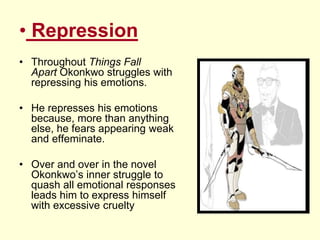
• Repression
• Throughout Things Fall
Apart Okonkwo struggles with
repressing his emotions.
• He represses his emotions
because, more than anything
else, he fears appearing weak
and effeminate.
• Over and over in the novel
Okonkwo’s inner struggle to
quash all emotional responses
leads him to express himself
with excessive cruelty
Example:-
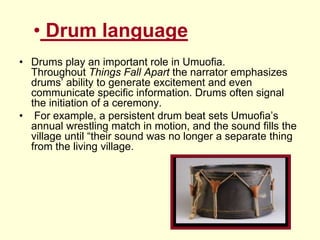
• Drum language
• Drums play an important role in Umuofia.
Throughout Things Fall Apart the narrator emphasizes
drums’ ability to generate excitement and even
communicate specific information. Drums often signal
the initiation of a ceremony.
• For example, a persistent drum beat sets Umuofia’s
annual wrestling match in motion, and the sound fills the
village until “their sound was no longer a separate thing
from the living village.
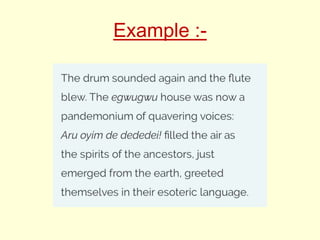
Example :-
• Ethnographic distance
• The term “ethnographic distance” refers to a method in
anthropology where the anthropologists distance
themselves from the culture they are studying in order to
make sense of that culture.
• At several points in the novel, the narrator, who
otherwise seems fully immersed in Igbo culture, takes a
step back in order to explain certain aspects of the Igbo
world to the reader.
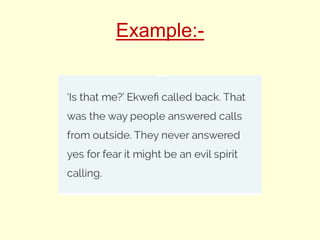
• For example, when Okonkwo’s first wife calls out to
Ekwefi in chapter five, Ekwefi calls back from inside her
hut, “Is that me?” This response may seem strange to
non-Igbo readers, so the narrator explains the cultural
logic of Ekwefi’s response: “That was the way people
answered calls from outside
Example:-
Conclusion
• Achebe tries to explain whole story
through these themes. He talked
about mostly on character of
Okonkwo.
Reference
• https://www.sparknotes.com/lit/things/
Thank you

Themes in Things Fall Apart

  • 1.
    The African Literature Preparedby Monika Makwana Department of English
  • 2.
    • Themes inThings Fall Apart • Name:- Monika Makwana • Roll no:- 19 • Paper No:- 13 The African Literature • Topic:- Themes in Things Fall Apart • Enrollment No:- 206908420190027 • Email I’d:- makwanamonika26@gmail.com • Submitted to:- S. B. Gardi department of English
  • 3.
    • Introduction ofthe novel • Things Fall Apart is a novel. • Written by Nigerian author Chinua Achebe. • Published in 1958. • It is story chronicles pre- colonial life in the south- eastern part of Nigeria and the arrival of the Europeans during the late nineteenth century.
  • 4.
    •About the Author •Albert Chinualumogu Achebe • Born on 16 November 1930 • He was a Nigerian novelist, poet, professor, and critic. • His first novel Things Fall Apart in 1958, often considered his masterpiece is the most widely read book in modern African literature.
  • 5.
    •Things Fall apart Thestruggle between change and tradition Varying interpretations of Masculinity Language as a sign of culture difference Generational divide Pride Repression Drum language Ethnographic distance
  • 6.
    •The struggle betweenchange and tradition • Things Fall Apart deals with how the prospect and reality of change affect various characters. • The tension about whether change should be privileged over tradition often involves questions of personal status. • Okonkwo, for example, resists the new political and religious orders because he feels that they are not manly and that he himself will not be manly if he consents to join or even tolerate them. • To some extent, Okonkwo’s resistance of cultural change is also due to his fear of losing societal status. • His sense of self-worth is dependent upon the traditional standards by which society judges him.
  • 7.
    • Varying interpretationsof Masculinity • Okonkwo’s relationship with his late father shapes much of his violent and ambitious demeanor. • He wants to rise above his father’s legacy of spendthrift, indolent behavior, which he views as weak and therefore effeminate. • This association is inherent in the clan’s language—the narrator mentions that the word for a man who has not taken any of the expensive, prestige-indicating titles is agbala, which also means “woman.” But, for the most part, Okonkwo’s idea of manliness is not the clan’s • He associates masculinity with aggression and feels that anger is the only emotion that he should display. For this reason, he frequently beats his wives, even threatening to kill them from time to time..
  • 8.
    • Language asa sign of culture difference • Language is an important theme in Things Fall Apart on several levels. • In demonstrating the imaginative, often formal language of the Igbo, Achebe emphasizes that Africa is not the silent or incomprehensible continent that books such as Heart of Darkness made it out to be. • Rather, by peppering the novel with Igbo words, Achebe shows that the Igbo language is too complex for direct translation into English. • Similarly, Igbo culture cannot be understood within the framework of European colonialist values. • Achebe also points out that Africa has many different languages: the villagers of Umuofia, for example, make fun of Mr. Brown’s translator because his language is slightly different from their own.
  • 9.
    • Generational divide •Things Fall Apart spotlights two significant generational divides. • The first divide separates Okonkwo from his father, Unoka. • Unlike his son, Unoka is not a warrior, nor has he distinguished himself as a man in any other way. • Instead, Unoka prefers to drink and play music with friends. • For a hypermasculine man like Okonkwo, Unoka’s lack of drive is shameful, and Okonkwo dismisses his father as a coward. • Just as Okonkwo is divided from his father, he is also divided from his eldest son, Nwoye.
  • 10.
  • 11.
    • Pride • Okonkwo’sgreatest weakness is his pride, which is constantly under threat both from within his community and from without. • Okonkwo takes pride in his achievements. • This pride is justifiable, since he has accomplished a lot. • Not only has he proven himself among Umuofia’s fiercest warriors, but he has also climbed Umuofia’s social ladder faster than any of his peers. • Yet Okonkwo’s pride also makes him quick to disdain others who don’t live up to his high standards.
  • 12.
  • 13.
    • Repression • ThroughoutThings Fall Apart Okonkwo struggles with repressing his emotions. • He represses his emotions because, more than anything else, he fears appearing weak and effeminate. • Over and over in the novel Okonkwo’s inner struggle to quash all emotional responses leads him to express himself with excessive cruelty
  • 14.
  • 15.
    • Drum language •Drums play an important role in Umuofia. Throughout Things Fall Apart the narrator emphasizes drums’ ability to generate excitement and even communicate specific information. Drums often signal the initiation of a ceremony. • For example, a persistent drum beat sets Umuofia’s annual wrestling match in motion, and the sound fills the village until “their sound was no longer a separate thing from the living village.
  • 16.
  • 17.
    • Ethnographic distance •The term “ethnographic distance” refers to a method in anthropology where the anthropologists distance themselves from the culture they are studying in order to make sense of that culture. • At several points in the novel, the narrator, who otherwise seems fully immersed in Igbo culture, takes a step back in order to explain certain aspects of the Igbo world to the reader. • For example, when Okonkwo’s first wife calls out to Ekwefi in chapter five, Ekwefi calls back from inside her hut, “Is that me?” This response may seem strange to non-Igbo readers, so the narrator explains the cultural logic of Ekwefi’s response: “That was the way people answered calls from outside
  • 18.
  • 19.
    Conclusion • Achebe triesto explain whole story through these themes. He talked about mostly on character of Okonkwo.
  • 20.
  • 21.