Introduction
Definition:
◦ Matted sheet or felted sheet of fibre usually cellulosic and generally
formed on fine wire screen from waste suspension.
◦ Paper is a thin sheet material produced by mechanically or chemically
processing cellulose fibers derived from wood, rags, grasses or other
vegetable sources in water, draining the water through fine mesh leaving
the fiber evenly distributed on the surface, followed by pressing and
drying.
Types of paper
Classification:
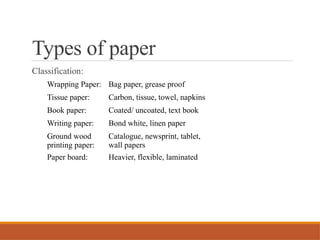
Wrapping Paper: Bag paper, grease proof
Tissue paper: Carbon, tissue, towel, napkins
Book paper: Coated/ uncoated, text book
Writing paper: Bond white, linen paper
Ground wood
printing paper:
Catalogue, newsprint, tablet,
wall papers
Paper board: Heavier, flexible, laminated
Raw materials
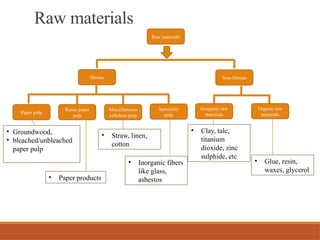
Raw materials
fibrous Non-fibrous
Paper pulp
Reuse paper
pulp
Miscellaneous
cellulose pulp
Speciality
pulp
Inorganic raw
materials
Organic raw
materials
• Groundwood,
• bleached/unbleached
paper pulp
• Paper products
• Straw, linen,
cotton
• Inorganic fibers
like glass,
asbestos
• Glue, resin,
waxes, glycerol
• Clay, talc,
titanium
dioxide, zinc
sulphide, etc
Method of production
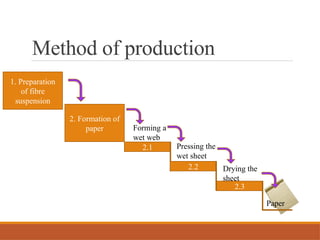
1. Preparation
of fibre
suspension
2. Formation of
paper
2.1
Forming a
wet web
2.2
Pressing the
wet sheet
2.3
Drying the
sheet
Paper
1. Preparation of fibre
suspension
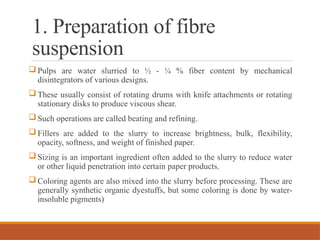
 Pulps are water slurried to ½ - ¼ % fiber content by mechanical
disintegrators of various designs.
 These usually consist of rotating drums with knife attachments or rotating
stationary disks to produce viscous shear.
 Such operations are called beating and refining.
 Fillers are added to the slurry to increase brightness, bulk, flexibility,
opacity, softness, and weight of finished paper.
 Sizing is an important ingredient often added to the slurry to reduce water
or other liquid penetration into certain paper products.
 Coloring agents are also mixed into the slurry before processing. These are
generally synthetic organic dyestuffs, but some coloring is done by water-
insoluble pigments)
2. Formation of paper
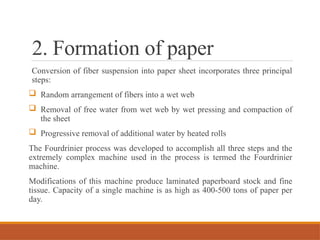
Conversion of fiber suspension into paper sheet incorporates three principal
steps:
 Random arrangement of fibers into a wet web
 Removal of free water from wet web by wet pressing and compaction of
the sheet
 Progressive removal of additional water by heated rolls
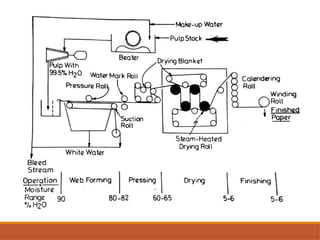
The Fourdrinier process was developed to accomplish all three steps and the
extremely complex machine used in the process is termed the Fourdrinier
machine.
Modifications of this machine produce laminated paperboard stock and fine
tissue. Capacity of a single machine is as high as 400-500 tons of paper per
day.
2.1 Forming the wet web
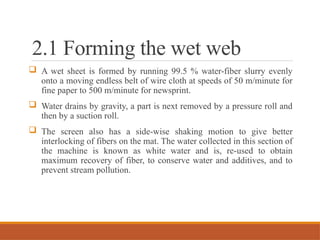
 A wet sheet is formed by running 99.5 % water-fiber slurry evenly
onto a moving endless belt of wire cloth at speeds of 50 m/minute for
fine paper to 500 m/minute for newsprint.
 Water drains by gravity, a part is next removed by a pressure roll and
then by a suction roll.
 The screen also has a side-wise shaking motion to give better
interlocking of fibers on the mat. The water collected in this section of
the machine is known as white water and is, re-used to obtain
maximum recovery of fiber, to conserve water and additives, and to
prevent stream pollution.
2.2 Pressing the wet sheet
 The wet paper sheet containing about 80% water is fed via felt roll to
the press section where water is removed by mild pressure to reduce
content to 60-65% water.
 Bond or water mark, if needed, is formed on the sheet during the
pressing.
2.3 Drying the sheet
 The sheet from the press section has sufficient strength to carry its own weight.
 It is passed through smoothing rolls, then a series of steam-heated metal cylinders
where heat and moisture are transferred to a felting or canvas belt running on top
of the Paper.
 Paperboard is dried directly without a felt. As the sheet leaves the last drying roll
with 5-6% H20, it is passed through a final series of pressure or calendering rolls
to produce a smooth, well-finished paper.
 It is wound on large rolls and transferred to the finishing department where it may
be cut, coated, and packaged.
 In the designing the roll speed in the dryer section, allowance must be made for a
5 – 10 % progressive stretching as the paper is pulled through the dryer.
 The tendency of paper to shrink on drying, coupled with the machine tendency to
stretch, creates a delicate force balance in machine design.
GLOBAL TRENDS IN THE
PAPER INDUSTRY
 In 2015, worldwide demand for graphic paper declined for the first
time ever. However, exciting new opportunities in specialist papers,
sustainable packaging and digitalisation offer new avenues for
growth for the paper industry.
 A survey report which looked at the transformational change in the
pulp and paper industry identified some of the challenges facing the
paper industry.
 It makes the point that the graphic paper market is shrinking and there
is no obvious estimate about where the market floor will be.
2018
Paper packaging growth
 However, the authors also note that, while the market for graphic papers is shrinking, the
market for paper packaging is growing worldwide. This growth is being driven by societal
changes, including our changing shopping habits. In particular, online shopping means
there is a growing need for paper and carboard packaging materials.
 Improved product safety, the unboxing experience, counterfeiting measures and
improvements to last-mile delivery are all identified as offering particular opportunities
for innovation and growth for paper manufacturers.
 The authors, identified particular opportunities for producers of softwood fibres. They say,
“In the medium term, requirements for a stronger, lighter-weight packaging and the need
to balance out the deteriorating quality of recycled fibre could increase demand.”
 However, while they see opportunities for growth, the authors also point out that the
plastics packaging market is growing faster than paper packaging growth. This has
prompted the authors to argue, “Given the confluence of technological changes,
demographic changes, and resource concerns that we anticipate over the next decade, we
believe the industry will have to embrace change that is, in character, as well as pace,
vastly different from what we have seen before.”
Digital Manufacturing
 The report authors are keen to highlight the benefits that digital
manufacturing could bring to the sector, identifying drone-based
forestry monitoring and improved mill automation as examples of
areas that are ripe for optimisation through technology.
 Overall, the verdict is optimistic: manufacturers have huge
opportunities for optimisation and innovation if they respond
effectively to changing market demand and the possibilities of
digitalisation.
Thank You

Paper manufacturing for chemical engineering

  • 1.
    Introduction Definition: ◦ Matted sheetor felted sheet of fibre usually cellulosic and generally formed on fine wire screen from waste suspension. ◦ Paper is a thin sheet material produced by mechanically or chemically processing cellulose fibers derived from wood, rags, grasses or other vegetable sources in water, draining the water through fine mesh leaving the fiber evenly distributed on the surface, followed by pressing and drying.
  • 2.
    Types of paper Classification: WrappingPaper: Bag paper, grease proof Tissue paper: Carbon, tissue, towel, napkins Book paper: Coated/ uncoated, text book Writing paper: Bond white, linen paper Ground wood printing paper: Catalogue, newsprint, tablet, wall papers Paper board: Heavier, flexible, laminated
  • 3.
    Raw materials Raw materials fibrousNon-fibrous Paper pulp Reuse paper pulp Miscellaneous cellulose pulp Speciality pulp Inorganic raw materials Organic raw materials • Groundwood, • bleached/unbleached paper pulp • Paper products • Straw, linen, cotton • Inorganic fibers like glass, asbestos • Glue, resin, waxes, glycerol • Clay, talc, titanium dioxide, zinc sulphide, etc
  • 4.
    Method of production 1.Preparation of fibre suspension 2. Formation of paper 2.1 Forming a wet web 2.2 Pressing the wet sheet 2.3 Drying the sheet Paper
  • 6.
    1. Preparation offibre suspension  Pulps are water slurried to ½ - ¼ % fiber content by mechanical disintegrators of various designs.  These usually consist of rotating drums with knife attachments or rotating stationary disks to produce viscous shear.  Such operations are called beating and refining.  Fillers are added to the slurry to increase brightness, bulk, flexibility, opacity, softness, and weight of finished paper.  Sizing is an important ingredient often added to the slurry to reduce water or other liquid penetration into certain paper products.  Coloring agents are also mixed into the slurry before processing. These are generally synthetic organic dyestuffs, but some coloring is done by water- insoluble pigments)
  • 7.
    2. Formation ofpaper Conversion of fiber suspension into paper sheet incorporates three principal steps:  Random arrangement of fibers into a wet web  Removal of free water from wet web by wet pressing and compaction of the sheet  Progressive removal of additional water by heated rolls The Fourdrinier process was developed to accomplish all three steps and the extremely complex machine used in the process is termed the Fourdrinier machine. Modifications of this machine produce laminated paperboard stock and fine tissue. Capacity of a single machine is as high as 400-500 tons of paper per day.
  • 8.
    2.1 Forming thewet web  A wet sheet is formed by running 99.5 % water-fiber slurry evenly onto a moving endless belt of wire cloth at speeds of 50 m/minute for fine paper to 500 m/minute for newsprint.  Water drains by gravity, a part is next removed by a pressure roll and then by a suction roll.  The screen also has a side-wise shaking motion to give better interlocking of fibers on the mat. The water collected in this section of the machine is known as white water and is, re-used to obtain maximum recovery of fiber, to conserve water and additives, and to prevent stream pollution.
  • 9.
    2.2 Pressing thewet sheet  The wet paper sheet containing about 80% water is fed via felt roll to the press section where water is removed by mild pressure to reduce content to 60-65% water.  Bond or water mark, if needed, is formed on the sheet during the pressing.
  • 10.
    2.3 Drying thesheet  The sheet from the press section has sufficient strength to carry its own weight.  It is passed through smoothing rolls, then a series of steam-heated metal cylinders where heat and moisture are transferred to a felting or canvas belt running on top of the Paper.  Paperboard is dried directly without a felt. As the sheet leaves the last drying roll with 5-6% H20, it is passed through a final series of pressure or calendering rolls to produce a smooth, well-finished paper.  It is wound on large rolls and transferred to the finishing department where it may be cut, coated, and packaged.  In the designing the roll speed in the dryer section, allowance must be made for a 5 – 10 % progressive stretching as the paper is pulled through the dryer.  The tendency of paper to shrink on drying, coupled with the machine tendency to stretch, creates a delicate force balance in machine design.
  • 11.
    GLOBAL TRENDS INTHE PAPER INDUSTRY  In 2015, worldwide demand for graphic paper declined for the first time ever. However, exciting new opportunities in specialist papers, sustainable packaging and digitalisation offer new avenues for growth for the paper industry.  A survey report which looked at the transformational change in the pulp and paper industry identified some of the challenges facing the paper industry.  It makes the point that the graphic paper market is shrinking and there is no obvious estimate about where the market floor will be. 2018
  • 12.
    Paper packaging growth However, the authors also note that, while the market for graphic papers is shrinking, the market for paper packaging is growing worldwide. This growth is being driven by societal changes, including our changing shopping habits. In particular, online shopping means there is a growing need for paper and carboard packaging materials.  Improved product safety, the unboxing experience, counterfeiting measures and improvements to last-mile delivery are all identified as offering particular opportunities for innovation and growth for paper manufacturers.  The authors, identified particular opportunities for producers of softwood fibres. They say, “In the medium term, requirements for a stronger, lighter-weight packaging and the need to balance out the deteriorating quality of recycled fibre could increase demand.”  However, while they see opportunities for growth, the authors also point out that the plastics packaging market is growing faster than paper packaging growth. This has prompted the authors to argue, “Given the confluence of technological changes, demographic changes, and resource concerns that we anticipate over the next decade, we believe the industry will have to embrace change that is, in character, as well as pace, vastly different from what we have seen before.”
  • 13.
    Digital Manufacturing  Thereport authors are keen to highlight the benefits that digital manufacturing could bring to the sector, identifying drone-based forestry monitoring and improved mill automation as examples of areas that are ripe for optimisation through technology.  Overall, the verdict is optimistic: manufacturers have huge opportunities for optimisation and innovation if they respond effectively to changing market demand and the possibilities of digitalisation.
  • 14.