International Journal of Research in Advent Technology, Vol.2, No.6, June 2014 
E-ISSN: 2321-9637 
270 
Use of Different Ribs, Fins and Inserts to Enhance the 
Heat Transfer Rate– A Review 
A. N.Mahure1, P.A.Hatwalne2 
1,2Assistant Professor Department of Mechanical Engg., JDIET, Yavatmal 
Abstract- Heat transfer enhancement techniques used to increase rate of heat transfer without affecting much the 
overall performance of the system. These techniques are used in heat exchangers. Like baffle, inserts, jet 
impingement and other passive heat transfer enhancement methods, insertion of ribs in heat enhancement system has 
been used for various types of industrial applications such as internal cooling systems of gas turbine blades, 
electronic cooling devices, shell type heat exchangers, thermal regenerators. These heat enhancement techniques 
broadly are of three types viz. passive, active and compound techniques. The present review paper is related to use 
of ribs ,fins and various inserts for enhancing heat transfer. 
Keywords: Heat transfer enhancement, ribs, fins. 
1. INTRODUCTION 
Generally, heat transfer enhancement techniques are 
classified in three broad categories: 
(a) Active method: This method involves some external 
power input for the 
enhancement of heat transfer; some examples of active 
methods include induced pulsation by cams and 
reciprocating plungers, the use of a magnetic field to 
disturb the seeded light particles in a flowing stream, 
fluid vibration etc. 
(b) Passive method: These methods generally use 
surface or geometrical modifications to the flow channel 
by incorporating inserts or additional devices. For 
example, use of inserts, use of rough surfaces, extended 
surface etc. 
(c) Compound method: When any two or more 
techniques employed simultaneously to obtain 
enhancement in heat transfer that is greater than that 
produced by either of them when used individually ,is 
termed as compound enhancement .This technique 
involves complex design and hence has limited 
application. 
Passive heat transfer augmentation methods 
Passive heat transfer enhancement methods not need 
any external power input. In the convective heat transfer 
one of the ways to enhance heat transfer rate is to 
increase the effective surface area and residence time of 
the heat transfer fluids. The passive methods are based 
on the same principle. Use of this technique causes the 
swirl in the bulk of the fluids and disturbs the actual 
boundary layer so as to increase effective surface area, 
residence time and consequently heat transfer 
coefficient in existing system. 
Following Methods are used generally used, 
1. Extended surface 
2. Inserts 
1. Extended Surface:- 
Extended or finned surfaces increase the heat transfer 
area which could be very effective in case of fluids with 
low heat transfer coefficients. This technique includes 
finned tube for shell & tube exchangers, plate fins for 
compact heat exchanger and finned heat sinks for 
electronic cooling. Finned surfaces enhance heat 
transfer in natural or forced convection which can be 
used for cooling of electrical and electronic devices. 
The use of extended surfaces for cooling electronic 
devices is not restricted to the natural convection heat 
transfer regime but also can be used for forced 
convective heat transfer. A variety of extended surfaces 
typically used include offset strip fins, louvered fins, 
perforated fins and wavy fins. 
2. Inserts 
Inserts refer to the additional arrangements made as an 
obstacle to fluid flow so as to augment heat transfer. 
Different types of inserts are 
1. Twisted tape and wire coils 
2. Ribs, Baffles, plates 
The present paper Contributes for review of Ribs, 
baffle/fins in duct and insert in tube. 
Ribs:
International Journal of Research in Advent Technology, Vol.2, No.6, June 2014 
E-ISSN: 2321-9637 
271 
There are several techniques available to enhance the 
heat transfer coefficient of gases in internal cooling. 
One of the common internal cooling enhances 
techniques is the placement of internal flow swirls, tape 
twisters, or baffles. The swirl insert and tape twister 
techniques create a flow disturbance, and the pressure 
drop losses are much higher compared to the gain in 
heat transfer coefficient. Different rib shapes and 
baffles create bulk flow disturbance, but unlike tapes or 
swirls, ribs and baffles are discrete objects. Therefore, 
the flow disturbance created by ribs and baffles may be 
localized, but more intense. Usually ribs and baffle 
plates are attached to the thermally active surface to 
augment heat transfer by providing additional fin-link 
surface area for heat transfer and better mixing. 
Use of ribs and fins: 
The main roles of a ribs and fins in a shell and tube heat 
exchanger are:- 
· To prevent the effect of vibration which is 
increased with fluid velocity. 
· To increase the heat transfer area. 
· To promote mixing in static mixture. 
· To increase the stiffness of the system. 
Types of Ribs & fins 
Implementation of ribs & fins is decided on the basis of 
size, cost and their ability to lend support to the tube 
bundles and direct flow. Often this is linked to available 
pressure drop and the size and number of passes within 
the exchanger. Special allowances/changes are also 
made for finned tubes. The different types of ribs & 
baffles include: 
· Z-shaped ribs. 
· Segmented ribs. 
· Corrugated surface. 
· Inclined ribs. 
· Porous ribs. 
· Segmental fins (of which single segment is the 
most common) 
· Orifice Baffles. 
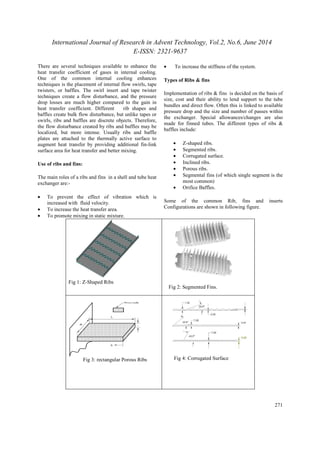
Some of the common Rib, fins and inserts 
Configurations are shown in following figure. 
Fig 1: Z-Shaped Ribs 
Fig 2: Segmented Fins. 
Fig 3: rectangular Porous Ribs Fig 4: Corrugated Surface
International Journal of Research in Advent Technology, Vol.2, No.6, June 2014 
E-ISSN: 2321-9637 
272 
Fig 5: Tape with attached baffle Fig 6: Porous Baffles 
Fig 7: Twisted tape inserts 
Fig 8: Tube equipped with propeller 
inserts 
2. LITERATURE SURVEY 
Monsak Pimsarn, et al. [1] Investigated the heat 
transfer characteristics and associated friction head loss 
in rectangular channel with Z-shaped ribs. These ribs 
were set on the rectangular duct at 30º,45 º,60 ºof flat rib 
was set at 90 º relative to air flow directions. These ribs 
were fitted in Z-shape (Z-rib) aligned in series on whole 
surface of upper plate. The constant heat flux was 
provided to top surface only .The comparison of the 
result of Z-ribs with 30º,45 º,60 º and flat rib with same 
rib height ,pitch ratio and smooth channel is done. The 
thermal enhancement factor of all Z-ribs are higher than 
flat rib.The 45º Z-rib provide highest increase in heat 
transfer rate and best thermal performance. 
Rajendra karwa , et al. [2] Carried out the experiment 
to measure heat transfer rate and friction factor in 
rectangular duct with fully perforated baffles and half 
perforated baffles fixed to one of broader wall. The 
baffled wall of duct is uniformly heated while remaining 
three walls insulated. The study shows an enhancement 
of 79-169% in Nusselt number over a smooth duct for 
fully perforated baffles and 133-274% for half 
perforated baffles while the friction factor for fully 
perforated baffles is 2.98-8.02 times that of half 
perforated baffles. Half perforated baffles are 
thermodynamically superior than fully perforated at 
same pitch. 
R.M.Majumdar,V.M.Kriplani [3] investigated the 
effect of the perforated baffle on performance of 
rectangular channel. The different types of perforated 
baffle with different diameter (4mm,6mm,8mm) are 
used. The experimental study investigated the local heat 
transfer characteristic and friction head loss in channel 
with inclined solid and perforated baffle .The Reynolds 
number for this experimental study was varied between 
7600 to 54000.The experimental results shows that the 
heat transfer rate increases with baffle as compared to 
without baffle and with increase in Reynolds number. 
The baffle with more number of hole and larger 
diameter causes more turbulence and maximum heat 
transfer occur. As the degree of inclination of baffle 
increases heat transfer rate increases as well as the 
increase in friction factor occurred. 
Soo Whan Ahn,et al. [4] Investigated the heat transfer 
and friction factor characteristics in rectangular duct 
with one side roughened by five different shapes. In this 
they examined the effect of rib shape geometries as well 
as Reynolds number on heat transfer .They used five 
different shape of ribs e.g. square, triangular, circular, 
semicircular and arc. These ribs were sequentially 
installed at bottom wall of duct. To understand the
International Journal of Research in Advent Technology, Vol.2, No.6, June 2014 
E-ISSN: 2321-9637 
273 
characteristics of heat transfer enhancement the friction 
factor is also measured. The square rib has highest value 
of friction factor ,while triangular type rib has a 
substantially higher heat transfer performance than any 
other one. 
Kang-Hoon Ko, et al. [5] carried out experiment to 
measure module average heat transfer coefficients in 
uniformly heated rectangular channel with wall 
mounted porous baffles. Baffles were mounted 
alternatively on top and bottom of the walls. Heat 
transfer coefficients and pressure loss for periodically 
fully developed flow and heat transfer were obtained for 
different types of porous medium (10,20, and 40 pores 
per inch) with two ratios baffle height to channel 
hydraulic diameter and baffle thickness to channel 
hydraulic diameter ratios. The experimental procedure 
was validated by comparing the data for the straight 
channel with no baffles with those in the literature 
[Publications in Engineering, vol.2, University of 
California, Berkeley,1930,p.443,Int.Chem.Eng. 16 
(1976)359].the use of porous baffles resulted in heat 
transfer enhancement as high as 300% compared to heat 
transfer in straight channel with no baffles. 
Experimental procedure was validated by making heat 
transfer measurements for flow through a straight 
channel without any baffles. The variation of average 
Nusselt number with Reynolds number for fully 
developed flow in straight channels without any baffle. 
Smith Eiamsa-ard, et al. [6] Investigated the effect of 
helical tapes in tube over the heat transfer. Helical tape 
inserted in tube with a view to generate swirl that helps 
to increase the heat transfer rate. Reynolds number 
considered between 2300-8000. The swirl devices 
consist of 
1. Full length helical tape with and without centered 
rod. 
2. Regularly spaced helical tape without rod. 
Hot air flowing through the tube and cold water in 
annulus space. Experimental data was compared with 
that of plain tube and found that full length helical tape 
with rod provides higher heat transfer rate over without 
rod but increased pressure drop. The maximum mean 
Nusselt number increased by about 160% for full length 
tape with rod,150% for full length helical tape without 
rod and 145% for regularly spaced helical tape. 
Teerapat chompookham et al. [7] In their 
experimental investigations they studied the effect of 
combined wedge ribs and winglet type vortex 
generators (WVGs) on heat transfer and friction loss 
behavior for turbulent air flow through a constant heat 
flux channel. To create reverse flow in channel ,two 
types of wedge (right-triangle) ribs were introduced 
.The arrangements of both types of ribs placed inside 
the opposite channel walls are in-line and staggered 
arrays. To generate longitudinal vortex flow through the 
tested section, two pairs of the WVGs with the attack 
angle of 60º were mounted on test channel entrance. 
The test channel had an aspect ratio,AR=10 and height 
H=30mm with rib height e/H =0.2 and rib 
pitch,P/H=1.33.The presence of combined ribs and 
WVGs shown the significant increase in heat transfer 
rate and friction loss over the smooth channel. The 
Nusselt number and friction factor values obtained from 
the conjunction with the WVGs ,the inline wedge 
pointing downstream provides the highest increase in 
both heat transfer rate and friction factor while the 
staggered wedge pointing upstream 
Paisarn Naphon [8] investigated the heat transfer 
characteristics and pressure drop in a channel with V 
corrugated upper and lower plates under constant heat 
flux. He has carried out the analysis on channel with 
two opposite corrugated plate on which all 
configuration peaks lie in staggered arrangement. 
Corrugated plates with three different corrugated angles 
of 20º,40ºand 60º for Reynolds number and heat flux in 
the ranges 2000-9000 and 0.5 -1.2KW/m2 respectively. 
He found that the heat transfer rate increases as air flow 
rate increases. For a given Reynolds number and heat 
flux ,the average plate temperatures at higher wavy 
angle are lower than those from lower wavy angles. 
However ,the increase in heat transfer rate is less than 
that of the air mass flow rate .Therefore, the outlet air 
temperature tend to decrease as air mass flow rate 
increases. The pressure drop is continuous to increase 
with Reynolds number, the pressure drop obtained from 
channel with higher wavy angle are higher than those 
with lower wavy angles. The measured pressure drop 
obtained from channel with corrugated surfaces are 1.96 
times higher than those from plane surface. 
REFERENCES 
[1] Monsak Pimsarn, et al. “Augmented Heat Transfer 
in Rectangular Duct with Angled Z-Shaped Ribs” 
PEA-AIT International Conference on Energy and 
Sustainable Development: Issues and Strategies 
(ESD 2010) The Empress Hotel, Chiang Mai, 
Thailand. 2-4 June 2010. 
[2] Rajendra Karwa , B.K. Maheshwari “Heat transfer 
and friction in an asymmetrically heated rectangular 
duct with half and fully perforated baffles at 
different pitches” International Communications in 
Heat and Mass Transfer 36 (2009) 264–268
International Journal of Research in Advent Technology, Vol.2, No.6, June 2014 
E-ISSN: 2321-9637 
274 
[3] R.M.Majumdar,V.M.Kriplani “Internal cooling 
augmentation using inclined perforated baffle in 
rectangular channel” International journal of 
mechanics and thermodynamics 
Vol.2,No.2(2011)113-126 
[4] Soo Whan Ahn , Kang Pil Son “An Investigation on 
Friction Factors and Heat Transfer Coefficients in a 
Rectangular Duct with Surface Roughness” KSME 
International Journal, VoL 16 No.4, pp. 549-556, 
2002 
[5] Kang-Hoon Ko, N.K.Anand “Use of porous baffles 
to enhance heat transfer in a rectangular channel” 
International Journal of Heat and Mass Transfer 
46(2003)4191-4199. 
[6] Smith Eiamsa-ard, Pongjet Promvonge 
“Enhancement of heat transfer in a tube with 
regularly-spaced helical tape swirl generators” 
Department of Mechanical Engineering, Faculty of 
Engineering, King Mongkut’s Institute of 
Technology Ladkrabang, Bangkok 10520, Thailand 
[7] Teerapat Chompookham, et al. “Heat transfer 
augmentation in a wedge-ribbed channel using 
winglet vortex generators” International 
Communications in Heat and Mass Transfer 37 
(2010) 163–169 
[8] Paisarn Naphon “Heat transfer characteristics and 
pressure drop in channel with V corrugated upper 
and lower plates” Thermo-Fluid and Heat Transfer 
Enhancement Laboratory ,Department of 
Mechanical Engineering, Faculty Of Engineering, 
Srinakharinwirot University,63 Rangsit- 
Nakhornnayok Road, Ongkharak, Nakhorn-Nayok 
26120,Thailand Received 17 May 2006;accepted 26 
November 2006 
[9] Sukhmeet Singh, et al “Heat transfer and friction 
factor of discrete V-down rib roughened solar air 
heater ducts” journal of renewable and sustainable 
energy 3, 013108 -2011. 
[10] R.Karwa , et al “Heat transfer coefficient and 
friction factor correlations for the transitional flow 
regime in rib roughened rectangular ducts” 
International Journal of Heat and Mass Transfer 31 
"0888# 0486_0504 
[11] S.W. Chang, et al “Endwall heat transfer and 
pressure drop in rectangular channels with attached 
and detached circular pin-fin array” International 
Journal of Heat and Mass Transfer 51 (2008) 5247– 
5259

Paper id 26201495

  • 1.
    International Journal ofResearch in Advent Technology, Vol.2, No.6, June 2014 E-ISSN: 2321-9637 270 Use of Different Ribs, Fins and Inserts to Enhance the Heat Transfer Rate– A Review A. N.Mahure1, P.A.Hatwalne2 1,2Assistant Professor Department of Mechanical Engg., JDIET, Yavatmal Abstract- Heat transfer enhancement techniques used to increase rate of heat transfer without affecting much the overall performance of the system. These techniques are used in heat exchangers. Like baffle, inserts, jet impingement and other passive heat transfer enhancement methods, insertion of ribs in heat enhancement system has been used for various types of industrial applications such as internal cooling systems of gas turbine blades, electronic cooling devices, shell type heat exchangers, thermal regenerators. These heat enhancement techniques broadly are of three types viz. passive, active and compound techniques. The present review paper is related to use of ribs ,fins and various inserts for enhancing heat transfer. Keywords: Heat transfer enhancement, ribs, fins. 1. INTRODUCTION Generally, heat transfer enhancement techniques are classified in three broad categories: (a) Active method: This method involves some external power input for the enhancement of heat transfer; some examples of active methods include induced pulsation by cams and reciprocating plungers, the use of a magnetic field to disturb the seeded light particles in a flowing stream, fluid vibration etc. (b) Passive method: These methods generally use surface or geometrical modifications to the flow channel by incorporating inserts or additional devices. For example, use of inserts, use of rough surfaces, extended surface etc. (c) Compound method: When any two or more techniques employed simultaneously to obtain enhancement in heat transfer that is greater than that produced by either of them when used individually ,is termed as compound enhancement .This technique involves complex design and hence has limited application. Passive heat transfer augmentation methods Passive heat transfer enhancement methods not need any external power input. In the convective heat transfer one of the ways to enhance heat transfer rate is to increase the effective surface area and residence time of the heat transfer fluids. The passive methods are based on the same principle. Use of this technique causes the swirl in the bulk of the fluids and disturbs the actual boundary layer so as to increase effective surface area, residence time and consequently heat transfer coefficient in existing system. Following Methods are used generally used, 1. Extended surface 2. Inserts 1. Extended Surface:- Extended or finned surfaces increase the heat transfer area which could be very effective in case of fluids with low heat transfer coefficients. This technique includes finned tube for shell & tube exchangers, plate fins for compact heat exchanger and finned heat sinks for electronic cooling. Finned surfaces enhance heat transfer in natural or forced convection which can be used for cooling of electrical and electronic devices. The use of extended surfaces for cooling electronic devices is not restricted to the natural convection heat transfer regime but also can be used for forced convective heat transfer. A variety of extended surfaces typically used include offset strip fins, louvered fins, perforated fins and wavy fins. 2. Inserts Inserts refer to the additional arrangements made as an obstacle to fluid flow so as to augment heat transfer. Different types of inserts are 1. Twisted tape and wire coils 2. Ribs, Baffles, plates The present paper Contributes for review of Ribs, baffle/fins in duct and insert in tube. Ribs:
  • 2.
    International Journal ofResearch in Advent Technology, Vol.2, No.6, June 2014 E-ISSN: 2321-9637 271 There are several techniques available to enhance the heat transfer coefficient of gases in internal cooling. One of the common internal cooling enhances techniques is the placement of internal flow swirls, tape twisters, or baffles. The swirl insert and tape twister techniques create a flow disturbance, and the pressure drop losses are much higher compared to the gain in heat transfer coefficient. Different rib shapes and baffles create bulk flow disturbance, but unlike tapes or swirls, ribs and baffles are discrete objects. Therefore, the flow disturbance created by ribs and baffles may be localized, but more intense. Usually ribs and baffle plates are attached to the thermally active surface to augment heat transfer by providing additional fin-link surface area for heat transfer and better mixing. Use of ribs and fins: The main roles of a ribs and fins in a shell and tube heat exchanger are:- · To prevent the effect of vibration which is increased with fluid velocity. · To increase the heat transfer area. · To promote mixing in static mixture. · To increase the stiffness of the system. Types of Ribs & fins Implementation of ribs & fins is decided on the basis of size, cost and their ability to lend support to the tube bundles and direct flow. Often this is linked to available pressure drop and the size and number of passes within the exchanger. Special allowances/changes are also made for finned tubes. The different types of ribs & baffles include: · Z-shaped ribs. · Segmented ribs. · Corrugated surface. · Inclined ribs. · Porous ribs. · Segmental fins (of which single segment is the most common) · Orifice Baffles. Some of the common Rib, fins and inserts Configurations are shown in following figure. Fig 1: Z-Shaped Ribs Fig 2: Segmented Fins. Fig 3: rectangular Porous Ribs Fig 4: Corrugated Surface
  • 3.
    International Journal ofResearch in Advent Technology, Vol.2, No.6, June 2014 E-ISSN: 2321-9637 272 Fig 5: Tape with attached baffle Fig 6: Porous Baffles Fig 7: Twisted tape inserts Fig 8: Tube equipped with propeller inserts 2. LITERATURE SURVEY Monsak Pimsarn, et al. [1] Investigated the heat transfer characteristics and associated friction head loss in rectangular channel with Z-shaped ribs. These ribs were set on the rectangular duct at 30º,45 º,60 ºof flat rib was set at 90 º relative to air flow directions. These ribs were fitted in Z-shape (Z-rib) aligned in series on whole surface of upper plate. The constant heat flux was provided to top surface only .The comparison of the result of Z-ribs with 30º,45 º,60 º and flat rib with same rib height ,pitch ratio and smooth channel is done. The thermal enhancement factor of all Z-ribs are higher than flat rib.The 45º Z-rib provide highest increase in heat transfer rate and best thermal performance. Rajendra karwa , et al. [2] Carried out the experiment to measure heat transfer rate and friction factor in rectangular duct with fully perforated baffles and half perforated baffles fixed to one of broader wall. The baffled wall of duct is uniformly heated while remaining three walls insulated. The study shows an enhancement of 79-169% in Nusselt number over a smooth duct for fully perforated baffles and 133-274% for half perforated baffles while the friction factor for fully perforated baffles is 2.98-8.02 times that of half perforated baffles. Half perforated baffles are thermodynamically superior than fully perforated at same pitch. R.M.Majumdar,V.M.Kriplani [3] investigated the effect of the perforated baffle on performance of rectangular channel. The different types of perforated baffle with different diameter (4mm,6mm,8mm) are used. The experimental study investigated the local heat transfer characteristic and friction head loss in channel with inclined solid and perforated baffle .The Reynolds number for this experimental study was varied between 7600 to 54000.The experimental results shows that the heat transfer rate increases with baffle as compared to without baffle and with increase in Reynolds number. The baffle with more number of hole and larger diameter causes more turbulence and maximum heat transfer occur. As the degree of inclination of baffle increases heat transfer rate increases as well as the increase in friction factor occurred. Soo Whan Ahn,et al. [4] Investigated the heat transfer and friction factor characteristics in rectangular duct with one side roughened by five different shapes. In this they examined the effect of rib shape geometries as well as Reynolds number on heat transfer .They used five different shape of ribs e.g. square, triangular, circular, semicircular and arc. These ribs were sequentially installed at bottom wall of duct. To understand the
  • 4.
    International Journal ofResearch in Advent Technology, Vol.2, No.6, June 2014 E-ISSN: 2321-9637 273 characteristics of heat transfer enhancement the friction factor is also measured. The square rib has highest value of friction factor ,while triangular type rib has a substantially higher heat transfer performance than any other one. Kang-Hoon Ko, et al. [5] carried out experiment to measure module average heat transfer coefficients in uniformly heated rectangular channel with wall mounted porous baffles. Baffles were mounted alternatively on top and bottom of the walls. Heat transfer coefficients and pressure loss for periodically fully developed flow and heat transfer were obtained for different types of porous medium (10,20, and 40 pores per inch) with two ratios baffle height to channel hydraulic diameter and baffle thickness to channel hydraulic diameter ratios. The experimental procedure was validated by comparing the data for the straight channel with no baffles with those in the literature [Publications in Engineering, vol.2, University of California, Berkeley,1930,p.443,Int.Chem.Eng. 16 (1976)359].the use of porous baffles resulted in heat transfer enhancement as high as 300% compared to heat transfer in straight channel with no baffles. Experimental procedure was validated by making heat transfer measurements for flow through a straight channel without any baffles. The variation of average Nusselt number with Reynolds number for fully developed flow in straight channels without any baffle. Smith Eiamsa-ard, et al. [6] Investigated the effect of helical tapes in tube over the heat transfer. Helical tape inserted in tube with a view to generate swirl that helps to increase the heat transfer rate. Reynolds number considered between 2300-8000. The swirl devices consist of 1. Full length helical tape with and without centered rod. 2. Regularly spaced helical tape without rod. Hot air flowing through the tube and cold water in annulus space. Experimental data was compared with that of plain tube and found that full length helical tape with rod provides higher heat transfer rate over without rod but increased pressure drop. The maximum mean Nusselt number increased by about 160% for full length tape with rod,150% for full length helical tape without rod and 145% for regularly spaced helical tape. Teerapat chompookham et al. [7] In their experimental investigations they studied the effect of combined wedge ribs and winglet type vortex generators (WVGs) on heat transfer and friction loss behavior for turbulent air flow through a constant heat flux channel. To create reverse flow in channel ,two types of wedge (right-triangle) ribs were introduced .The arrangements of both types of ribs placed inside the opposite channel walls are in-line and staggered arrays. To generate longitudinal vortex flow through the tested section, two pairs of the WVGs with the attack angle of 60º were mounted on test channel entrance. The test channel had an aspect ratio,AR=10 and height H=30mm with rib height e/H =0.2 and rib pitch,P/H=1.33.The presence of combined ribs and WVGs shown the significant increase in heat transfer rate and friction loss over the smooth channel. The Nusselt number and friction factor values obtained from the conjunction with the WVGs ,the inline wedge pointing downstream provides the highest increase in both heat transfer rate and friction factor while the staggered wedge pointing upstream Paisarn Naphon [8] investigated the heat transfer characteristics and pressure drop in a channel with V corrugated upper and lower plates under constant heat flux. He has carried out the analysis on channel with two opposite corrugated plate on which all configuration peaks lie in staggered arrangement. Corrugated plates with three different corrugated angles of 20º,40ºand 60º for Reynolds number and heat flux in the ranges 2000-9000 and 0.5 -1.2KW/m2 respectively. He found that the heat transfer rate increases as air flow rate increases. For a given Reynolds number and heat flux ,the average plate temperatures at higher wavy angle are lower than those from lower wavy angles. However ,the increase in heat transfer rate is less than that of the air mass flow rate .Therefore, the outlet air temperature tend to decrease as air mass flow rate increases. The pressure drop is continuous to increase with Reynolds number, the pressure drop obtained from channel with higher wavy angle are higher than those with lower wavy angles. The measured pressure drop obtained from channel with corrugated surfaces are 1.96 times higher than those from plane surface. REFERENCES [1] Monsak Pimsarn, et al. “Augmented Heat Transfer in Rectangular Duct with Angled Z-Shaped Ribs” PEA-AIT International Conference on Energy and Sustainable Development: Issues and Strategies (ESD 2010) The Empress Hotel, Chiang Mai, Thailand. 2-4 June 2010. [2] Rajendra Karwa , B.K. Maheshwari “Heat transfer and friction in an asymmetrically heated rectangular duct with half and fully perforated baffles at different pitches” International Communications in Heat and Mass Transfer 36 (2009) 264–268
  • 5.
    International Journal ofResearch in Advent Technology, Vol.2, No.6, June 2014 E-ISSN: 2321-9637 274 [3] R.M.Majumdar,V.M.Kriplani “Internal cooling augmentation using inclined perforated baffle in rectangular channel” International journal of mechanics and thermodynamics Vol.2,No.2(2011)113-126 [4] Soo Whan Ahn , Kang Pil Son “An Investigation on Friction Factors and Heat Transfer Coefficients in a Rectangular Duct with Surface Roughness” KSME International Journal, VoL 16 No.4, pp. 549-556, 2002 [5] Kang-Hoon Ko, N.K.Anand “Use of porous baffles to enhance heat transfer in a rectangular channel” International Journal of Heat and Mass Transfer 46(2003)4191-4199. [6] Smith Eiamsa-ard, Pongjet Promvonge “Enhancement of heat transfer in a tube with regularly-spaced helical tape swirl generators” Department of Mechanical Engineering, Faculty of Engineering, King Mongkut’s Institute of Technology Ladkrabang, Bangkok 10520, Thailand [7] Teerapat Chompookham, et al. “Heat transfer augmentation in a wedge-ribbed channel using winglet vortex generators” International Communications in Heat and Mass Transfer 37 (2010) 163–169 [8] Paisarn Naphon “Heat transfer characteristics and pressure drop in channel with V corrugated upper and lower plates” Thermo-Fluid and Heat Transfer Enhancement Laboratory ,Department of Mechanical Engineering, Faculty Of Engineering, Srinakharinwirot University,63 Rangsit- Nakhornnayok Road, Ongkharak, Nakhorn-Nayok 26120,Thailand Received 17 May 2006;accepted 26 November 2006 [9] Sukhmeet Singh, et al “Heat transfer and friction factor of discrete V-down rib roughened solar air heater ducts” journal of renewable and sustainable energy 3, 013108 -2011. [10] R.Karwa , et al “Heat transfer coefficient and friction factor correlations for the transitional flow regime in rib roughened rectangular ducts” International Journal of Heat and Mass Transfer 31 "0888# 0486_0504 [11] S.W. Chang, et al “Endwall heat transfer and pressure drop in rectangular channels with attached and detached circular pin-fin array” International Journal of Heat and Mass Transfer 51 (2008) 5247– 5259