Name : Baldaniya Vanita Velabhai
Sem: 2 M. A. Part 1
Roll No: 29
Paper : 7 literary Theory
&Criticism
Topic: Structuralism and Literary
Criticism by
Gerard Genette
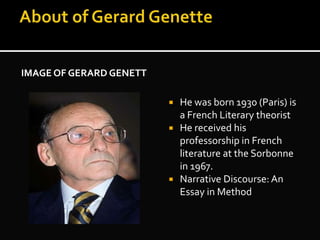
IMAGE OF GERARD GENETT
 He was born 1930 (Paris) is
a French Literary theorist
 He received his
professorship in French
literature at the Sorbonne
in 1967.
 Narrative Discourse: An
Essay in Method
 Structuralism: it is the offshoot of certain developments in
linguistic and anthropology.
 Saussure’s mode of the synchronic study of language was an
attempt to formulate the grammar of a language from a study
of parole.
 structuralism criticism aims at forming a poetics or the science
of literature from a study of literary works.
 The best work in structuralist poetics has been done in the
field of narrative.
 In his essay, “structuralism and Literary
Criticism” that methods developed for the study
of one discipline could be satisfactorily applied
to the study of other discipline as well.
 This is what he calls;
“intellectual bricolage” borrowing a term
from Claude Levi-Strauss. This is precisely so, so
far as structuralism is concerned.
 Structuralism as a method is peculiarly imitable
to literary criticism which is a discourse upon a
discourse.
 Literary criticism in that it is metalinguistic in
character and comes into being/existence as
metaliterature.
 In his word;
“it can therefore be metaliterature, that is to
say, a literature of which literature is the imposed
object”.
 In Genette’s words;
“ It the writer questions the universe the
critic question literature, that is to say, the
universe of signs. But what was a sign for the
writer becomes meaning for the critic, and in
another way what was meaning for the writer
becomes a sign for the critic, ad the theme and
symbol of a certain literary nature.”
 1)They analyse prose narratives, relating
the text to some larger containing structure,
such as :
a) the conventions of a particular literary
genre, or
b) a network of intertextual connections or
c) a projected model of an underlying universal
narrative structure, or
d) a notion of narrative as a complex of
recurrent patterns or motifs.
 2)They interpret literature in terms of a
range of underlying parallels with the
structure of language, as
 described by modern linguistics. For
instance, the notion of the ‘mytheme, posited
by Levi-Strauss,
 denotion the minimal units of narrative
‘sense’ is formed on the analogy of the
morpheme which, in
 linguistics is the smalls nit of grammatical
sense. An example of a morpheme is the past
tense.
 3)They apply the concept of systematic
patterning and structuring to the whole field
of western culture,
and across culture, treating as ‘ systems of
signs’ anything from Ancient Greek myths to
brands of soup powder.
Listening
me
carefully
for

Paper 7

  • 1.
    Name : BaldaniyaVanita Velabhai Sem: 2 M. A. Part 1 Roll No: 29 Paper : 7 literary Theory &Criticism Topic: Structuralism and Literary Criticism by Gerard Genette
  • 2.
    IMAGE OF GERARDGENETT  He was born 1930 (Paris) is a French Literary theorist  He received his professorship in French literature at the Sorbonne in 1967.  Narrative Discourse: An Essay in Method
  • 3.
     Structuralism: itis the offshoot of certain developments in linguistic and anthropology.  Saussure’s mode of the synchronic study of language was an attempt to formulate the grammar of a language from a study of parole.  structuralism criticism aims at forming a poetics or the science of literature from a study of literary works.  The best work in structuralist poetics has been done in the field of narrative.
  • 4.
     In hisessay, “structuralism and Literary Criticism” that methods developed for the study of one discipline could be satisfactorily applied to the study of other discipline as well.  This is what he calls; “intellectual bricolage” borrowing a term from Claude Levi-Strauss. This is precisely so, so far as structuralism is concerned.
  • 5.
     Structuralism asa method is peculiarly imitable to literary criticism which is a discourse upon a discourse.  Literary criticism in that it is metalinguistic in character and comes into being/existence as metaliterature.  In his word; “it can therefore be metaliterature, that is to say, a literature of which literature is the imposed object”.
  • 6.
     In Genette’swords; “ It the writer questions the universe the critic question literature, that is to say, the universe of signs. But what was a sign for the writer becomes meaning for the critic, and in another way what was meaning for the writer becomes a sign for the critic, ad the theme and symbol of a certain literary nature.”
  • 7.
     1)They analyseprose narratives, relating the text to some larger containing structure, such as : a) the conventions of a particular literary genre, or b) a network of intertextual connections or c) a projected model of an underlying universal narrative structure, or d) a notion of narrative as a complex of recurrent patterns or motifs.
  • 8.
     2)They interpretliterature in terms of a range of underlying parallels with the structure of language, as  described by modern linguistics. For instance, the notion of the ‘mytheme, posited by Levi-Strauss,  denotion the minimal units of narrative ‘sense’ is formed on the analogy of the morpheme which, in
  • 9.
     linguistics isthe smalls nit of grammatical sense. An example of a morpheme is the past tense.
  • 10.
     3)They applythe concept of systematic patterning and structuring to the whole field of western culture, and across culture, treating as ‘ systems of signs’ anything from Ancient Greek myths to brands of soup powder.
  • 11.