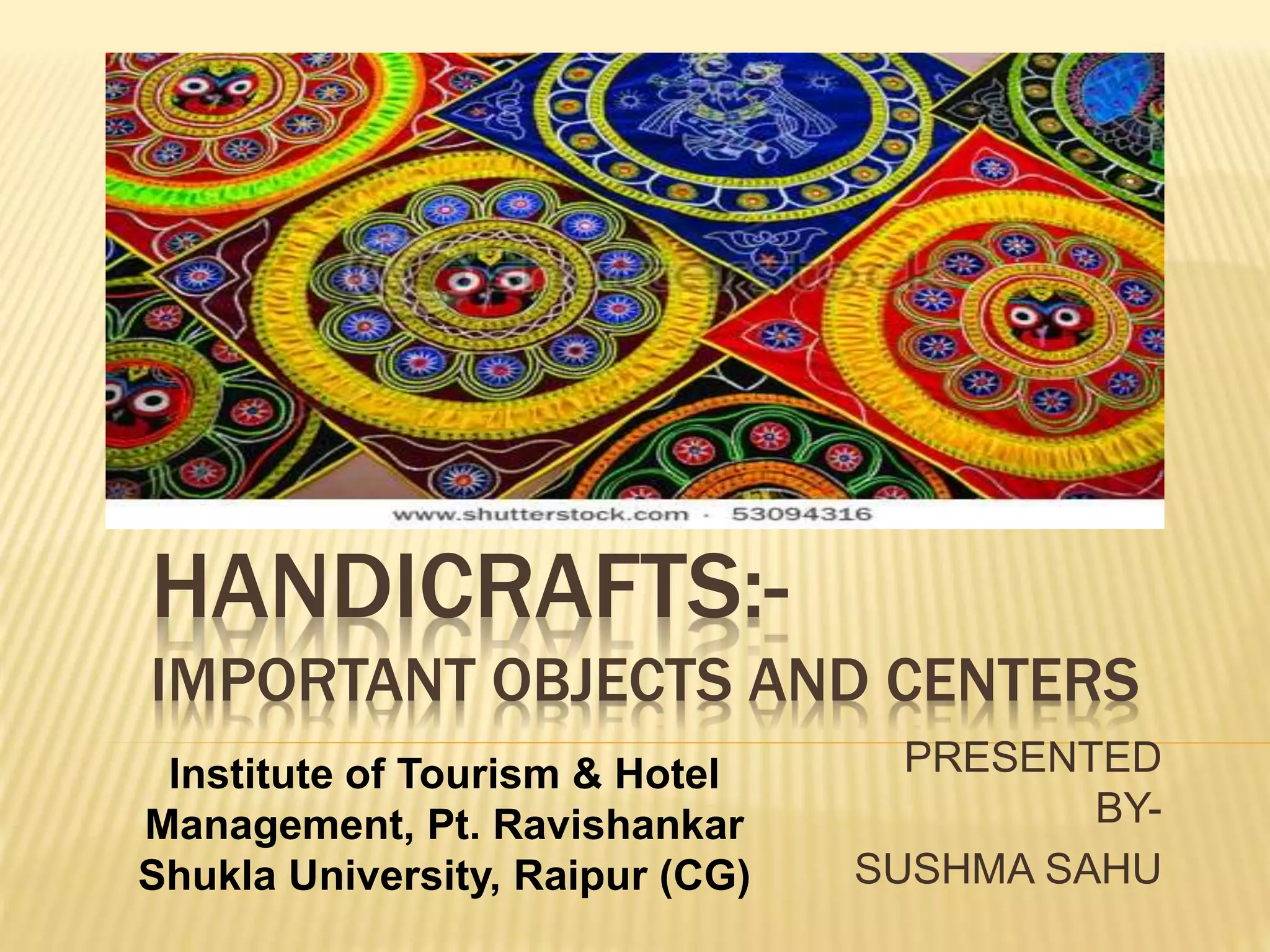
HANDICRAFTS:-
IMPORTANT OBJECTS AND CENTERS
PRESENTED
BY-
SUSHMA SAHU
Institute of Tourism & Hotel
Management, Pt. Ravishankar
Shukla University, Raipur (CG)
INTRODUCTION-
 Handicrafts are mostly defined as "items made
by hand, often with the use of simple tools, and
are generally artistic and for traditional in nature
 Handicrafts resembles certain culture
 They are also object of utility and object of
decoration.
 The main mediums in which the crafts are
practiced are stone, wood and metal.
IMPORTANCE-
 Indian handicrafts represent perhaps the
oldest tradition of living culture.
 The continuity of the traditional crafts still
offer creative expression to the great mass of
our people.
 The Indian craftsman uses this medium for
rendering creative expression of his inner
self.
 It contributes significantly to employment
generation and export earnings
 Almost all clusters of villages have their
own craftsmen who work on these
mediums.
 The diversity of Indian cultural tradition is
aptly reflected in the tradition of
handicrafts.
 For the novice tourist, Indian arts and
crafts are a feast of colours, textures ,
techniques and motifs.
 Indian performing arts is known for it’s
uniqueness all over the world.
MAJOR OBJECTIVES-
 Providing commercially useful information and
assistance to members in developing and
increasing exports.
 Offering professional advice and services to
members in areas of technology upgradation,
quality and design improvement, standards and
specifications, product development, innovation
etc.
 Interaction between exporting community
and Govt. both at the Central and State level.
 Dissemination of government notification,
orders, information on trade and other
relevant information to members.
 Organizing visits of delegation of its members
abroad to explore overseas market opportunities.
 Organizing & Participating in specialized
International Trade Fairs of handicrafts & gifts..
 To create an environment of awareness through
Workshops on "Export Marketing, Procedures and
Documentation", Packaging, Design Development,
Buyer Seller Meet, Open House etc.
 Interaction with Central and State Govt. and various
other similar programmes.
CHIEF HANDICRAFT OBJECTS
AND THEIR CENTERS IN
INDIA-
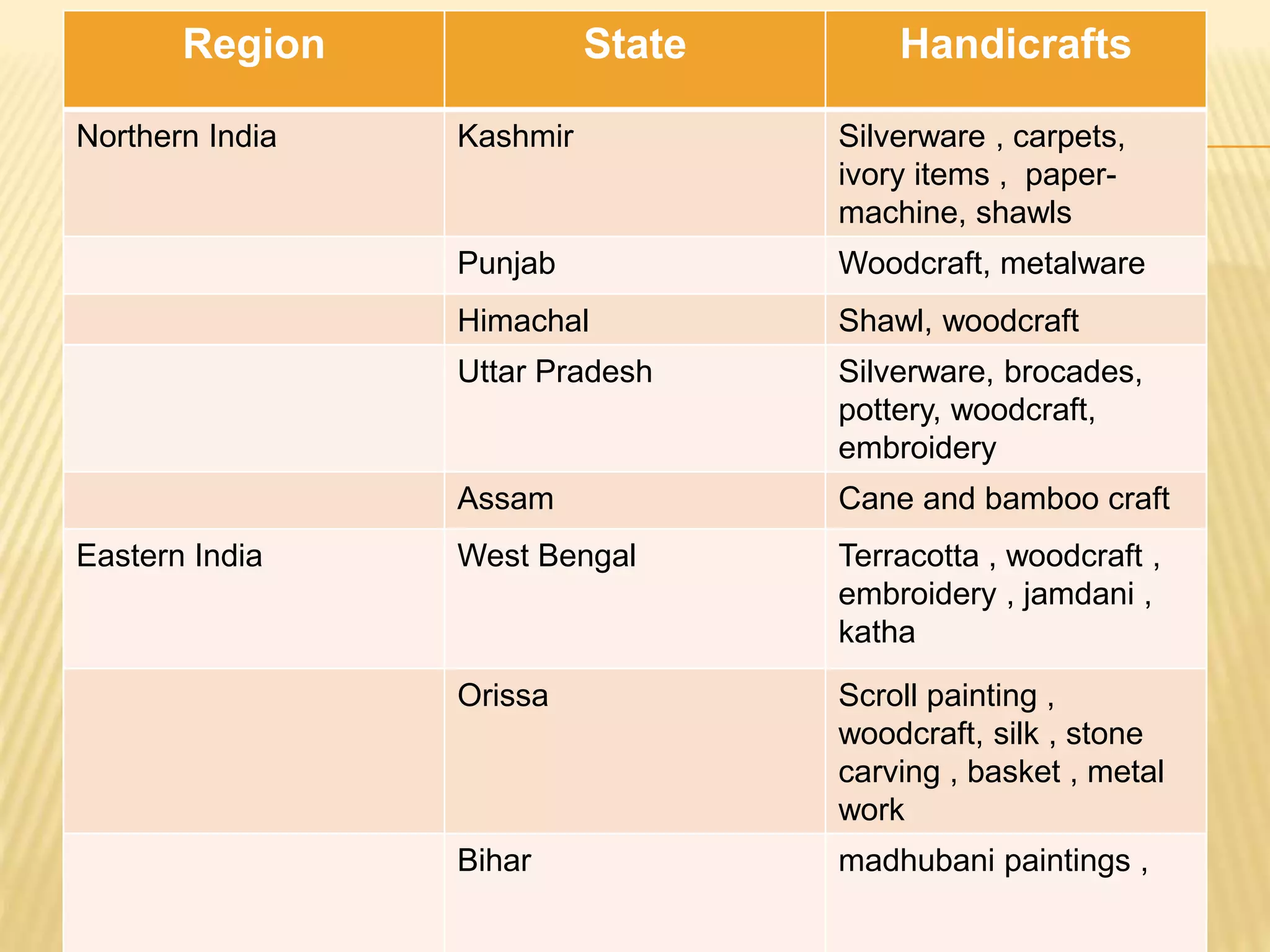
Region State Handicrafts
Northern India Kashmir Silverware , carpets,
ivory items , paper-
machine, shawls
Punjab Woodcraft, metalware
Himachal Shawl, woodcraft
Uttar Pradesh Silverware, brocades,
pottery, woodcraft,
embroidery
Assam Cane and bamboo craft
Eastern India West Bengal Terracotta , woodcraft ,
embroidery , jamdani ,
katha
Orissa Scroll painting ,
woodcraft, silk , stone
carving , basket , metal
work
Bihar madhubani paintings ,
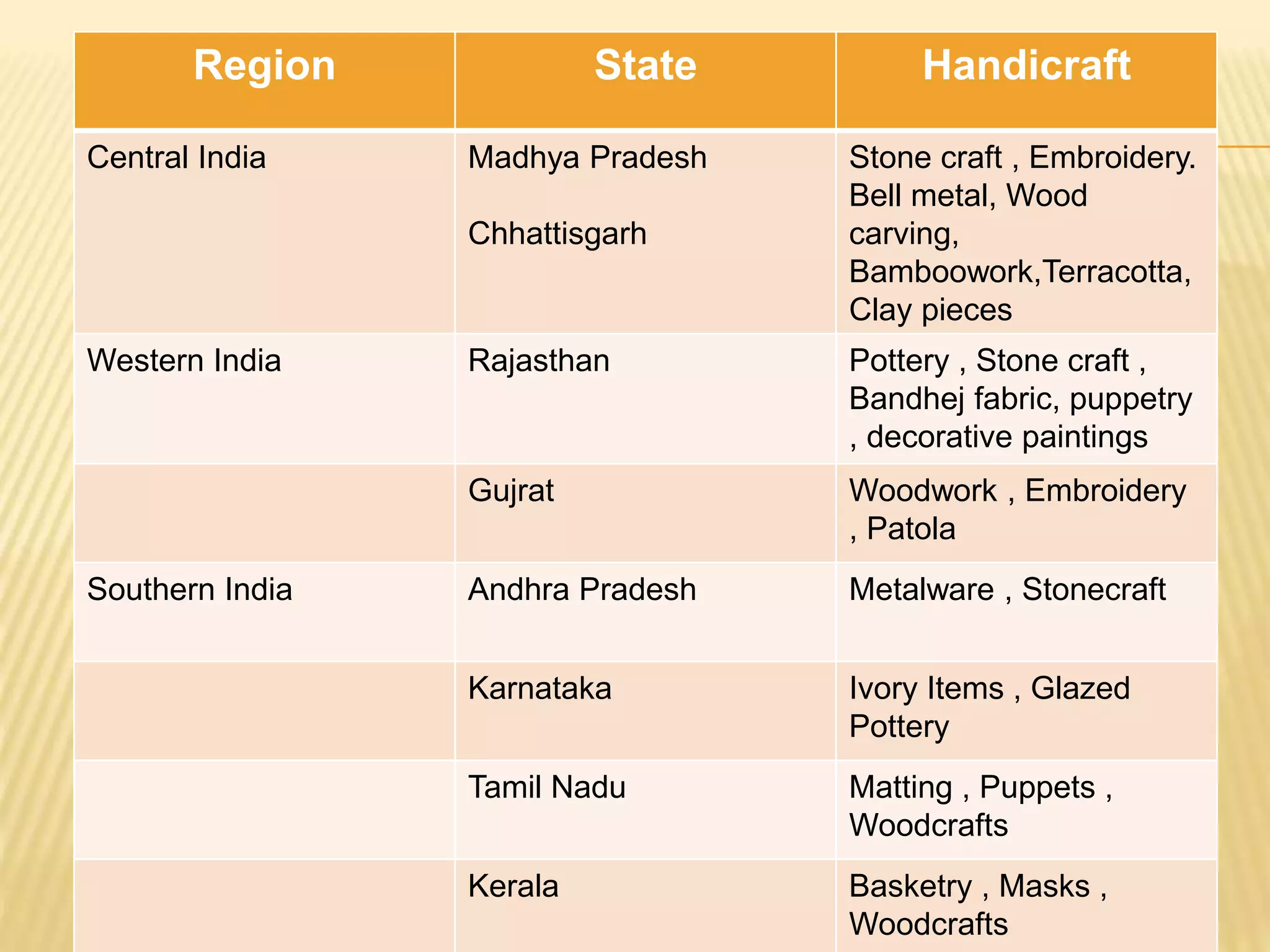
Region State Handicraft
Central India Madhya Pradesh
Chhattisgarh
Stone craft , Embroidery.
Bell metal, Wood
carving,
Bamboowork,Terracotta,
Clay pieces
Western India Rajasthan Pottery , Stone craft ,
Bandhej fabric, puppetry
, decorative paintings
Gujrat Woodwork , Embroidery
, Patola
Southern India Andhra Pradesh Metalware , Stonecraft
Karnataka Ivory Items , Glazed
Pottery
Tamil Nadu Matting , Puppets ,
Woodcrafts
Kerala Basketry , Masks ,
Woodcrafts
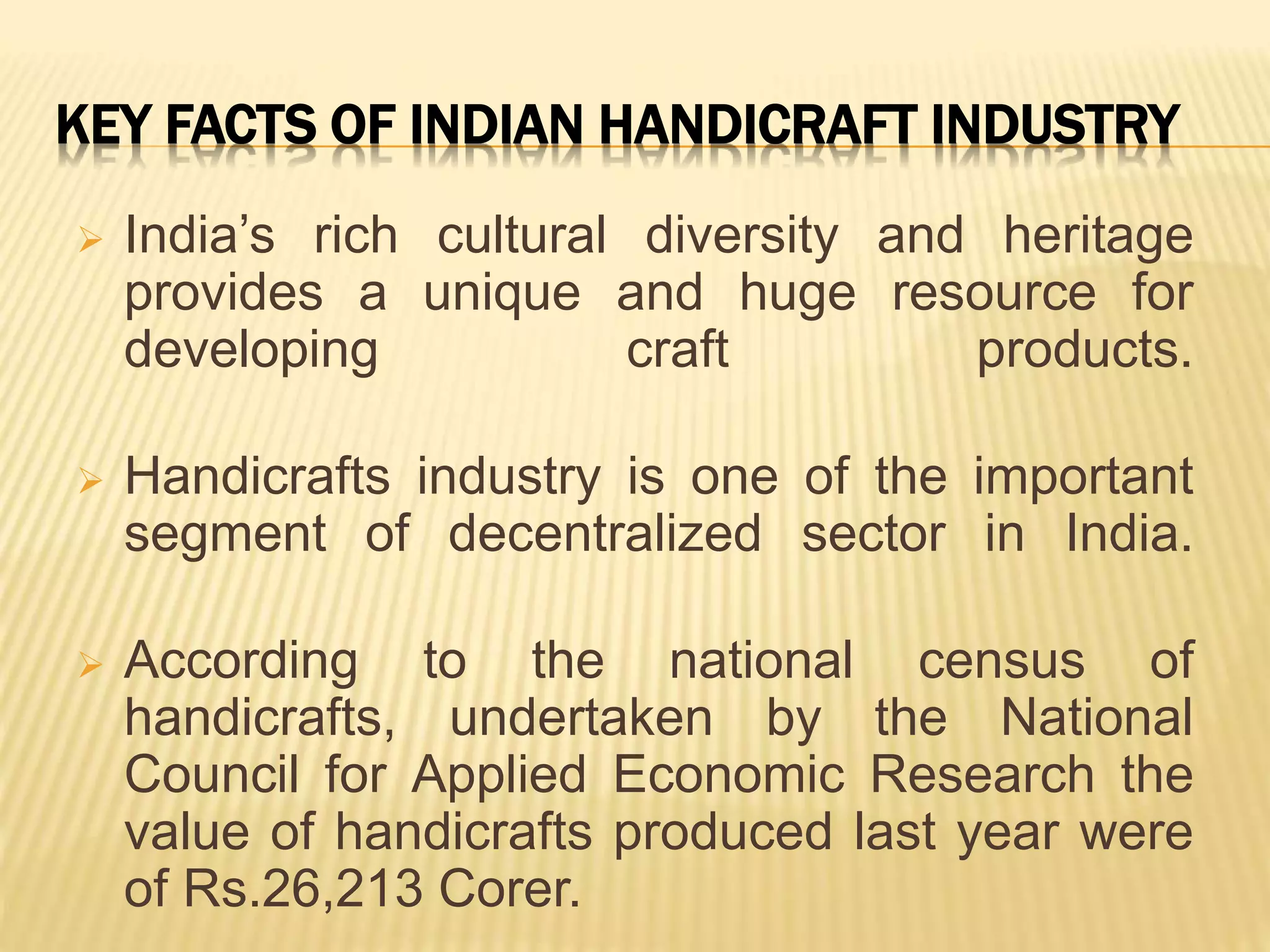
KEY FACTS OF INDIAN HANDICRAFT INDUSTRY
 India’s rich cultural diversity and heritage
provides a unique and huge resource for
developing craft products.
 Handicrafts industry is one of the important
segment of decentralized sector in India.
 According to the national census of
handicrafts, undertaken by the National
Council for Applied Economic Research the
value of handicrafts produced last year were
of Rs.26,213 Corer.
 Provides huge employment opportunities to artisans
that include women and people belonging to
backward and weaker society (6 million artisans).
 The Indian Handicraft Industry is a $100 billion
industry worldwide.
 India’s contribution in world market is 1.2%
 The total exports of crafts items: - Rs. 13412.92
Crore.
 Industry’s share in India's exports:- 1.51 %
THANK YOU…
Any Queries

HANDICRAFTS:- IMPORTANT OBJECTS AND CENTERS

  • 1.
    HANDICRAFTS:- IMPORTANT OBJECTS ANDCENTERS PRESENTED BY- SUSHMA SAHU Institute of Tourism & Hotel Management, Pt. Ravishankar Shukla University, Raipur (CG)
  • 2.
    INTRODUCTION-  Handicrafts aremostly defined as "items made by hand, often with the use of simple tools, and are generally artistic and for traditional in nature  Handicrafts resembles certain culture  They are also object of utility and object of decoration.  The main mediums in which the crafts are practiced are stone, wood and metal.
  • 3.
    IMPORTANCE-  Indian handicraftsrepresent perhaps the oldest tradition of living culture.  The continuity of the traditional crafts still offer creative expression to the great mass of our people.  The Indian craftsman uses this medium for rendering creative expression of his inner self.  It contributes significantly to employment generation and export earnings
  • 4.
     Almost allclusters of villages have their own craftsmen who work on these mediums.  The diversity of Indian cultural tradition is aptly reflected in the tradition of handicrafts.  For the novice tourist, Indian arts and crafts are a feast of colours, textures , techniques and motifs.  Indian performing arts is known for it’s uniqueness all over the world.
  • 5.
    MAJOR OBJECTIVES-  Providingcommercially useful information and assistance to members in developing and increasing exports.  Offering professional advice and services to members in areas of technology upgradation, quality and design improvement, standards and specifications, product development, innovation etc.
  • 6.
     Interaction betweenexporting community and Govt. both at the Central and State level.  Dissemination of government notification, orders, information on trade and other relevant information to members.
  • 7.
     Organizing visitsof delegation of its members abroad to explore overseas market opportunities.  Organizing & Participating in specialized International Trade Fairs of handicrafts & gifts..
  • 8.
     To createan environment of awareness through Workshops on "Export Marketing, Procedures and Documentation", Packaging, Design Development, Buyer Seller Meet, Open House etc.  Interaction with Central and State Govt. and various other similar programmes.
  • 9.
    CHIEF HANDICRAFT OBJECTS ANDTHEIR CENTERS IN INDIA-
  • 10.
    Region State Handicrafts NorthernIndia Kashmir Silverware , carpets, ivory items , paper- machine, shawls Punjab Woodcraft, metalware Himachal Shawl, woodcraft Uttar Pradesh Silverware, brocades, pottery, woodcraft, embroidery Assam Cane and bamboo craft Eastern India West Bengal Terracotta , woodcraft , embroidery , jamdani , katha Orissa Scroll painting , woodcraft, silk , stone carving , basket , metal work Bihar madhubani paintings ,
  • 11.
    Region State Handicraft CentralIndia Madhya Pradesh Chhattisgarh Stone craft , Embroidery. Bell metal, Wood carving, Bamboowork,Terracotta, Clay pieces Western India Rajasthan Pottery , Stone craft , Bandhej fabric, puppetry , decorative paintings Gujrat Woodwork , Embroidery , Patola Southern India Andhra Pradesh Metalware , Stonecraft Karnataka Ivory Items , Glazed Pottery Tamil Nadu Matting , Puppets , Woodcrafts Kerala Basketry , Masks , Woodcrafts
  • 12.
    KEY FACTS OFINDIAN HANDICRAFT INDUSTRY  India’s rich cultural diversity and heritage provides a unique and huge resource for developing craft products.  Handicrafts industry is one of the important segment of decentralized sector in India.  According to the national census of handicrafts, undertaken by the National Council for Applied Economic Research the value of handicrafts produced last year were of Rs.26,213 Corer.
  • 13.
     Provides hugeemployment opportunities to artisans that include women and people belonging to backward and weaker society (6 million artisans).  The Indian Handicraft Industry is a $100 billion industry worldwide.  India’s contribution in world market is 1.2%  The total exports of crafts items: - Rs. 13412.92 Crore.  Industry’s share in India's exports:- 1.51 %
  • 14.
  • 15.