Handicraft
Presented by sweta and kaveri
1. Pashmina Shawls
2. Woodwork
3. Pottery
4. Leather
5. Jute
6. Shell
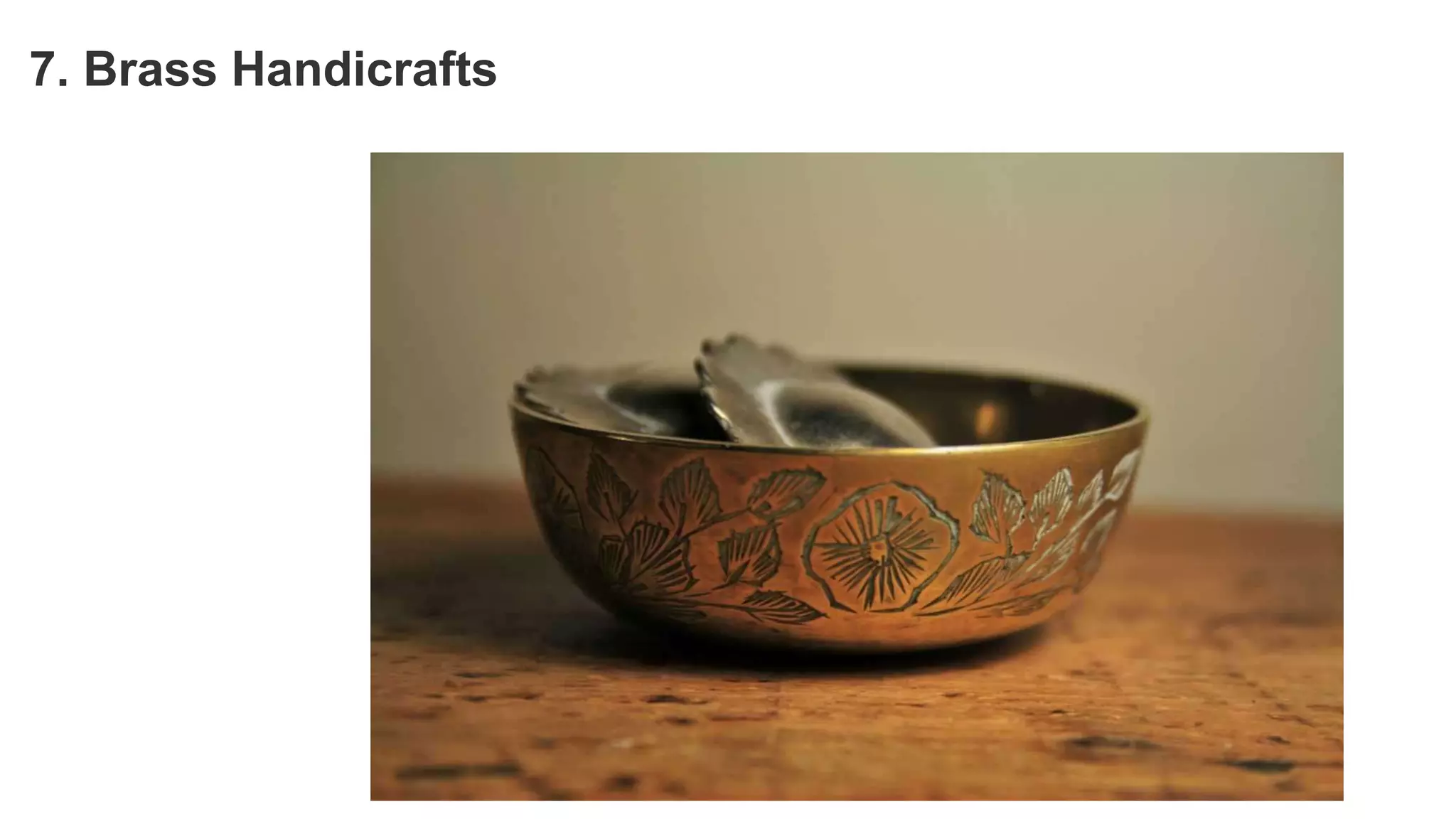
7. Brass Handicrafts
8. Bamboo Handicrafts
9. Phulkari
10. Zardozi
11. Saris and Silk
12. Carpet Weaving
• The steps taken by the Government to boost and strengthen handicrafts sector,
which includes handmade carpets, so as to compete with machine-made
products are as follows:
1. Market Development Assistance (MDA) Grant and Market Access Initiative (MAI)
Assistance for participation in Fairs & Exhibitions/Reverse/Buyer-Seller Meets in
India & abroad.
2. Assistance provided by the Government for marketing study,
branding/International publicity, participation in Fairs & Exhibitions, Buyer-Seller
Meet in India & abroad etc. through Marketing and other Schemes.
3. Thematic display and live demonstration of crafts by Master Craftspersons in
exhibitions abroad.
4. Brand image promotion of Indian handicrafts abroad through seminars and
publicity as well as awareness programs in India.
5. Organizing Indian Handicrafts & Gifts Fair twice a year besides product-specific
shows.
6. Display of new design through exporters for creating awareness and marketing.
7.To provide technological support to wooden crafts, a Technological Upgradation
centre has been set up in Saharanpur.
8. To facilitate manufactures/ exporters for developing new design and finishing
products, Common Facility Centres have been setup in Jodhpur and Saharanpur.
9. International Lace Trade Centre has been sanctioned in Crafts Cluster of Lace &
Crocheted crafts at Narasapur, Andhra Pradesh.
10. Moradabad Resource Centre setup at Moradabad to facilitate
information relating to business development, word market trends, marketing
and publicity and to cater to the changing tastes and requirements of international
market and remain abreast with the latest development.
11.Setting up of Mega Clusters in Bhadohi-Mirzapur & Srinagar for increasing
manufacturing and exports of carpets.
12. Providing Skill Development Training for Carpets weaving.
13.Providing financial assistance for running Carpet Weaving Training
Centers in Bhadohi-Varanasi-Mirzapur areas for creating new Artisans/
Weavers with stipend.
14.The Excise & Customs Duties paid for importing inputs are
refunded through Duty Drawback channel.
15.Setting up of Indian Institute of Carpet Technology (IICT) at
Bhadohi.
16. Interest subvention and grant of MUDRA loan schemes to the
handicrafts artisans so as to compete with machine-made products.
Government Approved
Handicraft Shops in India
•Dilli Haat in Delhi
•Kala Madhyam in Bangalore
•MESH in Hyderabad and Delhi
•Khazana in Taj Group of Hotels
•Ekamra Haat in Bhubaneshwar
•Rajasthali in Jaipur
The Strategy to achieve this vision is as follows:
“To create a globally competitive Handicrafts Sector and provide sustainable
livelihood opportunities to the artisans through innovative products designs,
improvement in product quality, introduction of modern technology and
preserving traditions.”
1. Product development and production
2. Marketing and compliance
3. Infrastructure Development
4. Livelihood and working environment
Implementation model for cluster
development
• Classification of Clusters: It is proposed to classify the major
handicrafts cluster into three categories based on the number of
artisans, cluster turnover and its importance in the local economy.
Tier I Clusters
Tier II Clusters
Tier III Clusters
DISTRIBUTION ROUTES FOR EFFECTIVELY TAPPING
THE THREE DIFFERENT MARKET SEGMENTS
ENTITIES IN THE FAIR TRADE CHANNEL FOR
HANDICRAFTS
a) Producer/ Exporter Organizations
b) Fair Trade Importing Organizations
c) Fair Trade Retail Organization
MAIN INTERNATIONAL, REGIONAL & NATIONAL
LEVEL ACCREDITING ORGANIZATIONS INVOLVED
IN FAIR TRADE
a) IFAT - International Federation for Alternative Trade
b) FLO-I - Fair trade Labeling Organization International
IMPORTANT REGIONAL LEVEL FAIR TRADE
ORGANIZATIONS
a) FTF- Fair Trade Federation
b) EFTA- European Fair Trade Association
c) NEWS! - Network of European world Shops
d) FTA - Fair Trade Association
Following are the Major Buyers of Indian Handicrafts:
• The USA is one of the major buyers of hand-printed textiles, Zari
woods, Embroidery goods, Imitation jewelry, and Shawls.
• The UK is a client of Indian Handicrafts and consumes Art wares,
Crocheted items, Handmade handicrafts, Wood wares, and
Imitation jewelry. Germany is commonly known for the
purchase of hand-printed textiles, Imitation jewelry, Embroidery
items, and Art metals.
• Strengths:
• Large, diversified and potential market.
• There is large product variety and range is available because of diversified culture.
• It has strong, diversified and supportive retail infrastructure.
• Diversified product range that service different market.
• Cheap labor rates that result to competitive price.
• Need low capital investment.
• There is flexible production flexibility.
• Low barriers of new entry.
• Advantages and Critical Success Factors:
• Easy creation and development of production centers.
• There is no need for macro-investment.
• Industry provides potential sources of employment.
• Products are high value added, and handicrafts have various applications.
• It is the potential source of foreign revenue because of higher export.
Weaknesses:
• Lack of infrastructure and communication facilities.
• Unawareness about international requirements and market.
• Lack of co-ordination between government bodies and private
players.
• Inadequate information of new technology.
• Inadequate information of current market trends.
• Less interest of young people in craft industry.
• Lack of skilled labor.
• Still confined to rural areas and small cities and untapped
market.
• Lack of promotion of products.
Opportunities:
• Rising demand for handicraft products in developed countries
such as USA, Canada, Britain, France, Germany, Italy etc.
• Developing fashion industry requires handicrafts products.
• Development of sectors like Retail, Real Estate that offers
great requirements of handicrafts products.
• Development of domestic and international tourism sector.
• E-Commerce and Internet are emerged as promissory
distribution channels to market and sell the craft products.
Threats:
• Competition in domestic market.
• Balance between high demand and supply.
• Quality products produced by competing countries like China,
South Africa.
• Better Trade terms offered by competing countries.
• Increased and better technological support and R and D facility
in competing countries.
Specific measures for Promotion , Advertising
And Brand Building
• Indian Handicrafts Trade Fairs
• International Trade Fairs
• Internet Advertising
• Magazine Advertising
• India shows / Road shows
• Publicity
• Brand Building
Key issues that India must address to develop
the Handicrafts sector Domestically .
• Sector competitiveness
• Raw material supply
• Product design
• Technology / Machinery
• Sales and Promotion through collaborations
• Cost of doing Business
Competitors
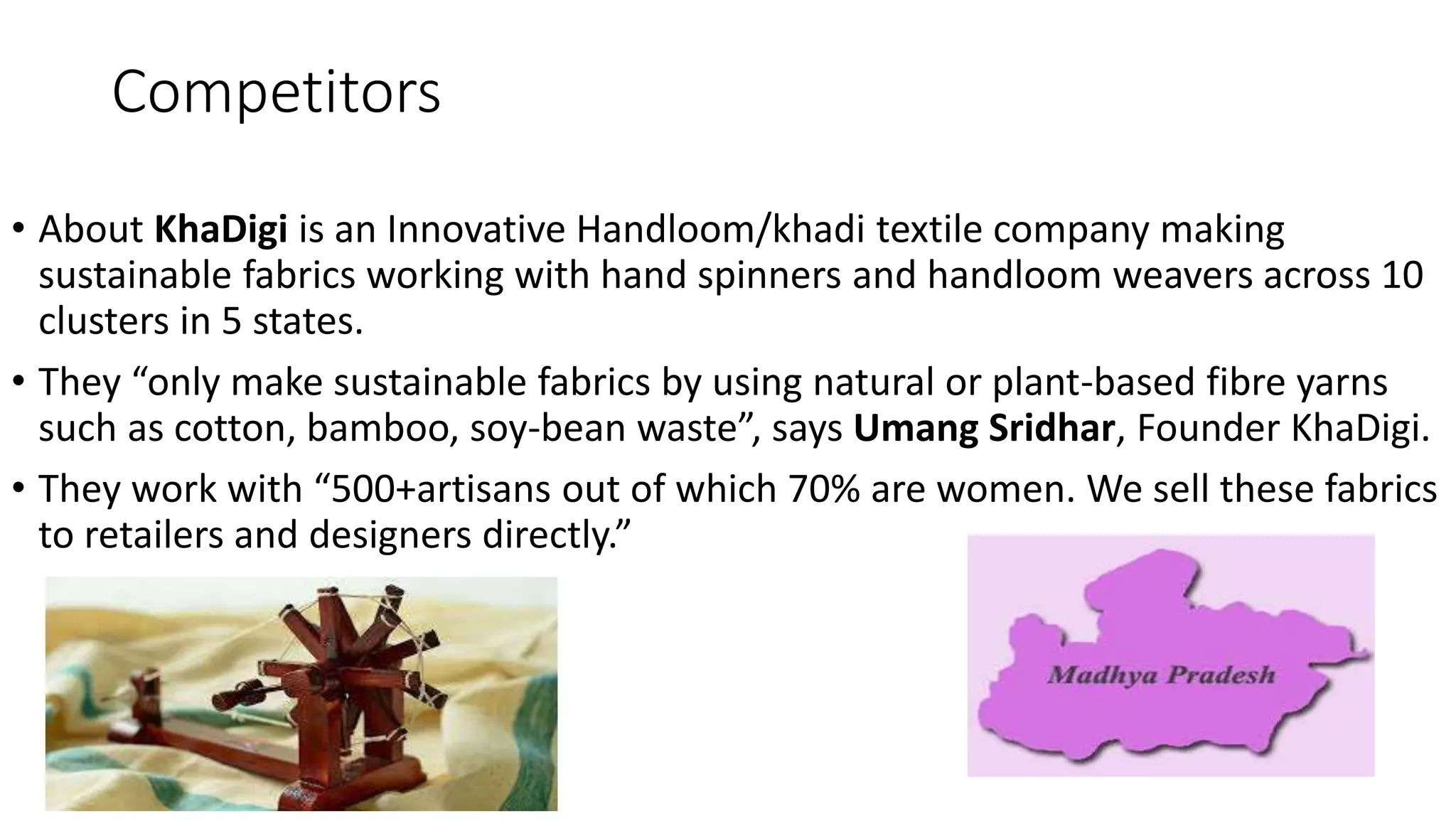
• About KhaDigi is an Innovative Handloom/khadi textile company making
sustainable fabrics working with hand spinners and handloom weavers across 10
clusters in 5 states.
• They “only make sustainable fabrics by using natural or plant-based fibre yarns
such as cotton, bamboo, soy-bean waste”, says Umang Sridhar, Founder KhaDigi.
• They work with “500+artisans out of which 70% are women. We sell these fabrics
to retailers and designers directly.”
• About Creating fashionable apparel using local crafts for the global audience .
• Vision Aavaran’s vision is to promote the traditional Dabu ( Mud Resist ) printing,
specifically of Mewar region of Southern Rajasthan.
• It is to promote traditional dyeing and printing technique using natural dyes and
print. It is also to revive and survive the craft and the craft community. It is also
to make it nationally and internationally acclaimed.
Aavaran was conceptualized and
founded in 2008 by Alka sharma, a
textile graduate from the Indian
Institute of Crafts and Design.
• About P-Tal sells handcrafted brass copper and bell metal products, which are
scientifically proven to be healthy and are made by the UNESCO listed Thathera
community of Jandiala Guru, Punjab.
• Vision To create a technology enabled marketing platform for Thatheras all across
India, and to be synonymous with the word brass, copper and bell metal.
• Products Their main products are Copper Water Dispenser, Chapati Box and
Masala Daani.
• Kirti Goel, co-founder and head designer of P-TAL

ppt handicraft business.pptx

  • 1.
  • 6.
  • 7.
  • 8.
  • 9.
  • 10.
  • 11.
  • 12.
  • 13.
  • 14.
  • 15.
  • 16.
  • 17.
  • 18.
    • The stepstaken by the Government to boost and strengthen handicrafts sector, which includes handmade carpets, so as to compete with machine-made products are as follows: 1. Market Development Assistance (MDA) Grant and Market Access Initiative (MAI) Assistance for participation in Fairs & Exhibitions/Reverse/Buyer-Seller Meets in India & abroad. 2. Assistance provided by the Government for marketing study, branding/International publicity, participation in Fairs & Exhibitions, Buyer-Seller Meet in India & abroad etc. through Marketing and other Schemes. 3. Thematic display and live demonstration of crafts by Master Craftspersons in exhibitions abroad. 4. Brand image promotion of Indian handicrafts abroad through seminars and publicity as well as awareness programs in India. 5. Organizing Indian Handicrafts & Gifts Fair twice a year besides product-specific shows.
  • 19.
    6. Display ofnew design through exporters for creating awareness and marketing. 7.To provide technological support to wooden crafts, a Technological Upgradation centre has been set up in Saharanpur. 8. To facilitate manufactures/ exporters for developing new design and finishing products, Common Facility Centres have been setup in Jodhpur and Saharanpur. 9. International Lace Trade Centre has been sanctioned in Crafts Cluster of Lace & Crocheted crafts at Narasapur, Andhra Pradesh. 10. Moradabad Resource Centre setup at Moradabad to facilitate information relating to business development, word market trends, marketing and publicity and to cater to the changing tastes and requirements of international market and remain abreast with the latest development. 11.Setting up of Mega Clusters in Bhadohi-Mirzapur & Srinagar for increasing manufacturing and exports of carpets. 12. Providing Skill Development Training for Carpets weaving.
  • 20.
    13.Providing financial assistancefor running Carpet Weaving Training Centers in Bhadohi-Varanasi-Mirzapur areas for creating new Artisans/ Weavers with stipend. 14.The Excise & Customs Duties paid for importing inputs are refunded through Duty Drawback channel. 15.Setting up of Indian Institute of Carpet Technology (IICT) at Bhadohi. 16. Interest subvention and grant of MUDRA loan schemes to the handicrafts artisans so as to compete with machine-made products.
  • 21.
    Government Approved Handicraft Shopsin India •Dilli Haat in Delhi •Kala Madhyam in Bangalore •MESH in Hyderabad and Delhi •Khazana in Taj Group of Hotels •Ekamra Haat in Bhubaneshwar •Rajasthali in Jaipur
  • 22.
    The Strategy toachieve this vision is as follows: “To create a globally competitive Handicrafts Sector and provide sustainable livelihood opportunities to the artisans through innovative products designs, improvement in product quality, introduction of modern technology and preserving traditions.” 1. Product development and production 2. Marketing and compliance 3. Infrastructure Development 4. Livelihood and working environment
  • 23.
    Implementation model forcluster development • Classification of Clusters: It is proposed to classify the major handicrafts cluster into three categories based on the number of artisans, cluster turnover and its importance in the local economy. Tier I Clusters Tier II Clusters Tier III Clusters
  • 24.
    DISTRIBUTION ROUTES FOREFFECTIVELY TAPPING THE THREE DIFFERENT MARKET SEGMENTS
  • 28.
    ENTITIES IN THEFAIR TRADE CHANNEL FOR HANDICRAFTS a) Producer/ Exporter Organizations b) Fair Trade Importing Organizations c) Fair Trade Retail Organization
  • 29.
    MAIN INTERNATIONAL, REGIONAL& NATIONAL LEVEL ACCREDITING ORGANIZATIONS INVOLVED IN FAIR TRADE a) IFAT - International Federation for Alternative Trade b) FLO-I - Fair trade Labeling Organization International
  • 30.
    IMPORTANT REGIONAL LEVELFAIR TRADE ORGANIZATIONS a) FTF- Fair Trade Federation b) EFTA- European Fair Trade Association c) NEWS! - Network of European world Shops d) FTA - Fair Trade Association
  • 31.
    Following are theMajor Buyers of Indian Handicrafts: • The USA is one of the major buyers of hand-printed textiles, Zari woods, Embroidery goods, Imitation jewelry, and Shawls. • The UK is a client of Indian Handicrafts and consumes Art wares, Crocheted items, Handmade handicrafts, Wood wares, and Imitation jewelry. Germany is commonly known for the purchase of hand-printed textiles, Imitation jewelry, Embroidery items, and Art metals.
  • 32.
    • Strengths: • Large,diversified and potential market. • There is large product variety and range is available because of diversified culture. • It has strong, diversified and supportive retail infrastructure. • Diversified product range that service different market. • Cheap labor rates that result to competitive price. • Need low capital investment. • There is flexible production flexibility. • Low barriers of new entry. • Advantages and Critical Success Factors: • Easy creation and development of production centers. • There is no need for macro-investment. • Industry provides potential sources of employment. • Products are high value added, and handicrafts have various applications. • It is the potential source of foreign revenue because of higher export.
  • 33.
    Weaknesses: • Lack ofinfrastructure and communication facilities. • Unawareness about international requirements and market. • Lack of co-ordination between government bodies and private players. • Inadequate information of new technology. • Inadequate information of current market trends. • Less interest of young people in craft industry. • Lack of skilled labor. • Still confined to rural areas and small cities and untapped market. • Lack of promotion of products.
  • 34.
    Opportunities: • Rising demandfor handicraft products in developed countries such as USA, Canada, Britain, France, Germany, Italy etc. • Developing fashion industry requires handicrafts products. • Development of sectors like Retail, Real Estate that offers great requirements of handicrafts products. • Development of domestic and international tourism sector. • E-Commerce and Internet are emerged as promissory distribution channels to market and sell the craft products.
  • 35.
    Threats: • Competition indomestic market. • Balance between high demand and supply. • Quality products produced by competing countries like China, South Africa. • Better Trade terms offered by competing countries. • Increased and better technological support and R and D facility in competing countries.
  • 36.
    Specific measures forPromotion , Advertising And Brand Building • Indian Handicrafts Trade Fairs • International Trade Fairs • Internet Advertising • Magazine Advertising • India shows / Road shows • Publicity • Brand Building
  • 37.
    Key issues thatIndia must address to develop the Handicrafts sector Domestically . • Sector competitiveness • Raw material supply • Product design • Technology / Machinery • Sales and Promotion through collaborations • Cost of doing Business
  • 38.
    Competitors • About KhaDigiis an Innovative Handloom/khadi textile company making sustainable fabrics working with hand spinners and handloom weavers across 10 clusters in 5 states. • They “only make sustainable fabrics by using natural or plant-based fibre yarns such as cotton, bamboo, soy-bean waste”, says Umang Sridhar, Founder KhaDigi. • They work with “500+artisans out of which 70% are women. We sell these fabrics to retailers and designers directly.”
  • 39.
    • About Creatingfashionable apparel using local crafts for the global audience . • Vision Aavaran’s vision is to promote the traditional Dabu ( Mud Resist ) printing, specifically of Mewar region of Southern Rajasthan. • It is to promote traditional dyeing and printing technique using natural dyes and print. It is also to revive and survive the craft and the craft community. It is also to make it nationally and internationally acclaimed. Aavaran was conceptualized and founded in 2008 by Alka sharma, a textile graduate from the Indian Institute of Crafts and Design.
  • 40.
    • About P-Talsells handcrafted brass copper and bell metal products, which are scientifically proven to be healthy and are made by the UNESCO listed Thathera community of Jandiala Guru, Punjab. • Vision To create a technology enabled marketing platform for Thatheras all across India, and to be synonymous with the word brass, copper and bell metal. • Products Their main products are Copper Water Dispenser, Chapati Box and Masala Daani. • Kirti Goel, co-founder and head designer of P-TAL