PRESENTED BY-PANKAJ 
YADAV 
BABA SAHEB BHIM RAO 
AMBEDKAR CENTRAL 
UNIVERSITY LUCKNOW
Chapter 
ISO-OSI Reference Model and 
IEEE Standards 
© N. Ganesan, Ph.D. , All rights reserved.
Chapter Objectives 
• Discuss the most popular ISO-OSI 7- 
layer communication reference model 
• Explain the reference model and 
standards relevant to network 
communications 
• Describe the different IEEE standards 
that apply to different types of 
networks
Module 1 
An Overview of ISO and its 
7-Layer OSI Model 
© N. Ganesan, Ph.D. , All rights reserved.
Models and Standards in 
Communication 
• Communication 
– Established standards 
– Standards are known as protocols 
• Implementation 
– A framework is helpful in the design of 
hardware and software for communication 
– ISO-OSI Model serves this purpose 
– ISO-OSI supersedes the TCP/IP model
ISO and OSI Defined 
• ISO 
– International Standards Organization 
• OSI 
– Open Systems Interconnect
OSI Model Background 
• Introduced in 1978 and revised in 1984 
• Formulates the communication process 
into structured layers 
• There are seven layers in the model, 
hence the name the 7-Layer model 
• The model acts as a frame of reference 
in the design of communications and 
networking products
The Layered Approach to 
Communication 
7. Application 
6. Presentation 
5. Session 
4. Transport 
3. Network 
2. Data Link 
1. Physical
Division of Layers 
Upper Layers 
Middle Layer 
Lower Layers 
7. Application 
6. Presentation 
5. Session 
4. Transport 
3. Network 
2. Data Link 
1. Physical
The Function of a Layer 
• Each layer deals with one aspect of 
networking 
– Layer 1 deals with the communication media 
• Each layer communicates with the adjacent 
layers 
– In both directions 
– Ex: Network layer communicates with: 
• Transport layer 
• Data Link layer 
• Each layer formats the data packet 
– Ex: Adds or deletes addresses
Role of Layers 
7. Application 
6. Presentation 
1. Physical 
Node A 
Data In 
Data Out 
To/from 
Node B
Communication Between Layers 
7. Application 
6. Presentation 
5. Session 
Data 
Encapsulation 
Data 
Stripping
The Role of Layers in Point-to-point 
Communication 
Node a Node b 
7. Application 
1. Physical 
7. Application 
1.Physical
Virtual Communication Between 
Layers 
7. Application 
3. Network 
7. Application 
3. Network
End of Module 1
Module 2 
The ISO Upper Layers 
© N. Ganesan, Ph.D. , All rights reserved.
Module Objectives 
• Application Layer 
• Presentation Layer 
• Session Layer 
• Transport Layer 
• Network Layer
7. Application Layer 
• Purpose 
– User application to network service 
interface 
• Examples 
– File request from server 
– E-mail services 
– etc.
Application Layer Function 
• General network access 
• Flow control 
• Error recovery
6. Presentation Layer 
• Purpose 
– Formats data for exchange between points 
of communication 
•Ex: Between nodes in a network 
• Example: 
– Redirector software 
•Formats for transmission to the server
Presentation Layer Function 
• Protocol conversion 
• Data translation 
• Encryption 
• Character set conversion 
• Expansion of graphics command
Redirector Example 
F:/PUR/ORDER C:/CORRES/USDA 
REDIRECTOR 
TO SERVER TO LOCAL 
DISK
5. Session Layer 
• Purpose 
– Oversee a communication session 
•Establish 
•Maintain 
•Terminate 
• Example
Session Layer Function 
• Performs name recognition and related 
security 
• Synchronization between sender and 
receiver 
• Assignment of time for transmission 
– Start time 
– End time etc.
4. Transport Layer 
• Purpose 
– Repackage proper and efficient delivery of 
packages 
•Error free 
•In sequence 
•Without duplication 
• Example
Transport Layer Function 
• For sending data 
– Repackage the message to fit into packets 
• Split long messages 
• Assemble small messages 
• On receiving data 
– Perform the reverse 
– Send an acknowledgment to the sender 
• Solve packet problems 
– During transmission and reception
3. Network Layer 
• Purpose 
– Addressing and routing the packets 
• Example application at the router 
– If the packet size is large, splits into small 
packets
Network Layer Function 
• Address messages 
• Address translation from logical to 
physical 
– Ex: nganesa ----------> 102.13.345.25 
• Routing of data 
– Based on priority 
– Best path at the time of transmission 
• Congestion control
End of Module 2
Module 3 
The ISO Lower Layers 
© N. Ganesan, Ph.D. , All rights reserved.
2. Data Link Layer 
• Purpose 
– Manages the flow of data over the physical 
media 
• Responsible for error-free transmission 
over the physical media 
• Assures error-free data submission to 
the Network Layer
Data Link Layer Function 
• Point of origin 
– Packages data for transmission over physical line 
• Receiving end 
– Packages data for submission to the network layer 
• Deals with network transmission protocols 
– IEEE 802. protocols
Data Link Layer Subdivision 
• Improvement to ISO Model 
• Logical Link Control (LLC) sub-layer 
– Manages service access points (logical link) 
– Error and flow control 
•Media Access Control (MAC) sub-layer 
– Applies directly to network card 
communication 
– Access control
Logical Link Control
Media Access Control 
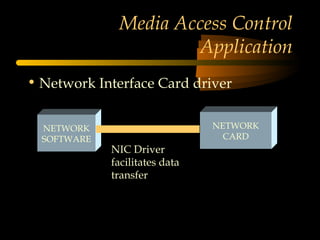
Application 
• Network Interface Card driver 
NETWORK 
SOFTWARE 
NETWORK 
CARD 
NIC Driver 
facilitates data 
transfer
1. Physical Layer 
• Purpose 
– Deals with the transmission of 0s and 1s 
over the physical media 
•Translation of bits into signals 
• Example 
– Pulse duration determination 
– Transmission synchronization 
– etc.
Physical Layer Function 
• Encode bits into signals 
– Carry data from the h higher layers 
• Define the interface to the card 
– Electrical 
– Mechanical 
– Functional 
– Example: Pin count on the connector
Lower Layers Application Areas 
• Special significance to network card design 
• Applies to general LAN hardware design 
– Exceptions 
• Routers etc. 
• 802. standards 
– Centered around the lower layers 
– Applies to networks
End of Module 3
Module 4 
Summary of ISO-OSI Functional 
Layers 
© N. Ganesan, Ph.D. , All rights reserved.
Layer Operations 
• At each layer, additional information is 
added to the data packet 
• An example would be information 
related to the IP protocol that is added 
at Layer 3
Formatting of Data Through the 
Layers 
Application Header Presentation Header Session Header 
Network Header Transport Header 
Data Link Header and Trailer Physical Frame Preamble
Packet : General Format 
Header Trailer 
Data 
A general concept of packets serves as a prerequisite to 
the understanding of the ISO-OSI model.
Some Header Information Added at 
Various Layers 
• Packet arrival information 
• Receiver’s address 
• Sender’s address 
• Synchronization character
Data 
• Actual data 
• May contain error correction code 
– Performed on individual characters of the data 
– Example: Parity 
• Size may vary 
– Depending on the protocol 
– Example 
• 802.3 specifies range of data packet length
Some Trailer Information Added at 
Various Layers 
• Error correction code 
– Character oriented 
– VRC (Parity Checking) 
• Packet oriented error correction codes 
– LRC 
– CRC
A Note on CRC 
• Used widely 
• Sophisticated 
– Polynomial of deferent degrees are used 
for error correction 
– Example: Degrees 16, 32 etc. 
• CRC-32 is a more stringent error 
checking procedure than CRC-16
Some of the Major Components of 
the Data Packet 
Receiver’s 
Address 
Sender’s 
Address 
Control 
Data 
Data 
Error 
Correction 
Protocol 
Start/synch 
Information
Standardizing Packet Formatting 
• Packets must conform to a standard in order 
for the nodes in a network to be able to 
communicate with one another 
• The International Standards Organization 
(ISO) has provided a reference model 
• Standards are established for operations at 
each layer of the ISO/OSI model in the form 
of protocols
End of Module 4
Module 5 
The IEEE 802 Group and the 
Standards 
© N. Ganesan, Ph.D. , All rights reserved.
IEEE Background 
• Institution of Electrical and Electronic 
Engineers (IEEE) 
– A professional non-profit organization 
• Project group 802 
– Responsible for setting standards relating 
to the physical link of the network
IEEE 802 Focus 
• OSI Reference 
– Data Link layer 
– Physical layer 
• Areas 
– Network cards and cables 
– Network electronic/optical/ wireless 
communication standard as they apply to the 
lower two layers mentioned above 
– WAN connectivity
Upper Layer Focus 
• IETF 
•W3C 
• ISO/IEC 
• The above agencies focus on setting 
standards on higher level protocol 
– TCP, IP etc.
IEEE 802 Committees And 
Responsibilities 
• 802.1 
– Internetworking 
• 802.2 
– Logical Link Control (LLC) 
• 802.3 
– CSMA/CD 
• 802.4 
– Token Bus LAN
IEEE 802 Committees and 
Responsibilities (Cont.) 
• 802.5 
– Token Ring LAN 
• 802.6 
– Metropolitan Area Network 
• 802.7 
– Broadband Technical Advisory Group 
• 802.8 
– Fiber-Optic Technical Advisory Group
IEEE 802 (Cont.) 
• 802.9 
– Integrated Voice/Data Networks 
• 802.10 
– Network Security 
• 802.11 
– Wireless Networks 
• 802.12 
– Demand Priority Access LANs 
– Ex: 100BaseVG-AnyLAN
OSI Sub-Layer Reference to 
IEEE 802 Standards 
Logical 
Link 
Control 
(LLC) 
Media 
Access 
Control 
(MAC) 
802.2 
802.3 
802.4 
802.5 
802.12 
802.1 for 
both.
End of Module 5
EENNDD OOFF MMOODDUULLEE 
EENNDD OOFF CCHHAAPPTTEERR

Pankaj YADAV

  • 1.
    PRESENTED BY-PANKAJ YADAV BABA SAHEB BHIM RAO AMBEDKAR CENTRAL UNIVERSITY LUCKNOW
  • 2.
    Chapter ISO-OSI ReferenceModel and IEEE Standards © N. Ganesan, Ph.D. , All rights reserved.
  • 3.
    Chapter Objectives •Discuss the most popular ISO-OSI 7- layer communication reference model • Explain the reference model and standards relevant to network communications • Describe the different IEEE standards that apply to different types of networks
  • 4.
    Module 1 AnOverview of ISO and its 7-Layer OSI Model © N. Ganesan, Ph.D. , All rights reserved.
  • 5.
    Models and Standardsin Communication • Communication – Established standards – Standards are known as protocols • Implementation – A framework is helpful in the design of hardware and software for communication – ISO-OSI Model serves this purpose – ISO-OSI supersedes the TCP/IP model
  • 6.
    ISO and OSIDefined • ISO – International Standards Organization • OSI – Open Systems Interconnect
  • 7.
    OSI Model Background • Introduced in 1978 and revised in 1984 • Formulates the communication process into structured layers • There are seven layers in the model, hence the name the 7-Layer model • The model acts as a frame of reference in the design of communications and networking products
  • 8.
    The Layered Approachto Communication 7. Application 6. Presentation 5. Session 4. Transport 3. Network 2. Data Link 1. Physical
  • 9.
    Division of Layers Upper Layers Middle Layer Lower Layers 7. Application 6. Presentation 5. Session 4. Transport 3. Network 2. Data Link 1. Physical
  • 10.
    The Function ofa Layer • Each layer deals with one aspect of networking – Layer 1 deals with the communication media • Each layer communicates with the adjacent layers – In both directions – Ex: Network layer communicates with: • Transport layer • Data Link layer • Each layer formats the data packet – Ex: Adds or deletes addresses
  • 11.
    Role of Layers 7. Application 6. Presentation 1. Physical Node A Data In Data Out To/from Node B
  • 12.
    Communication Between Layers 7. Application 6. Presentation 5. Session Data Encapsulation Data Stripping
  • 13.
    The Role ofLayers in Point-to-point Communication Node a Node b 7. Application 1. Physical 7. Application 1.Physical
  • 14.
    Virtual Communication Between Layers 7. Application 3. Network 7. Application 3. Network
  • 15.
  • 16.
    Module 2 TheISO Upper Layers © N. Ganesan, Ph.D. , All rights reserved.
  • 17.
    Module Objectives •Application Layer • Presentation Layer • Session Layer • Transport Layer • Network Layer
  • 18.
    7. Application Layer • Purpose – User application to network service interface • Examples – File request from server – E-mail services – etc.
  • 19.
    Application Layer Function • General network access • Flow control • Error recovery
  • 20.
    6. Presentation Layer • Purpose – Formats data for exchange between points of communication •Ex: Between nodes in a network • Example: – Redirector software •Formats for transmission to the server
  • 21.
    Presentation Layer Function • Protocol conversion • Data translation • Encryption • Character set conversion • Expansion of graphics command
  • 22.
    Redirector Example F:/PUR/ORDERC:/CORRES/USDA REDIRECTOR TO SERVER TO LOCAL DISK
  • 23.
    5. Session Layer • Purpose – Oversee a communication session •Establish •Maintain •Terminate • Example
  • 24.
    Session Layer Function • Performs name recognition and related security • Synchronization between sender and receiver • Assignment of time for transmission – Start time – End time etc.
  • 25.
    4. Transport Layer • Purpose – Repackage proper and efficient delivery of packages •Error free •In sequence •Without duplication • Example
  • 26.
    Transport Layer Function • For sending data – Repackage the message to fit into packets • Split long messages • Assemble small messages • On receiving data – Perform the reverse – Send an acknowledgment to the sender • Solve packet problems – During transmission and reception
  • 27.
    3. Network Layer • Purpose – Addressing and routing the packets • Example application at the router – If the packet size is large, splits into small packets
  • 28.
    Network Layer Function • Address messages • Address translation from logical to physical – Ex: nganesa ----------> 102.13.345.25 • Routing of data – Based on priority – Best path at the time of transmission • Congestion control
  • 29.
  • 30.
    Module 3 TheISO Lower Layers © N. Ganesan, Ph.D. , All rights reserved.
  • 31.
    2. Data LinkLayer • Purpose – Manages the flow of data over the physical media • Responsible for error-free transmission over the physical media • Assures error-free data submission to the Network Layer
  • 32.
    Data Link LayerFunction • Point of origin – Packages data for transmission over physical line • Receiving end – Packages data for submission to the network layer • Deals with network transmission protocols – IEEE 802. protocols
  • 33.
    Data Link LayerSubdivision • Improvement to ISO Model • Logical Link Control (LLC) sub-layer – Manages service access points (logical link) – Error and flow control •Media Access Control (MAC) sub-layer – Applies directly to network card communication – Access control
  • 34.
  • 35.
    Media Access Control Application • Network Interface Card driver NETWORK SOFTWARE NETWORK CARD NIC Driver facilitates data transfer
  • 36.
    1. Physical Layer • Purpose – Deals with the transmission of 0s and 1s over the physical media •Translation of bits into signals • Example – Pulse duration determination – Transmission synchronization – etc.
  • 37.
    Physical Layer Function • Encode bits into signals – Carry data from the h higher layers • Define the interface to the card – Electrical – Mechanical – Functional – Example: Pin count on the connector
  • 38.
    Lower Layers ApplicationAreas • Special significance to network card design • Applies to general LAN hardware design – Exceptions • Routers etc. • 802. standards – Centered around the lower layers – Applies to networks
  • 39.
  • 40.
    Module 4 Summaryof ISO-OSI Functional Layers © N. Ganesan, Ph.D. , All rights reserved.
  • 41.
    Layer Operations •At each layer, additional information is added to the data packet • An example would be information related to the IP protocol that is added at Layer 3
  • 42.
    Formatting of DataThrough the Layers Application Header Presentation Header Session Header Network Header Transport Header Data Link Header and Trailer Physical Frame Preamble
  • 43.
    Packet : GeneralFormat Header Trailer Data A general concept of packets serves as a prerequisite to the understanding of the ISO-OSI model.
  • 44.
    Some Header InformationAdded at Various Layers • Packet arrival information • Receiver’s address • Sender’s address • Synchronization character
  • 45.
    Data • Actualdata • May contain error correction code – Performed on individual characters of the data – Example: Parity • Size may vary – Depending on the protocol – Example • 802.3 specifies range of data packet length
  • 46.
    Some Trailer InformationAdded at Various Layers • Error correction code – Character oriented – VRC (Parity Checking) • Packet oriented error correction codes – LRC – CRC
  • 47.
    A Note onCRC • Used widely • Sophisticated – Polynomial of deferent degrees are used for error correction – Example: Degrees 16, 32 etc. • CRC-32 is a more stringent error checking procedure than CRC-16
  • 48.
    Some of theMajor Components of the Data Packet Receiver’s Address Sender’s Address Control Data Data Error Correction Protocol Start/synch Information
  • 49.
    Standardizing Packet Formatting • Packets must conform to a standard in order for the nodes in a network to be able to communicate with one another • The International Standards Organization (ISO) has provided a reference model • Standards are established for operations at each layer of the ISO/OSI model in the form of protocols
  • 50.
  • 51.
    Module 5 TheIEEE 802 Group and the Standards © N. Ganesan, Ph.D. , All rights reserved.
  • 52.
    IEEE Background •Institution of Electrical and Electronic Engineers (IEEE) – A professional non-profit organization • Project group 802 – Responsible for setting standards relating to the physical link of the network
  • 53.
    IEEE 802 Focus • OSI Reference – Data Link layer – Physical layer • Areas – Network cards and cables – Network electronic/optical/ wireless communication standard as they apply to the lower two layers mentioned above – WAN connectivity
  • 54.
    Upper Layer Focus • IETF •W3C • ISO/IEC • The above agencies focus on setting standards on higher level protocol – TCP, IP etc.
  • 55.
    IEEE 802 CommitteesAnd Responsibilities • 802.1 – Internetworking • 802.2 – Logical Link Control (LLC) • 802.3 – CSMA/CD • 802.4 – Token Bus LAN
  • 56.
    IEEE 802 Committeesand Responsibilities (Cont.) • 802.5 – Token Ring LAN • 802.6 – Metropolitan Area Network • 802.7 – Broadband Technical Advisory Group • 802.8 – Fiber-Optic Technical Advisory Group
  • 57.
    IEEE 802 (Cont.) • 802.9 – Integrated Voice/Data Networks • 802.10 – Network Security • 802.11 – Wireless Networks • 802.12 – Demand Priority Access LANs – Ex: 100BaseVG-AnyLAN
  • 58.
    OSI Sub-Layer Referenceto IEEE 802 Standards Logical Link Control (LLC) Media Access Control (MAC) 802.2 802.3 802.4 802.5 802.12 802.1 for both.
  • 59.
  • 60.
    EENNDD OOFF MMOODDUULLEE EENNDD OOFF CCHHAAPPTTEERR