INTRODUCTION:-
The legandary punjabi cuisine which has no doubt been
responsible to a great extent for promoting the love of indian food
outside india.the influence from the persians, afghans, greeks and
mongols has resulted in the cuisines not only rich and exotic but
robust and earthy as well..”The taste of punjab” would perhaps
inspired the indomitable tandoor . The rich and spicy tandoori
preperations topped up with butter will be tantalisingly tasty and
nutritious.
Mention punjab and the first image that comes to mind is that of
lush green fields. Mention punjabi food and the first thing that
comes to mind is makkai ki roti and sarson ka saag. Punjabi
cuisine is like the punjabis themselves. It is simple, sizeable and
hearty - with no unnecessary frills or exotic accompaniments.
“variety is the spice of life” is the diversity which has put the
boundaries in indian food.
Punjabi people have vigorous appetites and their love for food is
visible from the food pallet that they offer. The Punjabi food, like
other Indian cuisines is very spicy. The use of Tandoor is very
prominent in Punjabi cooking. A Tandoor is a kind of an eathern
oven which are half buried in the ground in which charcoal is used.
Food cooked in these ovens is earthy smelling which lends a very
exotic and rich aroma to it. Marinated meat, chicken, fish, paneer,
rotis and naans of many types are cooked in this oven and the
results are absolutely amazing.
Punjabi food includes a large variety of breads like: Nans,
parathas, chapati's made of maize flour are so soft that they simply
melt in the mouth. With the passage of time the Punjabi cuisine has
undergone a lot many changes like the addition of rumali roti and
lacchha paratha. Punjabi cuisine is synonymous with spicy, creamy
and aromatic gravies.
The Punjabi dishes are lavishly garnished with chopped and
slivered and sliced spices, while gravies are made rich by the use
of ghee and cream. For most of the people living abroad Indian
cuisine is synonymous with the Punjabi cuisine. For them,
savoring Indian food means having naans, gravied vegetables,
curries and pulaos.
ABOUT THE STATE:-
The land of punjab is a land of earthy culture, emerald green fields
and warm people whose robust rustic ways of bonhomie are very
much a part of their heritage. Beyond its joyous people and carpet
spreads of fertile fields, this 'land of milk and honey' has a host of
culinary treasures that it readily offers to the others too.
THE SEASONS OF PUNJAB:-
There are three well defined seasons in the punjab. These are:
1. Hot season (mid-april to the end of june)
2. Rainy season ( early july to the end of september)
3. Cold season (early december to the end of february
Agriculture
Punjab is called the "granary of india" or "india's bread-basket." it
produces the following:
60% of india's wheat
40% of india's rice
In worldwide terms:
2% of the world's cotton
2% of world’s wheat
1% of the world's rice
The largest grown crop is wheat.
Other important crops are rice, cotton, sugarcane, millet, maize,
barley and fruit.
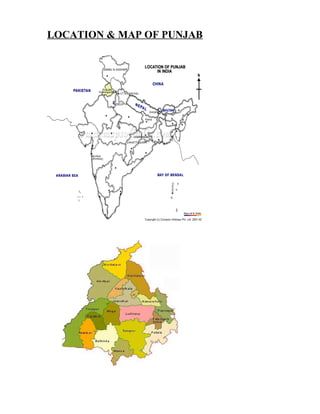
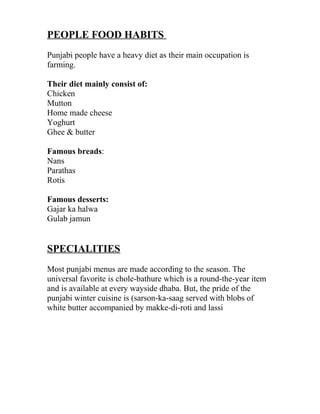
LOCATION & MAP OF PUNJAB
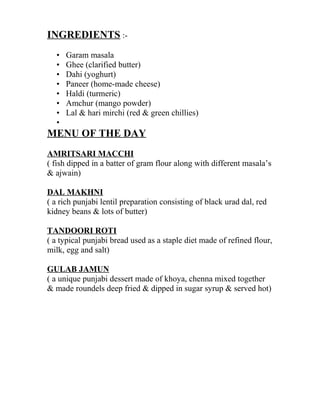
PEOPLE FOOD HABITS
Punjabi people have a heavy diet as their main occupation is
farming.
Their diet mainly consist of:
Chicken
Mutton
Home made cheese
Yoghurt
Ghee & butter
Famous breads:
Nans
Parathas
Rotis
Famous desserts:
Gajar ka halwa
Gulab jamun
SPECIALITIES
Most punjabi menus are made according to the season. The
universal favorite is chole-bathure which is a round-the-year item
and is available at every wayside dhaba. But, the pride of the
punjabi winter cuisine is (sarson-ka-saag served with blobs of
white butter accompanied by makke-di-roti and lassi
INGREDIENTS :-
• Garam masala
• Ghee (clarified butter)
• Dahi (yoghurt)
• Paneer (home-made cheese)
• Haldi (turmeric)
• Amchur (mango powder)
• Lal & hari mirchi (red & green chillies)
•
MENU OF THE DAY
AMRITSARI MACCHI
( fish dipped in a batter of gram flour along with different masala’s
& ajwain)
DAL MAKHNI
( a rich punjabi lentil preparation consisting of black urad dal, red
kidney beans & lots of butter)
TANDOORI ROTI
( a typical punjabi bread used as a staple diet made of refined flour,
milk, egg and salt)
GULAB JAMUN
( a unique punjabi dessert made of khoya, chenna mixed together
& made roundels deep fried & dipped in sugar syrup & served hot)
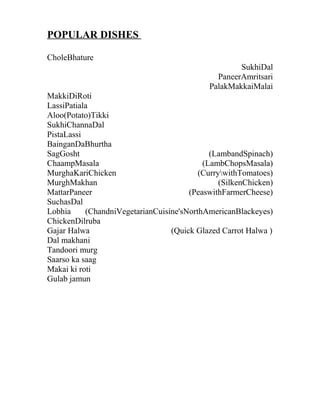
POPULAR DISHES
CholeBhature
SukhiDal
PaneerAmritsari
PalakMakkaiMalai
MakkiDiRoti
LassiPatiala
Aloo(Potato)Tikki
SukhiChannaDal
PistaLassi
BainganDaBhurtha
SagGosht (LambandSpinach)
ChaampMasala (LambChopsMasala)
MurghaKariChicken (CurrywithTomatoes)
MurghMakhan (SilkenChicken)
MattarPaneer (PeaswithFarmerCheese)
SuchasDal
Lobhia (ChandniVegetarianCuisine'sNorthAmericanBlackeyes)
ChickenDilruba
Gajar Halwa (Quick Glazed Carrot Halwa )
Dal makhani
Tandoori murg
Saarso ka saag
Makai ki roti
Gulab jamun
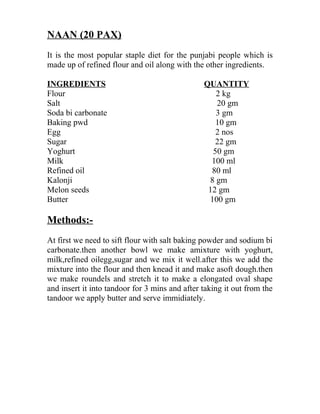
NAAN (20 PAX)
It is the most popular staple diet for the punjabi people which is
made up of refined flour and oil along with the other ingredients.
INGREDIENTS QUANTITY
Flour 2 kg
Salt 20 gm
Soda bi carbonate 3 gm
Baking pwd 10 gm
Egg 2 nos
Sugar 22 gm
Yoghurt 50 gm
Milk 100 ml
Refined oil 80 ml
Kalonji 8 gm
Melon seeds 12 gm
Butter 100 gm
Methods:-
At first we need to sift flour with salt baking powder and sodium bi
carbonate.then another bowl we make amixture with yoghurt,
milk,refined oilegg,sugar and we mix it well.after this we add the
mixture into the flour and then knead it and make asoft dough.then
we make roundels and stretch it to make a elongated oval shape
and insert it into tandoor for 3 mins and after taking it out from the
tandoor we apply butter and serve immidiately.
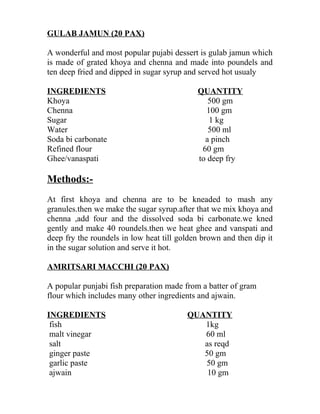
GULAB JAMUN (20 PAX)
A wonderful and most popular pujabi dessert is gulab jamun which
is made of grated khoya and chenna and made into poundels and
ten deep fried and dipped in sugar syrup and served hot usualy
INGREDIENTS QUANTITY
Khoya 500 gm
Chenna 100 gm
Sugar 1 kg
Water 500 ml
Soda bi carbonate a pinch
Refined flour 60 gm
Ghee/vanaspati to deep fry
Methods:-
At first khoya and chenna are to be kneaded to mash any
granules.then we make the sugar syrup.after that we mix khoya and
chenna ,add four and the dissolved soda bi carbonate.we kned
gently and make 40 roundels.then we heat ghee and vanspati and
deep fry the roundels in low heat till golden brown and then dip it
in the sugar solution and serve it hot.
AMRITSARI MACCHI (20 PAX)
A popular punjabi fish preparation made from a batter of gram
flour which includes many other ingredients and ajwain.
INGREDIENTS QUANTITY
fish 1kg
malt vinegar 60 ml
salt as reqd
ginger paste 50 gm
garlic paste 50 gm
ajwain 10 gm
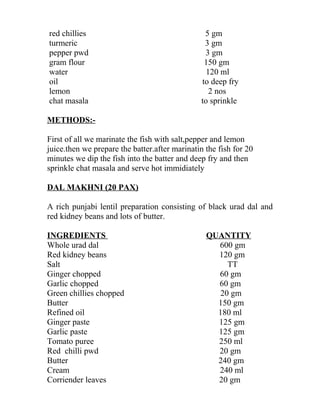
red chillies 5 gm
turmeric 3 gm
pepper pwd 3 gm
gram flour 150 gm
water 120 ml
oil to deep fry
lemon 2 nos
chat masala to sprinkle
METHODS:-
First of all we marinate the fish with salt,pepper and lemon
juice.then we prepare the batter.after marinatin the fish for 20
minutes we dip the fish into the batter and deep fry and then
sprinkle chat masala and serve hot immidiately
DAL MAKHNI (20 PAX)
A rich punjabi lentil preparation consisting of black urad dal and
red kidney beans and lots of butter.
INGREDIENTS QUANTITY
Whole urad dal 600 gm
Red kidney beans 120 gm
Salt TT
Ginger chopped 60 gm
Garlic chopped 60 gm
Green chillies chopped 20 gm
Butter 150 gm
Refined oil 180 ml
Ginger paste 125 gm
Garlic paste 125 gm
Tomato puree 250 ml
Red chilli pwd 20 gm
Butter 240 gm
Cream 240 ml
Corriender leaves 20 gm
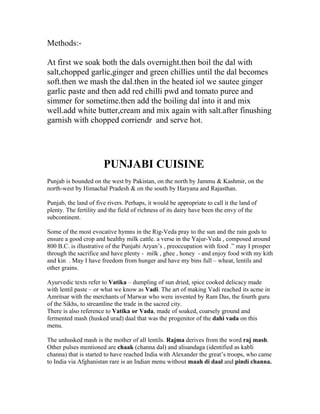
Methods:-
At first we soak both the dals overnight.then boil the dal with
salt,chopped garlic,ginger and green chillies until the dal becomes
soft.then we mash the dal.then in the heated iol we sautee ginger
garlic paste and then add red chilli pwd and tomato puree and
simmer for sometime.then add the boiling dal into it and mix
well.add white butter,cream and mix again with salt.after finushing
garnish with chopped corriendr and serve hot.
PUNJABI CUISINE
Punjab is bounded on the west by Pakistan, on the north by Jammu & Kashmir, on the
north-west by Himachal Pradesh & on the south by Haryana and Rajasthan.
Punjab, the land of five rivers. Perhaps, it would be appropriate to call it the land of
plenty. The fertility and the field of richness of its dairy have been the envy of the
subcontinent.
Some of the most evocative hymns in the Rig-Veda pray to the sun and the rain gods to
ensure a good crop and healthy milk cattle. a verse in the Yajur-Veda , composed around
800 B.C. is illustrative of the Punjabi Aryan’s , preoccupation with food .” may I prosper
through the sacrifice and have plenty - milk , ghee , honey - and enjoy food with my kith
and kin . May I have freedom from hunger and have my bins full – wheat, lentils and
other grains.
Ayurvedic texts refer to Vatika – dumpling of sun dried, spice cooked delicacy made
with lentil paste – or what we know as Vadi. The art of making Vadi reached its acme in
Amritsar with the merchants of Marwar who were invented by Ram Das, the fourth guru
of the Sikhs, to streamline the trade in the sacred city.
There is also reference to Vatika or Vada, made of soaked, coarsely ground and
fermented mash (husked urad) daal that was the progenitor of the dahi vada on this
menu.
The unhusked mash is the mother of all lentils. Rajma derives from the word raj mash.
Other pulses mentioned are chaak (channa dal) and alisandaga (identified as kabli
channa) that is started to have reached India with Alexander the great’s troops, who came
to India via Afghanistan rare is an Indian menu without maah di daal and pindi channa.
As soon as partition occurred, the “restaurization” of the nation began. The Punjabi
people introduced tandoori cuisine and pleasure of eating out. This road side dhaba was
born to cater to the basic food needs of the uprooted.
It would be no exaggeration to say that the most stylish and elegant eateries in the
country are Punjabi.
There are some sub regions that have contributed to enriching the cuisine of Punjab.
PESHAWAR: the most north-western of districts in India. Peshawar city was rich with
fruits, game birds, fish, peaches, apricots, plums, lime, apples etc.
AMRITSAR: shaped like an oblong between the Ravi and Beas rivers, the district lies
northwest of gurdaspur and south west of Lahore. The chief crops are wheat, grams,
barley, maize, rice, cotton, pulses and sugar cane.
FAIRS AND FESTIVALS OF PUNJAB
The festivals in Punjab have always been celebrated with much exuberance and fan farce.
Punjab being a predominately agricultural state that provides itself on its food grain
production. Baisakhi is indication of arrival of harvesting season.
Tika is celebrated in the month of Kartik, one day after Diwali. Lohri is celebrated in the
month of December –January. .
FOOD HABITS
Food of Punjab is wholesome and very rich in taste and texture. In Punjab, the tandoor is
much more than versatile kitchen equipment. The tandoor is used for cooking all trends
roti, parathas, naan, kulcha and for cooking non vegetarian dishes like tandoori
chicken and tandoori jhinga.
The foods of Punjab usually have a thick creamy consistency. They use desi ghee, white
butter in almost all the dishes. Milk and milk products are available in abundance like
paneer, curd, and cream etc.
One of the main crop of Punjab is mustard or sarson and this is used to make famous
vegetarian dishes i.e. sarson ka saag, accompanied with makki ki roti ( roti prepared
with maize flour).
SPICES
Various masalas used in Punjabi cuisines are garam masala ( made of cumin seeds ,
black cardamom seeds , black pepper corn , green cardamom , cinnamon , mace, shahi
jeera , bay leaves and dry rose petals , coriander seeds , fennel seeds , cloves and ginger
powder , nutmeg ), aromatic garam masala ( made of green cardamom , cumin seeds,
black pepper corn , cinnamon , cloves and nutmeg ) chaat masala ( made of cumin seeds
, black pepper corn , black salt , dry pudina , hing , tartaric acid , am choor , ajwain ,
ginger powder , yellow chili powder ), tandoori chaat masala ( made of cumin seeds ,
black pepper corn , black salt, dry pudina , kasoori methi, green cardamom, cloves ,
cinnamon , ajwain , hing , tartaric acid , mace , mango powder , ginger powder , yellow
chili powder )
It cannot be denied that spices in their new form have certain disadvantages. Whole or
ground spices do not always impart their flavors readily and when we use proprietary,
pre-ground spices, much of the aromatic quality is lost. This is the result of the volatility
of essential oils and oleoresins which are the life of the spices.
THE TANDOOR
The discovery of fire was a blessing to man. And use of tandoor in Punjabi cuisine is the
distinct characteristics. India got its first taste of kebab with the Muslim invasions. The
tandoor is a cylindrical clay barrel, dug in the ground and lit with wood, was use to bake
breads. it is not only used for making breads and kebabs . The delicacies cooked in the
tandoor have a unique flavor. The tandoor shell should be placed on a slightly raised
platform. A fire –proof brick wall should be erected around it. The gap is filled with sand.
The top covered with either a slab of Kota stone or fire proof tiles. The tandoor should be
enclosed on the sides with the same materials. The sand bricks and Kota stone all provide
insulation and prevent heat from escaping. An iron ring should be placed on the opening
to strengthen the mouth of the tandoor. Punjabis use home made tandoor to make breads
like naan, roti and kebabs etc.
FAMOUS DRINKS
Punjabi cuisine is quite rich in refreshing drinks like kanjee ( fermented carrot and
mustard paste drink , served in earthen ware “matka” ), shikanjvi (chilled drink made of
chili water , lemon juice, salt ,sugar black salt powder and black pepper powder ), lussee
(sweetened dahi diluted with water and flavored with rose syrup) and mattha/butter
milk (made of diluted curd , broiled cumin seed powder , chopped ginger , chopped green
chili , fresh coriander leaves with crushed ice and salt )
FAMOUS PUNJABI DISHES
AMRITSARI MACHHI: Ajwain flavored batter fried fish pieces, served with chutney
and lemon wedges.
MULTANI TIKKA: Crispy ajwain flavored paneer and onion tikka, served with tandoor
kebab masala.
BHARWAN SHIMLA MIRCH: Tandoori stuffed shimla mirch.
TANDOORI JHEENGA: Tandoori prawn enriched with tandoori masala.
MURG MALAAI KEBAB: Chicken supreme kebabs rich in cream and saffron.
SARSON DA SAAG: Green leafy vegetable preparation made of mustard leaves, served
with makki ki roti.
BAINGAN KA BHARTHA: Smoky flavored mashed brinjal preparation served with
tandoori paratha.
MAAH CHHOLE DI DAAL: It is a dal preparation made of urad dal, rajma, channa
dal, enriched with cream and desi ghee.
AMRITSARI KULCHA: Potato cauliflower, paneer stuffed roti cooked in tandoor.
CHOLLE BHATURE: Cooked spicy chickpeas served with deep-fried yoghurt based
bread.
MAKKI KI ROTI: Roti made of maize flour, atta, and Maida.
MISSI ROTI: Roti made of cooked mashed chana dal and mung dal, atta, maida, onion,
green chili etc. Cooked on tandoor.
RANNA GOSHT: A rich heavy and thick mutton preparation in which mutton boti and
mutton mince is cooked together with onion and masalas till done.
MURGH MAKHNI: Tandoori chicken in tomato based rich gravy which is enriched by
addition of cashew nut cream and butter.
SHAHI TUKRA, KESARI KHEER, GAJJAR KA HALWA, PHIRNE, is the best
sweet preparation of Punjab.

Panjabi cuisine

  • 1.
    INTRODUCTION:- The legandary punjabicuisine which has no doubt been responsible to a great extent for promoting the love of indian food outside india.the influence from the persians, afghans, greeks and mongols has resulted in the cuisines not only rich and exotic but robust and earthy as well..”The taste of punjab” would perhaps inspired the indomitable tandoor . The rich and spicy tandoori preperations topped up with butter will be tantalisingly tasty and nutritious. Mention punjab and the first image that comes to mind is that of lush green fields. Mention punjabi food and the first thing that comes to mind is makkai ki roti and sarson ka saag. Punjabi cuisine is like the punjabis themselves. It is simple, sizeable and hearty - with no unnecessary frills or exotic accompaniments. “variety is the spice of life” is the diversity which has put the boundaries in indian food. Punjabi people have vigorous appetites and their love for food is visible from the food pallet that they offer. The Punjabi food, like other Indian cuisines is very spicy. The use of Tandoor is very prominent in Punjabi cooking. A Tandoor is a kind of an eathern oven which are half buried in the ground in which charcoal is used. Food cooked in these ovens is earthy smelling which lends a very exotic and rich aroma to it. Marinated meat, chicken, fish, paneer, rotis and naans of many types are cooked in this oven and the results are absolutely amazing. Punjabi food includes a large variety of breads like: Nans, parathas, chapati's made of maize flour are so soft that they simply melt in the mouth. With the passage of time the Punjabi cuisine has undergone a lot many changes like the addition of rumali roti and lacchha paratha. Punjabi cuisine is synonymous with spicy, creamy and aromatic gravies. The Punjabi dishes are lavishly garnished with chopped and
  • 2.
    slivered and slicedspices, while gravies are made rich by the use of ghee and cream. For most of the people living abroad Indian cuisine is synonymous with the Punjabi cuisine. For them, savoring Indian food means having naans, gravied vegetables, curries and pulaos. ABOUT THE STATE:- The land of punjab is a land of earthy culture, emerald green fields and warm people whose robust rustic ways of bonhomie are very much a part of their heritage. Beyond its joyous people and carpet spreads of fertile fields, this 'land of milk and honey' has a host of culinary treasures that it readily offers to the others too. THE SEASONS OF PUNJAB:- There are three well defined seasons in the punjab. These are: 1. Hot season (mid-april to the end of june) 2. Rainy season ( early july to the end of september) 3. Cold season (early december to the end of february Agriculture Punjab is called the "granary of india" or "india's bread-basket." it produces the following: 60% of india's wheat 40% of india's rice In worldwide terms: 2% of the world's cotton 2% of world’s wheat 1% of the world's rice The largest grown crop is wheat. Other important crops are rice, cotton, sugarcane, millet, maize, barley and fruit.
  • 3.
    LOCATION & MAPOF PUNJAB
  • 4.
    PEOPLE FOOD HABITS Punjabipeople have a heavy diet as their main occupation is farming. Their diet mainly consist of: Chicken Mutton Home made cheese Yoghurt Ghee & butter Famous breads: Nans Parathas Rotis Famous desserts: Gajar ka halwa Gulab jamun SPECIALITIES Most punjabi menus are made according to the season. The universal favorite is chole-bathure which is a round-the-year item and is available at every wayside dhaba. But, the pride of the punjabi winter cuisine is (sarson-ka-saag served with blobs of white butter accompanied by makke-di-roti and lassi
  • 5.
    INGREDIENTS :- • Garammasala • Ghee (clarified butter) • Dahi (yoghurt) • Paneer (home-made cheese) • Haldi (turmeric) • Amchur (mango powder) • Lal & hari mirchi (red & green chillies) • MENU OF THE DAY AMRITSARI MACCHI ( fish dipped in a batter of gram flour along with different masala’s & ajwain) DAL MAKHNI ( a rich punjabi lentil preparation consisting of black urad dal, red kidney beans & lots of butter) TANDOORI ROTI ( a typical punjabi bread used as a staple diet made of refined flour, milk, egg and salt) GULAB JAMUN ( a unique punjabi dessert made of khoya, chenna mixed together & made roundels deep fried & dipped in sugar syrup & served hot)
  • 6.
    POPULAR DISHES CholeBhature SukhiDal PaneerAmritsari PalakMakkaiMalai MakkiDiRoti LassiPatiala Aloo(Potato)Tikki SukhiChannaDal PistaLassi BainganDaBhurtha SagGosht (LambandSpinach) ChaampMasala(LambChopsMasala) MurghaKariChicken (CurrywithTomatoes) MurghMakhan (SilkenChicken) MattarPaneer (PeaswithFarmerCheese) SuchasDal Lobhia (ChandniVegetarianCuisine'sNorthAmericanBlackeyes) ChickenDilruba Gajar Halwa (Quick Glazed Carrot Halwa ) Dal makhani Tandoori murg Saarso ka saag Makai ki roti Gulab jamun
  • 7.
    NAAN (20 PAX) Itis the most popular staple diet for the punjabi people which is made up of refined flour and oil along with the other ingredients. INGREDIENTS QUANTITY Flour 2 kg Salt 20 gm Soda bi carbonate 3 gm Baking pwd 10 gm Egg 2 nos Sugar 22 gm Yoghurt 50 gm Milk 100 ml Refined oil 80 ml Kalonji 8 gm Melon seeds 12 gm Butter 100 gm Methods:- At first we need to sift flour with salt baking powder and sodium bi carbonate.then another bowl we make amixture with yoghurt, milk,refined oilegg,sugar and we mix it well.after this we add the mixture into the flour and then knead it and make asoft dough.then we make roundels and stretch it to make a elongated oval shape and insert it into tandoor for 3 mins and after taking it out from the tandoor we apply butter and serve immidiately.
  • 8.
    GULAB JAMUN (20PAX) A wonderful and most popular pujabi dessert is gulab jamun which is made of grated khoya and chenna and made into poundels and ten deep fried and dipped in sugar syrup and served hot usualy INGREDIENTS QUANTITY Khoya 500 gm Chenna 100 gm Sugar 1 kg Water 500 ml Soda bi carbonate a pinch Refined flour 60 gm Ghee/vanaspati to deep fry Methods:- At first khoya and chenna are to be kneaded to mash any granules.then we make the sugar syrup.after that we mix khoya and chenna ,add four and the dissolved soda bi carbonate.we kned gently and make 40 roundels.then we heat ghee and vanspati and deep fry the roundels in low heat till golden brown and then dip it in the sugar solution and serve it hot. AMRITSARI MACCHI (20 PAX) A popular punjabi fish preparation made from a batter of gram flour which includes many other ingredients and ajwain. INGREDIENTS QUANTITY fish 1kg malt vinegar 60 ml salt as reqd ginger paste 50 gm garlic paste 50 gm ajwain 10 gm
  • 9.
    red chillies 5gm turmeric 3 gm pepper pwd 3 gm gram flour 150 gm water 120 ml oil to deep fry lemon 2 nos chat masala to sprinkle METHODS:- First of all we marinate the fish with salt,pepper and lemon juice.then we prepare the batter.after marinatin the fish for 20 minutes we dip the fish into the batter and deep fry and then sprinkle chat masala and serve hot immidiately DAL MAKHNI (20 PAX) A rich punjabi lentil preparation consisting of black urad dal and red kidney beans and lots of butter. INGREDIENTS QUANTITY Whole urad dal 600 gm Red kidney beans 120 gm Salt TT Ginger chopped 60 gm Garlic chopped 60 gm Green chillies chopped 20 gm Butter 150 gm Refined oil 180 ml Ginger paste 125 gm Garlic paste 125 gm Tomato puree 250 ml Red chilli pwd 20 gm Butter 240 gm Cream 240 ml Corriender leaves 20 gm
  • 10.
    Methods:- At first wesoak both the dals overnight.then boil the dal with salt,chopped garlic,ginger and green chillies until the dal becomes soft.then we mash the dal.then in the heated iol we sautee ginger garlic paste and then add red chilli pwd and tomato puree and simmer for sometime.then add the boiling dal into it and mix well.add white butter,cream and mix again with salt.after finushing garnish with chopped corriendr and serve hot. PUNJABI CUISINE Punjab is bounded on the west by Pakistan, on the north by Jammu & Kashmir, on the north-west by Himachal Pradesh & on the south by Haryana and Rajasthan. Punjab, the land of five rivers. Perhaps, it would be appropriate to call it the land of plenty. The fertility and the field of richness of its dairy have been the envy of the subcontinent. Some of the most evocative hymns in the Rig-Veda pray to the sun and the rain gods to ensure a good crop and healthy milk cattle. a verse in the Yajur-Veda , composed around 800 B.C. is illustrative of the Punjabi Aryan’s , preoccupation with food .” may I prosper through the sacrifice and have plenty - milk , ghee , honey - and enjoy food with my kith and kin . May I have freedom from hunger and have my bins full – wheat, lentils and other grains. Ayurvedic texts refer to Vatika – dumpling of sun dried, spice cooked delicacy made with lentil paste – or what we know as Vadi. The art of making Vadi reached its acme in Amritsar with the merchants of Marwar who were invented by Ram Das, the fourth guru of the Sikhs, to streamline the trade in the sacred city. There is also reference to Vatika or Vada, made of soaked, coarsely ground and fermented mash (husked urad) daal that was the progenitor of the dahi vada on this menu. The unhusked mash is the mother of all lentils. Rajma derives from the word raj mash. Other pulses mentioned are chaak (channa dal) and alisandaga (identified as kabli channa) that is started to have reached India with Alexander the great’s troops, who came to India via Afghanistan rare is an Indian menu without maah di daal and pindi channa.
  • 11.
    As soon aspartition occurred, the “restaurization” of the nation began. The Punjabi people introduced tandoori cuisine and pleasure of eating out. This road side dhaba was born to cater to the basic food needs of the uprooted. It would be no exaggeration to say that the most stylish and elegant eateries in the country are Punjabi. There are some sub regions that have contributed to enriching the cuisine of Punjab. PESHAWAR: the most north-western of districts in India. Peshawar city was rich with fruits, game birds, fish, peaches, apricots, plums, lime, apples etc. AMRITSAR: shaped like an oblong between the Ravi and Beas rivers, the district lies northwest of gurdaspur and south west of Lahore. The chief crops are wheat, grams, barley, maize, rice, cotton, pulses and sugar cane. FAIRS AND FESTIVALS OF PUNJAB The festivals in Punjab have always been celebrated with much exuberance and fan farce. Punjab being a predominately agricultural state that provides itself on its food grain production. Baisakhi is indication of arrival of harvesting season. Tika is celebrated in the month of Kartik, one day after Diwali. Lohri is celebrated in the month of December –January. . FOOD HABITS Food of Punjab is wholesome and very rich in taste and texture. In Punjab, the tandoor is much more than versatile kitchen equipment. The tandoor is used for cooking all trends roti, parathas, naan, kulcha and for cooking non vegetarian dishes like tandoori chicken and tandoori jhinga. The foods of Punjab usually have a thick creamy consistency. They use desi ghee, white butter in almost all the dishes. Milk and milk products are available in abundance like paneer, curd, and cream etc. One of the main crop of Punjab is mustard or sarson and this is used to make famous vegetarian dishes i.e. sarson ka saag, accompanied with makki ki roti ( roti prepared with maize flour). SPICES Various masalas used in Punjabi cuisines are garam masala ( made of cumin seeds , black cardamom seeds , black pepper corn , green cardamom , cinnamon , mace, shahi jeera , bay leaves and dry rose petals , coriander seeds , fennel seeds , cloves and ginger powder , nutmeg ), aromatic garam masala ( made of green cardamom , cumin seeds,
  • 12.
    black pepper corn, cinnamon , cloves and nutmeg ) chaat masala ( made of cumin seeds , black pepper corn , black salt , dry pudina , hing , tartaric acid , am choor , ajwain , ginger powder , yellow chili powder ), tandoori chaat masala ( made of cumin seeds , black pepper corn , black salt, dry pudina , kasoori methi, green cardamom, cloves , cinnamon , ajwain , hing , tartaric acid , mace , mango powder , ginger powder , yellow chili powder ) It cannot be denied that spices in their new form have certain disadvantages. Whole or ground spices do not always impart their flavors readily and when we use proprietary, pre-ground spices, much of the aromatic quality is lost. This is the result of the volatility of essential oils and oleoresins which are the life of the spices. THE TANDOOR The discovery of fire was a blessing to man. And use of tandoor in Punjabi cuisine is the distinct characteristics. India got its first taste of kebab with the Muslim invasions. The tandoor is a cylindrical clay barrel, dug in the ground and lit with wood, was use to bake breads. it is not only used for making breads and kebabs . The delicacies cooked in the tandoor have a unique flavor. The tandoor shell should be placed on a slightly raised platform. A fire –proof brick wall should be erected around it. The gap is filled with sand. The top covered with either a slab of Kota stone or fire proof tiles. The tandoor should be enclosed on the sides with the same materials. The sand bricks and Kota stone all provide insulation and prevent heat from escaping. An iron ring should be placed on the opening to strengthen the mouth of the tandoor. Punjabis use home made tandoor to make breads like naan, roti and kebabs etc. FAMOUS DRINKS Punjabi cuisine is quite rich in refreshing drinks like kanjee ( fermented carrot and mustard paste drink , served in earthen ware “matka” ), shikanjvi (chilled drink made of chili water , lemon juice, salt ,sugar black salt powder and black pepper powder ), lussee (sweetened dahi diluted with water and flavored with rose syrup) and mattha/butter milk (made of diluted curd , broiled cumin seed powder , chopped ginger , chopped green chili , fresh coriander leaves with crushed ice and salt ) FAMOUS PUNJABI DISHES AMRITSARI MACHHI: Ajwain flavored batter fried fish pieces, served with chutney and lemon wedges. MULTANI TIKKA: Crispy ajwain flavored paneer and onion tikka, served with tandoor kebab masala.
  • 13.
    BHARWAN SHIMLA MIRCH:Tandoori stuffed shimla mirch. TANDOORI JHEENGA: Tandoori prawn enriched with tandoori masala. MURG MALAAI KEBAB: Chicken supreme kebabs rich in cream and saffron. SARSON DA SAAG: Green leafy vegetable preparation made of mustard leaves, served with makki ki roti. BAINGAN KA BHARTHA: Smoky flavored mashed brinjal preparation served with tandoori paratha. MAAH CHHOLE DI DAAL: It is a dal preparation made of urad dal, rajma, channa dal, enriched with cream and desi ghee. AMRITSARI KULCHA: Potato cauliflower, paneer stuffed roti cooked in tandoor. CHOLLE BHATURE: Cooked spicy chickpeas served with deep-fried yoghurt based bread. MAKKI KI ROTI: Roti made of maize flour, atta, and Maida. MISSI ROTI: Roti made of cooked mashed chana dal and mung dal, atta, maida, onion, green chili etc. Cooked on tandoor. RANNA GOSHT: A rich heavy and thick mutton preparation in which mutton boti and mutton mince is cooked together with onion and masalas till done. MURGH MAKHNI: Tandoori chicken in tomato based rich gravy which is enriched by addition of cashew nut cream and butter. SHAHI TUKRA, KESARI KHEER, GAJJAR KA HALWA, PHIRNE, is the best sweet preparation of Punjab.