Click to edit Master
Putting the principles
of disease control
into practice
Click to edit MasterSession Overview
• Brief project overviews
– PA ARC – Meghann Pierdon, VMD
– NC IL ARC – Carrie Pollard
– SE IA ARC – Sonya Maas
– SW IA ARC and NE IA ARC – Kayla Donald
• Coordinator round table discussion
• Audience Q & A
– Text questions to: 612-559-1451
Pennsylvania Swine Disease Control
Program
Meghann Pierdon, VMD
PA Project History
• Statewide program in existence for over 10 years
• Started with negative areas and goals of
maintaining and expanding
• ARC coordinator started in 2012
– Updated database- VERY IMPORTANT
– Know the politics to get everyone included
– Covers over 90% of the pigs in Pennsylvania
– Started using Basecamp for information sharing
PA Participants
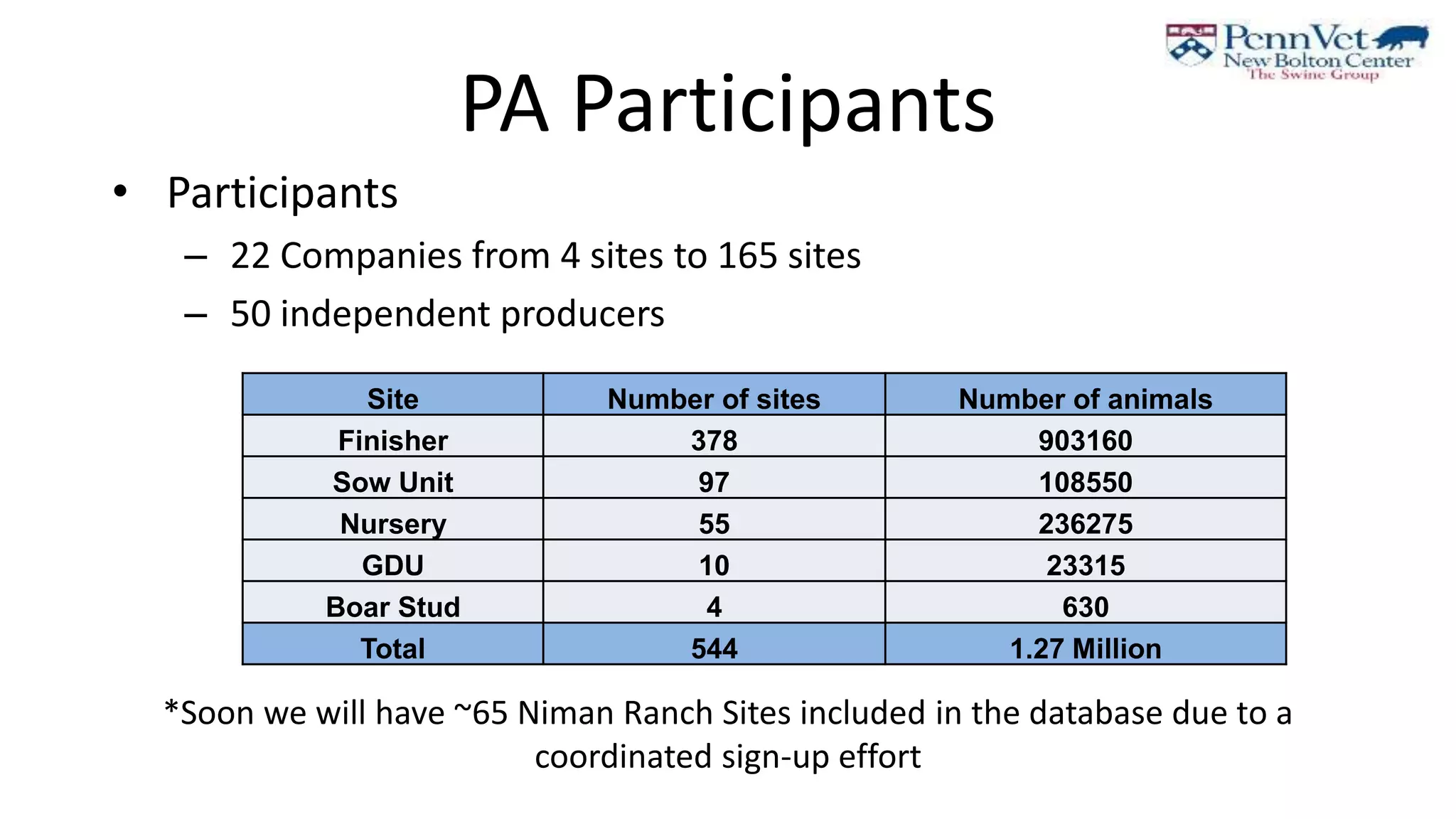
Site Number of sites Number of animals
Finisher 378 903160
Sow Unit 97 108550
Nursery 55 236275
GDU 10 23315
Boar Stud 4 630
Total 544 1.27 Million
*Soon we will have ~65 Niman Ranch Sites included in the database due to a
coordinated sign-up effort
• Participants
– 22 Companies from 4 sites to 165 sites
– 50 independent producers
PA Project Goals
• Regional control zones
– Goal is to be PRRS and PED
negative in these zones
– Chosen for high numbers of
multiplication animals or sow units
• 3 mile buffer zones
– Goal is to decrease the PRRS and
PED positive pigs in the 3 miles
around sows, boars and gilts to
zero
– Had gotten to only a few positive
sites in a 2 mile radius so expanded
to 3 miles
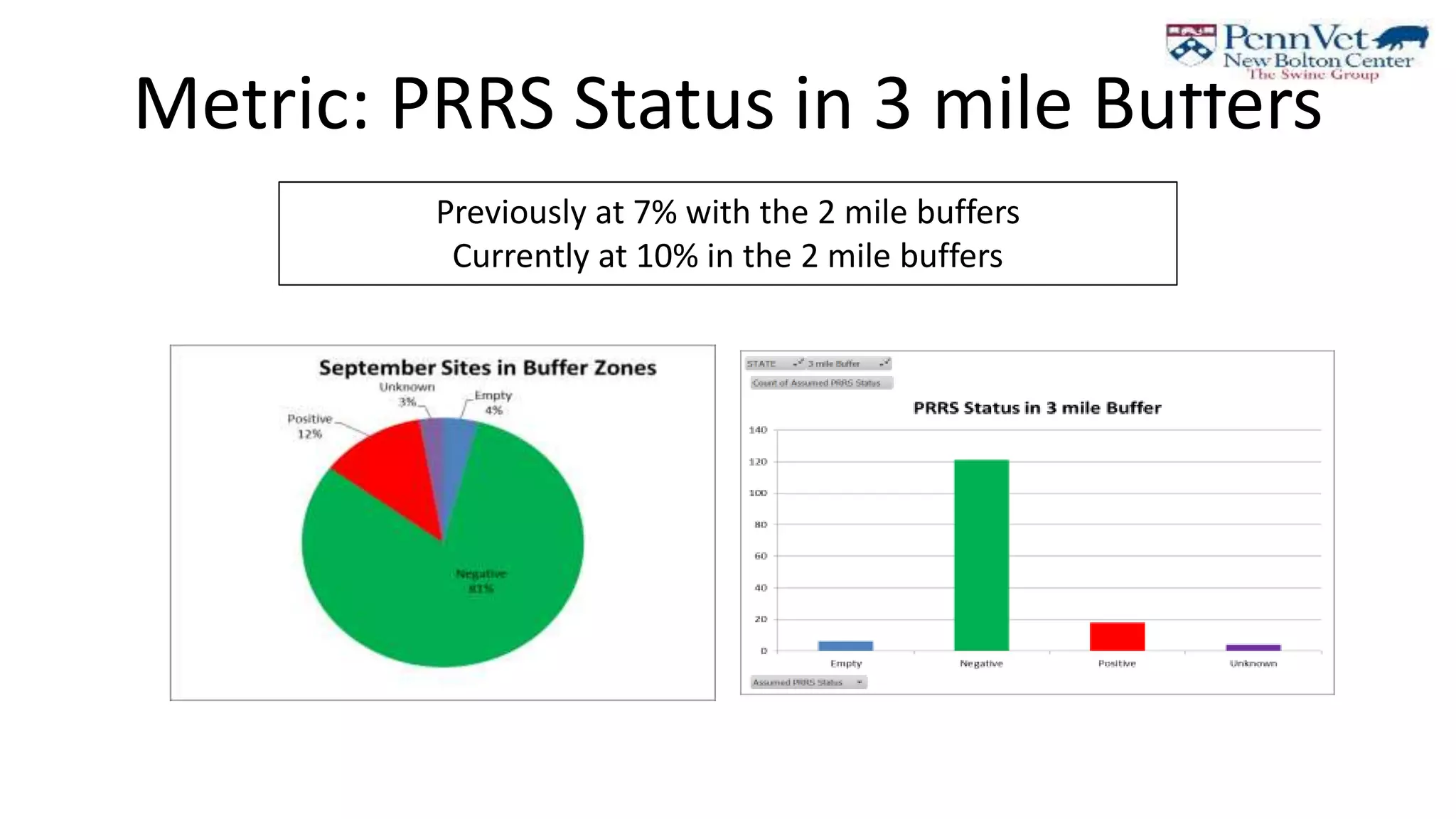
Metric: PRRS Status in 3 mile Buffers
Previously at 7% with the 2 mile buffers
Currently at 10% in the 2 mile buffers
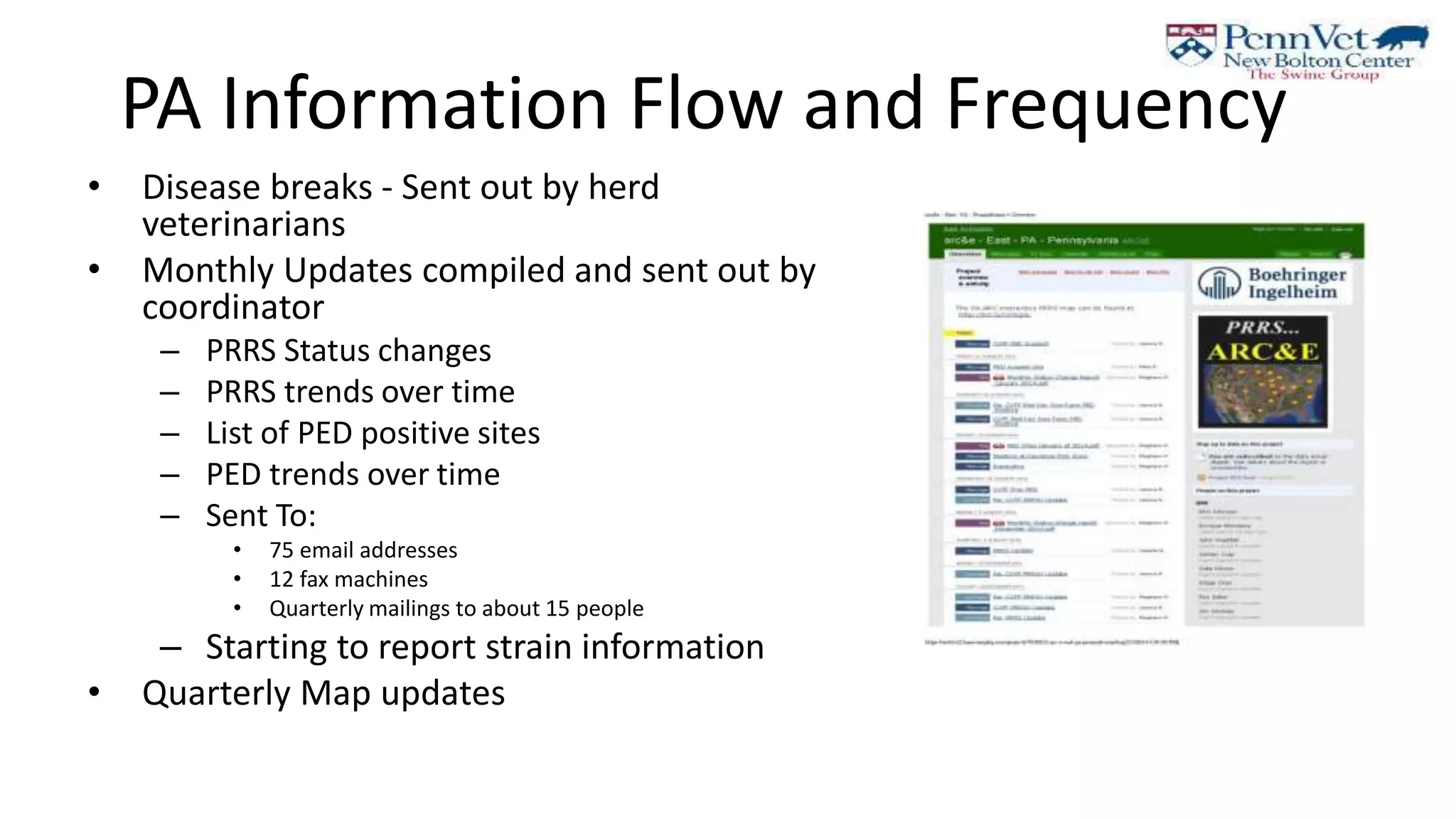
PA Information Flow and Frequency
• Disease breaks - Sent out by herd
veterinarians
• Monthly Updates compiled and sent out by
coordinator
– PRRS Status changes
– PRRS trends over time
– List of PED positive sites
– PED trends over time
– Sent To:
• 75 email addresses
• 12 fax machines
• Quarterly mailings to about 15 people
– Starting to report strain information
• Quarterly Map updates
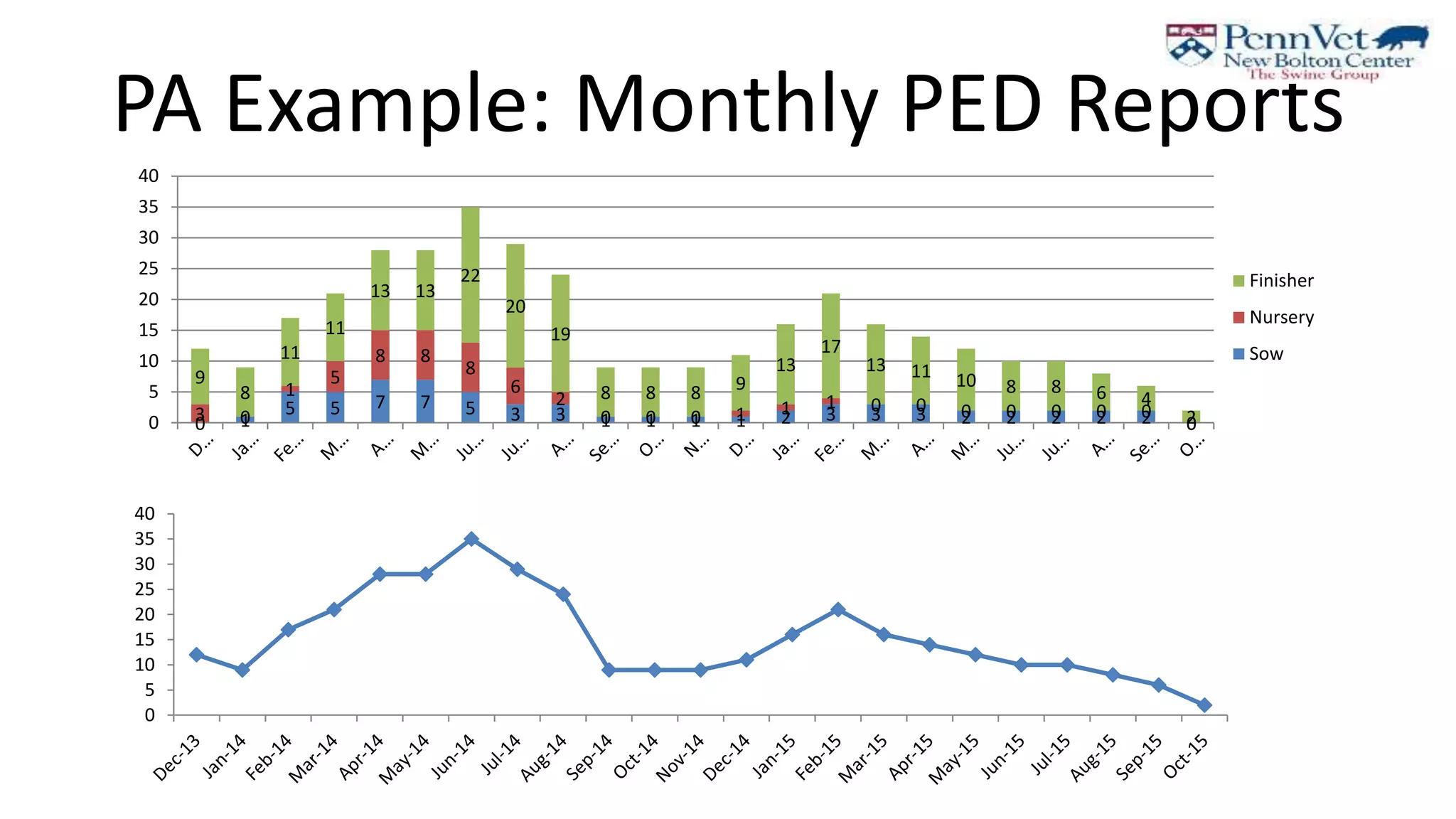
PA Example: Monthly PED Reports
0 1
5 5 7 7 5 3 3 1 1 1 1 2 3 3 3 2 2 2 2 2 03 0
1
5
8 8
8
6
2
0 0 0 1 1 1 0 0 0 0 0 0 0
0
9
8
11
11
13 13
22
20
19
8 8 8 9
13
17
13 11 10 8 8 6 4
20
5
10
15
20
25
30
35
40
Finisher
Nursery
Sow
0
5
10
15
20
25
30
35
40
PA project take home
• Producer engagement is high and the reason for
success
– Examples:
• Map is down for maintenance and I get emails asking why they can
not get access to the map
• Every company got a list of all their finishers and how close they
are to sows, gilts and boars
– Emails from people saying they “loved” the list
– Used during the last two PRRS breaks by companies placing their pigs
• They were not content to stop with the 2 mile radius and wanted
to keep expanding
NC IL ARC Project
Carrie Pollard, M.S.
Technical Services Manager
Bethany Swine Health Services
NC IL Project History
• Began winter of 2009-2010
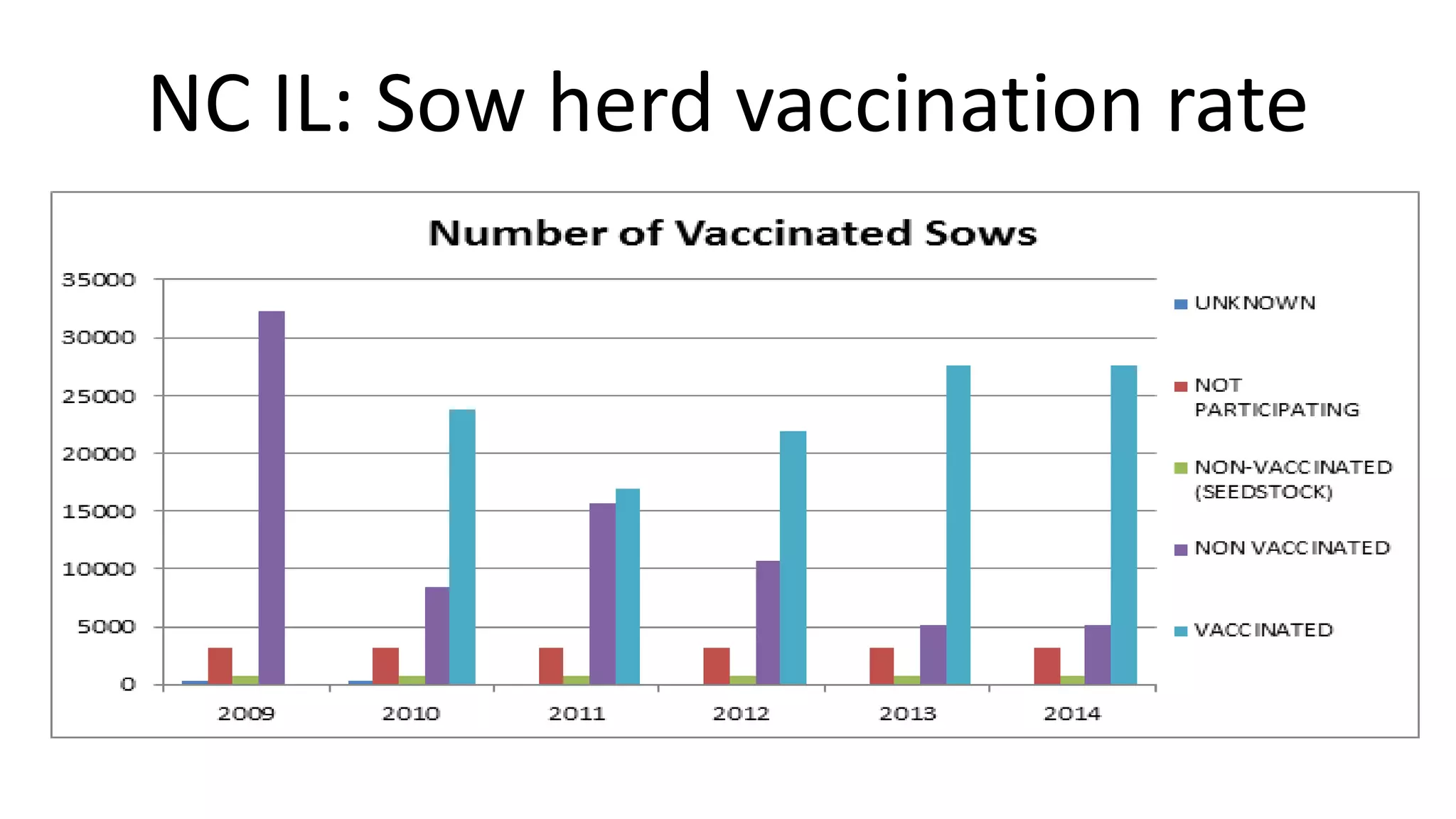
• ~20,000 sows in the area changing genetics
– PRRS-negative breeding stock
• Massive changes early
• Slow, sideways movement currently
• PEDv provided positive motivation
• Our break rate was 30% vs. national average >40%
NC IL Participants
• ~80 sites
– 1/3 sows, 2/3 finishing
• ~45 producers
– Mostly independents,
though 90% is associated
either via pig flow or
veterinary relationship
with Bethany Swine
NC IL Project Goals
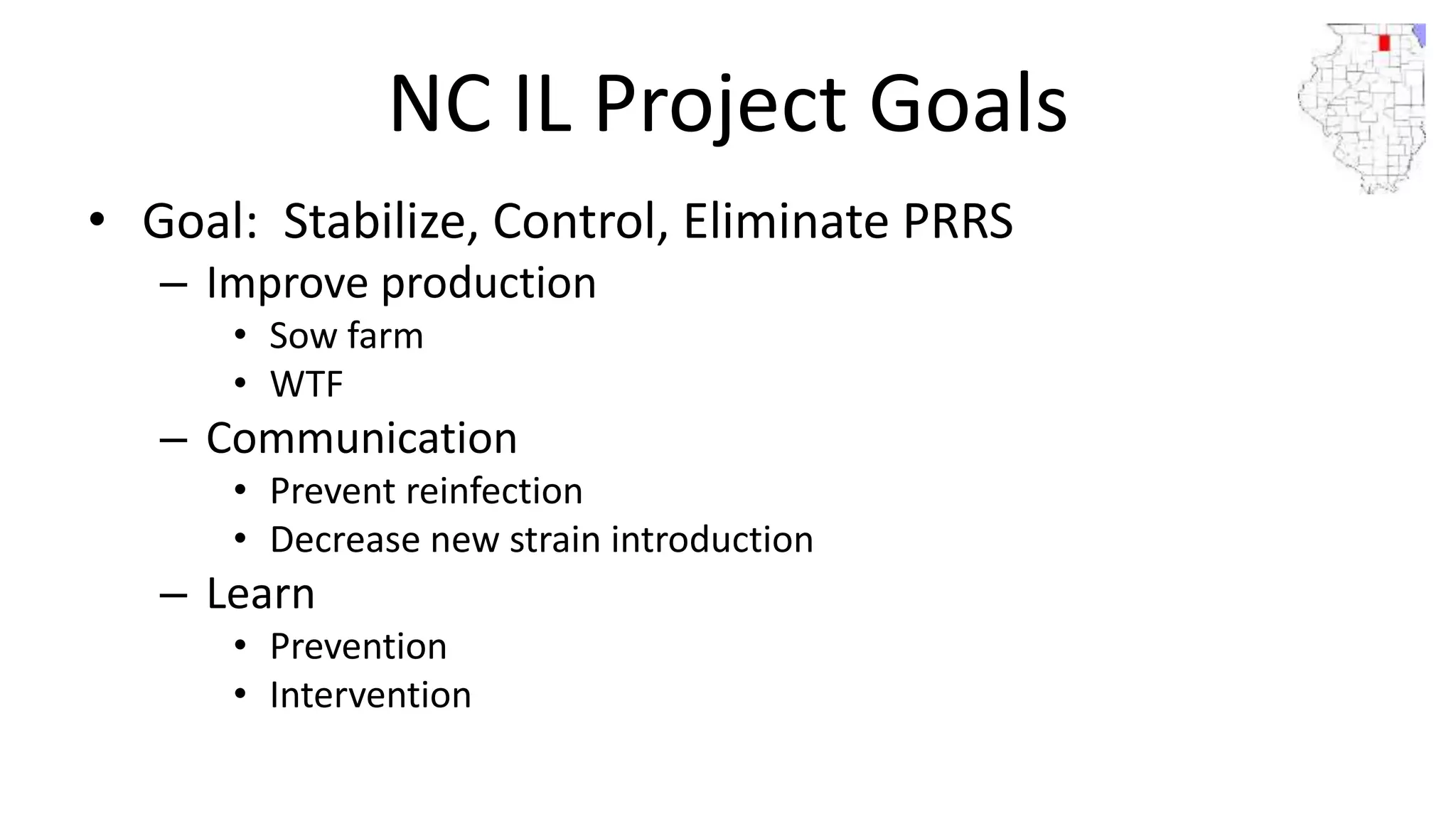
• Goal: Stabilize, Control, Eliminate PRRS
– Improve production
• Sow farm
• WTF
– Communication
• Prevent reinfection
• Decrease new strain introduction
– Learn
• Prevention
• Intervention
NC IL: Sow herd vaccination rate
NC IL Information flow and frequency
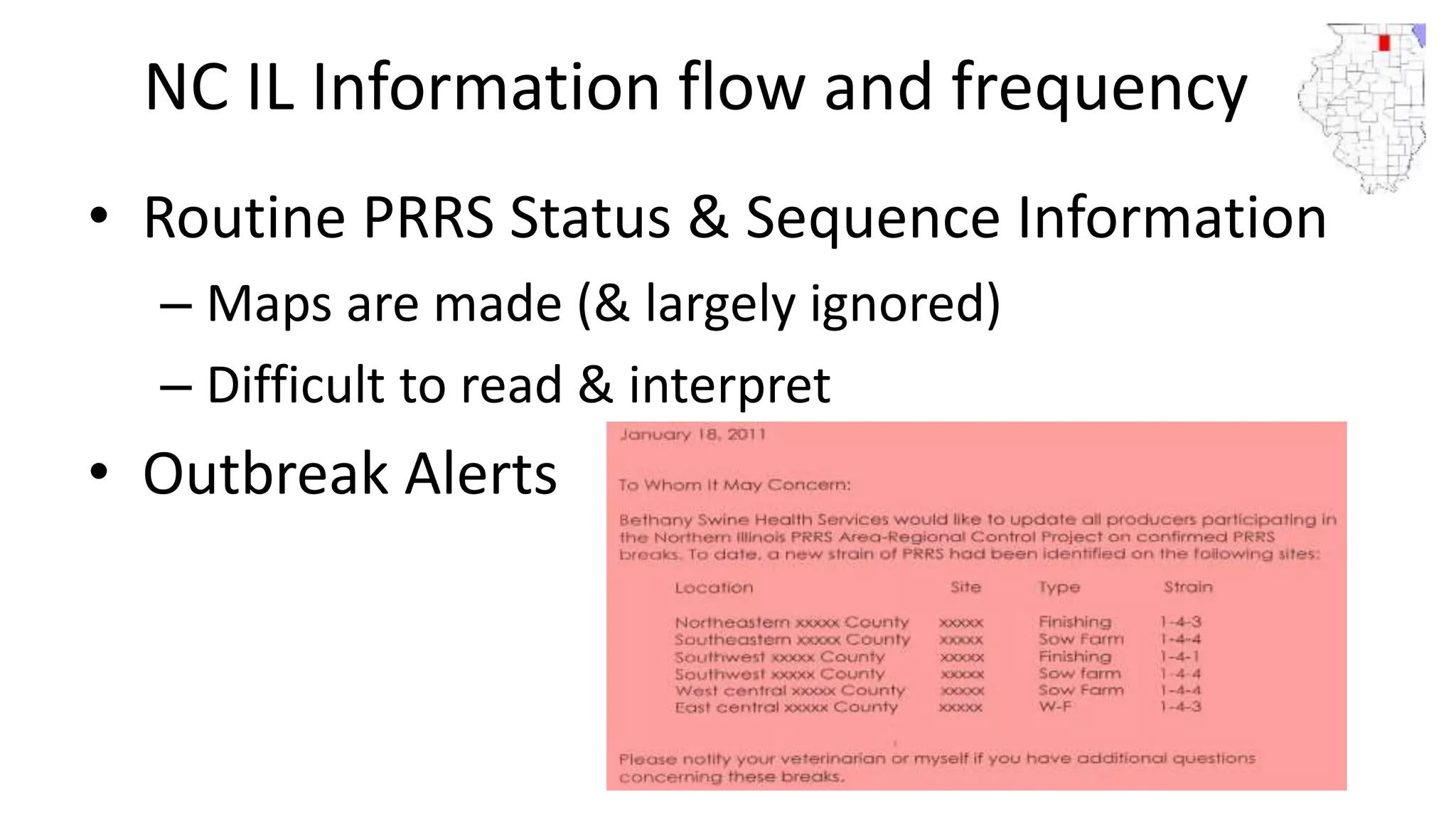
• Routine PRRS Status & Sequence Information
– Maps are made (& largely ignored)
– Difficult to read & interpret
• Outbreak Alerts
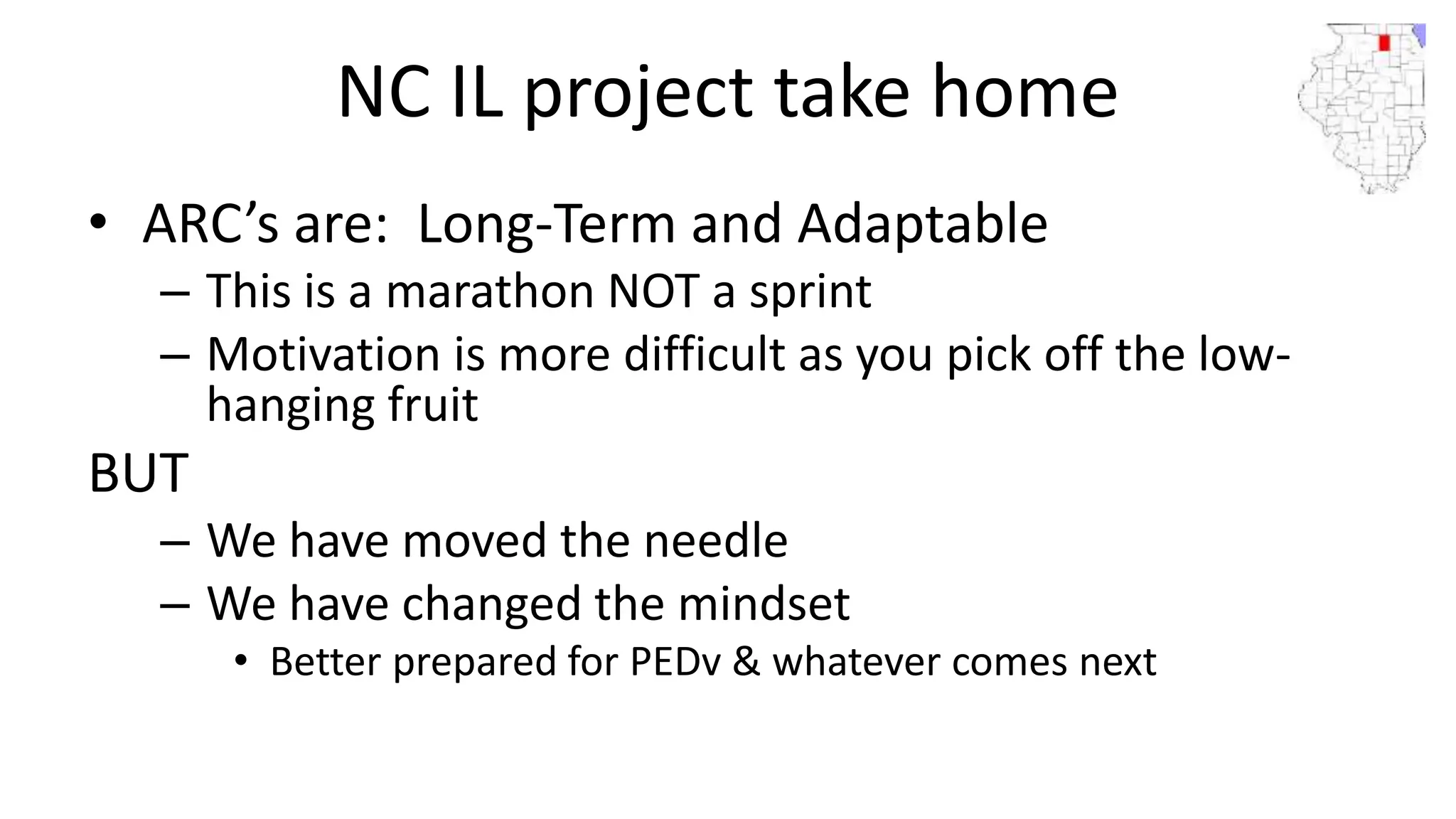
NC IL project take home
• ARC’s are: Long-Term and Adaptable
– This is a marathon NOT a sprint
– Motivation is more difficult as you pick off the low-
hanging fruit
BUT
– We have moved the needle
– We have changed the mindset
• Better prepared for PEDv & whatever comes next
South East Iowa ARC Project
Sonya Maas
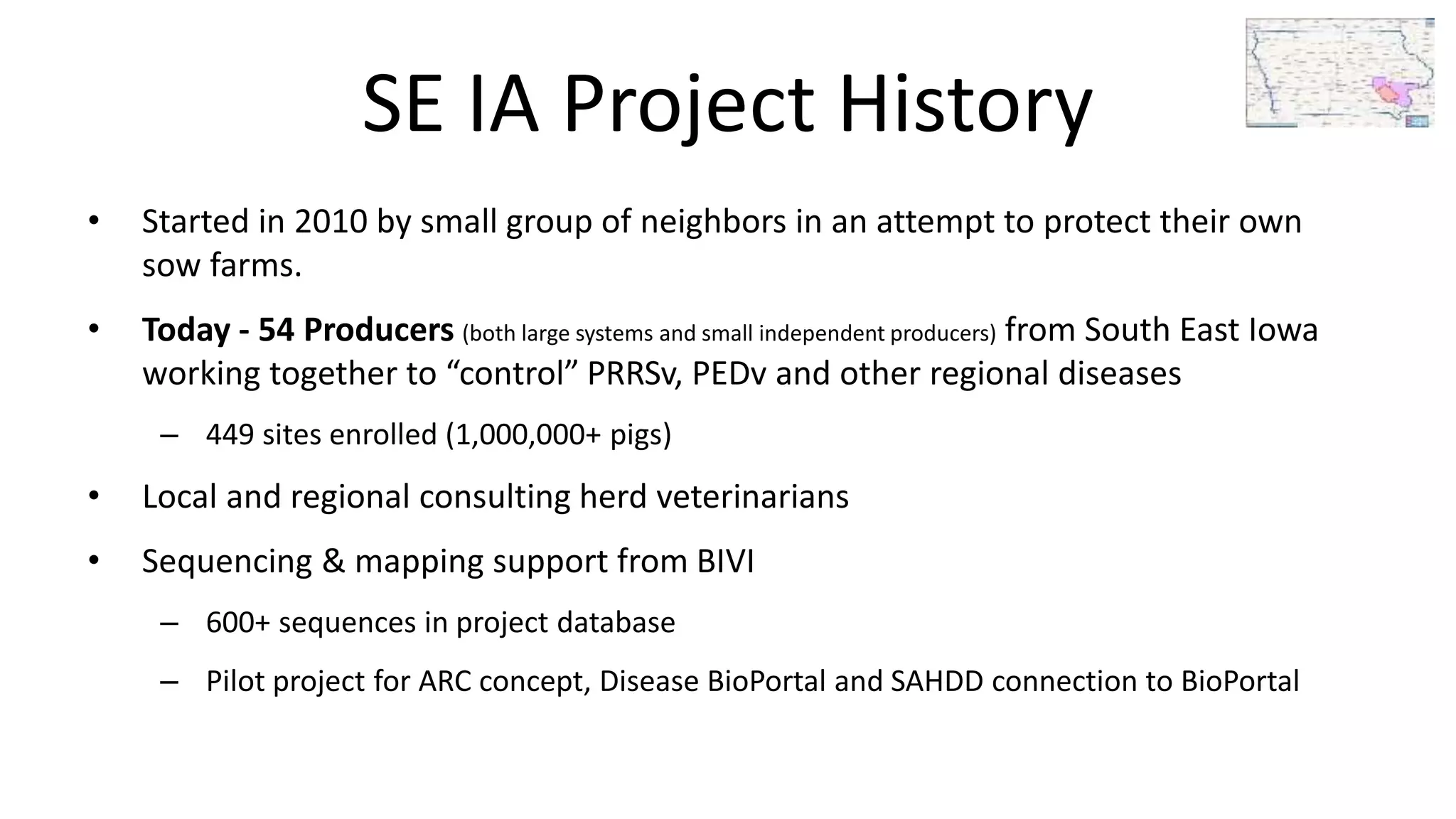
SE IA Project History
• Started in 2010 by small group of neighbors in an attempt to protect their own
sow farms.
• Today - 54 Producers (both large systems and small independent producers) from South East Iowa
working together to “control” PRRSv, PEDv and other regional diseases
– 449 sites enrolled (1,000,000+ pigs)
• Local and regional consulting herd veterinarians
• Sequencing & mapping support from BIVI
– 600+ sequences in project database
– Pilot project for ARC concept, Disease BioPortal and SAHDD connection to BioPortal
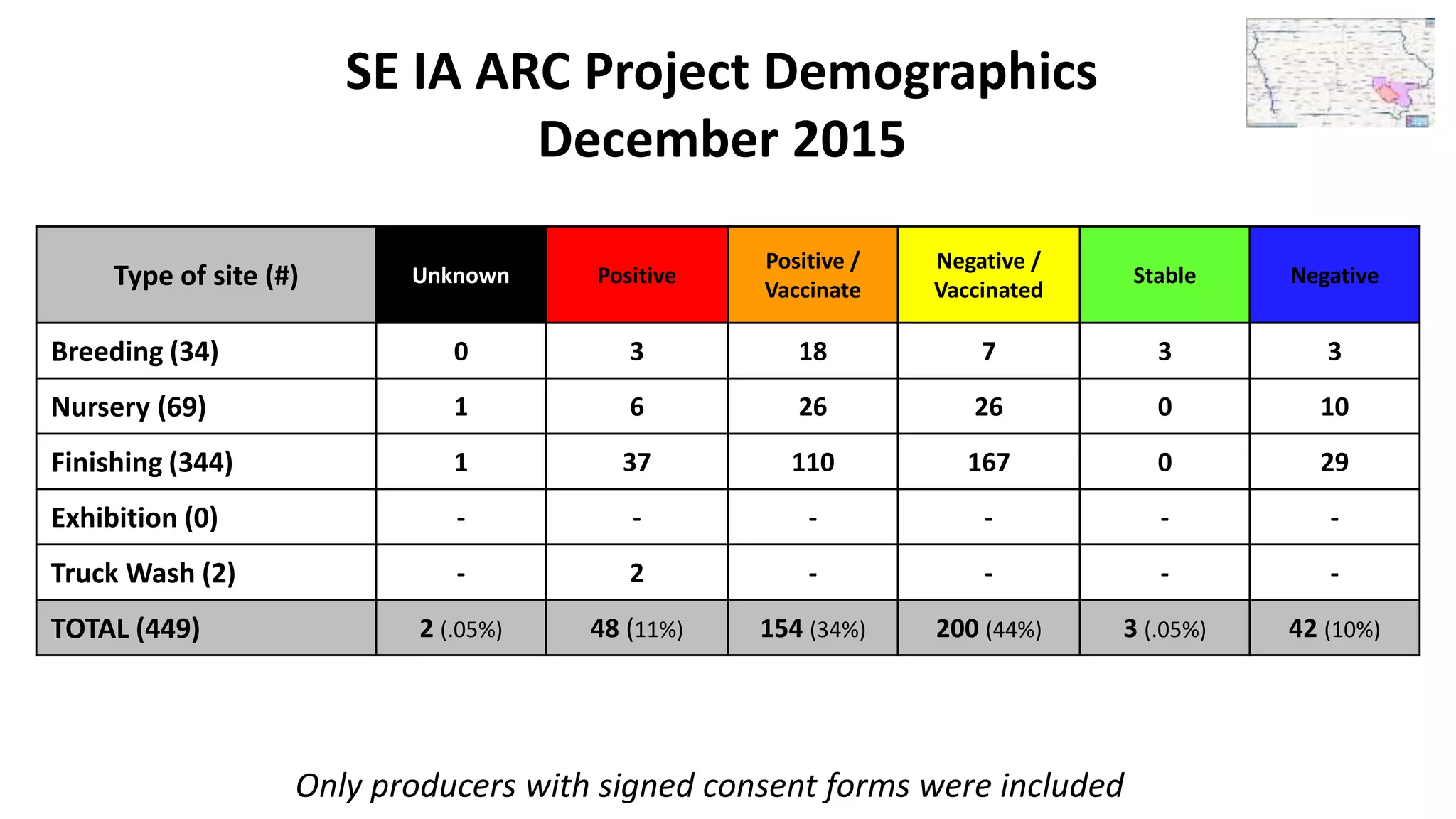
SE IA ARC Project Demographics
December 2015
Type of site (#) Unknown Positive
Positive /
Vaccinate
Negative /
Vaccinated
Stable Negative
Breeding (34) 0 3 18 7 3 3
Nursery (69) 1 6 26 26 0 10
Finishing (344) 1 37 110 167 0 29
Exhibition (0) - - - - - -
Truck Wash (2) - 2 - - - -
TOTAL (449) 2 (.05%) 48 (11%) 154 (34%) 200 (44%) 3 (.05%) 42 (10%)
Only producers with signed consent forms were included
SE IA Project Goals
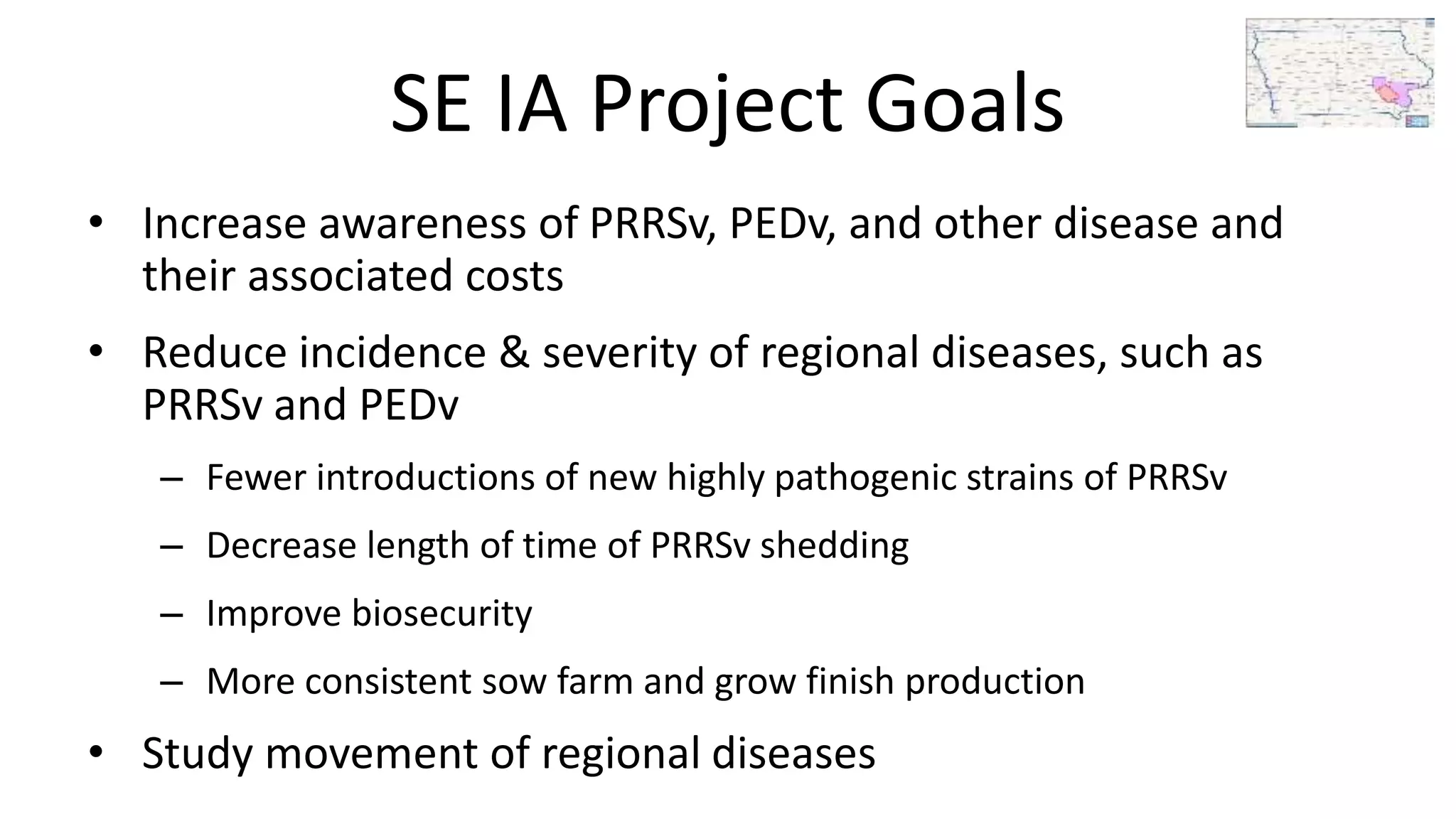
• Increase awareness of PRRSv, PEDv, and other disease and
their associated costs
• Reduce incidence & severity of regional diseases, such as
PRRSv and PEDv
– Fewer introductions of new highly pathogenic strains of PRRSv
– Decrease length of time of PRRSv shedding
– Improve biosecurity
– More consistent sow farm and grow finish production
• Study movement of regional diseases
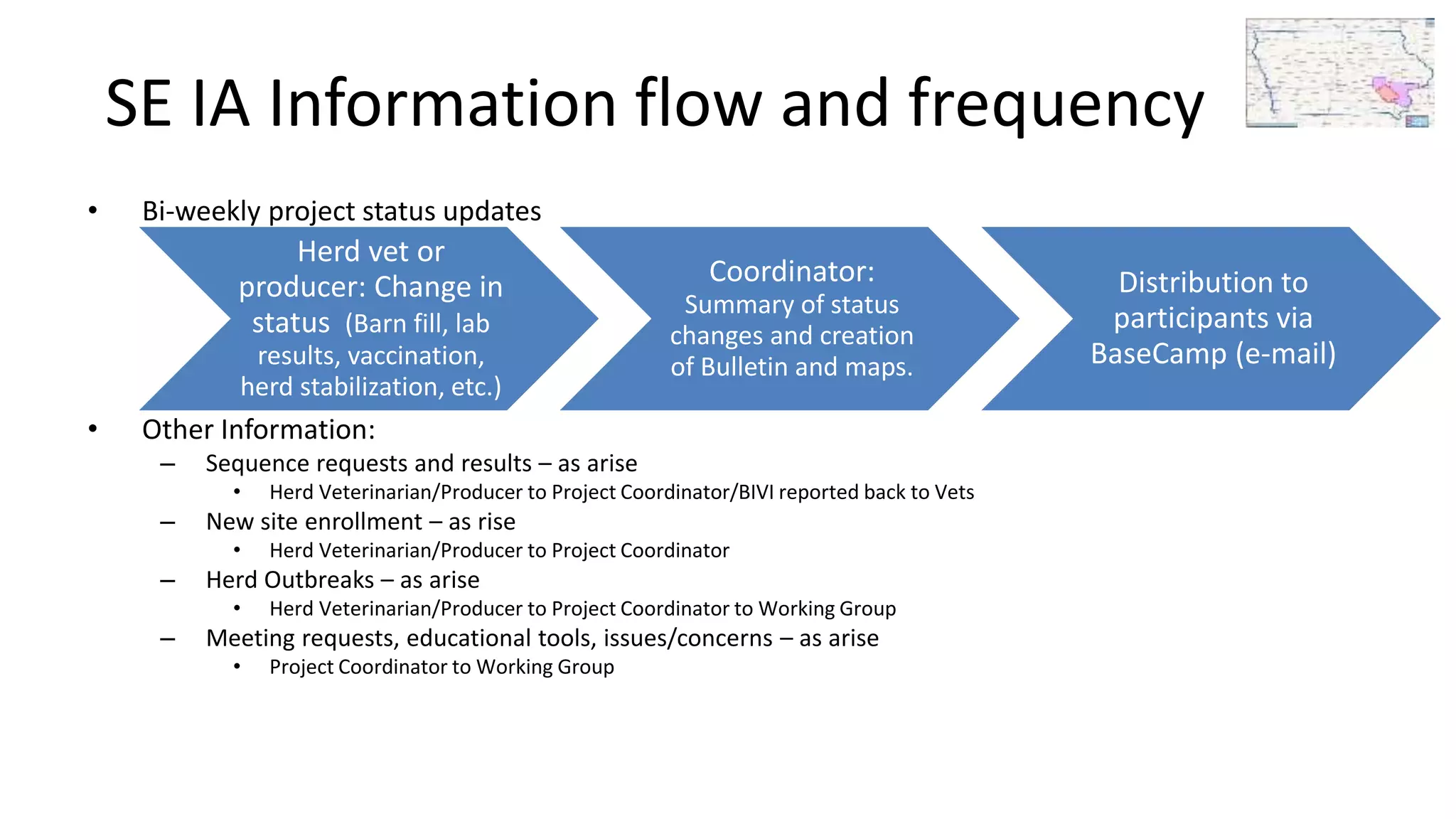
Herd vet or
producer: Change in
status (Barn fill, lab
results, vaccination,
herd stabilization, etc.)
Coordinator:
Summary of status
changes and creation
of Bulletin and maps.
Distribution to
participants via
BaseCamp (e-mail)
SE IA Information flow and frequency
• Bi-weekly project status updates
• Other Information:
– Sequence requests and results – as arise
• Herd Veterinarian/Producer to Project Coordinator/BIVI reported back to Vets
– New site enrollment – as rise
• Herd Veterinarian/Producer to Project Coordinator
– Herd Outbreaks – as arise
• Herd Veterinarian/Producer to Project Coordinator to Working Group
– Meeting requests, educational tools, issues/concerns – as arise
• Project Coordinator to Working Group
SE IA take home
Our local producers and veterinarians have taken
ownership of the program and are committed to
protecting their herds through participation in the
project.
We have a long way to go to keep PRRSv under control in
the area, but the group is driven to achieve our goals
based on the results and accomplishments they’ve seen
in the last 5 years.
Project History
SW IA ARC
• Spring 2013
• With it being a relatively
low risk area we wanted to
work together to monitor
PRRS movement and
maintain a negative PRRS
status in GDU/Sow/Boar
sites within the ARC area.
NE IA/SE MN ARC
• August 2013
• With it being a relatively low risk
area we wanted to work together
to monitor PRRS movement
within the ARC area.
• The larger producers in the area
got involved right away and we
are currently seeking out the
independent producers in the
area.
SW IA Participants
• 224 Sites
– 73 Wean to Finish
– 12 Nursery
– 60 Finishing
– 39 GDU
– 35 Sow
– 5 Boar
• 8 Active Companies
NE IA/SE MN Participants
• 159 Sites
– 28 Wean to Finish
– 18 Nursery
– 96 Finishing
– 5 GDU
– 12 Sow
• 6 Active Companies
Project Goals
SW IA ARC
• Understand PRRS risk from
neighboring sites
• Mitigate PRRS transmission
between sites in the area
• Share sequences to
differentiate new PRRS
introductions into the ARC
area from area spread of
existing viruses.
NE IA/SE MN ARC
• Understand PRRS risk from
neighboring sites
• Mitigate PRRS transmission
between sites in the area
• Share sequences to differentiate
new PRRS introductions into the
ARC area from area spread of
existing viruses.
• Gain a better understanding of
the viral circulation in the area.
Information Flow
• Currently both groups are only sharing PRRS status.
– Monthly Status Update
• Reminder Email  BioPortal Update  Basecamp Notification of
Updated Maps
• The monthly reminder is mainly for finishing changes.
– Outbreak alerts
• If there are any major issues, such as a PRRS break at a sow farm,
GDU, or Boar stud within the ARC, I am notified and relay the
message on to the group.
SW IA and NE IA/SE MN
take homes
• Teamwork:
– A sow farm in an otherwise PRRS stable area broke
with a new PRRS virus and had no way to get positive
weaned pigs out of the area.
– Another participant offered up a site to move the
wean pigs outside the ARC area.
– This is an example of successful teamwork with the
same end goal in mind-PRRS stabilization.
Click to edit Master
Quick Synopsis
Click to edit Master
• Each ARC Project is unique
– Make up of participants
– Goals and objectives
– Communication style and frequency
• What defines a successful project?
– Producer involvement
– Fewer Positive sites in sow/GDU/Boar buffers
– Fewer new emerging strains in the area
– Teamwork and information sharing
Synopsis
Click to edit MasterRound table discussion
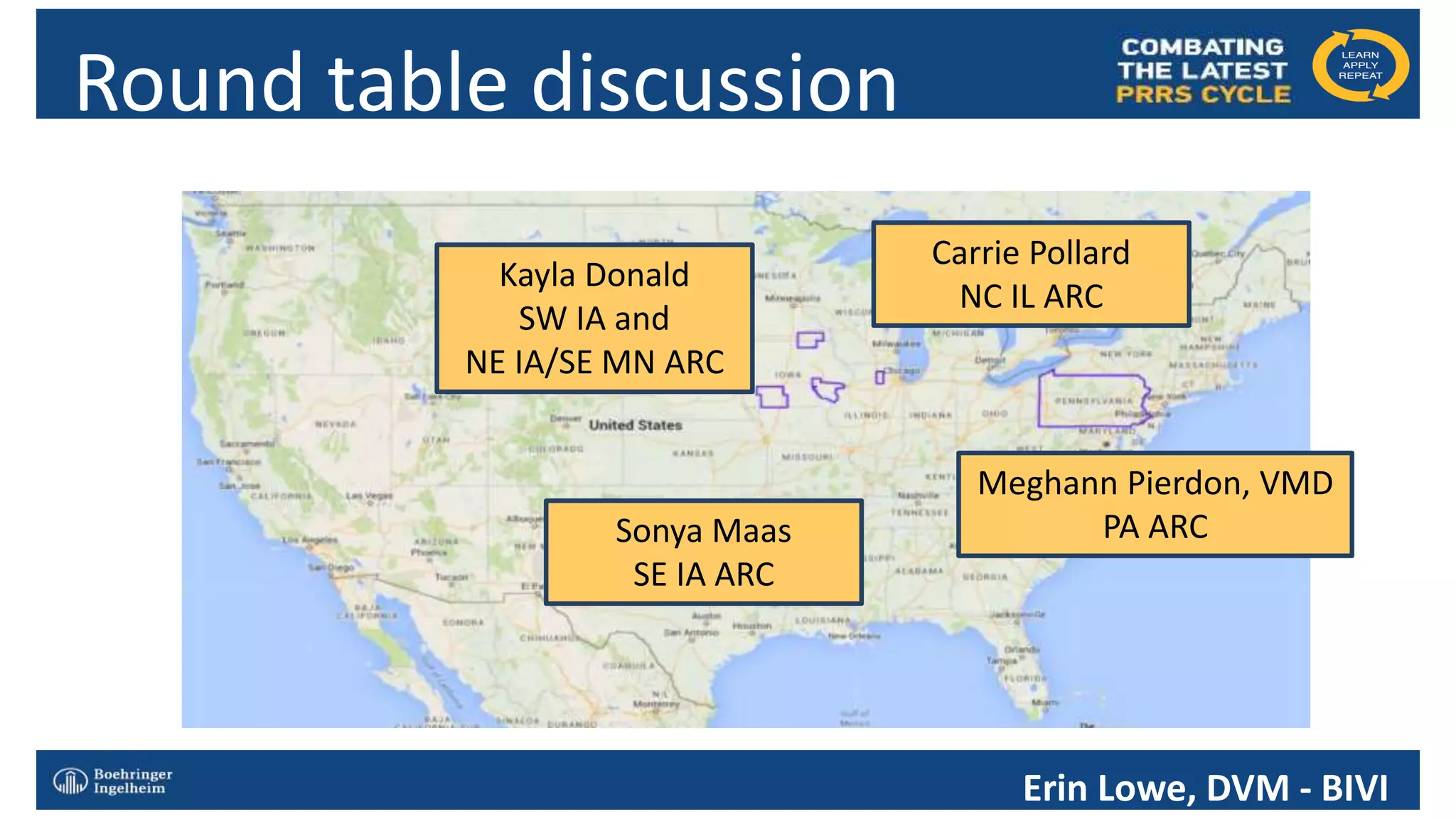
Kayla Donald
SW IA and
NE IA/SE MN ARC
Carrie Pollard
NC IL ARC
Meghann Pierdon, VMD
PA ARCSonya Maas
SE IA ARC
Erin Lowe, DVM - BIVI

Panel - Putting the Principles of PRRS Control into Practice - Tools and Their Application to Coordinated Disease Control

  • 1.
    Click to editMaster Putting the principles of disease control into practice
  • 2.
    Click to editMasterSession Overview • Brief project overviews – PA ARC – Meghann Pierdon, VMD – NC IL ARC – Carrie Pollard – SE IA ARC – Sonya Maas – SW IA ARC and NE IA ARC – Kayla Donald • Coordinator round table discussion • Audience Q & A – Text questions to: 612-559-1451
  • 3.
    Pennsylvania Swine DiseaseControl Program Meghann Pierdon, VMD
  • 4.
    PA Project History •Statewide program in existence for over 10 years • Started with negative areas and goals of maintaining and expanding • ARC coordinator started in 2012 – Updated database- VERY IMPORTANT – Know the politics to get everyone included – Covers over 90% of the pigs in Pennsylvania – Started using Basecamp for information sharing
  • 5.
    PA Participants Site Numberof sites Number of animals Finisher 378 903160 Sow Unit 97 108550 Nursery 55 236275 GDU 10 23315 Boar Stud 4 630 Total 544 1.27 Million *Soon we will have ~65 Niman Ranch Sites included in the database due to a coordinated sign-up effort • Participants – 22 Companies from 4 sites to 165 sites – 50 independent producers
  • 6.
    PA Project Goals •Regional control zones – Goal is to be PRRS and PED negative in these zones – Chosen for high numbers of multiplication animals or sow units • 3 mile buffer zones – Goal is to decrease the PRRS and PED positive pigs in the 3 miles around sows, boars and gilts to zero – Had gotten to only a few positive sites in a 2 mile radius so expanded to 3 miles
  • 7.
    Metric: PRRS Statusin 3 mile Buffers Previously at 7% with the 2 mile buffers Currently at 10% in the 2 mile buffers
  • 8.
    PA Information Flowand Frequency • Disease breaks - Sent out by herd veterinarians • Monthly Updates compiled and sent out by coordinator – PRRS Status changes – PRRS trends over time – List of PED positive sites – PED trends over time – Sent To: • 75 email addresses • 12 fax machines • Quarterly mailings to about 15 people – Starting to report strain information • Quarterly Map updates
  • 9.
    PA Example: MonthlyPED Reports 0 1 5 5 7 7 5 3 3 1 1 1 1 2 3 3 3 2 2 2 2 2 03 0 1 5 8 8 8 6 2 0 0 0 1 1 1 0 0 0 0 0 0 0 0 9 8 11 11 13 13 22 20 19 8 8 8 9 13 17 13 11 10 8 8 6 4 20 5 10 15 20 25 30 35 40 Finisher Nursery Sow 0 5 10 15 20 25 30 35 40
  • 10.
    PA project takehome • Producer engagement is high and the reason for success – Examples: • Map is down for maintenance and I get emails asking why they can not get access to the map • Every company got a list of all their finishers and how close they are to sows, gilts and boars – Emails from people saying they “loved” the list – Used during the last two PRRS breaks by companies placing their pigs • They were not content to stop with the 2 mile radius and wanted to keep expanding
  • 11.
    NC IL ARCProject Carrie Pollard, M.S. Technical Services Manager Bethany Swine Health Services
  • 12.
    NC IL ProjectHistory • Began winter of 2009-2010 • ~20,000 sows in the area changing genetics – PRRS-negative breeding stock • Massive changes early • Slow, sideways movement currently • PEDv provided positive motivation • Our break rate was 30% vs. national average >40%
  • 13.
    NC IL Participants •~80 sites – 1/3 sows, 2/3 finishing • ~45 producers – Mostly independents, though 90% is associated either via pig flow or veterinary relationship with Bethany Swine
  • 14.
    NC IL ProjectGoals • Goal: Stabilize, Control, Eliminate PRRS – Improve production • Sow farm • WTF – Communication • Prevent reinfection • Decrease new strain introduction – Learn • Prevention • Intervention
  • 15.
    NC IL: Sowherd vaccination rate
  • 16.
    NC IL Informationflow and frequency • Routine PRRS Status & Sequence Information – Maps are made (& largely ignored) – Difficult to read & interpret • Outbreak Alerts
  • 17.
    NC IL projecttake home • ARC’s are: Long-Term and Adaptable – This is a marathon NOT a sprint – Motivation is more difficult as you pick off the low- hanging fruit BUT – We have moved the needle – We have changed the mindset • Better prepared for PEDv & whatever comes next
  • 18.
    South East IowaARC Project Sonya Maas
  • 19.
    SE IA ProjectHistory • Started in 2010 by small group of neighbors in an attempt to protect their own sow farms. • Today - 54 Producers (both large systems and small independent producers) from South East Iowa working together to “control” PRRSv, PEDv and other regional diseases – 449 sites enrolled (1,000,000+ pigs) • Local and regional consulting herd veterinarians • Sequencing & mapping support from BIVI – 600+ sequences in project database – Pilot project for ARC concept, Disease BioPortal and SAHDD connection to BioPortal
  • 20.
    SE IA ARCProject Demographics December 2015 Type of site (#) Unknown Positive Positive / Vaccinate Negative / Vaccinated Stable Negative Breeding (34) 0 3 18 7 3 3 Nursery (69) 1 6 26 26 0 10 Finishing (344) 1 37 110 167 0 29 Exhibition (0) - - - - - - Truck Wash (2) - 2 - - - - TOTAL (449) 2 (.05%) 48 (11%) 154 (34%) 200 (44%) 3 (.05%) 42 (10%) Only producers with signed consent forms were included
  • 21.
    SE IA ProjectGoals • Increase awareness of PRRSv, PEDv, and other disease and their associated costs • Reduce incidence & severity of regional diseases, such as PRRSv and PEDv – Fewer introductions of new highly pathogenic strains of PRRSv – Decrease length of time of PRRSv shedding – Improve biosecurity – More consistent sow farm and grow finish production • Study movement of regional diseases
  • 22.
    Herd vet or producer:Change in status (Barn fill, lab results, vaccination, herd stabilization, etc.) Coordinator: Summary of status changes and creation of Bulletin and maps. Distribution to participants via BaseCamp (e-mail) SE IA Information flow and frequency • Bi-weekly project status updates • Other Information: – Sequence requests and results – as arise • Herd Veterinarian/Producer to Project Coordinator/BIVI reported back to Vets – New site enrollment – as rise • Herd Veterinarian/Producer to Project Coordinator – Herd Outbreaks – as arise • Herd Veterinarian/Producer to Project Coordinator to Working Group – Meeting requests, educational tools, issues/concerns – as arise • Project Coordinator to Working Group
  • 23.
    SE IA takehome Our local producers and veterinarians have taken ownership of the program and are committed to protecting their herds through participation in the project. We have a long way to go to keep PRRSv under control in the area, but the group is driven to achieve our goals based on the results and accomplishments they’ve seen in the last 5 years.
  • 24.
    Project History SW IAARC • Spring 2013 • With it being a relatively low risk area we wanted to work together to monitor PRRS movement and maintain a negative PRRS status in GDU/Sow/Boar sites within the ARC area. NE IA/SE MN ARC • August 2013 • With it being a relatively low risk area we wanted to work together to monitor PRRS movement within the ARC area. • The larger producers in the area got involved right away and we are currently seeking out the independent producers in the area.
  • 25.
    SW IA Participants •224 Sites – 73 Wean to Finish – 12 Nursery – 60 Finishing – 39 GDU – 35 Sow – 5 Boar • 8 Active Companies
  • 26.
    NE IA/SE MNParticipants • 159 Sites – 28 Wean to Finish – 18 Nursery – 96 Finishing – 5 GDU – 12 Sow • 6 Active Companies
  • 27.
    Project Goals SW IAARC • Understand PRRS risk from neighboring sites • Mitigate PRRS transmission between sites in the area • Share sequences to differentiate new PRRS introductions into the ARC area from area spread of existing viruses. NE IA/SE MN ARC • Understand PRRS risk from neighboring sites • Mitigate PRRS transmission between sites in the area • Share sequences to differentiate new PRRS introductions into the ARC area from area spread of existing viruses. • Gain a better understanding of the viral circulation in the area.
  • 28.
    Information Flow • Currentlyboth groups are only sharing PRRS status. – Monthly Status Update • Reminder Email  BioPortal Update  Basecamp Notification of Updated Maps • The monthly reminder is mainly for finishing changes. – Outbreak alerts • If there are any major issues, such as a PRRS break at a sow farm, GDU, or Boar stud within the ARC, I am notified and relay the message on to the group.
  • 29.
    SW IA andNE IA/SE MN take homes • Teamwork: – A sow farm in an otherwise PRRS stable area broke with a new PRRS virus and had no way to get positive weaned pigs out of the area. – Another participant offered up a site to move the wean pigs outside the ARC area. – This is an example of successful teamwork with the same end goal in mind-PRRS stabilization.
  • 30.
    Click to editMaster Quick Synopsis
  • 31.
    Click to editMaster • Each ARC Project is unique – Make up of participants – Goals and objectives – Communication style and frequency • What defines a successful project? – Producer involvement – Fewer Positive sites in sow/GDU/Boar buffers – Fewer new emerging strains in the area – Teamwork and information sharing Synopsis
  • 32.
    Click to editMasterRound table discussion Kayla Donald SW IA and NE IA/SE MN ARC Carrie Pollard NC IL ARC Meghann Pierdon, VMD PA ARCSonya Maas SE IA ARC Erin Lowe, DVM - BIVI

Editor's Notes

  • #4 Brief self introduction prior to introducing the project.
  • #11 Success story, unique point, progress over time, key learning, etc.
  • #12 Brief self introduction prior to introducing the project.
  • #17 Carrie – what route do you use (email, word of mouth from the vets?) and what is the frequency of delivery for routine stuff (annual mtg/quarterly?) and Outbreak alerts (as needed?)? Just don’t want you to sell yourself short as the center of communication for the project.
  • #18 Success story, unique point, progress over time, key learning, etc.
  • #19 Brief self introduction prior to introducing the project.
  • #24 Success story, unique point, progress over time, key learning, etc.
  • #30 Success story, unique point, progress over time, key learning, etc.