
Is there a crisis
for subjects?
David Lambert
2
www.geography.org.uk/resources/adifferentview/downloads
A Different View
The World Subject
3
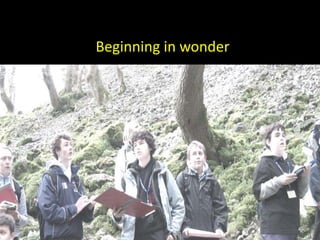
Beginning in wonder
4
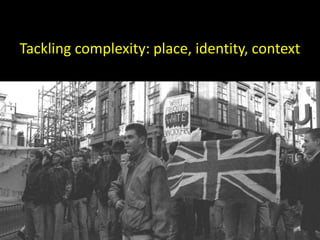
Tackling complexity: place, identity, context
5
6
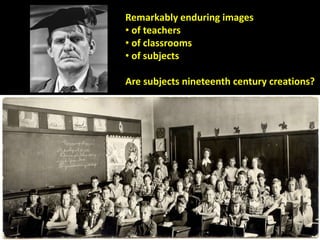
Remarkably enduring images
• of teachers
• of classrooms
• of subjects
Are subjects nineteenth century creations?
7
QCA 2004
“The UK has moved from a manufacturing economy to a service and
knowledge-based economy. In an increasingly technological world,
jobs migrate ... In an uncertain future (we need people who are)
flexible and equipped to learn and adapt ...”
OECD (on ‘21st century skills’)
“ ... for jobs that have not yet been created, using technologies
that have not yet been invented to solve problems that cannot
be foreseen”
Mick Waters (2010)
“A school shouldn’t start with curriculum content. It should start
with designing a learning experience and then check it has met
national curriculum requirements.”
The neo-liberal orthodoxy has “dulled our ability to think for, or beyond, ourselves”
[Wadley 2008]
Academic arguments
What’s The Point of School?
“The only time my education was interrupted was
while I was at school”
This quote is ascribed to Winston Churchill by Guy
Claxton
It is a fashionable view, but is potentially damaging
“The purpose of education is to prepare young
people for the future. Schools should be
helping young people to develop the
capacities they will need to thrive. What they
need, and want, is the confidence to talk to
strangers, to try things out, to handle tricky
situations, to stand up for themselves, to ask
for help, to think new thoughts”.
“That is not too much to ask – it is every young
person’s basic educational entitlement.
But they are not getting it”.
There is no evidence that being able to solve
simultaneous equations, or discuss the plot of
Hamlet, equips young people to deal with life.
We have lazily assumed that, somehow, it
must do, but research shows that even
successful students are often left timid and
unsettled when they step outside the narrow
comfort zones of their academic success.
Summary
There is much to take from Claxton’s idea of
building learning power
He reminds us of the broader purposes of
education
But is there a danger of throwing the baby out
with the bath water?
More Arguments
“There is no point in hanging on to a curriculum
that may have suited ... the eighteenth and
nineteenth centuries but needs radical reshaping
today”
This is the philosopher John White
White goes on
“(QCDA) are devising ways of encouraging the
subjects to see themselves more as servants of
the aims than as self-contained worlds of their
own”
Summary
Again, White reminds us of broader aims of
education
But again, appears to undermine subject
disciplines (as old fashioned)
Counter Arguments
Must avoid:
– Swinging pendulums and false dichotomies
• Knowledge versus skills
• Curriculum versus pedagogy
– Defending subject knowledge/expertise
Must promote:
– Teachers as ‘boundary workers’
– Subject disciplines as resources
– An evolving theory of knowledge
“Bringing Knowledge Back In”
(Michael Young)
• Schools are special places (they are not
‘everyday places’)
• Inducting young people into ‘powerful
knowledge’ (not simply the knowledge of the
powerful)
• Clear distinction between curriculum and
pedagogy
22
Manifesto
Section 2
Thinking geographically
“An essential educational outcome of learning
geography is to be able to apply knowledge and
conceptual understanding to new settings: that is,
to ‘think geographically’ about the changing world”.
.
• “
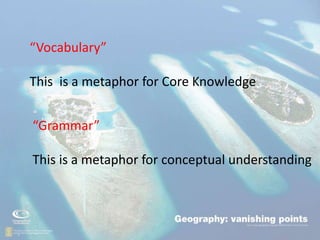
“Vocabulary”
This is a metaphor for Core Knowledge
“Grammar”
This is a metaphor for conceptual understanding
.
• “
“Capability”
In geography, ‘capability’ is enhanced through:
• Acquisition and development of ‘world knowledge’ (this
may be equated with ‘core knowledge’, or essential and
enabling knowledge
• Development of ‘inter-relational understanding’ – the
basis of grasping global interdependence (captured by
Massey’s concept of a ‘global sense of place’)
• Enhanced propensity to think, through ‘decision making’
and other applied pedagogic activities, about how places,
societies and environments are made
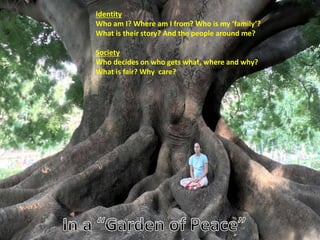
Identity
Who am I? Where am I from? Who is my ‘family’?
What is their story? And the people around me?
Society
Who decides on who gets what, where and why?
What is fair? Why care?
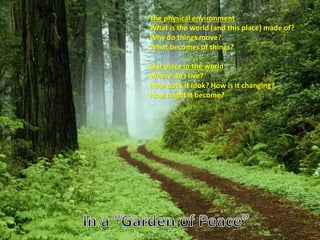
The physical environment
What is the world (and this place) made of?
Why do things move?
What becomes of things?
Our place in the world
Where do I live?
How does it look? How is it changing?
How might it become?
28
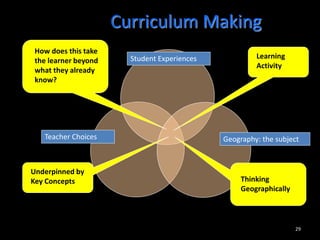
Student Experiences
Geography: the subjectTeacher Choices
Underpinned by
Key Concepts Thinking
Geographically
Learning
Activity
How does this take
the learner beyond
what they already
know?
Curriculum Making
29
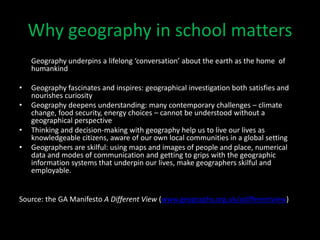
Why geography in school matters
Geography underpins a lifelong ‘conversation’ about the earth as the home of
humankind
• Geography fascinates and inspires: geographical investigation both satisfies and
nourishes curiosity
• Geography deepens understanding: many contemporary challenges – climate
change, food security, energy choices – cannot be understood without a
geographical perspective
• Thinking and decision-making with geography help us to live our lives as
knowledgeable citizens, aware of our own local communities in a global setting
• Geographers are skilful: using maps and images of people and place, numerical
data and modes of communication and getting to grips with the geographic
information systems that underpin our lives, make geographers skilful and
employable.
Source: the GA Manifesto A Different View (www.geography.org.uk/adifferentview)

November 2010 SSAT Presentation

  • 2.
    Is there acrisis for subjects? David Lambert 2 www.geography.org.uk/resources/adifferentview/downloads A Different View
  • 3.
  • 4.
  • 5.
    Tackling complexity: place,identity, context 5
  • 6.
  • 7.
    Remarkably enduring images •of teachers • of classrooms • of subjects Are subjects nineteenth century creations? 7
  • 8.
    QCA 2004 “The UKhas moved from a manufacturing economy to a service and knowledge-based economy. In an increasingly technological world, jobs migrate ... In an uncertain future (we need people who are) flexible and equipped to learn and adapt ...”
  • 9.
    OECD (on ‘21stcentury skills’) “ ... for jobs that have not yet been created, using technologies that have not yet been invented to solve problems that cannot be foreseen”
  • 10.
    Mick Waters (2010) “Aschool shouldn’t start with curriculum content. It should start with designing a learning experience and then check it has met national curriculum requirements.”
  • 11.
    The neo-liberal orthodoxyhas “dulled our ability to think for, or beyond, ourselves” [Wadley 2008]
  • 12.
    Academic arguments What’s ThePoint of School? “The only time my education was interrupted was while I was at school” This quote is ascribed to Winston Churchill by Guy Claxton It is a fashionable view, but is potentially damaging
  • 13.
    “The purpose ofeducation is to prepare young people for the future. Schools should be helping young people to develop the capacities they will need to thrive. What they need, and want, is the confidence to talk to strangers, to try things out, to handle tricky situations, to stand up for themselves, to ask for help, to think new thoughts”.
  • 14.
    “That is nottoo much to ask – it is every young person’s basic educational entitlement. But they are not getting it”.
  • 15.
    There is noevidence that being able to solve simultaneous equations, or discuss the plot of Hamlet, equips young people to deal with life. We have lazily assumed that, somehow, it must do, but research shows that even successful students are often left timid and unsettled when they step outside the narrow comfort zones of their academic success.
  • 16.
    Summary There is muchto take from Claxton’s idea of building learning power He reminds us of the broader purposes of education But is there a danger of throwing the baby out with the bath water?
  • 17.
    More Arguments “There isno point in hanging on to a curriculum that may have suited ... the eighteenth and nineteenth centuries but needs radical reshaping today” This is the philosopher John White
  • 18.
    White goes on “(QCDA)are devising ways of encouraging the subjects to see themselves more as servants of the aims than as self-contained worlds of their own”
  • 19.
    Summary Again, White remindsus of broader aims of education But again, appears to undermine subject disciplines (as old fashioned)
  • 20.
    Counter Arguments Must avoid: –Swinging pendulums and false dichotomies • Knowledge versus skills • Curriculum versus pedagogy – Defending subject knowledge/expertise Must promote: – Teachers as ‘boundary workers’ – Subject disciplines as resources – An evolving theory of knowledge
  • 21.
    “Bringing Knowledge BackIn” (Michael Young) • Schools are special places (they are not ‘everyday places’) • Inducting young people into ‘powerful knowledge’ (not simply the knowledge of the powerful) • Clear distinction between curriculum and pedagogy
  • 22.
  • 23.
    Manifesto Section 2 Thinking geographically “Anessential educational outcome of learning geography is to be able to apply knowledge and conceptual understanding to new settings: that is, to ‘think geographically’ about the changing world”.
  • 24.
    . • “ “Vocabulary” This isa metaphor for Core Knowledge “Grammar” This is a metaphor for conceptual understanding
  • 25.
    . • “ “Capability” In geography,‘capability’ is enhanced through: • Acquisition and development of ‘world knowledge’ (this may be equated with ‘core knowledge’, or essential and enabling knowledge • Development of ‘inter-relational understanding’ – the basis of grasping global interdependence (captured by Massey’s concept of a ‘global sense of place’) • Enhanced propensity to think, through ‘decision making’ and other applied pedagogic activities, about how places, societies and environments are made
  • 26.
    Identity Who am I?Where am I from? Who is my ‘family’? What is their story? And the people around me? Society Who decides on who gets what, where and why? What is fair? Why care?
  • 27.
    The physical environment Whatis the world (and this place) made of? Why do things move? What becomes of things? Our place in the world Where do I live? How does it look? How is it changing? How might it become?
  • 28.
  • 29.
    Student Experiences Geography: thesubjectTeacher Choices Underpinned by Key Concepts Thinking Geographically Learning Activity How does this take the learner beyond what they already know? Curriculum Making 29
  • 30.
    Why geography inschool matters Geography underpins a lifelong ‘conversation’ about the earth as the home of humankind • Geography fascinates and inspires: geographical investigation both satisfies and nourishes curiosity • Geography deepens understanding: many contemporary challenges – climate change, food security, energy choices – cannot be understood without a geographical perspective • Thinking and decision-making with geography help us to live our lives as knowledgeable citizens, aware of our own local communities in a global setting • Geographers are skilful: using maps and images of people and place, numerical data and modes of communication and getting to grips with the geographic information systems that underpin our lives, make geographers skilful and employable. Source: the GA Manifesto A Different View (www.geography.org.uk/adifferentview)

Editor's Notes

  • #5 The idea that a sense of awe and wonder is a powerful stimulus to learning is a familiar one.
  • #6 Talking about the concepts of place, identity and home is of course fraught with controversies, ambiguities and complexities. But rather then sweeping the issues under the carpet, I believe that such difficulties actually suggest that these concepts be approached in the spirit of open and thoughtful discussion. In particular, we must avoid the unhelpful platitudes that are often put forward for or against these concepts by all sides of the political spectrum. In these times when the far right acquires popularity once more, we cannot afford to leave these issues unaddressed.