Bhendi Yellow Vein Clearing
STUDENT
Miss. PANDEESWARI P
ID. No. 2015021091
COURSE TEACHER
Dr. PARTHASARATHY S
Asst. Professor (Plant Pathology)
 Okra (Abelmoschus esculentus L. Moench) belongs to
the family Malvaceae.
 It is an important growing crop of Indo-Pak sub-
continent.
 This viral diseases infects during all the stages of
growth. The most susceptible stage of is from 35 to 50
days.
 Bhendi yellow vein mosaic was first reported
in okra plants in 1924 in India and Sri Lanka.
 It is the most devastating disease in all the bhendi
growing regions of India.
 The great loss observed during rainy season.
 In case the plants get infected at early stages of
development it causes 80% of crop loss.
 If the plants are infected at 50 and 65 days after
germination suffer a loss of 84 and 49 percent
respectively. The extent of damage declines with the
delay in infection.
Group II : ssDNA virus
Family : Geminiviridae
Genus : Begomovirus
Species : Bhendi yellow vein mosaic virus
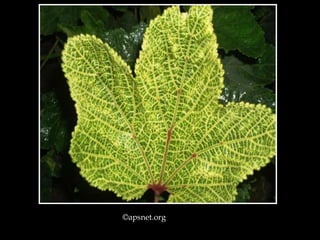
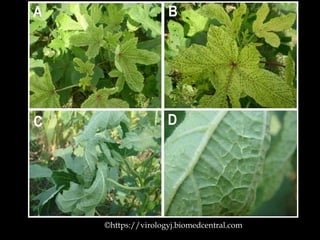
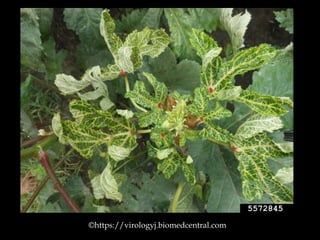
 The symptoms include alternate green and yellow
patches, vein clearing, and vein chlorosis of leaves.
 The yellow network of veins is very conspicuous,
and vein and veinlets are thickened.
 In severe cases, the chlorosis may extend to the
interveinal area and may result in complete
yellowing of leaves.
 Infected plants stunted and bear very deformed and
small, yellow green fruits.
©apsnet.org
©https://virologyj.biomedcentral.com
 Pathogen name: Bhendi yellow vein mosaic virus
 Wild hosts of virus : Rail weed (Croton sparsiflora),
and goat weed (Ageratum sp).
 The causal agent is the single-stranded DNA.
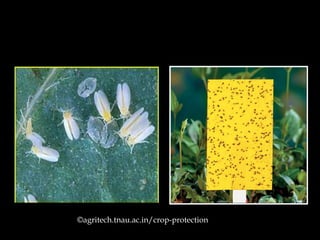
 Vector -Whitefly- Bemisia tabaci - Aleyrodidae
 The whitefly vector reproduces to significant
numbers during the summer season when it
transmits the virus between okra plants.
©agritech.tnau.ac.in/crop-protection
 The insect vectors transmit the virus from wild hosts
to the main crop. The disease is not seed borne.
 A continuous cycle is maintained through wild or
cultivated hosts.
 Climatic factors favour the population build up of
vectors and the prevalence of wild hosts.
 Grow resistant varieties like Parbhani Kranti, Arka
Abhay, Arka Anamika and Varsha Uphar to minimise
the incidence of the disease.
 Maintain proper crop spacing.
 Raise maize as a border crop to trap the insect.
 Set up yellow sticky traps @12/acre above the plant
height to minimize the pest incidence.
 Synthetic Pyrethroids should not be used because
they will aggravate the situation.
 When the infestation is 5-10 nymphs or adults per
leaf before 9 A.M. then go for chemical control:
 Spray acephate 75% SP @ 3 gm/ lit of water.
 Apply chlorpyrifos 20% EC @ 2.5 ml + Neem oil @ 2 ml/
litre of water
 R.S.Singh, Plant Diseases, Oxford &IBH
Pubilshing, co.pvt.Ltd-9th Edition, New Delhi.
PageNo(539-542).
 https://www.apsnet.org
 https://www.plantwise.org
 https://www.ncbi.nlm.nih.gov

Pandeeswari p 2015021091

  • 1.
    Bhendi Yellow VeinClearing STUDENT Miss. PANDEESWARI P ID. No. 2015021091 COURSE TEACHER Dr. PARTHASARATHY S Asst. Professor (Plant Pathology)
  • 2.
     Okra (Abelmoschusesculentus L. Moench) belongs to the family Malvaceae.  It is an important growing crop of Indo-Pak sub- continent.  This viral diseases infects during all the stages of growth. The most susceptible stage of is from 35 to 50 days.
  • 3.
     Bhendi yellowvein mosaic was first reported in okra plants in 1924 in India and Sri Lanka.  It is the most devastating disease in all the bhendi growing regions of India.
  • 4.
     The greatloss observed during rainy season.  In case the plants get infected at early stages of development it causes 80% of crop loss.  If the plants are infected at 50 and 65 days after germination suffer a loss of 84 and 49 percent respectively. The extent of damage declines with the delay in infection.
  • 5.
    Group II :ssDNA virus Family : Geminiviridae Genus : Begomovirus Species : Bhendi yellow vein mosaic virus
  • 6.
     The symptomsinclude alternate green and yellow patches, vein clearing, and vein chlorosis of leaves.  The yellow network of veins is very conspicuous, and vein and veinlets are thickened.
  • 7.
     In severecases, the chlorosis may extend to the interveinal area and may result in complete yellowing of leaves.  Infected plants stunted and bear very deformed and small, yellow green fruits.
  • 8.
  • 9.
  • 10.
  • 11.
     Pathogen name:Bhendi yellow vein mosaic virus  Wild hosts of virus : Rail weed (Croton sparsiflora), and goat weed (Ageratum sp).  The causal agent is the single-stranded DNA.
  • 12.
     Vector -Whitefly-Bemisia tabaci - Aleyrodidae  The whitefly vector reproduces to significant numbers during the summer season when it transmits the virus between okra plants.
  • 13.
  • 14.
     The insectvectors transmit the virus from wild hosts to the main crop. The disease is not seed borne.  A continuous cycle is maintained through wild or cultivated hosts.  Climatic factors favour the population build up of vectors and the prevalence of wild hosts.
  • 15.
     Grow resistantvarieties like Parbhani Kranti, Arka Abhay, Arka Anamika and Varsha Uphar to minimise the incidence of the disease.  Maintain proper crop spacing.  Raise maize as a border crop to trap the insect.  Set up yellow sticky traps @12/acre above the plant height to minimize the pest incidence.
  • 16.
     Synthetic Pyrethroidsshould not be used because they will aggravate the situation.  When the infestation is 5-10 nymphs or adults per leaf before 9 A.M. then go for chemical control:  Spray acephate 75% SP @ 3 gm/ lit of water.  Apply chlorpyrifos 20% EC @ 2.5 ml + Neem oil @ 2 ml/ litre of water
  • 17.
     R.S.Singh, PlantDiseases, Oxford &IBH Pubilshing, co.pvt.Ltd-9th Edition, New Delhi. PageNo(539-542).  https://www.apsnet.org  https://www.plantwise.org  https://www.ncbi.nlm.nih.gov