INTRODUCTION:
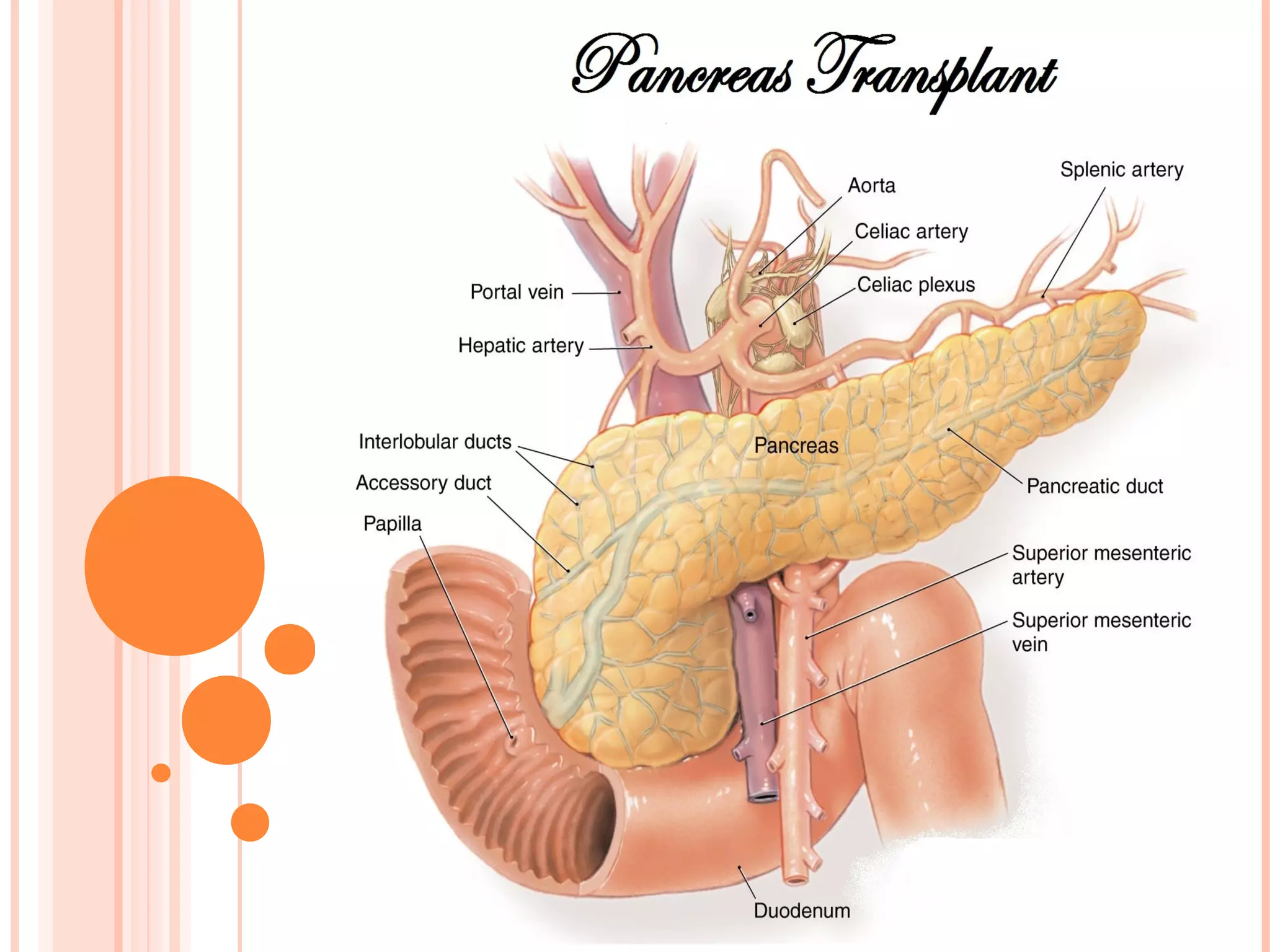
Our pancreas is an organ that
lies behind the lower part of
our stomach. It’s main function
is to make insulin, a hormone
that regulates the absorption of
the sugar into our cells.
Type 1 diabetes results when
our pancreas can’t make enough
insulin, causing our blood sugar
to rise to dangerous levels.
DEFINITION:
A pancreas transplant
is a surgical procedure
to place a healthy
pancreas from a
diceased donor into a
person whose pancreas
no longer functions
properly.
WHY IS IT DONE?:
It’s not a standard
treatment. Often, the
side effects of the anti-
rejection medications
required after a
pancreas transplant, can
be serious.
But if you have any
of the following, the
pancreas transplant
may be worthwhile:
1. Type 1 diabetes that
can’t be controlled with
standard treatment.
2. Frequent insulin
reactions.
3. Consistently poor blood
sugar control.
4. Severe kidney damage.
RISKS:
Pancreas transplant surgery
carries a risk of significant
complications, including:
Blood clots.
Bleeding.
Infections.
Excess sugar in your blood
(hyperglycemia).
Urinary complications, including
leaking or urinary tract infections.
Failured of the donated pancreas.
Rejection of the donated pancreas.
ANTI-REJECTION MEDICATION SIDE
EFFECTS:
 After a pancreas transplant, you will take
medications for the rest of your life to help
prevent your body from rejecting the donor
pancreas. These medications can cause a variety
of side effects, including:
1. Bone thinning.
2. High cholesterol.
3. High blood pressure.
4. Skin sensitivity.
5. Puffiness.
6. Weight gain.
7. Swollen gums.
8. Acne.
9. Excessive hair growth.
HOW YOU PREPARE: Choosing a transplant centre: If your doctor recommends
a pancreas transplant, you will be refered to a transplant
centre. You’re also free to select a transplant centre on
your own or choose a centre of your insurance company’s
list of preferred providers.
 Staying healthy: Whether you’re waiting for a donated
pancreas to become available or your transplant surgery
is already scheduled, it’s important to keep your mind
and body healthy.
1. Take your medications as prescribed.
2. Follow your diet and exercise guidelines.
3. Keep all the appointments with your health care team.
4. Stay involved in healthy activities, including relaxing and
spending time with families and friends.
If you’re waiting for a donated
pancreas, make sure the
transplant team knows how to
reach you at all times and
arranged transportation to the
transplant centre in advance.
WHAT CAN YOU EXPECT:
 During a pancreas transplant: Surgeons perform
pancreas transplant during general anesthesia, so
your unconscious during the procedure.
 Pancreas transplant surgery usually lasts about
three hours. Simultaneous kidney-pancreas
transplant surgery takes a few more hours.
AFTER A PANCREAS TRANSPLANT:1. Stay in the intensive care unit for a few days.
2. Spend about one week in the hospital.
3. Have frequent check ups as you continue
recovering.
4. Take lifelong medications.
 After a successful pancreas transplant your
immune system will try to reject your new
pancreas. So you will need medications to
supress your immune system. Because of this,
your body will be more vulnerable to infections,
for that reason your doctor may also prescribe
antibacterial, antiviral and antifungal
medications.
RESULTS:
 If your new pancreas fails, you can resume insulin
treatments and consider a second transplant. This
decision will depend on your current health, your
ability to withstand surgery and your spectations
for maintaining a certain quality of life.
 The side effects of a pancreas transplant can be
significant, so a pancreas transplant is tipically
reserved for those who have serious diabetes
complications. A pancreas transplant is often done
in conjuction with a kidney transplant.
 Because type 2 diabetes occurs due to the body’s
inability to use insulin properly – and not beacuse
of a problem with insulin production in the
pancreas – a pancreas transplant isn’t a treatment
option for most people with type 2 diabetes.

Info:
http://www.mayoclinic.com/health/pancreas-
transplant/MY00762
http://fremdeng.ning.com/profiles/blogs/stiff-a-fascinating-
read-but-not-for-the-faint-of-heart
Team:
Valeria Marchena;
Laura Ramírez;
Michael Cejas;
Jesica Rainhart.
Questions:
What aspects, in your opinion, are important to consider
when choosing a transplant centre?
what do you think about why the kidney transplant is done
simoultaneous to pancreas transplant?

Pancreas transplant

  • 2.
    INTRODUCTION: Our pancreas isan organ that lies behind the lower part of our stomach. It’s main function is to make insulin, a hormone that regulates the absorption of the sugar into our cells. Type 1 diabetes results when our pancreas can’t make enough insulin, causing our blood sugar to rise to dangerous levels.
  • 3.
    DEFINITION: A pancreas transplant isa surgical procedure to place a healthy pancreas from a diceased donor into a person whose pancreas no longer functions properly.
  • 4.
    WHY IS ITDONE?: It’s not a standard treatment. Often, the side effects of the anti- rejection medications required after a pancreas transplant, can be serious. But if you have any of the following, the pancreas transplant may be worthwhile: 1. Type 1 diabetes that can’t be controlled with standard treatment. 2. Frequent insulin reactions. 3. Consistently poor blood sugar control. 4. Severe kidney damage.
  • 5.
    RISKS: Pancreas transplant surgery carriesa risk of significant complications, including: Blood clots. Bleeding. Infections. Excess sugar in your blood (hyperglycemia). Urinary complications, including leaking or urinary tract infections. Failured of the donated pancreas. Rejection of the donated pancreas.
  • 6.
    ANTI-REJECTION MEDICATION SIDE EFFECTS: After a pancreas transplant, you will take medications for the rest of your life to help prevent your body from rejecting the donor pancreas. These medications can cause a variety of side effects, including: 1. Bone thinning. 2. High cholesterol. 3. High blood pressure. 4. Skin sensitivity. 5. Puffiness. 6. Weight gain. 7. Swollen gums. 8. Acne. 9. Excessive hair growth.
  • 7.
    HOW YOU PREPARE:Choosing a transplant centre: If your doctor recommends a pancreas transplant, you will be refered to a transplant centre. You’re also free to select a transplant centre on your own or choose a centre of your insurance company’s list of preferred providers.  Staying healthy: Whether you’re waiting for a donated pancreas to become available or your transplant surgery is already scheduled, it’s important to keep your mind and body healthy. 1. Take your medications as prescribed. 2. Follow your diet and exercise guidelines. 3. Keep all the appointments with your health care team. 4. Stay involved in healthy activities, including relaxing and spending time with families and friends. If you’re waiting for a donated pancreas, make sure the transplant team knows how to reach you at all times and arranged transportation to the transplant centre in advance.
  • 8.
    WHAT CAN YOUEXPECT:  During a pancreas transplant: Surgeons perform pancreas transplant during general anesthesia, so your unconscious during the procedure.  Pancreas transplant surgery usually lasts about three hours. Simultaneous kidney-pancreas transplant surgery takes a few more hours. AFTER A PANCREAS TRANSPLANT:1. Stay in the intensive care unit for a few days. 2. Spend about one week in the hospital. 3. Have frequent check ups as you continue recovering. 4. Take lifelong medications.  After a successful pancreas transplant your immune system will try to reject your new pancreas. So you will need medications to supress your immune system. Because of this, your body will be more vulnerable to infections, for that reason your doctor may also prescribe antibacterial, antiviral and antifungal medications.
  • 9.
    RESULTS:  If yournew pancreas fails, you can resume insulin treatments and consider a second transplant. This decision will depend on your current health, your ability to withstand surgery and your spectations for maintaining a certain quality of life.  The side effects of a pancreas transplant can be significant, so a pancreas transplant is tipically reserved for those who have serious diabetes complications. A pancreas transplant is often done in conjuction with a kidney transplant.  Because type 2 diabetes occurs due to the body’s inability to use insulin properly – and not beacuse of a problem with insulin production in the pancreas – a pancreas transplant isn’t a treatment option for most people with type 2 diabetes.
  • 10.
     Info: http://www.mayoclinic.com/health/pancreas- transplant/MY00762 http://fremdeng.ning.com/profiles/blogs/stiff-a-fascinating- read-but-not-for-the-faint-of-heart Team: Valeria Marchena; Laura Ramírez; MichaelCejas; Jesica Rainhart. Questions: What aspects, in your opinion, are important to consider when choosing a transplant centre? what do you think about why the kidney transplant is done simoultaneous to pancreas transplant?