Futility In Liver
Transplantation
Dr. Abhishek Yadav
Senior consultant GI and Liver Transplantation 

VPS Lakeshore Hospital Kochi
Real life Scenario
• 18 year female patient with Acute liver failure 

• Referred to us on day 4, worsening mentation- intubated at presentation

• Lactate- 10 , on noradrenaline

• Family initially reluctant for transplantation

• Day 6- Ventilated, hemodynamicaly stable ( 2 inotropes), no sepsis, renal shut down—>requiring CRRT

• Family now wants to proceed with a transplantation
Is there a reasonable chance of survival with
transplantation
OR
Will the transplantation be Futile?
Medical Futility
“ Medicine is powerless for
those who are overmastered
by their disease”
Futility in Liver transplantation
Definitions
• Rana et al 2008- Post transplant mortality>wait list
mortality

• Lao et al 2010- One year mortality

• Petrowsky et al 2014- 90 day or in-hospital mortality

• Asrani et al 2015- >50% at 5 years
General definitions of
Futility
• Physiological futility- Transplant very early/very sick
patients 

• Imminent disease futility- Failure of life support pre
transplant

• Lethal condition futility- Advanced HCC

• Qualitative futility- Failure to thrive/ brain injury in ALF
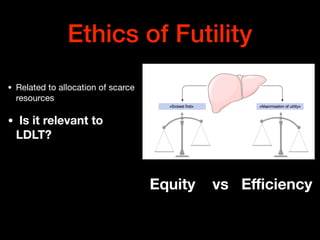
Ethics of Futility
• Related to allocation of scarce
resources 

• Is it relevant to
LDLT?
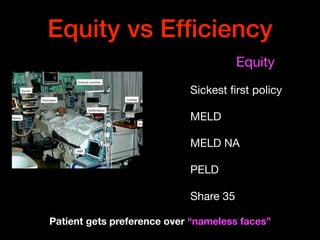
Equity vs Efficiency
Equity

Sickest first policy

MELD

MELD NA

PELD

Share 35
Patient gets preference over “nameless faces”
Equity vs Efficiency
Efficiency 

• Organs allocated where they can be utilised efficiently

• Kidney allocation model/exclude high risk transplants 

• Single patient benefit OR greatest benefit to aggregate of
patients 

• Medical and ethical challenge
Medical acuity
• Level of severity of an illness

• Initially conceptualised for allocation of nursing resources
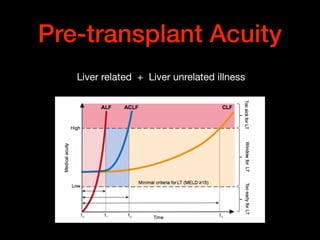
Pre-transplant Acuity
Liver related + Liver unrelated illness
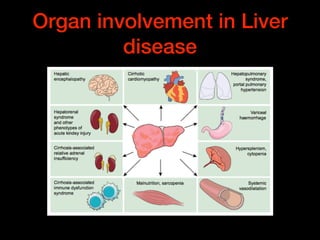
Organ involvement in Liver
disease
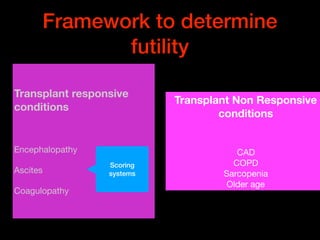
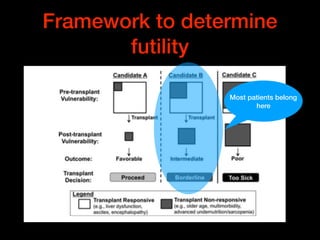
Framework to determine
futility
Transplant responsive
conditions 

Encephalopathy 

Ascites

Coagulopathy
Scoring
systems
Transplant Non Responsive
conditions
CAD

COPD

Sarcopenia

Older age
Framework to determine
futility
• a
Most patients belong
here
Scenarios
• Transplantation for high MELD patients - MELD>40

• Transplantation in ACLF

• Transplantation in ALF

• Age and Co-morbidities

• Frailty and Sarcopenia 

• Pulmonary conditions - PPH, HPS
Transplantation for MELD
>40
• MELD score was introduced in 2002 as an allocation
score 

• Not an outcomes assessment tool

• Most evidence suggests worse outcomes and higher
resource utilisation

• Is transplanting these patients worth it?

• Which subset predicts futility?
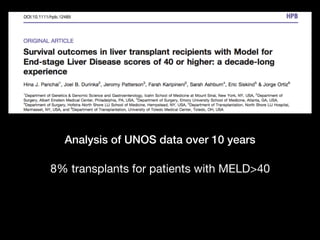
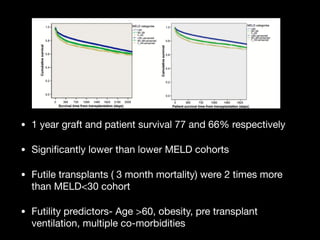
Analysis of UNOS data over 10 years
8% transplants for patients with MELD>40
• 1 year graft and patient survival 77 and 66% respectively 

• Significantly lower than lower MELD cohorts

• Futile transplants ( 3 month mortality) were 2 times more
than MELD<30 cohort 

• Futility predictors- Age >60, obesity, pre transplant
ventilation, multiple co-morbidities
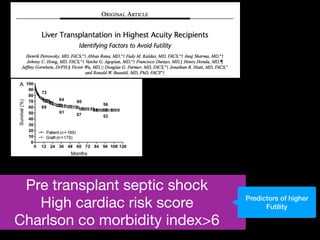
Pre transplant septic shock

High cardiac risk score

Charlson co morbidity index>6
Predictors of higher
Futility
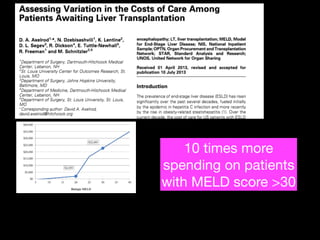
10 times more
spending on patients
with MELD score >30
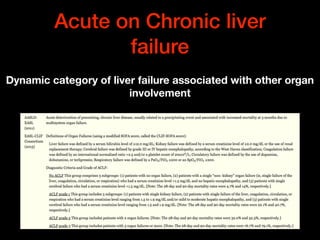
Acute on Chronic liver
failure
Dynamic category of liver failure associated with other organ
involvement
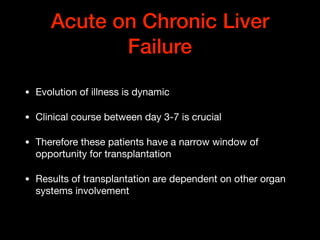
Acute on Chronic Liver
Failure
• Evolution of illness is dynamic

• Clinical course between day 3-7 is crucial 

• Therefore these patients have a narrow window of
opportunity for transplantation

• Results of transplantation are dependent on other organ
systems involvement
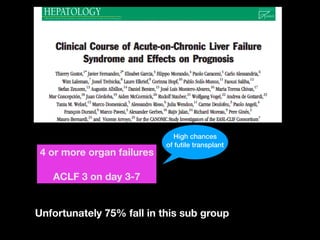
4 or more organ failures
ACLF 3 on day 3-7
High chances
of futile transplant
Unfortunately 75% fall in this sub group
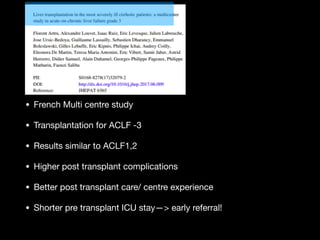
• French Multi centre study

• Transplantation for ACLF -3

• Results similar to ACLF1,2

• Higher post transplant complications 

• Better post transplant care/ centre experience

• Shorter pre transplant ICU stay—> early referral!
Acute on Chronic Liver
Failure
• Early listing for transplantation

• De- listing should be dynamic 

• Ongoing GI bleed, sepsis control <24 hours definite
contra indications

• Subjective parameters cannot be neglected

• Centre experience plays a major role in outcomes
Acute Liver Failure
• Accounts for 10-15% of transplants world wide

• Results of transplantation worse than other indications

• Well defined listing criteria King’s college criteria etc

• Few guidelines to guide when not to transplant other than
irreversible brain injury
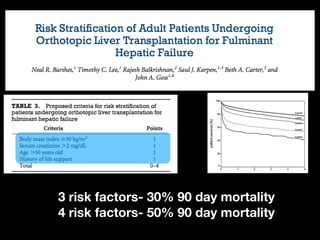
3 risk factors- 30% 90 day mortality
4 risk factors- 50% 90 day mortality
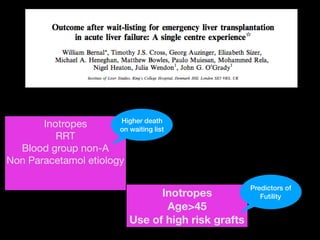
Inotropes

RRT

Blood group non-A

Non Paracetamol etiology 

Higher death
on waiting list
Inotropes
Age>45
Use of high risk grafts
Predictors of
Futility
Age and Co morbidities
• Increasingly geriatric population being listed for
transplantation

• 5% in the UNOS database >70 years

• Marginally lower survival when age adjusted for co
morbidities

• No defined age cut off 

• Most centres would not list above 75 years
Co Morbidities and Futility
• Few studies have evaluated the effects of co morbidities
on results of transplantation

• Though individual diseases might not affect the outcomes

• A combination of co morbidities might be ominous —>
the concept of multiplication of risk factors
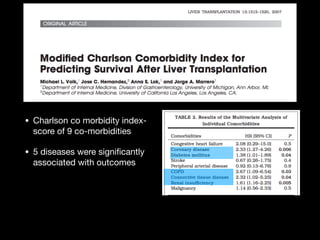
• Charlson co morbidity index-
score of 9 co-morbidities 

• 5 diseases were significantly
associated with outcomes
Physical Frailty and
Outcomes
• Frailty originates from geriatric practise

• Biological syndrome leading to increased vulnerability 

• Co-morbidity is a risk factor for frailty

• Fried frailty index, six minute walk test, frailty index—>
scores for frailty

• Frail patients have a low reserve to tolerate complications
—> Sepsis, delayed graft function etc.
Sarcopenia and outcomes
• Effect of liver disease on sarcopenia is well described

• Gut- Liver axis and Liver-muscle axis are gaining interest 

• Sarcopenia is a good morphological correlate to frailty

• Hand grip strength, stair climb power test, six minute walk
distance, CT scan, bio electric impedance - Measures of
sarcopenia

• BMI, skin fold thickness unreliable because of fluid
retention
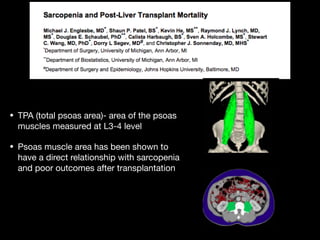
• TPA (total psoas area)- area of the psoas
muscles measured at L3-4 level

• Psoas muscle area has been shown to
have a direct relationship with sarcopenia
and poor outcomes after transplantation
Pulmonary complications
• Hepato- pulmonary syndrome
• 15-30% prevalence 

• PaO2 <70, intra pulmonary shunts 

• No correlation with severity of liver diseases

• No evidence of poor post transplant outcomes
Pulmonary Complications
• Porto pulmonary hypertension
• mPAP>25, PVR >240 dynes/cm, pawp<15mm hg

• Mild-mPAP 25-35; Moderate-mPAP 35-45; Severe-
mPAP >45

• Reversibility with transplantation unpredictable

• High peri operative mortality 

• High futility when unresponsive to medical management
Scoring systems to predict
futility
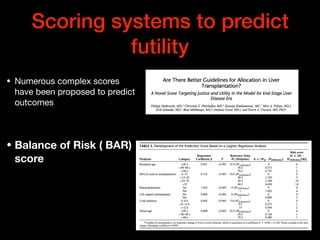
• Numerous complex scores
have been proposed to predict
outcomes 

• Balance of Risk ( BAR)
score
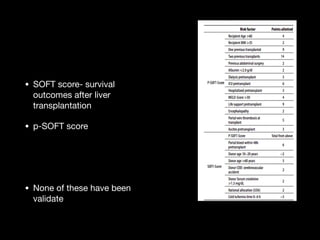
• SOFT score- survival
outcomes after liver
transplantation 

• p-SOFT score 

• None of these have been
validate
Too Sick to Transplant
• >4 organ failure (liver, kidney, lungs, circulation, brain)

• Brain oedema and herniation

• Circulatory failure>vasopressors with limited responsiveness

• Severe PPH

• Maximal ventilatory support/ECMO

• Infection- bacteraemia/ fungaemia, septic shock, active SBP
Conclusions
• No reliable and validated de-listing criteria exist

• Very small window of opportunity to transplant in ALF and
ACLF

• Transplant non-responsive conditions should weigh heavy in
decision making

• High MELD patients entail higher resources and
complications

• Extra hepatic system involvement determines success in
transplantation for ACLF
Conclusions
• Combination of co morbidities could determine futility

• Frailty and Sarcopenia are often neglected in decision making

• There will always be an element of subjectivity
• Criteria shift with individual and centre
experience

Futility in liver transplantation

  • 1.
    Futility In Liver Transplantation Dr.Abhishek Yadav Senior consultant GI and Liver Transplantation VPS Lakeshore Hospital Kochi
  • 2.
    Real life Scenario •18 year female patient with Acute liver failure • Referred to us on day 4, worsening mentation- intubated at presentation • Lactate- 10 , on noradrenaline • Family initially reluctant for transplantation • Day 6- Ventilated, hemodynamicaly stable ( 2 inotropes), no sepsis, renal shut down—>requiring CRRT • Family now wants to proceed with a transplantation Is there a reasonable chance of survival with transplantation OR Will the transplantation be Futile?
  • 3.
    Medical Futility “ Medicineis powerless for those who are overmastered by their disease”
  • 4.
    Futility in Livertransplantation Definitions • Rana et al 2008- Post transplant mortality>wait list mortality • Lao et al 2010- One year mortality • Petrowsky et al 2014- 90 day or in-hospital mortality • Asrani et al 2015- >50% at 5 years
  • 5.
    General definitions of Futility •Physiological futility- Transplant very early/very sick patients • Imminent disease futility- Failure of life support pre transplant • Lethal condition futility- Advanced HCC • Qualitative futility- Failure to thrive/ brain injury in ALF
  • 6.
    Ethics of Futility •Related to allocation of scarce resources • Is it relevant to LDLT? Equity vs Efficiency
  • 7.
    Equity vs Efficiency Equity Sickestfirst policy MELD MELD NA PELD Share 35 Patient gets preference over “nameless faces”
  • 8.
    Equity vs Efficiency Efficiency • Organs allocated where they can be utilised efficiently • Kidney allocation model/exclude high risk transplants • Single patient benefit OR greatest benefit to aggregate of patients • Medical and ethical challenge
  • 9.
    Medical acuity • Levelof severity of an illness • Initially conceptualised for allocation of nursing resources
  • 10.
    Pre-transplant Acuity Liver related+ Liver unrelated illness
  • 11.
    Organ involvement inLiver disease
  • 12.
    Framework to determine futility Transplantresponsive conditions Encephalopathy Ascites Coagulopathy Scoring systems Transplant Non Responsive conditions CAD COPD Sarcopenia Older age
  • 13.
    Framework to determine futility •a Most patients belong here
  • 14.
    Scenarios • Transplantation forhigh MELD patients - MELD>40 • Transplantation in ACLF • Transplantation in ALF • Age and Co-morbidities • Frailty and Sarcopenia • Pulmonary conditions - PPH, HPS
  • 15.
    Transplantation for MELD >40 •MELD score was introduced in 2002 as an allocation score • Not an outcomes assessment tool • Most evidence suggests worse outcomes and higher resource utilisation • Is transplanting these patients worth it? • Which subset predicts futility?
  • 16.
    Analysis of UNOSdata over 10 years 8% transplants for patients with MELD>40
  • 17.
    • 1 yeargraft and patient survival 77 and 66% respectively • Significantly lower than lower MELD cohorts • Futile transplants ( 3 month mortality) were 2 times more than MELD<30 cohort • Futility predictors- Age >60, obesity, pre transplant ventilation, multiple co-morbidities
  • 18.
    Pre transplant septicshock High cardiac risk score Charlson co morbidity index>6 Predictors of higher Futility
  • 19.
    10 times more spendingon patients with MELD score >30
  • 20.
    Acute on Chronicliver failure Dynamic category of liver failure associated with other organ involvement
  • 21.
    Acute on ChronicLiver Failure • Evolution of illness is dynamic • Clinical course between day 3-7 is crucial • Therefore these patients have a narrow window of opportunity for transplantation • Results of transplantation are dependent on other organ systems involvement
  • 22.
    4 or moreorgan failures ACLF 3 on day 3-7 High chances of futile transplant Unfortunately 75% fall in this sub group
  • 23.
    • French Multicentre study • Transplantation for ACLF -3 • Results similar to ACLF1,2 • Higher post transplant complications • Better post transplant care/ centre experience • Shorter pre transplant ICU stay—> early referral!
  • 24.
    Acute on ChronicLiver Failure • Early listing for transplantation • De- listing should be dynamic • Ongoing GI bleed, sepsis control <24 hours definite contra indications • Subjective parameters cannot be neglected • Centre experience plays a major role in outcomes
  • 25.
    Acute Liver Failure •Accounts for 10-15% of transplants world wide • Results of transplantation worse than other indications • Well defined listing criteria King’s college criteria etc • Few guidelines to guide when not to transplant other than irreversible brain injury
  • 26.
    3 risk factors-30% 90 day mortality 4 risk factors- 50% 90 day mortality
  • 27.
    Inotropes RRT Blood group non-A NonParacetamol etiology Higher death on waiting list Inotropes Age>45 Use of high risk grafts Predictors of Futility
  • 28.
    Age and Comorbidities • Increasingly geriatric population being listed for transplantation • 5% in the UNOS database >70 years • Marginally lower survival when age adjusted for co morbidities • No defined age cut off • Most centres would not list above 75 years
  • 29.
    Co Morbidities andFutility • Few studies have evaluated the effects of co morbidities on results of transplantation • Though individual diseases might not affect the outcomes • A combination of co morbidities might be ominous —> the concept of multiplication of risk factors
  • 30.
    • Charlson comorbidity index- score of 9 co-morbidities • 5 diseases were significantly associated with outcomes
  • 31.
    Physical Frailty and Outcomes •Frailty originates from geriatric practise • Biological syndrome leading to increased vulnerability • Co-morbidity is a risk factor for frailty • Fried frailty index, six minute walk test, frailty index—> scores for frailty • Frail patients have a low reserve to tolerate complications —> Sepsis, delayed graft function etc.
  • 32.
    Sarcopenia and outcomes •Effect of liver disease on sarcopenia is well described • Gut- Liver axis and Liver-muscle axis are gaining interest • Sarcopenia is a good morphological correlate to frailty • Hand grip strength, stair climb power test, six minute walk distance, CT scan, bio electric impedance - Measures of sarcopenia • BMI, skin fold thickness unreliable because of fluid retention
  • 33.
    • TPA (totalpsoas area)- area of the psoas muscles measured at L3-4 level • Psoas muscle area has been shown to have a direct relationship with sarcopenia and poor outcomes after transplantation
  • 34.
    Pulmonary complications • Hepato-pulmonary syndrome • 15-30% prevalence • PaO2 <70, intra pulmonary shunts • No correlation with severity of liver diseases • No evidence of poor post transplant outcomes
  • 35.
    Pulmonary Complications • Portopulmonary hypertension • mPAP>25, PVR >240 dynes/cm, pawp<15mm hg • Mild-mPAP 25-35; Moderate-mPAP 35-45; Severe- mPAP >45 • Reversibility with transplantation unpredictable • High peri operative mortality • High futility when unresponsive to medical management
  • 36.
    Scoring systems topredict futility • Numerous complex scores have been proposed to predict outcomes • Balance of Risk ( BAR) score
  • 37.
    • SOFT score-survival outcomes after liver transplantation • p-SOFT score • None of these have been validate
  • 38.
    Too Sick toTransplant • >4 organ failure (liver, kidney, lungs, circulation, brain) • Brain oedema and herniation • Circulatory failure>vasopressors with limited responsiveness • Severe PPH • Maximal ventilatory support/ECMO • Infection- bacteraemia/ fungaemia, septic shock, active SBP
  • 39.
    Conclusions • No reliableand validated de-listing criteria exist • Very small window of opportunity to transplant in ALF and ACLF • Transplant non-responsive conditions should weigh heavy in decision making • High MELD patients entail higher resources and complications • Extra hepatic system involvement determines success in transplantation for ACLF
  • 40.
    Conclusions • Combination ofco morbidities could determine futility • Frailty and Sarcopenia are often neglected in decision making • There will always be an element of subjectivity • Criteria shift with individual and centre experience