Empty vessels? Conceptualisation of ‘the child’ in parenting discourse Dr Pam LoweAston UniversityDr Geraldine Brady Coventry University  
OutlineThe rise of parenting cultureThe ‘child’  in parenting culture The child as an empty vesselChildren as social actors
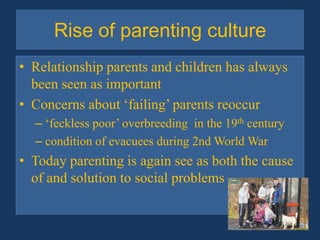
Rise of parenting cultureRelationship parents and children has always been seen as important  Concerns about ‘failing’ parents reoccur ‘feckless poor’ overbreeding  in the 19th centurycondition of evacuees during 2nd World War Today parenting is again see as both the cause of and solution to social problems
Rise of parenting cultureWithin current parenting discourse we can see three interrelated themes of importanceParenting as the determining factor Parents totally responsible for  children’s health, education, behaviour etc  Emphasis  on intensive motherhoodParenting as a project aimed to achieve the 	‘best outcomes ‘Rise of parenting ‘science’Parenting ‘rules’ using (and abusing) science
Rise of parenting cultureAs part of this culture ‘parenting programmes’ are seen as the policy solution to ‘problem’ parentingParenting programmes ‘translate’ the science of parenting into practiceNeed to be considered as part of the individualisation of social issues within a neo-liberal public health discourse
The ‘child’  in parenting cultureParenting programmes seek to modify the parents behaviourThus a child’s deviance is mostly 	(or even all) due to poor parenting practicesThus the child is a just a malleable compliant body whose life trajectory is to be decided by the actions and/or inactions of others.
The child as an empty vesselWithin child development theories, the child is progresses:irrational  to rationalincompetence to competenceasocial to social Socialisation is linked to development theory in producing ‘competent citizens’
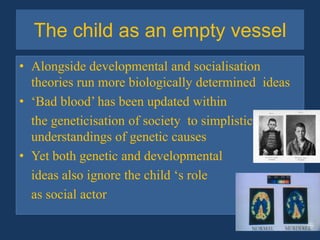
The child as an empty vesselAlongside developmental and socialisation theories run more biologically determined  ideas‘Bad blood’ has been updated within 	the geneticisationof society  to simplistic understandings of genetic causesYet both genetic and developmental	ideas also ignore the child ‘s role 	as social actor
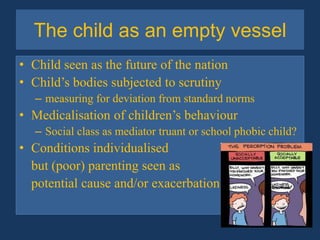
The child as an empty vesselChild seen as the future of the nationChild’s bodies subjected to scrutinymeasuring for deviation from standard normsMedicalisation of children’s behaviourSocial class as mediator truant or school phobic child?Conditions individualised 	but (poor) parenting seen as 	potential cause and/or exacerbation
Children as social actorsPrevious research has revealed that children are social actorsPlay an active role in negotiating 	their own livesParental/child relationship is reciprocal not unidirectional
Children as social actorsOur previous research has shown:How sleep is negotiated between parents and children. Children understand their need for sleep but try to balance this with their desire for leisure timeChildren make strategic decisions around medicationUnderstanding the impact of their bodies, and how it might impact on their chosen activitiesChildren understand but may reject advice about sexual healthFully accepting that any consequences are from theri own actions.
Children as social actorsCurrent discourse of parenting has a pervasive element of determinismGood parenting in / useful citizen outIgnores the child as a person within specific social and cultural circumstances
SummaryParenting polices have increasing levels of coercion and consequencesIncreasingly seen as the dominant cause of social problems But built on an understanding of children as a empty vessel
SummaryParenting discourse that regards children as empty vessels is a significant miscalculationChildren are unique social beings and that a uniform approach is problematic  The omission of full understanding of children will undermine the outcomes of this policy agenda Potentially serious implications for children and parents caught up in the policy

Pam lowe empty vessels

  • 1.
    Empty vessels? Conceptualisationof ‘the child’ in parenting discourse Dr Pam LoweAston UniversityDr Geraldine Brady Coventry University  
  • 2.
    OutlineThe rise ofparenting cultureThe ‘child’ in parenting culture The child as an empty vesselChildren as social actors
  • 3.
    Rise of parentingcultureRelationship parents and children has always been seen as important Concerns about ‘failing’ parents reoccur ‘feckless poor’ overbreeding in the 19th centurycondition of evacuees during 2nd World War Today parenting is again see as both the cause of and solution to social problems
  • 4.
    Rise of parentingcultureWithin current parenting discourse we can see three interrelated themes of importanceParenting as the determining factor Parents totally responsible for children’s health, education, behaviour etc Emphasis on intensive motherhoodParenting as a project aimed to achieve the ‘best outcomes ‘Rise of parenting ‘science’Parenting ‘rules’ using (and abusing) science
  • 5.
    Rise of parentingcultureAs part of this culture ‘parenting programmes’ are seen as the policy solution to ‘problem’ parentingParenting programmes ‘translate’ the science of parenting into practiceNeed to be considered as part of the individualisation of social issues within a neo-liberal public health discourse
  • 6.
    The ‘child’ in parenting cultureParenting programmes seek to modify the parents behaviourThus a child’s deviance is mostly (or even all) due to poor parenting practicesThus the child is a just a malleable compliant body whose life trajectory is to be decided by the actions and/or inactions of others.
  • 7.
    The child asan empty vesselWithin child development theories, the child is progresses:irrational to rationalincompetence to competenceasocial to social Socialisation is linked to development theory in producing ‘competent citizens’
  • 8.
    The child asan empty vesselAlongside developmental and socialisation theories run more biologically determined ideas‘Bad blood’ has been updated within the geneticisationof society to simplistic understandings of genetic causesYet both genetic and developmental ideas also ignore the child ‘s role as social actor
  • 9.
    The child asan empty vesselChild seen as the future of the nationChild’s bodies subjected to scrutinymeasuring for deviation from standard normsMedicalisation of children’s behaviourSocial class as mediator truant or school phobic child?Conditions individualised but (poor) parenting seen as potential cause and/or exacerbation
  • 10.
    Children as socialactorsPrevious research has revealed that children are social actorsPlay an active role in negotiating their own livesParental/child relationship is reciprocal not unidirectional
  • 11.
    Children as socialactorsOur previous research has shown:How sleep is negotiated between parents and children. Children understand their need for sleep but try to balance this with their desire for leisure timeChildren make strategic decisions around medicationUnderstanding the impact of their bodies, and how it might impact on their chosen activitiesChildren understand but may reject advice about sexual healthFully accepting that any consequences are from theri own actions.
  • 12.
    Children as socialactorsCurrent discourse of parenting has a pervasive element of determinismGood parenting in / useful citizen outIgnores the child as a person within specific social and cultural circumstances
  • 13.
    SummaryParenting polices haveincreasing levels of coercion and consequencesIncreasingly seen as the dominant cause of social problems But built on an understanding of children as a empty vessel
  • 14.
    SummaryParenting discourse thatregards children as empty vessels is a significant miscalculationChildren are unique social beings and that a uniform approach is problematic The omission of full understanding of children will undermine the outcomes of this policy agenda Potentially serious implications for children and parents caught up in the policy