Not Quite 
Happily Ever 
After 
• All family situations are 
not fairy tales….
Many at home scenarios can cause 
undesirable situations that affect the 
student’s abilities in school and their services 
• Homelessness 
• Teen Parents 
• Legal or Criminal Issues 
• Work Related Factors 
• Education 
• All these factors can make it 
difficult for a child to effectively 
receive their services in school and 
also difficult to communicate with 
parents who may have other 
worries in their life.
Fear, uncertainty, hunger, 
instability, and parents who may 
be worried about 
survival…these are the issues 
educators face with the, 
“1,168,354 students enrolled in 
American preschools and K-12 
schools were homeless in 2012. 
The number is a 10 percent 
increase from the previous year, 
and a nearly 75 percent 
increase since the recession 
began.”
The future does 
not hold an end to 
homelessness. In 
fact as current 
trends continue, 
instructors can 
expect to see a 
rising struggle with 
these students. 
•
Recognize the needs of the 
individual child. 
Communicate with the 
caregiver. Remember to 
refer to additional 
resources for the child. An 
educational crises may not 
be an immediate focus for 
the family, make sure you 
share any concerns with 
anyone who can help the 
child. Guardians, school 
counselors, and principals 
can be excellent resources. 
"If we wish to 
prevent another 
generation of 
children from 
becoming homeless 
adults, we must 
meet their basic 
needs and ensure a 
stable, supportive 
school 
environment.”
Teenagers…every single one of 
them….a little fact that is 
conveniently forgotten…
Teen Parents 
Children with teen parents face a myriad of possible 
problems: 
Lack of parental knowledge 
Lack of support in the home 
Possible unstable home life 
Many times single parent household 
Lack of financial support 
Lack of parental education 
Lack of parental support system that is needed to extend 
to the child
Only 77% of children born to teen parents will receive a high school diploma compared to 89% of children 
born to older parent 
23,600 or 5% of children born to teen mothers will end up in foster care, partly due to higher rates of abuse 
Consistent contraceptive use is less likely among children of teen parents, who are more likely to be 
sexually active by age 14. As a result, these children are at higher risk of becoming teen parents 
themselves
Remember, no matter what grade level you may be 
teaching, children born to teen parents have needs 
that extend through their own teen years. They 
have high risk of becoming teen parents themselves 
and of incompletion of high school. 
Recognize the needs of the individual child. 
Communicate with the caregiver. Remember to refer 
to additional resources for the child. An educational 
crises may not be an immediate focus for the family, 
make sure you share any concerns with anyone who 
can help the child. Guardians, school counselors, and 
principals can be excellent resources.
Everyone has a skeleton 
or two in their family 
tree…but sometimes they 
can interfere with a 
student’s ability to focus 
on education. 
Legal or Criminal Issues do not 
just impact the adults in the 
family, children are greatly 
affected by incarcerated 
parents or siblings, as well as 
those with other legal 
problems.
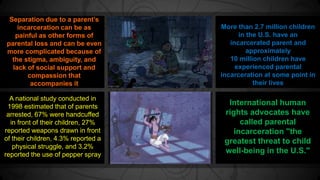
Separation due to a parent’s 
incarceration can be as 
painful as other forms of 
parental loss and can be even 
more complicated because of 
the stigma, ambiguity, and 
lack of social support and 
compassion that 
accompanies it 
More than 2.7 million children 
in the U.S. have an 
incarcerated parent and 
approximately 
10 million children have 
experienced parental 
incarceration at some point in 
their lives 
International human 
rights advocates have 
called parental 
incarceration "the 
greatest threat to child 
well-being in the U.S." 
A national study conducted in 
1998 estimated that of parents 
arrested, 67% were handcuffed 
in front of their children, 27% 
reported weapons drawn in front 
of their children, 4.3% reported a 
physical struggle, and 3.2% 
reported the use of pepper spray
A misperception exists that 
children of incarcerated 
parents are more likely to be 
incarcerated than their peers, 
and are predisposed to 
criminal activity. There is no 
basis for this in existing 
research 
Recognize the needs of the individual child. 
Communicate with the caregiver. Remember to refer 
to additional resources for the child. An educational 
crises may not be an immediate focus for the family, 
make sure you share any concerns with anyone who 
can help the child. Guardians, school counselors, and 
principals can be excellent resources.
There are many different work 
issues a family can face…. 
-Lack of a job 
-Interruption of employment 
-Change of Income 
-Parents numerous jobs 
-Stress carry over to home 
-Lack of time for the family 
Students whose teachers reported higher 
levels of parental involvement were more 
likely to graduate high school or earn a 
GED than peers whose parents were not 
so involved, and those who did not 
graduate were more likely to have 
completed a higher grade in high school. 
The more years a parent was involved, 
the greater was this association with 
educational attainment
Parents Matter 
to All Children 
The greater the fathers’ involvement 
was, the lower the level of adolescents’ 
behavioral problems, both in terms of 
aggression and antisocial behavior and 
negative feelings such as anxiety, 
depression, and low selfesteem. 
Fathers’ involvement was measured by 
the frequency with which fathers 
discussed important decisions with and 
listened to their adolescents, whether 
fathers knew who their adolescents 
were with when not at home, and 
whether fathers missed events or 
activities that were important to their 
adolescents. Other measures included 
as adolescents’ reports of closeness to 
their fathers, whether their fathers 
spent sufficient time with them, and 
how well they shared and 
communicated with one another. 
On average, youths whose fathers 
engage in leisure and educational 
activities with them achieve better 
grades than peers whose fathers 
spend less time with them. Pre-teens 
whose fathers spent leisure time away 
from the home (picnics, movies, sports, 
etc.) with them, shared meals with them, 
helped with homework or reading, and 
engaged in other home activities with 
them earned better grades in school, on 
average, than peers whose fathers spent 
less time with them. Similarly, teens 
whose fathers engaged in activities in the 
home and outdoors, spent leisure time, 
and talked with them earned better 
grades, on average, than teens whose 
fathers spent less time with them
Remember, financial situations may not 
be the only factor in a work related 
family issue. If a parent is 
absentee…no matter where they are, 
they can cause adverse reactions on 
their child’s education. Educational 
issues are typically associated with 
lower socioeconomic issues, but 
children are at risk with parent’s whose 
jobs, or lack thereof, interferes with 
their education. 
Recognize the needs of the 
individual child. Communicate with 
the caregiver. Remember to refer to 
additional resources for the child. 
An educational crises may not be an 
immediate focus for the family, make 
sure you share any concerns with 
anyone who can help the child. 
Guardians, school counselors, and 
principals can be excellent 
resources.
Education can actually interfere with 
education…There are numerous 
factors. The first and most obvious, 
a lack of valued education in the 
home. If a student’s family does not 
value education, the student 
themselves will not value it either. 
Parents may seem uninterested in 
“school issues” if they do not feel the 
education is important. This can 
cause a life-long hindrance to the 
child, as they struggle to find the 
balance between home and school.
Students with Parents 
who 
Value Education 
•Earn higher grades and test scores, and enroll in higher-level 
programs 
•Be promoted, pass their classes, and earn credits 
•Attend school regularly 
•Have better social skills, show improved behavior, and 
adapt well to school 
•Graduate and go on to postsecondary education
Parents may value education, but 
not understand their 
roles…schools can help parents 
learn what they can do to help 
and why it is important to the 
success of their child. 
The entire IEP process may be 
a challenge for some parents. 
The teacher may need to 
educate the parents about their 
rights and abilities for planning 
and executing an IEP. 
Teachers may need to offer 
additional support to teach 
special needs parents what they 
can do at home to help their 
child. There is a lot of learning 
that occurs at home!
A Special Education Teacher once shared the story with me of a 
student she had on her caseload. This student had two 
cardiothoracic surgeons for parents, and three brilliant siblings. 
This child barely qualified for services, and only with strong pushing 
by the parents, who did not understand why their athletic child, was 
simply not an “A” student like his siblings…. Here, the high 
education of his family made the student seem inadequate. While 
rare, cases like this, where strengths of the student should be 
encouraged, may help the parents realize where their expectations 
for the child should lie. As a teacher, it would not be my place to tell 
parents what they should/should not do. But I can encourage the 
student to expand their skill strengths, while helping them in areas 
that have begun to struggle in. 
Recognize the needs of the individual 
child. Communicate with the caregiver. 
Remember to refer to additional resources 
for the child. An educational crises may 
not be an immediate focus for the family, 
make sure you share any concerns with 
anyone who can help the child. 
Guardians, school counselors, and 
principals can be excellent resources.
Recognize the needs of the individual child. 
Communicate with the caregiver. Remember to 
refer to additional resources for the child. An 
educational crises may not be an immediate 
focus for the family, make sure you share any 
concerns with anyone who can help the child. 
Guardians, school counselors, and principals can 
be excellent resources. 
Are you beginning to see a 
theme?
Each Child is an Individual…. 
• NO matter what their back story… 
• Their socioeconomic background…. 
• Their family situation…. 
• Rich or Poor…. Involved Parents…Parents that Ignore… 
• Busy Lifestyles…. Nothing fun to do…. 
• Each child has one thing in common…. Their reason for being in your 
classroom 
• How do we look at room of students….each one so different yet the same? 
How do we help that many kids? It seems like an overwhelming task for one 
teacher!
Recognize the needs of the individual 
child. Communicate with the caregiver. 
Remember to refer to additional 
resources for the child. An educational 
crises may not be an immediate focus for 
the family, make sure you share any 
concerns with anyone who can help the 
child. Guardians, school counselors, and 
principals can be excellent resources. 
Not every child will be in 
crisis. Not every child will 
need personal intervention. 
As teachers we need to be 
ready to recognize that do 
need us!
When we recognize 
struggles, we can help 
students find their 
happily every education 
after….
http://www.usnews.com/news/articles/201 
3/10/25/number-of-homeless-students-has- 
soared-since-the-recession-began 
http://www.healthyteennetwork.org 
http://www.osborneny.org/images/uploads 
/printMedia/Initiative%20CIP%20Stats_ 
Fact%20Sheet.pdf 
http://www.familyfacts.org/briefs/40/parent 
al-involvement-and-childrens-well-being 
http://www.nea.org/tools/17360.htm

Not quite happily ever after

  • 1.
    Not Quite HappilyEver After • All family situations are not fairy tales….
  • 2.
    Many at homescenarios can cause undesirable situations that affect the student’s abilities in school and their services • Homelessness • Teen Parents • Legal or Criminal Issues • Work Related Factors • Education • All these factors can make it difficult for a child to effectively receive their services in school and also difficult to communicate with parents who may have other worries in their life.
  • 3.
    Fear, uncertainty, hunger, instability, and parents who may be worried about survival…these are the issues educators face with the, “1,168,354 students enrolled in American preschools and K-12 schools were homeless in 2012. The number is a 10 percent increase from the previous year, and a nearly 75 percent increase since the recession began.”
  • 4.
    The future does not hold an end to homelessness. In fact as current trends continue, instructors can expect to see a rising struggle with these students. •
  • 5.
    Recognize the needsof the individual child. Communicate with the caregiver. Remember to refer to additional resources for the child. An educational crises may not be an immediate focus for the family, make sure you share any concerns with anyone who can help the child. Guardians, school counselors, and principals can be excellent resources. "If we wish to prevent another generation of children from becoming homeless adults, we must meet their basic needs and ensure a stable, supportive school environment.”
  • 6.
    Teenagers…every single oneof them….a little fact that is conveniently forgotten…
  • 7.
    Teen Parents Childrenwith teen parents face a myriad of possible problems: Lack of parental knowledge Lack of support in the home Possible unstable home life Many times single parent household Lack of financial support Lack of parental education Lack of parental support system that is needed to extend to the child
  • 8.
    Only 77% ofchildren born to teen parents will receive a high school diploma compared to 89% of children born to older parent 23,600 or 5% of children born to teen mothers will end up in foster care, partly due to higher rates of abuse Consistent contraceptive use is less likely among children of teen parents, who are more likely to be sexually active by age 14. As a result, these children are at higher risk of becoming teen parents themselves
  • 9.
    Remember, no matterwhat grade level you may be teaching, children born to teen parents have needs that extend through their own teen years. They have high risk of becoming teen parents themselves and of incompletion of high school. Recognize the needs of the individual child. Communicate with the caregiver. Remember to refer to additional resources for the child. An educational crises may not be an immediate focus for the family, make sure you share any concerns with anyone who can help the child. Guardians, school counselors, and principals can be excellent resources.
  • 10.
    Everyone has askeleton or two in their family tree…but sometimes they can interfere with a student’s ability to focus on education. Legal or Criminal Issues do not just impact the adults in the family, children are greatly affected by incarcerated parents or siblings, as well as those with other legal problems.
  • 11.
    Separation due toa parent’s incarceration can be as painful as other forms of parental loss and can be even more complicated because of the stigma, ambiguity, and lack of social support and compassion that accompanies it More than 2.7 million children in the U.S. have an incarcerated parent and approximately 10 million children have experienced parental incarceration at some point in their lives International human rights advocates have called parental incarceration "the greatest threat to child well-being in the U.S." A national study conducted in 1998 estimated that of parents arrested, 67% were handcuffed in front of their children, 27% reported weapons drawn in front of their children, 4.3% reported a physical struggle, and 3.2% reported the use of pepper spray
  • 12.
    A misperception existsthat children of incarcerated parents are more likely to be incarcerated than their peers, and are predisposed to criminal activity. There is no basis for this in existing research Recognize the needs of the individual child. Communicate with the caregiver. Remember to refer to additional resources for the child. An educational crises may not be an immediate focus for the family, make sure you share any concerns with anyone who can help the child. Guardians, school counselors, and principals can be excellent resources.
  • 13.
    There are manydifferent work issues a family can face…. -Lack of a job -Interruption of employment -Change of Income -Parents numerous jobs -Stress carry over to home -Lack of time for the family Students whose teachers reported higher levels of parental involvement were more likely to graduate high school or earn a GED than peers whose parents were not so involved, and those who did not graduate were more likely to have completed a higher grade in high school. The more years a parent was involved, the greater was this association with educational attainment
  • 14.
    Parents Matter toAll Children The greater the fathers’ involvement was, the lower the level of adolescents’ behavioral problems, both in terms of aggression and antisocial behavior and negative feelings such as anxiety, depression, and low selfesteem. Fathers’ involvement was measured by the frequency with which fathers discussed important decisions with and listened to their adolescents, whether fathers knew who their adolescents were with when not at home, and whether fathers missed events or activities that were important to their adolescents. Other measures included as adolescents’ reports of closeness to their fathers, whether their fathers spent sufficient time with them, and how well they shared and communicated with one another. On average, youths whose fathers engage in leisure and educational activities with them achieve better grades than peers whose fathers spend less time with them. Pre-teens whose fathers spent leisure time away from the home (picnics, movies, sports, etc.) with them, shared meals with them, helped with homework or reading, and engaged in other home activities with them earned better grades in school, on average, than peers whose fathers spent less time with them. Similarly, teens whose fathers engaged in activities in the home and outdoors, spent leisure time, and talked with them earned better grades, on average, than teens whose fathers spent less time with them
  • 15.
    Remember, financial situationsmay not be the only factor in a work related family issue. If a parent is absentee…no matter where they are, they can cause adverse reactions on their child’s education. Educational issues are typically associated with lower socioeconomic issues, but children are at risk with parent’s whose jobs, or lack thereof, interferes with their education. Recognize the needs of the individual child. Communicate with the caregiver. Remember to refer to additional resources for the child. An educational crises may not be an immediate focus for the family, make sure you share any concerns with anyone who can help the child. Guardians, school counselors, and principals can be excellent resources.
  • 16.
    Education can actuallyinterfere with education…There are numerous factors. The first and most obvious, a lack of valued education in the home. If a student’s family does not value education, the student themselves will not value it either. Parents may seem uninterested in “school issues” if they do not feel the education is important. This can cause a life-long hindrance to the child, as they struggle to find the balance between home and school.
  • 17.
    Students with Parents who Value Education •Earn higher grades and test scores, and enroll in higher-level programs •Be promoted, pass their classes, and earn credits •Attend school regularly •Have better social skills, show improved behavior, and adapt well to school •Graduate and go on to postsecondary education
  • 18.
    Parents may valueeducation, but not understand their roles…schools can help parents learn what they can do to help and why it is important to the success of their child. The entire IEP process may be a challenge for some parents. The teacher may need to educate the parents about their rights and abilities for planning and executing an IEP. Teachers may need to offer additional support to teach special needs parents what they can do at home to help their child. There is a lot of learning that occurs at home!
  • 19.
    A Special EducationTeacher once shared the story with me of a student she had on her caseload. This student had two cardiothoracic surgeons for parents, and three brilliant siblings. This child barely qualified for services, and only with strong pushing by the parents, who did not understand why their athletic child, was simply not an “A” student like his siblings…. Here, the high education of his family made the student seem inadequate. While rare, cases like this, where strengths of the student should be encouraged, may help the parents realize where their expectations for the child should lie. As a teacher, it would not be my place to tell parents what they should/should not do. But I can encourage the student to expand their skill strengths, while helping them in areas that have begun to struggle in. Recognize the needs of the individual child. Communicate with the caregiver. Remember to refer to additional resources for the child. An educational crises may not be an immediate focus for the family, make sure you share any concerns with anyone who can help the child. Guardians, school counselors, and principals can be excellent resources.
  • 20.
    Recognize the needsof the individual child. Communicate with the caregiver. Remember to refer to additional resources for the child. An educational crises may not be an immediate focus for the family, make sure you share any concerns with anyone who can help the child. Guardians, school counselors, and principals can be excellent resources. Are you beginning to see a theme?
  • 21.
    Each Child isan Individual…. • NO matter what their back story… • Their socioeconomic background…. • Their family situation…. • Rich or Poor…. Involved Parents…Parents that Ignore… • Busy Lifestyles…. Nothing fun to do…. • Each child has one thing in common…. Their reason for being in your classroom • How do we look at room of students….each one so different yet the same? How do we help that many kids? It seems like an overwhelming task for one teacher!
  • 22.
    Recognize the needsof the individual child. Communicate with the caregiver. Remember to refer to additional resources for the child. An educational crises may not be an immediate focus for the family, make sure you share any concerns with anyone who can help the child. Guardians, school counselors, and principals can be excellent resources. Not every child will be in crisis. Not every child will need personal intervention. As teachers we need to be ready to recognize that do need us!
  • 23.
    When we recognize struggles, we can help students find their happily every education after….
  • 24.
    http://www.usnews.com/news/articles/201 3/10/25/number-of-homeless-students-has- soared-since-the-recession-began http://www.healthyteennetwork.org http://www.osborneny.org/images/uploads /printMedia/Initiative%20CIP%20Stats_ Fact%20Sheet.pdf http://www.familyfacts.org/briefs/40/parent al-involvement-and-childrens-well-being http://www.nea.org/tools/17360.htm