Privileged Access
Management (PAM)
Securing the 21st Century Enterprise
Lance Peterman
Agenda
What is PAM?
Industry perspective
Why PAM is necessary?
Identity is the New Perimeter
In the News
Recent Data Loss / Breaches
PAM as a Program/Service
The Practice
Collaboration is Key
Use Cases
Adoption Approach/Keys to Success
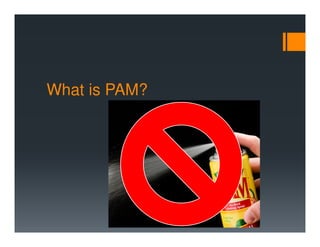
What is PAM?
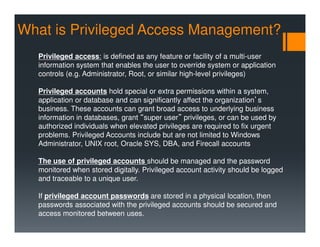
Privileged access: is defined as any feature or facility of a multi-user
information system that enables the user to override system or application
controls (e.g. Administrator, Root, or similar high-level privileges)
Privileged accounts hold special or extra permissions within a system,
application or database and can significantly affect the organization’s
business. These accounts can grant broad access to underlying business
information in databases, grant “super user” privileges, or can be used by
authorized individuals when elevated privileges are required to fix urgent
problems. Privileged Accounts include but are not limited to Windows
Administrator, UNIX root, Oracle SYS, DBA, and Firecall accounts
The use of privileged accounts should be managed and the password
monitored when stored digitally. Privileged account activity should be logged
and traceable to a unique user.
If privileged account passwords are stored in a physical location, then
passwords associated with the privileged accounts should be secured and
access monitored between uses.
What is Privileged Access Management?
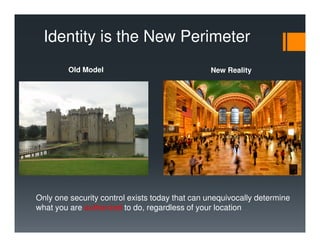
Identity is the New Perimeter
Only one security control exists today that can unequivocally determine
what you are authorized to do, regardless of your location
Old Model New Reality
Breaches, old and new…
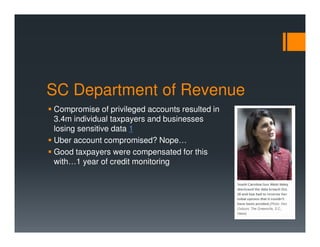
SC Department of Revenue
Compromise of privileged accounts resulted in
3.4m individual taxpayers and businesses
losing sensitive data 1
Uber account compromised? Nope…
Good taxpayers were compensated for this
with…1 year of credit monitoring
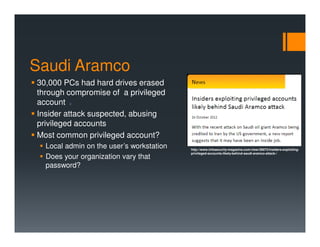
Saudi Aramco
30,000 PCs had hard drives erased
through compromise of a privileged
account 2
Insider attack suspected, abusing
privileged accounts
Most common privileged account?
Local admin on the user’s workstation
Does your organization vary that
password?
http://www.infosecurity-magazine.com/view/28973/insiders-exploiting-
privileged-accounts-likely-behind-saudi-aramco-attack-/
EBay
Spear Phishing targeted
key IT resources
Does your primary network
account have privileged
access?
Two factor
authentication…anyone?
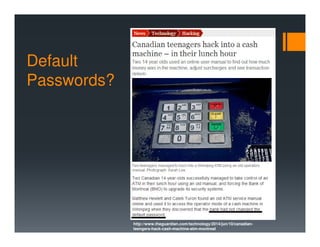
Default
Passwords?
http://www.theguardian.com/technology/2014/jun/10/canadian-
teengers-hack-cash-machine-atm-montreal
What does that tell us?
The threat landscape is changing…DAILY
“The compromise of privileged access is a key stage
in 100% of all advanced attacks.” – CyberSheath
Report 4/13 3
This is the critical attack vector for internal and
external threats
Verizon DBIR – “97% of all breaches are preventable
through basic and intermediate controls.”
43% of respondents in a 2012 survey did not have a
PAM practice or wasn’t sure if they did
The Practice of Privileged Access
Management (PAM)
Designed to answer:
Who has access
When it was used
Where it was used from
What was done
Technology is only One part of the equation – People &
Process are essential
Has to be part of your governance process, not just a one off
enrollment
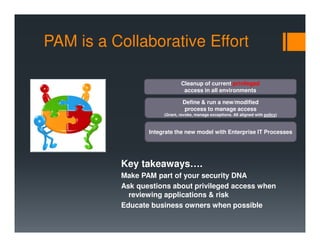
PAM is a Collaborative Effort
Key takeaways….
Make PAM part of your security DNA
Ask questions about privileged access when
reviewing applications & risk
Educate business owners when possible
Cleanup of current privileged
access in all environments
Define & run a new/modified
process to manage access
(Grant, revoke, manage exceptions. All aligned with policy)
Integrate the new model with Enterprise IT Processes
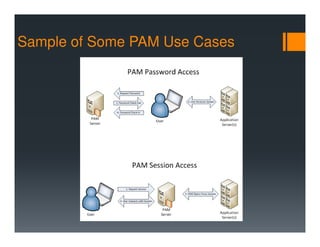
Sample of Some PAM Use Cases
Other PAM Use Cases
Script/batch management
Local workstation admin management
Cloud infrastructure, SaaS accounts
Virtualization platforms
Look at ALL hardware platforms
Adoption Approach
Pre-Engagement - business area
• Inventory of privileged accounts & their use
• Documentation of access processes (if available)
• List of candidate systems
• Prioritization of critical systems based on key criteria
• Regulatory constraints
• Data Type (PII / IPSI)
• Create/Revise access processes
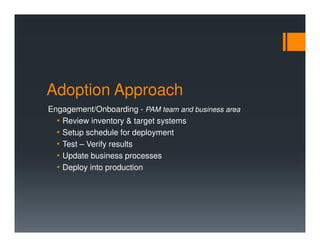
Adoption Approach
Engagement/Onboarding - PAM team and business area
• Review inventory & target systems
• Setup schedule for deployment
• Test – Verify results
• Update business processes
• Deploy into production
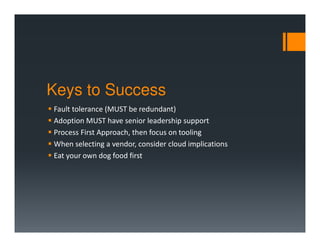
Keys to Success
Fault tolerance (MUST be redundant)
Adoption MUST have senior leadership support & driven by policy
Process First Approach, then focus on tooling
Be creative, one size does not fit all
When selecting a vendor, consider cloud implications
Eat your own dog food first
Don’t think you’re too small for this…
Questions?
Contact
Twitter: @lpeterman
LinkedIn: Lance Peterman

Privleged Access Management

  • 1.
    Privileged Access Management (PAM) Securingthe 21st Century Enterprise Lance Peterman
  • 2.
    Agenda What is PAM? Industryperspective Why PAM is necessary? Identity is the New Perimeter In the News Recent Data Loss / Breaches PAM as a Program/Service The Practice Collaboration is Key Use Cases Adoption Approach/Keys to Success
  • 3.
  • 4.
    Privileged access: isdefined as any feature or facility of a multi-user information system that enables the user to override system or application controls (e.g. Administrator, Root, or similar high-level privileges) Privileged accounts hold special or extra permissions within a system, application or database and can significantly affect the organization’s business. These accounts can grant broad access to underlying business information in databases, grant “super user” privileges, or can be used by authorized individuals when elevated privileges are required to fix urgent problems. Privileged Accounts include but are not limited to Windows Administrator, UNIX root, Oracle SYS, DBA, and Firecall accounts The use of privileged accounts should be managed and the password monitored when stored digitally. Privileged account activity should be logged and traceable to a unique user. If privileged account passwords are stored in a physical location, then passwords associated with the privileged accounts should be secured and access monitored between uses. What is Privileged Access Management?
  • 5.
    Identity is theNew Perimeter Only one security control exists today that can unequivocally determine what you are authorized to do, regardless of your location Old Model New Reality
  • 6.
  • 7.
    SC Department ofRevenue Compromise of privileged accounts resulted in 3.4m individual taxpayers and businesses losing sensitive data 1 Uber account compromised? Nope… Good taxpayers were compensated for this with…1 year of credit monitoring
  • 8.
    Saudi Aramco 30,000 PCshad hard drives erased through compromise of a privileged account 2 Insider attack suspected, abusing privileged accounts Most common privileged account? Local admin on the user’s workstation Does your organization vary that password? http://www.infosecurity-magazine.com/view/28973/insiders-exploiting- privileged-accounts-likely-behind-saudi-aramco-attack-/
  • 9.
    EBay Spear Phishing targeted keyIT resources Does your primary network account have privileged access? Two factor authentication…anyone?
  • 10.
  • 11.
    What does thattell us? The threat landscape is changing…DAILY “The compromise of privileged access is a key stage in 100% of all advanced attacks.” – CyberSheath Report 4/13 3 This is the critical attack vector for internal and external threats Verizon DBIR – “97% of all breaches are preventable through basic and intermediate controls.” 43% of respondents in a 2012 survey did not have a PAM practice or wasn’t sure if they did
  • 12.
    The Practice ofPrivileged Access Management (PAM) Designed to answer: Who has access When it was used Where it was used from What was done Technology is only One part of the equation – People & Process are essential Has to be part of your governance process, not just a one off enrollment
  • 13.
    PAM is aCollaborative Effort Key takeaways…. Make PAM part of your security DNA Ask questions about privileged access when reviewing applications & risk Educate business owners when possible Cleanup of current privileged access in all environments Define & run a new/modified process to manage access (Grant, revoke, manage exceptions. All aligned with policy) Integrate the new model with Enterprise IT Processes
  • 14.
    Sample of SomePAM Use Cases
  • 15.
    Other PAM UseCases Script/batch management Local workstation admin management Cloud infrastructure, SaaS accounts Virtualization platforms Look at ALL hardware platforms
  • 16.
    Adoption Approach Pre-Engagement -business area • Inventory of privileged accounts & their use • Documentation of access processes (if available) • List of candidate systems • Prioritization of critical systems based on key criteria • Regulatory constraints • Data Type (PII / IPSI) • Create/Revise access processes
  • 17.
    Adoption Approach Engagement/Onboarding -PAM team and business area • Review inventory & target systems • Setup schedule for deployment • Test – Verify results • Update business processes • Deploy into production
  • 18.
    Keys to Success Faulttolerance (MUST be redundant) Adoption MUST have senior leadership support & driven by policy Process First Approach, then focus on tooling Be creative, one size does not fit all When selecting a vendor, consider cloud implications Eat your own dog food first Don’t think you’re too small for this…
  • 19.
  • 20.