Privileged Access
Management (PAM)
Compliance in IT Security
Protecting sensitive data and systems is crucial in today's digital environment. Privileged Access
Management is a crucial element of a successful IT security plan (PAM). PAM is essential for protecting
privileged accounts from potential misuse and unauthorized access as businesses battle more complex
cyberattacks. This presentation explores the complexities of PAM compliance, including its significance,
legal requirements, recommended procedures, and the difficulties businesses encounter when putting it
into effect.
Bert Blevins
https://bertblevins.com/
02.07.2024
What is Privileged Access Management
(PAM)?
Definition
The term "privileged access management" (PAM) describes the procedures, tools, and
regulations that are used to restrict, track, and secure privileged users' access to sensitive
information and vital systems.
Privileged Users
Administrators and other privileged users have more access permissions than regular users,
giving them the ability to control networks, systems, and applications.
Importance
PAM is crucial for preserving the integrity and security of IT environments because of the
possible harm that could arise from compromised privileged accounts.
Bert Blevins
https://bertblevins.com/
Importance of PAM Compliance
1 Mitigating Security Risks
Privileged accounts are prime targets for cyber attackers. PAM compliance helps mitigate the
risk of internal and external threats by ensuring that only authorized users have access to
critical systems.
2 Regulatory Compliance
Various regulatory frameworks mandate strict control over privileged access. Non-compliance
can result in hefty fines, legal repercussions, and reputational damage.
3 Operational Efficiency
By implementing PAM, organizations can streamline access management processes,
reducing the administrative burden and enhancing overall operational efficiency.
4 Audit and Accountability
PAM solutions provide detailed audit trails, enabling organizations to track and review
privileged access activities. This transparency is crucial for forensic investigations and
accountability.
Bert Blevins
https://bertblevins.com/
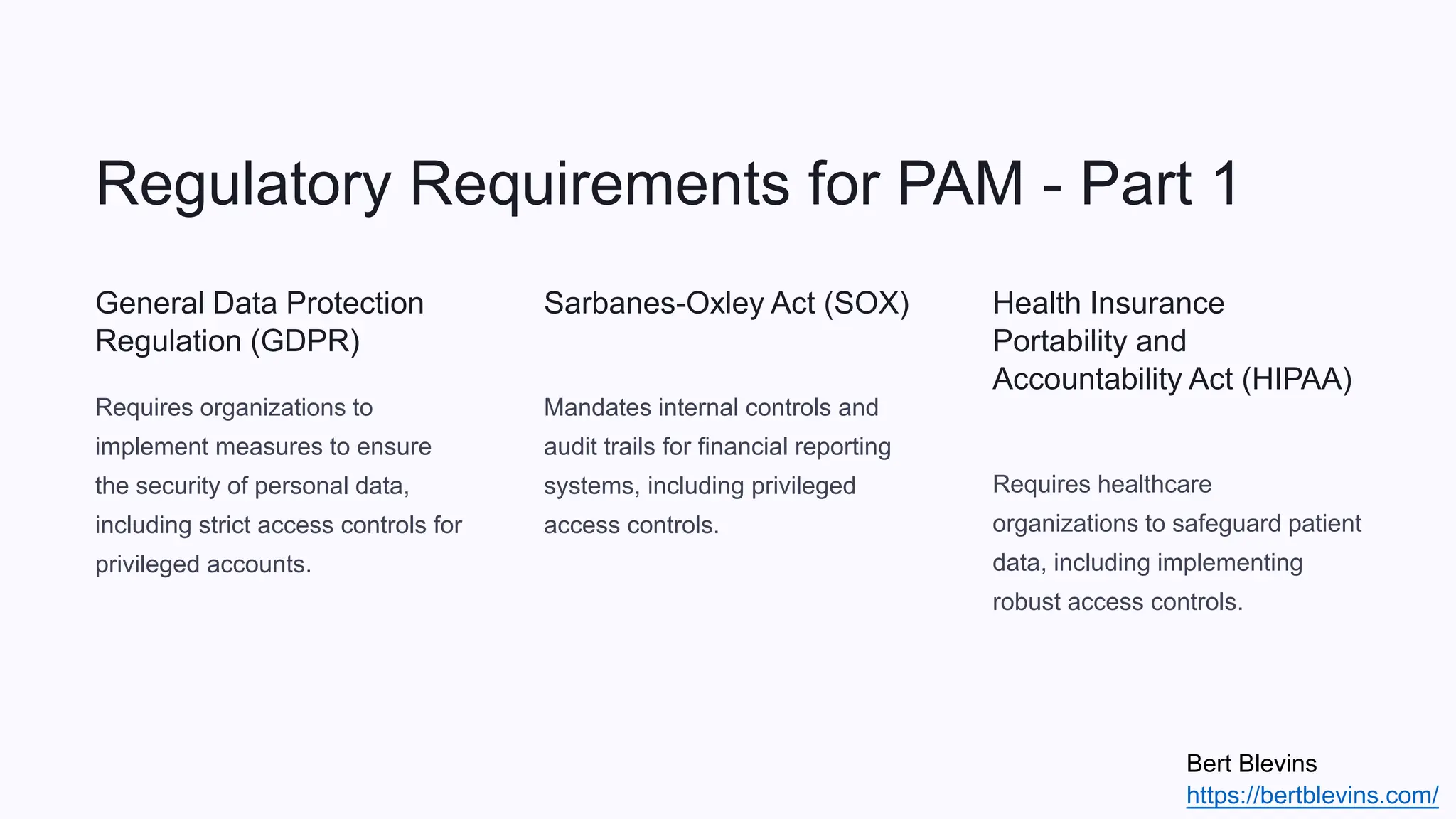
Regulatory Requirements for PAM - Part 1
General Data Protection
Regulation (GDPR)
Requires organizations to
implement measures to ensure
the security of personal data,
including strict access controls for
privileged accounts.
Sarbanes-Oxley Act (SOX)
Mandates internal controls and
audit trails for financial reporting
systems, including privileged
access controls.
Health Insurance
Portability and
Accountability Act (HIPAA)
Requires healthcare
organizations to safeguard patient
data, including implementing
robust access controls.
Bert Blevins
https://bertblevins.com/
Regulatory Requirements for PAM - Part 2
Payment Card Industry Data Security
Standard (PCI DSS)
Specifies requirements for protecting cardholder data,
including managing and monitoring access to system
components.
National Institute of Standards and
Technology (NIST) SP 800-53
Provides guidelines for implementing security controls,
including those for privileged access.
Bert Blevins
https://bertblevins.com/
Best Practices for PAM Compliance
- Part 1
1 Implement Least Privilege Principle
Ensure that users have the minimum level of access necessary to perform
their duties. Regularly review and adjust access rights to align with job
responsibilities.
2 Use Multi-Factor Authentication (MFA)
Strengthen the security of privileged accounts by requiring multiple forms of
authentication.
3 Continuous Monitoring and Auditing
Implement real-time monitoring and auditing of privileged access activities
to detect and respond to suspicious behavior promptly.
Bert Blevins
https://bertblevins.com/
Best Practices for PAM Compliance -
Part 2
1 Segregation of Duties
Divide responsibilities among multiple users to prevent a single individual from having
excessive control over critical systems.
2 Automated Password Management
Use automated tools to manage, rotate, and secure passwords for privileged
accounts, reducing the risk of password-related breaches.
3 Session Monitoring and Recording
Monitor and record privileged sessions to provide a detailed audit trail and support
forensic investigations.
4 Regularly Update and Patch Systems
Ensure that all systems, applications, and PAM solutions are up to date with the
latest security patches.
Bert Blevins
https://bertblevins.com/
Challenges in Implementing PAM
Complexity of IT Environments
Modern IT environments are often complex and
dynamic, making it challenging to manage and secure
privileged access across various systems and
platforms.
User Resistance
Users may resist PAM implementations due to
perceived inconvenience or disruption to their
workflows. Effective communication and training are
essential to address these concerns.
Resource Constraints
Implementing and maintaining a robust PAM solution
requires significant investment in terms of time, money,
and personnel.
Evolving Threat Landscape
Cyber threats are constantly evolving, requiring
organizations to continuously update and adapt their
PAM strategies to stay ahead of attackers.
Bert Blevins
https://bertblevins.com/
Integration Challenges
Integration with Existing Systems
Integrating PAM solutions with existing IT infrastructure can
be complex and may require significant customization.
Bert Blevins
https://bertblevins.com/
Conclusion on PAM Compliance
1 Key Component of IT Security
A key component of strong IT security is Privileged Access Management (PAM), which offers
vital safeguards to keep privileged accounts safe from potential misuse and illegal access.
2 Benefits of Implementation
Organizations can augment their security stance, guarantee adherence to regulations, and
alleviate the hazards linked with privileged access by putting best practices into
implementation.
3 Overcoming Challenges
Although there are obstacles to overcome, a properly executed PAM strategy offers much
more advantages than disadvantages, making it a crucial part of any all-encompassing
cybersecurity approach.
4 Stakeholder Trust
In an increasingly linked world, enterprises may preserve stakeholder confidence and protect
their most valuable assets by comprehending and tackling the intricacies of PAM compliance.
Bert Blevins
https://bertblevins.com/
Managing Privileged Access in
Remote Work Environments
Remote Work Revolution
The rise of remote work has revolutionized the modern workplace, offering
flexibility and convenience to employees worldwide. However, with this
newfound freedom comes increased cybersecurity risks, particularly
concerning privileged access.
Adaptation Necessity
As organizations adapt to this new paradigm, implementing robust privileged
access management (PAM) strategies is essential to ensure the security and
compliance of remote work environments.
Bert Blevins
https://bertblevins.com/
Zero Trust Principles in Remote
Work
1 Traditional Models Insufficient
In a remote work environment, traditional perimeter-based security
models are no longer sufficient.
2 Zero Trust Approach
Adopting a Zero Trust approach, which assumes that all users and
devices are potentially compromised, is critical.
3 Strict Access Controls
Implementing strict access controls based on user identity, device
posture, and other contextual factors helps mitigate the risk of
unauthorized access to sensitive resources.
Bert Blevins
https://bertblevins.com/
Multi-Factor Authentication (MFA) in Remote
Work
Extra Layer of Security
Multi-factor authentication (MFA) adds an extra layer
of security by requiring users to provide multiple
forms of verification before granting access.
Risk Reduction
By implementing MFA for privileged accounts,
organizations can significantly reduce the risk of
unauthorized access, even in the event of
compromised credentials.
Bert Blevins
https://bertblevins.com/
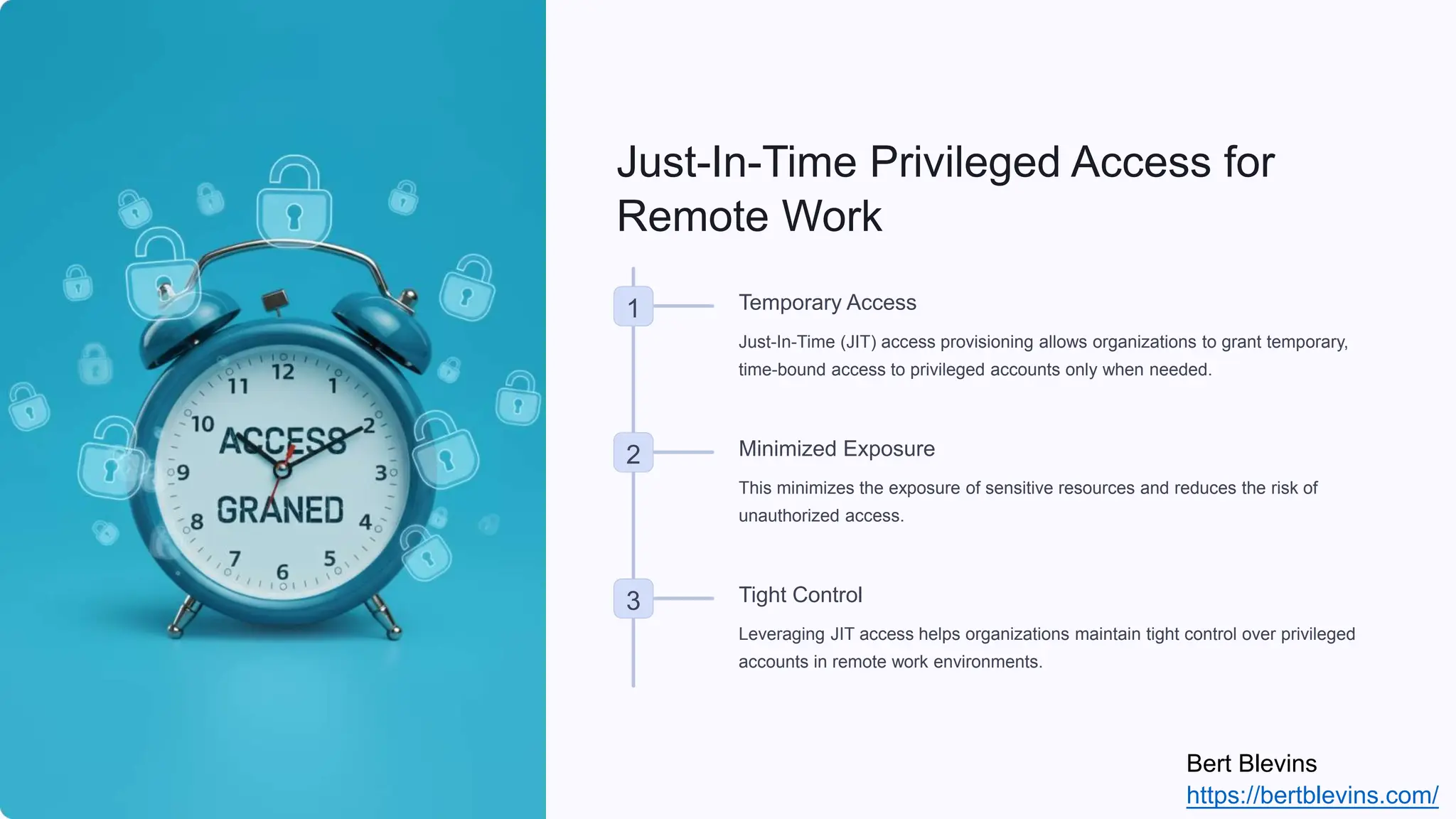
Just-In-Time Privileged Access for
Remote Work
1 Temporary Access
Just-In-Time (JIT) access provisioning allows organizations to grant temporary,
time-bound access to privileged accounts only when needed.
2 Minimized Exposure
This minimizes the exposure of sensitive resources and reduces the risk of
unauthorized access.
3 Tight Control
Leveraging JIT access helps organizations maintain tight control over privileged
accounts in remote work environments.
Bert Blevins
https://bertblevins.com/
Monitoring and Auditing Privileged Access in
Remote Work
1 Continuous Monitoring
Continuous monitoring and auditing of privileged
access activities are essential for detecting and
responding to suspicious behavior in remote work
environments.
2 Robust Logging
By implementing robust logging mechanisms and
real-time monitoring tools, organizations can
identify potential security incidents and maintain
compliance with regulatory requirements.
Bert Blevins
https://bertblevins.com/
Educating and Training Remote Employees
Crucial Role
Remote employees play a crucial role in maintaining the security of privileged access.
Comprehensive Training
Providing comprehensive training and education on security best practices, including the importance of safeguarding
privileged credentials and recognizing phishing attempts, helps empower employees to act as the first line of defense
against cyber threats.
Security Awareness
Educating remote employees on security best practices is essential for maintaining a strong security posture in
distributed work environments.
Bert Blevins
https://bertblevins.com/
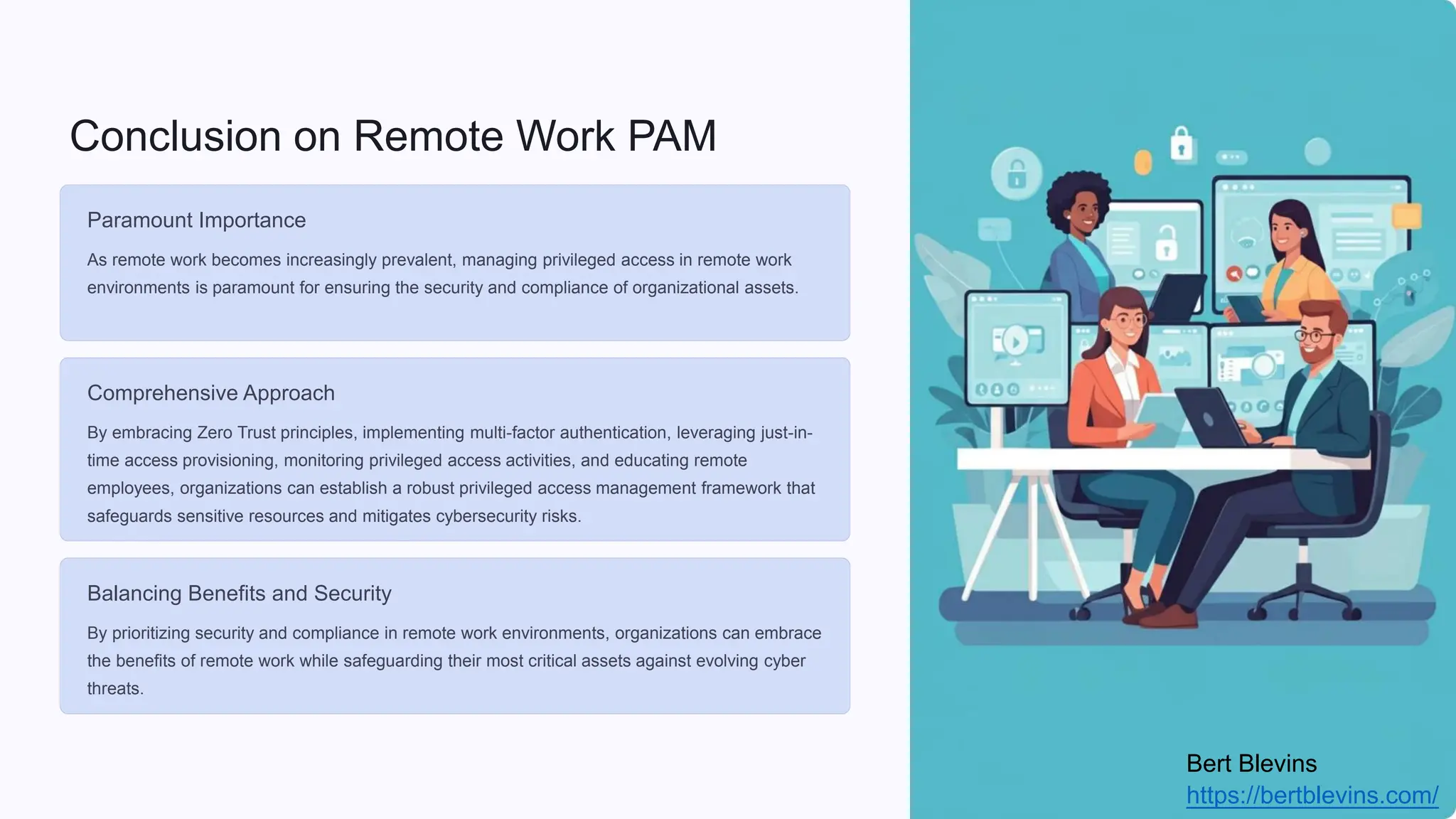
Conclusion on Remote Work PAM
Paramount Importance
As remote work becomes increasingly prevalent, managing privileged access in remote work
environments is paramount for ensuring the security and compliance of organizational assets.
Comprehensive Approach
By embracing Zero Trust principles, implementing multi-factor authentication, leveraging just-in-
time access provisioning, monitoring privileged access activities, and educating remote
employees, organizations can establish a robust privileged access management framework that
safeguards sensitive resources and mitigates cybersecurity risks.
Balancing Benefits and Security
By prioritizing security and compliance in remote work environments, organizations can embrace
the benefits of remote work while safeguarding their most critical assets against evolving cyber
threats.
Bert Blevins
https://bertblevins.com/
About the Presenter
Phone
832-281-0330
Email
info@incgpt.com
LinkedIn
https://www.linkedin.com
/in/bertblevins/
Qualifications
Bachelor's Degree in
Advertising, Master of
Business Administration
Bert Blevins is a passionate and experienced professional who is constantly seeking knowledge and professional
development. With a diverse educational background and numerous certifications, Bert is dedicated to making a
positive impact in the field of server security and privilege management.
Bert Blevins
https://bertblevins.com/

Privileged Access Management (PAM) Compliance in IT Security

  • 1.
    Privileged Access Management (PAM) Compliancein IT Security Protecting sensitive data and systems is crucial in today's digital environment. Privileged Access Management is a crucial element of a successful IT security plan (PAM). PAM is essential for protecting privileged accounts from potential misuse and unauthorized access as businesses battle more complex cyberattacks. This presentation explores the complexities of PAM compliance, including its significance, legal requirements, recommended procedures, and the difficulties businesses encounter when putting it into effect. Bert Blevins https://bertblevins.com/ 02.07.2024
  • 2.
    What is PrivilegedAccess Management (PAM)? Definition The term "privileged access management" (PAM) describes the procedures, tools, and regulations that are used to restrict, track, and secure privileged users' access to sensitive information and vital systems. Privileged Users Administrators and other privileged users have more access permissions than regular users, giving them the ability to control networks, systems, and applications. Importance PAM is crucial for preserving the integrity and security of IT environments because of the possible harm that could arise from compromised privileged accounts. Bert Blevins https://bertblevins.com/
  • 3.
    Importance of PAMCompliance 1 Mitigating Security Risks Privileged accounts are prime targets for cyber attackers. PAM compliance helps mitigate the risk of internal and external threats by ensuring that only authorized users have access to critical systems. 2 Regulatory Compliance Various regulatory frameworks mandate strict control over privileged access. Non-compliance can result in hefty fines, legal repercussions, and reputational damage. 3 Operational Efficiency By implementing PAM, organizations can streamline access management processes, reducing the administrative burden and enhancing overall operational efficiency. 4 Audit and Accountability PAM solutions provide detailed audit trails, enabling organizations to track and review privileged access activities. This transparency is crucial for forensic investigations and accountability. Bert Blevins https://bertblevins.com/
  • 4.
    Regulatory Requirements forPAM - Part 1 General Data Protection Regulation (GDPR) Requires organizations to implement measures to ensure the security of personal data, including strict access controls for privileged accounts. Sarbanes-Oxley Act (SOX) Mandates internal controls and audit trails for financial reporting systems, including privileged access controls. Health Insurance Portability and Accountability Act (HIPAA) Requires healthcare organizations to safeguard patient data, including implementing robust access controls. Bert Blevins https://bertblevins.com/
  • 5.
    Regulatory Requirements forPAM - Part 2 Payment Card Industry Data Security Standard (PCI DSS) Specifies requirements for protecting cardholder data, including managing and monitoring access to system components. National Institute of Standards and Technology (NIST) SP 800-53 Provides guidelines for implementing security controls, including those for privileged access. Bert Blevins https://bertblevins.com/
  • 6.
    Best Practices forPAM Compliance - Part 1 1 Implement Least Privilege Principle Ensure that users have the minimum level of access necessary to perform their duties. Regularly review and adjust access rights to align with job responsibilities. 2 Use Multi-Factor Authentication (MFA) Strengthen the security of privileged accounts by requiring multiple forms of authentication. 3 Continuous Monitoring and Auditing Implement real-time monitoring and auditing of privileged access activities to detect and respond to suspicious behavior promptly. Bert Blevins https://bertblevins.com/
  • 7.
    Best Practices forPAM Compliance - Part 2 1 Segregation of Duties Divide responsibilities among multiple users to prevent a single individual from having excessive control over critical systems. 2 Automated Password Management Use automated tools to manage, rotate, and secure passwords for privileged accounts, reducing the risk of password-related breaches. 3 Session Monitoring and Recording Monitor and record privileged sessions to provide a detailed audit trail and support forensic investigations. 4 Regularly Update and Patch Systems Ensure that all systems, applications, and PAM solutions are up to date with the latest security patches. Bert Blevins https://bertblevins.com/
  • 8.
    Challenges in ImplementingPAM Complexity of IT Environments Modern IT environments are often complex and dynamic, making it challenging to manage and secure privileged access across various systems and platforms. User Resistance Users may resist PAM implementations due to perceived inconvenience or disruption to their workflows. Effective communication and training are essential to address these concerns. Resource Constraints Implementing and maintaining a robust PAM solution requires significant investment in terms of time, money, and personnel. Evolving Threat Landscape Cyber threats are constantly evolving, requiring organizations to continuously update and adapt their PAM strategies to stay ahead of attackers. Bert Blevins https://bertblevins.com/
  • 9.
    Integration Challenges Integration withExisting Systems Integrating PAM solutions with existing IT infrastructure can be complex and may require significant customization. Bert Blevins https://bertblevins.com/
  • 10.
    Conclusion on PAMCompliance 1 Key Component of IT Security A key component of strong IT security is Privileged Access Management (PAM), which offers vital safeguards to keep privileged accounts safe from potential misuse and illegal access. 2 Benefits of Implementation Organizations can augment their security stance, guarantee adherence to regulations, and alleviate the hazards linked with privileged access by putting best practices into implementation. 3 Overcoming Challenges Although there are obstacles to overcome, a properly executed PAM strategy offers much more advantages than disadvantages, making it a crucial part of any all-encompassing cybersecurity approach. 4 Stakeholder Trust In an increasingly linked world, enterprises may preserve stakeholder confidence and protect their most valuable assets by comprehending and tackling the intricacies of PAM compliance. Bert Blevins https://bertblevins.com/
  • 11.
    Managing Privileged Accessin Remote Work Environments Remote Work Revolution The rise of remote work has revolutionized the modern workplace, offering flexibility and convenience to employees worldwide. However, with this newfound freedom comes increased cybersecurity risks, particularly concerning privileged access. Adaptation Necessity As organizations adapt to this new paradigm, implementing robust privileged access management (PAM) strategies is essential to ensure the security and compliance of remote work environments. Bert Blevins https://bertblevins.com/
  • 12.
    Zero Trust Principlesin Remote Work 1 Traditional Models Insufficient In a remote work environment, traditional perimeter-based security models are no longer sufficient. 2 Zero Trust Approach Adopting a Zero Trust approach, which assumes that all users and devices are potentially compromised, is critical. 3 Strict Access Controls Implementing strict access controls based on user identity, device posture, and other contextual factors helps mitigate the risk of unauthorized access to sensitive resources. Bert Blevins https://bertblevins.com/
  • 13.
    Multi-Factor Authentication (MFA)in Remote Work Extra Layer of Security Multi-factor authentication (MFA) adds an extra layer of security by requiring users to provide multiple forms of verification before granting access. Risk Reduction By implementing MFA for privileged accounts, organizations can significantly reduce the risk of unauthorized access, even in the event of compromised credentials. Bert Blevins https://bertblevins.com/
  • 14.
    Just-In-Time Privileged Accessfor Remote Work 1 Temporary Access Just-In-Time (JIT) access provisioning allows organizations to grant temporary, time-bound access to privileged accounts only when needed. 2 Minimized Exposure This minimizes the exposure of sensitive resources and reduces the risk of unauthorized access. 3 Tight Control Leveraging JIT access helps organizations maintain tight control over privileged accounts in remote work environments. Bert Blevins https://bertblevins.com/
  • 15.
    Monitoring and AuditingPrivileged Access in Remote Work 1 Continuous Monitoring Continuous monitoring and auditing of privileged access activities are essential for detecting and responding to suspicious behavior in remote work environments. 2 Robust Logging By implementing robust logging mechanisms and real-time monitoring tools, organizations can identify potential security incidents and maintain compliance with regulatory requirements. Bert Blevins https://bertblevins.com/
  • 16.
    Educating and TrainingRemote Employees Crucial Role Remote employees play a crucial role in maintaining the security of privileged access. Comprehensive Training Providing comprehensive training and education on security best practices, including the importance of safeguarding privileged credentials and recognizing phishing attempts, helps empower employees to act as the first line of defense against cyber threats. Security Awareness Educating remote employees on security best practices is essential for maintaining a strong security posture in distributed work environments. Bert Blevins https://bertblevins.com/
  • 17.
    Conclusion on RemoteWork PAM Paramount Importance As remote work becomes increasingly prevalent, managing privileged access in remote work environments is paramount for ensuring the security and compliance of organizational assets. Comprehensive Approach By embracing Zero Trust principles, implementing multi-factor authentication, leveraging just-in- time access provisioning, monitoring privileged access activities, and educating remote employees, organizations can establish a robust privileged access management framework that safeguards sensitive resources and mitigates cybersecurity risks. Balancing Benefits and Security By prioritizing security and compliance in remote work environments, organizations can embrace the benefits of remote work while safeguarding their most critical assets against evolving cyber threats. Bert Blevins https://bertblevins.com/
  • 18.
    About the Presenter Phone 832-281-0330 Email info@incgpt.com LinkedIn https://www.linkedin.com /in/bertblevins/ Qualifications Bachelor'sDegree in Advertising, Master of Business Administration Bert Blevins is a passionate and experienced professional who is constantly seeking knowledge and professional development. With a diverse educational background and numerous certifications, Bert is dedicated to making a positive impact in the field of server security and privilege management. Bert Blevins https://bertblevins.com/