•
•
•
•
•
•










Privileged access: is defined as any feature or facility of
a multi-user information system that enables the user to
override system or application controls (e.g.
Administrator, Root, or similar high-level privileges)
Privileged accounts or identities hold special or extra
permissions within a system, application or database and
can significantly affect the organization’s business.
These accounts can grant broad access to underlying
business information in databases, grant “super user”
privileges, or can be used by authorized individuals when
elevated privileges are required to fix urgent problems.
The use of privileged accounts should be managed
and the password monitored when stored digitally.
Privileged account activity should be logged and
traceable to a unique user. This is the essence of
Privileged Access Management (PAM)
IDENTITY IS NOT THE NEW
PERIMETER
(HINT: THE PERIMETER IS GONE)
AUTHORIZED
Old Model New Reality
•
1
•
•
•
2
•
•
•
•
•
http://www.infosecurity-magazine.com/view/28973/insiders-
exploiting-privileged-accounts-likely-behind-saudi-aramco-attack-/
•
•
•
http://www.theguardian.com/technology/2014/jun/10/canadian-
teengers-hack-cash-machine-atm-montreal
•
•
100%
3
• THE
•
•
•
•
•
•
•
•
•
•
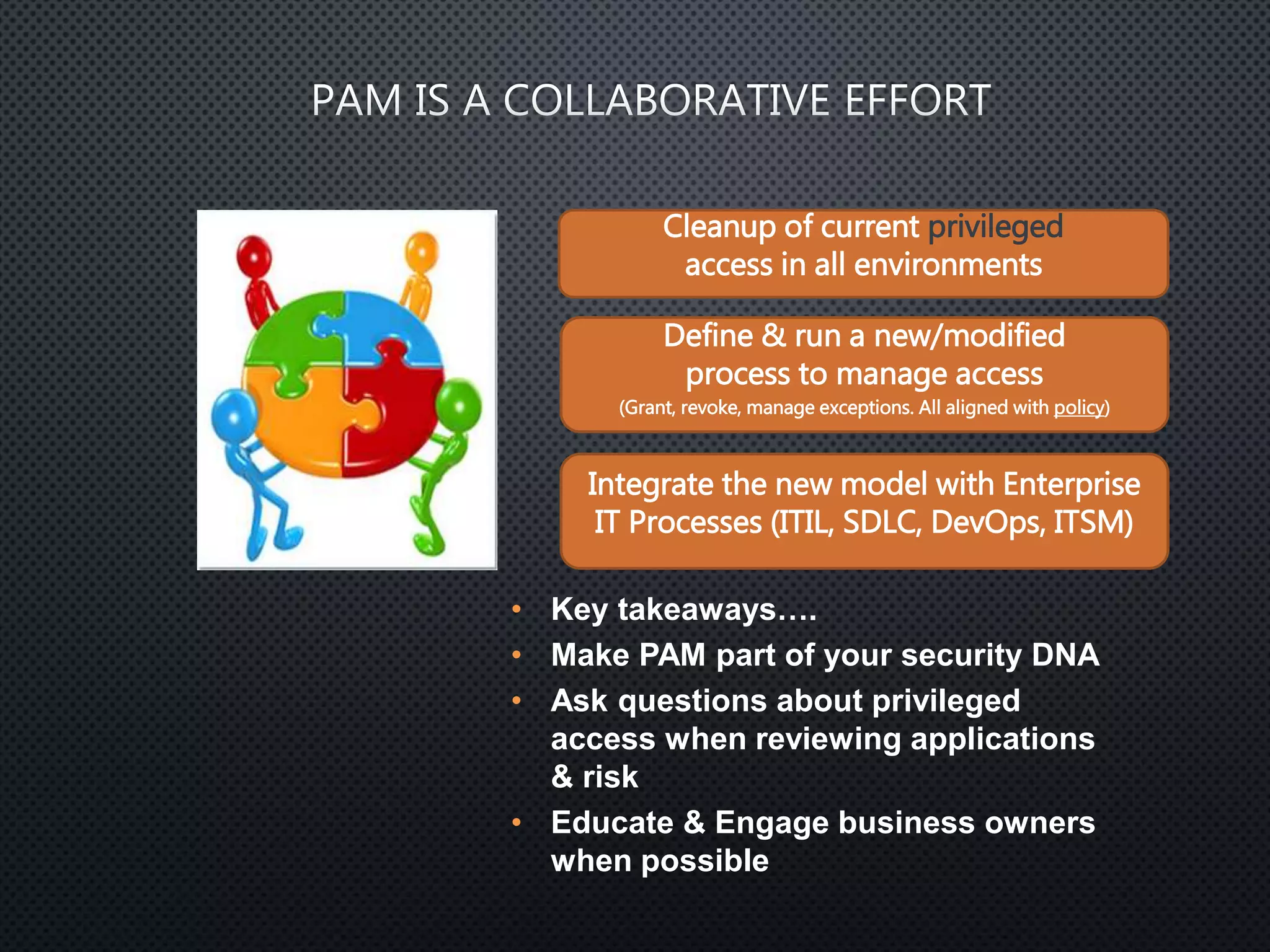
• Key takeaways….
• Make PAM part of your security DNA
• Ask questions about privileged
access when reviewing applications
& risk
• Educate & Engage business owners
when possible
Cleanup of current privileged
access in all environments
Define & run a new/modified
process to manage access
(Grant, revoke, manage exceptions. All aligned with policy)
Integrate the new model with Enterprise
IT Processes (ITIL, SDLC, DevOps, ITSM)
17
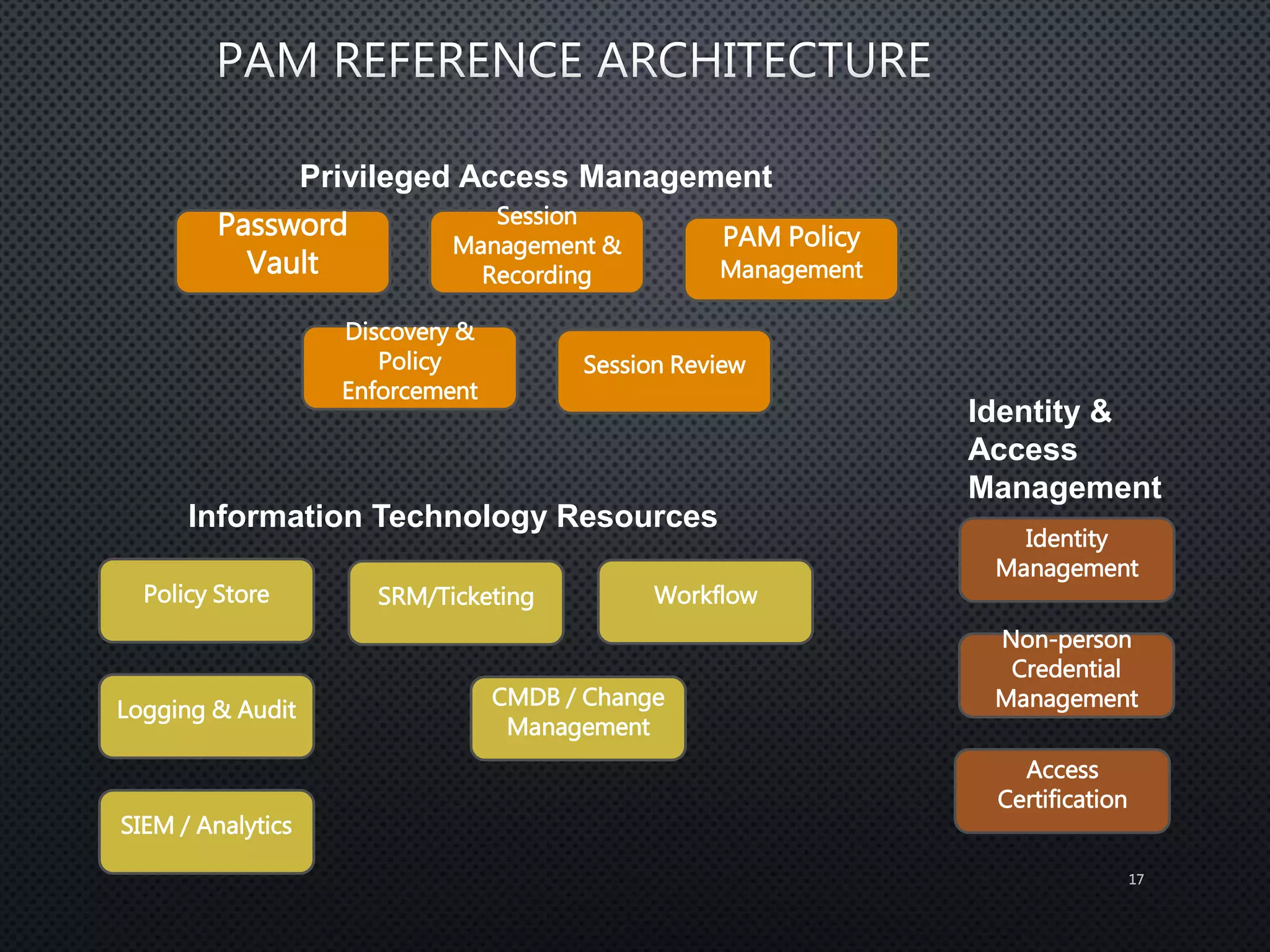
Password
Vault
Session
Management &
Recording
PAM Policy
Management
Discovery &
Policy
Enforcement
Session Review
Privileged Access Management
SRM/Ticketing WorkflowPolicy Store
Logging & Audit
SIEM / Analytics
CMDB / Change
Management
Information Technology Resources
Access
Certification
Identity
Management
Non-person
Credential
Management
Identity &
Access
Management
•
•
•
•
•
•
•
•
•
•
•
•
•
•
•
•
•
•
•
•
•
•
POLICY
•
•
•
•
•
•
•
•
•
•
•
•
•
•
25
QUESTIONS?

Privileged Access Management - 2016

Editor's Notes

  • #3 Here’s the Betty White video. I deleted it to reduce filesize. https://www.youtube.com/watch?v=yLJ6Y3eoYDA
  • #4 Obligatory safe harbor
  • #8 All three terms are interchangable, but Privileged ACCESS Management address the full spectrum and lifecycle for privileged identities and the systems they access
  • #9 Information security has had to make the transition from a fortress mentality to the new reality. Everyone wants access from everywhere on any device to nearly everything. Identity is the center of this new security universe.
  • #11 Something as innocuous as a backup service account allowed the hacker to exfiltrate the entire DoR taxpayer database.
  • #15 Essentially, the most generic pattern of attacks today is: phish –> send malware –> gather and then use valid credentials to get to your goal /in case you have to ask: why send malware if you can phish for credentials? malware can get you MORE and BETTER credentials/
  • #17 This isn’t simply an IT initiative, PAM has to become part of your company’s information security awareness strategy and embedded in its respective SDLC/ITIL or analogous processes
  • #18 The elements of the reference architecture are never meant to be all inclusive. You can add capabilities or leverage them as your practice matures.