UNIVERSITY OF CAMERINO
SCHOOL OF PHARMACY
MASTER’S DEGREE
PHARMACEUTICAL CHEMISTRY AND TECHNOLOGY

SYNTHESIS AND BIOLOGICAL EVALUATION OF
RADIOLABELED CURCUMINS AND THEIR RUTHENIUMARENE COMPLEXES

STUDENT:
LUCA PALMIERI

TUTOR:
PROF. CLAUDIO PETTINARI
DR. DOMENICO MARTINI
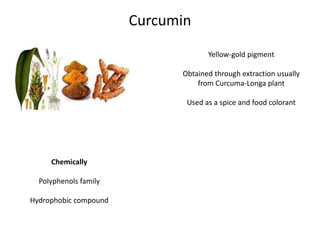
Curcumin
Yellow-gold pigment
Obtained through extraction usually
from Curcuma-Longa plant
Used as a spice and food colorant

Chemically
Polyphenols family
Hydrophobic compound
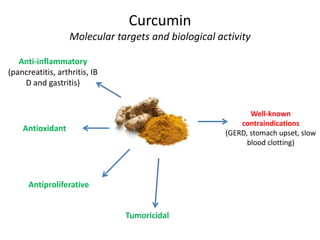
Curcumin
Molecular targets and biological activity
Anti-inflammatory
(pancreatitis, arthritis, IB
D and gastritis)

Well-known
contraindications
(GERD, stomach upset, slow
blood clotting)

Antioxidant

Antiproliferative
Tumoricidal
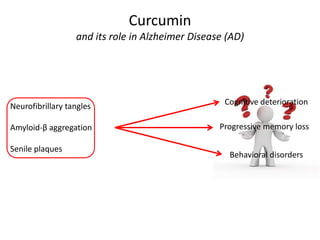
Curcumin
and its role in Alzheimer Disease (AD)

Neurofibrillary tangles

Cognitive deterioration

Amyloid-β aggregation

Progressive memory loss

Senile plaques

Behavioral disorders
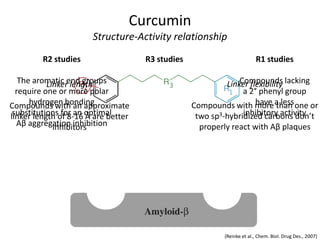
Curcumin
Structure-Activity relationship
R2 studies
The aromatic end groups
Linker length
require one or more polar
hydrogen bonding
Compounds with an approximate
substitutions for an Å are better
linker length of 8-16 optimal
Aβ aggregation inhibition
inhibitors

R3 studies

R1 studies
Compounds
Linker flexibility lacking
a 2° phenyl group
have than
Compounds with more a less one or
inhibitory activity
two sp3-hybridized carbons don’t

properly react with Aβ plaques

(Reinke et al., Chem. Biol. Drug Des., 2007)
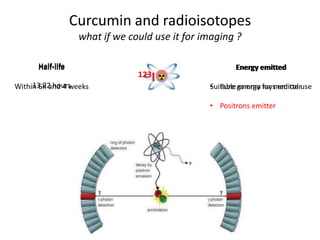
Curcumin and radioisotopes
what if we could use it for imaging ?
Half-life
13.22 hours
Within 6h and 4 weeks

123I

Energy emitted
Suitable energy rays emitter
• Pure gamma for medical use
• Positrons emitter
Aim of the work

Synthesis of Curcumin as a tin or borate precursor for the 123I labeling of
Curcumin and the binding of the compound with β-amyloid plaques in
Alzheimer disease (AD) through in-vivo tests.
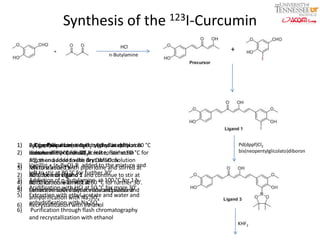
Synthesis of the 123I-Curcumin
HCl
n-Butylamine

1)
2)
2)
3)
2)
3)
4)
4)
3)
5)
5)
6)
6)

Pd(dppf)Cl2 + bis(neopentylglicolato)diboron
B2O3 + Precursor + B2O stirred in ethyl
2,4 pentanedionestirred3in ethyl acetate at 80 °C
dissolved 80 °C for 30’.
Iodo-vanillin + (n-BuO) B left to stir at in
acetate atin potassium3acetate, flushed80 °C for
argon and added with first solution
30’, then added to the dry DMSO. Solution
Vanillin + (n-BuO)3B piperidinethe mixture and
left to stir for 15’
Mixture added with added to and stirred at
left to stir of Ligand 1 and continue to stir at
Addiction at 80 °C
80°C for more 30’ for further 30’
Addictionmore almost at 50 at 100further130’.
80 °C for of with HCl 4h
Acidification n-Butylamine °C for °C for h
Acidification withunder reduced pressure
Solvent removed HCl at 50 °C for more and
Extraction with ethyl acetate and water 30’
Extraction with with Na SO and water and
anhydrification ethyl acetate
2
4
anhydrification with Na2SO4
Recrystallization with ethanol
Purification through flash chromatography
and recrystallization with ethanol

+

Pd(dppf)Cl2
bis(neopentylglicolato)diboron

KHF2
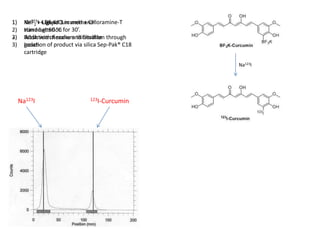
1)
2)
2)
3)
3)

Na123I Ligand 3 in methanol
KHF2 ++ BF3K-Curcumin + Chloramine-T
stirred at 60 °C
Hand-agitation for 30’.
Addiction of sodium thiosulfite through
Wash with hexane and filtration
Isolation
gooch of product via silica Sep-Pak® C18
cartridge
Na123I

Na123I

123I-Curcumin
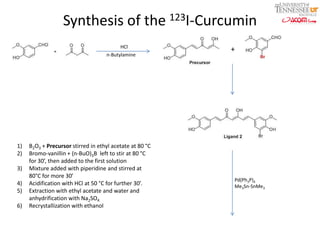
Synthesis of the 123I-Curcumin
HCl
n-Butylamine

1)
2)
3)
4)
5)
6)

B2O3 + Precursor stirred in ethyl acetate at 80 °C
Bromo-vanillin + (n-BuO)3B left to stir at 80 °C
for 30’, then added to the first solution
Mixture added with piperidine and stirred at
80°C for more 30’
Acidification with HCl at 50 °C for further 30’.
Extraction with ethyl acetate and water and
anhydrification with Na2SO4
Recrystallization with ethanol

+

Pd(Ph3P)4
Me3Sn-SnMe3
1)
2)

3)
4)
5)
6)

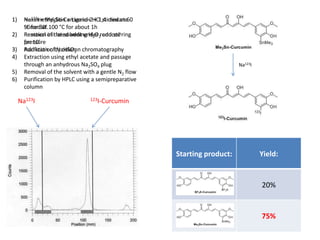
Hexamethylditin + Ligand 2 + 1,4-dioxane
Na123I + Me3Sn-Curcumin+ HCl stirred at 60
stirred at
°C for 30’.100 °C for about 1h
Removal initiated adding H2O and stirring
Reaction of the solvent under 2reduced
pressure
for 10’
Purification NaHSO3
Addiction ofby column chromatography
Extraction using ethyl acetate and passage
through an anhydrous Na2SO4 plug
Removal of the solvent with a gentle N2 flow
Purification by HPLC using a semipreparative
column

Na123I

Na123I

123I-Curcumin

Starting product:

Yield:

20%

75%
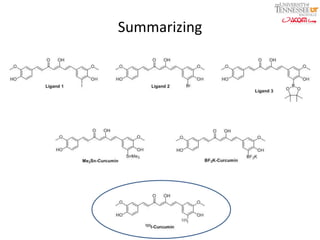
Summarizing
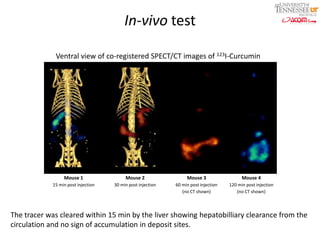
In-vivo test
Ventral view of co-registered SPECT/CT images of 123I-Curcumin

Mouse 1

Mouse 2

Mouse 3

Mouse 4

15 min post injection

30 min post injection

60 min post injection
(no CT shown)

120 min post injection
(no CT shown)

The tracer was cleared within 15 min by the liver showing hepatobilliary clearance from the
circulation and no sign of accumulation in deposit sites.
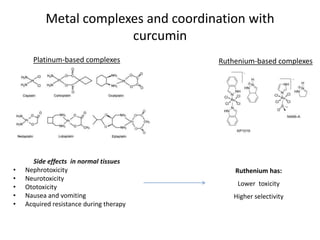
Metal complexes and coordination with
curcumin
Platinum-based complexes

•
•
•
•
•

Side effects in normal tissues
Nephrotoxicity
Neurotoxicity
Ototoxicity
Nausea and vomiting
Acquired resistance during therapy

Ruthenium-based complexes

Ruthenium has:
Lower toxicity
Higher selectivity
Aim of the work

The role of a complex between the iodo-curcumin and the Ruthenium pcymene dimer will be researched as a possible antioxidant and antitumoral
compound. Evaluating his chemical synthesis, characterization, and in-vitro
studies.
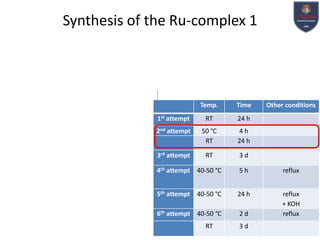
Synthesis of the Ru-complex 1

Temp.

Time

st attempt
1MeOH

RT

24 h

2nd attempt

50 °C
RT

4h
24 h

3rd attempt

RT

Other conditions

3d

KOH

4th attempt 40-50 °C

5h

reflux

5th attempt 40-50 °C

24 h

6th attempt 40-50 °C

2d

reflux
+ KOH
reflux

RT

3d
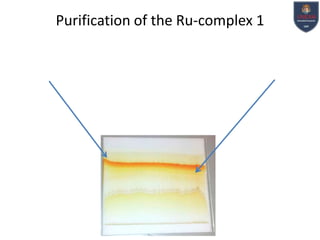
Purification of the Ru-complex 1
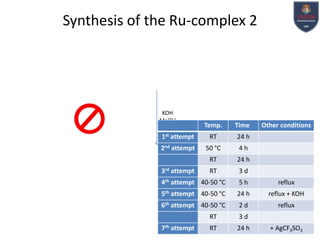
Synthesis of the Ru-complex 2

KOH
MeOH

Temp.

Time

1st attempt

RT

24 h

2nd attempt

50 °C

4h

RT

24 h

RT

3d

3rd attempt

Other conditions

4th attempt 40-50 °C

5h

reflux

5th attempt 40-50 °C

24 h

reflux + KOH

6th attempt 40-50 °C

2d

reflux

RT
7th attempt

3d

RT

24 h

+ AgCF3SO3
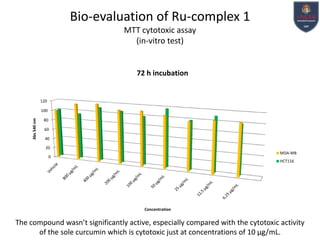
Bio-evaluation of Ru-complex 1
MTT cytotoxic assay
(in-vitro test)

72 h incubation

120

Abs 540 nm

100
80
60
40
20
MDA-MB

0

HCT116

Concentration

The compound wasn’t significantly active, especially compared with the cytotoxic activity
of the sole curcumin which is cytotoxic just at concentrations of 10 µg/mL.
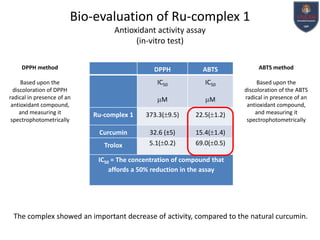
Bio-evaluation of Ru-complex 1
Antioxidant activity assay
(in-vitro test)
DPPH method

DPPH

ABTS

ABTS method

Based upon the
discoloration of DPPH
radical in presence of an
antioxidant compound,
and measuring it
spectrophotometrically

IC50

IC50

M

M

Ru-complex 1

373.3( 9.5)

22.5( 1.2)

Based upon the
discoloration of the ABTS
radical in presence of an
antioxidant compound,
and measuring it
spectrophotometrically

Curcumin

32.6 (±5)
5.1( 0.2)

15.4( 1.4)
69.0( 0.5)

Trolox

IC50 = The concentration of compound that
affords a 50% reduction in the assay

The complex showed an important decrease of activity, compared to the natural curcumin.
Conclusions
• Five curcumin-like ligands were synthesized and chemically characterized

• Two of these ligands reacted with a radioisotope to give a new radio-ligand
• Unfortunately, the radio-ligand showed no sign of bio-accumulation in β-amyloid
deposit sites in mice
• A new Ru-complex was synthesized, chemically characterized, and tested in-vitro for its
antioxidant and cytotoxic activities
• The complex showed to possess a decreased cytotoxic and antioxidant effects
compared to curcumin

Future perspectives
It should be interesting to synthesize a complex containing radiolabeled curcumin and test
it, not just in-vitro but also, in-vivo in order to follow its biodistribution and bioaccumulation.
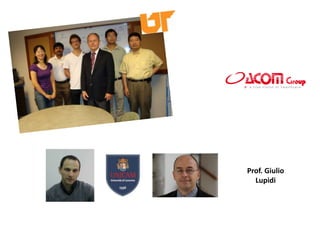
Prof. Giulio
Lupidi

Synthesis and biological evaluation of radiolabeled curcumins and their ruthenium-arene complexes

  • 1.
    UNIVERSITY OF CAMERINO SCHOOLOF PHARMACY MASTER’S DEGREE PHARMACEUTICAL CHEMISTRY AND TECHNOLOGY SYNTHESIS AND BIOLOGICAL EVALUATION OF RADIOLABELED CURCUMINS AND THEIR RUTHENIUMARENE COMPLEXES STUDENT: LUCA PALMIERI TUTOR: PROF. CLAUDIO PETTINARI DR. DOMENICO MARTINI
  • 2.
    Curcumin Yellow-gold pigment Obtained throughextraction usually from Curcuma-Longa plant Used as a spice and food colorant Chemically Polyphenols family Hydrophobic compound
  • 3.
    Curcumin Molecular targets andbiological activity Anti-inflammatory (pancreatitis, arthritis, IB D and gastritis) Well-known contraindications (GERD, stomach upset, slow blood clotting) Antioxidant Antiproliferative Tumoricidal
  • 4.
    Curcumin and its rolein Alzheimer Disease (AD) Neurofibrillary tangles Cognitive deterioration Amyloid-β aggregation Progressive memory loss Senile plaques Behavioral disorders
  • 5.
    Curcumin Structure-Activity relationship R2 studies Thearomatic end groups Linker length require one or more polar hydrogen bonding Compounds with an approximate substitutions for an Å are better linker length of 8-16 optimal Aβ aggregation inhibition inhibitors R3 studies R1 studies Compounds Linker flexibility lacking a 2° phenyl group have than Compounds with more a less one or inhibitory activity two sp3-hybridized carbons don’t properly react with Aβ plaques (Reinke et al., Chem. Biol. Drug Des., 2007)
  • 6.
    Curcumin and radioisotopes whatif we could use it for imaging ? Half-life 13.22 hours Within 6h and 4 weeks 123I Energy emitted Suitable energy rays emitter • Pure gamma for medical use • Positrons emitter
  • 7.
    Aim of thework Synthesis of Curcumin as a tin or borate precursor for the 123I labeling of Curcumin and the binding of the compound with β-amyloid plaques in Alzheimer disease (AD) through in-vivo tests.
  • 8.
    Synthesis of the123I-Curcumin HCl n-Butylamine 1) 2) 2) 3) 2) 3) 4) 4) 3) 5) 5) 6) 6) Pd(dppf)Cl2 + bis(neopentylglicolato)diboron B2O3 + Precursor + B2O stirred in ethyl 2,4 pentanedionestirred3in ethyl acetate at 80 °C dissolved 80 °C for 30’. Iodo-vanillin + (n-BuO) B left to stir at in acetate atin potassium3acetate, flushed80 °C for argon and added with first solution 30’, then added to the dry DMSO. Solution Vanillin + (n-BuO)3B piperidinethe mixture and left to stir for 15’ Mixture added with added to and stirred at left to stir of Ligand 1 and continue to stir at Addiction at 80 °C 80°C for more 30’ for further 30’ Addictionmore almost at 50 at 100further130’. 80 °C for of with HCl 4h Acidification n-Butylamine °C for °C for h Acidification withunder reduced pressure Solvent removed HCl at 50 °C for more and Extraction with ethyl acetate and water 30’ Extraction with with Na SO and water and anhydrification ethyl acetate 2 4 anhydrification with Na2SO4 Recrystallization with ethanol Purification through flash chromatography and recrystallization with ethanol + Pd(dppf)Cl2 bis(neopentylglicolato)diboron KHF2
  • 9.
    1) 2) 2) 3) 3) Na123I Ligand 3in methanol KHF2 ++ BF3K-Curcumin + Chloramine-T stirred at 60 °C Hand-agitation for 30’. Addiction of sodium thiosulfite through Wash with hexane and filtration Isolation gooch of product via silica Sep-Pak® C18 cartridge Na123I Na123I 123I-Curcumin
  • 10.
    Synthesis of the123I-Curcumin HCl n-Butylamine 1) 2) 3) 4) 5) 6) B2O3 + Precursor stirred in ethyl acetate at 80 °C Bromo-vanillin + (n-BuO)3B left to stir at 80 °C for 30’, then added to the first solution Mixture added with piperidine and stirred at 80°C for more 30’ Acidification with HCl at 50 °C for further 30’. Extraction with ethyl acetate and water and anhydrification with Na2SO4 Recrystallization with ethanol + Pd(Ph3P)4 Me3Sn-SnMe3
  • 11.
    1) 2) 3) 4) 5) 6) Hexamethylditin + Ligand2 + 1,4-dioxane Na123I + Me3Sn-Curcumin+ HCl stirred at 60 stirred at °C for 30’.100 °C for about 1h Removal initiated adding H2O and stirring Reaction of the solvent under 2reduced pressure for 10’ Purification NaHSO3 Addiction ofby column chromatography Extraction using ethyl acetate and passage through an anhydrous Na2SO4 plug Removal of the solvent with a gentle N2 flow Purification by HPLC using a semipreparative column Na123I Na123I 123I-Curcumin Starting product: Yield: 20% 75%
  • 12.
  • 13.
    In-vivo test Ventral viewof co-registered SPECT/CT images of 123I-Curcumin Mouse 1 Mouse 2 Mouse 3 Mouse 4 15 min post injection 30 min post injection 60 min post injection (no CT shown) 120 min post injection (no CT shown) The tracer was cleared within 15 min by the liver showing hepatobilliary clearance from the circulation and no sign of accumulation in deposit sites.
  • 14.
    Metal complexes andcoordination with curcumin Platinum-based complexes • • • • • Side effects in normal tissues Nephrotoxicity Neurotoxicity Ototoxicity Nausea and vomiting Acquired resistance during therapy Ruthenium-based complexes Ruthenium has: Lower toxicity Higher selectivity
  • 15.
    Aim of thework The role of a complex between the iodo-curcumin and the Ruthenium pcymene dimer will be researched as a possible antioxidant and antitumoral compound. Evaluating his chemical synthesis, characterization, and in-vitro studies.
  • 16.
    Synthesis of theRu-complex 1 Temp. Time st attempt 1MeOH RT 24 h 2nd attempt 50 °C RT 4h 24 h 3rd attempt RT Other conditions 3d KOH 4th attempt 40-50 °C 5h reflux 5th attempt 40-50 °C 24 h 6th attempt 40-50 °C 2d reflux + KOH reflux RT 3d
  • 17.
    Purification of theRu-complex 1
  • 18.
    Synthesis of theRu-complex 2 KOH MeOH Temp. Time 1st attempt RT 24 h 2nd attempt 50 °C 4h RT 24 h RT 3d 3rd attempt Other conditions 4th attempt 40-50 °C 5h reflux 5th attempt 40-50 °C 24 h reflux + KOH 6th attempt 40-50 °C 2d reflux RT 7th attempt 3d RT 24 h + AgCF3SO3
  • 19.
    Bio-evaluation of Ru-complex1 MTT cytotoxic assay (in-vitro test) 72 h incubation 120 Abs 540 nm 100 80 60 40 20 MDA-MB 0 HCT116 Concentration The compound wasn’t significantly active, especially compared with the cytotoxic activity of the sole curcumin which is cytotoxic just at concentrations of 10 µg/mL.
  • 20.
    Bio-evaluation of Ru-complex1 Antioxidant activity assay (in-vitro test) DPPH method DPPH ABTS ABTS method Based upon the discoloration of DPPH radical in presence of an antioxidant compound, and measuring it spectrophotometrically IC50 IC50 M M Ru-complex 1 373.3( 9.5) 22.5( 1.2) Based upon the discoloration of the ABTS radical in presence of an antioxidant compound, and measuring it spectrophotometrically Curcumin 32.6 (±5) 5.1( 0.2) 15.4( 1.4) 69.0( 0.5) Trolox IC50 = The concentration of compound that affords a 50% reduction in the assay The complex showed an important decrease of activity, compared to the natural curcumin.
  • 21.
    Conclusions • Five curcumin-likeligands were synthesized and chemically characterized • Two of these ligands reacted with a radioisotope to give a new radio-ligand • Unfortunately, the radio-ligand showed no sign of bio-accumulation in β-amyloid deposit sites in mice • A new Ru-complex was synthesized, chemically characterized, and tested in-vitro for its antioxidant and cytotoxic activities • The complex showed to possess a decreased cytotoxic and antioxidant effects compared to curcumin Future perspectives It should be interesting to synthesize a complex containing radiolabeled curcumin and test it, not just in-vitro but also, in-vivo in order to follow its biodistribution and bioaccumulation.
  • 22.