 Cyanation is the substitution or
attachment of cyanide group on various
substrates.
 Compounds with cyanide group “CN” are
called nitriles.
Nitriles have vast applications in the
synthesis of natural products, materials,
pharmaceuticals, agricultural chemicals,
and dyes.
 In earlier days, metal complexes of Zinc,
Copper, Nickel etc. was used for cyanation.
For example, Sandmeyer reaction,
Rosenmund–von Braun reaction, Leimgruber-
Batcho indole synthesis etc.
 Advancement in this regard is the use of
palladium catalyst with high yield and less
harsh conditions.
 First Pd-catalyzed cyanation method was
reported by Takagi et al. 40 years ago.
Ushkov and Grushin uses reducing agents or
exploit low solubility of NaCN, KCN and
Zn(CN)2 in organic solvents to prevent
poisoning of cyanide group.
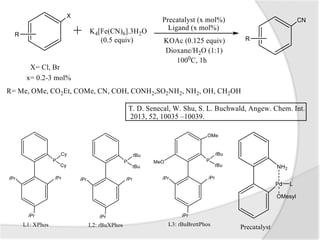
 Beller and Weissman discovered K4[Fe(CN)6],
a nontoxic food additive, as cyanide source for
Pd-catalyzed coupling reactions.
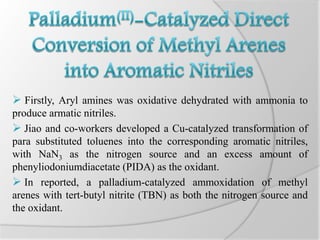
 Firstly, Aryl amines was oxidative dehydrated with ammonia to
produce armatic nitriles.
 Jiao and co-workers developed a Cu-catalyzed transformation of
para substituted toluenes into the corresponding aromatic nitriles,
with NaN3 as the nitrogen source and an excess amount of
phenyliodoniumdiacetate (PIDA) as the oxidant.
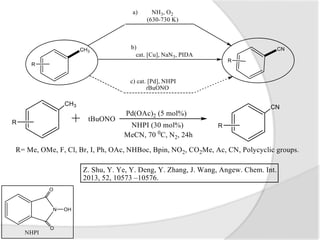
 In reported, a palladium-catalyzed ammoxidation of methyl
arenes with tert-butyl nitrite (TBN) as both the nitrogen source and
the oxidant.
Palladium-Catalyzed
Cyanoalkenylation of Indoles
Indoles are heterocyclic compounds consisting
on benzene ring fused to a five member
nitrogen containing ring.
Palladium catalyzed
cynaoalkenylation of N-substituted
indoles in the presence of
K4[Fe(CN)6] as cyanating agent.
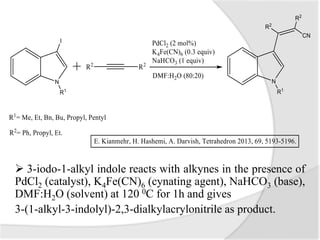
 3-iodo-1-alkyl indole reacts with alkynes in the presence of
PdCl2 (catalyst), K4Fe(CN)6 (cynating agent), NaHCO3 (base),
DMF:H2O (solvent) at 120 0C for 1h and gives
3-(1-alkyl-3-indolyl)-2,3-dialkylacrylonitrile as product.
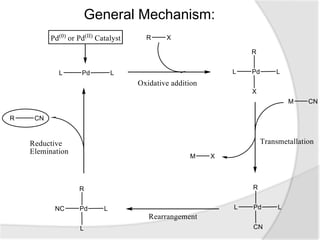
General Mechanism:
 Indoles exhibits a broad range of useful
pharmacological effects, including antibiotic, anti-
inflammatory, antihypertensive, and antitumor
activities.
 Aromatic nitriles have application in a variety of
fields as both synthetic intermediates and final
targets. For example, the antineoplastic (Letrozole),
antidepressant (Citalopram), and anti-HIV drug
(Etravirine).
Palladium Catalysed Cyanation

Palladium Catalysed Cyanation

  • 2.
     Cyanation isthe substitution or attachment of cyanide group on various substrates.  Compounds with cyanide group “CN” are called nitriles. Nitriles have vast applications in the synthesis of natural products, materials, pharmaceuticals, agricultural chemicals, and dyes.
  • 3.
     In earlierdays, metal complexes of Zinc, Copper, Nickel etc. was used for cyanation. For example, Sandmeyer reaction, Rosenmund–von Braun reaction, Leimgruber- Batcho indole synthesis etc.  Advancement in this regard is the use of palladium catalyst with high yield and less harsh conditions.
  • 4.
     First Pd-catalyzedcyanation method was reported by Takagi et al. 40 years ago. Ushkov and Grushin uses reducing agents or exploit low solubility of NaCN, KCN and Zn(CN)2 in organic solvents to prevent poisoning of cyanide group.  Beller and Weissman discovered K4[Fe(CN)6], a nontoxic food additive, as cyanide source for Pd-catalyzed coupling reactions.
  • 6.
     Firstly, Arylamines was oxidative dehydrated with ammonia to produce armatic nitriles.  Jiao and co-workers developed a Cu-catalyzed transformation of para substituted toluenes into the corresponding aromatic nitriles, with NaN3 as the nitrogen source and an excess amount of phenyliodoniumdiacetate (PIDA) as the oxidant.  In reported, a palladium-catalyzed ammoxidation of methyl arenes with tert-butyl nitrite (TBN) as both the nitrogen source and the oxidant.
  • 8.
    Palladium-Catalyzed Cyanoalkenylation of Indoles Indolesare heterocyclic compounds consisting on benzene ring fused to a five member nitrogen containing ring. Palladium catalyzed cynaoalkenylation of N-substituted indoles in the presence of K4[Fe(CN)6] as cyanating agent.
  • 9.
     3-iodo-1-alkyl indolereacts with alkynes in the presence of PdCl2 (catalyst), K4Fe(CN)6 (cynating agent), NaHCO3 (base), DMF:H2O (solvent) at 120 0C for 1h and gives 3-(1-alkyl-3-indolyl)-2,3-dialkylacrylonitrile as product.
  • 10.
  • 11.
     Indoles exhibitsa broad range of useful pharmacological effects, including antibiotic, anti- inflammatory, antihypertensive, and antitumor activities.  Aromatic nitriles have application in a variety of fields as both synthetic intermediates and final targets. For example, the antineoplastic (Letrozole), antidepressant (Citalopram), and anti-HIV drug (Etravirine).