Pain Assessment: By Juan C Delgado
Infants: They have same capacity for pain as adult. By the 20 th  week of gestation, they are capable of feeling pain They are more sensitive to pain as their inhibitory neurotransmitters are not fully developed. At RISK of undertreatment for pain due to myth they forget painful sensations.
Aging Adult: Myth: “ It is Ok to have pain as we get older” Pain always indicates a pathology or injury. Older adults fear more medical expenses, dependant of medications and invasive procedures. Most common pain producing conditions in older adults:  Osteoarthritis Arthritis Osteoporosis Periopherial Vascular problems/disease Cancer Angina Chronic Constipation
Gender Differences: Differs on hormonal and social expectations Men: tend to be stoic Woman: tend to display/express pain Woman are 3 times more likely to experience more pain than men since they: Childbearing Premenstrual and menstrual cycles Calcium deficiency
Cultural awareness: Cultural backgrounds will show different ways to manage pain. Ex: Hispanics tend to verbalized their pain, while Asians tend to hide and suppress pain.
Pain Assessment Tools: The subjective report is most reliable indicator of pain. Only in infant and NON-verbal patients you might have to rely on Objective Data; Facial gestures, movements, body positions, etc. Clinicians can NOT based the diagnosis on pain EXCLUSELY on physical findings. Pain encompasses physical, affective and functional domains. Explain patient how to use the tools; questionnaire NOTE: If needed and available: Translation of the information on patient’s native language.  Larger letters for visual limitations.  Appropiate tool for age and comprehensive level of patient: mentally impaired patients.
EXAMINER and/or NURSE:  YOU ARE NOT THE ONE WITH THE PAIN.  NEVER DETERMINE FOR  PATIENT HIS/HER LEVEL OF PAIN.  It is important to assess and cover these areas for a more accurate pain assessment: Location- ask them to point mark the area. Duration- 1hr, days, at night or day,etc Quality-burning, throbbing, etc Intensity- scales 1 -10 Aggravating and Relieving factors Effects on one’s quality life- sleep, eat, breath, walk, etc
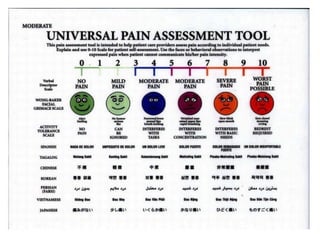
Tools: Check and follow standards of institution for pain assessment. Initial Pain Assessment –pag. 185 Brief Pain Inventory- pag 186 Scales- pag 187 CRIES-  pag190
 
Infants & Children: Infants are Pre-verbal and incapable of self report of pain. Use CRIES pain tool measurement- pag 190 Look and OBSERVE for Objective Data: gestures, sleep cycles, body positions. Children ages of 2 and more will point and verbalize pain. Some try to act like grown up and play to be brave or will not express pain in fear of invasive treatments or needles. For Children is suggested to use a scale with faces. Pag 187 Explain the chart use and ask them to pick the face that shows how they feel.
Examiner and Nurses: Look for behavioral clues Walking patterns Daily activities changes Eating habits Those examples can help you determine other Nursing Interventions you might have to develop in order to help your client. Ex.: Risk for Falls, Nutrition- Less than Body Requirements.
ALWAYS show a caring attitude towards the patient.  Remember you can NOT determine someone else’s level of pain.  Assess the pain accordingly to patient’s subjective data and ,when possible or evident, objective data.

Pain Assessment Basics

  • 1.
    Pain Assessment: ByJuan C Delgado
  • 2.
    Infants: They havesame capacity for pain as adult. By the 20 th week of gestation, they are capable of feeling pain They are more sensitive to pain as their inhibitory neurotransmitters are not fully developed. At RISK of undertreatment for pain due to myth they forget painful sensations.
  • 3.
    Aging Adult: Myth:“ It is Ok to have pain as we get older” Pain always indicates a pathology or injury. Older adults fear more medical expenses, dependant of medications and invasive procedures. Most common pain producing conditions in older adults: Osteoarthritis Arthritis Osteoporosis Periopherial Vascular problems/disease Cancer Angina Chronic Constipation
  • 4.
    Gender Differences: Differson hormonal and social expectations Men: tend to be stoic Woman: tend to display/express pain Woman are 3 times more likely to experience more pain than men since they: Childbearing Premenstrual and menstrual cycles Calcium deficiency
  • 5.
    Cultural awareness: Culturalbackgrounds will show different ways to manage pain. Ex: Hispanics tend to verbalized their pain, while Asians tend to hide and suppress pain.
  • 6.
    Pain Assessment Tools:The subjective report is most reliable indicator of pain. Only in infant and NON-verbal patients you might have to rely on Objective Data; Facial gestures, movements, body positions, etc. Clinicians can NOT based the diagnosis on pain EXCLUSELY on physical findings. Pain encompasses physical, affective and functional domains. Explain patient how to use the tools; questionnaire NOTE: If needed and available: Translation of the information on patient’s native language. Larger letters for visual limitations. Appropiate tool for age and comprehensive level of patient: mentally impaired patients.
  • 7.
    EXAMINER and/or NURSE: YOU ARE NOT THE ONE WITH THE PAIN. NEVER DETERMINE FOR PATIENT HIS/HER LEVEL OF PAIN. It is important to assess and cover these areas for a more accurate pain assessment: Location- ask them to point mark the area. Duration- 1hr, days, at night or day,etc Quality-burning, throbbing, etc Intensity- scales 1 -10 Aggravating and Relieving factors Effects on one’s quality life- sleep, eat, breath, walk, etc
  • 8.
    Tools: Check andfollow standards of institution for pain assessment. Initial Pain Assessment –pag. 185 Brief Pain Inventory- pag 186 Scales- pag 187 CRIES- pag190
  • 9.
  • 10.
    Infants & Children:Infants are Pre-verbal and incapable of self report of pain. Use CRIES pain tool measurement- pag 190 Look and OBSERVE for Objective Data: gestures, sleep cycles, body positions. Children ages of 2 and more will point and verbalize pain. Some try to act like grown up and play to be brave or will not express pain in fear of invasive treatments or needles. For Children is suggested to use a scale with faces. Pag 187 Explain the chart use and ask them to pick the face that shows how they feel.
  • 11.
    Examiner and Nurses:Look for behavioral clues Walking patterns Daily activities changes Eating habits Those examples can help you determine other Nursing Interventions you might have to develop in order to help your client. Ex.: Risk for Falls, Nutrition- Less than Body Requirements.
  • 12.
    ALWAYS show acaring attitude towards the patient. Remember you can NOT determine someone else’s level of pain. Assess the pain accordingly to patient’s subjective data and ,when possible or evident, objective data.