
Risk mitigation
strategies.
Page 2
Instructor, PACE-IT Program – Edmonds Community College
Areas of Expertise Industry Certifications
 PC Hardware
 Network Administration
 IT Project Management
 Network Design
 User Training
 IT Troubleshooting
Qualifications Summary
Education
 M.B.A., IT Management, Western Governor’s University
 B.S., IT Security, Western Governor’s University
Entrepreneur, executive leader, and proven manger
with 10+ years of experience turning complex issues
into efficient and effective solutions.
Strengths include developing and mentoring diverse
workforces, improving processes, analyzing
business needs and creating the solutions
required— with a focus on technology.
Page 3
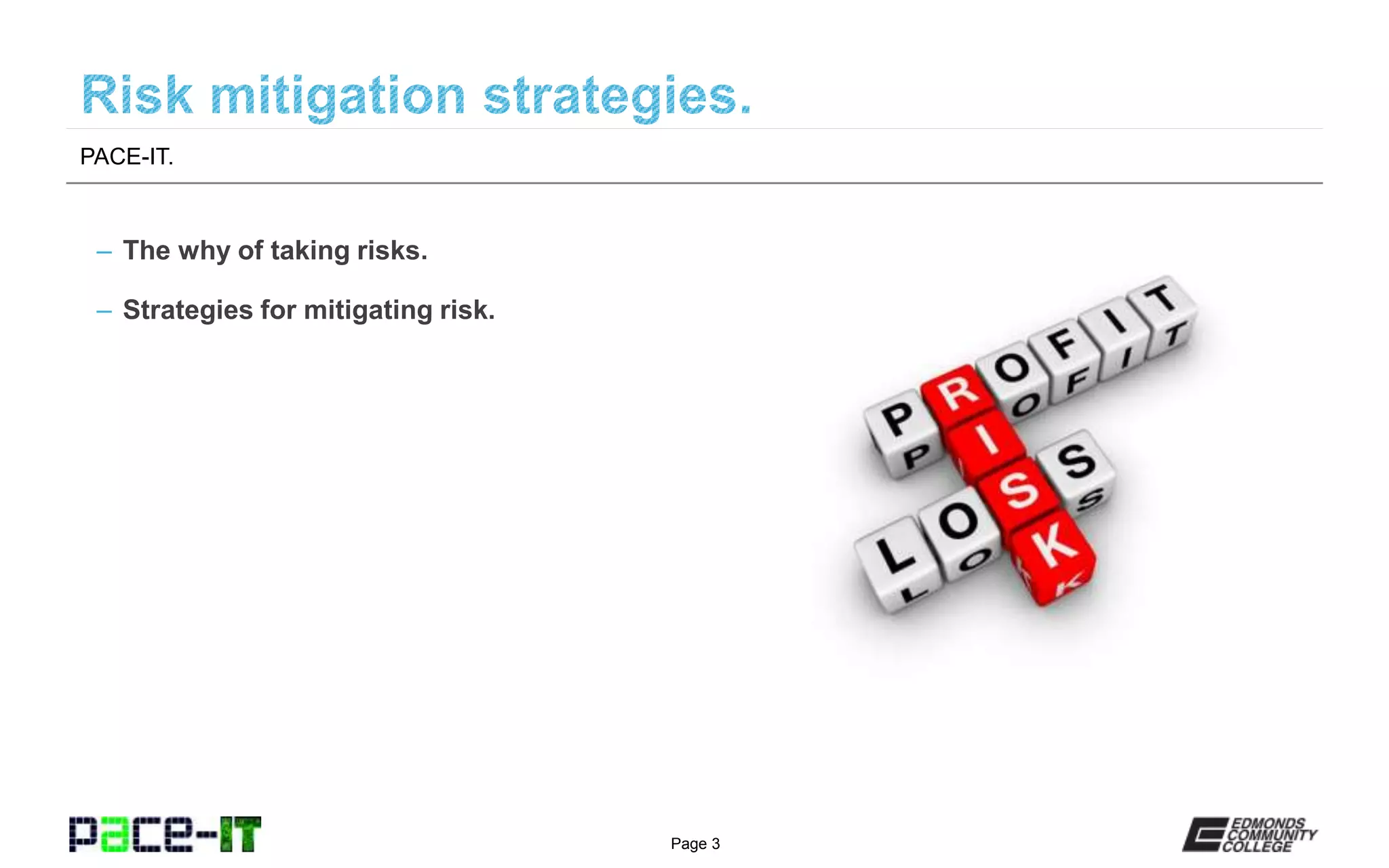
– The why of taking risks.
– Strategies for mitigating risk.
PACE-IT.
Page 4
Risk mitigation strategies.
Page 5
It seems to be a law of nature,
inflexible and inexorable, that
those who will not risk cannot
win.
– John Paul Jones
Page 6
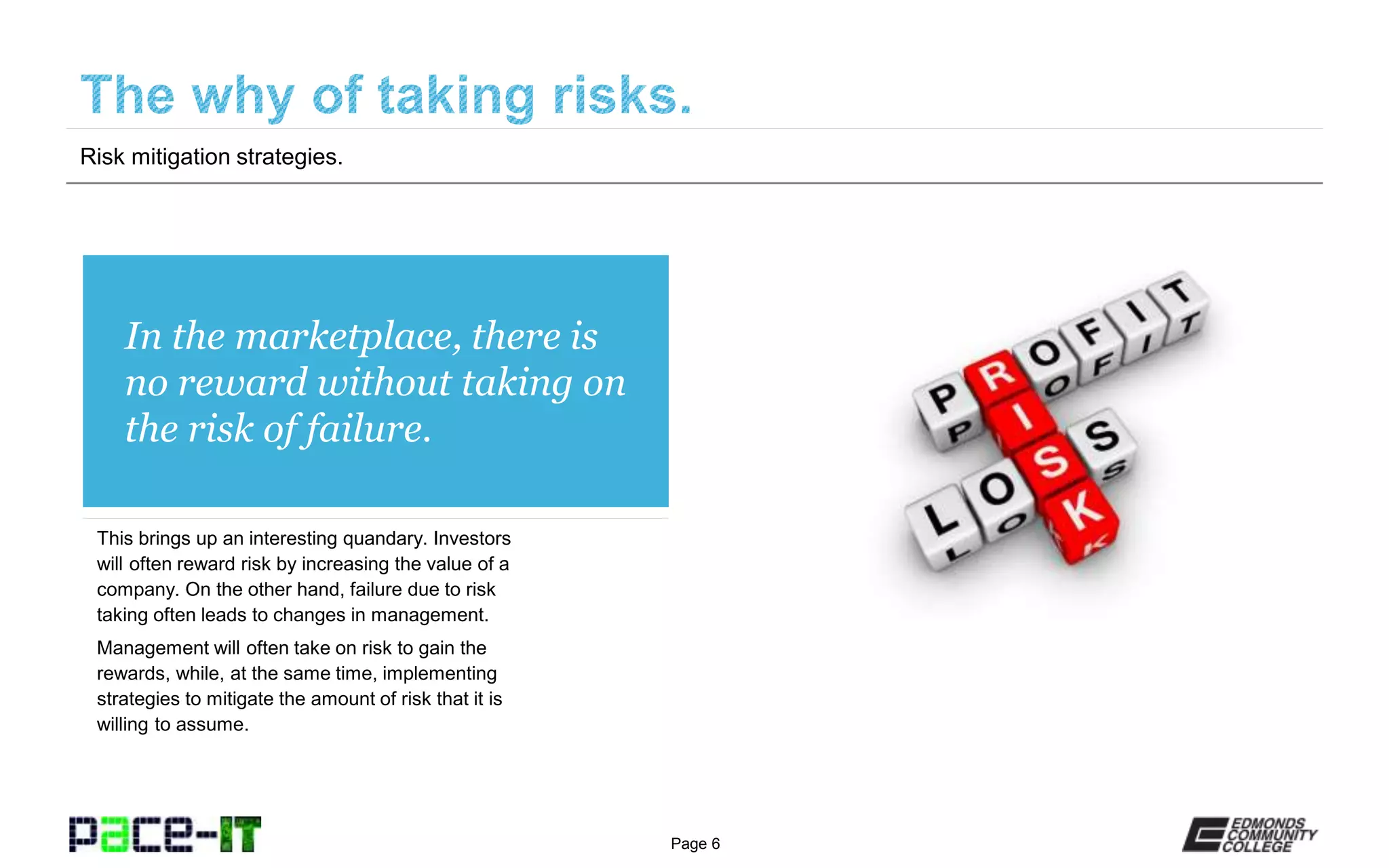
In the marketplace, there is
no reward without taking on
the risk of failure.
This brings up an interesting quandary. Investors
will often reward risk by increasing the value of a
company. On the other hand, failure due to risk
taking often leads to changes in management.
Management will often take on risk to gain the
rewards, while, at the same time, implementing
strategies to mitigate the amount of risk that it is
willing to assume.
Risk mitigation strategies.
Page 7
Risk mitigation strategies.
Page 8
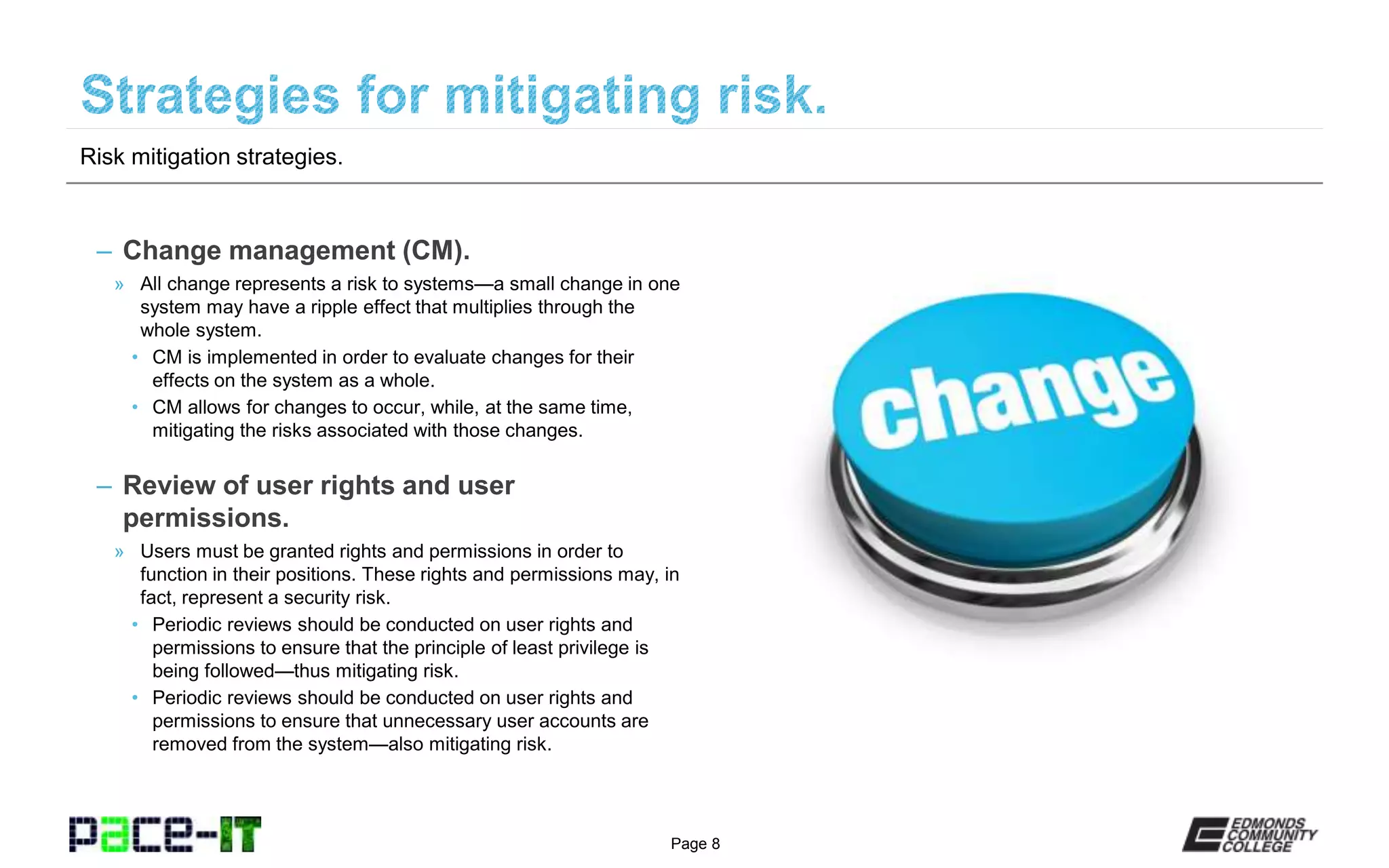
– Change management (CM).
» All change represents a risk to systems—a small change in one
system may have a ripple effect that multiplies through the
whole system.
• CM is implemented in order to evaluate changes for their
effects on the system as a whole.
• CM allows for changes to occur, while, at the same time,
mitigating the risks associated with those changes.
– Review of user rights and user
permissions.
» Users must be granted rights and permissions in order to
function in their positions. These rights and permissions may, in
fact, represent a security risk.
• Periodic reviews should be conducted on user rights and
permissions to ensure that the principle of least privilege is
being followed—thus mitigating risk.
• Periodic reviews should be conducted on user rights and
permissions to ensure that unnecessary user accounts are
removed from the system—also mitigating risk.
Risk mitigation strategies.
Page 9
– Perform routine audits.
» Audits (reviews) of systems should be conducted on a regular
basis in order to reduce risks.
• Security audits can be conducted on many different systems
to evaluate different aspects of risk, including system
configurations and vulnerability assessments.
– Incident management.
» A type of after-the-fact mitigation technique.
• After a security incident has occurred, effective incident
management can help to contain the damage.
• After a security incident has occurred, effective incident
management can help to prevent it from occurring again.
– Enforcing policies and procedures.
» Effective policies and procedures can reduce the chances of a
risk event from ever taking place.
• Proper enforcement of policies and procedures can help to
prevent the loss or theft of data.
Risk mitigation strategies.
Page 10
Data loss prevention (DLP)
systems can be implemented
as a type of technology
control to mitigate the risk
of loss or theft of data.
DLP systems can be a software application or network appliance.
They are designed to analyze information traversing the network
to help ensure that sensitive data remains contained inside the
established safe boundaries.
DLP systems can monitor network links and review what is being
transmitted through protocols associated with instant messaging,
email, FTP, HTTP, etc. DLP systems may also be configured to
scan storage systems to help ensure that data is being stored in
the proper locations.
Risk mitigation strategies.
Page 11
Risk mitigation strategies.
John Paul Jones once said, “It seems to be a law of nature, inflexible and
inexorable, that those who will not risk cannot win.” There is no reward in
the marketplace without taking risks. Investors reward risk, while, at the
same time, punishing failure. Management often takes on risk, while, at the
same time, implementing strategies to mitigate risk and the effects of risk.
Topic
The why of taking risks.
Summary
Any change in a system represents a risk. CM is a mitigation strategy to
reduce the risks associated with changes to systems. Periodic reviews of
users rights and privileges can also mitigate risk. Security audits should be
performed to reduce risks to systems and data. Effective incident
management can restrict the damage that a risk event causes and help to
prevent that event from occurring again. Properly enforcing policies and
procedures can help to prevent the loss or theft of data. DLP systems can
also be put in place to help prevent the loss or theft of sensitive data.
Strategies for mitigating risk.
Page 12
THANK YOU!
This workforce solution was 100 percent funded by a $3 million grant awarded by the
U.S. Department of Labor's Employment and Training Administration. The solution was
created by the grantee and does not necessarily reflect the official position of the U.S.
Department of Labor. The Department of Labor makes no guarantees, warranties, or
assurances of any kind, express or implied, with respect to such information, including
any information on linked sites and including, but not limited to, accuracy of the
information or its completeness, timeliness, usefulness, adequacy, continued availability
or ownership. Funded by the Department of Labor, Employment and Training
Administration, Grant #TC-23745-12-60-A-53.
PACE-IT is an equal opportunity employer/program and auxiliary aids and services are
available upon request to individuals with disabilities. For those that are hearing
impaired, a video phone is available at the Services for Students with Disabilities (SSD)
office in Mountlake Terrace Hall 159. Check www.edcc.edu/ssd for office hours. Call
425.354.3113 on a video phone for more information about the PACE-IT program. For
any additional special accommodations needed, call the SSD office at 425.640.1814.
Edmonds Community College does not discriminate on the basis of race; color; religion;
national origin; sex; disability; sexual orientation; age; citizenship, marital, or veteran
status; or genetic information in its programs and activities.

PACE-IT, Security+ 2.2: Integrating Data and Systems with 3rd Parties

  • 1.
  • 2.
    Page 2 Instructor, PACE-ITProgram – Edmonds Community College Areas of Expertise Industry Certifications  PC Hardware  Network Administration  IT Project Management  Network Design  User Training  IT Troubleshooting Qualifications Summary Education  M.B.A., IT Management, Western Governor’s University  B.S., IT Security, Western Governor’s University Entrepreneur, executive leader, and proven manger with 10+ years of experience turning complex issues into efficient and effective solutions. Strengths include developing and mentoring diverse workforces, improving processes, analyzing business needs and creating the solutions required— with a focus on technology.
  • 3.
    Page 3 – Thewhy of taking risks. – Strategies for mitigating risk. PACE-IT.
  • 4.
  • 5.
    Page 5 It seemsto be a law of nature, inflexible and inexorable, that those who will not risk cannot win. – John Paul Jones
  • 6.
    Page 6 In themarketplace, there is no reward without taking on the risk of failure. This brings up an interesting quandary. Investors will often reward risk by increasing the value of a company. On the other hand, failure due to risk taking often leads to changes in management. Management will often take on risk to gain the rewards, while, at the same time, implementing strategies to mitigate the amount of risk that it is willing to assume. Risk mitigation strategies.
  • 7.
  • 8.
    Page 8 – Changemanagement (CM). » All change represents a risk to systems—a small change in one system may have a ripple effect that multiplies through the whole system. • CM is implemented in order to evaluate changes for their effects on the system as a whole. • CM allows for changes to occur, while, at the same time, mitigating the risks associated with those changes. – Review of user rights and user permissions. » Users must be granted rights and permissions in order to function in their positions. These rights and permissions may, in fact, represent a security risk. • Periodic reviews should be conducted on user rights and permissions to ensure that the principle of least privilege is being followed—thus mitigating risk. • Periodic reviews should be conducted on user rights and permissions to ensure that unnecessary user accounts are removed from the system—also mitigating risk. Risk mitigation strategies.
  • 9.
    Page 9 – Performroutine audits. » Audits (reviews) of systems should be conducted on a regular basis in order to reduce risks. • Security audits can be conducted on many different systems to evaluate different aspects of risk, including system configurations and vulnerability assessments. – Incident management. » A type of after-the-fact mitigation technique. • After a security incident has occurred, effective incident management can help to contain the damage. • After a security incident has occurred, effective incident management can help to prevent it from occurring again. – Enforcing policies and procedures. » Effective policies and procedures can reduce the chances of a risk event from ever taking place. • Proper enforcement of policies and procedures can help to prevent the loss or theft of data. Risk mitigation strategies.
  • 10.
    Page 10 Data lossprevention (DLP) systems can be implemented as a type of technology control to mitigate the risk of loss or theft of data. DLP systems can be a software application or network appliance. They are designed to analyze information traversing the network to help ensure that sensitive data remains contained inside the established safe boundaries. DLP systems can monitor network links and review what is being transmitted through protocols associated with instant messaging, email, FTP, HTTP, etc. DLP systems may also be configured to scan storage systems to help ensure that data is being stored in the proper locations. Risk mitigation strategies.
  • 11.
    Page 11 Risk mitigationstrategies. John Paul Jones once said, “It seems to be a law of nature, inflexible and inexorable, that those who will not risk cannot win.” There is no reward in the marketplace without taking risks. Investors reward risk, while, at the same time, punishing failure. Management often takes on risk, while, at the same time, implementing strategies to mitigate risk and the effects of risk. Topic The why of taking risks. Summary Any change in a system represents a risk. CM is a mitigation strategy to reduce the risks associated with changes to systems. Periodic reviews of users rights and privileges can also mitigate risk. Security audits should be performed to reduce risks to systems and data. Effective incident management can restrict the damage that a risk event causes and help to prevent that event from occurring again. Properly enforcing policies and procedures can help to prevent the loss or theft of data. DLP systems can also be put in place to help prevent the loss or theft of sensitive data. Strategies for mitigating risk.
  • 12.
  • 13.
    This workforce solutionwas 100 percent funded by a $3 million grant awarded by the U.S. Department of Labor's Employment and Training Administration. The solution was created by the grantee and does not necessarily reflect the official position of the U.S. Department of Labor. The Department of Labor makes no guarantees, warranties, or assurances of any kind, express or implied, with respect to such information, including any information on linked sites and including, but not limited to, accuracy of the information or its completeness, timeliness, usefulness, adequacy, continued availability or ownership. Funded by the Department of Labor, Employment and Training Administration, Grant #TC-23745-12-60-A-53. PACE-IT is an equal opportunity employer/program and auxiliary aids and services are available upon request to individuals with disabilities. For those that are hearing impaired, a video phone is available at the Services for Students with Disabilities (SSD) office in Mountlake Terrace Hall 159. Check www.edcc.edu/ssd for office hours. Call 425.354.3113 on a video phone for more information about the PACE-IT program. For any additional special accommodations needed, call the SSD office at 425.640.1814. Edmonds Community College does not discriminate on the basis of race; color; religion; national origin; sex; disability; sexual orientation; age; citizenship, marital, or veteran status; or genetic information in its programs and activities.