




Family Group Conferencing:
Creating New Normals for At-Risk Families

A presentation by

Dr. Charlene Berquist & Heather Blades
The Center for Dispute Resolution
at Missouri State University
www.MissouriState.edu/CDR * CDR@MissouriState.edu * (417) 836-8831
Agenda






What is family group conferencing (FGC)?
Our experiences with FGC
Overview of the FGC process
Research on FGC
Discussion of applications of FGC in your work
Introductions
 Your name
 Why are you here? What is your interest in family group
conferencing?
What is Family Group Conferencing?
 Family group conferences bring a family together with their
relatives, friends, and other supportive people in their lives
to develop a plan to support an individual in the family who
is facing challenges or difficulties, or to address a specific
concern or issue.
 Family group conferences create “new normals” for families
in a variety of ways
J. Nice, Family Unity Project
 “Family Group Decision Making (FGC) is more a family
gathering to which service providers are invited, than an
agency meeting to which family members are invited.”
History of FGC
 Moari Tribe -“PUAO-TE-ATA-TU (DAY BREAK)
 Federal legislation in New Zealand -1989 Children, Young
Persons, and their Family Act
 Spread to Australia, Great Britain, Ireland, Canada, and
United States
 First U.S. model is the Family Unity Model –begun in Oregon
apx. 15 years ago – models of practice vary
 Currently implemented in over 35 states across the U.S.
Contexts Where FGC is Used





Child protection and child welfare
Juvenile offending
Addiction recovery
Re-integration of juveniles/adults after
detention/incarceration
 Child mental & physical health support
 Others?
Our Experiences with FGC
 FGC with female adolescent offenders (Networks for Girls)
 Collaborative partnership with Greene County Juvenile Office
 Program began 2010
 Funded by Title II Grant from the Missouri Department of Public Safety and the
Missouri Juvenile Justice Advisory Group from funding provided by the U.S.
Department of Justice, Office of Juvenile Justice and Delinquency Prevention

 FGC with parents in recovery (Regional Partnership Grant)
 Collaborative partnership with Alternative Opportunities/Carol Jones Recovery Center
 Program began in 2012
 Funded by a federal grant funded by the Children’s Bureau

 FGC Training and Support
 Regularly provide training for volunteers, court and child welfare personnel, and
mental health and recovery professionals
 Have applied for Federal Healthcare Innovation Grant as a collaborative partner
providing Family Group Conference training and ongoing teleconference
communication and conflict management support - notification date January, 2014
Human “Bean” Exercise
Human “Bean” Debrief
 What is your reaction to this exercise?
 How has your family coped with one of these situations?
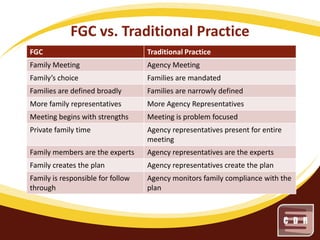
FGC vs. Traditional Practice
FGC

Traditional Practice

Family Meeting

Agency Meeting

Family’s choice

Families are mandated

Families are defined broadly

Families are narrowly defined

More family representatives

More Agency Representatives

Meeting begins with strengths

Meeting is problem focused

Private family time

Agency representatives present for entire
meeting

Family members are the experts

Agency representatives are the experts

Family creates the plan

Agency representatives create the plan

Family is responsible for follow
through

Agency monitors family compliance with the
plan
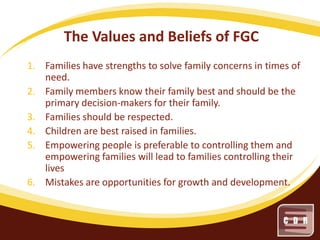
The Values and Beliefs of FGC
1. Families have strengths to solve family concerns in times of
need.
2. Family members know their family best and should be the
primary decision-makers for their family.
3. Families should be respected.
4. Children are best raised in families.
5. Empowering people is preferable to controlling them and
empowering families will lead to families controlling their
lives
6. Mistakes are opportunities for growth and development.
“Stand Up” for What You Believe
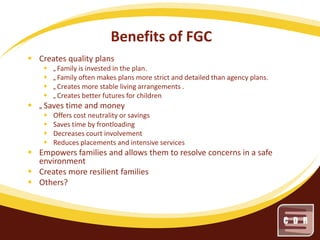
Benefits of FGC
 Creates quality plans





„Family is invested in the plan.
„Family often makes plans more strict and detailed than agency plans.
„Creates more stable living arrangements .
„Creates better futures for children

 „Saves time and money





Offers cost neutrality or savings
Saves time by frontloading
Decreases court involvement
Reduces placements and intensive services

 Empowers families and allows them to resolve concerns in a safe
environment
 Creates more resilient families
 Others?
Voices of Our Participants
 “I think it has shown her what strengths she has and what kind of
person she is and she is stronger than she knew.”
 “…I feel a lot more comfortable knowing that I can speak to my family
about any problems we have.”
 “Great experience. Really enjoyed being able to voice my thoughts and
opinions in a place where they wouldn’t be un-noticed. Hearing what
her concerns were helped me realize how she felt about everything.
 “This was really amazing and this helped me out a lot. I’m proud and
love myself now more than ever and I love my family.”
 “This really helped us figure out who is able to be there for support.”
 “I am very glad this group happened.”
Video: Family Voices
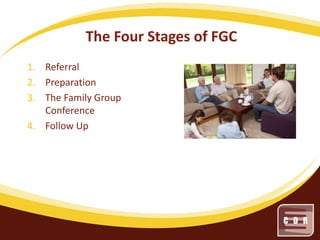
The Four Stages of FGC
1. Referral
2. Preparation
3. The Family Group
Conference
4. Follow Up
The Referral
 Process will vary depending on program
 Role of referring worker
 Introduces FGC to primary family
 Explains agency’s concerns
 Explains FGC values

 Referral information
Role of the Facilitators/Coordinators
 Professional vs. volunteer
 Are impartial architects of the FGC process
 Prepares family for the FGC and conducts the FGC






Protects the process
Keeps a safe space
Responds to changes and crisis
Facilitates beginning and end
Assists in evaluation of the plan
Principles Guiding the Preparation of
Families
 Family groups are entitled to information because of their
decision-making role.
 Process should be transparent – no surprises.
 Family groups must be adequately prepared.
 Information is shared with everyone – not the “keeper of
secrets”.
Preparing Family & Others
 Information is shared with family members
 What is FGC
 Why the family is involved
 What to expect

 Family asked key questions







Who to include
Safety concerns
Family culture
Strengths and concerns of family
Logistics
Commitment

 Others at the table
Stages of the FGC







Welcome
Introduction phase
Sharing of strengths and concerns
Information sharing
Private family time
Plan finalization
Current Research in Family Group
Conferencing
 Focus of current research






Participant satisfaction
Attitudes of system participants
Plan content
Perceptions of and placement of children
Limited implementation and follow-up research

 Gaps in the research





Comparison of program types
Limited understanding of specific features of process
Differences between types of cases and impact
Perceptions and experiences of different participants and
facilitator/coordinators
 Long term outcomes
Our Family Group Conferencing
Research








Quantitative and Qualitative
Program comparisons
Participant comparisons
Pre-and Post Surveys
Observational data
Focus Group Interviews
Longitudinal outcomes
Application
 How might this program
format be useful for you?
 Are there collaborations you
might draw upon?
 How could you solicit
volunteers and program
support?
 What challenges might you
face in implementing this
type of program?
Questions and Comments
To Learn More
The Center for Dispute Resolution
at Missouri State University
Phone: (417) 836-8831
Email: CDR@MissouriState.edu
Web: www.MissouriState.edu/CDR
Dropbox with Handouts:
http://tinyurl.com/meffu9f

Family Group Conferencing: Creating New Normals for At-Risk Families

  • 1.
    Family Group Conferencing: CreatingNew Normals for At-Risk Families A presentation by Dr. Charlene Berquist & Heather Blades The Center for Dispute Resolution at Missouri State University www.MissouriState.edu/CDR * CDR@MissouriState.edu * (417) 836-8831
  • 2.
    Agenda      What is familygroup conferencing (FGC)? Our experiences with FGC Overview of the FGC process Research on FGC Discussion of applications of FGC in your work
  • 3.
    Introductions  Your name Why are you here? What is your interest in family group conferencing?
  • 4.
    What is FamilyGroup Conferencing?  Family group conferences bring a family together with their relatives, friends, and other supportive people in their lives to develop a plan to support an individual in the family who is facing challenges or difficulties, or to address a specific concern or issue.  Family group conferences create “new normals” for families in a variety of ways
  • 5.
    J. Nice, FamilyUnity Project  “Family Group Decision Making (FGC) is more a family gathering to which service providers are invited, than an agency meeting to which family members are invited.”
  • 6.
    History of FGC Moari Tribe -“PUAO-TE-ATA-TU (DAY BREAK)  Federal legislation in New Zealand -1989 Children, Young Persons, and their Family Act  Spread to Australia, Great Britain, Ireland, Canada, and United States  First U.S. model is the Family Unity Model –begun in Oregon apx. 15 years ago – models of practice vary  Currently implemented in over 35 states across the U.S.
  • 7.
    Contexts Where FGCis Used     Child protection and child welfare Juvenile offending Addiction recovery Re-integration of juveniles/adults after detention/incarceration  Child mental & physical health support  Others?
  • 8.
    Our Experiences withFGC  FGC with female adolescent offenders (Networks for Girls)  Collaborative partnership with Greene County Juvenile Office  Program began 2010  Funded by Title II Grant from the Missouri Department of Public Safety and the Missouri Juvenile Justice Advisory Group from funding provided by the U.S. Department of Justice, Office of Juvenile Justice and Delinquency Prevention  FGC with parents in recovery (Regional Partnership Grant)  Collaborative partnership with Alternative Opportunities/Carol Jones Recovery Center  Program began in 2012  Funded by a federal grant funded by the Children’s Bureau  FGC Training and Support  Regularly provide training for volunteers, court and child welfare personnel, and mental health and recovery professionals  Have applied for Federal Healthcare Innovation Grant as a collaborative partner providing Family Group Conference training and ongoing teleconference communication and conflict management support - notification date January, 2014
  • 9.
  • 10.
    Human “Bean” Debrief What is your reaction to this exercise?  How has your family coped with one of these situations?
  • 11.
    FGC vs. TraditionalPractice FGC Traditional Practice Family Meeting Agency Meeting Family’s choice Families are mandated Families are defined broadly Families are narrowly defined More family representatives More Agency Representatives Meeting begins with strengths Meeting is problem focused Private family time Agency representatives present for entire meeting Family members are the experts Agency representatives are the experts Family creates the plan Agency representatives create the plan Family is responsible for follow through Agency monitors family compliance with the plan
  • 12.
    The Values andBeliefs of FGC 1. Families have strengths to solve family concerns in times of need. 2. Family members know their family best and should be the primary decision-makers for their family. 3. Families should be respected. 4. Children are best raised in families. 5. Empowering people is preferable to controlling them and empowering families will lead to families controlling their lives 6. Mistakes are opportunities for growth and development.
  • 13.
    “Stand Up” forWhat You Believe
  • 14.
    Benefits of FGC Creates quality plans     „Family is invested in the plan. „Family often makes plans more strict and detailed than agency plans. „Creates more stable living arrangements . „Creates better futures for children  „Saves time and money     Offers cost neutrality or savings Saves time by frontloading Decreases court involvement Reduces placements and intensive services  Empowers families and allows them to resolve concerns in a safe environment  Creates more resilient families  Others?
  • 15.
    Voices of OurParticipants  “I think it has shown her what strengths she has and what kind of person she is and she is stronger than she knew.”  “…I feel a lot more comfortable knowing that I can speak to my family about any problems we have.”  “Great experience. Really enjoyed being able to voice my thoughts and opinions in a place where they wouldn’t be un-noticed. Hearing what her concerns were helped me realize how she felt about everything.  “This was really amazing and this helped me out a lot. I’m proud and love myself now more than ever and I love my family.”  “This really helped us figure out who is able to be there for support.”  “I am very glad this group happened.”
  • 16.
  • 17.
    The Four Stagesof FGC 1. Referral 2. Preparation 3. The Family Group Conference 4. Follow Up
  • 18.
    The Referral  Processwill vary depending on program  Role of referring worker  Introduces FGC to primary family  Explains agency’s concerns  Explains FGC values  Referral information
  • 19.
    Role of theFacilitators/Coordinators  Professional vs. volunteer  Are impartial architects of the FGC process  Prepares family for the FGC and conducts the FGC      Protects the process Keeps a safe space Responds to changes and crisis Facilitates beginning and end Assists in evaluation of the plan
  • 20.
    Principles Guiding thePreparation of Families  Family groups are entitled to information because of their decision-making role.  Process should be transparent – no surprises.  Family groups must be adequately prepared.  Information is shared with everyone – not the “keeper of secrets”.
  • 21.
    Preparing Family &Others  Information is shared with family members  What is FGC  Why the family is involved  What to expect  Family asked key questions       Who to include Safety concerns Family culture Strengths and concerns of family Logistics Commitment  Others at the table
  • 22.
    Stages of theFGC       Welcome Introduction phase Sharing of strengths and concerns Information sharing Private family time Plan finalization
  • 23.
    Current Research inFamily Group Conferencing  Focus of current research      Participant satisfaction Attitudes of system participants Plan content Perceptions of and placement of children Limited implementation and follow-up research  Gaps in the research     Comparison of program types Limited understanding of specific features of process Differences between types of cases and impact Perceptions and experiences of different participants and facilitator/coordinators  Long term outcomes
  • 24.
    Our Family GroupConferencing Research        Quantitative and Qualitative Program comparisons Participant comparisons Pre-and Post Surveys Observational data Focus Group Interviews Longitudinal outcomes
  • 25.
    Application  How mightthis program format be useful for you?  Are there collaborations you might draw upon?  How could you solicit volunteers and program support?  What challenges might you face in implementing this type of program?
  • 26.
  • 27.
    To Learn More TheCenter for Dispute Resolution at Missouri State University Phone: (417) 836-8831 Email: CDR@MissouriState.edu Web: www.MissouriState.edu/CDR Dropbox with Handouts: http://tinyurl.com/meffu9f

Editor's Notes

  • #14 Debrief as a large group What is compelling about each of these values/beliefs?How are these values/beliefs present or absent in your agency?Are there changes you could make in your everyday work to further embrace these values/beliefs?
  • #28 To learn more about the Center for Dispute Resolution please explore our website or contact us by phone or email! We’ll look forward to hearing from you.