Lecture 2 – Children Act 1989

     shummi.s@hotmail.co.uk
Lesson Objectives:
1. To be able to recap what parental
responsibility is.
2. To be able to understand and discuss the
Welfare vs. Autonomy argument.
3. To be able to list 3 principles and a minimum
of 5 factors which are applied in court
proceedings when making a decision about a
child’s upbringing.
Recap Test
1.  Who has parental responsibility immediately from the birth of a child?
2.  Does a father who is married to the mother, when the child is born, have
    parental responsibility?
3. What kind of rights and duties does parental responsibility include?
4. What happened in Leeds Teaching Hospital NHS Trust v A? Who are the parents?
    Who has parental responsibility?
5. What was held in Gillick v West Norfolk and Wisbech Area Health Authority
    1985?
6. What did the court order in Re A (a minor) (Blood Transfusion) 1993? How does
    this demonstrate how the law has developed?
7. In S v R (Parental Responsibility) 1993, the court ordered 3 rules which a father
    must satisfy in order to be granted PR. What are these grounds?
8. Name a case where even if the grounds in S v R are satisfied, PR may still not be
    given? What was the courts reasoning in this case?
9. Name the various people that can have PR?
10. What are the advantages and disadvantages of several people having PR
    simultaneously?
The loss of parental responsibility
There are several ways in which PR can be lost, and
situations where it cannot be lost. Discuss with the
person next to you/ share ideas (3 mins).

1. PR that exists as a right of married parents/unmarried
   mother, can only be lost by adoption.
2. PR acquired by registration on the birth
   certificate, court order or agreement can be ended by
   a court order. Entering into a marriage or civil
   partnership with someone other than the child’s
   other parent does not bring PR to an end.
What does not affect PR?
1. PR is not lost because someone else later obtains it,
   even if this is a local authority under a care order; it is
   shared as described previously.
2. PR cannot be given away, although a particular
   right/duty may be delegated to another person or
   body. For example, a boarding school will be
   entrusted with the duty not only to educate a child in
   its care but also to look after his day-to-day welfare.
3. The GRA 2004 specifically provides that the
   acquisition of a new gender does not affect that
   person’s status as a father or mother. (Thus a man can
   be a mother and a woman can be father).
Activity
 Produce a diagram to reflect how many people
can acquire PR – and explain how. E.g. a Mother
(automatic). A minimum of 7 examples must be
                    shown.

               You have 5 mins
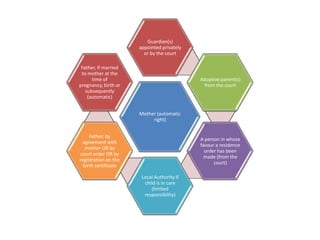
Guardian(s)
                      appointed privately
                        or by the court

 Father, if married
 to mother at the
      time of                               Adoptive parent(s)
pregnancy, birth or                          from the court
   subsequently
    (automatic)


                      Mother (automatic
                           right)


     Father, by
                                            A person in whose
 agreement with
                                            favour a residence
   mother OR by
                                              order has been
court order OR by
                                              made (from the
registration on the
                                                  court)
  birth certificate

                       Local Authority if
                        child is in care
                           (limited
                        responsibility)
The child’s autonomy
Key case?
Gillick v West Norfolk and Wisbech AHA [1986] AC 112:
M sought assurance that her daughters could not be given
contraceptive advice without her consent – AHA refused -
, Mrs G sought declaration that the advice was wrong and
infringed her rights as a parent. She claimed that the right to
decide whether they could or could not receive such advice
(like the right to consent to medical treatment) was part of
her “parental rights”.

What do you think? Do you think that Mrs G was right? Did
this infringe her parental rights? What about the child’s
rights?
Gillick – child’s autonomy
The HL held not. The parents’ authority “yields to the
child’s right to make his own decisions when he reaches a
sufficient understanding and intelligence to be capable of
making up his own mind on the matter requiring
decision” (Lord Scarman)

The court did not say that Mrs G had no “right” – simply
that her “right” could be trumped by the child’s own
“right” to decide (and when that happens is a question of
fact in each case). Gillick competency test arised. What
were the three factors that needed to be taken into
consideration??
The PRINCIPLE applied in court
            proceedings
The Children Act 1989 sets out three principles
which the court should apply when making a
decision about a child’s upbringing. These are:
(1) The paramountcy principle s 191) CA 1989 –
    states that the child’s welfare shall be the
    paramount consideration in all proceedings
    which affect it.

What does the term ‘paramount’ mean?
Re A (Minors)(Conjoined Twins: Medical Treatment)
                 [2001] 2 WLR 480 CA.
Take the above medical case:

Twins were born joined at the abdomen. The heart of the stronger one was keeping
the weaker one alive. The parents were in agreement – they felt an operation to
separate the twins should not take place as the weaker twin would die. The hospital
thought that was wrong – the weaker twin had no real prospect of life and would
endanger the other one – if the operation did not take place both were likely to die
within months – if it did take place the weaker one would die immediately but the
stronger one had a chance of life - so the hospital felt the operation should take
place, even though the weaker twin would then die. The hospital applied to the court.

What do you think is the paramount issue here?

Ward LJ said parental rights and powers “exist for the performance of their duties and
responsibilities to the child and must be exercised in the best interests of the child.”
Parents’ wishes are a weighty factor but “parental right is, however, subordinate to
welfare”.
Take note of the concept of “welfare”. We will look at that more closely, in
conjunction with the idea of “rights”.
(a) The paramountcy principle
It has been questioned whether the paramountcy
principle is compatible with Art 8 ECHR (right to life)
which, read strictly, would seem to require a
balancing of the interests of all the members of the
family (adults and children) when their interests
conflict. The English courts have taken the view that
there is no conflict between the two (RE B [2002])
and the ECHR have stated that the welfare of the
child may justify an interference with parental
rights (Johansen v Norway [1997]). ***
“Welfare”, “Best Interests” and
                 “Rights”
CA 1989 s1(1) says that the child’s “welfare” is “paramount” in
  deciding any question in relation to the child (the “welfare
  principle”)
“Paramount” means it overrides all other considerations

HL in J v C [1970] AC 668 held that “first and paramount”
meant that the child’s welfare is the sole consideration. As the
word “first” is otiose this is the settled understanding of
“paramount”.
Per L MacDermott it means “more than that the child’s
welfare is to be treated as the top item on a list….*it is+ the
paramount consideration because it rules upon or determines
the course to be followed.”
J v C [1970] AC 668
Child born in 1958 in England, of Spanish parents.
M ill so child went to foster parents for 1 year. Then
went to Spain with parents for 17 months. Then
returned to the foster parents. Made a ward of
court and decision in 1965 that he remain with the
foster parents. When child was 10 the
parents, who were now settled, asked for custody.
The court felt a move to Spain now would be
harmful. Even though the parents were
“unimpeachable” and so normally would have their
own children, their wishes were to be looked at in
the light of the child’s welfare.
Welfare vs Autonomy
So, if decisions are made with the child’s “welfare” as “paramount”, how does
this tie in with the child’s increasing right to self-determination (autonomy) as
per Gillick?

If the child has the “right” to decide, then can the state override that decision
on the basis of “welfare”? And, if so, what is “welfare”? – and who decides?

The case of Mabon v Mabon demonstrates the increasing tendency to hear
the child’s voice during legal proceedings. Here, the mother took the 3
youngest children and the father took the three eldest. The three eldest, aged
17, 15 and 13, wanted to instruct a solicitor and have their voice heard in the
proceedings. This meant they would have access to all the procedural
documents which the court thought might be harsh on children, and was
originally not allowed. However, the children appealed, and the CA ordered
for separate representation. The children knew the issues and had a right to
participate, referring to Article 12 – right to freedom of expression, which
outweighed the paternalistic judgement of ‘welfare’. It was also held that for
older, articulate children, to deny them the right to be heard would damage
their ‘welfare’ in itself.
The PRINCIPLES applied in court
              proceedings
(2) The no order/non-intervention principle – under s195) CA
1989 a general principle of non-intervention is stated. The
court should not make an order unless it is satisfied that to do
so will be better for the child than making no order at all.

Under the no order/non-intervention principle the court will
make an order only if it strictly necessary. For example, it is
not necessary to make a residence or contact order on divorce
unless there is a dispute between the parents over the
child, or one parent appears likely to take the child out of the
jurisdiction for any length of time. However, an order may be
made where there is agreement between the parties to
prevent future difficulties where they might reasonably be
anticipated.
The PRINCIPLES applied in court
             proceedings
(3) The avoidance of delay principle s1(2) CA 1989
provides that the court should have regard to the
general principle that any delay in determining a
question with respect to the upbringing of a child is
likely to prejudice the child’s welfare.

To promote this principle, the CA 1989 requires that
court to set a timetable for children proceedings
and not to permit any hearing to end without
another court date being set (until final resolution).
The FACTORS applied in court
                 proceedings
S.1(3) CA 1989 contains a checklist of the factors that the court should take
into account in certain proceedings involving children, including those for a
s.8 order (residence, contact, prohibited steps, and specific issue orders).

The factors include the following:
(a) The wishes and feelings of the child concerned, in the light of his age and
understanding.

The views of the children must be taken into account in light of their age and
maturity. Inevitably, the older a child, the more likely it is that his views will
be taken into account and even determine the issue. In Re S (Children’s
Views) [2002] the court refused to make an order for contact relating to two
children aged 14 and 16, who stated that they did not wish to see their father.

What key case can you think of that relates to the child’s autonomy?
(b) The child’s physical, emotional and
educational needs

The court will look at the need for
food, warmth, stability and affection as well as
the child’s age, health and educational
background. Wherever possible, brothers and
sisters should stay together. The court also
considers that the child’s emotional need for
contact with both parents and will take into
account which parent is most likely to facilitate
this.
© The likely effect on the child of any change in his
circumstances.

The court will generally be reluctant to move a child from
familiar surroundings, especially if he is settled and happy.
However, in a number of recent cases the courts have
transferred the residence of children where the parent with
whom they were living was preventing contact with the other
parent – Re S and Others (2008):
The local Authority were seeking a Care Order relating to the
fifth child of a couple. The first four children were already the
subject of Care Orders. As part of that history there were
reports and records relating to possible sexual misconduct by
the father containing two cautions; two prosecutions resulting
in two acquittals; and various other complaints and assertions
which had never been the subject of any criminal or family
proceedings.
(d) Any harm which the child has suffered or is
at risk of suffering.

This includes not only physical abuse, but also
anything else that might impair the child’s
development, such as a parent’s alcoholism or
drug use. ‘Harm’ also includes impairment from
seeing or bearing the ill treatment of another.
Thus, it is expressly recognised that children can
be harmed by seeing violence between their
parents.
(e) The child’s age, sex, background and any
characteristics which the court considers relevant.

This allows the court to focus on issues such as race
and religion as well as matters of day-to-day care. If
one parent adopts an unorthodox lifestyle, then this
will be taken into account. The court will not decide
between two competing lifestyles but will focus on
the effect, if any, they may have on the child (e.g.
estrangement from other members of the family, or
limited or no resort to medical treatment: M v H
(Education Welfare) [2008].
M v H (Education Welfare) [2008]

A specific issue arose under a joint residence arrangement as
to whether a young child should be educated in England and
therefore spend the majority of his time living with his father
or in Germany with his mother who has become a Jehovah’s
Witness. The held the mother’s beliefs and practices were
factors which favoured the child going to school in England
particularly in relation to parties and Christmas and in terms
of the range of social relationships open to the child.

Although there is no precise rules, the courts usually decide
that young children are best protected by staying with their
mother. It is not unusual for older children to be allowed to
live with their father.
(f) The capability of the child’s parents, or anyone
else that the court considers relevant to meet the
child’s needs.

This factor is considered in conjunction with the
child’s physical, emotional and education needs and
requires a decision as to which of the parties will be
best able to care for the child. This will be judged by
their perceived ability to provide a stable home and
presence for the child, rather than by the parents’
conduct towards each other, although the court will
take into account the extent to which each is willing
to promote contact with the others. If one parent
has a new partner, that partner’s parenting abilities
will also be considered.
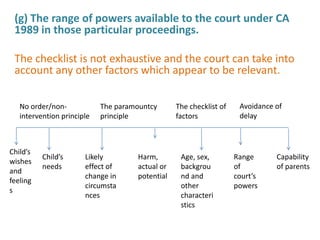
(g) The range of powers available to the court under CA
 1989 in those particular proceedings.

 The checklist is not exhaustive and the court can take into
 account any other factors which appear to be relevant.

   No order/non-            The paramountcy      The checklist of    Avoidance of
   intervention principle   principle            factors             delay


Child’s
          Child’s      Likely        Harm,        Age, sex,         Range      Capability
wishes
          needs        effect of     actual or    backgrou          of         of parents
and
                       change in     potential    nd and            court’s
feeling
                       circumsta                  other             powers
s
                       nces                       characteri
                                                  stics
Recap Test
1. What are the 3 principles applied in court
   proceedings needed to be considered for a
   child’s upbringing?
2. What are the 7 factors applied in court
   proceedings when considering a child’s
   upbringing?
3. Explain what is meant by paramountcy, welfare,
   and autonomy in relation to the CA 1989.
4. Discuss the Welfare vs Autonomy argument.

The Principles and the Factors

  • 1.
    Lecture 2 –Children Act 1989 shummi.s@hotmail.co.uk
  • 2.
    Lesson Objectives: 1. Tobe able to recap what parental responsibility is. 2. To be able to understand and discuss the Welfare vs. Autonomy argument. 3. To be able to list 3 principles and a minimum of 5 factors which are applied in court proceedings when making a decision about a child’s upbringing.
  • 3.
    Recap Test 1. Who has parental responsibility immediately from the birth of a child? 2. Does a father who is married to the mother, when the child is born, have parental responsibility? 3. What kind of rights and duties does parental responsibility include? 4. What happened in Leeds Teaching Hospital NHS Trust v A? Who are the parents? Who has parental responsibility? 5. What was held in Gillick v West Norfolk and Wisbech Area Health Authority 1985? 6. What did the court order in Re A (a minor) (Blood Transfusion) 1993? How does this demonstrate how the law has developed? 7. In S v R (Parental Responsibility) 1993, the court ordered 3 rules which a father must satisfy in order to be granted PR. What are these grounds? 8. Name a case where even if the grounds in S v R are satisfied, PR may still not be given? What was the courts reasoning in this case? 9. Name the various people that can have PR? 10. What are the advantages and disadvantages of several people having PR simultaneously?
  • 4.
    The loss ofparental responsibility There are several ways in which PR can be lost, and situations where it cannot be lost. Discuss with the person next to you/ share ideas (3 mins). 1. PR that exists as a right of married parents/unmarried mother, can only be lost by adoption. 2. PR acquired by registration on the birth certificate, court order or agreement can be ended by a court order. Entering into a marriage or civil partnership with someone other than the child’s other parent does not bring PR to an end.
  • 5.
    What does notaffect PR? 1. PR is not lost because someone else later obtains it, even if this is a local authority under a care order; it is shared as described previously. 2. PR cannot be given away, although a particular right/duty may be delegated to another person or body. For example, a boarding school will be entrusted with the duty not only to educate a child in its care but also to look after his day-to-day welfare. 3. The GRA 2004 specifically provides that the acquisition of a new gender does not affect that person’s status as a father or mother. (Thus a man can be a mother and a woman can be father).
  • 6.
    Activity Produce adiagram to reflect how many people can acquire PR – and explain how. E.g. a Mother (automatic). A minimum of 7 examples must be shown. You have 5 mins
  • 7.
    Guardian(s) appointed privately or by the court Father, if married to mother at the time of Adoptive parent(s) pregnancy, birth or from the court subsequently (automatic) Mother (automatic right) Father, by A person in whose agreement with favour a residence mother OR by order has been court order OR by made (from the registration on the court) birth certificate Local Authority if child is in care (limited responsibility)
  • 8.
    The child’s autonomy Keycase? Gillick v West Norfolk and Wisbech AHA [1986] AC 112: M sought assurance that her daughters could not be given contraceptive advice without her consent – AHA refused - , Mrs G sought declaration that the advice was wrong and infringed her rights as a parent. She claimed that the right to decide whether they could or could not receive such advice (like the right to consent to medical treatment) was part of her “parental rights”. What do you think? Do you think that Mrs G was right? Did this infringe her parental rights? What about the child’s rights?
  • 9.
    Gillick – child’sautonomy The HL held not. The parents’ authority “yields to the child’s right to make his own decisions when he reaches a sufficient understanding and intelligence to be capable of making up his own mind on the matter requiring decision” (Lord Scarman) The court did not say that Mrs G had no “right” – simply that her “right” could be trumped by the child’s own “right” to decide (and when that happens is a question of fact in each case). Gillick competency test arised. What were the three factors that needed to be taken into consideration??
  • 10.
    The PRINCIPLE appliedin court proceedings The Children Act 1989 sets out three principles which the court should apply when making a decision about a child’s upbringing. These are: (1) The paramountcy principle s 191) CA 1989 – states that the child’s welfare shall be the paramount consideration in all proceedings which affect it. What does the term ‘paramount’ mean?
  • 11.
    Re A (Minors)(ConjoinedTwins: Medical Treatment) [2001] 2 WLR 480 CA. Take the above medical case: Twins were born joined at the abdomen. The heart of the stronger one was keeping the weaker one alive. The parents were in agreement – they felt an operation to separate the twins should not take place as the weaker twin would die. The hospital thought that was wrong – the weaker twin had no real prospect of life and would endanger the other one – if the operation did not take place both were likely to die within months – if it did take place the weaker one would die immediately but the stronger one had a chance of life - so the hospital felt the operation should take place, even though the weaker twin would then die. The hospital applied to the court. What do you think is the paramount issue here? Ward LJ said parental rights and powers “exist for the performance of their duties and responsibilities to the child and must be exercised in the best interests of the child.” Parents’ wishes are a weighty factor but “parental right is, however, subordinate to welfare”. Take note of the concept of “welfare”. We will look at that more closely, in conjunction with the idea of “rights”.
  • 12.
    (a) The paramountcyprinciple It has been questioned whether the paramountcy principle is compatible with Art 8 ECHR (right to life) which, read strictly, would seem to require a balancing of the interests of all the members of the family (adults and children) when their interests conflict. The English courts have taken the view that there is no conflict between the two (RE B [2002]) and the ECHR have stated that the welfare of the child may justify an interference with parental rights (Johansen v Norway [1997]). ***
  • 13.
    “Welfare”, “Best Interests”and “Rights” CA 1989 s1(1) says that the child’s “welfare” is “paramount” in deciding any question in relation to the child (the “welfare principle”) “Paramount” means it overrides all other considerations HL in J v C [1970] AC 668 held that “first and paramount” meant that the child’s welfare is the sole consideration. As the word “first” is otiose this is the settled understanding of “paramount”. Per L MacDermott it means “more than that the child’s welfare is to be treated as the top item on a list….*it is+ the paramount consideration because it rules upon or determines the course to be followed.”
  • 14.
    J v C[1970] AC 668 Child born in 1958 in England, of Spanish parents. M ill so child went to foster parents for 1 year. Then went to Spain with parents for 17 months. Then returned to the foster parents. Made a ward of court and decision in 1965 that he remain with the foster parents. When child was 10 the parents, who were now settled, asked for custody. The court felt a move to Spain now would be harmful. Even though the parents were “unimpeachable” and so normally would have their own children, their wishes were to be looked at in the light of the child’s welfare.
  • 15.
    Welfare vs Autonomy So,if decisions are made with the child’s “welfare” as “paramount”, how does this tie in with the child’s increasing right to self-determination (autonomy) as per Gillick? If the child has the “right” to decide, then can the state override that decision on the basis of “welfare”? And, if so, what is “welfare”? – and who decides? The case of Mabon v Mabon demonstrates the increasing tendency to hear the child’s voice during legal proceedings. Here, the mother took the 3 youngest children and the father took the three eldest. The three eldest, aged 17, 15 and 13, wanted to instruct a solicitor and have their voice heard in the proceedings. This meant they would have access to all the procedural documents which the court thought might be harsh on children, and was originally not allowed. However, the children appealed, and the CA ordered for separate representation. The children knew the issues and had a right to participate, referring to Article 12 – right to freedom of expression, which outweighed the paternalistic judgement of ‘welfare’. It was also held that for older, articulate children, to deny them the right to be heard would damage their ‘welfare’ in itself.
  • 16.
    The PRINCIPLES appliedin court proceedings (2) The no order/non-intervention principle – under s195) CA 1989 a general principle of non-intervention is stated. The court should not make an order unless it is satisfied that to do so will be better for the child than making no order at all. Under the no order/non-intervention principle the court will make an order only if it strictly necessary. For example, it is not necessary to make a residence or contact order on divorce unless there is a dispute between the parents over the child, or one parent appears likely to take the child out of the jurisdiction for any length of time. However, an order may be made where there is agreement between the parties to prevent future difficulties where they might reasonably be anticipated.
  • 17.
    The PRINCIPLES appliedin court proceedings (3) The avoidance of delay principle s1(2) CA 1989 provides that the court should have regard to the general principle that any delay in determining a question with respect to the upbringing of a child is likely to prejudice the child’s welfare. To promote this principle, the CA 1989 requires that court to set a timetable for children proceedings and not to permit any hearing to end without another court date being set (until final resolution).
  • 18.
    The FACTORS appliedin court proceedings S.1(3) CA 1989 contains a checklist of the factors that the court should take into account in certain proceedings involving children, including those for a s.8 order (residence, contact, prohibited steps, and specific issue orders). The factors include the following: (a) The wishes and feelings of the child concerned, in the light of his age and understanding. The views of the children must be taken into account in light of their age and maturity. Inevitably, the older a child, the more likely it is that his views will be taken into account and even determine the issue. In Re S (Children’s Views) [2002] the court refused to make an order for contact relating to two children aged 14 and 16, who stated that they did not wish to see their father. What key case can you think of that relates to the child’s autonomy?
  • 19.
    (b) The child’sphysical, emotional and educational needs The court will look at the need for food, warmth, stability and affection as well as the child’s age, health and educational background. Wherever possible, brothers and sisters should stay together. The court also considers that the child’s emotional need for contact with both parents and will take into account which parent is most likely to facilitate this.
  • 20.
    © The likelyeffect on the child of any change in his circumstances. The court will generally be reluctant to move a child from familiar surroundings, especially if he is settled and happy. However, in a number of recent cases the courts have transferred the residence of children where the parent with whom they were living was preventing contact with the other parent – Re S and Others (2008): The local Authority were seeking a Care Order relating to the fifth child of a couple. The first four children were already the subject of Care Orders. As part of that history there were reports and records relating to possible sexual misconduct by the father containing two cautions; two prosecutions resulting in two acquittals; and various other complaints and assertions which had never been the subject of any criminal or family proceedings.
  • 21.
    (d) Any harmwhich the child has suffered or is at risk of suffering. This includes not only physical abuse, but also anything else that might impair the child’s development, such as a parent’s alcoholism or drug use. ‘Harm’ also includes impairment from seeing or bearing the ill treatment of another. Thus, it is expressly recognised that children can be harmed by seeing violence between their parents.
  • 22.
    (e) The child’sage, sex, background and any characteristics which the court considers relevant. This allows the court to focus on issues such as race and religion as well as matters of day-to-day care. If one parent adopts an unorthodox lifestyle, then this will be taken into account. The court will not decide between two competing lifestyles but will focus on the effect, if any, they may have on the child (e.g. estrangement from other members of the family, or limited or no resort to medical treatment: M v H (Education Welfare) [2008].
  • 23.
    M v H(Education Welfare) [2008] A specific issue arose under a joint residence arrangement as to whether a young child should be educated in England and therefore spend the majority of his time living with his father or in Germany with his mother who has become a Jehovah’s Witness. The held the mother’s beliefs and practices were factors which favoured the child going to school in England particularly in relation to parties and Christmas and in terms of the range of social relationships open to the child. Although there is no precise rules, the courts usually decide that young children are best protected by staying with their mother. It is not unusual for older children to be allowed to live with their father.
  • 24.
    (f) The capabilityof the child’s parents, or anyone else that the court considers relevant to meet the child’s needs. This factor is considered in conjunction with the child’s physical, emotional and education needs and requires a decision as to which of the parties will be best able to care for the child. This will be judged by their perceived ability to provide a stable home and presence for the child, rather than by the parents’ conduct towards each other, although the court will take into account the extent to which each is willing to promote contact with the others. If one parent has a new partner, that partner’s parenting abilities will also be considered.
  • 25.
    (g) The rangeof powers available to the court under CA 1989 in those particular proceedings. The checklist is not exhaustive and the court can take into account any other factors which appear to be relevant. No order/non- The paramountcy The checklist of Avoidance of intervention principle principle factors delay Child’s Child’s Likely Harm, Age, sex, Range Capability wishes needs effect of actual or backgrou of of parents and change in potential nd and court’s feeling circumsta other powers s nces characteri stics
  • 26.
    Recap Test 1. Whatare the 3 principles applied in court proceedings needed to be considered for a child’s upbringing? 2. What are the 7 factors applied in court proceedings when considering a child’s upbringing? 3. Explain what is meant by paramountcy, welfare, and autonomy in relation to the CA 1989. 4. Discuss the Welfare vs Autonomy argument.