Brain Behind, Body Forward
Rhonda Begos
Rhonda Begos Speaks
www.rhondabegos.com
Milwaukee, WI
April 14, 2015
Who Am I – Today
• Rhonda Begos – 46 year old
• Singer
• Single mom
• Musician, full time worker, volunteer,
• Non drinker, non partier, but I still have fun
• Will be a wife shortly
• Public speaker
• Advocate for children and victims of abuse
Who I WAS
• Almost died from drinking
• Suffered from severe claustrophobia
• Fears I didn’t understand
• Extreme substance abuse
• Very angry and combative
• Nightmares
• Hopelessness and despair
Who I WAS
• Diagnosed with juvenile (Type I) diabetes in 1983
• Relationships of any kind were unbelievably difficult to maintain
• Became physically self abusive in my sexual behavior
• Could not hold down a job where authority felt overbearing
• Severe depression
• Didn’t know what a “normal” life was
• Became worse after having children
• Had no idea where behavior was coming from
Childhood
• Life began in a confusing fashion
• No one to answer my questions
• Didn’t understand what was happening
• Didn’t understand the difference in my life and the lives of others, but
I knew it wasn’t the same
• Felt ostracized because of my color
• Wanted desperately to fit in
• Very Low Self Esteem
The Abuse
• First sexual abuse episode
• Didn’t know what was happening
• Couldn’t separate myself from the situation
• Knew something wasn’t right, but wasn’t sure what
• Did the right thing and told an older sibling
• I told my sister right away
• Directed by sister to tell her in front of brother in law – I did
• Expected to be saved
• Nothing happened
The Abuse
• First mental signs of dysfunction appear
• Combativeness in school
• Authority wasn’t tolerated
• Desperate for attention – wanted to tell someone but couldn’t felt too afraid
• Didn't understand the response from adults
• Not trusting adults began to infiltrate my life
• ON the other side, if anyone showed me affection and acceptance, I
began to cling to them immediately
• Began to equate love with being sexually available
The Abuse
• Second abuse episode happened
• Disassociation began
• Second incident was more violent
• My belief that adults would protect me was gone
• Did not believe life would ever be different than what had already been
established
• Never told anyone until I turned 17
• My brain took a back seat to understanding why my behavior was
abnormal
• My body began to react outwardly to what was happening inwardly
Early Adult Life
• Began experimenting with drugs as early as 14
• Became angry and combative with family members and could not
make the connection
• Was asked by a family member if the first incident of abuse could
have been provoked by the way I was dressed; that's when I revealed
the second incident
• Wanted to leave home to escape
• Was mentally, emotionally and physically exhausted
Early Adult Life
• Began drinking as soon as I got to college – even though I TOLD myself
I would never drink and/or smoke
• The only way to connect with a man was physically
• Couldn’t connect emotionally – if someone did connect emotionally, I
sabotaged it – friendship, or romantically
• Never received my degree
• Moved from Boston to Milwaukee – broke and broken
Late Adult Life
• Met my first husband and expected to be "saved"
• Was desperate to be understood and validated
• Intellectually put together; understood many things; could make no
sense of my behavior and thought process
• Anger began to take over
• Behavior became increasingly worse after birth of first son
• Drinking and bad behavior became a way of life
• When abuse was revealed, society said "get over it"
Late Adult Life
• August 4, 2004
• Finally got help – realized that being pharmaceutically medicated was
not the route
• Began to put puzzle pieces together – claustrophobia, fear of
commitment, substance abuse, problems with authority, self esteem,
anger, fear of good, trust, self destruction – all began to make sense
• Several years to find the right therapist
• Surround myself around those who either understood or were trying
to understand what I was going through
Late Adult Life
Health Issues Experienced
• Allergies
• Circulation problems
• Stomach and gastric disturbances
• Unexplained severe migraines
• Insomnia
• Rapid heartbeat and severe anxiety
• Acid reflux disease
• Some PTSD symptoms
Late Adult Life
Health Issues Experienced
• Eating disorders
• Autoimmune disorders (i.e., diabetes) (OR =4.4 (1.7, 11.6))
• Heart disease (OR = 3.7 (1.5, 9.4))
• Arthritic disorders (OR= 1.5 (1.1, 2.2))
• Peptic ulcers (OR= 1.5 (1.03, 2.2))
• Lung disease (OR= 1.5 (1.1, 2.2))
• Acid reflux disease
Bullet 2, 3, 4, 5 and 6 - http://www.ncbi.nlm.nih.gov/pubmed/15259836 - Association between childhood trauma and physical disorders among adults in the United States
Essential Process
• Victim must acknowledge abuse
• Victim must be committed to professional care
• Victim must re-experience their episode (so episode can slowly die)
• Victim must be ACKNOWLEDGED and BELIEVED
• Victim must be listened to
• Victim must be given efficient tools to deal with their abuse
• Victim must be dealt with honestly and openly
• Victim must be given strategies to transfer to the NOW and escape
the THEN
Essential Process
• Victim must be allowed to feel
• Victim must be comforted
• Victim must be respected
• Victim must be told they are not alone
• Victim must be shown how the behavior and episode(s) are related
• Victim must take responsibility for their behavior, but given reasons
for why the behavior happens
• Victim must be told that feelings may never go away, but that there
are tools to deal with those feelings
• Victim must be shown new ways to live peacefully
Essential Process
• Victim must be handled as the abused child and not the adult
• When a victim is allowed to BE….their brains are able to catch up with
what their bodies have been automatically, but dysfunctionally, been
looking for:
• Acknowledgement
• Acceptance
• Belief
• Love
• DO NOT REVICTIMIZE by MISDIAGNOSIS
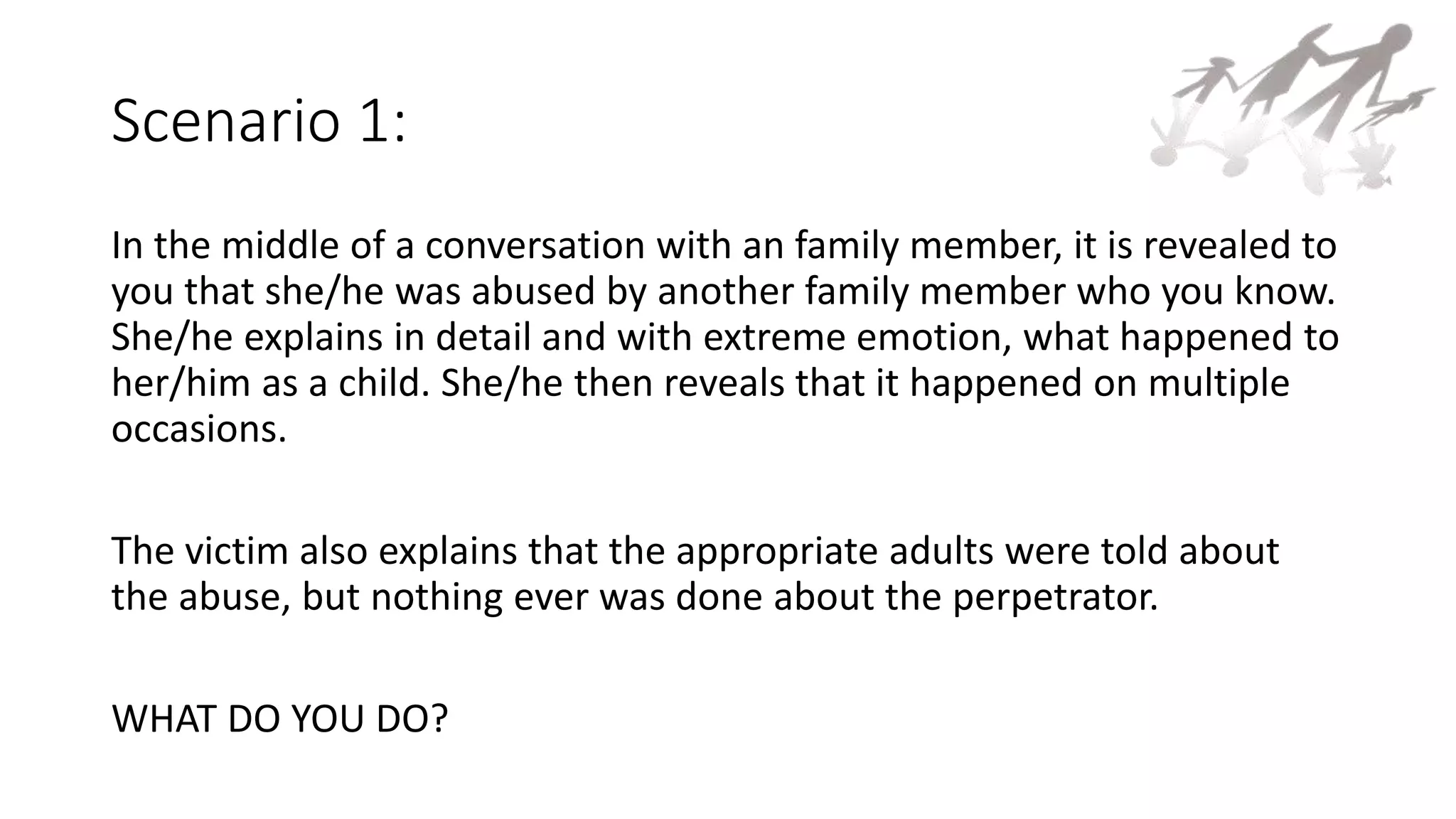
Scenario 1:
In the middle of a conversation with an family member, it is revealed to
you that she/he was abused by another family member who you know.
She/he explains in detail and with extreme emotion, what happened to
her/him as a child. She/he then reveals that it happened on multiple
occasions.
The victim also explains that the appropriate adults were told about
the abuse, but nothing ever was done about the perpetrator.
WHAT DO YOU DO?
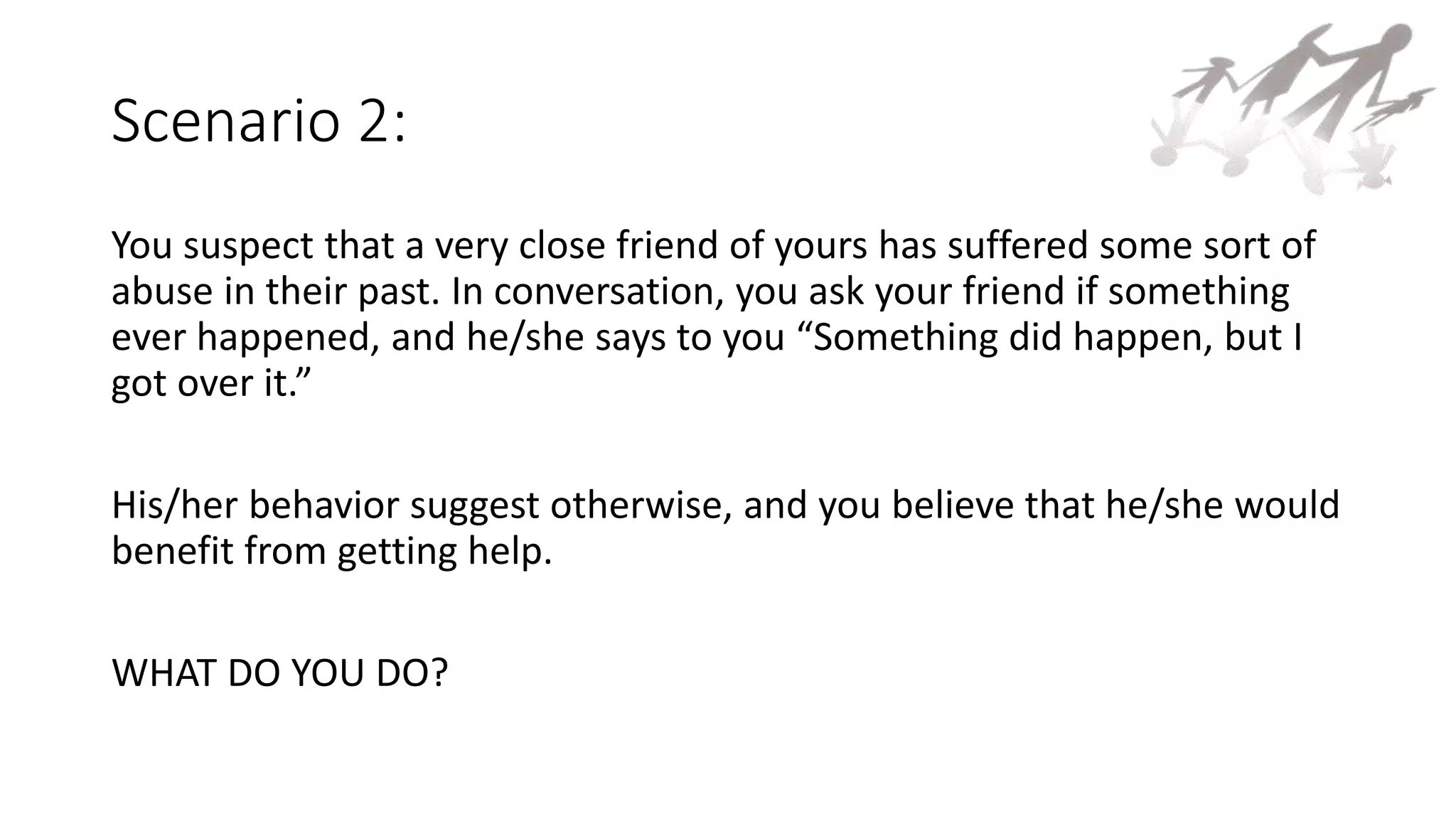
Scenario 2:
You suspect that a very close friend of yours has suffered some sort of
abuse in their past. In conversation, you ask your friend if something
ever happened, and he/she says to you “Something did happen, but I
got over it.”
His/her behavior suggest otherwise, and you believe that he/she would
benefit from getting help.
WHAT DO YOU DO?
Scenario 3:
A patient who has a myriad of emotional and mental dysfunctions, i.e.,
borderline personality disorder, post traumatic stress disorder, extreme
anxiety, finally reveals after years of therapy that childhood sexual
trauma has occurred in his/her past. She/he has not experienced any
improvement in the treatment as far as medications, and traditional
therapy as it happens in session modes.
All of his/her behavior is classic textbook behavior for someone who
has been sexually abused in their past.
WHAT DO YOU DO?
THANK YOU - QUESTIONS
Rhonda Begos
Rhonda Begos Speaks
www.rhondabegos.com
Milwaukee, WI
April 14, 2015

Brain Behind, Body Forward

  • 1.
    Brain Behind, BodyForward Rhonda Begos Rhonda Begos Speaks www.rhondabegos.com Milwaukee, WI April 14, 2015
  • 2.
    Who Am I– Today • Rhonda Begos – 46 year old • Singer • Single mom • Musician, full time worker, volunteer, • Non drinker, non partier, but I still have fun • Will be a wife shortly • Public speaker • Advocate for children and victims of abuse
  • 3.
    Who I WAS •Almost died from drinking • Suffered from severe claustrophobia • Fears I didn’t understand • Extreme substance abuse • Very angry and combative • Nightmares • Hopelessness and despair
  • 4.
    Who I WAS •Diagnosed with juvenile (Type I) diabetes in 1983 • Relationships of any kind were unbelievably difficult to maintain • Became physically self abusive in my sexual behavior • Could not hold down a job where authority felt overbearing • Severe depression • Didn’t know what a “normal” life was • Became worse after having children • Had no idea where behavior was coming from
  • 5.
    Childhood • Life beganin a confusing fashion • No one to answer my questions • Didn’t understand what was happening • Didn’t understand the difference in my life and the lives of others, but I knew it wasn’t the same • Felt ostracized because of my color • Wanted desperately to fit in • Very Low Self Esteem
  • 6.
    The Abuse • Firstsexual abuse episode • Didn’t know what was happening • Couldn’t separate myself from the situation • Knew something wasn’t right, but wasn’t sure what • Did the right thing and told an older sibling • I told my sister right away • Directed by sister to tell her in front of brother in law – I did • Expected to be saved • Nothing happened
  • 7.
    The Abuse • Firstmental signs of dysfunction appear • Combativeness in school • Authority wasn’t tolerated • Desperate for attention – wanted to tell someone but couldn’t felt too afraid • Didn't understand the response from adults • Not trusting adults began to infiltrate my life • ON the other side, if anyone showed me affection and acceptance, I began to cling to them immediately • Began to equate love with being sexually available
  • 8.
    The Abuse • Secondabuse episode happened • Disassociation began • Second incident was more violent • My belief that adults would protect me was gone • Did not believe life would ever be different than what had already been established • Never told anyone until I turned 17 • My brain took a back seat to understanding why my behavior was abnormal • My body began to react outwardly to what was happening inwardly
  • 9.
    Early Adult Life •Began experimenting with drugs as early as 14 • Became angry and combative with family members and could not make the connection • Was asked by a family member if the first incident of abuse could have been provoked by the way I was dressed; that's when I revealed the second incident • Wanted to leave home to escape • Was mentally, emotionally and physically exhausted
  • 10.
    Early Adult Life •Began drinking as soon as I got to college – even though I TOLD myself I would never drink and/or smoke • The only way to connect with a man was physically • Couldn’t connect emotionally – if someone did connect emotionally, I sabotaged it – friendship, or romantically • Never received my degree • Moved from Boston to Milwaukee – broke and broken
  • 11.
    Late Adult Life •Met my first husband and expected to be "saved" • Was desperate to be understood and validated • Intellectually put together; understood many things; could make no sense of my behavior and thought process • Anger began to take over • Behavior became increasingly worse after birth of first son • Drinking and bad behavior became a way of life • When abuse was revealed, society said "get over it"
  • 12.
    Late Adult Life •August 4, 2004 • Finally got help – realized that being pharmaceutically medicated was not the route • Began to put puzzle pieces together – claustrophobia, fear of commitment, substance abuse, problems with authority, self esteem, anger, fear of good, trust, self destruction – all began to make sense • Several years to find the right therapist • Surround myself around those who either understood or were trying to understand what I was going through
  • 13.
    Late Adult Life HealthIssues Experienced • Allergies • Circulation problems • Stomach and gastric disturbances • Unexplained severe migraines • Insomnia • Rapid heartbeat and severe anxiety • Acid reflux disease • Some PTSD symptoms
  • 14.
    Late Adult Life HealthIssues Experienced • Eating disorders • Autoimmune disorders (i.e., diabetes) (OR =4.4 (1.7, 11.6)) • Heart disease (OR = 3.7 (1.5, 9.4)) • Arthritic disorders (OR= 1.5 (1.1, 2.2)) • Peptic ulcers (OR= 1.5 (1.03, 2.2)) • Lung disease (OR= 1.5 (1.1, 2.2)) • Acid reflux disease Bullet 2, 3, 4, 5 and 6 - http://www.ncbi.nlm.nih.gov/pubmed/15259836 - Association between childhood trauma and physical disorders among adults in the United States
  • 15.
    Essential Process • Victimmust acknowledge abuse • Victim must be committed to professional care • Victim must re-experience their episode (so episode can slowly die) • Victim must be ACKNOWLEDGED and BELIEVED • Victim must be listened to • Victim must be given efficient tools to deal with their abuse • Victim must be dealt with honestly and openly • Victim must be given strategies to transfer to the NOW and escape the THEN
  • 16.
    Essential Process • Victimmust be allowed to feel • Victim must be comforted • Victim must be respected • Victim must be told they are not alone • Victim must be shown how the behavior and episode(s) are related • Victim must take responsibility for their behavior, but given reasons for why the behavior happens • Victim must be told that feelings may never go away, but that there are tools to deal with those feelings • Victim must be shown new ways to live peacefully
  • 17.
    Essential Process • Victimmust be handled as the abused child and not the adult • When a victim is allowed to BE….their brains are able to catch up with what their bodies have been automatically, but dysfunctionally, been looking for: • Acknowledgement • Acceptance • Belief • Love • DO NOT REVICTIMIZE by MISDIAGNOSIS
  • 18.
    Scenario 1: In themiddle of a conversation with an family member, it is revealed to you that she/he was abused by another family member who you know. She/he explains in detail and with extreme emotion, what happened to her/him as a child. She/he then reveals that it happened on multiple occasions. The victim also explains that the appropriate adults were told about the abuse, but nothing ever was done about the perpetrator. WHAT DO YOU DO?
  • 19.
    Scenario 2: You suspectthat a very close friend of yours has suffered some sort of abuse in their past. In conversation, you ask your friend if something ever happened, and he/she says to you “Something did happen, but I got over it.” His/her behavior suggest otherwise, and you believe that he/she would benefit from getting help. WHAT DO YOU DO?
  • 20.
    Scenario 3: A patientwho has a myriad of emotional and mental dysfunctions, i.e., borderline personality disorder, post traumatic stress disorder, extreme anxiety, finally reveals after years of therapy that childhood sexual trauma has occurred in his/her past. She/he has not experienced any improvement in the treatment as far as medications, and traditional therapy as it happens in session modes. All of his/her behavior is classic textbook behavior for someone who has been sexually abused in their past. WHAT DO YOU DO?
  • 21.
    THANK YOU -QUESTIONS Rhonda Begos Rhonda Begos Speaks www.rhondabegos.com Milwaukee, WI April 14, 2015

Editor's Notes

  • #3 Talk About Being A Wife Speak at schools, churches
  • #4  -mention the claustrophobia later in terms of it came from attic Explain later
  • #5 The only way I felt I could be loved
  • #6 FIRST BULLETT – Drinking Physical and Mental abusiveness from outside sources Homelessness and money problems Watching my mom getting abused Half black and half white
  • #7 Explain how I came to live with sister and brother in law Sibling suggested I tell my sister Talk about going on walk after telling sister Weeks went by
  • #9 Explain the attic and claustrophobia
  • #10 Could only relate sexually to all things. I equated like and love to sex
  • #12 Thought I had dealt with my issues – but had not. After having my son, my fear of failure in protecting him began to take over
  • #13 Lost jobs-fear of good-felt comfortable with dysfunction If people are only going to tell you what they think and not try to understand or research what you know, you need to separate from them, therapists included
  • #14 http://www.ncbi.nlm.nih.gov/pubmed/19845782 Childhood maltreatment and migraine (part I). Prevalence and adult revictimization: a multicenter headache clinic survey. Tietjen GE1, Brandes JL, Peterlin BL, Eloff A, Dafer RM, Stein MR, Drexler E, Martin VT, Hutchinson S, Aurora SK, Recober A, Herial NA, Utley C, White L,Khuder SA. Author information Abstract OBJECTIVES: To examine the prevalence of childhood maltreatment and adult revictimization in migraineurs and the association with sociodemographic factors, depression and anxiety. BACKGROUND: Population and practice-based studies have demonstrated an association of childhood abuse and headache in adults, although further details on headache diagnoses, characteristics, and comorbid conditions are lacking. There are mounting data suggesting substantial impact of early maltreatment on adult physical and mental health. METHODS: Electronic surveys were completed by patients seeking treatment in 11 headache centers across the United States and Canada. Physicians determined the primary headache diagnoses based on the International Classification of Headache Disorders-2 criteria and average monthly headache frequency. Self-reported information on demographics (including body mass index), social history, and physician-diagnosed depression and anxiety was collected. The survey also included validated screening measures for current depression (Patient Health Questionnaire-9) and anxiety (The Beck Anxiety Inventory). History and severity of childhood (<18 years) abuse (sexual, emotional, and physical) and neglect (emotional and physical) was gathered using the Childhood Trauma Questionnaire. There were also queries regarding adult physical and sexual abuse, including age of occurrence. Analysis includes all persons with migraine with aura, and migraine without aura. RESULTS: A total of 1348 migraineurs (88% women) were included (mean age 41 years). Diagnosis of migraine with aura was recorded in 40% and chronic headache (>or=15 days/month) was reported by 34%. The prevalence of childhood maltreatment types was as follows: physical abuse 21%, sexual abuse 25%, emotional abuse 38%, physical neglect 22%, and emotional neglect 38%. Nine percent reported all 3 categories of childhood abuse (physical, sexual, and emotional) and 17% reported both physical and emotional neglect. Overlap between maltreatment types ranged between 40% and 81%. Of those reporting childhood abuse, 43% reported abuse in adulthood, but infrequently (17%) over the age of 30 years. In logistic regression models adjusted for sociodemographic variables, current depression was associated with physical (P = .003), sexual (P = .007), and emotional abuse (P < .001), and physical and emotional neglect (P = .001 for both). Current anxiety was also associated with all childhood abuse and neglect categories (P < .001 for all). A graded relationship was observed between the number of childhood maltreatment types and remote or current depression and anxiety. In adjusted logistic regression analysis, migraineurs reporting 3 or more categories of childhood trauma were more likely to have received diagnoses of both depression and anxiety (odds ratios [OR] = 6.91, 95% confidence interval [CI]: 3.97-12.03), or either depression or anxiety (OR = 3.66, 95% CI: 2.28-5.88) as compared with those without childhood abuse or neglect. CONCLUSION: Reports of childhood maltreatment, especially emotional abuse and neglect, are prevalent in outpatients with migraine. There is extensive overlap of maltreatment types and a high rate of revictimization in adulthood. All types of childhood abuse and neglect are strongly associated with remote and current depression and anxiety, and the relationship strengthens with an increasing number of maltreatment types.
  • #15 All issues that can be caused by having been victimized as a child – mention my diabetes – no history of it in my family at all.
  • #16 Has to deal with truth Has to have a qualified therapist trained in dealing with victims of abuse – or a survivor Has to relive In order for experience to die. Nothin can die unless it's allowed to live Victim must be HEARD Not all victims require medications, which is why proper assessment is necessary. Lexopro…sleep pills Honesty is important and open conversation is needed Next slide……
  • #17 the one thing to understand is the victim, when abused, had every right taken away and has not found functional ways to re enter society. All aspects of what a victim needs to experience emotionally is not only essential in their care, but is also their way of reclaiming who the are. Their identity was robbed. They take Tay person back when allowing themselves to feel. Humanity.
  • #18 Victim must be approached as a child is approached when disclosing the abuse. Often times the adult has not progressed past the episode due to the non acknowledgement and denial from the outside world. In order to communicate with a victim you have to communicate with the child In the way the child never has been The brain has been behind because the body has been its spokesperson. Changing our thoughts about caring for victims will help us better care for those who are looking for answers. They are within them already.
  • #19 Help for the victim Believing the victim If possible, speaking with family members Finding out the statues of limitations in terms of prosecuting the adult perpetrator Finding out the physical outcomes of these abuses Mental disorders Asking the victim what they need and what you can do? Sharing your experience if it happened to you
  • #20 Do research on the subject. Victims respond to fact, not opinion Give the victim time to reveal their issues Talk about what they are going through – that they haven’t made a connection to, to give them an opportunity to see that there IS a connection to something. Be patient Believe – and never say “get over it”
  • #21 Believe the patient Let the patient talk Do more research on the meds that the patient is currently on – wean patient off of meds that are not allowing the patient to DEAL with the trauma Find an expert in childhood trauma if you are not one yourself The  EMDR (Eye Movement Desensitization and Reprocessing) has proven to be highly effective in dealing with childhood trauma - I use it myself Connects to a safe place Allows the victim to make the choice on where that safe place is Find out what physical ailments may also be a possible symptom of the abuse Support the victim Validate the Victim