TEEN’S SUICIDE
Presented by: Ester Mendoza
Do you know what suicide is?
• Suicide is the act of intentionally causing one's own death.[Risk
factors include mental disorders such as depression, bipolar
disorder, personality disorders, alcoholism, or substance
misuse, schizopherenia.
• Suicide, taking your own life, is a tragic reaction to stressful life
situations — and all the more tragic because suicide can be
prevented. Whether you're considering suicide or know someone
who feels suicidal, learn suicide warning signs and how to reach out
for immediate help and professional treatment. You may save a life
— your own or someone else's.
• Suicide is the tenth most common cause of death in
the United States. People may consider suicide when
they are hopeless and can't see any other solution to
their problems. Often it's related to
serious depression, alcohol or substance abuse, or a
major stressful event.
• People who have the highest risk of suicide are white
men. But women and teens report more suicide
attempts. If someone talks about suicide, you should
take it seriously.
• It may seem like there's no way to solve your
problems and that suicide is the only way to end the
pain. But you can take steps to stay safe — and start
enjoying your life.
• having the tendency to want to kill yourself
• Suicidal also means likely to cause your own defeat.
• Suicidal ideation is generally associated with depression and
disorders; however, it seems to have associations with many
other mental disorder, life events, and family events, all of which
may increase the risk of suicidal ideation.
• The range of suicidal ideation varies greatly from fleeting
thoughts, to extensive thoughts, to detailed planning, role
playing (e.g., standing on a chair with a noose), and incomplete
attempts, which may be deliberately constructed to not
complete or to be discovered , or may be fully intended to result
in death, but the individual survives (e.g., in the case of a
hanging in which the cord breaks).
• Suicidal ideation is generally associated with depression and
other mood disorder; however, it seems to have associations
with many other mental disorder, life events, and family
events, all of which may increase the risk of suicidal ideation.
• Suicide, also known as completed suicide, is the "act of taking
one's own life". Attempted suicide or non-fatal suicidal
behavior is self injury with the desire to end one's life that
does not result in death.
• Assisted suicide is when one individual helps another bring
about their own death indirectly via providing either advice
or the means to the end.
• This is in contrast to euthanasia, where another person takes
a more active role in bringing about a person's death.
• Suicidal ideation is thoughts of ending one's life but not
taking any active efforts to do so.
Why some teen’s commit suicide?
• It may seem like there's no way to solve your problems and that suicide
is the only way to end the pain. But you can take steps to stay safe —
and start enjoying your life again.
• Others are impulsive acts due to stress such as from financial
difficulties troubles with relationships, or from bullying.
• Most teens who have been interviewed after a suicide attempt say that
what causes teen suicide are feelings of hopelessness and helplessness.
Suicidal teens often feel like they are in situations that have no
solutions. The teens can see no way out but death.
• The teens feel like they have no control to change their situations.
• Other emotional teen suicide causes stem from trying to escape
feelings of pain, rejection, hurt, being unloved, victimization or
loss. Teens may feel like their feelings are unbearable and will
never end, so the only way to escape is suicide.
• Teens may also be afraid of disappointing others or feel like they
are a burden to others, such as their parents, and these can be
additional causes of teen suicide.
• Situations often drive the emotional causes of suicide. Bullying,
cyberbullying, abuse, a detrimental home life, loss of a loved one
or even a severe breakup can by contributing causes of teen
suicide.
• While all the above are driving factors of teen suicide, often the
underlying issue is one of a mental illness.
• Most teens who attempt suicide do so because of depression, bipolar
disorder or borderline personality disorder.
• These disorders amplify the pain a teen may feel.
• Often, many of these environmental factors occur together to cause
suicidal feelings and behaviors.
Symptoms to know that they are
committing suicide• Sleep problems.
• Sudden calmness: Suddenly becoming calm after a period of depression or
moodiness can be a sign that the person has made a decision to end his or her
life.
• Withdrawal: Choosing to be alone and avoiding friends or social activities also
are possible symptoms of depression, a leading cause of suicide. This includes the
loss of interest or pleasure in activities the person previously enjoyed.
• Changes in personality and/or appearance: A person who is considering suicide
might exhibit a change in attitude or behavior, such as speaking or moving with
unusual speed or slowness. In addition, the person might suddenly become less
concerned about his or her personal appearance.
•Dangerous or self-harmful behavior: Potentially dangerous behavior, such as reckless
driving, engaging in unsafe sex, and increased use of drugs and/or alcohol might indicate
that the person no longer values his or her life.
•Recent trauma or life crisis: A major life crises might trigger a suicide attempt. Crises
include the death of a loved one or pet, divorce or break-up of a relationship, diagnosis of
a major illness, loss of a job, or serious financial problems.
•Making preparations: Often, a person considering suicide will begin to put his or her
personal business in order. This might include visiting friends and family members, giving
away personal possessions, making a will, and cleaning up his or her room or home. Some
people will write a note before committing suicide. Some will buy a firearm or other
means like poison.
•Threatening suicide: From 50% to 75% of those considering suicide will give someone --
a friend or relative -- a warning sign. However, not everyone who is considering suicide
will say so, and not everyone who threatens suicide will follow through with it. Every
threat of suicide should be taken seriously.
Methods or Ways on
how they suicide
Drug Poisoning
• In researching this site it was
clear that suicide by drug
poisoning had been the subject
of more articles, chat rooms
and forums than any other
method. Everyone (who is
suicidal!) is looking for a
painless method to leave this
world. Regrettably, drug
poisoning is one of
the least effective methods of
suicide, and if it goes wrong,
can be very far from painless.
Cutting• Some people cut because they
feel desperate for relief from
bad feelings. People who cut
may not know better ways to
get relief from emotional pain
or pressure. Some people cut to
express strong feelings of rage,
sorrow, rejection, desperation,
longing, or emptiness.
• Cutting is a way some people try
to cope with the pain of strong
emotions, sure intense pressure,
or upsetting relationships
problems.
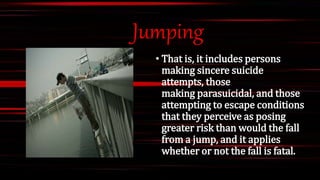
Jumping
• That is, it includes persons
making sincere suicide
attempts, those
making parasuicidal, and those
attempting to escape conditions
that they perceive as posing
greater risk than would the fall
from a jump, and it applies
whether or not the fall is fatal.
Hanging
• Hanging is often considered
to be a simple suicide
method that does not
require complicated
techniques. However, a
study of people who
attempted suicide by
hanging and lived suggests
that this perception needs
to be challenged.
Gun Shot
• One of the most often achieved
forms of suicide is by gun shot.
Generally a head shot is desired
since its results are 99 percent
effective, however a chest shot
can be equally as devastating.
• Sometimes the blast isn't
enough to kill. In this case,
severe to permanent bodily
damage can occur as well as
blood loss, organ and tissue
damage, and brain damage.
How we help others
on committing
suicide and how we
Reach Out - Ask them directly if they are thinking about suicide. It needs to be
a direct question that can’t be misinterpreted.
"Are you thinking about suicide?"
Most people with thoughts of suicide want to talk about it. They want to live –
but desperately need someone to hear their pain and offer them help to keep
safe.
Don’t be afraid to ask them if they are thinking about suicide. This shows you
care and they’re not alone. Listen to them - Allow them to express their
feelings. Let them do most of the talking. They will often feel a great sense of
relief someone wants to talk to them about their darkest thoughts.
Check their safety - If you are really worried don’t leave them alone. Remove any
means of suicide including weapons, medications, drugs, alcohol, even access to a
car. Get help by calling Lifeline 13 11 14, or emergency services on 000. You can
also take them to the local hospital emergency department.
Decide what to do and take action - Talk about steps you can take together to keep
them safe. Don’t agree to keep it a secret, you shouldn’t be the only one supporting
this person. You may need help from someone else to persuade them to get help.
You can also help by finding out information on what resources and services are
available for a person who is considering suicide.
Ask for a promise - Thoughts of suicide may return, so ask them to promise to
reach out and tell someone. Asking them to promise makes it more likely they will
tell someone.
Get help - There are lots of services and people that can help and provide
assistance.
Quotations to prevent suicide and How to
appreciate our life
• Suicide is the most sincere form of self-criticism. —Anonymous
• Suicide does not mean there was no killer. —Anonymous
• It is always consoling to think of suicide: in that way one gets through many a
bad night. —Friedrich Nietzsche
• “Dwell on the beauty of life. Watch the stars, and see yourself running with
them.”
― Marcus Aurelius, Meditations
• “Be thankful for what you have; you'll end up having more. If you concentrate
on what you don't have, you will never, ever have enough”
― Oprah Winfrey
• “The two hardest tests on the spiritual road are the patience to wait for the right
moment and the courage not to be disappointed with what we encounter.”
― Paulo Coelho, Veronika Decides to Die
• “Music has always been a matter of Energy to me, a question of Fuel. Sentimental
people call it Inspiration, but what they really mean is Fuel. I have always needed
Fuel. I am a serious consumer. On some nights I still believe that a car with the gas
needle on empty can run about fifty more miles if you have the right music very loud
on the radio.”
― Hunter S. Thompson“
• To get the full value of joy you must have someone to divide it with.”
― Mark Twain
• “Forget yesterday - it has already forgotten you. Don't sweat tomorrow - you haven't
even met. Instead, open your eyes and your heart to a truly precious gift - today.”
― Steve Maraboli, Life, the Truth, and Being Free
• “When you arise in the morning, think of what a precious privilege it is to
be alive—to breathe, to think, to enjoy, to love—then make that day
count!”
― Steve Maraboli, Life, the Truth, and Being Free
• “Appreciation is a wonderful thing. It makes what is excellent in others
belong to us as well.”
― Voltaire
• “Dance. Smile. Giggle. Marvel. TRUST. HOPE. LOVE. WISH. BELIEVE. Most
of all, enjoy every moment of the journey, and appreciate where you are at
this moment instead of always focusing on how far you have to go.”
― Mandy Hale, The Single Woman: Life, Love, and a Dash of Sass
• “I think it pisses God off if you walk by the color purple in a field
somewhere and don't notice it. People think pleasing God is all God cares
about. But any fool living in the world can see it always trying to please us
back.”
― Alice Walker, The Color Purple
“ALWAYS REMEMBER THAT
SUICIDE IS A PERMANENT
SOLUTION TO A
TEMPORARY PROBLEM”

Teens Suicide

  • 1.
  • 3.
    Do you knowwhat suicide is? • Suicide is the act of intentionally causing one's own death.[Risk factors include mental disorders such as depression, bipolar disorder, personality disorders, alcoholism, or substance misuse, schizopherenia. • Suicide, taking your own life, is a tragic reaction to stressful life situations — and all the more tragic because suicide can be prevented. Whether you're considering suicide or know someone who feels suicidal, learn suicide warning signs and how to reach out for immediate help and professional treatment. You may save a life — your own or someone else's.
  • 4.
    • Suicide isthe tenth most common cause of death in the United States. People may consider suicide when they are hopeless and can't see any other solution to their problems. Often it's related to serious depression, alcohol or substance abuse, or a major stressful event. • People who have the highest risk of suicide are white men. But women and teens report more suicide attempts. If someone talks about suicide, you should take it seriously. • It may seem like there's no way to solve your problems and that suicide is the only way to end the pain. But you can take steps to stay safe — and start enjoying your life. • having the tendency to want to kill yourself
  • 5.
    • Suicidal alsomeans likely to cause your own defeat. • Suicidal ideation is generally associated with depression and disorders; however, it seems to have associations with many other mental disorder, life events, and family events, all of which may increase the risk of suicidal ideation. • The range of suicidal ideation varies greatly from fleeting thoughts, to extensive thoughts, to detailed planning, role playing (e.g., standing on a chair with a noose), and incomplete attempts, which may be deliberately constructed to not complete or to be discovered , or may be fully intended to result in death, but the individual survives (e.g., in the case of a hanging in which the cord breaks).
  • 6.
    • Suicidal ideationis generally associated with depression and other mood disorder; however, it seems to have associations with many other mental disorder, life events, and family events, all of which may increase the risk of suicidal ideation. • Suicide, also known as completed suicide, is the "act of taking one's own life". Attempted suicide or non-fatal suicidal behavior is self injury with the desire to end one's life that does not result in death. • Assisted suicide is when one individual helps another bring about their own death indirectly via providing either advice or the means to the end. • This is in contrast to euthanasia, where another person takes a more active role in bringing about a person's death. • Suicidal ideation is thoughts of ending one's life but not taking any active efforts to do so.
  • 7.
    Why some teen’scommit suicide? • It may seem like there's no way to solve your problems and that suicide is the only way to end the pain. But you can take steps to stay safe — and start enjoying your life again. • Others are impulsive acts due to stress such as from financial difficulties troubles with relationships, or from bullying. • Most teens who have been interviewed after a suicide attempt say that what causes teen suicide are feelings of hopelessness and helplessness. Suicidal teens often feel like they are in situations that have no solutions. The teens can see no way out but death.
  • 8.
    • The teensfeel like they have no control to change their situations. • Other emotional teen suicide causes stem from trying to escape feelings of pain, rejection, hurt, being unloved, victimization or loss. Teens may feel like their feelings are unbearable and will never end, so the only way to escape is suicide. • Teens may also be afraid of disappointing others or feel like they are a burden to others, such as their parents, and these can be additional causes of teen suicide. • Situations often drive the emotional causes of suicide. Bullying, cyberbullying, abuse, a detrimental home life, loss of a loved one or even a severe breakup can by contributing causes of teen suicide.
  • 9.
    • While allthe above are driving factors of teen suicide, often the underlying issue is one of a mental illness. • Most teens who attempt suicide do so because of depression, bipolar disorder or borderline personality disorder. • These disorders amplify the pain a teen may feel. • Often, many of these environmental factors occur together to cause suicidal feelings and behaviors.
  • 10.
    Symptoms to knowthat they are committing suicide• Sleep problems. • Sudden calmness: Suddenly becoming calm after a period of depression or moodiness can be a sign that the person has made a decision to end his or her life. • Withdrawal: Choosing to be alone and avoiding friends or social activities also are possible symptoms of depression, a leading cause of suicide. This includes the loss of interest or pleasure in activities the person previously enjoyed. • Changes in personality and/or appearance: A person who is considering suicide might exhibit a change in attitude or behavior, such as speaking or moving with unusual speed or slowness. In addition, the person might suddenly become less concerned about his or her personal appearance.
  • 11.
    •Dangerous or self-harmfulbehavior: Potentially dangerous behavior, such as reckless driving, engaging in unsafe sex, and increased use of drugs and/or alcohol might indicate that the person no longer values his or her life. •Recent trauma or life crisis: A major life crises might trigger a suicide attempt. Crises include the death of a loved one or pet, divorce or break-up of a relationship, diagnosis of a major illness, loss of a job, or serious financial problems. •Making preparations: Often, a person considering suicide will begin to put his or her personal business in order. This might include visiting friends and family members, giving away personal possessions, making a will, and cleaning up his or her room or home. Some people will write a note before committing suicide. Some will buy a firearm or other means like poison. •Threatening suicide: From 50% to 75% of those considering suicide will give someone -- a friend or relative -- a warning sign. However, not everyone who is considering suicide will say so, and not everyone who threatens suicide will follow through with it. Every threat of suicide should be taken seriously.
  • 12.
    Methods or Wayson how they suicide
  • 13.
    Drug Poisoning • Inresearching this site it was clear that suicide by drug poisoning had been the subject of more articles, chat rooms and forums than any other method. Everyone (who is suicidal!) is looking for a painless method to leave this world. Regrettably, drug poisoning is one of the least effective methods of suicide, and if it goes wrong, can be very far from painless.
  • 14.
    Cutting• Some peoplecut because they feel desperate for relief from bad feelings. People who cut may not know better ways to get relief from emotional pain or pressure. Some people cut to express strong feelings of rage, sorrow, rejection, desperation, longing, or emptiness. • Cutting is a way some people try to cope with the pain of strong emotions, sure intense pressure, or upsetting relationships problems.
  • 15.
    Jumping • That is,it includes persons making sincere suicide attempts, those making parasuicidal, and those attempting to escape conditions that they perceive as posing greater risk than would the fall from a jump, and it applies whether or not the fall is fatal.
  • 16.
    Hanging • Hanging isoften considered to be a simple suicide method that does not require complicated techniques. However, a study of people who attempted suicide by hanging and lived suggests that this perception needs to be challenged.
  • 17.
    Gun Shot • Oneof the most often achieved forms of suicide is by gun shot. Generally a head shot is desired since its results are 99 percent effective, however a chest shot can be equally as devastating. • Sometimes the blast isn't enough to kill. In this case, severe to permanent bodily damage can occur as well as blood loss, organ and tissue damage, and brain damage.
  • 18.
    How we helpothers on committing suicide and how we
  • 19.
    Reach Out -Ask them directly if they are thinking about suicide. It needs to be a direct question that can’t be misinterpreted. "Are you thinking about suicide?" Most people with thoughts of suicide want to talk about it. They want to live – but desperately need someone to hear their pain and offer them help to keep safe. Don’t be afraid to ask them if they are thinking about suicide. This shows you care and they’re not alone. Listen to them - Allow them to express their feelings. Let them do most of the talking. They will often feel a great sense of relief someone wants to talk to them about their darkest thoughts.
  • 20.
    Check their safety- If you are really worried don’t leave them alone. Remove any means of suicide including weapons, medications, drugs, alcohol, even access to a car. Get help by calling Lifeline 13 11 14, or emergency services on 000. You can also take them to the local hospital emergency department. Decide what to do and take action - Talk about steps you can take together to keep them safe. Don’t agree to keep it a secret, you shouldn’t be the only one supporting this person. You may need help from someone else to persuade them to get help. You can also help by finding out information on what resources and services are available for a person who is considering suicide. Ask for a promise - Thoughts of suicide may return, so ask them to promise to reach out and tell someone. Asking them to promise makes it more likely they will tell someone. Get help - There are lots of services and people that can help and provide assistance.
  • 21.
    Quotations to preventsuicide and How to appreciate our life • Suicide is the most sincere form of self-criticism. —Anonymous • Suicide does not mean there was no killer. —Anonymous • It is always consoling to think of suicide: in that way one gets through many a bad night. —Friedrich Nietzsche • “Dwell on the beauty of life. Watch the stars, and see yourself running with them.” ― Marcus Aurelius, Meditations • “Be thankful for what you have; you'll end up having more. If you concentrate on what you don't have, you will never, ever have enough” ― Oprah Winfrey
  • 22.
    • “The twohardest tests on the spiritual road are the patience to wait for the right moment and the courage not to be disappointed with what we encounter.” ― Paulo Coelho, Veronika Decides to Die • “Music has always been a matter of Energy to me, a question of Fuel. Sentimental people call it Inspiration, but what they really mean is Fuel. I have always needed Fuel. I am a serious consumer. On some nights I still believe that a car with the gas needle on empty can run about fifty more miles if you have the right music very loud on the radio.” ― Hunter S. Thompson“ • To get the full value of joy you must have someone to divide it with.” ― Mark Twain • “Forget yesterday - it has already forgotten you. Don't sweat tomorrow - you haven't even met. Instead, open your eyes and your heart to a truly precious gift - today.” ― Steve Maraboli, Life, the Truth, and Being Free
  • 23.
    • “When youarise in the morning, think of what a precious privilege it is to be alive—to breathe, to think, to enjoy, to love—then make that day count!” ― Steve Maraboli, Life, the Truth, and Being Free • “Appreciation is a wonderful thing. It makes what is excellent in others belong to us as well.” ― Voltaire • “Dance. Smile. Giggle. Marvel. TRUST. HOPE. LOVE. WISH. BELIEVE. Most of all, enjoy every moment of the journey, and appreciate where you are at this moment instead of always focusing on how far you have to go.” ― Mandy Hale, The Single Woman: Life, Love, and a Dash of Sass • “I think it pisses God off if you walk by the color purple in a field somewhere and don't notice it. People think pleasing God is all God cares about. But any fool living in the world can see it always trying to please us back.” ― Alice Walker, The Color Purple
  • 24.
    “ALWAYS REMEMBER THAT SUICIDEIS A PERMANENT SOLUTION TO A TEMPORARY PROBLEM”