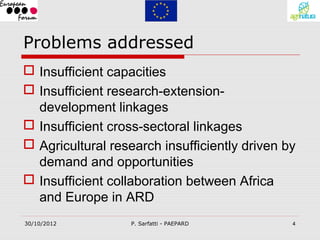
Platform for African-European
Partnership on Agricultural
Research for Development


   Paolo Sarfatti
   EFARD / AGRINATURA
Outline of the presentation
 Introduction
 Problems addressed
 Activities, outputs and outcomes
 Lessons learned
 Commitment to collective actions
  2012-2014

30/10/2012    P. Sarfatti - PAEPARD   2
Introduction
 PAEPARD Phase II (2009-2013)
 Total budget 6.85 Mio Euro (80% funded
  by the European Union)
 Collaboration between FARA and EFARD
 FARA  lead
 AGRINATURA (CIRAD/IAO/NRI)  colead
 Other partners  PAFFO
  (EAFF/ROPPA/PROPAC/SACAU);
  RUFORUM; FANRPAN; COLEACP; CSA;
  ICRA
30/10/2012     P. Sarfatti - PAEPARD   3
Problems addressed
 Insufficient capacities
 Insufficient research-extension-
  development linkages
 Insufficient cross-sectoral linkages
 Agricultural research insufficiently driven by
  demand and opportunities
 Insufficient collaboration between Africa
  and Europe in ARD
30/10/2012         P. Sarfatti - PAEPARD       4
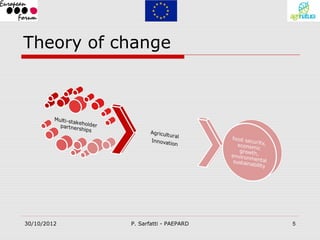
Theory of change


30/10/2012   P. Sarfatti - PAEPARD   5
Current activities
 Stakeholders networks mobilisation
  (Africa & Europe)
 Information & Communication
 Capacity strengthening
 Partnerships development
 Advocacy

30/10/2012    P. Sarfatti - PAEPARD   6
Outputs
 Regional SH consultations
 Information/communication
 19 Africa-EU research-user consortia
  established
 5 “sub-regional” partnerships around
  “federating themes” led by African Farmers
  Organisations and private sector.
 24 “Agricultural Innovation Facilitators”
 New funding modalities advocated
30/10/2012        P. Sarfatti - PAEPARD        7
Outcomes generated
 Strengthened EFARD, mobilized EU & African
  stakeholders
 Working relationship between Af/Eu networks
  and key constituent organizations established
 “Balanced” MS partnerships
 Role of partnership “brokers/facilitators”
  developed
 More effective funding mechanisms to support
  integrated ARD (expected through advocacy)

30/10/2012        P. Sarfatti - PAEPARD       8
Lessons learned 1
 EFARD - effective regional forum
 Understanding innovation processes
 Role of CSOs (NGOs, FOs) and linkages with
  other SH groups
 Traditional financing instruments favour initiatives
  led by formal research organizations.
 Community-managed Local Innovation Support
  Funds interesting alternative.
 Power goes with control of resources

30/10/2012           P. Sarfatti - PAEPARD               9
Lessons Learned 2
 ARD partnerships need to allow space/support
     for farmer-led experimentation/ innovation
 Incentives structures of research
     organisations
 Flexible “funding strategies”
 “Brokers” and “facilitators” vital in effective
     ARD partnerships
 Need to be realistic about
     “transaction/investments” costs
 Trust takes time P. Sarfatti - PAEPARD
30/10/2012                                        10
Committments to collective
    actions 2012-2014
 Mobilize stakeholders in the demand-led
  process
 Document and share information
 Improve/Strengthen PAEPARD e-platform
 Involve partners in capacity strengthening
 Mentoring established consortia
 Advocate for innovation approach

30/10/2012       P. Sarfatti - PAEPARD         11
With additional support

Finance partnerships/consortia
facilitated by PAEPARD through other
funding sources


30/10/2012     P. Sarfatti - PAEPARD   12
With large scale investments
 Mid-term review in 2012 recommened third
  phase
 Formulation phase launched by the EC
  (on-going)
 Explore feasibility of platforms with other
  regions.


30/10/2012        P. Sarfatti - PAEPARD     13
Thank you for your attention

                www.paepard.org
             www.paepard.blogspot.com
                  www.efard.org
                www.agrinatura.eu

30/10/2012            P. Sarfatti - PAEPARD   14

C1.3. Platform for African-European Partnership on Agricultural Research for Development

  • 1.
    Platform for African-European Partnershipon Agricultural Research for Development Paolo Sarfatti EFARD / AGRINATURA
  • 2.
    Outline of thepresentation  Introduction  Problems addressed  Activities, outputs and outcomes  Lessons learned  Commitment to collective actions 2012-2014 30/10/2012 P. Sarfatti - PAEPARD 2
  • 3.
    Introduction  PAEPARD PhaseII (2009-2013)  Total budget 6.85 Mio Euro (80% funded by the European Union)  Collaboration between FARA and EFARD  FARA  lead  AGRINATURA (CIRAD/IAO/NRI)  colead  Other partners  PAFFO (EAFF/ROPPA/PROPAC/SACAU); RUFORUM; FANRPAN; COLEACP; CSA; ICRA 30/10/2012 P. Sarfatti - PAEPARD 3
  • 4.
    Problems addressed  Insufficientcapacities  Insufficient research-extension- development linkages  Insufficient cross-sectoral linkages  Agricultural research insufficiently driven by demand and opportunities  Insufficient collaboration between Africa and Europe in ARD 30/10/2012 P. Sarfatti - PAEPARD 4
  • 5.
    Theory of change 30/10/2012 P. Sarfatti - PAEPARD 5
  • 6.
    Current activities  Stakeholdersnetworks mobilisation (Africa & Europe)  Information & Communication  Capacity strengthening  Partnerships development  Advocacy 30/10/2012 P. Sarfatti - PAEPARD 6
  • 7.
    Outputs  Regional SHconsultations  Information/communication  19 Africa-EU research-user consortia established  5 “sub-regional” partnerships around “federating themes” led by African Farmers Organisations and private sector.  24 “Agricultural Innovation Facilitators”  New funding modalities advocated 30/10/2012 P. Sarfatti - PAEPARD 7
  • 8.
    Outcomes generated  StrengthenedEFARD, mobilized EU & African stakeholders  Working relationship between Af/Eu networks and key constituent organizations established  “Balanced” MS partnerships  Role of partnership “brokers/facilitators” developed  More effective funding mechanisms to support integrated ARD (expected through advocacy) 30/10/2012 P. Sarfatti - PAEPARD 8
  • 9.
    Lessons learned 1 EFARD - effective regional forum  Understanding innovation processes  Role of CSOs (NGOs, FOs) and linkages with other SH groups  Traditional financing instruments favour initiatives led by formal research organizations.  Community-managed Local Innovation Support Funds interesting alternative.  Power goes with control of resources 30/10/2012 P. Sarfatti - PAEPARD 9
  • 10.
    Lessons Learned 2 ARD partnerships need to allow space/support for farmer-led experimentation/ innovation  Incentives structures of research organisations  Flexible “funding strategies”  “Brokers” and “facilitators” vital in effective ARD partnerships  Need to be realistic about “transaction/investments” costs  Trust takes time P. Sarfatti - PAEPARD 30/10/2012 10
  • 11.
    Committments to collective actions 2012-2014  Mobilize stakeholders in the demand-led process  Document and share information  Improve/Strengthen PAEPARD e-platform  Involve partners in capacity strengthening  Mentoring established consortia  Advocate for innovation approach 30/10/2012 P. Sarfatti - PAEPARD 11
  • 12.
    With additional support Financepartnerships/consortia facilitated by PAEPARD through other funding sources 30/10/2012 P. Sarfatti - PAEPARD 12
  • 13.
    With large scaleinvestments  Mid-term review in 2012 recommened third phase  Formulation phase launched by the EC (on-going)  Explore feasibility of platforms with other regions. 30/10/2012 P. Sarfatti - PAEPARD 13
  • 14.
    Thank you foryour attention www.paepard.org www.paepard.blogspot.com www.efard.org www.agrinatura.eu 30/10/2012 P. Sarfatti - PAEPARD 14

Editor's Notes

  • #8 awareness opportunities/ common interests, information/ capacity-strengthening needs. (website, blog, information, etc.), overviews of ARD funding opportunities. (11 by “ demand side ” ), 10 proposals submitted (African Union, ASARECA, CORAF, Edulink); 1 funded (to date). mobilized and financed to support research partnerships
  • #10 in mobilizing and coordinating European SH to form partnerships in ARD and lobby for increased resources. awareness of mutual roles; individual/organizational capacity of different stakeholders to function in ARD partnerships important to develop capacity/confidence, promote balanced/effective ARD partnerships.
  • #11 managed by CSOs can be as effective as initiatives led by formal research organizations. of many formal North and South research organizations, typically focus on individual/published output; but are currently absent in most innovation systems. The capacity, finance and institutional setting for this role need to be developed. Managing time/budget for communication, developing mutual understanding, joint planning considerable with many SH.