BACKGROUND
JEAN PIAGET
Jean Piaget
• Father of PSYCHOLOGY
• Began at age 11 - paper on albino
sparrow
• Wrote 60 books and over 100 articles
• His last 60 years - research on mental
development.
• Brought forth the theory of how
intelligence works
• Thought of as a child psychologist and
educator
• Prefers to be called genetic
epistemologist
• Contributed in field of computer
science and AI; were used to develop
LOGO
• Most important contribution: Theory of
Cognitive Development
Jean Piaget
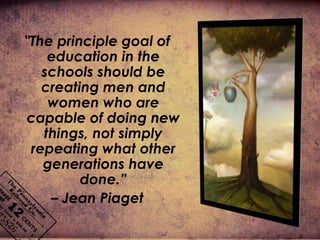
"The principle goal of
education in the
schools should be
creating men and
women who are
capable of doing new
things, not simply
repeating what other
generations have
done.”
– Jean Piaget
THEORY OF COGNITIVE
DEVELOPMENT
JEAN PIAGET
Theory of Cognitive Development
• humans cannot be "given" information;
must “construct” own knowledge
• Build knowledge through EXPERIENCE
• Schema - mental models
- made sophisticated through
assimilation and accommodation
FOUR STAGES
JEAN PIAGET
The Sensorimotor Stage
(Birth to 2 years old)
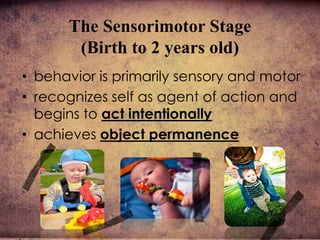
• behavior is primarily sensory and motor
• recognizes self as agent of action and
begins to act intentionally
• achieves object permanence
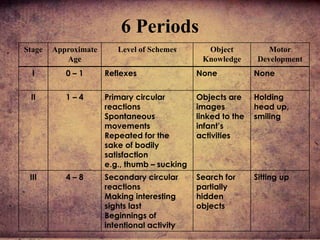
Stage Approximate
Age
Level of Schemes Object
Knowledge
Motor
Development
I 0 – 1 Reflexes None None
II 1 – 4 Primary circular
reactions
Spontaneous
movements
Repeated for the
sake of bodily
satisfaction
e.g., thumb – sucking
Objects are
images
linked to the
infant’s
activities
Holding
head up,
smiling
III 4 – 8 Secondary circular
reactions
Making interesting
sights last
Beginnings of
intentional activity
Search for
partially
hidden
objects
Sitting up
6 Periods
Stage Approximate
Age
Level of Schemes Object
Knowledge
Motor
Development
IV 8 – 12 Coordination of
schemes
Putting together
schemes used
separately in the past
e.g., coordination of
cover removal and
grasping, goal
oriented
Search for fully
hidden objects
A-not-B error
Sitting up
V 12 – 18 Tertiary circular
reactions
Inventing new means
Cannot take
account of
invisible
displacements
Crawling
VI 18 – 24 Mental representation
Insight
Full object
permanence
Walking
Brings about
detour
problems
6 Periods
The Preoperational Stage
(ages 2 to 4)
• need of concrete physical situations
• objects classified in simple ways especially
by important features.
• thinking is still egocentric
• As physical experience
accumulates,
accommodation is increased
• Can think logically about
objects and events
• Achieves conservation of
number (age 6), mass (age 7),
and weight (age 9)
• Classifies objects according to
several features such as size.
The Concrete Operational Stage
(ages 7 to 11)
• Cognition reaches its final
form
• capable of deductive and
hypothetical reasoning
• Can think logically about
abstract propositions and
test hypotheses
systematically.
• Becomes concerned with
the hypothetical, the future,
and ideological problems.
The Formal Operational Stage
(ages 11 to 15)
KEY PIAGETIAN PRINCIPLES
JEAN PIAGET
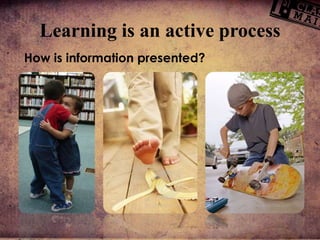
How is information presented?
Learning is an active process
Learning should be whole, authentic,
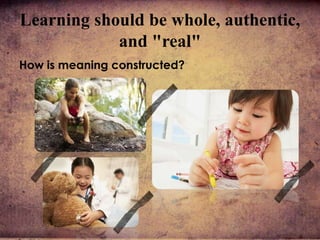
and "real"
How is meaning constructed?
P iaget

P iaget

  • 2.
  • 3.
    Jean Piaget • Fatherof PSYCHOLOGY • Began at age 11 - paper on albino sparrow • Wrote 60 books and over 100 articles • His last 60 years - research on mental development. • Brought forth the theory of how intelligence works
  • 4.
    • Thought ofas a child psychologist and educator • Prefers to be called genetic epistemologist • Contributed in field of computer science and AI; were used to develop LOGO • Most important contribution: Theory of Cognitive Development Jean Piaget
  • 5.
    "The principle goalof education in the schools should be creating men and women who are capable of doing new things, not simply repeating what other generations have done.” – Jean Piaget
  • 6.
  • 7.
    Theory of CognitiveDevelopment • humans cannot be "given" information; must “construct” own knowledge • Build knowledge through EXPERIENCE • Schema - mental models - made sophisticated through assimilation and accommodation
  • 8.
  • 9.
    The Sensorimotor Stage (Birthto 2 years old) • behavior is primarily sensory and motor • recognizes self as agent of action and begins to act intentionally • achieves object permanence
  • 10.
    Stage Approximate Age Level ofSchemes Object Knowledge Motor Development I 0 – 1 Reflexes None None II 1 – 4 Primary circular reactions Spontaneous movements Repeated for the sake of bodily satisfaction e.g., thumb – sucking Objects are images linked to the infant’s activities Holding head up, smiling III 4 – 8 Secondary circular reactions Making interesting sights last Beginnings of intentional activity Search for partially hidden objects Sitting up 6 Periods
  • 11.
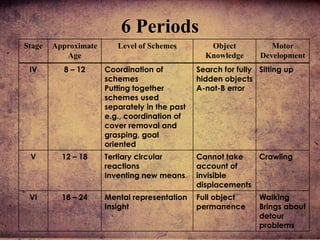
    Stage Approximate Age Level ofSchemes Object Knowledge Motor Development IV 8 – 12 Coordination of schemes Putting together schemes used separately in the past e.g., coordination of cover removal and grasping, goal oriented Search for fully hidden objects A-not-B error Sitting up V 12 – 18 Tertiary circular reactions Inventing new means Cannot take account of invisible displacements Crawling VI 18 – 24 Mental representation Insight Full object permanence Walking Brings about detour problems 6 Periods
  • 12.
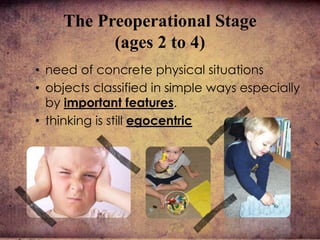
    The Preoperational Stage (ages2 to 4) • need of concrete physical situations • objects classified in simple ways especially by important features. • thinking is still egocentric
  • 13.
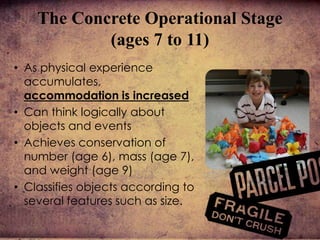
    • As physicalexperience accumulates, accommodation is increased • Can think logically about objects and events • Achieves conservation of number (age 6), mass (age 7), and weight (age 9) • Classifies objects according to several features such as size. The Concrete Operational Stage (ages 7 to 11)
  • 14.
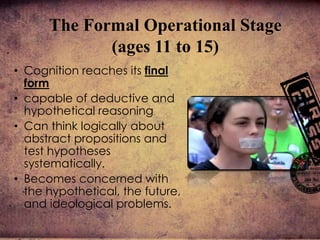
    • Cognition reachesits final form • capable of deductive and hypothetical reasoning • Can think logically about abstract propositions and test hypotheses systematically. • Becomes concerned with the hypothetical, the future, and ideological problems. The Formal Operational Stage (ages 11 to 15)
  • 15.
  • 17.
    How is informationpresented? Learning is an active process
  • 19.
    Learning should bewhole, authentic, and "real" How is meaning constructed?

Editor's Notes

  • #2 Legend: Underlined – definition Capitalized – emphasis Bold – explained (notes)
  • #4 -career of scientific research began at the age of 11 with the publication of a short paper on the albino sparrow. -wrote more than 60 books and 100+ articles -later became interested in children’s intellectual development, and spent his last 60 years gathering an impressive amount of research information pertaining to mental development. -This produced an elaborate and comprehensive theory of how intelligence works.
  • #5 -was most thought of as a child psychologist and educator though he preferred to be classified as a genetic epistemologist. -surprisingly, he also contributed in the field of computer science and AI. His works were used to develop a programming language called LOGO   -His most important contribution was his theory of cognitive and affective development or more commonly known as the Theory of Cognitive Development
  • #6 Quotation: Piaget pushes for innovation; using knowledge for improvement and for seeking ways to discover new things References: Wadsworth, Barry J. (1996). Piaget’s Theory of Cognitive and Affective Development: Foundations of Constructivism, Fifth Edition. New York: Longman Publishers.   Kendra Van Wagner. Jean Piaget Biography. from Ask.com Website: http://psychology.about.com/od/profilesofmajorthinkers/p/piaget.htm Image source: http://mdubbleu.wordpress.com/2009/01/25/the-religion-in-me-adam-and-eve/
  • #8 Piaget's theory of cognitive development proposes that humans cannot be "given" information which they immediately understand and use. Instead, humans must "construct" their own knowledge. They build their knowledge through experience. Experiences enable them to create schemas - mental models in their heads. These schemas are changed, enlarged, and made more sophisticated through two complimentary processes: assimilation and accommodation Assimilation - process of taking in new information into our previously existing schemata, modify experience or information somewhat to fit in with our preexisting beliefs Accommodation - changing or altering our existing schemas in light of new information From: Wadsworth, Barry J. (1996). Piaget’s Theory of Cognitive and Affective Development: Foundations of Constructivism, Fifth Edition. New York: Longman Publishers.   Anonymous. Piaget’s Key Ideas. from learningandteaching.info Website: http://www.learningandteaching.info/learning/piaget.htm   Anonymous. Jeans Piaget’s Background. from psychology.about.com Website: http://psychology.about.com/od/piagetstheory/a/keyconcepts.htm
  • #9 The Four Stages: The Sensorimotor Stage (Birth to 2 years old) The Preoperational Stage (ages 2 to 4) The Concrete Operational/Operations Stage (ages 7 to 11) The Formal Operational/Operations Stage (ages 11 to 15)
  • #10 The infant builds an understanding of himself or herself and reality (and how things work) through interactions with the environment. It is able to differentiate between itself and other objects. Ex. Of acting intentionally: pulls a string to set mobile in motion or shakes a rattle to make a noise  Object permanence-realizes that things continue to exist even when no longer present to the sense
  • #11 Has 6 periods * P1(0-1 mos.) * P2(1-4 mos.) * P3(4-8 mos.) * P4(8-12 mos.) * P5(12-18 mos.) * P6(18-24 mos.)
  • #12 Has 6 periods * P1(0-1 mos.) * P2(1-4 mos.) * P3(4-8 mos.) * P4(8-12 mos.) * P5(12-18 mos.) * P6(18-24 mos.)
  • #13 Classifies objects by a single feature: e.g. groups together all the red blocks regardless of shape or all the square blocks regardless of color  egocentric: has difficulty taking the viewpoint of others 
  • #14 Accommodation is increased-The child begins to think abstractly and conceptualize, creating logical structures that explain his or her physical experiences.
  • #15 Final form- the person no longer requires concrete objects to make rational judgments His or her ability for abstract thinking is very similar to an adult References: -Anonymous. Piaget’s Key Ideas. from learningandteaching.info Website: http://www.learningandteaching.info/learning/piaget.htm   -Wadsworth, Barry J. (1996). Piaget’s Theory of Cognitive and Affective Development: Foundations of Constructivism, Fifth Edition. New York: Longman Publishers.   Anonymous. Stage Theory of Cognitive Development. from learning-theories.com Website: http://www.learning-theories.com/piagets-stage-theory-of-cognitive-development.html   -Flavell, John H. (1993). Cognitive Development. New Jersey: Prentice-Hall Inc.
  • #16 The Four Stages: The Sensorimotor Stage (Birth to 2 years old) The Preoperational Stage (ages 2 to 4) The Concrete Operational/Operations Stage (ages 7 to 11) The Formal Operational/Operations Stage (ages 11 to 15)
  • #18 Learning is an active process: Direct experience, making errors, and looking for solutions are vital for the assimilation and accommodation of information. How information is presented is important. When information is introduced as an aid to problem solving, it functions as a tool rather than an isolated arbitrary fact.
  • #20 Piaget helps us to understand that meaning is constructed as children interact in meaningful ways with the world around them. Thus, That means less emphasis on isolated "skill" exercises that try to teach something like long division or end of sentence punctuation. Students still learn these things in Piagetian classrooms, but they are more likely to learn them if they are engaged in meaningful activities (such as operating a class "store" or "bank" or writing and editing a class newspaper). Whole activities-authentic activities which are inherently interesting and meaningful to the student Isolated- grade on a test or a "Great, you did well" from the computer lesson software References: http://viking.coe.uh.edu/~ichen/ebook/et-it/cognitiv.htm