Solving Linear Inequalities

 Pre Calculus Chapter 3, section 1
            pp 93 - 98
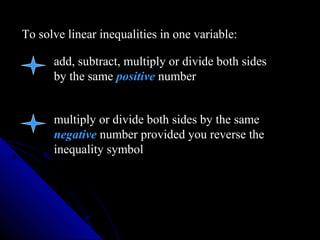
To solve linear inequalities in one variable:

      add, subtract, multiply or divide both sides
      by the same positive number


      multiply or divide both sides by the same
      negative number provided you reverse the
      inequality symbol
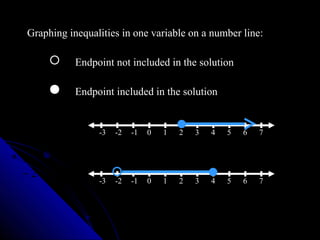
Graphing inequalities in one variable on a number line:

            Endpoint not included in the solution

            Endpoint included in the solution


  x≥2
                 -3   -2   -1   0   1   2   3   4   5   6   7


−2< x ≤ 4
                 -3   -2   -1   0   1   2   3   4   5   6   7
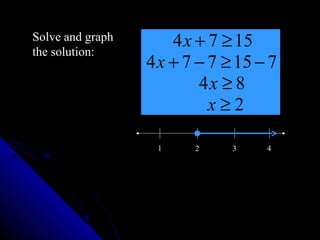
Solve and graph
the solution:
                      4 x + 7 ≥ 15
                  4 x + 7 − 7 ≥ 15 − 7
                          4x ≥ 8
                            x≥2

                   1     2     3    4
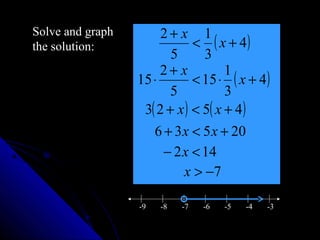
Solve and graph        2+ x 1
the solution:                 < ( x + 4)
                         5      3
                       2+ x          1
                  15 ⋅        < 15 ⋅ ( x + 4 )
                         5           3
                   3( 2 + x ) < 5( x + 4 )
                     6 + 3 x < 5 x + 20
                       − 2 x < 14
                           x > −7

                  -9   -8   -7   -6   -5   -4   -3
Assignment: p 97/1-10 all

P cc3s1

  • 1.
    Solving Linear Inequalities Pre Calculus Chapter 3, section 1 pp 93 - 98
  • 2.
    To solve linearinequalities in one variable: add, subtract, multiply or divide both sides by the same positive number multiply or divide both sides by the same negative number provided you reverse the inequality symbol
  • 3.
    Graphing inequalities inone variable on a number line: Endpoint not included in the solution Endpoint included in the solution x≥2 -3 -2 -1 0 1 2 3 4 5 6 7 −2< x ≤ 4 -3 -2 -1 0 1 2 3 4 5 6 7
  • 4.
    Solve and graph thesolution: 4 x + 7 ≥ 15 4 x + 7 − 7 ≥ 15 − 7 4x ≥ 8 x≥2 1 2 3 4
  • 5.
    Solve and graph 2+ x 1 the solution: < ( x + 4) 5 3 2+ x 1 15 ⋅ < 15 ⋅ ( x + 4 ) 5 3 3( 2 + x ) < 5( x + 4 ) 6 + 3 x < 5 x + 20 − 2 x < 14 x > −7 -9 -8 -7 -6 -5 -4 -3
  • 6.
  • 7.