1.6: Solve Linear
Inequalities
I can:
Solve a linear and/or compound inequality and graph
the solution set.
Manipulate a formula to solve for a particular variable.
Key Vocabulary
• Linear Inequality
• Compound Inequality
• Equivalent Inequalities
Linear Inequality
• Can be written in one of the following forms where a and b are
real numbers and a does not equal 0.
Compound Inequality
• Consists of two simple inequalities joined by “and” or “or”
GUIDED PRACTICE for Examples 1 and 2
Graph the inequality.
1. x > – 5
The solutions are all real numbers greater than 5.
An open dot is used in the graph to indicate – 5 is
not a solution.
GUIDED PRACTICE for Examples 1 and 2
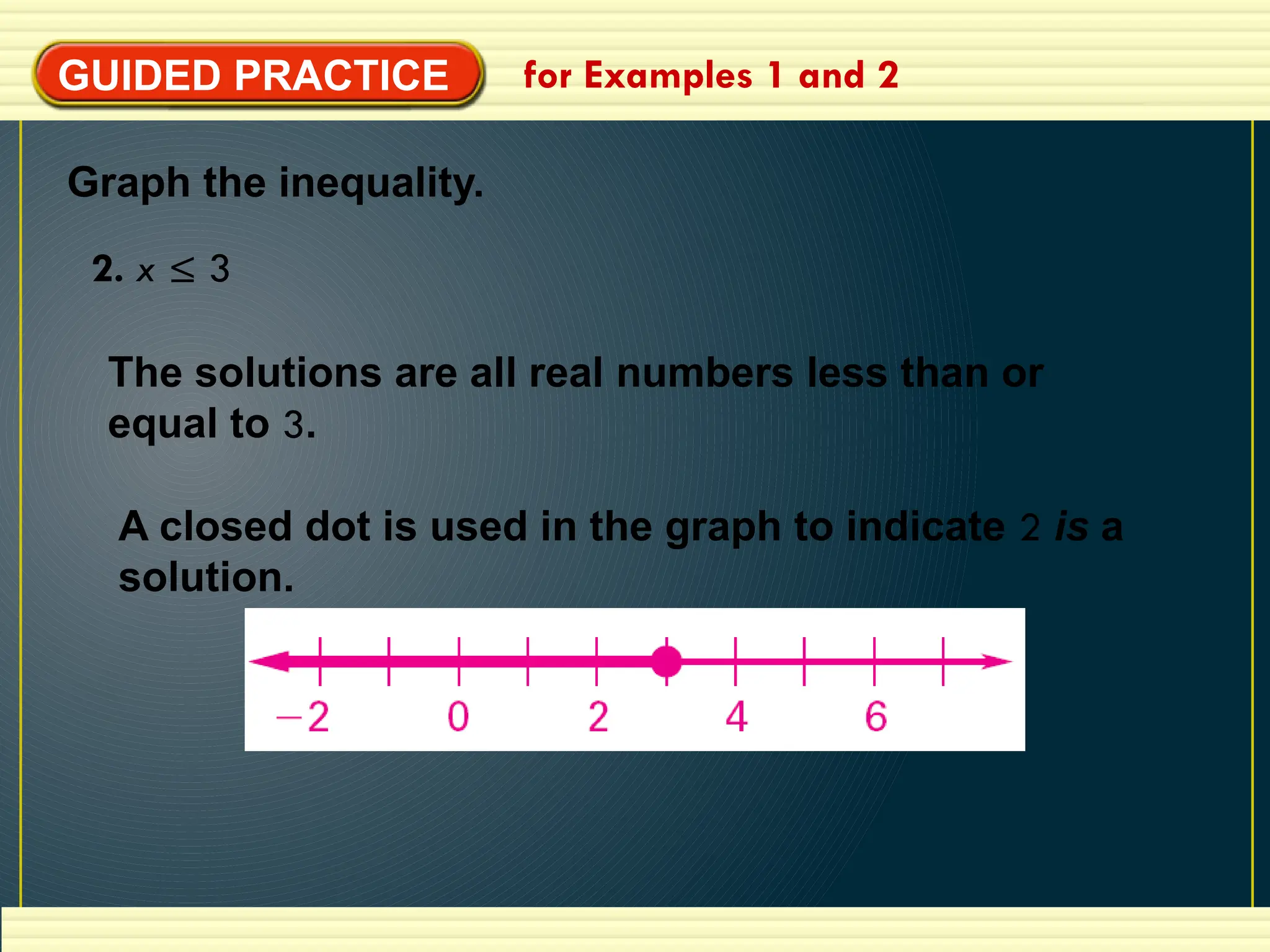
Graph the inequality.
2. x ≤ 3
The solutions are all real numbers less than or
equal to 3.
A closed dot is used in the graph to indicate 2 is a
solution.
GUIDED PRACTICE for Examples 1 and 2
Graph the inequality.
3. – 3 ≤ x < 1
The solutions are all real numbers that are greater
than or equalt to – 3 and less than 1.
GUIDED PRACTICE for Examples 1 and 2
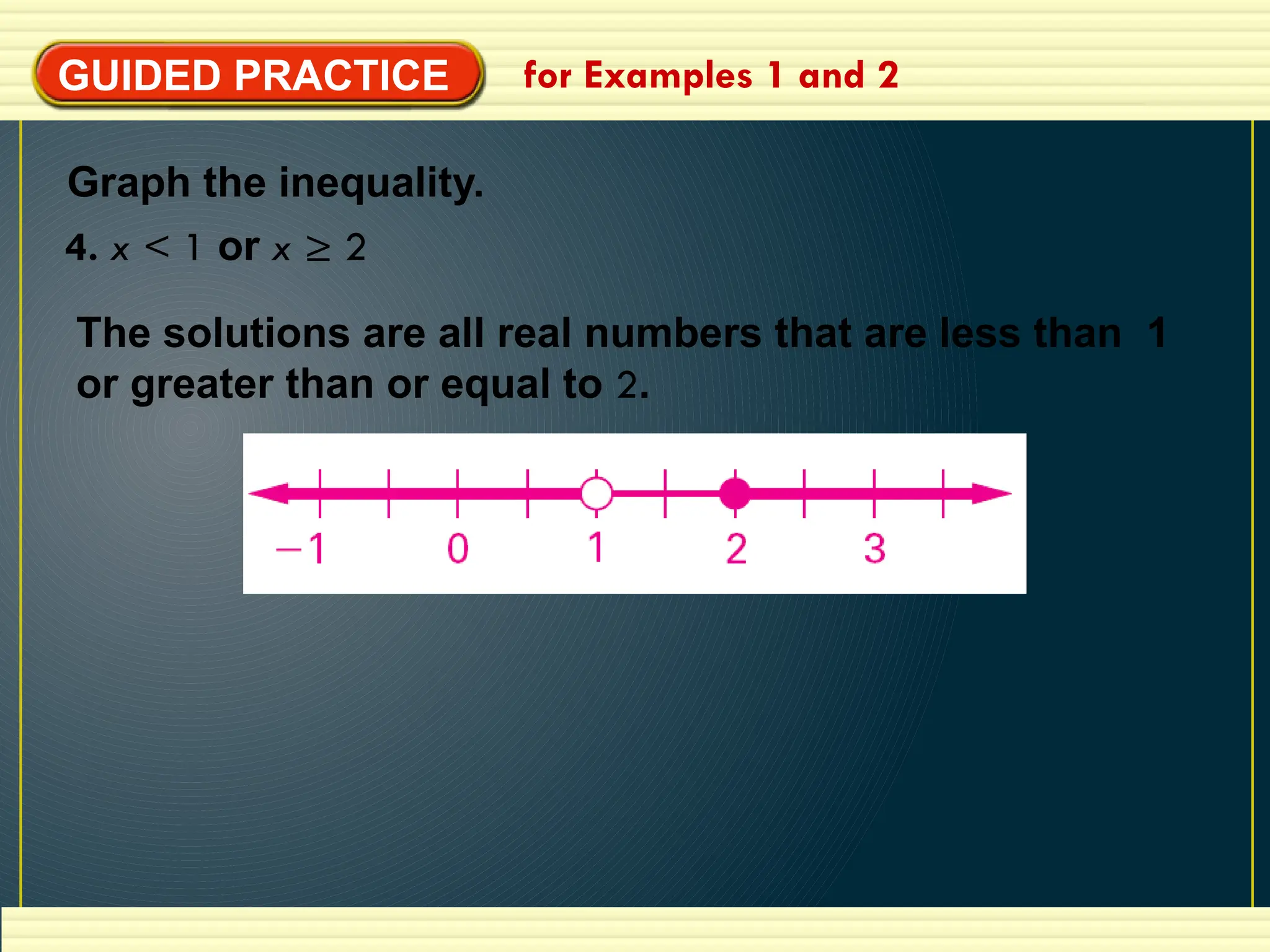
Graph the inequality.
4. x < 1 or x ≥ 2
The solutions are all real numbers that are less than 1
or greater than or equal to 2.
Why?
• Near the end of the semester or school year, I have students
ask me what scores they must get on a final in order to earn
a particular grade. You can use linear inequalities to
answer this question.
• You budgeted x amount of dollars for movies. You have
already spend $50 of the amount. You can use inequalities
to determine staying under budget or reaching your
budgeted target.
Equivalent Inequalities
GUIDED PRACTICE for Examples 3 and 4
Solve the inequality. Then graph the solution.
5. 4x + 9 < 25
4x + 9 < 25 Write original inequality.
4x < 16 Subtract 9 from each side.
x < 4 Divide each side by 4.
6. 1 – 3x ≥ – 14
1 – 3x ≥ – 14 Write original inequality.
– 3x ≥ – 15 Subtract –1 from each side.
x ≤ 5
GUIDED PRACTICE for Examples 3 and 4
Solve the inequality. Then graph the solution.
7. 5x – 7 ≤ 6x
8. 3 – x > x – 9
5x – 7 ≤ 6x Write original inequality.
x > – 7 Subtract 5x from each side.
3 – x > x – 9 Write original inequality.
3 – 2x > – 9
– 2x > – 12
x < 6
Subtract x from each side.
Subtract 3 from each side.
Divide each side by –2 and reverse.
EXAMPLE 6 Solve an “or” compound inequality
Solve 3x + 5 ≤
11 or 5x – 7 ≥ 23
. Then graph the solution.
SOLUTION
A solution of this compound inequality is a solution of
either of its parts.
First Inequality Second Inequality
3x + 5 ≤
11 3x ≤
6
x ≤
2
Write first inequality.
Subtract 5 from each side.
Divide each side by 3.
5x – 7 ≥
23 5x ≥
30
x ≥ 6
Write second inequality.
Add 7 to each side.
Divide each side by 5.
GUIDED PRACTICE for Examples 5,6, and 7
Solve the inequality. Then graph the solution.
9. – 1 < 2x + 7 < 19
– 1 < 2x + 7 < 19 Write original inequality.
Subtract 7 from each expression.
Simplify.
Divide each expression by 2.
– 1– 7 < 2x + 7 – 7 < 19 – 7
– 8 < 2x < 12
– 4 < x < 6
ANSWER
The solutions are all real numbers greater than – 4
and less than 6.
GUIDED PRACTICE for Examples 5,6 and 7
Solve the inequality. Then graph the solution.
10. – 8 ≤
– x – 5 ≤
6
– 8 ≤– x – 5 ≤
6
– 8+5 ≤– x – 5 + 5
≤ 6 + 5
– 3 ≤– x ≤ 11
– 11 ≤ x ≤
3
Write original inequality.
Add 5 to each expression.
Simplify.
The solutions are all real numbers greater than and
equal to – 11 and less than and equal to 3.
ANSWER
GUIDED PRACTICE for Examples 5,6 and 7
Solve the inequality. Then graph the solution.
11. x + 4 ≤
9 or x – 3 ≥ 7
SOLUTION
A solution of this compound inequality is a solution of
either of its parts.
First Inequality Second Inequality
x ≤
5
Write first inequality.
Subtract 4 from each side. x ≥
10
Write second inequality.
Add 3 to each side.
x + 4 ≤
9
x – 3 ≥ 7
GUIDED PRACTICE for Examples 5,6 and 7
ANSWER
The graph is shown below. The solutions are all real
numbers.
less than or equal to 5 or greater than or equal to 10.
GUIDED PRACTICE for Examples 5,6 and 7
Solve the inequality. Then graph the solution.
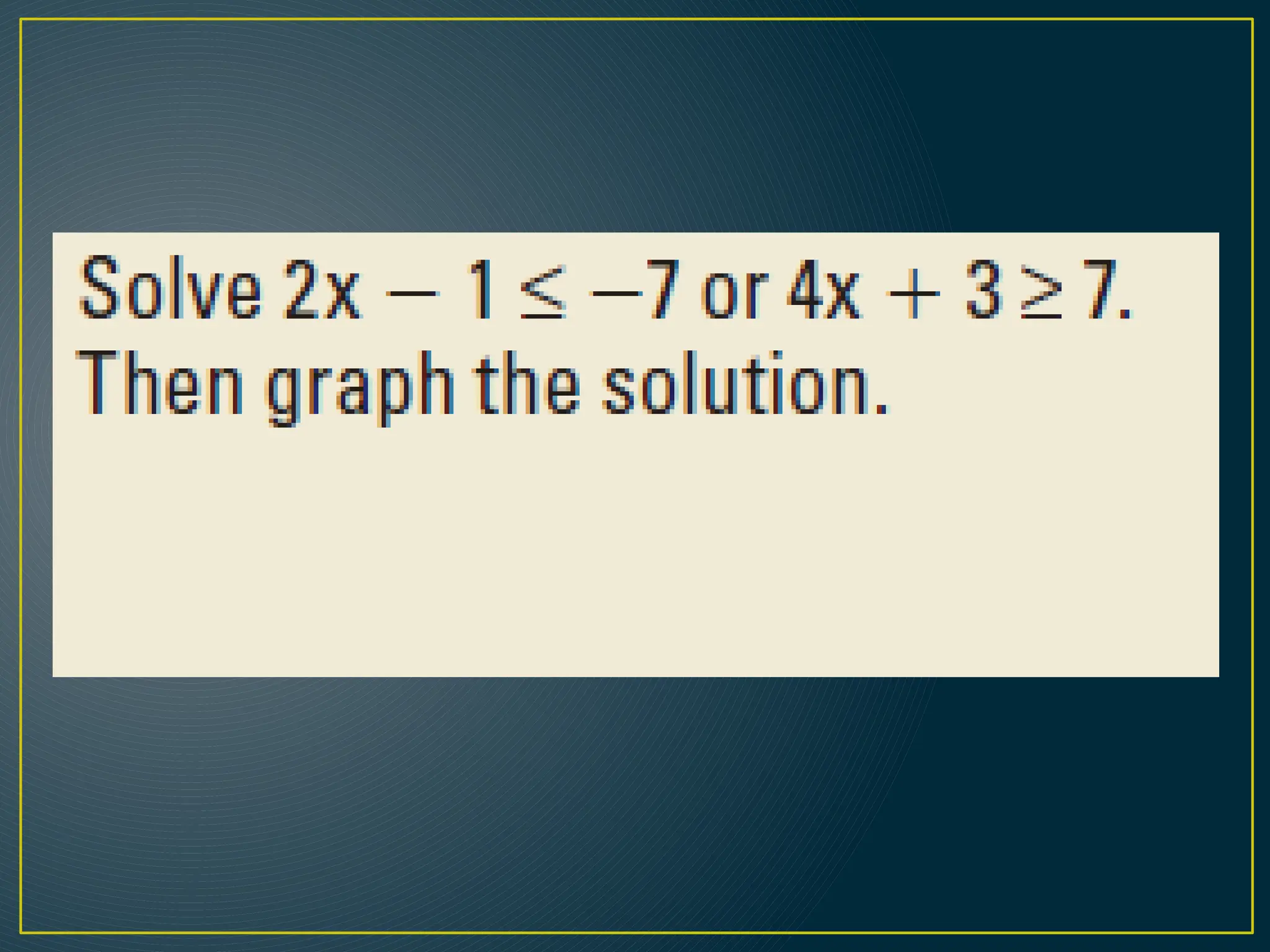
12. 3x – 1 < – 1 or 2x + 5 ≥
11
SOLUTION
A solution of this compound inequality is a solution of
either of its parts.
First Inequality Second Inequality
3x ≤
0
x ≤
0
Write first inequality.
Add 1 each side .
Divide each side by 3.
2x + 5 ≥
11 2x ≥ 6
x ≥ 3
Write second inequality.
Subtract 5 from each side
Divide each side by 5.
3x – 1< – 1
GUIDED PRACTICE for Examples 5,6 and 7
less than 0 or greater than or equal to 3.
ANSWER
The graph is shown below. The solutions are all real
numbers.

Algebra Inequality presentation power point.pptx

  • 1.
    1.6: Solve Linear Inequalities Ican: Solve a linear and/or compound inequality and graph the solution set. Manipulate a formula to solve for a particular variable.
  • 2.
    Key Vocabulary • LinearInequality • Compound Inequality • Equivalent Inequalities
  • 3.
    Linear Inequality • Canbe written in one of the following forms where a and b are real numbers and a does not equal 0.
  • 5.
    Compound Inequality • Consistsof two simple inequalities joined by “and” or “or”
  • 7.
    GUIDED PRACTICE forExamples 1 and 2 Graph the inequality. 1. x > – 5 The solutions are all real numbers greater than 5. An open dot is used in the graph to indicate – 5 is not a solution.
  • 8.
    GUIDED PRACTICE forExamples 1 and 2 Graph the inequality. 2. x ≤ 3 The solutions are all real numbers less than or equal to 3. A closed dot is used in the graph to indicate 2 is a solution.
  • 9.
    GUIDED PRACTICE forExamples 1 and 2 Graph the inequality. 3. – 3 ≤ x < 1 The solutions are all real numbers that are greater than or equalt to – 3 and less than 1.
  • 10.
    GUIDED PRACTICE forExamples 1 and 2 Graph the inequality. 4. x < 1 or x ≥ 2 The solutions are all real numbers that are less than 1 or greater than or equal to 2.
  • 11.
    Why? • Near theend of the semester or school year, I have students ask me what scores they must get on a final in order to earn a particular grade. You can use linear inequalities to answer this question. • You budgeted x amount of dollars for movies. You have already spend $50 of the amount. You can use inequalities to determine staying under budget or reaching your budgeted target.
  • 12.
  • 16.
    GUIDED PRACTICE forExamples 3 and 4 Solve the inequality. Then graph the solution. 5. 4x + 9 < 25 4x + 9 < 25 Write original inequality. 4x < 16 Subtract 9 from each side. x < 4 Divide each side by 4. 6. 1 – 3x ≥ – 14 1 – 3x ≥ – 14 Write original inequality. – 3x ≥ – 15 Subtract –1 from each side. x ≤ 5
  • 17.
    GUIDED PRACTICE forExamples 3 and 4 Solve the inequality. Then graph the solution. 7. 5x – 7 ≤ 6x 8. 3 – x > x – 9 5x – 7 ≤ 6x Write original inequality. x > – 7 Subtract 5x from each side. 3 – x > x – 9 Write original inequality. 3 – 2x > – 9 – 2x > – 12 x < 6 Subtract x from each side. Subtract 3 from each side. Divide each side by –2 and reverse.
  • 19.
    EXAMPLE 6 Solvean “or” compound inequality Solve 3x + 5 ≤ 11 or 5x – 7 ≥ 23 . Then graph the solution. SOLUTION A solution of this compound inequality is a solution of either of its parts. First Inequality Second Inequality 3x + 5 ≤ 11 3x ≤ 6 x ≤ 2 Write first inequality. Subtract 5 from each side. Divide each side by 3. 5x – 7 ≥ 23 5x ≥ 30 x ≥ 6 Write second inequality. Add 7 to each side. Divide each side by 5.
  • 20.
    GUIDED PRACTICE forExamples 5,6, and 7 Solve the inequality. Then graph the solution. 9. – 1 < 2x + 7 < 19 – 1 < 2x + 7 < 19 Write original inequality. Subtract 7 from each expression. Simplify. Divide each expression by 2. – 1– 7 < 2x + 7 – 7 < 19 – 7 – 8 < 2x < 12 – 4 < x < 6 ANSWER The solutions are all real numbers greater than – 4 and less than 6.
  • 21.
    GUIDED PRACTICE forExamples 5,6 and 7 Solve the inequality. Then graph the solution. 10. – 8 ≤ – x – 5 ≤ 6 – 8 ≤– x – 5 ≤ 6 – 8+5 ≤– x – 5 + 5 ≤ 6 + 5 – 3 ≤– x ≤ 11 – 11 ≤ x ≤ 3 Write original inequality. Add 5 to each expression. Simplify. The solutions are all real numbers greater than and equal to – 11 and less than and equal to 3. ANSWER
  • 22.
    GUIDED PRACTICE forExamples 5,6 and 7 Solve the inequality. Then graph the solution. 11. x + 4 ≤ 9 or x – 3 ≥ 7 SOLUTION A solution of this compound inequality is a solution of either of its parts. First Inequality Second Inequality x ≤ 5 Write first inequality. Subtract 4 from each side. x ≥ 10 Write second inequality. Add 3 to each side. x + 4 ≤ 9 x – 3 ≥ 7
  • 23.
    GUIDED PRACTICE forExamples 5,6 and 7 ANSWER The graph is shown below. The solutions are all real numbers. less than or equal to 5 or greater than or equal to 10.
  • 24.
    GUIDED PRACTICE forExamples 5,6 and 7 Solve the inequality. Then graph the solution. 12. 3x – 1 < – 1 or 2x + 5 ≥ 11 SOLUTION A solution of this compound inequality is a solution of either of its parts. First Inequality Second Inequality 3x ≤ 0 x ≤ 0 Write first inequality. Add 1 each side . Divide each side by 3. 2x + 5 ≥ 11 2x ≥ 6 x ≥ 3 Write second inequality. Subtract 5 from each side Divide each side by 5. 3x – 1< – 1
  • 25.
    GUIDED PRACTICE forExamples 5,6 and 7 less than 0 or greater than or equal to 3. ANSWER The graph is shown below. The solutions are all real numbers.