Copyright © 2015 by McGraw Hill Education (India) Private Limited. All rights reserved.
1.1
Chapter 1
Introduction
Cryptography and Network
Security
CRYPTOGRAPHY AND
NETWORK SECURITY
3e
Copyright © 2015 by McGraw Hill Education (India) Private Limited. All rights reserved.
1.2
● To define the three security goals
● To explain security attacks that threaten
confidentiality, integrity, and availability
● To infer to the different categories of cryptographic
attacks
● To relate to the relationship between security
services and their mechanisms.
● To outline the different techniques needed for
implementing security goals.
Copyright © 2015 by McGraw Hill Education (India) Private Limited. All rights reserved.
1.3
This section defines three security goals.
1.1.1 Confidentiality
1.1.2 Integrity
1.1.3 Availability
SECURITY GOALS
Copyright © 2015 by McGraw Hill Education (India) Private Limited. All rights reserved.
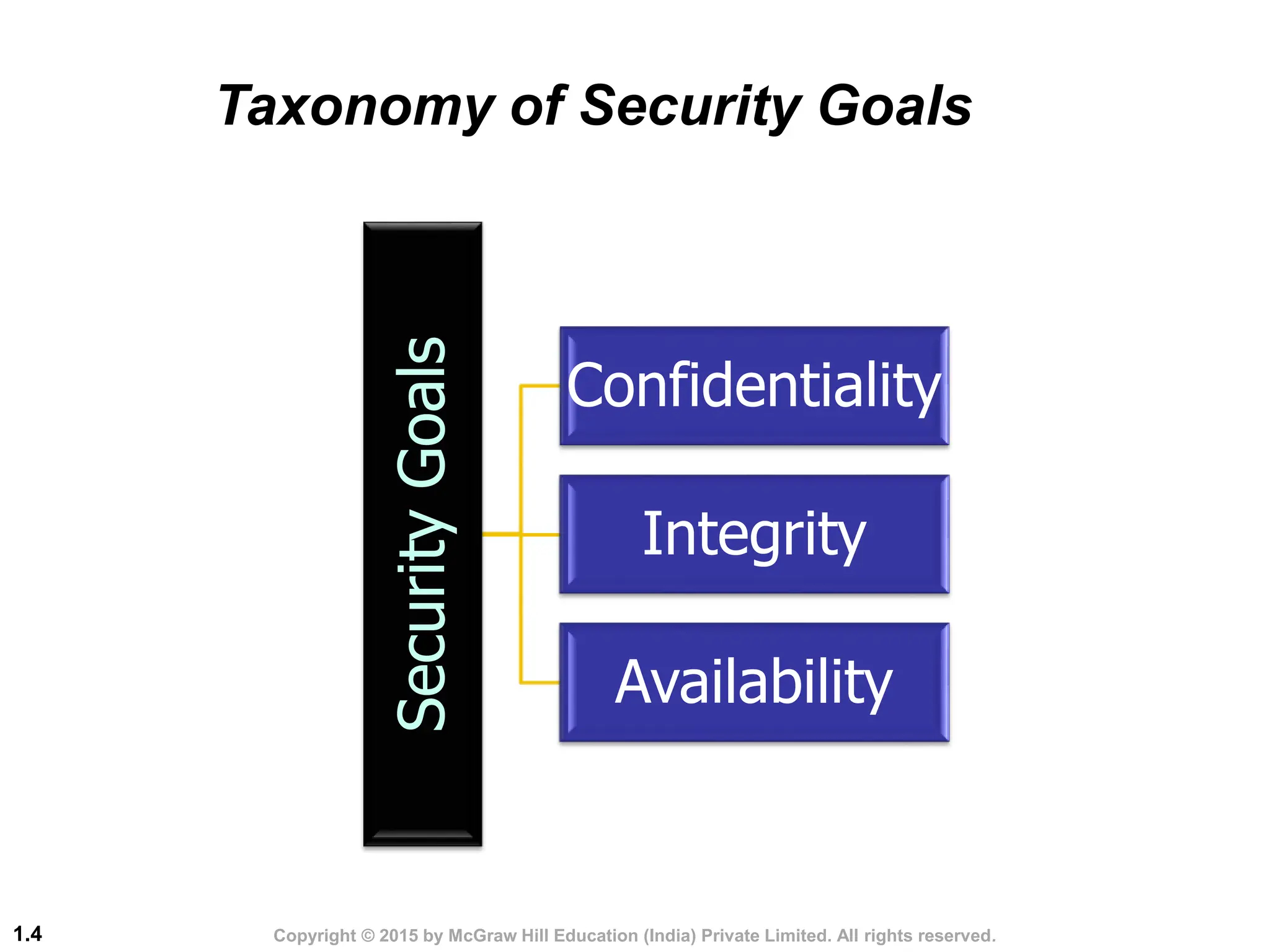
1.4
Security
Goals
Confidentiality
Integrity
Availability
Taxonomy of Security Goals
Copyright © 2015 by McGraw Hill Education (India) Private Limited. All rights reserved.
1.5
 It is probably the most common aspect of
information security.
 We need to protect our confidential information.
 An organization needs to guard against those
malicious actions that endanger the confidentiality of
its information.
Confidentiality
Copyright © 2015 by McGraw Hill Education (India) Private Limited. All rights reserved.
1.6
 Information needs to be changed constantly.
 Integrity means that changes need to be done only
by authorized entities and through authorized
mechanisms.
Integrity
Copyright © 2015 by McGraw Hill Education (India) Private Limited. All rights reserved.
1.7
 The third component of information security is
availability.
 The information created and stored by an
organization needs to be available to authorized
entities.
 Information needs to be constantly changed, which
means it must be accessible to authorized entities.
Availability
Copyright © 2015 by McGraw Hill Education (India) Private Limited. All rights reserved.
1.8
The three goals of security - confidentiality, integrity,
and availability - can be threatened by security attacks.
1.2.1 Attacks Threatening Confidentiality
1.2.2 Attacks Threatening Integrity
1.2.3 Attacks Threatening Availability
1.2.4 Passive versus Active Attacks
Topics discussed in this section:
CRYPTOGRAPHIC ATTACKS
Copyright © 2015 by McGraw Hill Education (India) Private Limited. All rights reserved.
1.9
Figure : Taxonomy of attacks with relation to security goals
Copyright © 2015 by McGraw Hill Education (India) Private Limited. All rights reserved.
1.10
Snooping refers to unauthorized access to or
interception of data.
Traffic analysis refers to obtaining some
other type of information by monitoring
online traffic.
Attacks Threatening Confidentiality
Copyright © 2015 by McGraw Hill Education (India) Private Limited. All rights reserved.
1.11
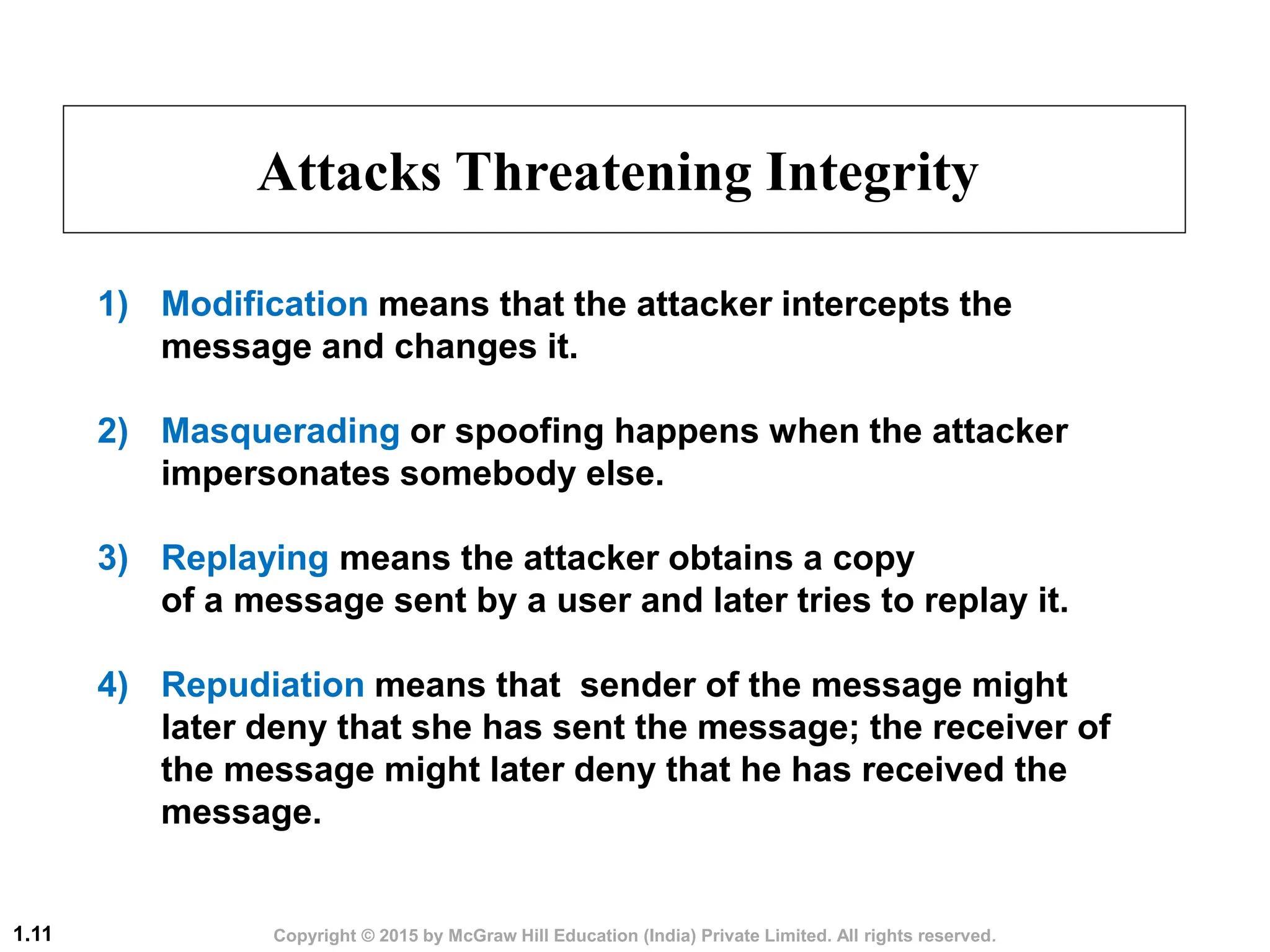
Attacks Threatening Integrity
1) Modification means that the attacker intercepts the
message and changes it.
2) Masquerading or spoofing happens when the attacker
impersonates somebody else.
3) Replaying means the attacker obtains a copy
of a message sent by a user and later tries to replay it.
4) Repudiation means that sender of the message might
later deny that she has sent the message; the receiver of
the message might later deny that he has received the
message.
Copyright © 2015 by McGraw Hill Education (India) Private Limited. All rights reserved.
1.12
Attacks Threatening Integrity
Denial of service (DoS) is a very common
attack. It may slow down or totally interrupt
the service of a system.
Copyright © 2015 by McGraw Hill Education (India) Private Limited. All rights reserved.
1.13
Table 1.1 Categorization of passive and active attacks
Copyright © 2015 by McGraw Hill Education (India) Private Limited. All rights reserved.
1.14
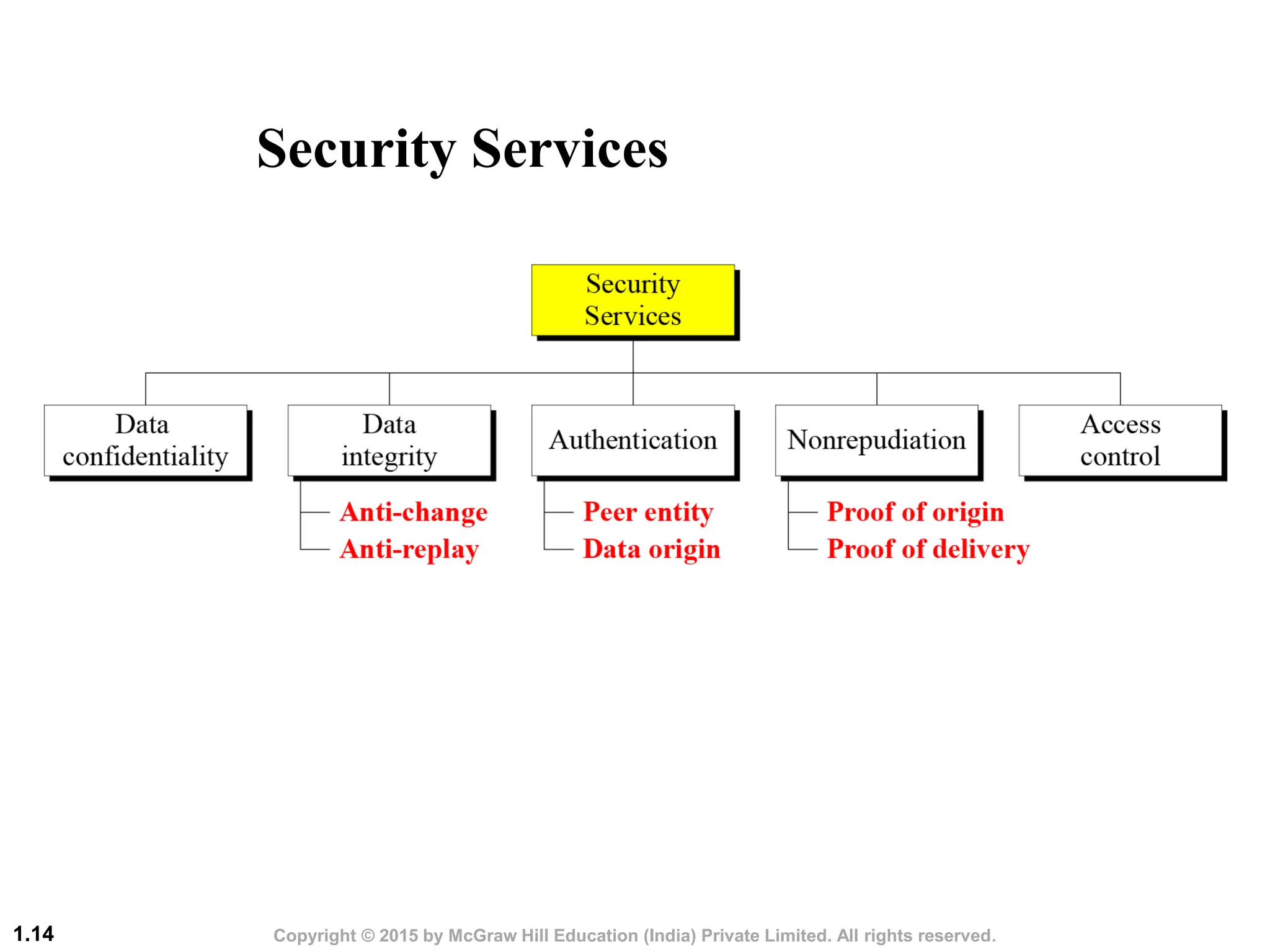
Figure 1.3 Security services
Security Services
Copyright © 2015 by McGraw Hill Education (India) Private Limited. All rights reserved.
1.15
Figure: Security mechanisms
Copyright © 2015 by McGraw Hill Education (India) Private Limited. All rights reserved.
1.16
Table: Relation between security services and mechanisms
Copyright © 2015 by McGraw Hill Education (India) Private Limited. All rights reserved.
1.17
Mechanisms discussed in the previous sections are only
theoretical recipes to implement security. The actual
implementation of security goals needs some
techniques. Two techniques are prevalent today:
cryptography and steganography.
1.4.1 Cryptography
1.4.2 Steganography
Topics discussed in this section:
TECHNIQUES
Copyright © 2015 by McGraw Hill Education (India) Private Limited. All rights reserved.
1.18
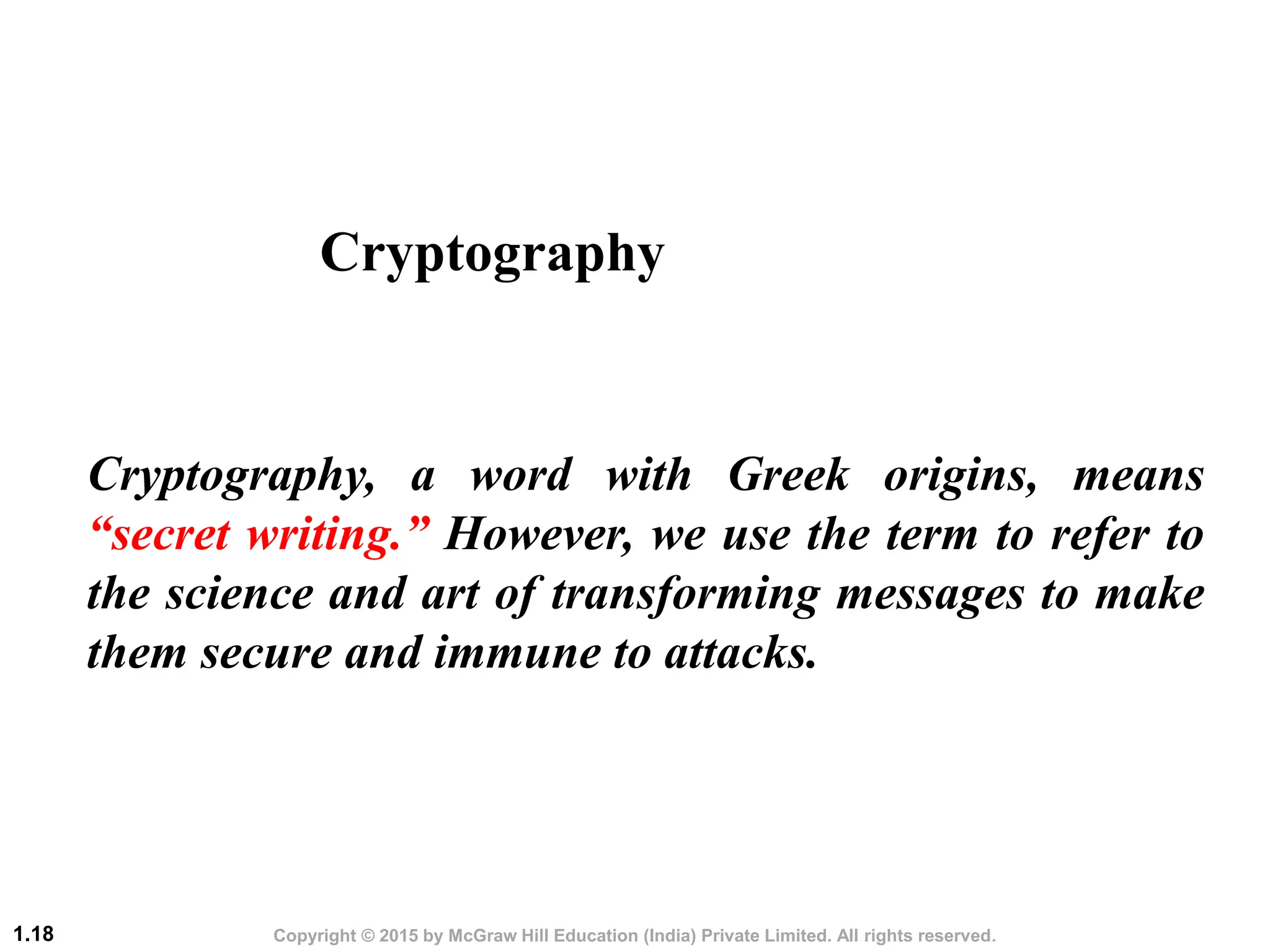
Cryptography, a word with Greek origins, means
“secret writing.” However, we use the term to refer to
the science and art of transforming messages to make
them secure and immune to attacks.
Cryptography
Copyright © 2015 by McGraw Hill Education (India) Private Limited. All rights reserved.
1.19
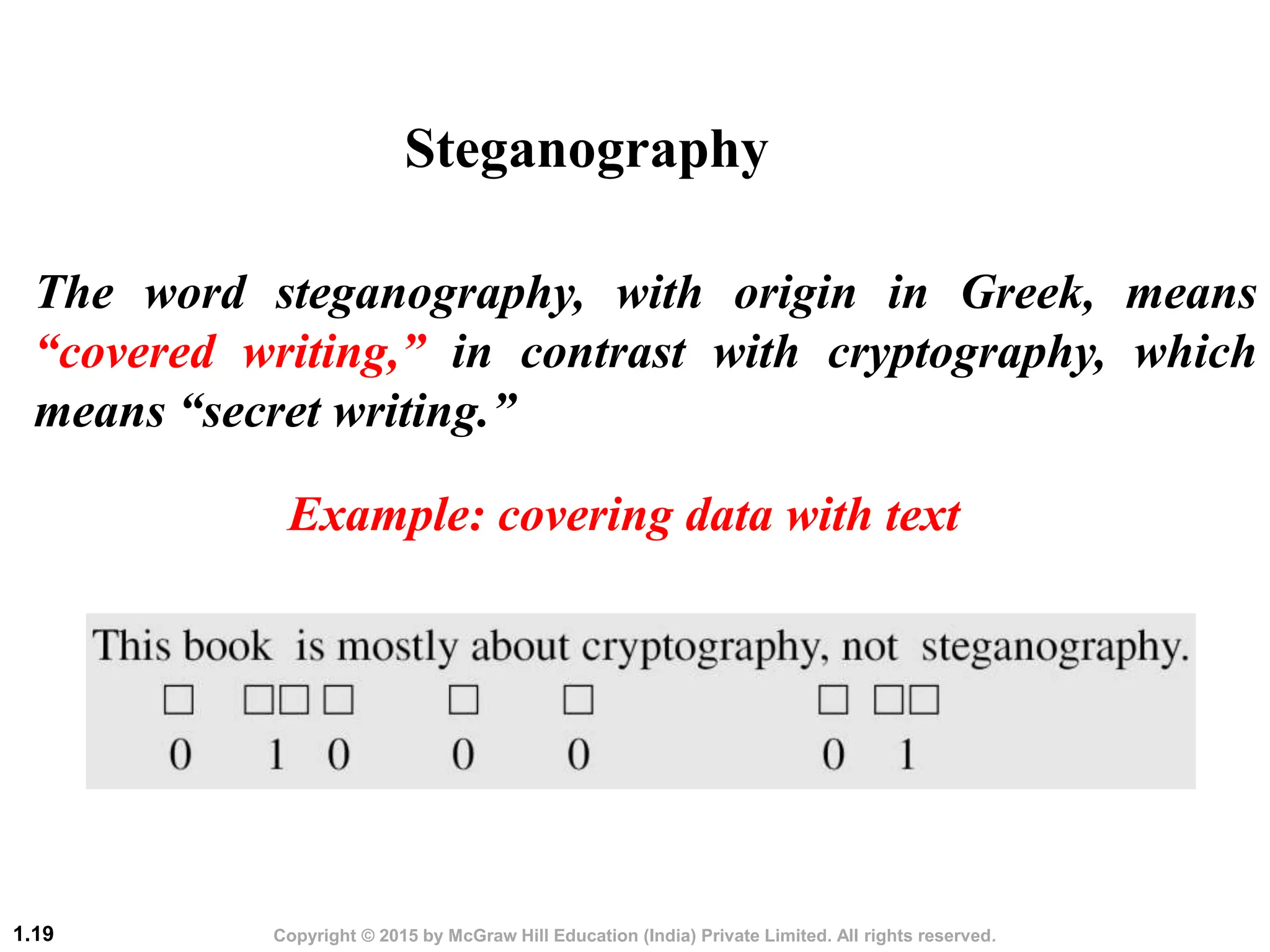
The word steganography, with origin in Greek, means
“covered writing,” in contrast with cryptography, which
means “secret writing.”
Example: covering data with text
Steganography
Copyright © 2015 by McGraw Hill Education (India) Private Limited. All rights reserved.
1.20
Example: using dictionary
Example: covering data under color image
Continued…

CNS PPT.ppt

  • 1.
    Copyright © 2015by McGraw Hill Education (India) Private Limited. All rights reserved. 1.1 Chapter 1 Introduction Cryptography and Network Security CRYPTOGRAPHY AND NETWORK SECURITY 3e
  • 2.
    Copyright © 2015by McGraw Hill Education (India) Private Limited. All rights reserved. 1.2 ● To define the three security goals ● To explain security attacks that threaten confidentiality, integrity, and availability ● To infer to the different categories of cryptographic attacks ● To relate to the relationship between security services and their mechanisms. ● To outline the different techniques needed for implementing security goals.
  • 3.
    Copyright © 2015by McGraw Hill Education (India) Private Limited. All rights reserved. 1.3 This section defines three security goals. 1.1.1 Confidentiality 1.1.2 Integrity 1.1.3 Availability SECURITY GOALS
  • 4.
    Copyright © 2015by McGraw Hill Education (India) Private Limited. All rights reserved. 1.4 Security Goals Confidentiality Integrity Availability Taxonomy of Security Goals
  • 5.
    Copyright © 2015by McGraw Hill Education (India) Private Limited. All rights reserved. 1.5  It is probably the most common aspect of information security.  We need to protect our confidential information.  An organization needs to guard against those malicious actions that endanger the confidentiality of its information. Confidentiality
  • 6.
    Copyright © 2015by McGraw Hill Education (India) Private Limited. All rights reserved. 1.6  Information needs to be changed constantly.  Integrity means that changes need to be done only by authorized entities and through authorized mechanisms. Integrity
  • 7.
    Copyright © 2015by McGraw Hill Education (India) Private Limited. All rights reserved. 1.7  The third component of information security is availability.  The information created and stored by an organization needs to be available to authorized entities.  Information needs to be constantly changed, which means it must be accessible to authorized entities. Availability
  • 8.
    Copyright © 2015by McGraw Hill Education (India) Private Limited. All rights reserved. 1.8 The three goals of security - confidentiality, integrity, and availability - can be threatened by security attacks. 1.2.1 Attacks Threatening Confidentiality 1.2.2 Attacks Threatening Integrity 1.2.3 Attacks Threatening Availability 1.2.4 Passive versus Active Attacks Topics discussed in this section: CRYPTOGRAPHIC ATTACKS
  • 9.
    Copyright © 2015by McGraw Hill Education (India) Private Limited. All rights reserved. 1.9 Figure : Taxonomy of attacks with relation to security goals
  • 10.
    Copyright © 2015by McGraw Hill Education (India) Private Limited. All rights reserved. 1.10 Snooping refers to unauthorized access to or interception of data. Traffic analysis refers to obtaining some other type of information by monitoring online traffic. Attacks Threatening Confidentiality
  • 11.
    Copyright © 2015by McGraw Hill Education (India) Private Limited. All rights reserved. 1.11 Attacks Threatening Integrity 1) Modification means that the attacker intercepts the message and changes it. 2) Masquerading or spoofing happens when the attacker impersonates somebody else. 3) Replaying means the attacker obtains a copy of a message sent by a user and later tries to replay it. 4) Repudiation means that sender of the message might later deny that she has sent the message; the receiver of the message might later deny that he has received the message.
  • 12.
    Copyright © 2015by McGraw Hill Education (India) Private Limited. All rights reserved. 1.12 Attacks Threatening Integrity Denial of service (DoS) is a very common attack. It may slow down or totally interrupt the service of a system.
  • 13.
    Copyright © 2015by McGraw Hill Education (India) Private Limited. All rights reserved. 1.13 Table 1.1 Categorization of passive and active attacks
  • 14.
    Copyright © 2015by McGraw Hill Education (India) Private Limited. All rights reserved. 1.14 Figure 1.3 Security services Security Services
  • 15.
    Copyright © 2015by McGraw Hill Education (India) Private Limited. All rights reserved. 1.15 Figure: Security mechanisms
  • 16.
    Copyright © 2015by McGraw Hill Education (India) Private Limited. All rights reserved. 1.16 Table: Relation between security services and mechanisms
  • 17.
    Copyright © 2015by McGraw Hill Education (India) Private Limited. All rights reserved. 1.17 Mechanisms discussed in the previous sections are only theoretical recipes to implement security. The actual implementation of security goals needs some techniques. Two techniques are prevalent today: cryptography and steganography. 1.4.1 Cryptography 1.4.2 Steganography Topics discussed in this section: TECHNIQUES
  • 18.
    Copyright © 2015by McGraw Hill Education (India) Private Limited. All rights reserved. 1.18 Cryptography, a word with Greek origins, means “secret writing.” However, we use the term to refer to the science and art of transforming messages to make them secure and immune to attacks. Cryptography
  • 19.
    Copyright © 2015by McGraw Hill Education (India) Private Limited. All rights reserved. 1.19 The word steganography, with origin in Greek, means “covered writing,” in contrast with cryptography, which means “secret writing.” Example: covering data with text Steganography
  • 20.
    Copyright © 2015by McGraw Hill Education (India) Private Limited. All rights reserved. 1.20 Example: using dictionary Example: covering data under color image Continued…