











Orange County One Stop Launching New Careers
What Has Changed
Lots of Hiring Going On! According to  Indeed.com , as of Friday, May 8, 2009, there were 28,283 open positions in Orange County, California.
Training Schedule 8:40am - 10:15am   The Customer, Career Mapping and Planning, Personal Branding  10:15am - 10:30am   Break 10:30am - 12pm   Resume Writing, Networking and Social Networking 12pm - 1pm   LUNCH 1pm - 2:30pm   Job Search, Interview Coaching 2:30pm - 2:45pm   Break 2:45pm - 4:30pm  Customer Placement, Role Playing
The Customer
Overview Introduction to the “Candidate-Centric” Model Assessment and Screening Personal Branding
Candidate-Centric Model Definition: Taking the best qualities of the best candidates, refining the candidates’ presentation, and proactively presenting that candidate to specific opportunities that match their skill set. “ (The) Candidate-Centric approach is about embracing the candidate (customer) so that the client (company) will greatly benefit.”   –  Greg Palmer, Former CEO of RemedyTemp, Inc.

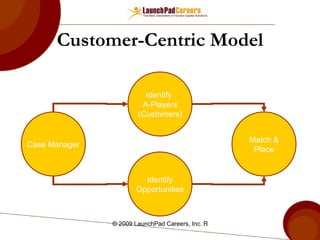
Customer-Centric Model Case Manager Identify  A-Players (Customers) Match & Place Identify Opportunities
Benefits of  Customer-Centric Model Targeted approach: Identify job seekers with higher placement potential and quickly refer them to specific opportunities. Spend your time more efficiently, investing it in customers that are most hire-able Provides needed labor to faster-growing sectors or job clusters. Allows you to place more customers.
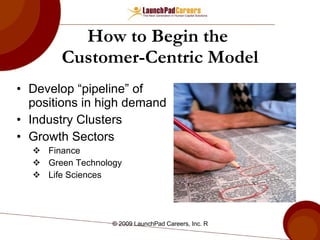
How to  Begin  the  Customer-Centric Model Develop “pipeline” of positions in high demand Industry Clusters Growth Sectors Finance Green Technology Life Sciences
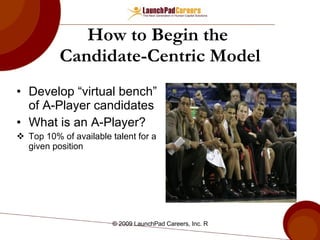
How to  Begin  the  Candidate-Centric Model Develop “virtual bench” of A-Player candidates What is an A-Player? Top 10% of available talent for a given position
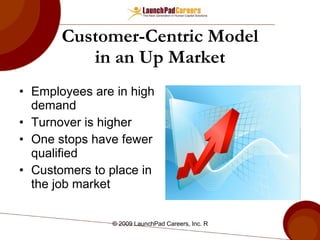
Customer-Centric Model in an Up Market Employees are in high demand Turnover is higher One stops have fewer qualified  Customers to place in the job market
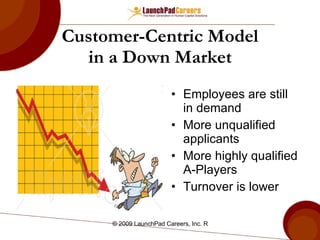
Customer-Centric Model in a Down Market Employees are still in demand More unqualified applicants More highly qualified A-Players  Turnover is lower
Career Mapping and Planning
See Everything as  an Opportunity Career mapping and planning is about seeing current situation   as an opportunity. List 5 reasons current situation   can be seen as an opportunity.  Examples: I am now free to take my career to the next level. I can finish that degree I have been putting off for years. I can spend more time with family and friends. I can spend more time on personal, professional, and spiritual development. I can find and achieve the career of my dreams.
Have a Positive Attitude The Law of Attraction is real! Understand the difference between Positive Affirmation vs. Limiting Beliefs. INVEST in positive influences and REMOVE all negative impediments.
RICH vs. POOR People Take stock of the people in your life. Think about how they contribute to or take away from your success. Begin to understand how you got to where you are just by looking at the people you surround yourself with.
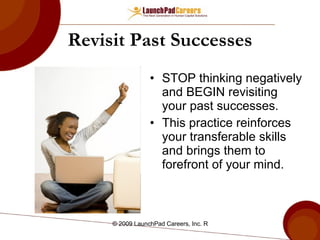
Revisit Past Successes STOP thinking negatively and BEGIN revisiting your past successes. This practice reinforces your transferable skills and brings them to forefront of your mind.
Career Planning Readiness Assessment What are your career goals? What are you really good at professionally? Can you provide a specific example where you demonstrated this skill? Can you describe your most significant accomplishment? What are you not so good at or not interested in doing? Can you give an example? How would each of your last 5 bosses rate your performance? How would these ratings compare to that of your peers? Why did you leave your last 5 places of employment? What are your expectations or goals regarding: travel, work hours and schedule, compensation?
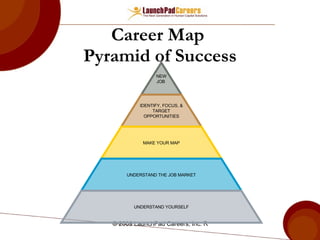
Career Map  Pyramid of Success NEW JOB  IDENTIFY, FOCUS, & TARGET OPPORTUNITIES MAKE YOUR MAP UNDERSTAND THE JOB MARKET UNDERSTAND YOURSELF
Understanding Yourself Career mapping and planning is a bottom up process. Begin your map by starting at your foundation, which is you. Start by analyzing strengths and “development areas” (what others refer to as weaknesses).
Understand Your Strengths  What are you good at? What do you enjoy doing? What have you been praised for?
Development Areas The brain is wired with a greater capacity for our strengths rather than weaknesses. This theory supports reasoning why we should not try to overcome all of our weaknesses, but instead learn how to manage them effectively. Instead of thinking of them as weaknesses, consider them as areas of development. Identifying areas of development enable you to start building systems to improve it.
Visualization  Ability to clearly visualize your dream job will take you further in realizing your goal than any other action. Do it through sensory detail. Your beliefs become your thoughts. Your thoughts become your words. Your words become your actions. Your actions become your habits. Your habits become your values. Your values become your destiny. Mahatma Gandhi
Career Mapping Questionnaire  If anything were possible, what would I want to be different about my career? What type of job would I want? What would I want to be responsible for? What type of boss/coworkers/team would I want to work with? What kind of hours would I want to work?
Career Mapping Questionnaire What type of company would I want work for? What sort of company culture would I want to work in? What city would I want to live in? What salary would I want to earn?
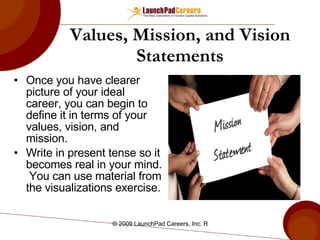
Values, Mission, and Vision Statements Once you have clearer picture of your ideal career, you can begin to define it in terms of your values, vision, and mission.  Write in present tense so it becomes real in your mind.  You can use material from the visualizations exercise.
The Job Market and  Your Career Path 5 industries or sectors expected to see strong growth over the next few years. Federal Government Construction and Engineering Healthcare Technology Education
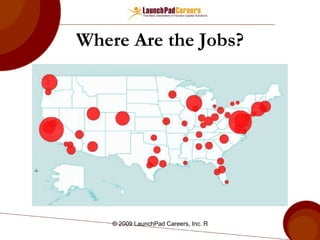
Where Are the Jobs?
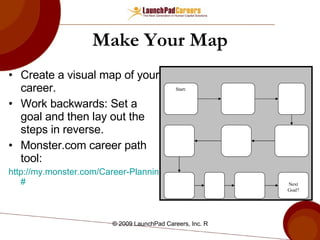
Make Your Map Create a visual map of your career. Work backwards: Set a goal and then lay out the steps in reverse. Monster.com career path tool:  http://my.monster.com/Career-Planning/Pathing.aspx # Start: Next Goal?
Take  Extraordinary  Action Follow up the training workshops with continued and sustained action. Life is a numbers game: apply to more jobs, make more calls, and establish more contacts to maximize your job search.
Measure and Calibrate Continually measure where you are at and re-calibrate according to your plan. Change the plan to more accurately reflect your likes and dislikes.
Any Questions?
Career Coaching
Personal Branding
What Is Personal Branding? Definition: The process of marketing people and their careers as brands. Self-help is about self- improvement  whereas personal branding suggests success comes from self- packaging . Examples: Oprah Winfrey and Donald Trump If done correctly, allows you to create strategic advantage over competition.
Why Create a Personal Brand? Project-Based Job Market Differentiation Value Creation Gives You a Voice
Project-Based Job Market Growing use of staffing agencies and contract workers.  Companies operate on project-by-project basis. Workers hired for ability to complete projects on time. Longevity and education take back seat to experience, deliverables, and measurables.
Fit for a Mobile Career Advantages of having a personal brand in a more transient, project-based working world: You didn’t need a personal brand working for a company for 20 years.  Companies provided a career path, and your reputation was known internally. In a mobile career world, after finishing your project or being released from an assignment, you take your personal brand with you.
Differentiation Set yourself apart from the crowd. Differentiation is accomplished by specialization and reputation building. Clearly demonstrate differentiation on your resume, CV, blogs, and online profiles.
Value Creation Being unique automatically creates more value for your brand. Have a proven track record and build your reputation. Value not finite or constant.  Changes based on customer’s wants and needs at any given time.
Gives You a Voice Blog about your field of expertise.  You might end up getting a referral from a well-known industry expert. Create a website to display the presentations you have given during your career.
Create Your Personal Brand
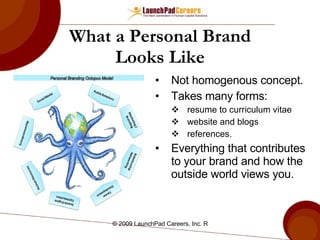
What a Personal Brand Looks Like Not homogenous concept. Takes many forms: resume to curriculum vitae website and blogs references. Everything that contributes to your brand and how the outside world views you.
What You Have to Offer Your personal brand should spell out exactly who you are and what the most important thing you have to offer is. What are your feature benefits? What makes you different? Don’t be generic. One benefit of going with a generic brand is the price. Once you’re relegated to “low-price” brand, you are treated as a commodity and lose your value.
How You Will Save or Make Money The more clearly you state how you will make or save a company money, the more valuable your brand becomes. Begin with a powerful summary of your brand. Focus on your value proposition.
What Is Your Greatest Accomplishment? Define and market your personal brand by having a specific answer to this question. Here is an opportunity to brag, so don’t be too modest.
Transferable Skills Definition: Skills you have acquired through life experiences that are transferable and applicable to your job or careers. Identify skills that can help you demonstrate a value-added brand. Show consistent track record from company to company and project to project.
Get a Brand Referral Endorsements are powerful tools that will help you get your foot in the door or land new clients. Referrals = Endorsements When someone endorses your brand, you “piggy-back” off of that person’s established brand within the company.
Identify the Sizzle 3 unique qualities that set you, the candidate, apart from the competition and speak to your personal brand. Example: Shown track record of growth, success, civic, and social consciousness. Present features in terms of benefits.
Communicate  Your Personal Brand
Personal Branding Tool Kit The Resume and Curriculum Vitae Recommended tool:  VisualCV.com   Business Cards  Email Signatures  Abraham J. Jankans President & Chief Career Coaching Officer LaunchPad Careers, Inc. d: 800.363.0307  f: 866.293.8564  c: 949.500.0711 2152 DuPont Dr., Suite 214, Irvine, CA 92612 [email_address]   Launchpadcareers.com  |  LinkedIn  |  Facebook  |  Twitter
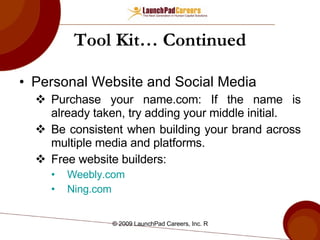
Tool Kit… Continued Personal Website and Social Media Purchase your name.com: If the name is already taken, try adding your middle initial. Be consistent when building your brand across multiple media and platforms. Free website builders: Weebly.com   Ning.com
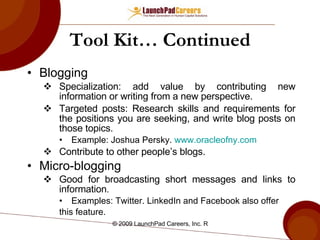
Tool Kit… Continued Blogging Specialization: add value by contributing new information or writing from a new perspective. Targeted posts: Research skills and requirements for the positions you are seeking, and write blog posts on those topics. Example: Joshua Persky.  www.oracleofny.com Contribute to other people’s blogs. Micro-blogging Good for broadcasting short messages and links to information . Examples: Twitter. LinkedIn and Facebook also offer this feature.
Using a Photo: The Benefits and Dangers Using your photo to promote your brand can have many benefits. Dangers: Can compromise your privacy and identity. When and where to include a photo: Resume: NO Online resume or CV: OPTIONAL Online blog, profile, website: YES Consider an Avatar http:// avatars.yahoo.com /
Maintain Your Personal Brand
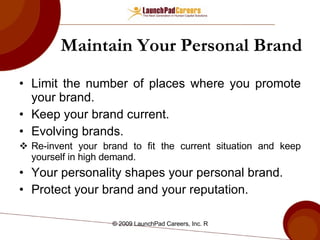
Maintain Your Personal Brand Limit the number of places where you promote your brand. Keep your brand current. Evolving brands. Re-invent your brand to fit the current situation and keep yourself in high demand. Your personality shapes your personal brand. Protect your brand and your reputation.
Any Questions?
Break
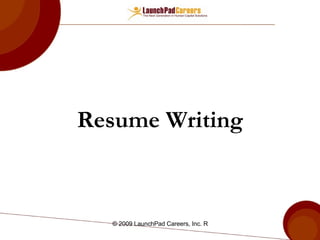
Resume  Writing
Past, Present, and Future of the Resume Standard 1-2 page documents showcasing professional, employment, and academic history. Past:  1-2 page word processor document mailed or faxed to prospective employers. Present:  The advent of the Internet (Web 1.0) brought online job boards and other changes. Future:  The Internet will continue to change the way resumes are created, displayed, and transmitted .
Creating a Successful Resume Be targeted: Create separate resumes for each type of job. Be specific and unique when describing personal brand and experience. Check and double-check for errors and omissions that could hurt your chances. What’s in it for the employer? Including cover letter isn’t always necessary, but if you do be specific about how your qualifications are good match for position.
Anatomy of a Resume Heading and Contact Information Title Objective Statement Summary Professional Experience Education Additional Optional Categories Key Words and Tags (next slide)
Keywords and Tags Search terms recruiters and hiring mangers use to filter resumes. Using the right keywords increases chances of your resume getting seen. Keywords often originate from job description. Keywords and tags are similar to Google keyword search of websites. Identify important keywords and use them prominently and frequently.
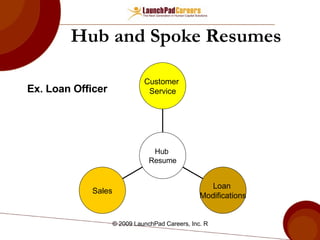
Hub and Spoke Resumes Ex. Loan Officer Sales Loan  Modifications Customer  Service Hub  Resume
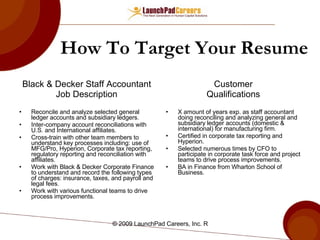
How To Target Your Resume  Black & Decker Staff Accountant Job Description Reconcile and analyze selected general ledger accounts and subsidiary ledgers. Inter-company account reconciliations with U.S. and International affiliates. Cross-train with other team members to understand key processes including: use of MFG/Pro, Hyperion, Corporate tax reporting, regulatory reporting and reconciliation with affiliates.  Work with Black & Decker Corporate Finance to understand and record the following types of charges: insurance, taxes, and payroll and legal fees. Work with various functional teams to drive process improvements.  Customer Qualifications X amount of years exp. as staff accountant doing reconciling and analyzing general and subsidiary ledger accounts (domestic & international) for manufacturing firm. Certified in corporate tax reporting and Hyperion. Selected numerous times by CFO to participate in corporate task force and project teams to drive process improvements. BA in Finance from Wharton School of Business.
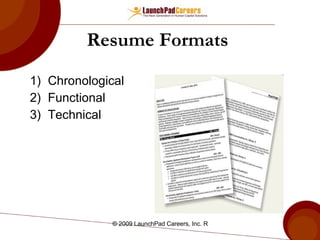
Resume Formats  Chronological Functional Technical
Chronological   Chronological  resume format provides your work history dating back from the present. Emphasizes your responsibilities, skills, and accomplishments. The format calls attention to your recent job history and experience. Why should you use chronological format?
Functional   Functional  resume format stresses qualifications over specific employers and dates. Groups information based on specific skill sets instead of chronologically. Directs attention to functional skills, strengths, and qualifications. Customize content to match job position. Not confined by chronological format. Why should you use functional format?
Technical   Technical  resume is designed to emphasize your technical skills and strengths. Lists computer, software, or specialized machinery knowledge early on. Emphasizes hard skills over soft skills. Focuses on two sections: Skills and Professional Experience sections. Technical/Chronological vs. Technical/Functional Most technical resumes follow chronological format but include summary of skills at beginning of resume. Mainly hired for project-based or contract work? Use functional format.
Three Steps to  Building a Better Resume Modern job search means you have to develop multiple resumes for different positions. Create a resume hub with all of your professional experience, skills, accomplishments, education. Maintain an inventory of everything you have done over time. Do your research.
Writing Your Resume Design Resume document formats:  Word.doc  or  PDF Free Word Processors:  Google Docs Zoho.com Openoffice.org Create online Web 2.0 resumes Recommended Web 2.0 Resume sites:  VisualCV.com  and  Gigtide.com
Overcoming  Obstacles and Objections Baby Boomers applying for lower-level jobs Advantages When writing your resume, emphasize your knowledge and experience  Overcoming Objections “ Older workers are more costly.”  “ Older workers need re-training and can’t learn new skills.” “ Older workers are over-qualified and will get bored.”
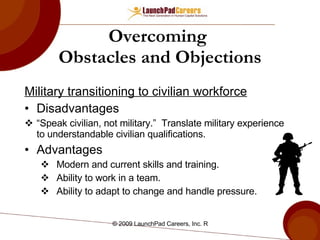
Military transitioning to civilian workforce Disadvantages “ Speak civilian, not military.”  Translate military experience to understandable civilian qualifications. Advantages Modern and current skills and training. Ability to work in a team. Ability to adapt to change and handle pressure. Overcoming  Obstacles and Objections
Changing  Careers and Industries Advantages Bring new and fresh perspective Overcoming objections “ Has no experience.” “ Why does this person want to leave their current field?”  Other helpful tips Do your research and change your resume accordingly. Emphasize accomplishments in your previous career and stress your transferable skills.
Guidelines for a  Well-Written Resume Use strong and concise language to communicate your skills and accomplishments. Do not use personal pronouns: “I,” “me,” “my,” “our.” Use professional language. Remove slang or localized terminology. Shorten long and complex sentences. Leave out extraneous information. Check grammar and spelling. Beware of red flags. Avoid other common mistakes.
Resume Checklist Do you have a “hub” resume cataloging all of your marketable skills and experience? Is your resume targeted to a specific job position? Do you address the needs of the employer over your needs? Does your resume sell your personal brand?  Do you demonstrate where you can add value? Does your resume include sufficient contact information including full name, address, phone number (cell phone number is ideal), and email?
Resume Checklist Does the experience you listed support the claims you made in your summary and objective? Does your resume include 10-20 keyword “tags” and strong action words? Does your resume focus on results, tasks, and accomplishments? Are your strengths highlighted early, prominently, and frequently? Is the language professional, concise, and specific?
Beware of Red Flags Grammatical and spelling errors Too wordy or too much information Irrelevant experience False claims and over-embellishment Inconsistent work history or unexplained career gaps Email address is too provocative
Any Questions?
Networking and  Social Networking
Common Problem Are you applying to position after position on countless job boards with little to no success?  Why aren’t you getting any response?
Powerful Statistics Only 20% of jobs are filled through responses to job postings on the Internet or on websites. The remaining 80% of opportunities are either filled by word of mouth and through referrals, or are never posted at all and are located on the “Hidden Market.”
Ask Yourself This Question If 80% of job opportunities are filled through networking, why are you spending 90% of your time applying to positions online?
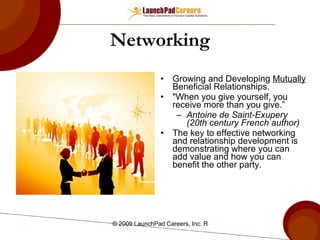
Networking Growing and Developing  Mutually   Beneficial Relationships. "When you give yourself, you receive more than you give.”   Antoine de Saint-Exupery (20th century French author) The key to effective networking and relationship development is demonstrating where you can add value and how you can benefit the other party.
Where Can You Add Value? Offer free information Develop transactional relationship Give a referral and connect the dots to find a solution to a problem
Offering Free Information Make a suggestion of a possible investment avenue. Provide information about a potential job opportunity. Offer to share resources such as an article or piece of literature that can directly benefit the other party.
Connect the Dots Everyone has a problem they would like to solve or an area that could be improved with the right contact.
Track Your Contacts Don’t lose sight of the big picture, which is  finding a job !  Though someone may not seem to be of value to you right away, they may be your ticket to connect with the right person later on in your job search. Tip: Keep the contact information of every person you meet in a networking folder or contact management program.
Develop a Strategic  Networking Game Plan Set a goal and develop a timeline. Example: A solid goal would be 5-10 new promising contacts a week and attending 2-3 networking events. Hold yourself accountable. Finding a job is a full-time job!
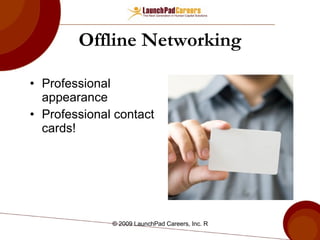
Offline Networking Professional appearance  Professional contact cards!
Get Out and Meet People Try to attend at least 2 to 3 networking events a week. Suggested resources: Events, Meetings & Mixers:  meetingsandmixers.com Meetup:  meetup.com OC networking:  www.ocregister.com/ocr/sections/business/article_408993.php Take advantage of alumni and common interest networks.
Social Networking
Power of Social Media and Networking What exactly is social networking?
Top Social Networking Sites MySpace: ~250 million users Facebook: ~200 million users Flixster: ~63 million users LinkedIn: ~35 million users Twitter: ~6 million users
Benefits of Social Networking and Social Media Grow your network. Gain visibility by sharing your brand. Nurture and grow existing contacts.
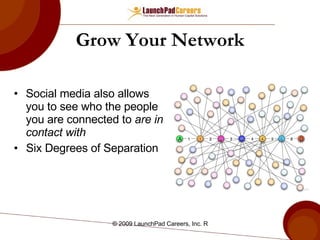
Grow Your Network Social media also allows you to see who the people you are connected to  are in contact with   Six Degrees of Separation
Gain Visibility by Sharing Your Brand Showcase your skills and create an awareness for your personal brand. If companies can’t find you, then they can’t hire you!  Used by Corporate Recruiters and third party recruiters to identify potential candidates.
Nurturing and Growing Existing Contacts Reconnect with old classmates, colleagues, and friends. Offers easy, unintrusive way of maintaining, nurturing, and growing relationships with contacts you have made through in-person networking.
Marketing Your Professional Brand Suggested 3-pronged approach: LinkedIn.com   Facebook.com   Twitter.com
Is an online resume and referral source. Displays your professional background. Openly displays professional referrals and recommendations. Gives you the ability to tap into second and third degree contacts. Caters to business professionals.
Is heavily used by corporate recruiters because it is seen as more professional than sites like  Monster.com . Is a known source for finding “Passive Job Seekers.” Increases web visibility by creating a public URL that you can send to people, put in the signature of an email, and will be returned as a result in a Google search of your name.
Is a casual social medium. Has a large network of users, which makes it possible for you to reconnect with old friends, co-workers, colleagues, etc. Paints a more of a humanizing picture of you as a candidate.  Allows people to see what kind of person you are socially and provides some insight into your personality.
Does not limit who you can connect with and how you connect with them. Allows you to connect with business professionals in a less formal way. Can be used to establish the initial connection in a casual setting and then used to refer contacts to your LinkedIn or Twitter profiles.
Is a micro-blogging site. Can be seen as a “text messaging” forum. Can be a medium to showcase your knowledge on various subjects and allows you to establish yourself as an expert in your designated field. Is a great rapport builder and instantly puts you on more of a conversational level with the people in your network.
Generates interest from people who can follow your “tweets.” Can be a resource to refer contacts to your LinkedIn, Facebook, and other profiles.  Creates URLs for each of your tweets, helping create web visibility.
Create Powerful Home Pages Use only your name in the header. Have a professional profile picture.  Have a professional headline.  Include website information. Create a public URL.  Fill out the Summary/About You section. Use keywords.
Get Connected and  Develop a Strong Network Set a solid immediate goal 10-Day Goals 100-200 contacts per site Join 10-12 professional groups connect with 10-20 new people a day/per site
Where to Start Import all of your existing email contacts. Search for old classmates and former co-workers. Aggressively join groups Use the advanced search tool to locate key players in your designated industry or profession.  Search company pages.
Where to Start Import all of your existing email contacts. Connect with old classmates and co-workers. Utilize the co-worker search tool. Search company pages and groups.
Where to Start Put personal branding pitch in your Twitter bio. Create a customized Twitter background.  Start growing your network by importing in all of your existing email contacts so you can connect with people you already know. Search for former classmates and coworkers.
Where to Start Use search bar to identify keywords that people have used in their “tweets” on their profile.  From there, you can check out their profile and determine if they are someone you would like to follow. “Tweet” or blog about your job search. Follow job search accounts. Numerous Twitter accounts are dedicated to connecting job seekers with employers.
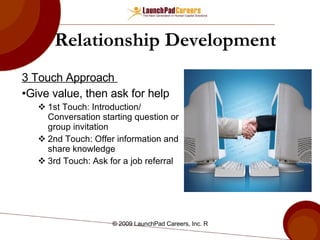
Relationship Development 3 Touch Approach  Give value, then ask for help  1st Touch: Introduction/ Conversation starting question or group invitation 2nd Touch: Offer information and share knowledge 3rd Touch: Ask for a job referral
1st Touch: Introduction Can be done in initial request to connect, or after you have connected in a direct message.  Recommended: Ask a flattering question, one that also demonstrates your industry experience and highlights your knowledge. Example:  Hi [name], My name is [name], and I am gathering information for an upcoming blog post on how the current economic climate is affecting [blank] industry. I am contacting local professionals to gain some insight and gather different points of view.  Would you be willing to provide your expertise? I look forward to hearing from you. Thank you for your time. Sincerely, [your name]
1st Touch: Group Invitation Start a group Create a group about your target industry. Establish yourself as a center of influence and an authority in your profession. Invite people to join your network.
2nd Touch: Offer Information Great way to offer value is to share information. Do this by recommending a good industry-specific article or book. On LinkedIn, you can utilize the “ANSWERS”   tool to showcase your knowledge, and also give opportunities for others to engage you in dialogue.
3rd Touch: Ask for a Job Referral You do not want to spend too much time talking to one specific contact unless he or she seems like a strong lead source. Example: Hi [name], I was hoping you could offer me some advice or steer me in the right direction.  I am actively looking for a job and you seem to very well-connected in the [blank] industry.  Do you know of any companies that could benefit from a [title] professional located within the [blank] area?  Or, if you have a contact who may have some more insight into [blank], I would be grateful if you could pass along my information.  Any advice you can offer would be greatly appreciated.  Please let me know if you have any questions.  Thank you for your time. Sincerely, [your name]
Immeasurable Value of  Networking Remember: 80% of opportunities are either filled by word of mouth and through referrals or are never posted at all.  These jobs are located on the “Hidden Market.” To leverage your networking abilities, you must successfully marry both online and offline networking.
Any Questions?
Lunch
Overview 21 st  Century Job Search  Interview Coaching Candidate Placement Role Playing Summary
21 st  Century Job Search
Job Search Technology and Tools Job Boards Social Networking Sites Company Websites and Associations Third Party Recruiters
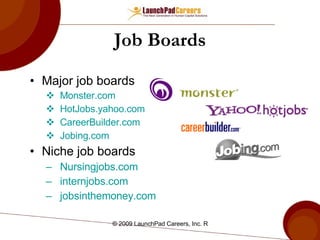
Job Boards Major job boards Monster.com   HotJobs.yahoo.com   CareerBuilder.com   Jobing.com   Niche job boards Nursingjobs.com internjobs.com jobsinthemoney.com
Where to Start? Get your resume out there Use resume distribution sites GadBall.com Job board aggregators Indeed.com Simplyhired.com Oodle.com
Utilize “Answers.” Monitor Status Updates. Status Updates (1) Ian Connell  is looking for a good Sr. level Accountant with manufacturing experience.  Reply privately  -  Add comment
Used by an increasing number of businesses to locate top talent for open positions .
Has recently experienced rapid growth. Grew by 75% from February ‘09 to March ’09. Tip: Follow accounts that blog or “tweet” exclusively on job openings and related issues. Gives job seekers the ability to jump on opportunities immediately.
Additional Tools Company Web Pages May have job opportunities not located on any other job board.  You should have a set list of at least 20 company web pages you check on a daily basis.  The “early bird” really does get the worm. Third Party Recruiters/Staffing Firms Can get your foot in the door at companies that may not publicly advertise their hiring needs. Since most are contingency based, you must understand how to work with them.
Applying Online Follow directions. Tailor your application information to the position. Don’t copy and paste text from your generic resume. Use keywords, buzzwords, and industry lingo. Create a skills inventory section if the application doesn’t require it. You might put this in the Comments Section. Include statements in the Comments Section that demonstrate you have researched the company and industry.
Applying Online Include numbers and statistics if they are available.  Complete all the fields, even those that aren’t required. If the company offers an optional assessment test online, take it. Make sure your resume can hold its own in a very simple format. If possible, spell check and grammar check your application before submitting it.  Include a strong objective.  List from  www.jobweb.org
Sell Yourself
The Approach You must adopt a “sales” mentality.  The shift to an employers’ market (position scarce market) means you must be aggressive and persistent in your methods to ensure that your application is seriously considered.
The Job Pursuit Process Proactive Marketing/Research Locate the Decision Maker Send an Introductory Email Make a Phone Call Follow Up
Proactive Marketing and Research You must have a strategic plan of attack to anticipate market trends and potential areas of growth for businesses. You should begin your sales campaign to market yourself  before  new opportunities are created.
Research Tools Google Alerts Emails you updates of the latest information gathered from web and news pages based on specific keywords you enter. Select from a variety of different types of searches: News, Web, Blogs, Comprehensive, and Video. Set up alerts for 3 different areas.  Keywords related to the top industries of choice. Names of top 10 companies where you would like to work. Names of top 3 positions you are interested in.
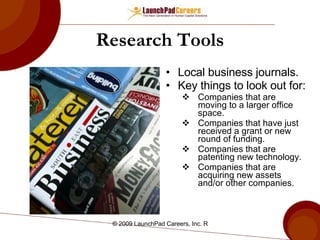
Research Tools Local business journals. Key things to look out for: Companies that are moving to a larger office space. Companies that have just received a grant or new round of funding. Companies that are patenting new technology. Companies that are acquiring new assets and/or other companies.
Research Tools Track government spending Find out which areas are receiving the most aid: UsaSpending.gov FedSpending.org www.propublica.org/special/the-stimulus-plan-a-detailed-list-of-spending Recovery.gov Whitehouse.gov
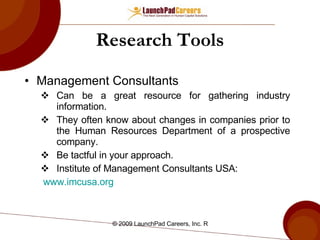
Research Tools Management Consultants Can be a great resource for gathering industry information. They often know about changes in companies prior to the Human Resources Department of a prospective company.  Be tactful in your approach. Institute of Management Consultants USA: www.imcusa.org
Locating the Decision Maker
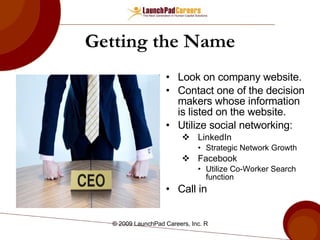
Getting the Name Look on company website. Contact one of the decision makers whose information is listed on the website. Utilize social networking: LinkedIn Strategic Network Growth Facebook Utilize Co-Worker Search function Call in
Referrals Are Best! Best way to connect with a hiring manager Instantly gives you some level of credibility Piggy back off of the relationship that is already developed between the referrer and the referee  Leverage both your off and on-line networks
Introductory Emails First form of contact Lack of response does not mean that they are going unread The main purpose of an introductory email is to provide you with a reason to follow up with a phone call They should be professional and include the following: Why you are contacting them A brief summary of experience and accomplishments Your interest in the company An action item sentence of a specific date and time when  you  are going to follow up with them.
The Call
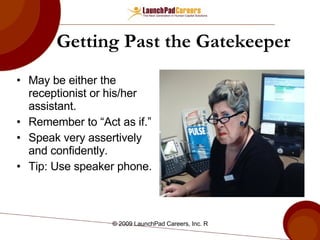
Getting Past the Gatekeeper May be either the receptionist or his/her assistant. Remember to “Act as if.”   Speak very assertively and confidently. Tip: Use speaker phone.
Getting Past the Gatekeeper The person asking the questions is in control of the conversation!  If you feel the conversation is not going the direction you would like, get it back on track with a well-placed question. Call early in the morning before 8am, during the lunch hour, or after 5pm.
The Purpose of the Call   Your goal should be one of two things:  1) The quick sale  2) To build a relationship
The Quick Sale Refers to a situation in which you know for certain that the targeted company is currently in the process of recruiting for a position that is of interest to you. The goal of the conversation, ideally, would be to set up an interview time directly with the hiring manager. Alternate goal: To peak the hiring manager’s interest in you as a potential candidate and receive a strong referral to the contact in the Human Resources Department.
The Quick Sale Introduction Quickly disclose the reason for your call. Tone and pace is very important in this portion of the call. It is good to repeat the person’s name as a pattern break and to make sure that you have the person’s attention.
Overcoming Stereotypes The decision maker will, in most cases, come to a conclusion and possibly form a negative stereotype about how the conversation is going and will go. You are going to waste their precious time with a boring conversation that you should really be having with the Human Resources Department. In order to overcome these stereotypes you must address them quickly and directly.
Value Proposition Statement   In a couple of sentences, you must be able to provide a summary of your applicable job experience while simultaneously sparking the hiring manager’s interest.  Focus on what differentiates you as a candidate and address how those unique qualities translate into added value for the company from day one. Note: Before you go into your proposition statement, verify that you are speaking with the right person.
Go for the Close Should come directly after the value proposition statement. Suggest that you can drop off your resume in person so the decision maker will have it for review.
Building a Relationship Refers to a situation in which you have identified through research that a particular organization is going to be growing in the near future and may potentially be hiring.  Some slight variations from the quick sale approach.
Differences in Relationship Development Call Demonstrate your Expertise replaces Value Proposition Statement. Goal is to establish yourself as an expert in your designated field and someone who’s main objective is to grow your professional network. Tip: Say that you are gathering information for a project that you are working on.
Differences in Relationship Building Call The close in a relationship building call is aimed at setting up a lunch meeting or another phone call during which you can further build rapport. The initial conversation is the first step in a long process. Tip: When attempting to set up meetings, the more specific you are the better.  A rule that is used in sales is that the decision maker will respond within the scope you designate by the question.
Follow Up
Follow Up Demonstrate through your follow up actions that you are motivated and proactive. Not receiving a call back doesn’t mean there’s no interest. Decision makers and hiring managers expect  you  to follow up.  Follow up method: Alternate call and email Once a week for three weeks
Any Questions?
Interview Coaching
Interviewing in Today’s  Job Market Companies seem to be placing more emphasis on the short term. What can this employee do for me  today ? Due to the candidate-saturated market, companies are not as focused on training. How can you affect the bottom line?
Stay Positive Remember, the prospective company would not have called you in for an interview in the first place unless your work history and skill set was a potential match for the position.
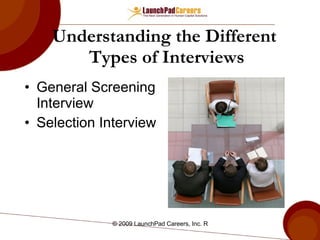
Understanding the Different  Types of Interviews General Screening Interview Selection Interview
General Screening Interview Typically conducted by an individual from the Human Resources Department. The main goal of this interview is to assess whether you meet a certain minimum qualification level for the position. Interviewers can only screen you  out  based on your qualifications. They cannot offer you the position.
Selection Interview Typically, this is the second interview in the interview process.  It is usually conducted by the hiring manager for the position and your potential future boss. The main goal of this interview is to select the best person for the position.  These interviews are usually more personality and situational based, and are intended to determine what kind of employee you will be.
Research the Company Where? Company website Google News Search Search blogs to find out what current employees are saying about the company
Research the Company Do you fully understand the company’s industry? Do you know what the company’s leading products and/or services are? Are you familiar with all of the basic company facts: size, employees, public/private, mission statement, etc.? Do you have a general understanding of the company’s structure? Do you know if the company is growing? Do you know the latest news about the company? Do you know company’s overall reputation? Do you know the company’s competition?
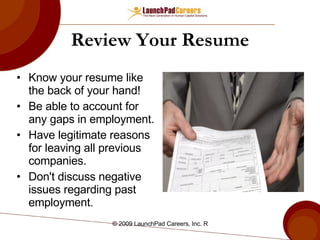
Review Your Resume Know your resume like the back of your hand!  Be able to account for any gaps in employment. Have legitimate reasons for leaving all previous companies. Don't discuss negative issues regarding past employment.
Gaps in Employment Gaps in employment jump out as red flags to prospective hiring managers. Under normal economic conditions, when an individual is out of work for a long period of time, the problem becomes a question of whether the candidate lacks certain skill sets, or has poor presentation and attitude. The gap is no longer explained away by “lack of opportunities.”
Reasons for Leaving The past predicts the future! You must have legitimate reasons for leaving every place of employment on your resume.  In this candidate-rich environment, you cannot afford to place any doubt in the hiring manager’s mind about your work ethic or loyalty.
During the Interview
Tell Me About Yourself Have a strong “commercial” about yourself memorized and rehearsed so you can deliver it with confidence. Remember to touch on all important aspects of your qualifications in relation to the position you are seeking.
General Interview Tips Practice good communication skills. Present yourself in a positive and confident manner. Offer a good handshake. Speak clearly and effectively. Listen attentively and maintain eye contact. Dress appropriately. Don’t forget your resume.
Interview Tips…Continued Be punctual. Don’t try to fake it. Never discuss negative issues regarding your past employment. When discussing previous job responsibilities with a potential employer, remember to be targeted and focus on position specific skills and accomplishments.
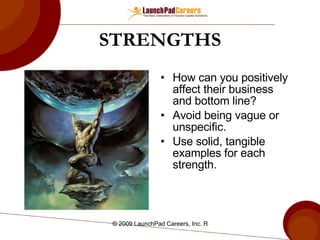
STRENGTHS How can you positively affect their business and bottom line? Avoid being vague or unspecific. Use solid, tangible examples for each strength.
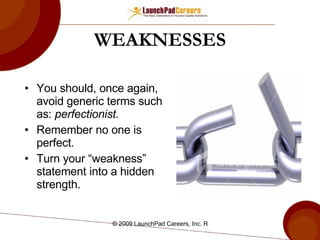
WEAKNESSES You should, once again, avoid generic terms such as:  perfectionist. Remember no one is perfect. Turn your “weakness” statement into a hidden strength.
Common Questions to Be Prepared For There aren’t usually that many variations of general behavioral based interview questions. As a result, your answers should be fresh in your mind as you go into the interview. The candidate who does his homework will usually walk away with the position.
Behavioral Interview Questions These questions usually start with phrases such as, “Tell me about a time when….,” or “What would you do if….”  To answer these types of questions, communicate a story or example from your previous employment that is relatable and had a positive outcome.
Questions to Ask
It’s not what you are selling, it’s what they are buying! Examples: What is the most important quality you are looking for in the ideal candidate for this position? What value are you looking for this new employee to add to your company? What is the most difficult part of this job? What do you like most about this company?
Closing the Interview
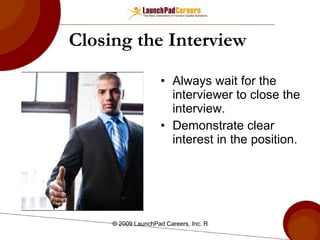
Closing the Interview  Always wait for the interviewer to close the interview. Demonstrate clear interest in the position.
After the Interview Hand write a thank you card and leave it with the receptionist. An email also works well: Summarize your skill set and focus once again on how you are a good fit for the position. Re-address any areas of concern that may have arisen from the interview.
Any Questions?
Break
Customer Placement
Skill Marketing
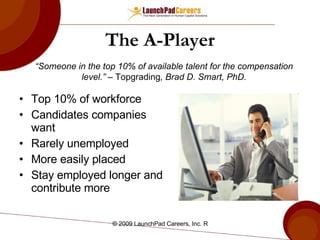
The A-Player Top 10% of workforce Candidates companies want Rarely unemployed More easily placed Stay employed longer and contribute more “ Someone in the top 10% of available talent for the compensation level.” –  Topgrading , Brad D. Smart, PhD.
Why Is the A-Player  Important Now? Businesses are looking to do more with less A-Players are 40% more productive Their qualifications rise to the top They require less coaching
Identifying A-Players Quantifiable, tangible, and factual accomplishments Their qualifications will have an immediate impact on the company’s bottom-line They have unique qualifications that make a strong value proposition
Drawing Out Value Ask Customer, “If I presented you to my client and they asked why they should interview and hire you.  What three things could I say?” How can you quantifiably, tangibly, and factually back those things up?
The Targeted Strategy
Orange County Growth Clusters Finance & Accounting Analysts Credit & Collections Healthcare Nursing Biotech & Pharmaceuticals Information Technology Network Systems Communications
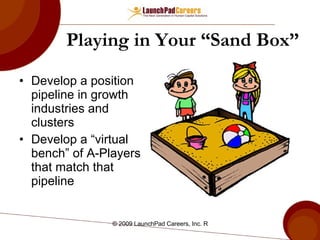
Playing in Your “Sand Box” Develop a position pipeline in growth industries and clusters Develop a “virtual bench” of A-Players that match that pipeline
Pre-Call Planning
Pre-Call Planning  Saves Time Before you call a company to interview a customer, take some time to plan. Understand the company’s needs. Understand the company’s motivations. Save Money Save Time
1HxP = 3H(s) For every 1 hour of planning you save 3 hours. Case Managers and Business Development Managers: take an hour a day to plan which job opportunities and which customers you are going to match up, and focus on the most likely opportunities first. In avg. 8-hour day, there are 4 blocks of productivity: 8-10am, 10-12pm, 1-3pm, 3-5pm, (mgrs) 5-7pm, 7-9pm.
Making the Match
Matching Job Description  with Customer Qualifications Black & Decker Staff Accountant Job Description Reconcile and analyze selected general ledger accounts and subsidiary ledgers. Inter-company account reconciliations with U.S. and International affiliates. Cross-train with other team members to understand key processes including: use of MFG/Pro, Hyperion, Corporate tax reporting, regulatory reporting and reconciliation with affiliates.  Work with Black & Decker Corporate Finance to understand and record the following types of charges: insurance, taxes, and payroll and legal fees. Work with various functional teams to drive process improvements.  Customer Qualifications X amount of years exp. as staff accountant doing reconciling and analyzing general and subsidiary ledger accounts (domestic & international) for manufacturing firm. Certified in corporate tax reporting and Hyperion. Selected numerous times by CFO to participate in corporate task force and project teams to drive process improvements. BA in Finance from Wharton School of Business.
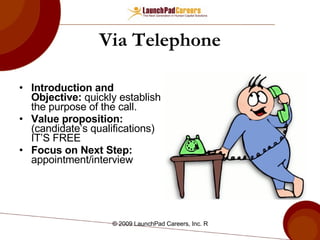
Via Telephone Introduction and Objective:  quickly establish the purpose of the call. Value proposition:  (candidate’s qualifications) IT’S FREE Focus on Next Step:  appointment/interview
Via Email Introduce yourself and quickly establish the purpose of email. Insert value proposition (candidate’s qualifications) and that service is free Focus on objective of setting appointment and/or interview
Customer Presentation Scripts (By Telephone) “ Hi (insert their name),  my name is (insert your name), I am calling with the Orange County One Stop Center.  We are a public-private agency that connects job seekers with employers, free of charge.  I understand you have an open position for (insert position), and I have a candidate with sizzle, sizzle, sizzle. Where are you currently at with that position? “ Great, I would like to set up a time for you to meet with this candidate.  Why don’t we first schedule a time for us to meet, and I can set up 2-3 interviews for you while you are here.”
Customer Presentation Scripts (By Email) “ Hi (Insert their name),  my name is (insert your name) and I am with the Orange County One Stop Center.  We are a public-private agency that connects job seekers with employers, free of charge.  I understand you have an open position for (insert position).  I have a candidate with sizzle, sizzle, sizzle.  “ We have one of the largest databases and networks of available talent in Orange County, so we can save you considerable time and money you’d otherwise spend on recruitment.  I am also interested in learning about other positions you are trying to fill so that we can connect you with our available and pre-screened candidates.”
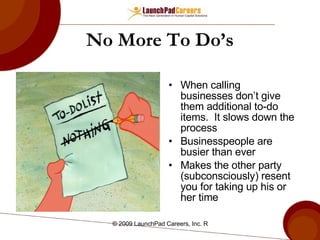
No More To Do’s When calling businesses don’t give them additional to-do items.  It slows down the process  Businesspeople are busier than ever Makes the other party (subconsciously) resent you for taking up his or her time
The Key to Every Call Keep the introduction short State your objective Offer maximum value with a value proposition statement Suggest next step
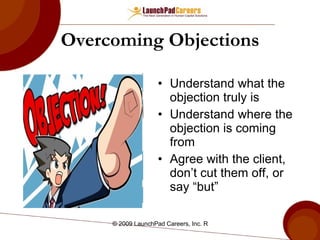
Overcoming Objections Understand what the objection truly is Understand where the objection is coming from Agree with the client,  don’t cut them off, or say “but”
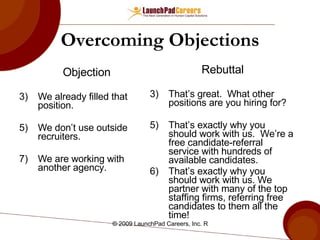
Overcoming Objections Objection We already filled that position. We don’t use outside recruiters. We are working with another agency. Rebuttal That’s great.  What other positions are you hiring for? That’s exactly why you should work with us.  We’re a free candidate-referral service with hundreds of available candidates. That’s exactly why you should work with us. We partner with many of the top staffing firms, referring free candidates to them all the time!
Referrals Make the World Go ‘Round
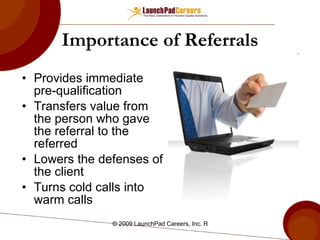
Importance of Referrals Provides immediate pre-qualification Transfers value from the person who gave the referral to the referred Lowers the defenses of the client Turns cold calls into warm calls
How to Get Referrals Deliver unmatched value Under-promise and over-deliver Throw in a little extra Ask for these three things: Feedback: How did I perform? Contract: When can we move forward? Referral: Who else should I talk to? Call References
Relationship Building & Management
Work the Circle Customers turn into clients Clients turn into customers Offer every individual the same amount of value
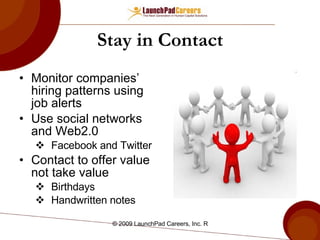
Stay in Contact Monitor companies’ hiring patterns using job alerts Use social networks and Web2.0  Facebook and Twitter Contact to offer value not take value Birthdays Handwritten notes
Role Playing
Summary Candidate-Centric Model Career Mapping and Planning Personal Branding Resume Coaching Networking and Social Networking Job Search Interview Coaching A-Player Placement Relationship Development
Any Final Questions?

LaunchPad_OC One Stop Staff Training

  • 1.
    Orange County OneStop Launching New Careers
  • 2.
  • 3.
    Lots of HiringGoing On! According to Indeed.com , as of Friday, May 8, 2009, there were 28,283 open positions in Orange County, California.
  • 4.
    Training Schedule 8:40am- 10:15am The Customer, Career Mapping and Planning, Personal Branding 10:15am - 10:30am Break 10:30am - 12pm Resume Writing, Networking and Social Networking 12pm - 1pm LUNCH 1pm - 2:30pm Job Search, Interview Coaching 2:30pm - 2:45pm Break 2:45pm - 4:30pm Customer Placement, Role Playing
  • 5.
  • 6.
    Overview Introduction tothe “Candidate-Centric” Model Assessment and Screening Personal Branding
  • 7.
    Candidate-Centric Model Definition:Taking the best qualities of the best candidates, refining the candidates’ presentation, and proactively presenting that candidate to specific opportunities that match their skill set. “ (The) Candidate-Centric approach is about embracing the candidate (customer) so that the client (company) will greatly benefit.” – Greg Palmer, Former CEO of RemedyTemp, Inc.
  • 8.
    Customer-Centric Model CaseManager Identify A-Players (Customers) Match & Place Identify Opportunities
  • 9.
    Benefits of Customer-Centric Model Targeted approach: Identify job seekers with higher placement potential and quickly refer them to specific opportunities. Spend your time more efficiently, investing it in customers that are most hire-able Provides needed labor to faster-growing sectors or job clusters. Allows you to place more customers.
  • 10.
    How to Begin the Customer-Centric Model Develop “pipeline” of positions in high demand Industry Clusters Growth Sectors Finance Green Technology Life Sciences
  • 11.
    How to Begin the Candidate-Centric Model Develop “virtual bench” of A-Player candidates What is an A-Player? Top 10% of available talent for a given position
  • 12.
    Customer-Centric Model inan Up Market Employees are in high demand Turnover is higher One stops have fewer qualified Customers to place in the job market
  • 13.
    Customer-Centric Model ina Down Market Employees are still in demand More unqualified applicants More highly qualified A-Players Turnover is lower
  • 14.
  • 15.
    See Everything as an Opportunity Career mapping and planning is about seeing current situation as an opportunity. List 5 reasons current situation can be seen as an opportunity. Examples: I am now free to take my career to the next level. I can finish that degree I have been putting off for years. I can spend more time with family and friends. I can spend more time on personal, professional, and spiritual development. I can find and achieve the career of my dreams.
  • 16.
    Have a PositiveAttitude The Law of Attraction is real! Understand the difference between Positive Affirmation vs. Limiting Beliefs. INVEST in positive influences and REMOVE all negative impediments.
  • 17.
    RICH vs. POORPeople Take stock of the people in your life. Think about how they contribute to or take away from your success. Begin to understand how you got to where you are just by looking at the people you surround yourself with.
  • 18.
    Revisit Past SuccessesSTOP thinking negatively and BEGIN revisiting your past successes. This practice reinforces your transferable skills and brings them to forefront of your mind.
  • 19.
    Career Planning ReadinessAssessment What are your career goals? What are you really good at professionally? Can you provide a specific example where you demonstrated this skill? Can you describe your most significant accomplishment? What are you not so good at or not interested in doing? Can you give an example? How would each of your last 5 bosses rate your performance? How would these ratings compare to that of your peers? Why did you leave your last 5 places of employment? What are your expectations or goals regarding: travel, work hours and schedule, compensation?
  • 20.
    Career Map Pyramid of Success NEW JOB IDENTIFY, FOCUS, & TARGET OPPORTUNITIES MAKE YOUR MAP UNDERSTAND THE JOB MARKET UNDERSTAND YOURSELF
  • 21.
    Understanding Yourself Careermapping and planning is a bottom up process. Begin your map by starting at your foundation, which is you. Start by analyzing strengths and “development areas” (what others refer to as weaknesses).
  • 22.
    Understand Your Strengths What are you good at? What do you enjoy doing? What have you been praised for?
  • 23.
    Development Areas Thebrain is wired with a greater capacity for our strengths rather than weaknesses. This theory supports reasoning why we should not try to overcome all of our weaknesses, but instead learn how to manage them effectively. Instead of thinking of them as weaknesses, consider them as areas of development. Identifying areas of development enable you to start building systems to improve it.
  • 24.
    Visualization Abilityto clearly visualize your dream job will take you further in realizing your goal than any other action. Do it through sensory detail. Your beliefs become your thoughts. Your thoughts become your words. Your words become your actions. Your actions become your habits. Your habits become your values. Your values become your destiny. Mahatma Gandhi
  • 25.
    Career Mapping Questionnaire If anything were possible, what would I want to be different about my career? What type of job would I want? What would I want to be responsible for? What type of boss/coworkers/team would I want to work with? What kind of hours would I want to work?
  • 26.
    Career Mapping QuestionnaireWhat type of company would I want work for? What sort of company culture would I want to work in? What city would I want to live in? What salary would I want to earn?
  • 27.
    Values, Mission, andVision Statements Once you have clearer picture of your ideal career, you can begin to define it in terms of your values, vision, and mission. Write in present tense so it becomes real in your mind. You can use material from the visualizations exercise.
  • 28.
    The Job Marketand Your Career Path 5 industries or sectors expected to see strong growth over the next few years. Federal Government Construction and Engineering Healthcare Technology Education
  • 29.
  • 30.
    Make Your MapCreate a visual map of your career. Work backwards: Set a goal and then lay out the steps in reverse. Monster.com career path tool: http://my.monster.com/Career-Planning/Pathing.aspx # Start: Next Goal?
  • 31.
    Take Extraordinary Action Follow up the training workshops with continued and sustained action. Life is a numbers game: apply to more jobs, make more calls, and establish more contacts to maximize your job search.
  • 32.
    Measure and CalibrateContinually measure where you are at and re-calibrate according to your plan. Change the plan to more accurately reflect your likes and dislikes.
  • 33.
  • 34.
  • 35.
  • 36.
    What Is PersonalBranding? Definition: The process of marketing people and their careers as brands. Self-help is about self- improvement whereas personal branding suggests success comes from self- packaging . Examples: Oprah Winfrey and Donald Trump If done correctly, allows you to create strategic advantage over competition.
  • 37.
    Why Create aPersonal Brand? Project-Based Job Market Differentiation Value Creation Gives You a Voice
  • 38.
    Project-Based Job MarketGrowing use of staffing agencies and contract workers. Companies operate on project-by-project basis. Workers hired for ability to complete projects on time. Longevity and education take back seat to experience, deliverables, and measurables.
  • 39.
    Fit for aMobile Career Advantages of having a personal brand in a more transient, project-based working world: You didn’t need a personal brand working for a company for 20 years. Companies provided a career path, and your reputation was known internally. In a mobile career world, after finishing your project or being released from an assignment, you take your personal brand with you.
  • 40.
    Differentiation Set yourselfapart from the crowd. Differentiation is accomplished by specialization and reputation building. Clearly demonstrate differentiation on your resume, CV, blogs, and online profiles.
  • 41.
    Value Creation Beingunique automatically creates more value for your brand. Have a proven track record and build your reputation. Value not finite or constant. Changes based on customer’s wants and needs at any given time.
  • 42.
    Gives You aVoice Blog about your field of expertise. You might end up getting a referral from a well-known industry expert. Create a website to display the presentations you have given during your career.
  • 43.
  • 44.
    What a PersonalBrand Looks Like Not homogenous concept. Takes many forms: resume to curriculum vitae website and blogs references. Everything that contributes to your brand and how the outside world views you.
  • 45.
    What You Haveto Offer Your personal brand should spell out exactly who you are and what the most important thing you have to offer is. What are your feature benefits? What makes you different? Don’t be generic. One benefit of going with a generic brand is the price. Once you’re relegated to “low-price” brand, you are treated as a commodity and lose your value.
  • 46.
    How You WillSave or Make Money The more clearly you state how you will make or save a company money, the more valuable your brand becomes. Begin with a powerful summary of your brand. Focus on your value proposition.
  • 47.
    What Is YourGreatest Accomplishment? Define and market your personal brand by having a specific answer to this question. Here is an opportunity to brag, so don’t be too modest.
  • 48.
    Transferable Skills Definition:Skills you have acquired through life experiences that are transferable and applicable to your job or careers. Identify skills that can help you demonstrate a value-added brand. Show consistent track record from company to company and project to project.
  • 49.
    Get a BrandReferral Endorsements are powerful tools that will help you get your foot in the door or land new clients. Referrals = Endorsements When someone endorses your brand, you “piggy-back” off of that person’s established brand within the company.
  • 50.
    Identify the Sizzle3 unique qualities that set you, the candidate, apart from the competition and speak to your personal brand. Example: Shown track record of growth, success, civic, and social consciousness. Present features in terms of benefits.
  • 51.
    Communicate YourPersonal Brand
  • 52.
    Personal Branding ToolKit The Resume and Curriculum Vitae Recommended tool: VisualCV.com Business Cards Email Signatures Abraham J. Jankans President & Chief Career Coaching Officer LaunchPad Careers, Inc. d: 800.363.0307 f: 866.293.8564 c: 949.500.0711 2152 DuPont Dr., Suite 214, Irvine, CA 92612 [email_address] Launchpadcareers.com | LinkedIn | Facebook | Twitter
  • 53.
    Tool Kit… ContinuedPersonal Website and Social Media Purchase your name.com: If the name is already taken, try adding your middle initial. Be consistent when building your brand across multiple media and platforms. Free website builders: Weebly.com Ning.com
  • 54.
    Tool Kit… ContinuedBlogging Specialization: add value by contributing new information or writing from a new perspective. Targeted posts: Research skills and requirements for the positions you are seeking, and write blog posts on those topics. Example: Joshua Persky. www.oracleofny.com Contribute to other people’s blogs. Micro-blogging Good for broadcasting short messages and links to information . Examples: Twitter. LinkedIn and Facebook also offer this feature.
  • 55.
    Using a Photo:The Benefits and Dangers Using your photo to promote your brand can have many benefits. Dangers: Can compromise your privacy and identity. When and where to include a photo: Resume: NO Online resume or CV: OPTIONAL Online blog, profile, website: YES Consider an Avatar http:// avatars.yahoo.com /
  • 56.
  • 57.
    Maintain Your PersonalBrand Limit the number of places where you promote your brand. Keep your brand current. Evolving brands. Re-invent your brand to fit the current situation and keep yourself in high demand. Your personality shapes your personal brand. Protect your brand and your reputation.
  • 58.
  • 59.
  • 60.
  • 61.
    Past, Present, andFuture of the Resume Standard 1-2 page documents showcasing professional, employment, and academic history. Past: 1-2 page word processor document mailed or faxed to prospective employers. Present: The advent of the Internet (Web 1.0) brought online job boards and other changes. Future: The Internet will continue to change the way resumes are created, displayed, and transmitted .
  • 62.
    Creating a SuccessfulResume Be targeted: Create separate resumes for each type of job. Be specific and unique when describing personal brand and experience. Check and double-check for errors and omissions that could hurt your chances. What’s in it for the employer? Including cover letter isn’t always necessary, but if you do be specific about how your qualifications are good match for position.
  • 63.
    Anatomy of aResume Heading and Contact Information Title Objective Statement Summary Professional Experience Education Additional Optional Categories Key Words and Tags (next slide)
  • 64.
    Keywords and TagsSearch terms recruiters and hiring mangers use to filter resumes. Using the right keywords increases chances of your resume getting seen. Keywords often originate from job description. Keywords and tags are similar to Google keyword search of websites. Identify important keywords and use them prominently and frequently.
  • 65.
    Hub and SpokeResumes Ex. Loan Officer Sales Loan Modifications Customer Service Hub Resume
  • 66.
    How To TargetYour Resume Black & Decker Staff Accountant Job Description Reconcile and analyze selected general ledger accounts and subsidiary ledgers. Inter-company account reconciliations with U.S. and International affiliates. Cross-train with other team members to understand key processes including: use of MFG/Pro, Hyperion, Corporate tax reporting, regulatory reporting and reconciliation with affiliates. Work with Black & Decker Corporate Finance to understand and record the following types of charges: insurance, taxes, and payroll and legal fees. Work with various functional teams to drive process improvements. Customer Qualifications X amount of years exp. as staff accountant doing reconciling and analyzing general and subsidiary ledger accounts (domestic & international) for manufacturing firm. Certified in corporate tax reporting and Hyperion. Selected numerous times by CFO to participate in corporate task force and project teams to drive process improvements. BA in Finance from Wharton School of Business.
  • 67.
    Resume Formats Chronological Functional Technical
  • 68.
    Chronological Chronological resume format provides your work history dating back from the present. Emphasizes your responsibilities, skills, and accomplishments. The format calls attention to your recent job history and experience. Why should you use chronological format?
  • 69.
    Functional Functional resume format stresses qualifications over specific employers and dates. Groups information based on specific skill sets instead of chronologically. Directs attention to functional skills, strengths, and qualifications. Customize content to match job position. Not confined by chronological format. Why should you use functional format?
  • 70.
    Technical Technical resume is designed to emphasize your technical skills and strengths. Lists computer, software, or specialized machinery knowledge early on. Emphasizes hard skills over soft skills. Focuses on two sections: Skills and Professional Experience sections. Technical/Chronological vs. Technical/Functional Most technical resumes follow chronological format but include summary of skills at beginning of resume. Mainly hired for project-based or contract work? Use functional format.
  • 71.
    Three Steps to Building a Better Resume Modern job search means you have to develop multiple resumes for different positions. Create a resume hub with all of your professional experience, skills, accomplishments, education. Maintain an inventory of everything you have done over time. Do your research.
  • 72.
    Writing Your ResumeDesign Resume document formats: Word.doc or PDF Free Word Processors: Google Docs Zoho.com Openoffice.org Create online Web 2.0 resumes Recommended Web 2.0 Resume sites: VisualCV.com and Gigtide.com
  • 73.
    Overcoming Obstaclesand Objections Baby Boomers applying for lower-level jobs Advantages When writing your resume, emphasize your knowledge and experience Overcoming Objections “ Older workers are more costly.” “ Older workers need re-training and can’t learn new skills.” “ Older workers are over-qualified and will get bored.”
  • 74.
    Military transitioning tocivilian workforce Disadvantages “ Speak civilian, not military.” Translate military experience to understandable civilian qualifications. Advantages Modern and current skills and training. Ability to work in a team. Ability to adapt to change and handle pressure. Overcoming Obstacles and Objections
  • 75.
    Changing Careersand Industries Advantages Bring new and fresh perspective Overcoming objections “ Has no experience.” “ Why does this person want to leave their current field?” Other helpful tips Do your research and change your resume accordingly. Emphasize accomplishments in your previous career and stress your transferable skills.
  • 76.
    Guidelines for a Well-Written Resume Use strong and concise language to communicate your skills and accomplishments. Do not use personal pronouns: “I,” “me,” “my,” “our.” Use professional language. Remove slang or localized terminology. Shorten long and complex sentences. Leave out extraneous information. Check grammar and spelling. Beware of red flags. Avoid other common mistakes.
  • 77.
    Resume Checklist Doyou have a “hub” resume cataloging all of your marketable skills and experience? Is your resume targeted to a specific job position? Do you address the needs of the employer over your needs? Does your resume sell your personal brand? Do you demonstrate where you can add value? Does your resume include sufficient contact information including full name, address, phone number (cell phone number is ideal), and email?
  • 78.
    Resume Checklist Doesthe experience you listed support the claims you made in your summary and objective? Does your resume include 10-20 keyword “tags” and strong action words? Does your resume focus on results, tasks, and accomplishments? Are your strengths highlighted early, prominently, and frequently? Is the language professional, concise, and specific?
  • 79.
    Beware of RedFlags Grammatical and spelling errors Too wordy or too much information Irrelevant experience False claims and over-embellishment Inconsistent work history or unexplained career gaps Email address is too provocative
  • 80.
  • 81.
    Networking and Social Networking
  • 82.
    Common Problem Areyou applying to position after position on countless job boards with little to no success? Why aren’t you getting any response?
  • 83.
    Powerful Statistics Only20% of jobs are filled through responses to job postings on the Internet or on websites. The remaining 80% of opportunities are either filled by word of mouth and through referrals, or are never posted at all and are located on the “Hidden Market.”
  • 84.
    Ask Yourself ThisQuestion If 80% of job opportunities are filled through networking, why are you spending 90% of your time applying to positions online?
  • 85.
    Networking Growing andDeveloping Mutually Beneficial Relationships. "When you give yourself, you receive more than you give.” Antoine de Saint-Exupery (20th century French author) The key to effective networking and relationship development is demonstrating where you can add value and how you can benefit the other party.
  • 86.
    Where Can YouAdd Value? Offer free information Develop transactional relationship Give a referral and connect the dots to find a solution to a problem
  • 87.
    Offering Free InformationMake a suggestion of a possible investment avenue. Provide information about a potential job opportunity. Offer to share resources such as an article or piece of literature that can directly benefit the other party.
  • 88.
    Connect the DotsEveryone has a problem they would like to solve or an area that could be improved with the right contact.
  • 89.
    Track Your ContactsDon’t lose sight of the big picture, which is finding a job ! Though someone may not seem to be of value to you right away, they may be your ticket to connect with the right person later on in your job search. Tip: Keep the contact information of every person you meet in a networking folder or contact management program.
  • 90.
    Develop a Strategic Networking Game Plan Set a goal and develop a timeline. Example: A solid goal would be 5-10 new promising contacts a week and attending 2-3 networking events. Hold yourself accountable. Finding a job is a full-time job!
  • 91.
    Offline Networking Professionalappearance Professional contact cards!
  • 92.
    Get Out andMeet People Try to attend at least 2 to 3 networking events a week. Suggested resources: Events, Meetings & Mixers: meetingsandmixers.com Meetup: meetup.com OC networking: www.ocregister.com/ocr/sections/business/article_408993.php Take advantage of alumni and common interest networks.
  • 93.
  • 94.
    Power of SocialMedia and Networking What exactly is social networking?
  • 95.
    Top Social NetworkingSites MySpace: ~250 million users Facebook: ~200 million users Flixster: ~63 million users LinkedIn: ~35 million users Twitter: ~6 million users
  • 96.
    Benefits of SocialNetworking and Social Media Grow your network. Gain visibility by sharing your brand. Nurture and grow existing contacts.
  • 97.
    Grow Your NetworkSocial media also allows you to see who the people you are connected to are in contact with Six Degrees of Separation
  • 98.
    Gain Visibility bySharing Your Brand Showcase your skills and create an awareness for your personal brand. If companies can’t find you, then they can’t hire you! Used by Corporate Recruiters and third party recruiters to identify potential candidates.
  • 99.
    Nurturing and GrowingExisting Contacts Reconnect with old classmates, colleagues, and friends. Offers easy, unintrusive way of maintaining, nurturing, and growing relationships with contacts you have made through in-person networking.
  • 100.
    Marketing Your ProfessionalBrand Suggested 3-pronged approach: LinkedIn.com Facebook.com Twitter.com
  • 101.
    Is an onlineresume and referral source. Displays your professional background. Openly displays professional referrals and recommendations. Gives you the ability to tap into second and third degree contacts. Caters to business professionals.
  • 102.
    Is heavily usedby corporate recruiters because it is seen as more professional than sites like Monster.com . Is a known source for finding “Passive Job Seekers.” Increases web visibility by creating a public URL that you can send to people, put in the signature of an email, and will be returned as a result in a Google search of your name.
  • 103.
    Is a casualsocial medium. Has a large network of users, which makes it possible for you to reconnect with old friends, co-workers, colleagues, etc. Paints a more of a humanizing picture of you as a candidate. Allows people to see what kind of person you are socially and provides some insight into your personality.
  • 104.
    Does not limitwho you can connect with and how you connect with them. Allows you to connect with business professionals in a less formal way. Can be used to establish the initial connection in a casual setting and then used to refer contacts to your LinkedIn or Twitter profiles.
  • 105.
    Is a micro-bloggingsite. Can be seen as a “text messaging” forum. Can be a medium to showcase your knowledge on various subjects and allows you to establish yourself as an expert in your designated field. Is a great rapport builder and instantly puts you on more of a conversational level with the people in your network.
  • 106.
    Generates interest frompeople who can follow your “tweets.” Can be a resource to refer contacts to your LinkedIn, Facebook, and other profiles. Creates URLs for each of your tweets, helping create web visibility.
  • 107.
    Create Powerful HomePages Use only your name in the header. Have a professional profile picture. Have a professional headline. Include website information. Create a public URL. Fill out the Summary/About You section. Use keywords.
  • 108.
    Get Connected and Develop a Strong Network Set a solid immediate goal 10-Day Goals 100-200 contacts per site Join 10-12 professional groups connect with 10-20 new people a day/per site
  • 109.
    Where to StartImport all of your existing email contacts. Search for old classmates and former co-workers. Aggressively join groups Use the advanced search tool to locate key players in your designated industry or profession. Search company pages.
  • 110.
    Where to StartImport all of your existing email contacts. Connect with old classmates and co-workers. Utilize the co-worker search tool. Search company pages and groups.
  • 111.
    Where to StartPut personal branding pitch in your Twitter bio. Create a customized Twitter background. Start growing your network by importing in all of your existing email contacts so you can connect with people you already know. Search for former classmates and coworkers.
  • 112.
    Where to StartUse search bar to identify keywords that people have used in their “tweets” on their profile. From there, you can check out their profile and determine if they are someone you would like to follow. “Tweet” or blog about your job search. Follow job search accounts. Numerous Twitter accounts are dedicated to connecting job seekers with employers.
  • 113.
    Relationship Development 3Touch Approach Give value, then ask for help 1st Touch: Introduction/ Conversation starting question or group invitation 2nd Touch: Offer information and share knowledge 3rd Touch: Ask for a job referral
  • 114.
    1st Touch: IntroductionCan be done in initial request to connect, or after you have connected in a direct message. Recommended: Ask a flattering question, one that also demonstrates your industry experience and highlights your knowledge. Example: Hi [name], My name is [name], and I am gathering information for an upcoming blog post on how the current economic climate is affecting [blank] industry. I am contacting local professionals to gain some insight and gather different points of view. Would you be willing to provide your expertise? I look forward to hearing from you. Thank you for your time. Sincerely, [your name]
  • 115.
    1st Touch: GroupInvitation Start a group Create a group about your target industry. Establish yourself as a center of influence and an authority in your profession. Invite people to join your network.
  • 116.
    2nd Touch: OfferInformation Great way to offer value is to share information. Do this by recommending a good industry-specific article or book. On LinkedIn, you can utilize the “ANSWERS” tool to showcase your knowledge, and also give opportunities for others to engage you in dialogue.
  • 117.
    3rd Touch: Askfor a Job Referral You do not want to spend too much time talking to one specific contact unless he or she seems like a strong lead source. Example: Hi [name], I was hoping you could offer me some advice or steer me in the right direction. I am actively looking for a job and you seem to very well-connected in the [blank] industry. Do you know of any companies that could benefit from a [title] professional located within the [blank] area? Or, if you have a contact who may have some more insight into [blank], I would be grateful if you could pass along my information. Any advice you can offer would be greatly appreciated. Please let me know if you have any questions. Thank you for your time. Sincerely, [your name]
  • 118.
    Immeasurable Value of Networking Remember: 80% of opportunities are either filled by word of mouth and through referrals or are never posted at all. These jobs are located on the “Hidden Market.” To leverage your networking abilities, you must successfully marry both online and offline networking.
  • 119.
  • 120.
  • 121.
    Overview 21 st Century Job Search Interview Coaching Candidate Placement Role Playing Summary
  • 122.
    21 st Century Job Search
  • 123.
    Job Search Technologyand Tools Job Boards Social Networking Sites Company Websites and Associations Third Party Recruiters
  • 124.
    Job Boards Majorjob boards Monster.com HotJobs.yahoo.com CareerBuilder.com Jobing.com Niche job boards Nursingjobs.com internjobs.com jobsinthemoney.com
  • 125.
    Where to Start?Get your resume out there Use resume distribution sites GadBall.com Job board aggregators Indeed.com Simplyhired.com Oodle.com
  • 126.
    Utilize “Answers.” MonitorStatus Updates. Status Updates (1) Ian Connell is looking for a good Sr. level Accountant with manufacturing experience. Reply privately - Add comment
  • 127.
    Used by anincreasing number of businesses to locate top talent for open positions .
  • 128.
    Has recently experiencedrapid growth. Grew by 75% from February ‘09 to March ’09. Tip: Follow accounts that blog or “tweet” exclusively on job openings and related issues. Gives job seekers the ability to jump on opportunities immediately.
  • 129.
    Additional Tools CompanyWeb Pages May have job opportunities not located on any other job board. You should have a set list of at least 20 company web pages you check on a daily basis. The “early bird” really does get the worm. Third Party Recruiters/Staffing Firms Can get your foot in the door at companies that may not publicly advertise their hiring needs. Since most are contingency based, you must understand how to work with them.
  • 130.
    Applying Online Followdirections. Tailor your application information to the position. Don’t copy and paste text from your generic resume. Use keywords, buzzwords, and industry lingo. Create a skills inventory section if the application doesn’t require it. You might put this in the Comments Section. Include statements in the Comments Section that demonstrate you have researched the company and industry.
  • 131.
    Applying Online Includenumbers and statistics if they are available. Complete all the fields, even those that aren’t required. If the company offers an optional assessment test online, take it. Make sure your resume can hold its own in a very simple format. If possible, spell check and grammar check your application before submitting it. Include a strong objective. List from www.jobweb.org
  • 132.
  • 133.
    The Approach Youmust adopt a “sales” mentality. The shift to an employers’ market (position scarce market) means you must be aggressive and persistent in your methods to ensure that your application is seriously considered.
  • 134.
    The Job PursuitProcess Proactive Marketing/Research Locate the Decision Maker Send an Introductory Email Make a Phone Call Follow Up
  • 135.
    Proactive Marketing andResearch You must have a strategic plan of attack to anticipate market trends and potential areas of growth for businesses. You should begin your sales campaign to market yourself before new opportunities are created.
  • 136.
    Research Tools GoogleAlerts Emails you updates of the latest information gathered from web and news pages based on specific keywords you enter. Select from a variety of different types of searches: News, Web, Blogs, Comprehensive, and Video. Set up alerts for 3 different areas. Keywords related to the top industries of choice. Names of top 10 companies where you would like to work. Names of top 3 positions you are interested in.
  • 137.
    Research Tools Localbusiness journals. Key things to look out for: Companies that are moving to a larger office space. Companies that have just received a grant or new round of funding. Companies that are patenting new technology. Companies that are acquiring new assets and/or other companies.
  • 138.
    Research Tools Trackgovernment spending Find out which areas are receiving the most aid: UsaSpending.gov FedSpending.org www.propublica.org/special/the-stimulus-plan-a-detailed-list-of-spending Recovery.gov Whitehouse.gov
  • 139.
    Research Tools ManagementConsultants Can be a great resource for gathering industry information. They often know about changes in companies prior to the Human Resources Department of a prospective company. Be tactful in your approach. Institute of Management Consultants USA: www.imcusa.org
  • 140.
  • 141.
    Getting the NameLook on company website. Contact one of the decision makers whose information is listed on the website. Utilize social networking: LinkedIn Strategic Network Growth Facebook Utilize Co-Worker Search function Call in
  • 142.
    Referrals Are Best!Best way to connect with a hiring manager Instantly gives you some level of credibility Piggy back off of the relationship that is already developed between the referrer and the referee Leverage both your off and on-line networks
  • 143.
    Introductory Emails Firstform of contact Lack of response does not mean that they are going unread The main purpose of an introductory email is to provide you with a reason to follow up with a phone call They should be professional and include the following: Why you are contacting them A brief summary of experience and accomplishments Your interest in the company An action item sentence of a specific date and time when you are going to follow up with them.
  • 144.
  • 145.
    Getting Past theGatekeeper May be either the receptionist or his/her assistant. Remember to “Act as if.” Speak very assertively and confidently. Tip: Use speaker phone.
  • 146.
    Getting Past theGatekeeper The person asking the questions is in control of the conversation! If you feel the conversation is not going the direction you would like, get it back on track with a well-placed question. Call early in the morning before 8am, during the lunch hour, or after 5pm.
  • 147.
    The Purpose ofthe Call Your goal should be one of two things: 1) The quick sale 2) To build a relationship
  • 148.
    The Quick SaleRefers to a situation in which you know for certain that the targeted company is currently in the process of recruiting for a position that is of interest to you. The goal of the conversation, ideally, would be to set up an interview time directly with the hiring manager. Alternate goal: To peak the hiring manager’s interest in you as a potential candidate and receive a strong referral to the contact in the Human Resources Department.
  • 149.
    The Quick SaleIntroduction Quickly disclose the reason for your call. Tone and pace is very important in this portion of the call. It is good to repeat the person’s name as a pattern break and to make sure that you have the person’s attention.
  • 150.
    Overcoming Stereotypes Thedecision maker will, in most cases, come to a conclusion and possibly form a negative stereotype about how the conversation is going and will go. You are going to waste their precious time with a boring conversation that you should really be having with the Human Resources Department. In order to overcome these stereotypes you must address them quickly and directly.
  • 151.
    Value Proposition Statement In a couple of sentences, you must be able to provide a summary of your applicable job experience while simultaneously sparking the hiring manager’s interest. Focus on what differentiates you as a candidate and address how those unique qualities translate into added value for the company from day one. Note: Before you go into your proposition statement, verify that you are speaking with the right person.
  • 152.
    Go for theClose Should come directly after the value proposition statement. Suggest that you can drop off your resume in person so the decision maker will have it for review.
  • 153.
    Building a RelationshipRefers to a situation in which you have identified through research that a particular organization is going to be growing in the near future and may potentially be hiring. Some slight variations from the quick sale approach.
  • 154.
    Differences in RelationshipDevelopment Call Demonstrate your Expertise replaces Value Proposition Statement. Goal is to establish yourself as an expert in your designated field and someone who’s main objective is to grow your professional network. Tip: Say that you are gathering information for a project that you are working on.
  • 155.
    Differences in RelationshipBuilding Call The close in a relationship building call is aimed at setting up a lunch meeting or another phone call during which you can further build rapport. The initial conversation is the first step in a long process. Tip: When attempting to set up meetings, the more specific you are the better. A rule that is used in sales is that the decision maker will respond within the scope you designate by the question.
  • 156.
  • 157.
    Follow Up Demonstratethrough your follow up actions that you are motivated and proactive. Not receiving a call back doesn’t mean there’s no interest. Decision makers and hiring managers expect you to follow up. Follow up method: Alternate call and email Once a week for three weeks
  • 158.
  • 159.
  • 160.
    Interviewing in Today’s Job Market Companies seem to be placing more emphasis on the short term. What can this employee do for me today ? Due to the candidate-saturated market, companies are not as focused on training. How can you affect the bottom line?
  • 161.
    Stay Positive Remember,the prospective company would not have called you in for an interview in the first place unless your work history and skill set was a potential match for the position.
  • 162.
    Understanding the Different Types of Interviews General Screening Interview Selection Interview
  • 163.
    General Screening InterviewTypically conducted by an individual from the Human Resources Department. The main goal of this interview is to assess whether you meet a certain minimum qualification level for the position. Interviewers can only screen you out based on your qualifications. They cannot offer you the position.
  • 164.
    Selection Interview Typically,this is the second interview in the interview process. It is usually conducted by the hiring manager for the position and your potential future boss. The main goal of this interview is to select the best person for the position. These interviews are usually more personality and situational based, and are intended to determine what kind of employee you will be.
  • 165.
    Research the CompanyWhere? Company website Google News Search Search blogs to find out what current employees are saying about the company
  • 166.
    Research the CompanyDo you fully understand the company’s industry? Do you know what the company’s leading products and/or services are? Are you familiar with all of the basic company facts: size, employees, public/private, mission statement, etc.? Do you have a general understanding of the company’s structure? Do you know if the company is growing? Do you know the latest news about the company? Do you know company’s overall reputation? Do you know the company’s competition?
  • 167.
    Review Your ResumeKnow your resume like the back of your hand! Be able to account for any gaps in employment. Have legitimate reasons for leaving all previous companies. Don't discuss negative issues regarding past employment.
  • 168.
    Gaps in EmploymentGaps in employment jump out as red flags to prospective hiring managers. Under normal economic conditions, when an individual is out of work for a long period of time, the problem becomes a question of whether the candidate lacks certain skill sets, or has poor presentation and attitude. The gap is no longer explained away by “lack of opportunities.”
  • 169.
    Reasons for LeavingThe past predicts the future! You must have legitimate reasons for leaving every place of employment on your resume. In this candidate-rich environment, you cannot afford to place any doubt in the hiring manager’s mind about your work ethic or loyalty.
  • 170.
  • 171.
    Tell Me AboutYourself Have a strong “commercial” about yourself memorized and rehearsed so you can deliver it with confidence. Remember to touch on all important aspects of your qualifications in relation to the position you are seeking.
  • 172.
    General Interview TipsPractice good communication skills. Present yourself in a positive and confident manner. Offer a good handshake. Speak clearly and effectively. Listen attentively and maintain eye contact. Dress appropriately. Don’t forget your resume.
  • 173.
    Interview Tips…Continued Bepunctual. Don’t try to fake it. Never discuss negative issues regarding your past employment. When discussing previous job responsibilities with a potential employer, remember to be targeted and focus on position specific skills and accomplishments.
  • 174.
    STRENGTHS How canyou positively affect their business and bottom line? Avoid being vague or unspecific. Use solid, tangible examples for each strength.
  • 175.
    WEAKNESSES You should,once again, avoid generic terms such as: perfectionist. Remember no one is perfect. Turn your “weakness” statement into a hidden strength.
  • 176.
    Common Questions toBe Prepared For There aren’t usually that many variations of general behavioral based interview questions. As a result, your answers should be fresh in your mind as you go into the interview. The candidate who does his homework will usually walk away with the position.
  • 177.
    Behavioral Interview QuestionsThese questions usually start with phrases such as, “Tell me about a time when….,” or “What would you do if….” To answer these types of questions, communicate a story or example from your previous employment that is relatable and had a positive outcome.
  • 178.
  • 179.
    It’s not whatyou are selling, it’s what they are buying! Examples: What is the most important quality you are looking for in the ideal candidate for this position? What value are you looking for this new employee to add to your company? What is the most difficult part of this job? What do you like most about this company?
  • 180.
  • 181.
    Closing the Interview Always wait for the interviewer to close the interview. Demonstrate clear interest in the position.
  • 182.
    After the InterviewHand write a thank you card and leave it with the receptionist. An email also works well: Summarize your skill set and focus once again on how you are a good fit for the position. Re-address any areas of concern that may have arisen from the interview.
  • 183.
  • 184.
  • 185.
  • 186.
  • 187.
    The A-Player Top10% of workforce Candidates companies want Rarely unemployed More easily placed Stay employed longer and contribute more “ Someone in the top 10% of available talent for the compensation level.” – Topgrading , Brad D. Smart, PhD.
  • 188.
    Why Is theA-Player Important Now? Businesses are looking to do more with less A-Players are 40% more productive Their qualifications rise to the top They require less coaching
  • 189.
    Identifying A-Players Quantifiable,tangible, and factual accomplishments Their qualifications will have an immediate impact on the company’s bottom-line They have unique qualifications that make a strong value proposition
  • 190.
    Drawing Out ValueAsk Customer, “If I presented you to my client and they asked why they should interview and hire you. What three things could I say?” How can you quantifiably, tangibly, and factually back those things up?
  • 191.
  • 192.
    Orange County GrowthClusters Finance & Accounting Analysts Credit & Collections Healthcare Nursing Biotech & Pharmaceuticals Information Technology Network Systems Communications
  • 193.
    Playing in Your“Sand Box” Develop a position pipeline in growth industries and clusters Develop a “virtual bench” of A-Players that match that pipeline
  • 194.
  • 195.
    Pre-Call Planning Saves Time Before you call a company to interview a customer, take some time to plan. Understand the company’s needs. Understand the company’s motivations. Save Money Save Time
  • 196.
    1HxP = 3H(s)For every 1 hour of planning you save 3 hours. Case Managers and Business Development Managers: take an hour a day to plan which job opportunities and which customers you are going to match up, and focus on the most likely opportunities first. In avg. 8-hour day, there are 4 blocks of productivity: 8-10am, 10-12pm, 1-3pm, 3-5pm, (mgrs) 5-7pm, 7-9pm.
  • 197.
  • 198.
    Matching Job Description with Customer Qualifications Black & Decker Staff Accountant Job Description Reconcile and analyze selected general ledger accounts and subsidiary ledgers. Inter-company account reconciliations with U.S. and International affiliates. Cross-train with other team members to understand key processes including: use of MFG/Pro, Hyperion, Corporate tax reporting, regulatory reporting and reconciliation with affiliates. Work with Black & Decker Corporate Finance to understand and record the following types of charges: insurance, taxes, and payroll and legal fees. Work with various functional teams to drive process improvements. Customer Qualifications X amount of years exp. as staff accountant doing reconciling and analyzing general and subsidiary ledger accounts (domestic & international) for manufacturing firm. Certified in corporate tax reporting and Hyperion. Selected numerous times by CFO to participate in corporate task force and project teams to drive process improvements. BA in Finance from Wharton School of Business.
  • 199.
    Via Telephone Introductionand Objective: quickly establish the purpose of the call. Value proposition: (candidate’s qualifications) IT’S FREE Focus on Next Step: appointment/interview
  • 200.
    Via Email Introduceyourself and quickly establish the purpose of email. Insert value proposition (candidate’s qualifications) and that service is free Focus on objective of setting appointment and/or interview
  • 201.
    Customer Presentation Scripts(By Telephone) “ Hi (insert their name), my name is (insert your name), I am calling with the Orange County One Stop Center. We are a public-private agency that connects job seekers with employers, free of charge. I understand you have an open position for (insert position), and I have a candidate with sizzle, sizzle, sizzle. Where are you currently at with that position? “ Great, I would like to set up a time for you to meet with this candidate. Why don’t we first schedule a time for us to meet, and I can set up 2-3 interviews for you while you are here.”
  • 202.
    Customer Presentation Scripts(By Email) “ Hi (Insert their name), my name is (insert your name) and I am with the Orange County One Stop Center. We are a public-private agency that connects job seekers with employers, free of charge. I understand you have an open position for (insert position). I have a candidate with sizzle, sizzle, sizzle. “ We have one of the largest databases and networks of available talent in Orange County, so we can save you considerable time and money you’d otherwise spend on recruitment. I am also interested in learning about other positions you are trying to fill so that we can connect you with our available and pre-screened candidates.”
  • 203.
    No More ToDo’s When calling businesses don’t give them additional to-do items. It slows down the process Businesspeople are busier than ever Makes the other party (subconsciously) resent you for taking up his or her time
  • 204.
    The Key toEvery Call Keep the introduction short State your objective Offer maximum value with a value proposition statement Suggest next step
  • 205.
    Overcoming Objections Understandwhat the objection truly is Understand where the objection is coming from Agree with the client, don’t cut them off, or say “but”
  • 206.
    Overcoming Objections ObjectionWe already filled that position. We don’t use outside recruiters. We are working with another agency. Rebuttal That’s great. What other positions are you hiring for? That’s exactly why you should work with us. We’re a free candidate-referral service with hundreds of available candidates. That’s exactly why you should work with us. We partner with many of the top staffing firms, referring free candidates to them all the time!
  • 207.
    Referrals Make theWorld Go ‘Round
  • 208.
    Importance of ReferralsProvides immediate pre-qualification Transfers value from the person who gave the referral to the referred Lowers the defenses of the client Turns cold calls into warm calls
  • 209.
    How to GetReferrals Deliver unmatched value Under-promise and over-deliver Throw in a little extra Ask for these three things: Feedback: How did I perform? Contract: When can we move forward? Referral: Who else should I talk to? Call References
  • 210.
  • 211.
    Work the CircleCustomers turn into clients Clients turn into customers Offer every individual the same amount of value
  • 212.
    Stay in ContactMonitor companies’ hiring patterns using job alerts Use social networks and Web2.0 Facebook and Twitter Contact to offer value not take value Birthdays Handwritten notes
  • 213.
  • 214.
    Summary Candidate-Centric ModelCareer Mapping and Planning Personal Branding Resume Coaching Networking and Social Networking Job Search Interview Coaching A-Player Placement Relationship Development
  • 215.

Editor's Notes

  • #2 Joke never introduce yourself