Mejorando sistemas para empoderar comunidades
Overview: Malnutrition, a clinical and
public health problem; understanding its
causes, measuring it and effective
interventions
Collaboratives Improvement in Adolescence and Child Health Workshop
Belize June 21st 2013.
MA Hinojosa-Sandoval - URC.
Malnutrition the facts
• Children have the same growth potential up
to age five, irrespective of where they are
born.
• In a healthy, well-nourished population only
around 2% of children would naturally be
short enough to be classed as stunted.
J L Smith and S Brooker, 2010, ‘Impact of hookworm infection and deworming on anaemia in non-pregnant
populations: a systematic review’, Tropical Medicine & International Health, 15(7): 776–795
R E Black, L H Allen, Z A Bhutta, et al (2008) ‘Maternal and child undernutrition: global and regional exposures and
health consequences’, The Lancet, 2008, Jan 19, 371 (9608), 243–60
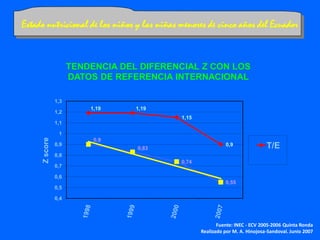
Estado nutricional de los niños y las niñas menores de cinco años del Ecuador
Fuente: INEC - ECV 2005-2006 Quinta Ronda
Realizado por M. A. Hinojosa-Sandoval. Junio 2007
1,19 1,19
1,15
0,9
0,9
0,83
0,74
0,55
0,4
0,5
0,6
0,7
0,8
0,9
1
1,1
1,2
1,3
Zscore
TENDENCIA DEL DIFERENCIAL Z CON LOS
DATOS DE REFERENCIA INTERNACIONAL
T/E
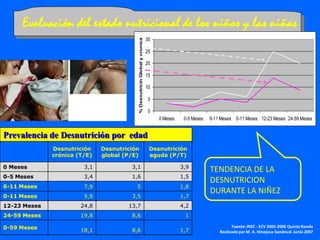
Evaluación del estado nutricional de los niños y las niñas
Fuente: INEC - ECV 2005-2006 Quinta Ronda
Realizado por M. A. Hinojosa-Sandoval.Junio 2007
Prevalencia de Desnutrición por edad
Desnutrición
crónica (T/E)
Desnutrición
global (P/E)
Desnutrición
aguda (P/T)
0 Meses 3,1 3,1 3,9
0-5 Meses 3,4 1,6 1,5
6-11 Meses 7,9 5 1,8
0-11 Meses 5,9 3,5 1,7
12-23 Meses 24,8 13,7 4,2
24-59 Meses 19,8 8,6 1
0-59 Meses 18,1 8,6 1,7
0
5
10
15
20
25
30
0 Meses 0-5 Meses 6-11 Meses 0-11 Meses 12-23 Meses 24-59 Meses
%DesnutricinGlobalycronica
TENDENCIA DE LA
DESNUTRICION
DURANTE LA NIÑEZ
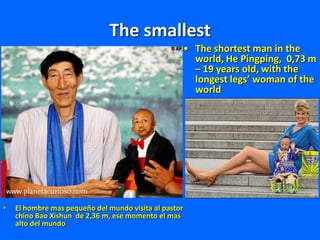
The smallest
• El hombre mas pequeño del mundo visita al pastor
chino Bao Xishun de 2,36 m, ese momento el mas
alto del mundo
• The shortest man in the
world, He Pingping, 0,73 m
– 19 years old, with the
longest legs’ woman of the
world
Malnutrition the facts
• Globally, 165 million children are stunted;
undernutrition underlies 3·1 million deaths in
children younger than 5 years
• As in Belize (22% EMI-UNICEF 2013 ), one in
four of the world’s children are stunted,. That
means their body and brain has failed to
develop properly because of malnutrition.
• Moreover, malnutrition is underlying cause of
one-third of the global children’s deaths.
• Evidence-based interventions for improvement of maternal and child nutrition: what can be done and at what cost? Zulfi qar A
Bhutta, Jai K Das, Arjumand Rizvi, Michelle F Gaff ey, Neff Walker, Susan Horton, Patrick Webb, Anna Lartey, Robert E Black. Published
Online June 6, 2013. http://dx.doi.org/10.1016/S0140-6736(13)60996-4
Malnutrition the facts
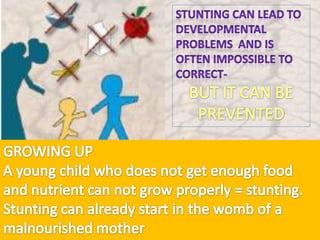
• Stunting, or chronic malnutrition, is
a result of a child having a poor diet
(too few calories or too little
nutritious food, or both) for a
number of years, or an infection
leading to a deficient absorption of
nutrients.
M de Onis, M Blossne and E Borghi, (2011) ‘Prevalence of stunting among pre-school children 1990-2020’, Growth Assessment and Surveillance Unit,
Public Health Nutrition, 2011, Jul 14:1–7 2 R E Black, L H Allen, Z A Bhutta, et al (2008)
‘Maternal and child undernutrition: global and regional exposures and health consequences’, The Lancet, 2008, Jan 19, 371 (9608), 43–60
R E Black, L H Allen, Z A Bhutta, et al (2008) ‘Maternal and child undernutrition: global and regional exposures and health consequences’, The Lancet,
2008, Jan 19, 371 (9608), 243–60
Malnutrition the facts
• The first 1,000 days of life, beginning
with conception, through a mother’s
pregnancy and up until the age of two, is
the most critical period in a child’s
development.
• Even if a child’s diet improves later in life
and any health issues are resolved,
damage done during this period is largely
irreversible.M de Onis, M Blossne and E Borghi, (2011) ‘Prevalence of stunting among pre-school children 1990-2020’, Growth Assessment and Surveillance Unit,
Public Health Nutrition, 2011, Jul 14:1–7 2 R E Black, L H Allen, Z A Bhutta, et al (2008)
‘Maternal and child undernutrition: global and regional exposures and health consequences’, The Lancet, 2008, Jan 19, 371 (9608), 43–60
R E Black, L H Allen, Z A Bhutta, et al (2008) ‘Maternal and child undernutrition: global and regional exposures and health consequences’, The Lancet,
2008, Jan 19, 371 (9608), 243–60
Malnutrition the facts
• Stunting can have an intergenerational effect:
a mother who is stunted may in turn give birth
to a small baby, because the fetus’s growth in
the womb may have been restricted.
• Besides, a long-term lack of nutritious food, or
having an infection such as worms, can result
in a lack of micronutrients (vitamins and
minerals) in a child’s diet.
• Nearly all deaths linked to micronutrient
deficiency are due to a lack of vitamin A, zinc
or iron.
UN Inter-agency Group for Child Mortality Estimation (2011) Levels & Trends in ChildMortality:Report 2011, New York: UNICEF
N S Scrimshaw and J P San Giobanni (1997) ‘Synergism of nutrition, infection, and immunity: an overview’, American Journal of Clinical
Nutrition,Vol 66, 464S–477S
See 1,000 Days Partnership website: http://www.thousanddays.org/about/
M H N Golden (1988) ‘The role of individual nutrient deficiencies in growth retardation of children as exemplified by zinc and protein’,
In: J C Waterlow (ed) (1988) Linear Growth Retardationin Less Developed Countries, New York: Raven press
Malnutrition the facts
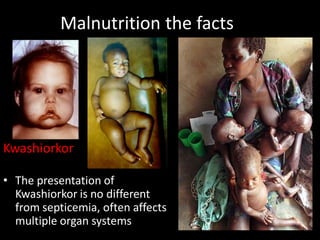
• The presentation of
Kwashiorkor is no different
from septicemia, often affects
multiple organ systems
Kwashiorkor
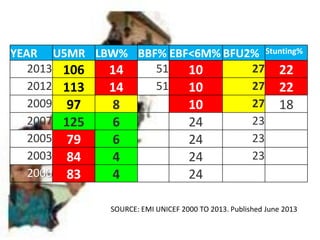
YEAR U5MR LBW% BBF% EBF<6M% BFU2% Stunting%
2013 106 14 51 10 27 22
2012 113 14 51 10 27 22
2009 97 8 10 27 18
2007 125 6 24 23
2005 79 6 24 23
2003 84 4 24 23
2000 83 4 24
SOURCE: EMI UNICEF 2000 TO 2013. Published June 2013
EVIDENCE BASED
INTERVENTIONS TO TACKLE
UNDERNUTRITION
Malnutrition the options
• There are many examples of success in reducing the
prevalence of chronic malnutrition (Brazil 1996-2006
1998-2006 Mexico, Peru 1990) . These experiences
have had in common interventions such as education
of women, an increased purchasing power of the
poorest families, increasing access and improved
quality of health services, health care models for
focalizing beneficiaries and the establishment of a
surveillance system and evaluation on the impact. All
of these interventions are considered as national
priorities, for public health in Belize.
50º CONSEJO DIRECTIVO, 62ª SESIÓN DEL COMITÉ REGIONAL. Washington DC ESTRATEGIA Y PLAN DE ACCION PARA REDUCIR LA
DESNUTRICIÓN CRÓNICA, EUA del 27 de septiembre al 1 de octubre de 2010. Punto 4.9 del orden del día provisional. CD 50/13
Standards nutrition update 2011
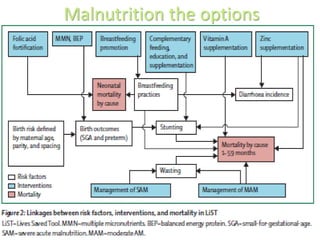
Malnutrition the options
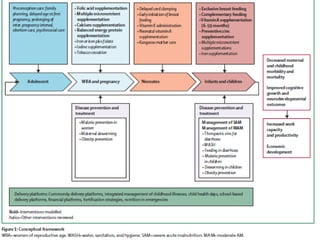
• Besides, recommendations to tackle the
chronic malnutrition in children under
two are in the following scheme, mainly
from the electronic library on nutrition
actions (eLENA) and existing evidence
used by WHO for development of
guidelines and policies for action
OPS/OMS
Standards nutrition update 2011
Zulfi qar A Bhutta, Jai K Das, Arjumand Rizvi, Michelle F Gaff ey, Neff Walker, Susan Horton, Patrick Webb, Anna Lartey, Robert E Black, The
Lancet Nutrition Interventions Review Group, and the Maternal and Child Nutrition Study GroupEvidence-based interventions for
improvement of maternal and child nutrition: what can be done and at what cost? www.thelancet.com Pubished online June 6, 2013
http://dx.doi.org/10.1016/S0140-6736(13)60996-4
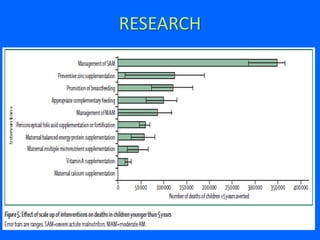
Malnutrition the options
RESEARCH
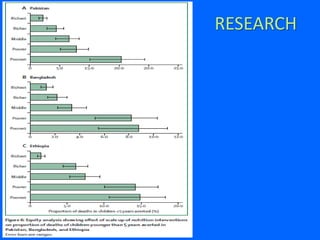
RESEARCH
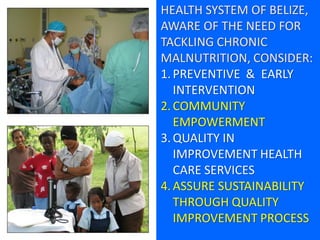
HEALTH SYSTEM OF BELIZE,
AWARE OF THE NEED FOR
TACKLING CHRONIC
MALNUTRITION, CONSIDER:
1.PREVENTIVE & EARLY
INTERVENTION
2.COMMUNITY
EMPOWERMENT
3.QUALITY IN
IMPROVEMENT HEALTH
CARE SERVICES
4.ASSURE SUSTAINABILITY
THROUGH QUALITY
IMPROVEMENT PROCESS
Collaborative Improvement in Child Health
Belize June 21st 2013.
MA Hinojosa-Sandoval - URC.
Collaborative Improvement in Child Health
Belize June 21st 2013.
MA Hinojosa-Sandoval - URC.

Overview final 20.06.13

  • 1.
    Mejorando sistemas paraempoderar comunidades Overview: Malnutrition, a clinical and public health problem; understanding its causes, measuring it and effective interventions Collaboratives Improvement in Adolescence and Child Health Workshop Belize June 21st 2013. MA Hinojosa-Sandoval - URC.
  • 3.
    Malnutrition the facts •Children have the same growth potential up to age five, irrespective of where they are born. • In a healthy, well-nourished population only around 2% of children would naturally be short enough to be classed as stunted. J L Smith and S Brooker, 2010, ‘Impact of hookworm infection and deworming on anaemia in non-pregnant populations: a systematic review’, Tropical Medicine & International Health, 15(7): 776–795 R E Black, L H Allen, Z A Bhutta, et al (2008) ‘Maternal and child undernutrition: global and regional exposures and health consequences’, The Lancet, 2008, Jan 19, 371 (9608), 243–60
  • 4.
    Estado nutricional delos niños y las niñas menores de cinco años del Ecuador Fuente: INEC - ECV 2005-2006 Quinta Ronda Realizado por M. A. Hinojosa-Sandoval. Junio 2007 1,19 1,19 1,15 0,9 0,9 0,83 0,74 0,55 0,4 0,5 0,6 0,7 0,8 0,9 1 1,1 1,2 1,3 Zscore TENDENCIA DEL DIFERENCIAL Z CON LOS DATOS DE REFERENCIA INTERNACIONAL T/E
  • 5.
    Evaluación del estadonutricional de los niños y las niñas Fuente: INEC - ECV 2005-2006 Quinta Ronda Realizado por M. A. Hinojosa-Sandoval.Junio 2007 Prevalencia de Desnutrición por edad Desnutrición crónica (T/E) Desnutrición global (P/E) Desnutrición aguda (P/T) 0 Meses 3,1 3,1 3,9 0-5 Meses 3,4 1,6 1,5 6-11 Meses 7,9 5 1,8 0-11 Meses 5,9 3,5 1,7 12-23 Meses 24,8 13,7 4,2 24-59 Meses 19,8 8,6 1 0-59 Meses 18,1 8,6 1,7 0 5 10 15 20 25 30 0 Meses 0-5 Meses 6-11 Meses 0-11 Meses 12-23 Meses 24-59 Meses %DesnutricinGlobalycronica TENDENCIA DE LA DESNUTRICION DURANTE LA NIÑEZ
  • 6.
    The smallest • Elhombre mas pequeño del mundo visita al pastor chino Bao Xishun de 2,36 m, ese momento el mas alto del mundo • The shortest man in the world, He Pingping, 0,73 m – 19 years old, with the longest legs’ woman of the world
  • 7.
    Malnutrition the facts •Globally, 165 million children are stunted; undernutrition underlies 3·1 million deaths in children younger than 5 years • As in Belize (22% EMI-UNICEF 2013 ), one in four of the world’s children are stunted,. That means their body and brain has failed to develop properly because of malnutrition. • Moreover, malnutrition is underlying cause of one-third of the global children’s deaths. • Evidence-based interventions for improvement of maternal and child nutrition: what can be done and at what cost? Zulfi qar A Bhutta, Jai K Das, Arjumand Rizvi, Michelle F Gaff ey, Neff Walker, Susan Horton, Patrick Webb, Anna Lartey, Robert E Black. Published Online June 6, 2013. http://dx.doi.org/10.1016/S0140-6736(13)60996-4
  • 8.
    Malnutrition the facts •Stunting, or chronic malnutrition, is a result of a child having a poor diet (too few calories or too little nutritious food, or both) for a number of years, or an infection leading to a deficient absorption of nutrients. M de Onis, M Blossne and E Borghi, (2011) ‘Prevalence of stunting among pre-school children 1990-2020’, Growth Assessment and Surveillance Unit, Public Health Nutrition, 2011, Jul 14:1–7 2 R E Black, L H Allen, Z A Bhutta, et al (2008) ‘Maternal and child undernutrition: global and regional exposures and health consequences’, The Lancet, 2008, Jan 19, 371 (9608), 43–60 R E Black, L H Allen, Z A Bhutta, et al (2008) ‘Maternal and child undernutrition: global and regional exposures and health consequences’, The Lancet, 2008, Jan 19, 371 (9608), 243–60
  • 9.
    Malnutrition the facts •The first 1,000 days of life, beginning with conception, through a mother’s pregnancy and up until the age of two, is the most critical period in a child’s development. • Even if a child’s diet improves later in life and any health issues are resolved, damage done during this period is largely irreversible.M de Onis, M Blossne and E Borghi, (2011) ‘Prevalence of stunting among pre-school children 1990-2020’, Growth Assessment and Surveillance Unit, Public Health Nutrition, 2011, Jul 14:1–7 2 R E Black, L H Allen, Z A Bhutta, et al (2008) ‘Maternal and child undernutrition: global and regional exposures and health consequences’, The Lancet, 2008, Jan 19, 371 (9608), 43–60 R E Black, L H Allen, Z A Bhutta, et al (2008) ‘Maternal and child undernutrition: global and regional exposures and health consequences’, The Lancet, 2008, Jan 19, 371 (9608), 243–60
  • 10.
    Malnutrition the facts •Stunting can have an intergenerational effect: a mother who is stunted may in turn give birth to a small baby, because the fetus’s growth in the womb may have been restricted. • Besides, a long-term lack of nutritious food, or having an infection such as worms, can result in a lack of micronutrients (vitamins and minerals) in a child’s diet. • Nearly all deaths linked to micronutrient deficiency are due to a lack of vitamin A, zinc or iron. UN Inter-agency Group for Child Mortality Estimation (2011) Levels & Trends in ChildMortality:Report 2011, New York: UNICEF N S Scrimshaw and J P San Giobanni (1997) ‘Synergism of nutrition, infection, and immunity: an overview’, American Journal of Clinical Nutrition,Vol 66, 464S–477S See 1,000 Days Partnership website: http://www.thousanddays.org/about/ M H N Golden (1988) ‘The role of individual nutrient deficiencies in growth retardation of children as exemplified by zinc and protein’, In: J C Waterlow (ed) (1988) Linear Growth Retardationin Less Developed Countries, New York: Raven press
  • 11.
    Malnutrition the facts •The presentation of Kwashiorkor is no different from septicemia, often affects multiple organ systems Kwashiorkor
  • 17.
    YEAR U5MR LBW%BBF% EBF<6M% BFU2% Stunting% 2013 106 14 51 10 27 22 2012 113 14 51 10 27 22 2009 97 8 10 27 18 2007 125 6 24 23 2005 79 6 24 23 2003 84 4 24 23 2000 83 4 24 SOURCE: EMI UNICEF 2000 TO 2013. Published June 2013
  • 18.
    EVIDENCE BASED INTERVENTIONS TOTACKLE UNDERNUTRITION
  • 19.
    Malnutrition the options •There are many examples of success in reducing the prevalence of chronic malnutrition (Brazil 1996-2006 1998-2006 Mexico, Peru 1990) . These experiences have had in common interventions such as education of women, an increased purchasing power of the poorest families, increasing access and improved quality of health services, health care models for focalizing beneficiaries and the establishment of a surveillance system and evaluation on the impact. All of these interventions are considered as national priorities, for public health in Belize. 50º CONSEJO DIRECTIVO, 62ª SESIÓN DEL COMITÉ REGIONAL. Washington DC ESTRATEGIA Y PLAN DE ACCION PARA REDUCIR LA DESNUTRICIÓN CRÓNICA, EUA del 27 de septiembre al 1 de octubre de 2010. Punto 4.9 del orden del día provisional. CD 50/13 Standards nutrition update 2011
  • 20.
    Malnutrition the options •Besides, recommendations to tackle the chronic malnutrition in children under two are in the following scheme, mainly from the electronic library on nutrition actions (eLENA) and existing evidence used by WHO for development of guidelines and policies for action OPS/OMS Standards nutrition update 2011 Zulfi qar A Bhutta, Jai K Das, Arjumand Rizvi, Michelle F Gaff ey, Neff Walker, Susan Horton, Patrick Webb, Anna Lartey, Robert E Black, The Lancet Nutrition Interventions Review Group, and the Maternal and Child Nutrition Study GroupEvidence-based interventions for improvement of maternal and child nutrition: what can be done and at what cost? www.thelancet.com Pubished online June 6, 2013 http://dx.doi.org/10.1016/S0140-6736(13)60996-4
  • 21.
  • 23.
  • 24.
  • 25.
    HEALTH SYSTEM OFBELIZE, AWARE OF THE NEED FOR TACKLING CHRONIC MALNUTRITION, CONSIDER: 1.PREVENTIVE & EARLY INTERVENTION 2.COMMUNITY EMPOWERMENT 3.QUALITY IN IMPROVEMENT HEALTH CARE SERVICES 4.ASSURE SUSTAINABILITY THROUGH QUALITY IMPROVEMENT PROCESS
  • 27.
    Collaborative Improvement inChild Health Belize June 21st 2013. MA Hinojosa-Sandoval - URC.
  • 28.
    Collaborative Improvement inChild Health Belize June 21st 2013. MA Hinojosa-Sandoval - URC.