Computation of machine hour rate(mhr)
MHR refers to the overhead cost of running a machine
for one hour
Steps for computation:
1. The overheads concerning the machine are divided into
fixed & variable overheads. Fixed are those that remain
constant irrespective of the use of the machine eg. rent,
lighting, supervisor salary etc. variable are those that
vary with the use of the machine eg. Depreciation,
repairs, power etc.
Computation of machine hour rate(mhr)
2. The fixed or standing overheads are totaled and then
divided by the machine hours to obtain fixed overhead
hourly rate .
3. For each variable overhead, per hour rate is
individually computed.
4. The total of fixed & variable hourly rate are summed
up to give the final MHR
Types of overhead rates
Overhead absorption rates can be :
 Actual & predetermined rates
Blanket & multiple rates
Actual Overhead rates
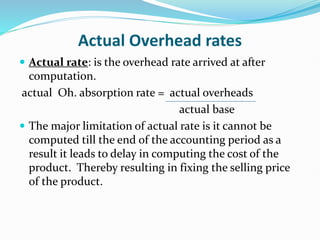
 Actual rate: is the overhead rate arrived at after
computation.
actual Oh. absorption rate = actual overheads
actual base
 The major limitation of actual rate is it cannot be
computed till the end of the accounting period as a
result it leads to delay in computing the cost of the
product. Thereby resulting in fixing the selling price
of the product.
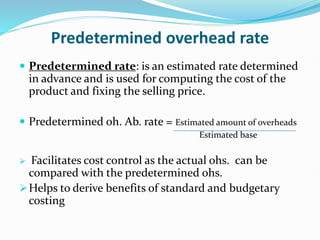
Predetermined overhead rate
 Predetermined rate: is an estimated rate determined
in advance and is used for computing the cost of the
product and fixing the selling price.
 Predetermined oh. Ab. rate = Estimated amount of overheads
Estimated base
 Facilitates cost control as the actual ohs. can be
compared with the predetermined ohs.
Helps to derive benefits of standard and budgetary
costing
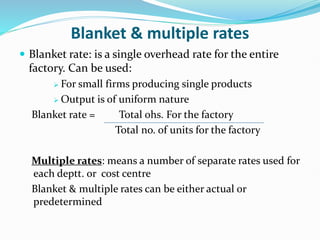
Blanket & multiple rates
 Blanket rate: is a single overhead rate for the entire
factory. Can be used:
 For small firms producing single products
 Output is of uniform nature
Blanket rate = Total ohs. For the factory
Total no. of units for the factory
Multiple rates: means a number of separate rates used for
each deptt. or cost centre
Blanket & multiple rates can be either actual or
predetermined
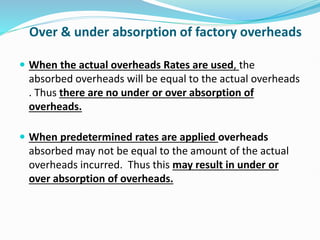
Over & under absorption of factory overheads
 When the actual overheads Rates are used, the
absorbed overheads will be equal to the actual overheads
. Thus there are no under or over absorption of
overheads.
 When predetermined rates are applied overheads
absorbed may not be equal to the amount of the actual
overheads incurred. Thus this may result in under or
over absorption of overheads.
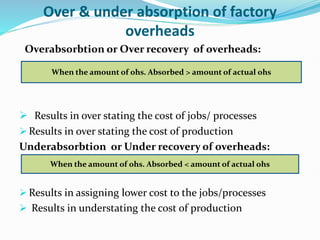
Over & under absorption of factory
overheads
Overabsorbtion or Over recovery of overheads:
 Results in over stating the cost of jobs/ processes
 Results in over stating the cost of production
Underabsorbtion or Under recovery of overheads:
 Results in assigning lower cost to the jobs/processes
 Results in understating the cost of production
When the amount of ohs. Absorbed > amount of actual ohs
When the amount of ohs. Absorbed < amount of actual ohs
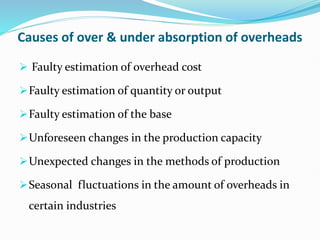
Causes of over & under absorption of overheads
 Faulty estimation of overhead cost
Faulty estimation of quantity or output
Faulty estimation of the base
Unforeseen changes in the production capacity
Unexpected changes in the methods of production
Seasonal fluctuations in the amount of overheads in
certain industries
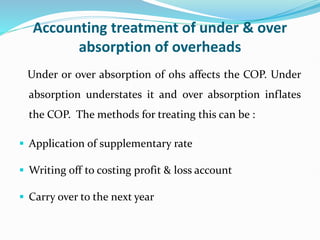
Accounting treatment of under & over
absorption of overheads
Under or over absorption of ohs affects the COP. Under
absorption understates it and over absorption inflates
the COP. The methods for treating this can be :
 Application of supplementary rate
 Writing off to costing profit & loss account
 Carry over to the next year
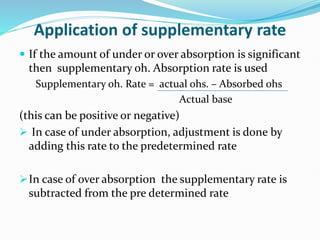
Application of supplementary rate
 If the amount of under or over absorption is significant
then supplementary oh. Absorption rate is used
Supplementary oh. Rate = actual ohs. – Absorbed ohs
Actual base
(this can be positive or negative)
 In case of under absorption, adjustment is done by
adding this rate to the predetermined rate
In case of over absorption the supplementary rate is
subtracted from the pre determined rate
Writing off to costing profit & loss
account
 This method is used:
 when the under or over absorbed amount is quite
negligible/insignificant
 When it arises because of abnormal factors such as
idle capacity, defective planning
 the under or over absorbed amount is transferred to the
costing P & L A/c
 Major drawback is COP will either be under or over stated
and will affect valuation of stocks (WIP and FG) and will
get transferred to the next year
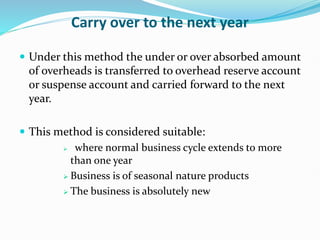
Carry over to the next year
 Under this method the under or over absorbed amount
of overheads is transferred to overhead reserve account
or suspense account and carried forward to the next
year.
 This method is considered suitable:
 where normal business cycle extends to more
than one year
 Business is of seasonal nature products
 The business is absolutely new
Treatment of certain items in cost
accounts
 interest on capital
Packaging expenses
Bad debts
Research and development
depreciation
Past year questions
 What do you mean by absorption of ohs? Discuss different
methods of absorption of factory ohs.
 What is the importance of machine hour as a basis for
absorption of factory ohs?
 What are the causes of under/over absorption of factory ohs.?
 Explain the treatment of over & under absorption of ohs. In cost
accounting?
 Distinguish Between allocation, apportionment & absorption of
ohs.
Past year questions
 Discuss the treatment of the following items in the
cost accounts
 Interest on capital
 Packaging expenses/ packaging material cost
Distinguish between:
 Cost allocation & cost absorption
Fixed ohs and variable ohs.

OVERHEAD-ACCOUNTING-PART-4.pptx

  • 2.
    Computation of machinehour rate(mhr) MHR refers to the overhead cost of running a machine for one hour Steps for computation: 1. The overheads concerning the machine are divided into fixed & variable overheads. Fixed are those that remain constant irrespective of the use of the machine eg. rent, lighting, supervisor salary etc. variable are those that vary with the use of the machine eg. Depreciation, repairs, power etc.
  • 3.
    Computation of machinehour rate(mhr) 2. The fixed or standing overheads are totaled and then divided by the machine hours to obtain fixed overhead hourly rate . 3. For each variable overhead, per hour rate is individually computed. 4. The total of fixed & variable hourly rate are summed up to give the final MHR
  • 5.
    Types of overheadrates Overhead absorption rates can be :  Actual & predetermined rates Blanket & multiple rates
  • 6.
    Actual Overhead rates Actual rate: is the overhead rate arrived at after computation. actual Oh. absorption rate = actual overheads actual base  The major limitation of actual rate is it cannot be computed till the end of the accounting period as a result it leads to delay in computing the cost of the product. Thereby resulting in fixing the selling price of the product.
  • 7.
    Predetermined overhead rate Predetermined rate: is an estimated rate determined in advance and is used for computing the cost of the product and fixing the selling price.  Predetermined oh. Ab. rate = Estimated amount of overheads Estimated base  Facilitates cost control as the actual ohs. can be compared with the predetermined ohs. Helps to derive benefits of standard and budgetary costing
  • 8.
    Blanket & multiplerates  Blanket rate: is a single overhead rate for the entire factory. Can be used:  For small firms producing single products  Output is of uniform nature Blanket rate = Total ohs. For the factory Total no. of units for the factory Multiple rates: means a number of separate rates used for each deptt. or cost centre Blanket & multiple rates can be either actual or predetermined
  • 9.
    Over & underabsorption of factory overheads  When the actual overheads Rates are used, the absorbed overheads will be equal to the actual overheads . Thus there are no under or over absorption of overheads.  When predetermined rates are applied overheads absorbed may not be equal to the amount of the actual overheads incurred. Thus this may result in under or over absorption of overheads.
  • 10.
    Over & underabsorption of factory overheads Overabsorbtion or Over recovery of overheads:  Results in over stating the cost of jobs/ processes  Results in over stating the cost of production Underabsorbtion or Under recovery of overheads:  Results in assigning lower cost to the jobs/processes  Results in understating the cost of production When the amount of ohs. Absorbed > amount of actual ohs When the amount of ohs. Absorbed < amount of actual ohs
  • 11.
    Causes of over& under absorption of overheads  Faulty estimation of overhead cost Faulty estimation of quantity or output Faulty estimation of the base Unforeseen changes in the production capacity Unexpected changes in the methods of production Seasonal fluctuations in the amount of overheads in certain industries
  • 12.
    Accounting treatment ofunder & over absorption of overheads Under or over absorption of ohs affects the COP. Under absorption understates it and over absorption inflates the COP. The methods for treating this can be :  Application of supplementary rate  Writing off to costing profit & loss account  Carry over to the next year
  • 13.
    Application of supplementaryrate  If the amount of under or over absorption is significant then supplementary oh. Absorption rate is used Supplementary oh. Rate = actual ohs. – Absorbed ohs Actual base (this can be positive or negative)  In case of under absorption, adjustment is done by adding this rate to the predetermined rate In case of over absorption the supplementary rate is subtracted from the pre determined rate
  • 14.
    Writing off tocosting profit & loss account  This method is used:  when the under or over absorbed amount is quite negligible/insignificant  When it arises because of abnormal factors such as idle capacity, defective planning  the under or over absorbed amount is transferred to the costing P & L A/c  Major drawback is COP will either be under or over stated and will affect valuation of stocks (WIP and FG) and will get transferred to the next year
  • 15.
    Carry over tothe next year  Under this method the under or over absorbed amount of overheads is transferred to overhead reserve account or suspense account and carried forward to the next year.  This method is considered suitable:  where normal business cycle extends to more than one year  Business is of seasonal nature products  The business is absolutely new
  • 16.
    Treatment of certainitems in cost accounts  interest on capital Packaging expenses Bad debts Research and development depreciation
  • 17.
    Past year questions What do you mean by absorption of ohs? Discuss different methods of absorption of factory ohs.  What is the importance of machine hour as a basis for absorption of factory ohs?  What are the causes of under/over absorption of factory ohs.?  Explain the treatment of over & under absorption of ohs. In cost accounting?  Distinguish Between allocation, apportionment & absorption of ohs.
  • 18.
    Past year questions Discuss the treatment of the following items in the cost accounts  Interest on capital  Packaging expenses/ packaging material cost Distinguish between:  Cost allocation & cost absorption Fixed ohs and variable ohs.